

The effect of diabetes self-management education on HbA1c and quality of life in African-Americans: a systematic review and meta-analysis
Open accessThe DOI matches its Crossref record; 45 of the 48 references it cites were found in a registry or an index.
Abstract
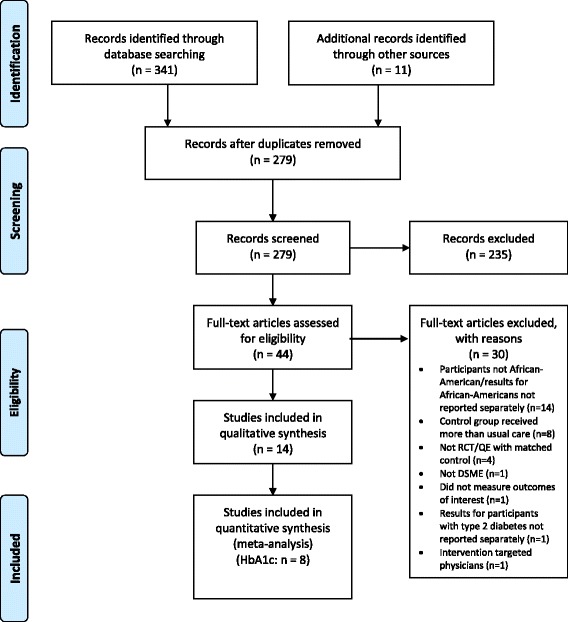
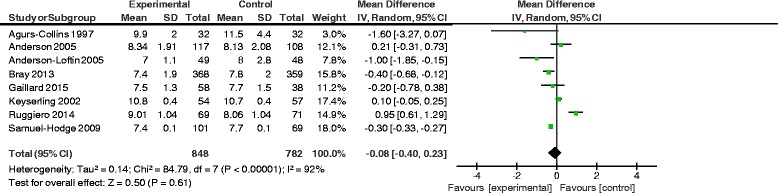
Type 2 diabetes presents a major morbidity and mortality burden in the United States. Diabetes self-management education (DSME) is an intervention associated with improved hemoglobin A1c(HbA1c) and quality of life(QOL), and is recommended for all individuals with type 2 diabetes. African-Americans have disproportionate type 2 diabetes morbidity and mortality, yet no prior meta-analyses have examined DSME outcomes exclusively in this population. This systematic review and meta-analysis examined the impact of DSME on HbA1c and QOL in African-Americans compared to usual care. Randomized controlled trials, cluster-randomized trials, and quasi-experimental interventions were included. 352 citations were retrieved; 279 abstracts were reviewed, and 44 full-text articles were reviewed. Fourteen studies were eligible for systematic review and 8 for HbA1c meta-analysis; QOL measures were too heterogeneous to pool. Heterogeneity of HbA1c findings was assessed with Cochran’s Q and I2. HbA1c weighted mean difference between intervention and usual care participants was not significant: − 0.08%[− 0.40–0.23];χ2 = 84.79 (p < .001), I2 = 92%, (n = 1630). Four of five studies measuring QOL reported significant improvements for intervention participants. Meta-analysis results showed non-significant effect of DSME on HbA1c in African-Americans. QOL did show improvement and is an important DSME outcome to measure in future trials. Further research is needed to understand effectiveness of DSME on HbA1c in this population. PROSPERO registration: CRD42017057282 .
Overview
The claims and statistics of this paper haven’t been checked yet.
Free: it reads the open-access text and checks the first 5 claims that cite a source we can check. Create a free account to check every claim.
Integrity signals
Registry
Cites
Statistics
Figures
Verification
Claims the paper makes
The claims and statistics of this paper haven’t been checked yet.
Free: it reads the open-access text and checks the first 5 claims that cite a source we can check. Create a free account to check every claim.
Claims other papers make about this one
Each is checked against this paper’s own text: does it say what the citing paper says it does?
The cited source says what the claim attributes to it.
In the citing paper
“Evidence indicates that DSMES imparts enhanced knowledge of DM and self-care practices resulting in improved A1C values,909,912,1449–1451 modest reductions in weight, better QoL,912,1451,1452 and lower mortality risk,1453 while at the same time leading to a reduction in health care costs.1454,1455”
From American Association of Clinical Endocrinology Clinical Practice Guideline: Developing a Diabetes Mellitus Comprehensive Care Plan-2022 Update. (2022) · cites this paper as [1452]
Self-check
Percentages, sums and reported differences re-computed from the paper’s own numbers.
The self-check needs the paper’s full text.
Citations
Cites
Preferred Reporting Items for Systematic Reviews and Meta-Analyses: the PRISMA statement
Moher, D., Liberati, A., Tetzlaff, J., Altman, D. G., & for the PRISMA Group (2009) · BMJ · doi:10.1136/bmj.b2535 · Cited by 83,823
Measuring inconsistency in meta-analyses
Higgins, J. P. T., Thompson, S. G., Deeks, J. J., & Altman, D. G. (2003) · BMJ · doi:10.1136/bmj.327.7414.557 · Cited by 63,139
Preferred reporting items for systematic reviews and meta-analyses: The PRISMA statement
Moher, D., Liberati, A., Tetzlaff, J., Altman, D. G., & the PRISMA Group* (2009) · Annals of Internal Medicine · doi:10.7326/0003-4819-151-4-200908180-00135 · Cited by 37,554
The Cochrane Collaboration's tool for assessing risk of bias in randomised trials
Higgins, J. P. T., Altman, D. G., Gotzsche, P. C., Juni, P., Moher, D., Oxman, A. D., Savovic, J., Schulz, K. F., Weeks, L., Sterne, J. A. C., et al. (2011) · BMJ · doi:10.1136/bmj.d5928 · Cited by 33,817
Dermyshi, E., Wang, Y., Yan, C., Hong, W., Qiu, G., Gong, X., & Zhang, T. (2017) · Neonatology · doi:10.1159/000454668 · Cited by 24,451
GRADE: an emerging consensus on rating quality of evidence and strength of recommendations
Guyatt, G. H., Oxman, A. D., Vist, G. E., Kunz, R., Falck-Ytter, Y., Alonso-Coello, P., & Schünemann, H. J. (2008) · BMJ · doi:10.1136/bmj.39489.470347.ad · Cited by 23,305 · cited 1×
“Factors that can increase a rating include a large magnitude of effect, a dose-response continuum, and plausible residual confounding in observational studies [26].”
BackgroundThe case of the misleading funnel plot
Lau, J., Ioannidis, J. P. A., Terrin, N., Schmid, C. H., & Olkin, I. (2006) · BMJ · doi:10.1136/bmj.333.7568.597 · Cited by 1,766 · cited 1×
“When fewer than ten studies are included in a meta-analysis, tests for forest plot asymmetry are not recommended due the low power to detect a real asymmetry [25].”
BackgroundSelf-Management Education for Adults With Type 2 Diabetes
Norris, S. L., Lau, J., Smith, S. J., Schmid, C. H., & Engelgau, M. M. (2002) · Diabetes Care · doi:10.2337/diacare.25.7.1159 · Cited by 1,750 · cited 6×
“The smaller number of DSME interventions measuring QOL relative to HbA1c is consistent with prior DSME meta-analyses, which have found a greater focus on surrogate outcomes such as HbA1c rather than patient-reported outcomes such as QOL [14].”
BackgroundResultInfluentialRubin, R. R., & Peyrot, M. (1999) · Diabetes/Metabolism Research and Reviews · doi:10.1002/(sici)1520-7560(199905/06)15:3<205::aid-dmrr29>3.0.co;2-o · Cited by 1,138 · cited 1×
“Individuals with diabetes report lower QOL than individuals without chronic illnesses [10].”
BackgroundNicolucci, A., Kovacs Burns, K., Holt, R. I. G., Comaschi, M., Hermanns, N., Ishii, H., Kokoszka, A., Pouwer, F., Skovlund, S. E., Stuckey, H., et al. (2013) · Diabetic Medicine · doi:10.1111/dme.12245 · Cited by 739
Research works printed but not linked: 2
- Cunningham AT, LaNoue MD, Crittendon D. Diabetes self-management education for African-Americans: a systematic review and meta-analysis. PROSPERO 2017:CRD42017057282. 2017. Available from: http://www.crd.york.ac.uk/PROSPERO/display_record.asp?ID=CRD42017057282 PMC5956958 29769078
- The Cochrane Collaboration. Review Manager (RevMan) [Computer program]. Copenhagen: The Nordic Cochrane Centre; 2014. Available from: http://community.cochrane.org/help/tools-and-software/revman-5.
Cited by
Items 101–141 of 141
Lowry, S., Low, J., Goff, L. M., Irwin, S., Sevdalis, N., Okeke, P., Brady, O., Curran, N., & Walker, A. (2024) · Journal of Human Nutrition and Dietetics · doi:10.1111/jhn.13396 · Cited by 1
“27,28 31 To date, culturally tailored programmes for communities of African and Caribbean heritage have largely been USA ‐ based, with no such DSMES programmes evaluated in the UK.”
Deskripsi Tingkat Pengetahuan Masyarakat Denpasar terhadap Obesitas Lebih Rentan Terinfeksi COVID-19
Laksmita, S. (2023) · THE JOURNAL OF MUHAMMADIYAH MEDICAL LABORATORY TECHNOLOGIST · doi:10.30651/jmlt.v6i2.17752 · Cited by 1
Istilli, P. T. (2019) · Digital Library of Theses and Dissertations (Universidade de São Paulo) · doi:10.11606/t.22.2019.tde-19032019-165706
Self-Management Status in Patients with Diabetes and Disease Control Indicators in Lamerd City, Iran
Jahangir, F., Kavi, E., Masmouei, B., Bazrafshan, M.-R., Delam, H., Shokrpour, N., Namjoonasab, M., Foruozandeh, H., & Zarei, E. (2020) · Jundishapur Journal of Chronic Disease Care · doi:10.5812/jjcdc.99992 · Cited by 1
Olbeci, O., Celik, A., & Jone, R. (2020) · Social Science Protocols · doi:10.7565/ssp.v3.4497 · Cited by 2
Hallberg, E. (2020) · DigitalCommons - Kennesaw State University (Kennesaw State University) · Cited by 1
Caleb, J. (2021) · Columbia Academic Commons (Columbia University) · doi:10.7916/d8-knn9-qs40 · Cited by 1
Mińko, A., Hilicka, Z., Turzyński, D., Findlik, J., Rotter, I., & Szylińska, A. (2021) · Issues of Rehabilitation Orthopaedics Neurophysiology and Sport Promotion – IRONS · doi:10.19271/irons-000133-2021-35
AN OVERVIEW OF PERSON-CENTERED DIABETES EDUCATION DELIVERY AMONG PATIENTS AND PARAMEDICS OF SILIGURI
Pal, S., & Pal, R. D. (2022) · INTERNATIONAL JOURNAL OF SCIENTIFIC RESEARCH · doi:10.36106/ijsr/8409963
EVALUATION OF EDUCATIONAL NEEDS FOR DIABETIC PATIENTS
Aksoy, N., Ozturk, N., Ulusoy, S., Umar, R. M., & OZAYDIN, S. (2022) · Ankara Universitesi Eczacilik Fakultesi Dergisi · doi:10.33483/jfpau.1079204 · Cited by 1
juan, H. W., jingjuan, X., yun, Y., Hao, X., Tang, Z., jiao, X., & minxing, Y. (2022) · PubMed · doi:10.2196/preprints.41274
Lamptey, R. (2023) · Utrecht University Repository (Utrecht University) · doi:10.33540/1646
Prevalence of Depression, Anxiety, OCD, and Social Isolation Among Married Men with Type II Diabetes
Bilal, A., & Fatima, I. (2022) · Pakistan Journal of Medical and Health Sciences · doi:10.53350/pjmhs20221612471
Van evidencebased medicine naar shared decision-making bij diabetes mellitus
D'Hoore, L., Verroken, C., Matthys, I., & Biesen, W. V. (2023) · Tijdschrift voor Geneeskunde · doi:10.47671/tvg.79.23.024
Nooseisai, M. (2018) · Chula Digiverse · doi:10.58837/chula.the.2018.474
Wang, L., Qiu, Y., Li, S., Li, L., & Wang, Z. (2023) · Research Square · doi:10.21203/rs.3.rs-3445186/v1
4. Community-Based Interventions
McDermott, R. J., Mayer, A. B., Martinasek, M. P., Loi, C. A., Vamos, S., Mahmooda K. Pasha, P., & McDaniel, J. T. (2023) · American Public Health Association eBooks · doi:10.2105/9780875533377ch04
Hati, A. K., Kristina, S. A., Yasin, N. M., & Lazuardi, L. (2023) · BIO Web of Conferences · doi:10.1051/bioconf/20237505008 · Cited by 1
“The results of a systematic literature review showed that 4 out of 5 educational curriculum succeeded in improving the quality of life [57].”
BackgroundAssociated Factors Related to Self-Management Behaviors among People with Type 2 Diabetes in Myanmar
Oo, A., Lininger, J., & Leelacharas, S. (2023) · Makara Journal of Health Research · doi:10.7454/msk.v27i3.1459 · Cited by 3
Jaramillo, R. G. M., Bello-Escamilla, N., Olate, R. C., Llanos, A. A., Martínez, P. C., & Vejar, C. V. (2024) · Index de Enfermería · doi:10.58807/indexenferm16360
Arslan, Z. C., Tüzün, S., Öner, C., Hacıağaoğlu, N., Çetin, H., & Şimşek, E. E. (2024) · Health Education Research · doi:10.1093/her/cyae029
Self Management and Immune Status Diabetes Mellitus Patients
Sianturi, M. (2022) · Nursing Care Journal · doi:10.63520/ncj.v1i1.227
Hu, J., Mion, L. C., Tan, A., Bartle‐Haring, S., Miller, C. K., & Joseph, J. J. (2025) · Contemporary Clinical Trials · doi:10.1016/j.cct.2025.108029
“Recent reviews of self-management studies that included AAs with T2D have been inconclusive, especially those with individual-level approaches [8,9].”
Goff, L. M., Johnson, D. A., Bell, V., Blyden, S. A., Bower, P., Dale, J. R., Harris, T. J., Healey, A., Hoverd, E., Jin, H., et al. (2025) · JMIR Research Protocols · doi:10.2196/71861 · Cited by 1
“A lack of access to T2D healthcare and reduced effectiveness of current T2D treatment programs in Black African and Black Caribbean populations have been proposed as key causes for these inequalities [13-15].”
Bozkuş, R., Helvacı, G., Balaban, S., & Özbebek, Y. E. (2025) · Sakarya Medical Journal · doi:10.31832/smj.1688759
Ozieh, M. N., Patterson, C. G., Williams, J. S., Walker, R. J., & Egede, L. E. (2025) · Contemporary Clinical Trials · doi:10.1016/j.cct.2025.108183 · Cited by 1
“Evidence suggests community poverty and unemployment rates explain variations in incident type 2 diabetes mellitus and that living in disadvantaged neighborhoods impact health independent of individuals’ health behaviors and by guiding individuals’ health behaviors [8,9].”
Lamptey, R., Amoakoh‐Coleman, M., Barker, M. M., Iddi, S., Hadjiconstantinou, M., Davies, M., Darko, D., Agyepong, I. A., Acheampong, F., Commey, M., et al. (2023) · Figshare · doi:10.6084/m9.figshare.22613564
Lamptey, R., Amoakoh‐Coleman, M., Barker, M. M., Iddi, S., Hadjiconstantinou, M., Davies, M., Darko, D., Agyepong, I. A., Acheampong, F., Commey, M., et al. (2023) · Figshare · doi:10.6084/m9.figshare.22613561
Lamptey, R., Amoakoh‐Coleman, M., Barker, M. M., Iddi, S., Hadjiconstantinou, M., Davies, M., Darko, D., Agyepong, I. A., Acheampong, F., Commey, M., et al. (2023) · Figshare · doi:10.6084/m9.figshare.22613558
Parra, D. I., Guevara, S. L. R., & Rojas, L. Z. (2019) · Research Square · doi:10.21203/rs.2.18001/v1 · Cited by 1
Hasanat, N. U., Rinaldi, M. R., van Luijtelaar, G., & Yuniarti, K. W. (2026) · American Journal of Health Education · doi:10.1080/19325037.2025.2609309
“Effective self-management interventions have been shown to improve glycemic control (Bekele et al., 2021; Cunningham et al., 2018; Ernawati et al., 2021; Yuan et al., 2014) and enhance patients’ quality of life (Cunningham et al., 2018; Fadli et al., 2024; Mikhael et al., 2020).”
Suglo, J. N., O’Connor, S., Hargrave, E., Nkhoma, K. B., & Sturt, J. A. (2026) · BMJ Open · doi:10.1136/bmjopen-2026-116383
“26 This creates uncertainty regarding which characteristics of DSME interventions may or may not account for effectiveness in improving glycaemic control and other care outcomes.”
Leng, M., Tang, S., Gan, C., Xu, J., & Luo, D. (2026) · Journal of Medical Systems · doi:10.1007/s10916-026-02403-3 · Cited by 1
“This result aligns with findings by Cunningham et al. [37 ] but contrasts with Polsook et al.’s systematic review conclusions [ 38].”
OSMAN, F., Jiang, C., Deckard, A. N., Staab, E. M., Thomas, N. C., Wan, W., Peek, M. E., Alexander, J. T., & Laiteerapong, N. (2026) · Journal of Racial and Ethnic Health Disparities · doi:10.1007/s40615-026-03035-6
Montero‐Zamora, P., Lehrer, H. M., Welsh, A. M., Wang, T., McLaurin, N., Dubois, S. K., Tanaka, H., & Steinhardt, M. A. (2026) · Journal of Racial and Ethnic Health Disparities · doi:10.1007/s40615-026-03056-1
TIKARE, O. A., Omuya, H., Wen, M., Kansariwala, T., Pickard, A. L., Pouncy, J., Maurer, M. A., & Shiyanbola, O. O. (2026) · Frontiers in Public Health · doi:10.3389/fpubh.2026.1806362
“Indeed, one meta-analysis found no significant effect of DSME on A1c among Black adults, suggesting it may be attributable to low program completion, recommending more rigorous approaches to cultural adaptations of DSME for Black adults (7).”
Serum irisin levels in women with polycystic ovary syndrome: a cross-sectional case-control study
Toyran, A., Minareci, Y., & Gülerman, C. (2026) · Sao Paulo Medical Journal · doi:10.1590/1516-3180.2026.3566.08042026
Chu, D., Liu, B., Soh, K. L., Saidi, H. I., & Japar, S. (2026) · Journal of Nursing and Midwifery Sciences · doi:10.5812/jnms-171456
Chu, D., Bingyang, L., Soh, K. L., Saidi, H. I., & Japar, S. (2026) · PLoS ONE · doi:10.1371/journal.pone.0360475
“…self-management interventions have been shown to be effective and cost-effective in promotion and facilitation of self-management, with improvements in patients’ knowledge, skills, and motivation leading to improved biomedical, glycemic control, behavioral, and psychosocial outcomes [22–24].”
Beyond education: Optimizing diabetes self management education for glycemic control
Javed, D., & Niazi, S. K. (2026) · Journal of Public Health Research · doi:10.1177/22799036261494485
Metadata
- Authors
- Cunningham, A. T., Crittendon, D. R., White, N., Mills, G. D., Diaz, V., & LaNoue, M. D.
- Affiliations
- Thomas Jefferson University (US)
- Thomas Jefferson University Hospital (US)
- Corresponding author
- Cunningham, Amy T.
- Venue
- BMC Health Services Research
- Published
- 2018-05-16
- Volume
- 18
- Issue
- 1
- Pages
- 367-367
- ISSN
- 1472-6963 (ISSN-L)
- PMC
- PMC5956958
- OpenAlex
- W2805767128
- Cited by
- 142
- References
- 48
- Citations by year
- 2026: 13 · 2025: 14 · 2024: 18 · 2023: 26 · 2022: 26 · 2021: 18 · 2020: 15 · 2019: 9 · 2018: 3
- FWCI
- 1.73
- Type
- journal article
- Language
- en
- Open access
- gold
- doi.org
- Licence
- cc-by
- creativecommons.org/licenses/by/4.0/ (tdm)
- Locations
- BMC Health Services Research (publishedVersion, cc-by)
- Europe PMC (PubMed Central) (publishedVersion, other-oa)
- PubMed Central (publishedVersion, cc-by)
- PubMed (publishedVersion)
- The Medicine Forum (submittedVersion, cc-by)
- DOAJ (DOAJ: Directory of Open Access Journals) (submittedVersion, cc-by-sa)
- Funders
- Thomas Jefferson University
- Topics
- Health Sciences › Medicine › Endocrinology, Diabetes and Metabolism › Diabetes Management and Education
- Health Sciences › Medicine › Endocrinology, Diabetes and Metabolism › Diabetes Management and Research
- Health Sciences › Medicine › Endocrinology, Diabetes and Metabolism › Diabetes, Cardiovascular Risks, and Lipoproteins
- Keywords
- diabetes self-management education, type 2 diabetes, African Americans, HbA1c, glycemic control, quality of life, usual care comparison
- MeSH terms
- Self-Management, Black or African American, Diabetes Mellitus, Type 2, Female, Glycated Hemoglobin, Humans, Male, Middle Aged, Patient Education as Topic, Quality of Life, United States, Randomized Controlled Trials as Topic
About these checks
Registry, retraction, Cites and statistics results are computed, not judged, with one exception: a printed reference that no index lists is read once by a model before it counts as a citation error. Claims are extracted by a model and kept only when their quote appears verbatim in the text; each cited source is then checked, with a model’s help, for whether it says what the claim relies on. Those verdicts can be wrong — read the claim’s quote and the cited source before relying on one.
Statistics and arithmetic are recomputed, not judged.
Confidence bands are shown only for fields calibrated on our annotated test set. None is calibrated yet, so no band is shown.
What counts as a claim ›How we measure confidence ›How we check this ›
Are you an author, or do you see a problem with this page? Request a review
Data sources
Bibliographic data: Semantic Scholar, OpenAlex, Crossref.
Contains information from the Semantic Scholar Academic Graph Datasets, made available under the ODC Attribution License (ODC-BY 1.0).
Semantic Scholar’s data is described in: Kinney, R., et al. (2023). The Semantic Scholar Open Data Platform. arXiv:2301.10140.
