

The effect of diabetes self-management education on HbA1c and quality of life in African-Americans: a systematic review and meta-analysis
Open accessThe DOI matches its Crossref record; 47 of the 48 references it cites were found in a registry or an index.
Abstract
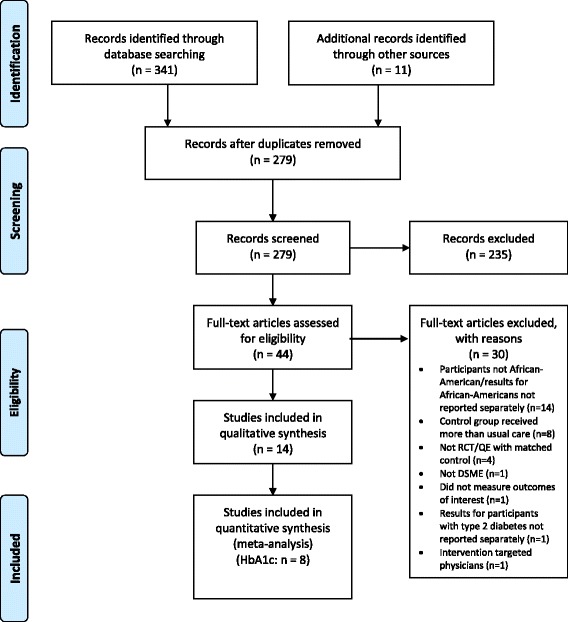
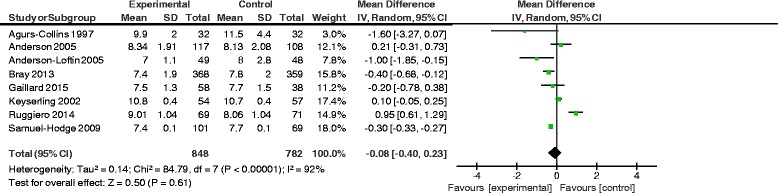
Type 2 diabetes presents a major morbidity and mortality burden in the United States. Diabetes self-management education (DSME) is an intervention associated with improved hemoglobin A1c(HbA1c) and quality of life(QOL), and is recommended for all individuals with type 2 diabetes. African-Americans have disproportionate type 2 diabetes morbidity and mortality, yet no prior meta-analyses have examined DSME outcomes exclusively in this population. This systematic review and meta-analysis examined the impact of DSME on HbA1c and QOL in African-Americans compared to usual care. Randomized controlled trials, cluster-randomized trials, and quasi-experimental interventions were included. 352 citations were retrieved; 279 abstracts were reviewed, and 44 full-text articles were reviewed. Fourteen studies were eligible for systematic review and 8 for HbA1c meta-analysis; QOL measures were too heterogeneous to pool. Heterogeneity of HbA1c findings was assessed with Cochran’s Q and I2. HbA1c weighted mean difference between intervention and usual care participants was not significant: − 0.08%[− 0.40–0.23];χ2 = 84.79 (p < .001), I2 = 92%, (n = 1630). Four of five studies measuring QOL reported significant improvements for intervention participants. Meta-analysis results showed non-significant effect of DSME on HbA1c in African-Americans. QOL did show improvement and is an important DSME outcome to measure in future trials. Further research is needed to understand effectiveness of DSME on HbA1c in this population. PROSPERO registration: CRD42017057282 .
Overview
The claims and statistics of this paper haven’t been checked yet.
Free: it reads the open-access text and checks the first 5 claims that cite a source we can check. Create a free account to check every claim.
Integrity signals
Registry
Cites
Statistics
Figures
Verification
Claims the paper makes
The claims and statistics of this paper haven’t been checked yet.
Free: it reads the open-access text and checks the first 5 claims that cite a source we can check. Create a free account to check every claim.
Claims other papers make about this one
Each is checked against this paper’s own text: does it say what the citing paper says it does?
The cited source says what the claim attributes to it.
In the citing paper
“Evidence indicates that DSMES imparts enhanced knowledge of DM and self-care practices resulting in improved A1C values,909,912,1449–1451 modest reductions in weight, better QoL,912,1451,1452 and lower mortality risk,1453 while at the same time leading to a reduction in health care costs.1454,1455”
From American Association of Clinical Endocrinology Clinical Practice Guideline: Developing a Diabetes Mellitus Comprehensive Care Plan-2022 Update. (2022) · cites this paper as [1452]
Self-check
Percentages, sums and reported differences re-computed from the paper’s own numbers.
The self-check needs the paper’s full text.
Citations
Cites
Preferred Reporting Items for Systematic Reviews and Meta-Analyses: the PRISMA statement
Moher, D., Liberati, A., Tetzlaff, J., Altman, D. G., & for the PRISMA Group (2009) · BMJ · doi:10.1136/bmj.b2535 · Cited by 83,823
Measuring inconsistency in meta-analyses
Higgins, J. P. T., Thompson, S. G., Deeks, J. J., & Altman, D. G. (2003) · BMJ · doi:10.1136/bmj.327.7414.557 · Cited by 63,139
Preferred reporting items for systematic reviews and meta-analyses: The PRISMA statement
Moher, D., Liberati, A., Tetzlaff, J., Altman, D. G., & the PRISMA Group* (2009) · Annals of Internal Medicine · doi:10.7326/0003-4819-151-4-200908180-00135 · Cited by 37,554
The Cochrane Collaboration's tool for assessing risk of bias in randomised trials
Higgins, J. P. T., Altman, D. G., Gotzsche, P. C., Juni, P., Moher, D., Oxman, A. D., Savovic, J., Schulz, K. F., Weeks, L., Sterne, J. A. C., et al. (2011) · BMJ · doi:10.1136/bmj.d5928 · Cited by 33,817
Dermyshi, E., Wang, Y., Yan, C., Hong, W., Qiu, G., Gong, X., & Zhang, T. (2017) · Neonatology · doi:10.1159/000454668 · Cited by 24,451
GRADE: an emerging consensus on rating quality of evidence and strength of recommendations
Guyatt, G. H., Oxman, A. D., Vist, G. E., Kunz, R., Falck-Ytter, Y., Alonso-Coello, P., & Schünemann, H. J. (2008) · BMJ · doi:10.1136/bmj.39489.470347.ad · Cited by 23,305 · cited 1×
“Factors that can increase a rating include a large magnitude of effect, a dose-response continuum, and plausible residual confounding in observational studies [26].”
BackgroundThe case of the misleading funnel plot
Lau, J., Ioannidis, J. P. A., Terrin, N., Schmid, C. H., & Olkin, I. (2006) · BMJ · doi:10.1136/bmj.333.7568.597 · Cited by 1,766 · cited 1×
“When fewer than ten studies are included in a meta-analysis, tests for forest plot asymmetry are not recommended due the low power to detect a real asymmetry [25].”
BackgroundSelf-Management Education for Adults With Type 2 Diabetes
Norris, S. L., Lau, J., Smith, S. J., Schmid, C. H., & Engelgau, M. M. (2002) · Diabetes Care · doi:10.2337/diacare.25.7.1159 · Cited by 1,750 · cited 6×
“The smaller number of DSME interventions measuring QOL relative to HbA1c is consistent with prior DSME meta-analyses, which have found a greater focus on surrogate outcomes such as HbA1c rather than patient-reported outcomes such as QOL [14].”
BackgroundResultInfluentialRubin, R. R., & Peyrot, M. (1999) · Diabetes/Metabolism Research and Reviews · doi:10.1002/(sici)1520-7560(199905/06)15:3<205::aid-dmrr29>3.0.co;2-o · Cited by 1,138 · cited 1×
“Individuals with diabetes report lower QOL than individuals without chronic illnesses [10].”
BackgroundNicolucci, A., Kovacs Burns, K., Holt, R. I. G., Comaschi, M., Hermanns, N., Ishii, H., Kokoszka, A., Pouwer, F., Skovlund, S. E., Stuckey, H., et al. (2013) · Diabetic Medicine · doi:10.1111/dme.12245 · Cited by 739
Steinsbekk, A., Rygg, L., Lisulo, M., Rise, M. B., & Fretheim, A. (2012) · BMC Health Services Research · doi:10.1186/1472-6963-12-213 · Cited by 660 · cited 2×
“Three studies were eligible for a QOL meta-analysis; QOL changes were not significant, but the authors stipulated that the heterogeneity of the included studies was high [15].”
BackgroundAssociation of Weight Status With Mortality in Adults With Incident Diabetes
Carnethon, M. R., De Chavez, P. J. D., Biggs, M. L., Lewis, C. E., Pankow, J. S., Bertoni, A. G., Golden, S. H., Liu, K., Mukamal, K. J., Campbell-Jenkins, B., et al. (2012) · JAMA · doi:10.1001/jama.2012.9282 · Cited by 567 · cited 8×
“When developing DSME in the United States and globally, educators should be sensitive to the experiences of marginalized groups and how these experiences can impact diabetes self-management [45].”
BackgroundInfluentialPeek, M. E., Cargill, A., & Huang, E. S. (2007) · Medical Care Research and Review · doi:10.1177/1077558707305409 · Cited by 451 · cited 1×
“When developing DSME in the United States and globally, educators should be sensitive to the experiences of marginalized groups and how these experiences can impact diabetes self-management [45].”
BackgroundDisparities in Diabetes: The Nexus of Race, Poverty, and Place
Gaskin, D. J., Thorpe, R. J., McGinty, E. E., Bower, K., Rohde, C., Young, J. H., LaVeist, T. A., & Dubay, L. (2014) · American Journal of Public Health · doi:10.2105/ajph.2013.301420 · Cited by 417 · cited 1×
“Additionally, African-Americans are disproportionately affected by socioeconomic factors such as poverty, poorer quality housing, lack of neighborhood spaces for physical activity, and limited access to healthy food [8].”
BackgroundGolden, S. H., Brown, A., Cauley, J. A., Chin, M. H., Gary-Webb, T. L., Kim, C., Sosa, J. A., Sumner, A. E., & Anton, B. (2012) · The Journal of Clinical Endocrinology & Metabolism · doi:10.1210/jc.2012-2043 · Cited by 405 · cited 2×
“Low birth-weight and maternal-fetal stress are more common in African-American children and increase the risk of developing type 2 diabetes [6].”
BackgroundAgurs-Collins, T. D., Kumanyika, S. K., Have, T. R. T., & Adams-Campbell, L. L. (1997) · Diabetes Care · doi:10.2337/diacare.20.10.1503 · Cited by 347 · cited 3×
“Additionally, subgroup analyses were conducted based on intervention contact hours (< 10 versus ≥10), given that 10 or more contact hours has been shown to lead to better DSME outcomes; DSME provider type(s) (e.g., individual (physician, nurse, dietician, pharmacist, health educator), or multiple provider types), indi…”
MethodTang, T. S., Brown, M. B., Funnell, M. M., & Anderson, R. M. (2008) · The Diabetes Educator · doi:10.1177/0145721708315680 · Cited by 347 · cited 1×
“Future DSME research could also examine with relationship of QOL and potential moderators such as self-efficacy and social support [44].”
Powers, M. A., Bardsley, J., Cypress, M., Duker, P., Funnell, M. M., Fischl, A. H., Maryniuk, M. D., Siminerio, L., & Vivian, E. (2017) · The Diabetes Educator · doi:10.1177/0145721716689694 · Cited by 345
American Association of Diabetes Educators 2017
Carracher, A. M., Marathe, P. H., & Close, K. L. (2017) · Journal of Diabetes · doi:10.1111/1753-0407.12603 · Cited by 300
Meta-analysis of quality of life outcomes following diabetes self-management training
Cochran, J., & Conn, V. S. (2008) · The Diabetes Educator · doi:10.1177/0145721708323640 · Cited by 279 · cited 1×
“In turn, lower QOL affects the ability to manage HbA1c and other diabetes care activities [12].”
BackgroundKovacs Burns, K., Nicolucci, A., Holt, R. I. G., Willaing, I., Hermanns, N., Kalra, S., Wens, J., Pouwer, F., Skovlund, S. E., Peyrot, M., et al. (2013) · Diabetic Medicine · doi:10.1111/dme.12239 · Cited by 272
Keyserling, T. C., Samuel-Hodge, C. D., Ammerman, A. S., Ainsworth, B. E., Henríquez-Roldán, C. F., Elasy, T. A., Skelly, A. H., Johnston, L. F., & Bangdiwala, S. I. (2002) · Diabetes Care · doi:10.2337/diacare.25.9.1576 · Cited by 255
Gary, T. L., Bone, L. R., Hill, M. N., Levine, D. M., McGuire, M., Saudek, C., & Brancati, F. L. (2003) · Preventive Medicine · doi:10.1016/s0091-7435(03)00040-9 · Cited by 226 · cited 3×
“Additionally, subgroup analyses were conducted based on intervention contact hours (< 10 versus ≥10), given that 10 or more contact hours has been shown to lead to better DSME outcomes; DSME provider type(s) (e.g., individual (physician, nurse, dietician, pharmacist, health educator), or multiple provider types), indi…”
MethodSamuel-Hodge, C. D., Keyserling, T. C., Park, S., Johnston, L. F., Gizlice, Z., & Bangdiwala, S. I. (2009) · The Diabetes Educator · doi:10.1177/0145721709333270 · Cited by 199 · cited 5×
“The number of contact hours varied from 4 to 27; in two studies the contact hours were not specified [36, 39].”
BackgroundMethodResultInfluentialThe Disparate Impact of Diabetes on Racial/Ethnic Minority Populations
Chow, E. A., Foster, H., Gonzalez, V., & McIver, L. (2012) · Clinical Diabetes · doi:10.2337/diaclin.30.3.130 · Cited by 173
Disparities in A1C Levels Between Hispanic and Non-Hispanic White Adults With Diabetes
Kirk, J. K., Passmore, L. V., Bell, R. A., Narayan, K. M. V., D'Agostino, R. B., Arcury, T. A., & Quandt, S. A. (2008) · Diabetes Care · doi:10.2337/dc07-0382 · Cited by 167 · cited 1×
“African-Americans are less likely to have controlled HbA1c than non-Hispanic whites [2], are also more likely to develop retinopathy and nephropathy [3], and more likely to be hospitalized with diabetes-related * Correspondence: Amy.”
BackgroundRicci-Cabello, I., Ruiz-Pérez, I., Rojas-García, A., Pastor, G., Rodríguez-Barranco, M., & Gonçalves, D. C. (2014) · BMC Endocrine Disorders · doi:10.1186/1472-6823-14-60 · Cited by 157 · cited 5×
“31% HbA1c reduction in the 39 included studies; 33% of these studies included African-Americans [18].”
BackgroundResultInfluentialPatient Trust in Physicians and Shared Decision-Making Among African-Americans With Diabetes
Peek, M. E., Gorawara-Bhat, R., Quinn, M. T., Odoms-Young, A., Wilson, S. C., & Chin, M. H. (2013) · Health Communication · doi:10.1080/10410236.2012.710873 · Cited by 152 · cited 1×
“Health care access barriers and lower quality of care also contribute to poorer diabetes outcomes in AfricanAmericans, as can patient-provider racial discordance, perceived racial bias in medical encounters, and resulting patient mistrust in healthcare providers and systems [9].”
BackgroundAADE Guidelines for the Practice of Diabetes Self-Management Education and Training (DSME/T)
American Association of Diabetes Educators (2009) · The Science of Diabetes Self-Management and Care · doi:10.1177/0145721709352436 · Cited by 148
Anderson, R. M., Funnell, M. M., Nwankwo, R. B., Gillard, M. L., Oh, M. S., & Fitzgerald, J. T. (2005) · PubMed · doi:10.13016/k9xj-wze8 · Cited by 139
Culturally Competent Diabetes Education
Anderson-Loftin, W., Barnett, S., Bunn, P., Sullivan, P., Hussey, J., & Tavakoli, A. (2005) · The Diabetes Educator · doi:10.1177/0145721705278948 · Cited by 127
Carter, E. L., Nunlee‐Bland, G., & Callender, C. O. (2011) · PubMed Central · Cited by 117
Puhan, M. A., Soesilo, I., Guyatt, G. H., & Schünemann, H. J. (2006) · Health and Quality of Life Outcomes · doi:10.1186/1477-7525-4-94 · Cited by 101
Prictor, M., & Hill, S. (2013) · Journal of Evidence-Based Medicine · doi:10.1111/jebm.12066 · Cited by 76
Gary‐Webb, T. L., Batts-Turner, M. L., Bone, L., Yeh, H., Wang, N., Hill‐Briggs, F., Levine, D. M., Powe, N. R., Hill, M. N., Saudek, C. D., et al. (2004) · Controlled Clinical Trials · doi:10.1016/j.cct.2003.10.010 · Cited by 75
Nam, S., Janson, S. L., Stotts, N. A., Chesla, C., & Kroon, L. (2012) · Journal of Cardiovascular Nursing · doi:10.1097/jcn.0b013e31822375a5 · Cited by 72 · cited 2×
“’s meta-analysis of culturally-tailored DSME in ethnic minorities, the authors noted that more research was needed to determine the most effective culturally-tailored elements for various racial and ethnic groups [17].”
BackgroundUpdate in the CNS Response to Hypoglycemia
McCrimmon, R. J. (2012) · The Journal of Clinical Endocrinology & Metabolism · doi:10.1210/jc.2011-1927 · Cited by 71
Food, Culture, and Diabetes in the United States
Kulkarni, K. D. (2004) · Clinical Diabetes · doi:10.2337/diaclin.22.4.190 · Cited by 69 · cited 1×
“Cultural food practices and customs may also pose a challenge to diabetes management, such as consumption of breaded and fried meats and simple carbohydrates [7].”
BackgroundPeyrot, M. F., Egede, L. E., Campos, C., Cannon, A. J., Funnell, M. M., Hsu, W. C., Ruggiero, L., Siminerio, L. M., & Stuckey, H. L. (2014) · Current Medical Research and Opinion · doi:10.1185/03007995.2014.947023 · Cited by 61 · cited 1×
“African-Americans with type 2 diabetes also report higher levels of diabetes-related distress than non-Hispanic whites [5].”
BackgroundRuggiero, L., Riley, B. B., Hernandez, R., Quinn, L. T., Gerber, B. S., Castillo, A., Day, J., Ingram, D., Wang, Y., & Butler, P. (2014) · Western Journal of Nursing Research · doi:10.1177/0193945914522862 · Cited by 53 · cited 4×
“Additionally, subgroup analyses were conducted based on intervention contact hours (< 10 versus ≥10), given that 10 or more contact hours has been shown to lead to better DSME outcomes; DSME provider type(s) (e.g., individual (physician, nurse, dietician, pharmacist, health educator), or multiple provider types), indi…”
BackgroundMethodInfluentialEffect of Culturally Tailored Diabetes Education in Ethnic Minorities With Type 2 Diabetes
Nam, S., Janson, S. L., Stotts, N. A., Chesla, C. A., & Kroon, L. J. (2011) · Cited by 50
Outcomes of an Intervention to Reduce Uncertainty Among African American Women with Diabetes
Amoako, E., Skelly, A. H., & Rossen, E. K. (2008) · Western Journal of Nursing Research · doi:10.1177/0193945908320465 · Cited by 46 · cited 7×
“Additionally, subgroup analyses were conducted based on intervention contact hours (< 10 versus ≥10), given that 10 or more contact hours has been shown to lead to better DSME outcomes; DSME provider type(s) (e.g., individual (physician, nurse, dietician, pharmacist, health educator), or multiple provider types), indi…”
BackgroundMethodResultInfluentialSymptom-focused management for African American women with Type 2 diabetes: a pilot study
Skelly, A. H., Carlson, J. R., Leeman, J., Holditch‐Davis, D., & Soward, A. C. M. (2005) · Applied Nursing Research · doi:10.1016/j.apnr.2004.08.008 · Cited by 42 · cited 4×
“QOL measures included Mental Well Being and Social Well Being, [36] Psychological Distress Scale, [37] Healthy Days Measure Scale, [37] the 12-Item Short-Form Survey, (SF-12) [34] the Problem Areas in Diabetes Survey (PADS), [41, 42] the Diabetes Care Profile (DCP), [30] the Diabetes Empowerment Scale Short-Form (DESS…”
BackgroundMethodResultInfluentialImproved Outcomes in Diabetes Care for Rural African Americans
Bray, P., Cummings, D. M., Morrissey, S., Thompson, D., Holbert, D., Wilson, K., Lukosius, E., & Tanenberg, R. (2013) · The Annals of Family Medicine · doi:10.1370/afm.1470 · Cited by 37 · cited 4×
“Additionally, subgroup analyses were conducted based on intervention contact hours (< 10 versus ≥10), given that 10 or more contact hours has been shown to lead to better DSME outcomes; DSME provider type(s) (e.g., individual (physician, nurse, dietician, pharmacist, health educator), or multiple provider types), indi…”
BackgroundMethodInfluentialPromoting Diabetes Self-Management among African Americans: An Educational Intervention
Walker, E. A., Stevens, K. A., & Persaud, S. (2010) · Journal of Health Care for the Poor and Underserved · doi:10.1353/hpu.0.0363 · Cited by 26 · cited 6×
“Additionally, subgroup analyses were conducted based on intervention contact hours (< 10 versus ≥10), given that 10 or more contact hours has been shown to lead to better DSME outcomes; DSME provider type(s) (e.g., individual (physician, nurse, dietician, pharmacist, health educator), or multiple provider types), indi…”
BackgroundMethodInfluentialPeña-Purcell, N. C., Jiang, L., Ory, M. G., & Hollingsworth, R. (2015) · Diabetes Spectrum · doi:10.2337/diaspect.28.2.106 · Cited by 24
Gaillard, T. R., Amponsah, G., & Osei, K. (2015) · PubMed · Cited by 11
Research works printed but not linked: 2
- Cunningham AT, LaNoue MD, Crittendon D. Diabetes self-management education for African-Americans: a systematic review and meta-analysis. PROSPERO 2017:CRD42017057282. 2017. Available from: http://www.crd.york.ac.uk/PROSPERO/display_record.asp?ID=CRD42017057282 PMC5956958 29769078
- The Cochrane Collaboration. Review Manager (RevMan) [Computer program]. Copenhagen: The Nordic Cochrane Centre; 2014. Available from: http://community.cochrane.org/help/tools-and-software/revman-5.
Cited by
Blonde, L., Umpierrez, G. E., Reddy, S. S., McGill, J. B., Berga, S. L., Bush, M., Chandrasekaran, S., DeFronzo, R. A., Einhorn, D., Galindo, R. J., et al. (2022) · Endocrine Practice · doi:10.1016/j.eprac.2022.08.002 · Cited by 507
Ernawati, U., Wihastuti, T. A., & Utami, Y. W. (2021) · Journal of Public Health Research · doi:10.4081/jphr.2021.2240 · Cited by 191
McCall, A. L., Lieb, D. C., Gianchandani, R., MacMaster, H., Maynard, G. A., Murad, M. H., Seaquist, E., Wolfsdorf, J. I., Wright, R. F., & Wiercioch, W. (2023) · The Journal of Clinical Endocrinology & Metabolism · doi:10.1210/clinem/dgac596 · Cited by 123
Pérez-Panero, A. J., Ruiz‐Muñoz, M., Vargas, A. I. C., & González‐Sánchez, M. (2019) · Medicine · doi:10.1097/md.0000000000016877 · Cited by 167
Hermanns, N., Ehrmann, D., Finke‐Groene, K., & Kulzer, B. (2020) · Diabetic Medicine · doi:10.1111/dme.14256 · Cited by 117
Metadata
- Authors
- Cunningham, A. T., Crittendon, D. R., White, N., Mills, G. D., Diaz, V., & LaNoue, M. D.
- Affiliations
- Thomas Jefferson University (US)
- Thomas Jefferson University Hospital (US)
- Corresponding author
- Cunningham, Amy T.
- Venue
- BMC Health Services Research
- Published
- 2018-05-16
- Volume
- 18
- Issue
- 1
- Pages
- 367-367
- ISSN
- 1472-6963 (ISSN-L)
- PMC
- PMC5956958
- OpenAlex
- W2805767128
- Cited by
- 142
- References
- 48
- Citations by year
- 2026: 13 · 2025: 14 · 2024: 18 · 2023: 26 · 2022: 26 · 2021: 18 · 2020: 15 · 2019: 9 · 2018: 3
- FWCI
- 1.73
- Type
- journal article
- Language
- en
- Open access
- gold
- doi.org
- Licence
- cc-by
- creativecommons.org/licenses/by/4.0/ (tdm)
- Locations
- BMC Health Services Research (publishedVersion, cc-by)
- Europe PMC (PubMed Central) (publishedVersion, other-oa)
- PubMed Central (publishedVersion, cc-by)
- PubMed (publishedVersion)
- The Medicine Forum (submittedVersion, cc-by)
- DOAJ (DOAJ: Directory of Open Access Journals) (submittedVersion, cc-by-sa)
- Funders
- Thomas Jefferson University
- Topics
- Health Sciences › Medicine › Endocrinology, Diabetes and Metabolism › Diabetes Management and Education
- Health Sciences › Medicine › Endocrinology, Diabetes and Metabolism › Diabetes Management and Research
- Health Sciences › Medicine › Endocrinology, Diabetes and Metabolism › Diabetes, Cardiovascular Risks, and Lipoproteins
- Keywords
- diabetes self-management education, type 2 diabetes, African Americans, HbA1c, glycemic control, quality of life, usual care comparison
- MeSH terms
- Self-Management, Black or African American, Diabetes Mellitus, Type 2, Female, Glycated Hemoglobin, Humans, Male, Middle Aged, Patient Education as Topic, Quality of Life, United States, Randomized Controlled Trials as Topic
About these checks
Registry, retraction, Cites and statistics results are computed, not judged, with one exception: a printed reference that no index lists is read once by a model before it counts as a citation error. Claims are extracted by a model and kept only when their quote appears verbatim in the text; each cited source is then checked, with a model’s help, for whether it says what the claim relies on. Those verdicts can be wrong — read the claim’s quote and the cited source before relying on one.
Statistics and arithmetic are recomputed, not judged.
Confidence bands are shown only for fields calibrated on our annotated test set. None is calibrated yet, so no band is shown.
What counts as a claim ›How we measure confidence ›How we check this ›
Are you an author, or do you see a problem with this page? Request a review
Data sources
Bibliographic data: Semantic Scholar, OpenAlex, Crossref.
Contains information from the Semantic Scholar Academic Graph Datasets, made available under the ODC Attribution License (ODC-BY 1.0).
Semantic Scholar’s data is described in: Kinney, R., et al. (2023). The Semantic Scholar Open Data Platform. arXiv:2301.10140.
