

Medicine shortages and challenges with the procurement process among public sector hospitals in South Africa; findings and implications
Open accessThe DOI matches its Crossref record; 30 of the 30 references it cites were found in a registry or an index; 18 of the 42 sources its claims cite were checked for support.
Abstract
Qualitative study of 10 pharmacy managers in public sector hospitals in Gauteng Province, South Africa, identifying procurement challenges contributing to medicine shortages.
Overview
CoChat Summary
## TL;DR
This qualitative study interviewed 10 pharmacy managers in Gauteng public hospitals to identify why medicine shortages persist in South Africa’s public sector. It found that procurement problems—especially lengthy buy-outs, poor supplier performance, and inaccurate use of the RxSolution inventory system—were key contributors.
## Key findings
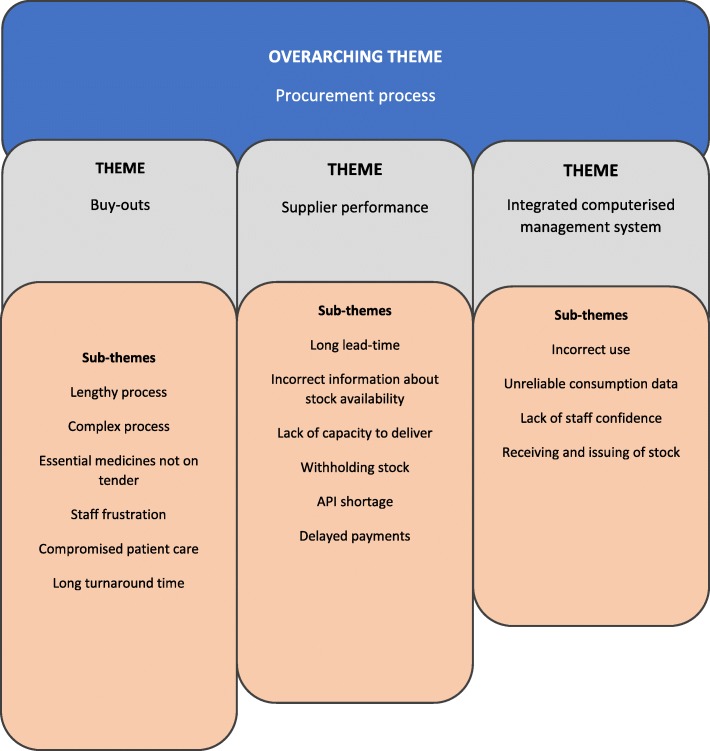
- The overarching theme was “Procurement process”, with three main contributing themes: buy-outs, supplier performance, and integrated computerized inventory management system (RxSolution).
- The buy-out process was described as very lengthy, taking at least 4 weeks in one account and six weeks at most in another, and was said to compromise patient care.
- Participants reported supplier-related problems including lead times longer than 21 days, orders outstanding for about three months, deliveries of less than ordered quantities, and incorrect claims about stock availability.
- RxSolution was reported as unreliable in some hospitals because staff did not use it properly; this produced inaccurate stock data and, in turn, insufficient orders. One participant said the system could generate short-dated stock reports that helped redistribute medicines before expiry.
## Methods
- Design: Qualitative descriptive study using in-depth interviews and thematic content analysis.
- Sample/data: 10 pharmacy managers from public sector hospitals in Gauteng Province, South Africa; participants came from district, regional, tertiary, and central hospitals. The study originally targeted 32 people, but only pharmacy managers were interviewed.
- Analysis: Interviews were recorded, transcribed verbatim, coded in NVivo 12, independently coded by two authors, and discussed until consensus; themes were then developed.
## Limitations
- The authors state that the sample was small and limited to one of South Africa’s nine provinces, so the findings may not be generalizable to all public sector hospitals in South Africa.
- The authors note that drug controllers were not available for interviews, so the study missed a perspective different from that of pharmacy managers.
- Evident from the text: the study included only 10 interviewed participants and only pharmacy managers, which further limits breadth of perspective and transferability.
Model-written summary. Check it against the paper before relying on it.
Integrity signals
Registry
Cites
Statistics
Figures
Verification
Claims the paper makes
9 Valid · 0 Not valid · 13 Not checked · 51 Own results and interpretations
The cited sources support only part of this claim — read each source’s verdict below.
In the paper
“In addition, pharmacists reported being given incorrect information about stock availability leading to medicine shortages similar to previous findings in South Africa [25].”
§ Medicine shortages and challenges with the procurement process among public sector hospitals in South Africa; findings and implications > Discussion
What the sources say
- Partly supportedcites [25] Magadzire BP Ward K Leng HMJ Sanders D Inefficient procurement processes undermine access to medicines in the Western Cape Province of South Africa S Afr Med J 2017 107 7 581 584 29025446 sourceExperimental — accuracy not yet measured
Our copy does report a pharmacist (a pharmacy manager) describing an information lapse that produced a shortage — 'nobody told the depot ... the depot didn't know to tell the company [supplier], so now we've got this snowball effect and ... we don't have enough to give the patient' (Overview of the general state of medicines availability in the WC) — but the lapse was a failure to communicate increased demand/poor facility forecasting, not incorrect information about stock availability given to pharmacists. On the latter point the paper says the opposite of the claim's framing: 'Frontline health workers received regular updates on the stock situation from the depots, which enabled them to make alternative arrangements' (same section), and it attributes stock-outs unanimously to three central-level procurement inefficiencies — tender delays, absence of contracts for medicines on provincial code lists, and supplier failure to meet contract obligations (Abstract; Perceived causes of procurement inefficiencies; Discussion). So the part of the claim about pharmacists being given incorrect stock-availability information is not supported by this source. (LLM, conf=0.65)
plainstates a cause- Asserted: passes — The authors put it forward as true.
- Checkable: passes — It can be checked against evidence.
- Load-bearing: unclear — It is unclear whether the paper’s conclusions depend on it.
- Based: passes — The paper gives a reason why it holds.
- Partly supported
A result the paper reports from its own data — it cites no other source for it, so there is none to check. The quote shows it is in the paper.
In the paper
“However, overall it became evident there were concerns generally with RxSolution.”
§ Medicine shortages and challenges with the procurement process among public sector hospitals in South Africa; findings and implications > Results > Theme 3: integrated computerized inventory management system (RxSolution)
plain- Asserted: passes — The authors put it forward as true.
- Checkable: passes — It can be checked against evidence.
- Load-bearing: unclear — It is unclear whether the paper’s conclusions depend on it.
- Based: passes — The paper gives a reason why it holds.
- Rests on an assumption not shown here.
A result the paper reports from its own data — it cites no other source for it, so there is none to check. The quote shows it is in the paper.
In the paper
“Counting and verifying stock physically was also undertaken by storeroom staff due to the fact that the quantities produced by the software were not always reliable.”
§ Medicine shortages and challenges with the procurement process among public sector hospitals in South Africa; findings and implications > Results > Theme 3: integrated computerized inventory management system (RxSolution)
plainstates a cause- Asserted: passes — The authors put it forward as true.
- Checkable: passes — It can be checked against evidence.
- Load-bearing: unclear — It is unclear whether the paper’s conclusions depend on it.
- Based: passes — The paper gives a reason why it holds.
- Rests on an assumption not shown here.
A result the paper reports from its own data — it cites no other source for it, so there is none to check. The quote shows it is in the paper.
In the paper
“Some participants alluded to the fact that suppliers were unable to deliver on orders placed because of the shortage of active pharmaceutical ingredients (APIs).”
§ Medicine shortages and challenges with the procurement process among public sector hospitals in South Africa; findings and implications > Results > Theme 2: supplier performance
hedgedstates a cause- Asserted: passes — The authors put it forward as true.
- Checkable: passes — It can be checked against evidence.
- Load-bearing: unclear — It is unclear whether the paper’s conclusions depend on it.
- Based: passes — The paper gives a reason why it holds.
A result the paper reports from its own data — it cites no other source for it, so there is none to check. The quote shows it is in the paper.
In the paper
“Four of the ten participants raised specific concerns with RxSolution.”
§ Medicine shortages and challenges with the procurement process among public sector hospitals in South Africa; findings and implications > Results > Theme 3: integrated computerized inventory management system (RxSolution)
plainn = 4- Asserted: passes — The authors put it forward as true.
- Checkable: passes — It can be checked against evidence.
- Load-bearing: unclear — It is unclear whether the paper’s conclusions depend on it.
- Based: passes — The paper gives a reason why it holds.
- Rests on an assumption not shown here.
17 more claims
Create a free account to see all 73 claims and to verify the 12 references still open.
- Probably not a substantial claim. 30
- It may state two separate claims as one. 36
- The quote only partly states this claim. 2
Claims other papers make about this one
Each is checked against this paper’s own text: does it say what the citing paper says it does?
In the citing paper
“The major reported barriers to implementing ASP especially in LMIC include leadership/structural issues such as poor infrastructure, inadequate skilled human resource to champion ASP activities in hospitals, and a lack of adequate facilities/support to undertake diagnostic tests including culture and sensitivity testing to promote optimal antibiotic use.”
From An Assessment of the Current Level of Implementation of the Core Elements of Antimicrobial Stewardship Programs in Public Hospitals in Ghana (2024) · cites this paper as [26]
Citations
Cites
Content analysis and thematic analysis: Implications for conducting a qualitative descriptive study
Vaismoradi, M., Turunen, H., & Bondas, T. (2013) · Nursing & Health Sciences · doi:10.1111/nhs.12048 · Cited by 8,327 · cited 1×
“proach was used based on the hermeneutic theory where data were coded into ranks after a process of classifying codes and re-classifying sub-codes to ensure that exclusionary themes emerged [40, 41].”
MethodASHP Guidelines on Managing Drug Product Shortages in Hospitals and Health Systems
Fox, E. R., Birt, A., James, K. B., Kokko, H., Salverson, S., & Soflin, D. L. (2009) · American Journal of Health-System Pharmacy · doi:10.2146/ajhp090026 · Cited by 217
ASHP Guidelines on the Pharmacy and Therapeutics Committee and the Formulary System
Tyler, L. S., Cole, S. W., May, J. R., Millares, M., Valentino, M. A., Vermeulen, L. C., & Wilson, A. L. (2008) · American Journal of Health-System Pharmacy · doi:10.2146/ajhp080086 · Cited by 208
Meyer, J. C., Schellack, N., Stokes, J., Lancaster, R., Zeeman, H., Defty, D., Godman, B., & Steel, G. (2017) · Frontiers in Pharmacology · doi:10.3389/fphar.2017.00751 · Cited by 175 · cited 6×
“The continuous and adequate supply of medicines is a key element in managing diseases especially chronic diseases [21], with the availability of essential medicines dependent on efficient supply chain systems among other factors [22].”
BackgroundInfluentialSelf-citationMedicine Shortages: Gaps Between Countries and Global Perspectives
Acosta, A., Vanegas, E. P., Rovira, J., Godman, B., & Bochenek, T. (2019) · Frontiers in Pharmacology · doi:10.3389/fphar.2019.00763 · Cited by 147
Self-citationShortages of medicines: a complex global challenge
Gray, A., & Manasse, H. (2012) · Bulletin of the World Health Organization · doi:10.2471/blt.11.101303 · Cited by 136 · cited 2×
“This is an issue especially among sub-Saharan African countries including South Africa [10, 15, 22, 23].”
BackgroundEffects on Patient Care Caused by Drug Shortages: A Survey
McLaughlin, M., Kotis, D., Thomson, K., Harrison, M., Fennessy, G., Postelnick, M., & Scheetz, M. H. (2013) · Journal of Managed Care Pharmacy · doi:10.18553/jmcp.2013.19.9.783 · Cited by 133
Bochenek, T., Abilova, V., Alkan, A., Asanin, B., de Miguel Beriain, I., Besovic, Z., Vella Bonanno, P., Bucsics, A., Davidescu, M., De Weerdt, E., et al. (2018) · Frontiers in Pharmacology · doi:10.3389/fphar.2017.00942 · Cited by 112 · cited 4×
“There are also considerable shortages in other continents and countries including other low and middle income countries (LMICs) across South America and wider [5, 6, 8, 9].”
BackgroundInfluentialSelf-citationPerumal-Pillay, V. A., & Suleman, F. (2017) · BMC Health Services Research · doi:10.1186/s12913-016-1946-9 · Cited by 81 · cited 2×
“proach was used based on the hermeneutic theory where data were coded into ranks after a process of classifying codes and re-classifying sub-codes to ensure that exclusionary themes emerged [40, 41].”
BackgroundMethodPharmaceutical Policy in Countries with Developing Healthcare Systems
Babar, Z. (2017) · Springer eBooks · doi:10.1007/978-3-319-51673-8 · Cited by 72
Research works printed but not linked: 4
- WHO Department of Essential Medicines and Health Products. Medicines shortages -Global approaches to addressing shortages of essential medicines in health systems. WHO Drug Information. 2016; 30 (2): 180–5. Available at URL: https://apps.who.int/medicinedocs/documents/s22463en/s22463en.pdf.
- Barraclough A Clark M Managing Procurement. Chapter 12 in Managing Access to Medicines and Health Technologies Management Sciences for Health 2012
- Gray A Suleman F Pharasi B South Africa’s National Drug Policy: 20 years and still going South African Health Rev 2017 2017 1 49 58
- Chimberengwa PT Masuka N Gombe NT Tshimanga M Bangure D Procurement processes at Gwanda provincial hospital, Matebeleland South Province, Zimbabwe, 2012; a descriptive cross sectional study Austin J Public Health Epidemiol 2015 2 1 1018
Cited by
Drug Shortage: Causes, Impact, and Mitigation Strategies
Shukar, S., Zahoor, F., Hayat, K., Saeed, A., Gillani, A. H., Omer, S., Hu, S., Babar, Z.-U.-D., Fang, Y., & Yang, C. (2021) · Frontiers in Pharmacology · doi:10.3389/fphar.2021.693426 · Cited by 322
“The United States has established a platform that conducts institutional level analyses and forecasts drug shortages (Valgus et al., 2013; Modisakeng et al., 2020).”
BackgroundStrategies to Improve Antimicrobial Utilization with a Special Focus on Developing Countries
Godman, B., Egwuenu, A., Haque, M., Malande, O. O., Schellack, N., Kumar, S., Saleem, Z., Sneddon, J., Hoxha, I., Islam, S., et al. (2021) · Life · doi:10.3390/life11060528 · Cited by 237
Self-citationOgunleye, O. O., Basu, D., Mueller, D., Sneddon, J., Seaton, R. A., Yinka-Ogunleye, A. F., Wamboga, J., Miljković, N., Mwita, J. C., Rwegerera, G. M., et al. (2020) · Frontiers in Pharmacology · doi:10.3389/fphar.2020.01205 · Cited by 208
“However, African countries are already taking steps to address concerns with shortages before and during the pandemic including suggesting potential alternatives (Chigome et al., 2019; Medical Brief, 2020b; Modisakeng et al., 2020; Review Online, 2020; Tomlinson, 2020).”
BackgroundSelf-citationYenet, A., Nibret, G., & Tegegne, B. A. (2023) · ClinicoEconomics and Outcomes Research · doi:10.2147/ceor.s413546 · Cited by 202
“According to the World Bank, approximately 80% of the African continent’s population, primarily those in the middle and lower income brackets, rely on public health facilities to access health care.(25) Several factors have been linked to affecting the accessibility of essential medicines in Africa’s public and privat…”
Godman, B., Egwuenu, A. J., Wesangula, E., Schellack, N., Kalungia, A. C., Tiroyakgosi, C., Kgatlwane, J., Mwita, J. C., Okwen, P., Niba, L. L., et al. (2022) · Expert Opinion on Drug Safety · doi:10.1080/14740338.2022.2106368 · Cited by 164
Self-citationVulnerability of the medical product supply chain: the wake-up call of COVID-19
Miller, F. A., Young, S. B., Dobrow, M., & Shojania, K. G. (2020) · BMJ Quality & Safety · doi:10.1136/bmjqs-2020-012133 · Cited by 132
Medicines and vaccines supply chains challenges in Nigeria: a scoping review
Olutuase, V. O., Iwu-Jaja, C. J., Akuoko, C. P., Adewuyi, E. O., & Khanal, V. (2022) · BMC Public Health · doi:10.1186/s12889-021-12361-9 · Cited by 99
“This finding agrees with the results of a study on procurement challenges conducted in South Africa which similarly identified inefficient inventory control systems as parts of the factors contributing to shortages of medicines in the country [41].”
ResultSaleem, Z., Godman, B., Cook, A., Khan, M. A., Campbell, S. M., Seaton, R. A., Siachalinga, L., Haseeb, A., Amir, A., Kurdi, A., et al. (2022) · Antibiotics · doi:10.3390/antibiotics11121824 · Cited by 91
“therapeutic interchange recommendations ready for when the need arises [196,230].”
BackgroundSelf-citationSefah, I. A., Ogunleye, O. O., Essah, D. O., Opanga, S. A., Butt, N., Wamaitha, A., Guantai, A. N., Chikowe, I., Khuluza, F., Kibuule, D., et al. (2021) · Frontiers in Pharmacology · doi:10.3389/fphar.2020.588106 · Cited by 72
Self-citationGodman, B., Fadare, J. O., Kwon, H.-Y., Dias, C. Z., Kurdi, A. B., Godói, I. P. D., Kibuule, D., Hoxha, I., Opanga, S. A., Saleem, Z., et al. (2021) · Journal of Comparative Effectiveness Research · doi:10.2217/cer-2020-0273 · Cited by 72
Self-citationMokwele, R. N., Schellack, N., Bronkhorst, E., Brink, A. J., Schweickerdt, L., & Godman, B. (2022) · JAC-Antimicrobial Resistance · doi:10.1093/jacamr/dlab196 · Cited by 50
Self-citationSupply chain transparency and the availability of essential medicines
Årdal, C., Baraldi, E., Beyer, P., Lacotte, Y., Larsson, D. G. J., Ploy, M.-C., Røttingen, J., & Smith, I. (2021) · Bulletin of the World Health Organization · doi:10.2471/blt.20.267724 · Cited by 44
Skosana, P., Schellack, N., Godman, B., Kurdi, A. B., Bennie, M., Kruger, D., & Meyer, J. C. (2021) · Journal of Global Antimicrobial Resistance · doi:10.1016/j.jgar.2021.12.003 · Cited by 40
Self-citationMukwena, N. V., & Manyisa, Z. M. (2022) · BMC Health Services Research · doi:10.1186/s12913-022-08367-7 · Cited by 44
“These findings are in line with another researcher’s findings [34] who in their study, found that there were drug shortages which were caused by procurement processes in the public health sector in South Africa.”
BackgroundResultMensah, K. B., Mensah, A. B. B., Bangalee, V., Padayachee, N., & Oosthuizen, F. (2021) · BMC Cancer · doi:10.1186/s12885-021-08435-x · Cited by 30
“4Department of Pharmacy and Pharmacology, University of the Witwatersrand, Johannesburg, South Africa.”
BackgroundInfluentialAssessment of medicine stock-outs challenges in public health services
Zuma, S. M. (2022) · Africa’s Public Service Delivery and Performance Review · doi:10.4102/apsdpr.v10i1.578 · Cited by 26
“(Participant 3, head of pharmaceutical services, female) This challenge is confirmed by Modisakeng et al. (2020) who states that although there have been some successes over the past three years and several initiatives undertaken by the government to improve the supply chain for medicines,…”
BackgroundMekonnen, Z., Melaku, T., Tucho, G. T., Mecha, M., Årdal, C., & Jahre, M. (2023) · BMC Health Services Research · doi:10.1186/s12913-023-09535-z · Cited by 23
AlRuthia, Y. S., Almutiri, N. M., Almutairi, R. M., Almohammed, O. A., Alhamdan, H. S., El-Haddad, S. A., & Asiri, Y. A. (2023) · Saudi Pharmaceutical Journal · doi:10.1016/j.jsps.2023.04.019 · Cited by 30
Sefah, I. A., Chetty, S., Yamoah, P., Godman, B., & Bangalee, V. (2024) · Hospital Pharmacy · doi:10.1177/00185787231224066 · Cited by 20
“,26-32 The 7 core elements of ASP in the toolkit comprise of leadership commitment, accountability and responsibilities, AMS actions and interventions, education and training, monitoring and surveillance, and reporting and feedback.”
BackgroundSelf-citationAdhikari, B., Ranabhat, K., Khanal, P., Poudel, M., Marahatta, S. B., Khanal, S., Paudyal, V., & Shrestha, S. (2024) · PLOS Global Public Health · doi:10.1371/journal.pgph.0003128 · Cited by 37
Githendu, P., Morrison, L., Silaa, R., Pothapregada, S., Asiimwe, S., Idris, R., Peterson, T., Davidson, E., Lesego, A., Mwale, N., et al. (2020) · BMJ Open · doi:10.1136/bmjopen-2020-040276 · Cited by 24
Hayat, K., Mustafa, Z. U., Godman, B., Arshed, M., Zhang, J., Khan, F. U., Saleem, F., Lambojon, K., Li, P., Feng, Z., et al. (2021) · Frontiers in Pharmacology · doi:10.3389/fphar.2021.650137 · Cited by 22
“…as seen in South Africa with their increasing role in DTC and other activities (Matlala et al., 2017; Terblanche et al., 2018; Matlala et al., 2020; Modisakeng et al., 2020) and in Kenya where hospital pharmacists are introducing new practices to improve the administration of oncology medicines…”
BackgroundSelf-citationFalco, M. F., Meyer, J. C., Putter, S. J., Underwood, R. S., Nabayiga, H., Opanga, S. A., Miljković, N., Nyathi, E., & Godman, B. (2023) · Healthcare · doi:10.3390/healthcare11131838 · Cited by 20
“They subsequently identified that the specific challenges affecting medicines availability and access across the country highlighted the need for a comprehensive, evidence-based response to address ongoing concerns [4,11,12].”
BackgroundSelf-citationMalematja, D. N., Nkosi, E. M., & Nene, S. E. (2025) · Curationis · doi:10.4102/curationis.v48i1.2696 · Cited by 19
“Modisakeng et al. (2020) confirmed the importance of a consistent supply of medication.”
The Challenges of Implementing a Health Referral System in South Africa: A Qualitative Study
Matolengwe, A., Murray, D., & Okafor, U. B. (2024) · Risk Management and Healthcare Policy · doi:10.2147/rmhp.s450998 · Cited by 23
“35 Participants in this study recommended various ways that could assist address the plethora of obstacles identified as impeding effective referrals system’s implementation in this region.”
BackgroundAli, W., Khalid, M., Khan, N., & Javaid, S. (2025) · Life Cycle Reliability and Safety Engineering · doi:10.1007/s41872-025-00322-9 · Cited by 17
“One of the significant issues in hospital management is the procurement and distribution of medical supplies (Modisakeng et al. 2020).”
Tenza, I. S., Blignaut, A. J., Ellis, S. M., & Coetzee, S. K. (2024) · BMC Nursing · doi:10.1186/s12912-024-01992-z · Cited by 31
“Major challenges reported in the South African literature associated with poor quality of patient care include poor infrastructure [54, 55], unavailability of medicine [56, 57], shortage of staff, increased workload, shift work and long working hours [58, 59].”
BackgroundMakukule, A., Modjadji, P., Thovhogi, N., Mokgalaboni, K., & Kengne, A. P. (2023) · Healthcare · doi:10.3390/healthcare11202783 · Cited by 27
Pilusa, S. I., Myezwa, H., & Potterton, J. L. (2021) · PLoS ONE · doi:10.1371/journal.pone.0252280 · Cited by 18
“The shortage of medication is a national problem due to inadequate procurement processes and suppliers [35].”
BackgroundRamafikeng, M. C., & Marshall, E. (2023) · BMC Health Services Research · doi:10.1186/s12913-023-09658-3 · Cited by 21
“These free services are available to all citizens with no formal health insurance plans or the ability to pay for private health care [40].”
BackgroundVogler, S., Habimana, K., & Haasis, M. A. (2022) · The International Journal of Health Planning and Management · doi:10.1002/hpm.3444 · Cited by 16
Chitha, W. W., Mnyaka, O. R., Ncinitwa, A., Giwu, O., Mashao, T., Mabophe, K., Nomatshila, S. C., Funani, I. N., Essel, V., Ntlongweni, X., et al. (2024) · BMC Health Services Research · doi:10.1186/s12913-024-12002-y · Cited by 15
Owolabi, E. O., & Ajayi, A. I. (2024) · Journal of Evaluation in Clinical Practice · doi:10.1111/jep.14035 · Cited by 14
Mabizela, S., Nakambale, H. N., & Bangalee, V. (2023) · BMC Health Services Research · doi:10.1186/s12913-023-10096-4 · Cited by 16
Mbonane, H., Sibanda, M., Godman, B., Meyer, J. C., & Matlala, M. (2023) · Exploratory Research in Clinical and Social Pharmacy · doi:10.1016/j.rcsop.2023.100233 · Cited by 13
“These include the RxSolution and the Stock Visibility System (SVS) to assist supply chain management and improve the speed and visibility of data at national level.(15,38,39) The SVS was implemented specifically for surveillance and visibility of medicines among PHC facilities as there have been continued concerns wit…”
BackgroundMethodInfluentialSelf-citationShukar, S., Zahoor, F., Omer, S., Ejaz, S., Yang, C., & Fang, Y. (2022) · International Journal of Environmental Research and Public Health · doi:10.3390/ijerph192316373 · Cited by 13
“A study conducted at the public hospitals of South Africa stated that continuous monitoring and computerized system played an important role in drug shortage management [31].”
BackgroundNabayiga, H., Meer, R. V. D., & Agha, M. S. A. (2025) · Decision Analytics Journal · doi:10.1016/j.dajour.2025.100555 · Cited by 9
Alshibli, F., Alqarni, K. A., & Balfaqih, H. (2024) · Informatics in Medicine Unlocked · doi:10.1016/j.imu.2024.101457 · Cited by 14
The impact of drug shortages on drug prices: evidence from China
Hu, S., Zhang, J., Li, J., Zhang, J., Pan, M., Xiang, C., Dave, C. V., Yang, C., & Fang, Y. (2023) · Frontiers in Public Health · doi:10.3389/fpubh.2023.1185356 · Cited by 9
The Process of Contract Compliance: A Public Procurement Perspective
Nsereko, H. B., Tait, M., & Oosthuizen, N. (2023) · Southern African Business Review · doi:10.25159/1998-8125/11565 · Cited by 18
“It is crucial in ensuring provider compliance (Modisakeng et al. 2020).”
BackgroundJoosse, I. R., van den Ham, H. A., Mantel-Teeuwisse, A. K., & Suleman, F. (2023) · BMJ Global Health · doi:10.1136/bmjgh-2023-012309 · Cited by 8
Enhancing pharmacy operations: factors shaping the adoption of automated drug dispensing systems
Gupta, S., Singh, J., Ali, L., & Stephan, T. (2025) · International Journal of Quality and Service Sciences · doi:10.1108/ijqss-03-2025-0054 · Cited by 8
Exploring quality standards implementation at a South African municipality’s health facilities
Matahela, R. S., Adekola, A. P., & Mavhandu‐Mudzusi, A. H. (2023) · Curationis · doi:10.4102/curationis.v46i1.2416 · Cited by 8
Jo, Y., Rosen, S. B., Nichols, B. E., Jamieson, L., Lekodeba, N., & Horsburgh, C. R. (2025) · Journal of the International AIDS Society · doi:10.1002/jia2.26413 · Cited by 8
Joosse, I. R., van den Ham, H. A., Mantel-Teeuwisse, A. K., Perumal-Pillay, V. A., & Suleman, F. (2024) · Journal of Pharmaceutical Policy and Practice · doi:10.1080/20523211.2024.2372033 · Cited by 6
“Internally, provinces and hospitals should address known inefficiencies in procurement (Magadzire et al., 2017; Modisakeng et al., 2020) and educate their personnel where necessary.”
BackgroundInfluentialElias, L., & Mushi, L. (2024) · BMC Health Services Research · doi:10.1186/s12913-024-10581-4 · Cited by 6
Matlala, M. E., Lubisi, N. P., Chauke, S., Kola, E., Ramarumo, L. J., & Ndhlovu, P. T. (2025) · Next research. · doi:10.1016/j.nexres.2025.100446 · Cited by 6
Self-citationMudenda, S., Simbaya, R., Moonga, G., Mwaba, F., Zulu, M., Tembo, R., Chiyangi, H. K., Vlahakis, P. A., Mohamed, S., Lubanga, A. F., et al. (2025) · Pharmacology & Pharmacy · doi:10.4236/pp.2025.161001 · Cited by 6
Sallam, M., Oliver, A., Allam, D., Kassem, R., & Damani, M. (2024) · Cureus · doi:10.7759/cureus.76377 · Cited by 9
Takawira, B., & Mutambara, E. (2023) · Business Ethics and Leadership · doi:10.61093/bel.7(4).89-107.2023 · Cited by 13
“…such as complex supply chains, regulatory environments, and evolving market dynamics, necessitate a deeper understanding of the strategic leadership practices that can enable firms to navigate these environments effectively (Modisakeng, Matlala, Godman, & Meyer, 2020; Adebisi, Nwogu et al., 2022).”
BackgroundIn Shortage: Understanding Global Antibiotic Supply Chains Through Pharmaceutical Trade Fairs
Zhang, M. (2023) · Anthropologica · doi:10.18357/anthropologica65120232605 · Cited by 5
Sánchez, D. I. R., & Vogler, S. (2023) · Pharmacy · doi:10.3390/pharmacy11040120 · Cited by 5
Sefah, I. A., Kordorwu, H. E. K., Essah, D. O., et al. (2021) · Advances in Human Biology · doi:10.4103/aihb.aihb_148_20 · Cited by 5
Self-citationObeagu, E. I., Abdulrahman, A. O., & Anetor, J. I. (2026) · Annals of Medicine and Surgery · doi:10.1097/ms9.0000000000004641 · Cited by 6
“Furthermore, poor forecasting and inaccurate quantification of drug needs can lead to either overstocking or understocking, both of which disrupt consistent drug availability [ 17 ] .”
Katende-Kyenda, L. N. (2025) · International Journal of Environmental Research and Public Health · doi:10.3390/ijerph22081209 · Cited by 12
“Family support, especially during the intensive phase of treatment, plays a crucial role in a patient’s ability to adhere to his or her medication regimen [48].”
Ogbodu, O. M., Mrara, B., & Sewani-Rusike, C. R. (2025) · BMJ Open · doi:10.1136/bmjopen-2025-101349 · Cited by 8
Bachoolall, R., & Suleman, F. (2024) · International Journal of Clinical Pharmacy · doi:10.1007/s11096-024-01799-7 · Cited by 10
Schmidt, C., Matlala, M., Godman, B., Kurdi, A. B., & Meyer, J. C. (2023) · Pharmacy · doi:10.3390/pharmacy11020054 · Cited by 4
“Furthermore, encouragingly, most of the surveyed students intended to complete their internship in South African public sector institutions, challenged with significant workforce shortages as well as medicine shortages, requiring pro-active ways to deal with this without seriously impeding on patient care [9,26,68,69].”
BackgroundSelf-citationCOVID-19 and emerging markets: A strategic framework for pharmaceutical supply chains
Takawira, B., & Mutambara, E. (2023) · Corporate and Business Strategy Review · doi:10.22495/cbsrv4i4siart15 · Cited by 6
“This would require the South African government to adopt a proactive approach to promoting R&D, supporting local manufacturing, and attracting foreign investments in the pharmaceutical industry (Modisakeng et al., 2020).”
BackgroundThwala, N. R., Havenga, Y., & Bester, M. (2022) · Africa Journal of Nursing and Midwifery · doi:10.25159/2520-5293/10007 · Cited by 5
Recognising the impact of traditional herbal medicine in managing cancer: The South African context
Xego, S., Kambizi, L., & Nchu, F. (2021) · Journal of Medicinal Plants for Economic Development · doi:10.4102/jomped.v5i1.121 · Cited by 6
Procurement and Management of Pharmaceutical Supplies at the Siaya County Referral Hospital
Oloo, D. O. (2021) · African Journal of Health Sciences · Cited by 6
Munzhedzi, M., Kumar, S., Godman, B., & Meyer, J. C. (2025) · Advances in Human Biology · doi:10.4103/aihb.aihb_132_25 · Cited by 7
Self-citationMafanele, P., Maziriri, E. T., Masakale, A. M., & Mabuyana, B. (2025) · Benchmarking An International Journal · doi:10.1108/bij-04-2024-0269 · Cited by 3
Lived experiences of radiology caregivers during a health crisis: A COVID-19 case analysis
Hundah, S. N., Sibiya, M. N., & Khoza, T. E. (2024) · Health SA Gesondheid · doi:10.4102/hsag.v29i0.2532 · Cited by 4
“…have different economic and operational statuses with records of non-operational or faulty radiology equipment and deteriorating healthcare services reported in KZN as well as unique occupational stressors among the KZN radiographers (Gam, Naidoo & Puckree 2015:18; Modisakeng et al. 2020:3).”
BackgroundThe adoption of ICT and robotic automation systems in the pharmaceutical industry
Moodley, K., & James, R. (2024) · South African journal of information management · doi:10.4102/sajim.v26i1.1744 · Cited by 6
Makwaga, O., Adungo, F., Mokaya, T., Echoka, E., & Mwau, M. (2024) · Pan African Medical Journal · doi:10.11604/pamj.2024.47.101.40829 · Cited by 3
“This scenario was similarly reported in other studies elsewhere [30] which reported shortages of medicines in a hospital due to procurement challenges.”
ResultNyika, A., Ngara, B., Mutingwende, I., & Gwaza, L. (2022) · BMC Health Services Research · doi:10.1186/s12913-022-07995-3 · Cited by 3
Denu, Z. A., Yassin, M. O., Azale, T., et al. (2022) · Disaster Medicine and Public Health Preparedness · doi:10.1017/dmp.2022.44 · Cited by 3
Medicine shortages in France: a 6-year retrospective study in a university medical centre
Traore, S., Decoene, A., & Mazaud, P. (2021) · European Journal of Hospital Pharmacy · doi:10.1136/ejhpharm-2021-002911 · Cited by 4
Majola, T. N., Blose, N., Mthethwa, M., et al. (2026) · African Journal of Primary Health Care & Family Medicine · doi:10.4102/phcfm.v18i1.5368 · Cited by 3
“32 Similar issues were observed in Mpumalanga province , where delivery bottlenecks and poor forecasting from the Provincial Department of Health were cited as major barriers to consistent availability of essential medicines, further undermining PHC credibility.”
Edward, M. M., & Owoicho, A. W. (2026) · Critical Public Health · doi:10.1080/09581596.2026.2670791 · Cited by 2
Sharma, R. K., Kumari, M., & Baxi, R. (2026) · Journal of Public Health Research · doi:10.1177/22799036261418439 · Cited by 3
Munzhedzi, M., Chigome, A., Miljković, N., Moore, C. E., Campbell, S., Godman, B., & Meyer, J. C. (2025) · Advances in Human Biology · doi:10.4103/aihb.aihb_175_25 · Cited by 3
Self-citationKebirungi, B., Ocran, P., Kamere, N., et al. (2025) · Journal of Pharmaceutical Policy and Practice · doi:10.1080/20523211.2025.2523937 · Cited by 2
“…the public healthcare sector serves the needs of more than 82.5%–84% of the population (60 million); this accounts for 16% (ZAR 6.1 billion) of total pharmaceutical expenditure, and access to 2400 product lines (Modisakeng et al., 2020; Organisation for Economic Co-operation and Development, 2018).”
InfluentialMaphanga, B., Matlala, M., Vagiri, R. V., Godman, B., & Makhele, L. (2025) · BMC Health Services Research · doi:10.1186/s12913-025-12533-y · Cited by 2
“In addition, benchmark figures for health authorities to assess the payments they make for pharmaceuticals should be provided, similar to other benchmark studies across countries, including among African countries [65, 66].”
Self-citationWleh, C. J., & Nkoane, N. L. (2025) · Nursing Forum · doi:10.1155/nuf/9939848 · Cited by 3
“Teparticipants concluded that South Africa’s pro-curement process struggles with issues such as supplier nonpayment, subpar supplier performance, drawn-out buy-out procedures, and inaccurate electronic inventory management systems [33].”
Nsiah, R. B., Ankamah, J., Krah, T., Yeboah, A. K., Nyarko, D., Gmanyami, J. M., Peprah, F. O., Prempeh, F., Domfeh, C. Y., Ayirebi, I., et al. (2024) · American Journal of Health Research · doi:10.11648/j.ajhr.20241206.11 · Cited by 3
Austerity Measures and the Resilience of Zimbabwe's Healthcare System: Challenges and Solutions
Chiwaridzo, O. T. (2024) · International Journal of Social Determinants of Health and Health Services · doi:10.1177/27551938241269118 · Cited by 3
“16 However, despite government funding, out-of-pocket payments remain a signi fi cant contributor to health fi nancing, which creates fi nancial barriers for individuals seeking health care services.”
Sama, H. K., & Mdemu, R. (2024) · International Journal of Business Economics and Social Development · doi:10.46336/ijbesd.v5i2.606 · Cited by 2
“Governments in poor countries have a lot of issues, and poor inventory management is one of the biggest ones (Mesterházy, et al., 2020; Modisakeng, et al ., 2020).”
BackgroundFaradiba, F., Satibi, S., Lazuardi, L., et al. (2024) · JURNAL ILMU KEFARMASIAN INDONESIA · doi:10.35814/jifi.v22i1.1574 · Cited by 2
“In addition, the difficulty of monitoring inventory due to the absence of an information system contributes to vacancies and low drug availability[8],[9].”
BackgroundEditorial: Pharmaceutical policy, impact and health outcomes
Kwon, H.-Y., & Godman, B. (2023) · Frontiers in Pharmacology · doi:10.3389/fphar.2023.1150055 · Cited by 2
Self-citationEvaluación del desempeño de los sistemas de salud: Un marco para el análisis de políticas
de la Salud, O. P. (2023) · Pan American Health Organization eBooks · doi:10.37774/9789275326787 · Cited by 12
Domie, G., & Dodzi, S. (2023) · Open Journal of Business and Management · doi:10.4236/ojbm.2023.115115 · Cited by 2
“…medicine procurement is too cum-bersome and is not working perfectly due to long contract process, non-payment of suppliers, poor supplier performance, and lengthy buy-out process and non-inclusivity of stakeholders resulting in unnecessary stock-outs (Arney et al., 2014; Modisakeng et al., 2020).”
BackgroundImplementing essential diagnostics-learning from essential medicines: A scoping review
Nyanchoka, M., Mulaku, M., Nyagol, B., Owino, E. J., Kariuki, S., & Ochodo, E. (2022) · PLOS Global Public Health · doi:10.1371/journal.pgph.0000827 · Cited by 5
AISDL (2021) · OSF Preprints (OSF Preprints) · doi:10.31219/osf.io/vyrqk · Cited by 2
Ambe, I. M., & Selby, D. (2026) · Journal of Health Organization and Management · doi:10.1108/jhom-07-2025-0377 · Cited by 1
Uahupirapi, K., Shifotoka, S., & Nangombe, V. (2025) · Tropical Medicine and Health · doi:10.1186/s41182-025-00799-1 · Cited by 5
“This dependency creates vulnerability to supply chain disruptions, both regionally and globally, with the majority of pharmaceutical imports coming from neighbouring South Africa, which itself experiences shortages in its public sector [8].”
InfluentialAssessing the Challenges of Managing Pharmacy Services in Public Hospitals in Erbil City
Kamal, S. I., & Surji, K. M. (2025) · Iranian journal of pharmaceutical research · doi:10.5812/ijpr-162251 · Cited by 2
“Furthermore, challenges in procurement policies have been shown to contribute to medication shortages (40, 41).”
Ogbodu, O. M. (2025) · International Journal of Innovative Research and Scientific Studies · doi:10.53894/ijirss.v8i5.8760 · Cited by 1
Limited resources in clinical facilities: Experiences of nursing students during placements
Mafumo, J. L., & Maputle, M. S. (2025) · Curationis · doi:10.4102/curationis.v48i1.2732 · Cited by 10
“On the contrary, many healthcare facilities are faced with challenges of shortage of resources, both human (Tamata & Mohammadnezhad 2023) and material (Modisakeng et al. 2020).”
Exploring the gastric cancer care pathway in South Africa
Ramadhar, A., Kagura, J., Muchengeti, M. M., Gaskill, C. E., & Khamisa, N. (2025) · African Journal of Primary Health Care & Family Medicine · doi:10.4102/phcfm.v17i1.4774 · Cited by 1
“25,26 The shortage of medicines and medical staff, suboptimal infrastructure and staff competencies, and poor safety and working conditions in the public health 7,11 sector align with the delayed time to GC diagnosis, delayed treatment access, limited treatment options, and restricted nutritional…”
Spatial disparities in drug stock-outs in Zimbabwe
Chari, A., & Kamninga, T. M. (2025) · Oxford Open Economics · doi:10.1093/ooec/odaf004 · Cited by 2
Temesgen, S. A., & Netangaheni, R. T. (2024) · Health SA Gesondheid · doi:10.4102/hsag.v29i0.2694 · Cited by 4
“However, the findings of studies conducted in Africa (Kolleh et al. 2022:7; Frank 2020:696) did not show any association.”
BackgroundInfluentialJoosse, I. R., van den Ham, H. A., Mantel-Teeuwisse, A. K., & Suleman, F. (2024) · South African Health Review · doi:10.61473/001c.118489 · Cited by 1
Nduhura, A., Hofisi, C., Tshombe, L. M., Molokwane, T., Settumba, J. P., & Wanume, P. (2024) · Journal of African Development · doi:10.5325/jafrideve.25.1.0075 · Cited by 1
Kalumanga, V. E., & Mwita, O. N. (2024) · NG Journal of Social Development · doi:10.4314/ngjsd.v13i1.8 · Cited by 2
“The primary goal of pharmaceutical inventory management is to ensure that medications are readily available to meet patient needs (Modisakeng et al., 2020).”
BackgroundNgaledzani, R. I., Ndou-Mammbona, A. A., & Mavhandu‐Mudzusi, A. H. (2024) · F1000Research · doi:10.12688/f1000research.125582.2 · Cited by 1
“Contrary to the above, as shared in a study conducted in Chhattisgarh, 34 the proximity of the blood bank to the theatre is very important as it also reduces delays that can lead to complications and death.”
ResultBachoolall, R., & Suleman, F. (2024) · Research Square · doi:10.21203/rs.3.rs-3917831/v1 · Cited by 1
Metadata
- Authors
- Modisakeng, C., Matlala, M., Godman, B., & Meyer, J. C.
- Affiliations
- Sefako Makgatho Health Sciences University (ZA)
- University of Strathclyde (GB)
- Corresponding author
- Matlala, Moliehi
- Venue
- BMC Health Services Research
- Published
- 2020-03-19
- Volume
- 20
- Issue
- 1
- Pages
- 234-234
- ISSN
- 1472-6963 (ISSN-L)
- PMC
- PMC7082963
- OpenAlex
- W2993937115
- Semantic Scholar
- 9e55db16d07cd5165932e516077d6f53e310ce05
- Cited by
- 130
- References
- 30
- Citations by year
- 2026: 14 · 2025: 29 · 2024: 27 · 2023: 24 · 2022: 14 · 2021: 17 · 2020: 5
- FWCI
- 12.74
- Type
- journal article
- Language
- en
- Open access
- gold
- doi.org
- Licence
- cc-by
- creativecommons.org/licenses/by/4.0/ (tdm)
- creativecommons.org/licenses/by/4.0/ (vor)
- Locations
- BMC Health Services Research (publishedVersion, cc-by)
- PubMed Central (publishedVersion, cc-by)
- PubMed (publishedVersion)
- DOAJ (DOAJ: Directory of Open Access Journals) (submittedVersion, cc-by-sa)
- Topics
- Social Sciences › Economics, Econometrics and Finance › Economics and Econometrics › Pharmaceutical Economics and Policy
- Social Sciences › Decision Sciences › Management Science and Operations Research › Supply Chain and Inventory Management
- Health Sciences › Medicine › Public Health, Environmental and Occupational Health › Healthcare Systems and Reforms
- Keywords
- drug shortages, drug procurement, public hospitals, hospital pharmacy management, supplier contracts, essential medicines availability, South Africa, Gauteng
- MeSH terms
- Adult, Female, Hospitals, Public, Humans, Interviews as Topic, Longitudinal Studies, Male, Middle Aged, Purchasing, Hospital, South Africa, Drugs, Essential, Contracts, Qualitative Research
About these checks
Registry, retraction, Cites and statistics results are computed, not judged, with one exception: a printed reference that no index lists is read once by a model before it counts as a citation error. Claims are extracted by a model and kept only when their quote appears verbatim in the text; each cited source is then checked, with a model’s help, for whether it says what the claim relies on. Those verdicts can be wrong — read the claim’s quote and the cited source before relying on one.
The claim verdicts this report counts are experimental: their accuracy is not yet measured.
A language model drew the claims from the paper on 2026-10-10, under version 3 of the claim definition (model deepseek-v4.1-flash, prompt extract-v3).
A second model labelled each claim on 2026-10-10 (model jev-1.13-20260917, definition revision gold-guideline-v0.2).
Cited sources are checked with a language model’s help (qwen3.8-omni-flash).
Statistics and arithmetic are recomputed, not judged.
Confidence bands are shown only for fields calibrated on our annotated test set. None is calibrated yet, so no band is shown.
What counts as a claim ›How we measure confidence ›How we check this ›
Are you an author, or do you see a problem with this page? Request a review
Data sources
Bibliographic data: Semantic Scholar, OpenAlex, Crossref.
Contains information from the Semantic Scholar Academic Graph Datasets, made available under the ODC Attribution License (ODC-BY 1.0).
Semantic Scholar’s data is described in: Kinney, R., et al. (2023). The Semantic Scholar Open Data Platform. arXiv:2301.10140.
