

Medicine shortages and challenges with the procurement process among public sector hospitals in South Africa; findings and implications
Open accessThe DOI matches its Crossref record; 30 of the 30 references it cites were found in a registry or an index; 18 of the 42 sources its claims cite were checked for support.
Abstract
Qualitative study of 10 pharmacy managers in public sector hospitals in Gauteng Province, South Africa, identifying procurement challenges contributing to medicine shortages.
Overview
CoChat Summary
## TL;DR
This qualitative study interviewed 10 pharmacy managers in Gauteng public hospitals to identify why medicine shortages persist in South Africa’s public sector. It found that procurement problems—especially lengthy buy-outs, poor supplier performance, and inaccurate use of the RxSolution inventory system—were key contributors.
## Key findings
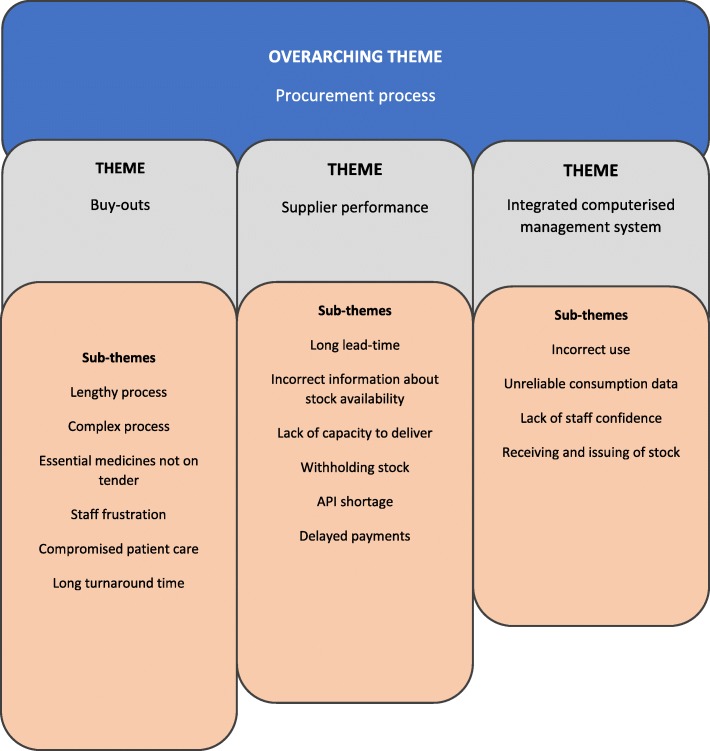
- The overarching theme was “Procurement process”, with three main contributing themes: buy-outs, supplier performance, and integrated computerized inventory management system (RxSolution).
- The buy-out process was described as very lengthy, taking at least 4 weeks in one account and six weeks at most in another, and was said to compromise patient care.
- Participants reported supplier-related problems including lead times longer than 21 days, orders outstanding for about three months, deliveries of less than ordered quantities, and incorrect claims about stock availability.
- RxSolution was reported as unreliable in some hospitals because staff did not use it properly; this produced inaccurate stock data and, in turn, insufficient orders. One participant said the system could generate short-dated stock reports that helped redistribute medicines before expiry.
## Methods
- Design: Qualitative descriptive study using in-depth interviews and thematic content analysis.
- Sample/data: 10 pharmacy managers from public sector hospitals in Gauteng Province, South Africa; participants came from district, regional, tertiary, and central hospitals. The study originally targeted 32 people, but only pharmacy managers were interviewed.
- Analysis: Interviews were recorded, transcribed verbatim, coded in NVivo 12, independently coded by two authors, and discussed until consensus; themes were then developed.
## Limitations
- The authors state that the sample was small and limited to one of South Africa’s nine provinces, so the findings may not be generalizable to all public sector hospitals in South Africa.
- The authors note that drug controllers were not available for interviews, so the study missed a perspective different from that of pharmacy managers.
- Evident from the text: the study included only 10 interviewed participants and only pharmacy managers, which further limits breadth of perspective and transferability.
Model-written summary. Check it against the paper before relying on it.
Integrity signals
Registry
Cites
Statistics
Figures
Verification
Claims the paper makes
9 Valid · 0 Not valid · 13 Not checked · 51 Own results and interpretations
The cited sources support only part of this claim — read each source’s verdict below.
In the paper
“In addition, pharmacists reported being given incorrect information about stock availability leading to medicine shortages similar to previous findings in South Africa [25].”
§ Medicine shortages and challenges with the procurement process among public sector hospitals in South Africa; findings and implications > Discussion
What the sources say
- Partly supportedcites [25] Magadzire BP Ward K Leng HMJ Sanders D Inefficient procurement processes undermine access to medicines in the Western Cape Province of South Africa S Afr Med J 2017 107 7 581 584 29025446 sourceExperimental — accuracy not yet measured
Our copy does report a pharmacist (a pharmacy manager) describing an information lapse that produced a shortage — 'nobody told the depot ... the depot didn't know to tell the company [supplier], so now we've got this snowball effect and ... we don't have enough to give the patient' (Overview of the general state of medicines availability in the WC) — but the lapse was a failure to communicate increased demand/poor facility forecasting, not incorrect information about stock availability given to pharmacists. On the latter point the paper says the opposite of the claim's framing: 'Frontline health workers received regular updates on the stock situation from the depots, which enabled them to make alternative arrangements' (same section), and it attributes stock-outs unanimously to three central-level procurement inefficiencies — tender delays, absence of contracts for medicines on provincial code lists, and supplier failure to meet contract obligations (Abstract; Perceived causes of procurement inefficiencies; Discussion). So the part of the claim about pharmacists being given incorrect stock-availability information is not supported by this source. (LLM, conf=0.65)
plainstates a cause- Asserted: passes — The authors put it forward as true.
- Checkable: passes — It can be checked against evidence.
- Load-bearing: unclear — It is unclear whether the paper’s conclusions depend on it.
- Based: passes — The paper gives a reason why it holds.
- Partly supported
A result the paper reports from its own data — it cites no other source for it, so there is none to check. The quote shows it is in the paper.
In the paper
“However, overall it became evident there were concerns generally with RxSolution.”
§ Medicine shortages and challenges with the procurement process among public sector hospitals in South Africa; findings and implications > Results > Theme 3: integrated computerized inventory management system (RxSolution)
plain- Asserted: passes — The authors put it forward as true.
- Checkable: passes — It can be checked against evidence.
- Load-bearing: unclear — It is unclear whether the paper’s conclusions depend on it.
- Based: passes — The paper gives a reason why it holds.
- Rests on an assumption not shown here.
A result the paper reports from its own data — it cites no other source for it, so there is none to check. The quote shows it is in the paper.
In the paper
“Counting and verifying stock physically was also undertaken by storeroom staff due to the fact that the quantities produced by the software were not always reliable.”
§ Medicine shortages and challenges with the procurement process among public sector hospitals in South Africa; findings and implications > Results > Theme 3: integrated computerized inventory management system (RxSolution)
plainstates a cause- Asserted: passes — The authors put it forward as true.
- Checkable: passes — It can be checked against evidence.
- Load-bearing: unclear — It is unclear whether the paper’s conclusions depend on it.
- Based: passes — The paper gives a reason why it holds.
- Rests on an assumption not shown here.
A result the paper reports from its own data — it cites no other source for it, so there is none to check. The quote shows it is in the paper.
In the paper
“Some participants alluded to the fact that suppliers were unable to deliver on orders placed because of the shortage of active pharmaceutical ingredients (APIs).”
§ Medicine shortages and challenges with the procurement process among public sector hospitals in South Africa; findings and implications > Results > Theme 2: supplier performance
hedgedstates a cause- Asserted: passes — The authors put it forward as true.
- Checkable: passes — It can be checked against evidence.
- Load-bearing: unclear — It is unclear whether the paper’s conclusions depend on it.
- Based: passes — The paper gives a reason why it holds.
A result the paper reports from its own data — it cites no other source for it, so there is none to check. The quote shows it is in the paper.
In the paper
“Four of the ten participants raised specific concerns with RxSolution.”
§ Medicine shortages and challenges with the procurement process among public sector hospitals in South Africa; findings and implications > Results > Theme 3: integrated computerized inventory management system (RxSolution)
plainn = 4- Asserted: passes — The authors put it forward as true.
- Checkable: passes — It can be checked against evidence.
- Load-bearing: unclear — It is unclear whether the paper’s conclusions depend on it.
- Based: passes — The paper gives a reason why it holds.
- Rests on an assumption not shown here.
17 more claims
Create a free account to see all 73 claims and to verify the 12 references still open.
- Probably not a substantial claim. 30
- It may state two separate claims as one. 36
- The quote only partly states this claim. 2
Claims other papers make about this one
Each is checked against this paper’s own text: does it say what the citing paper says it does?
In the citing paper
“The major reported barriers to implementing ASP especially in LMIC include leadership/structural issues such as poor infrastructure, inadequate skilled human resource to champion ASP activities in hospitals, and a lack of adequate facilities/support to undertake diagnostic tests including culture and sensitivity testing to promote optimal antibiotic use.”
From An Assessment of the Current Level of Implementation of the Core Elements of Antimicrobial Stewardship Programs in Public Hospitals in Ghana (2024) · cites this paper as [26]
Citations
Cites
Content analysis and thematic analysis: Implications for conducting a qualitative descriptive study
Vaismoradi, M., Turunen, H., & Bondas, T. (2013) · Nursing & Health Sciences · doi:10.1111/nhs.12048 · Cited by 8,327 · cited 1×
“proach was used based on the hermeneutic theory where data were coded into ranks after a process of classifying codes and re-classifying sub-codes to ensure that exclusionary themes emerged [40, 41].”
MethodASHP Guidelines on Managing Drug Product Shortages in Hospitals and Health Systems
Fox, E. R., Birt, A., James, K. B., Kokko, H., Salverson, S., & Soflin, D. L. (2009) · American Journal of Health-System Pharmacy · doi:10.2146/ajhp090026 · Cited by 217
ASHP Guidelines on the Pharmacy and Therapeutics Committee and the Formulary System
Tyler, L. S., Cole, S. W., May, J. R., Millares, M., Valentino, M. A., Vermeulen, L. C., & Wilson, A. L. (2008) · American Journal of Health-System Pharmacy · doi:10.2146/ajhp080086 · Cited by 208
Meyer, J. C., Schellack, N., Stokes, J., Lancaster, R., Zeeman, H., Defty, D., Godman, B., & Steel, G. (2017) · Frontiers in Pharmacology · doi:10.3389/fphar.2017.00751 · Cited by 175 · cited 6×
“The continuous and adequate supply of medicines is a key element in managing diseases especially chronic diseases [21], with the availability of essential medicines dependent on efficient supply chain systems among other factors [22].”
BackgroundInfluentialSelf-citationMedicine Shortages: Gaps Between Countries and Global Perspectives
Acosta, A., Vanegas, E. P., Rovira, J., Godman, B., & Bochenek, T. (2019) · Frontiers in Pharmacology · doi:10.3389/fphar.2019.00763 · Cited by 147
Self-citationShortages of medicines: a complex global challenge
Gray, A., & Manasse, H. (2012) · Bulletin of the World Health Organization · doi:10.2471/blt.11.101303 · Cited by 136 · cited 2×
“This is an issue especially among sub-Saharan African countries including South Africa [10, 15, 22, 23].”
BackgroundEffects on Patient Care Caused by Drug Shortages: A Survey
McLaughlin, M., Kotis, D., Thomson, K., Harrison, M., Fennessy, G., Postelnick, M., & Scheetz, M. H. (2013) · Journal of Managed Care Pharmacy · doi:10.18553/jmcp.2013.19.9.783 · Cited by 133
Bochenek, T., Abilova, V., Alkan, A., Asanin, B., de Miguel Beriain, I., Besovic, Z., Vella Bonanno, P., Bucsics, A., Davidescu, M., De Weerdt, E., et al. (2018) · Frontiers in Pharmacology · doi:10.3389/fphar.2017.00942 · Cited by 112 · cited 4×
“There are also considerable shortages in other continents and countries including other low and middle income countries (LMICs) across South America and wider [5, 6, 8, 9].”
BackgroundInfluentialSelf-citationPerumal-Pillay, V. A., & Suleman, F. (2017) · BMC Health Services Research · doi:10.1186/s12913-016-1946-9 · Cited by 81 · cited 2×
“proach was used based on the hermeneutic theory where data were coded into ranks after a process of classifying codes and re-classifying sub-codes to ensure that exclusionary themes emerged [40, 41].”
BackgroundMethodPharmaceutical Policy in Countries with Developing Healthcare Systems
Babar, Z. (2017) · Springer eBooks · doi:10.1007/978-3-319-51673-8 · Cited by 72
Wouters, O. J., Sandberg, D. M., Pillay, A., & Kanavos, P. G. (2018) · Social Science & Medicine · doi:10.1016/j.socscimed.2018.11.029 · Cited by 72
Yang, C., Wu, L., Cai, W., Zhu, W., Shen, Q., Li, Z., & Fang, Y. (2016) · PLOS ONE · doi:10.1371/journal.pone.0165183 · Cited by 70
Drug shortages in developed countries—reasons, therapeutic consequences, and handling
Dill, S., & Ahn, J. (2014) · European Journal of Clinical Pharmacology · doi:10.1007/s00228-014-1747-1 · Cited by 66 · cited 1×
“Other factors include long lead times, delays in awarding tenders, absence of national contracts on the regional code lists of medicines, the failure of suppliers to meet demand, and the failure to pay suppliers [2, 19, 20].”
BackgroundMedicine shortages in Fiji: A qualitative exploration of stakeholders’ views
Walker, J., Chaar, B. B., Vera, N., Pillai, A. S., Lim, J. S., Bero, L., & Moles, R. J. (2017) · PLOS ONE · doi:10.1371/journal.pone.0178429 · Cited by 57 · cited 2×
“There are also considerable shortages in other continents and countries including other low and middle income countries (LMICs) across South America and wider [5, 6, 8, 9].”
BackgroundImpact of shortages of injectable oncology drugs on patient care
Goldsack, J. C., Reilly, C., Bush, C., McElligott, S., Bristol, M. N., Motanya, U. N., Field, R., Vozniak, J. M., Wong, Y.-N., Schwartz, J. S., et al. (2014) · American Journal of Health-System Pharmacy · doi:10.2146/ajhp130569 · Cited by 53 · cited 1×
“pharmacists in a study published in 2014 reported experiencing at least one shortage during the previous 12 months, 64% reported that their facility had completely run out of at least one injectable oncology drug during the past 12 months and 25% reported that one or more safety events had occurred at their facility a…”
BackgroundHeiskanen, K., Ahonen, R., Kanerva, R., Karttunen, P., & Timonen, J. (2017) · PLOS ONE · doi:10.1371/journal.pone.0179479 · Cited by 51 · cited 3×
“[2], shortage of raw materials was a common reason for shortage of medicines in agreement with our findings.”
BackgroundResultClinical, Economic and Policy Implications of Drug Shortages in the European Union
De Weerdt, E., Simoens, S., Casteels, M., & Huys, I. (2017) · Applied Health Economics and Health Policy · doi:10.1007/s40258-016-0264-z · Cited by 50
Drug shortages in Israel: regulatory perspectives, challenges and solutions
Schwartzberg, E., Ainbinder, D., Vishkauzan, A., & Gamzu, R. (2017) · Israel Journal of Health Policy Research · doi:10.1186/s13584-017-0140-9 · Cited by 46 · cited 1×
“Shortage of APIs affects many manufacturers worldwide, causing medicine shortages and leading to concerns with patient management [5, 43, 44].”
BackgroundHealth Care and Pharmacy Practice in South Africa
Gray, A., Riddin, J., & Jugathpal, J. (2016) · The Canadian Journal of Hospital Pharmacy · doi:10.4212/cjhp.v69i1.1521 · Cited by 46 · cited 2×
“Healthcare services in the public sector are financed through general tax revenues while healthcare services in the private sector are largely financed by medical aid schemes with a small fraction financed through out of pocket payments [30].”
BackgroundGriffith, M. M., Pentoney, Z., & Scheetz, M. H. (2012) · Pharmacotherapy The Journal of Human Pharmacology and Drug Therapy · doi:10.1002/j.1875-9114.2012.01158.x · Cited by 31
Alsheikh, M., Seoane-Vazquez, E., Rittenhouse, B., Fox, E. R., & Fanikos, J. (2016) · Hospital Pharmacy · doi:10.1310/hpj5105-370 · Cited by 29
South African health care system analysis
Conmy, A. (2018) · Cited by 28
When did medicines become essential?
Greene, J. A. (2010) · Bulletin of the World Health Organization · doi:10.2471/blt.10.079970 · Cited by 27 · cited 1×
“The continuous and adequate supply of medicines is a key element in managing diseases especially chronic diseases [21], with the availability of essential medicines dependent on efficient supply chain systems among other factors [22].”
BackgroundMagadzire, B. P., Ward, K., Leng, H. M. J., & Sanders, D. (2017) · South African Medical Journal · doi:10.7196/samj.2017.v107i7.11356 · Cited by 24 · cited 2×
“We are aware that there have been recent programs to help reduce potential medicine shortages in the public sector in South Africa [22] building on concerns in some provinces [25].”
BackgroundResultMuhia, J., Waithera, L., & Songole, R. (2017) · Medical & Clinical Reviews · doi:10.21767/2471-299x.1000061 · Cited by 23
Medicines shortages—unpicking the evidence from a year in South Africa
Gray, A. (2014) · Australasian Medical Journal · doi:10.4066/amj.2014.1932 · Cited by 18 · cited 2×
“The NDoH in South Africa in an attempt to prevent nonpayment of supplier accounts posed penalties to Provinces that were found guilty of such conduct [15].”
BackgroundEditorial: Medicine shortages in Australia - what are we doing about them?
Morris, S. (2018) · Australian Prescriber · doi:10.18773/austprescr.2018.047 · Cited by 15
ChePa, N., Jasin, N. M., & Bakar, N. A. A. (2017) · AIP conference proceedings · doi:10.1063/1.5005370 · Cited by 13 · cited 3×
“(2017) highlighted there could be negative mind-sets and perceptions during the implementation of the electronic inventory management systems in hospitals making change hard to implement [49].”
BackgroundInfluentialMedicines selection and procurement in South Africa : medicines, vaccines and technology
Pharasi, B., & Miot, J. (2012) · South African Health Review · Cited by 3
Research works printed but not linked: 4
- WHO Department of Essential Medicines and Health Products. Medicines shortages -Global approaches to addressing shortages of essential medicines in health systems. WHO Drug Information. 2016; 30 (2): 180–5. Available at URL: https://apps.who.int/medicinedocs/documents/s22463en/s22463en.pdf.
- Barraclough A Clark M Managing Procurement. Chapter 12 in Managing Access to Medicines and Health Technologies Management Sciences for Health 2012
- Gray A Suleman F Pharasi B South Africa’s National Drug Policy: 20 years and still going South African Health Rev 2017 2017 1 49 58
- Chimberengwa PT Masuka N Gombe NT Tshimanga M Bangure D Procurement processes at Gwanda provincial hospital, Matebeleland South Province, Zimbabwe, 2012; a descriptive cross sectional study Austin J Public Health Epidemiol 2015 2 1 1018
Cited by
Drug Shortage: Causes, Impact, and Mitigation Strategies
Shukar, S., Zahoor, F., Hayat, K., Saeed, A., Gillani, A. H., Omer, S., Hu, S., Babar, Z.-U.-D., Fang, Y., & Yang, C. (2021) · Frontiers in Pharmacology · doi:10.3389/fphar.2021.693426 · Cited by 322
“The United States has established a platform that conducts institutional level analyses and forecasts drug shortages (Valgus et al., 2013; Modisakeng et al., 2020).”
BackgroundStrategies to Improve Antimicrobial Utilization with a Special Focus on Developing Countries
Godman, B., Egwuenu, A., Haque, M., Malande, O. O., Schellack, N., Kumar, S., Saleem, Z., Sneddon, J., Hoxha, I., Islam, S., et al. (2021) · Life · doi:10.3390/life11060528 · Cited by 237
Self-citationOgunleye, O. O., Basu, D., Mueller, D., Sneddon, J., Seaton, R. A., Yinka-Ogunleye, A. F., Wamboga, J., Miljković, N., Mwita, J. C., Rwegerera, G. M., et al. (2020) · Frontiers in Pharmacology · doi:10.3389/fphar.2020.01205 · Cited by 208
“However, African countries are already taking steps to address concerns with shortages before and during the pandemic including suggesting potential alternatives (Chigome et al., 2019; Medical Brief, 2020b; Modisakeng et al., 2020; Review Online, 2020; Tomlinson, 2020).”
BackgroundSelf-citationYenet, A., Nibret, G., & Tegegne, B. A. (2023) · ClinicoEconomics and Outcomes Research · doi:10.2147/ceor.s413546 · Cited by 202
“According to the World Bank, approximately 80% of the African continent’s population, primarily those in the middle and lower income brackets, rely on public health facilities to access health care.(25) Several factors have been linked to affecting the accessibility of essential medicines in Africa’s public and privat…”
Godman, B., Egwuenu, A. J., Wesangula, E., Schellack, N., Kalungia, A. C., Tiroyakgosi, C., Kgatlwane, J., Mwita, J. C., Okwen, P., Niba, L. L., et al. (2022) · Expert Opinion on Drug Safety · doi:10.1080/14740338.2022.2106368 · Cited by 164
Self-citation
Metadata
- Authors
- Modisakeng, C., Matlala, M., Godman, B., & Meyer, J. C.
- Affiliations
- Sefako Makgatho Health Sciences University (ZA)
- University of Strathclyde (GB)
- Corresponding author
- Matlala, Moliehi
- Venue
- BMC Health Services Research
- Published
- 2020-03-19
- Volume
- 20
- Issue
- 1
- Pages
- 234-234
- ISSN
- 1472-6963 (ISSN-L)
- PMC
- PMC7082963
- OpenAlex
- W2993937115
- Semantic Scholar
- 9e55db16d07cd5165932e516077d6f53e310ce05
- Cited by
- 130
- References
- 30
- Citations by year
- 2026: 14 · 2025: 29 · 2024: 27 · 2023: 24 · 2022: 14 · 2021: 17 · 2020: 5
- FWCI
- 12.74
- Type
- journal article
- Language
- en
- Open access
- gold
- doi.org
- Licence
- cc-by
- creativecommons.org/licenses/by/4.0/ (tdm)
- creativecommons.org/licenses/by/4.0/ (vor)
- Locations
- BMC Health Services Research (publishedVersion, cc-by)
- PubMed Central (publishedVersion, cc-by)
- PubMed (publishedVersion)
- DOAJ (DOAJ: Directory of Open Access Journals) (submittedVersion, cc-by-sa)
- Topics
- Social Sciences › Economics, Econometrics and Finance › Economics and Econometrics › Pharmaceutical Economics and Policy
- Social Sciences › Decision Sciences › Management Science and Operations Research › Supply Chain and Inventory Management
- Health Sciences › Medicine › Public Health, Environmental and Occupational Health › Healthcare Systems and Reforms
- Keywords
- drug shortages, drug procurement, public hospitals, hospital pharmacy management, supplier contracts, essential medicines availability, South Africa, Gauteng
- MeSH terms
- Adult, Female, Hospitals, Public, Humans, Interviews as Topic, Longitudinal Studies, Male, Middle Aged, Purchasing, Hospital, South Africa, Drugs, Essential, Contracts, Qualitative Research
About these checks
Registry, retraction, Cites and statistics results are computed, not judged, with one exception: a printed reference that no index lists is read once by a model before it counts as a citation error. Claims are extracted by a model and kept only when their quote appears verbatim in the text; each cited source is then checked, with a model’s help, for whether it says what the claim relies on. Those verdicts can be wrong — read the claim’s quote and the cited source before relying on one.
The claim verdicts this report counts are experimental: their accuracy is not yet measured.
A language model drew the claims from the paper on 2026-10-10, under version 3 of the claim definition (model deepseek-v4.1-flash, prompt extract-v3).
A second model labelled each claim on 2026-10-10 (model jev-1.13-20260917, definition revision gold-guideline-v0.2).
Cited sources are checked with a language model’s help (qwen3.8-omni-flash).
Statistics and arithmetic are recomputed, not judged.
Confidence bands are shown only for fields calibrated on our annotated test set. None is calibrated yet, so no band is shown.
What counts as a claim ›How we measure confidence ›How we check this ›
Are you an author, or do you see a problem with this page? Request a review
Data sources
Bibliographic data: Semantic Scholar, OpenAlex, Crossref.
Contains information from the Semantic Scholar Academic Graph Datasets, made available under the ODC Attribution License (ODC-BY 1.0).
Semantic Scholar’s data is described in: Kinney, R., et al. (2023). The Semantic Scholar Open Data Platform. arXiv:2301.10140.
