

Unpacking organizational readiness for change: an updated systematic review and content analysis of assessments
Open accessThe DOI matches its Crossref record; 46 of the 47 references it cites were found in a registry or an index.
Abstract
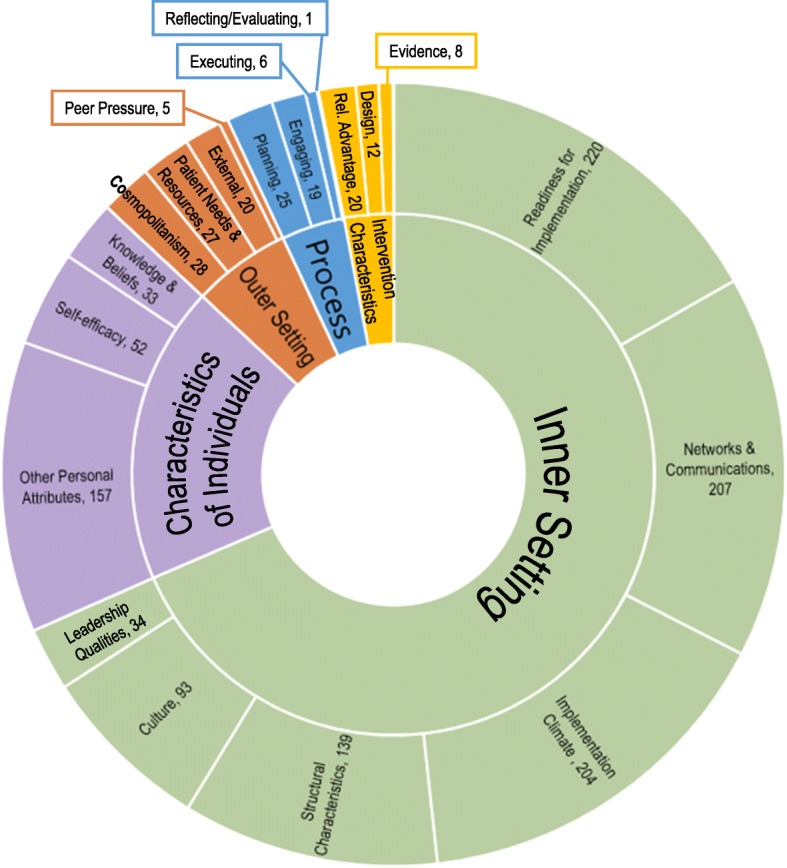
Background: Organizational readiness assessments have a history of being developed as important support tools for successful implementation. However, it remains unclear how best to operationalize readiness across varied projects or settings. We conducted a synthesis and content analysis of published readiness instruments to compare how investigators have operationalized the concept of organizational readiness for change. Methods: We identified readiness assessments using a systematic review and update search. We mapped individual assessment items to the Consolidated Framework for Implementation Research (CFIR), which identifies five domains affecting implementation (outer setting, inner setting, intervention characteristics, characteristics of individuals, and implementation process) and multiple constructs within each domain. Results: Of 1370 survey items, 897 (68%) mapped to the CFIR domain of inner setting, most commonly related to constructs of readiness for implementation (n = 220); networks and communication (n = 207); implementation climate (n = 204); structural characteristics (n = 139); and culture (n = 93). Two hundred forty-two items (18%) mapped to characteristics of individuals (mainly other personal attributes [n = 157] and self-efficacy [n = 52]); 80 (6%) mapped to outer setting; 51 (4%) mapped to implementation process; 40 (3%) mapped to intervention characteristics; and 60 (4%) did not map to CFIR constructs. Instruments were typically tailored to specific interventions or contexts. Discussion: Available readiness instruments predominantly focus on contextual factors within the organization and characteristics of individuals, but the specificity of most assessment items suggests a need to tailor items to the specific scenario in which an assessment is fielded. Readiness assessments must bridge the gap between measuring a theoretical construct and factors of importance to a particular implementation.
Overview
The claims and statistics of this paper haven’t been checked yet.
Free: it reads the open-access text and checks the first 5 claims that cite a source we can check. Create a free account to check every claim.
Integrity signals
Registry
Cites
Statistics
Figures
Verification
Claims the paper makes
The claims and statistics of this paper haven’t been checked yet.
Free: it reads the open-access text and checks the first 5 claims that cite a source we can check. Create a free account to check every claim.
Claims other papers make about this one
Each is checked against this paper’s own text: does it say what the citing paper says it does?
The cited source says what the claim attributes to it.
In the citing paper
“Some users recommended dividing the Inner Setting into multiple levels [52] to account for teams or units [53, 54].”
From The updated consolidated framework for implementation research based on user feedback (2022) · cites this paper as [53]
Self-check
Percentages, sums and reported differences re-computed from the paper’s own numbers.
The self-check needs the paper’s full text.
Citations
Cites
Three Approaches to Qualitative Content Analysis
Hsieh, H.-F., & Shannon, S. E. (2005) · Qualitative Health Research · doi:10.1177/1049732305276687 · Cited by 44,601
PRISMA-P Group, Moher, D., Shamseer, L., Clarke, M., Ghersi, D., Liberati, A., Petticrew, M., Shekelle, P., & Stewart, L. A. (2015) · Systematic Reviews · doi:10.1186/2046-4053-4-1 · Cited by 26,223
Damschroder, L. J., Aron, D. C., Keith, R. E., Kirsh, S. R., Alexander, J. A., & Lowery, J. C. (2009) · Implementation Science · doi:10.1186/1748-5908-4-50 · Cited by 14,496 · cited 6×
“values, and basic assumptions of a given organization” [13] contained 93 items that were never specific to a particular”
BackgroundMethodInfluentialDiffusion of Innovations in Service Organizations: Systematic Review and Recommendations
GREENHALGH, T., ROBERT, G., MACFARLANE, F., BATE, P., & KYRIAKIDOU, O. (2004) · The Milbank Quarterly · doi:10.1111/j.0887-378x.2004.00325.x · Cited by 7,448 · cited 1×
“Background The rapid growth of multi-disciplinary fields, including implementation science, brings along with it the propagation of more terminology [1, 2].”
BackgroundAdvancing a Conceptual Model of Evidence-Based Practice Implementation in Public Service Sectors
Aarons, G. A., Hurlburt, M., & Horwitz, S. M. (2011) · Administration and Policy in Mental Health and Mental Health Services Research · doi:10.1007/s10488-010-0327-7 · Cited by 3,240 · cited 1×
“And while the definition of organizational readiness for change can be either intervention-specific or more general, [7, 14, 44, 45] in developing measures authors chose to be intervention-specific for 23 of the 29 assessment uses we identified.”
BackgroundA theory of organizational readiness for change
Weiner, B. J. (2009) · Implementation Science · doi:10.1186/1748-5908-4-67 · Cited by 2,268
Wandersman, A., Duffy, J., Flaspohler, P., Noonan, R., Lubell, K., Stillman, L., Blachman, M., Dunville, R., & Saul, J. (2008) · American Journal of Community Psychology · doi:10.1007/s10464-008-9174-z · Cited by 1,339 · cited 1×
“And while the definition of organizational readiness for change can be either intervention-specific or more general, [7, 14, 44, 45] in developing measures authors chose to be intervention-specific for 23 of the 29 assessment uses we identified.”
BackgroundAarons, G. A. (2004) · Mental Health Services Research · doi:10.1023/b:mhsr.0000024351.12294.65 · Cited by 1,272
Readiness for Organizational Change: The Systematic Development of a Scale
Holt, D. T., Armenakis, A. A., Feild, H. S., & Harris, S. G. (2007) · The Journal of Applied Behavioral Science · doi:10.1177/0021886306295295 · Cited by 1,243
Interpretation of Educational Measurements
Freeman, F. S., & Kelley, T. L. (1928) · The American Journal of Psychology · doi:10.2307/1414476 · Cited by 877
Assessing organizational readiness for change
Lehman, W. E. K., Greener, J. M., & Simpson, D. D. (2002) · Journal of Substance Abuse Treatment · doi:10.1016/s0740-5472(02)00233-7 · Cited by 863 · cited 4×
“Items in the relatedness subconstruct (n = 15) described communications like “staff share common goals about the care of residents at the beginning of and throughout each shift” [10].”
BackgroundMethodInfluentialOrganizational readiness for implementing change: a psychometric assessment of a new measure
Shea, C. M., Jacobs, S. R., Esserman, D. A., Bruce, K., & Weiner, B. J. (2014) · Implementation Science · doi:10.1186/1748-5908-9-7 · Cited by 856 · cited 3×
“Shea, 2014b [41] Assessment name: Organizational Readiness for Implementing Change (ORIC) Items mapped/items total: 12/12 Setting: Tested in 4 studies Sample: Study 1: 98 students at a university in southeastern U.”
BackgroundChaudoir, S. R., Dugan, A. G., & Barr, C. H. (2013) · Implementation Science · doi:10.1186/1748-5908-8-22 · Cited by 800 · cited 1×
“In the former case, we do not yet have good distinctions between assessing “organizational readiness for change,” “needs,” “barriers and facilitators,” or “factors affecting implementation” [5].”
BackgroundHelfrich, C. D., Li, Y.-F., Sharp, N. D., & Sales, A. E. (2009) · Implementation Science · doi:10.1186/1748-5908-4-38 · Cited by 564
Organizational Change Recipients' Beliefs Scale: Development of an Assessment Instrument
Armenakis, A. A., Bernerth, J. B., Pitts, J. P., & Walker, H. J. (2007) · The Journal of Applied Behavioral Science · doi:10.1177/0021886307303654 · Cited by 386 · cited 2×
“Two assessments were not conducted in healthcare delivery settings [8, 30], but were included by Gagnon’s earlier work and had items that were deemed flexible enough to apply in healthcare delivery settings.”
MethodMelnyk, B. M., Fineout‐Overholt, E., & Mays, M. Z. (2008) · Worldviews on Evidence-Based Nursing · doi:10.1111/j.1741-6787.2008.00126.x · Cited by 378
Designing Effective Organizations: The Sociotechnical Systems Perspective
Muller, G. W., & Pasmore, W. A. (1989) · The Academy of Management Review · doi:10.2307/258183 · Cited by 346
Toward a Comprehensive Definition of Readiness for Change: A Review of Research and Instrumentation
HOLT, D., ARMENAKIS, A., HARRIS, S., & FEILD, H. (2007) · Research in Organizational Change and Development · doi:10.1016/s0897-3016(06)16009-7 · Cited by 255 · cited 2×
“And while the definition of organizational readiness for change can be either intervention-specific or more general, [7, 14, 44, 45] in developing measures authors chose to be intervention-specific for 23 of the 29 assessment uses we identified.”
BackgroundLanham, H. J., McDaniel, R. R., Crabtree, B. F., Miller, W. L., Stange, K. C., Tallia, A. F., & Nutting, P. A. (2009) · The Joint Commission Journal on Quality and Patient Safety · doi:10.1016/s1553-7250(09)35064-3 · Cited by 170 · cited 6×
“Heedfulness is described as interactions “where individuals are sensitive to the task at hand (the job they are doing) and are paying attention to the way their roles and actions fit into (affect) the roles and actions of the entire group” [18].”
BackgroundMethodInfluentialGagnon, M.-P., Attieh, R., Ghandour, E. K., Légaré, F., Ouimet, M., Estabrooks, C. A., & Grimshaw, J. (2014) · PLoS ONE · doi:10.1371/journal.pone.0114338 · Cited by 138 · cited 4×
“The Ready, Set, Change! team included assessments from a 2014 systematic review [6] that met predetermined criteria for validity and reliability.”
BackgroundMethodInfluentialAn Introduction to the Theory of Mental and Social Measurements.
Giddings, F. H., & Thorndike, E. L. (1905) · The Journal of Philosophy, Psychology and Scientific Methods · doi:10.2307/2012040 · Cited by 125
Measurement resources for dissemination and implementation research in health
Rabin, B. A., Lewis, C. C., Norton, W. E., Neta, G., Chambers, D., Tobin, J. N., Brownson, R. C., & Glasgow, R. E. (2015) · Implementation Science · doi:10.1186/s13012-016-0401-y · Cited by 92 · cited 1×
“In the absence of a consensus on a conceptual framework for organizational readiness for change, knowing what needs to be included in such an assessment may remain a challenge [9].”
BackgroundThe Organizational Readiness for Change scale in adolescent programs: Criterion validity
Saldana, L., Chapman, J. E., Henggeler, S. W., & Rowland, M. D. (2007) · Journal of Substance Abuse Treatment · doi:10.1016/j.jsat.2006.12.029 · Cited by 88 · cited 1×
“Saldana, 2007 [23] Assessment name: Organizational Readiness for Change Treatment Staff Version (ORC-S) Items mapped/items total: 124/134 Setting: State mental health and substance abuse treatment sectors Sample: 543 community-based therapists treating substance-abusing youth Type of intervention: N/A Additional data…”
MethodClaiborne, N., Auerbach, C., Lawrence, C., & Schudrich, W. Z. (2013) · Children and Youth Services Review · doi:10.1016/j.childyouth.2013.09.012 · Cited by 86 · cited 2×
“Readiness assessment data were supplemented with additional data collection efforts in 14 uses, which commonly took the form of interviews or other complementary instruments, such as a job satisfaction survey [22].”
BackgroundMethodShaw, R. J., Kaufman, M. A., Bosworth, H. B., Weiner, B. J., Zullig, L. L., Lee, S.-Y. D., Kravetz, J. D., Rakley, S. M., Roumie, C. L., Bowen, M. E., et al. (2013) · Implementation Science · doi:10.1186/1748-5908-8-106 · Cited by 83 · cited 1×
“Shaw, 2013 [39] Assessment name: N/A Items mapped/items total: 22/22 Setting: US Veterans Health Administration Sample: 102 primary care physicians, non-physician providers, nurses, and information technology professionals Type of intervention: evidence-based nurse-delivered selfmanagement phone intervention to facili…”
BackgroundReadiness of healthcare providers for eHealth: the case from primary healthcare centers in Lebanon
Saleh, S., Khodor, R., Alameddine, M., & Baroud, M. (2016) · BMC Health Services Research · doi:10.1186/s12913-016-1896-2 · Cited by 79 · cited 1×
“Saleh, 2016 [24] Assessment name: Adapted Readiness for Organizational Change scale Items mapped/items total: 41/41 Setting: Primary Health Care centers in Lebanon Sample: 213 primary healthcare providers (physicians, nurses, other providers) working in 22 PHC centers Type of intervention: eHealth tools Additional dat…”
BackgroundTimmings, C., Khan, S., Moore, J. E., Marquez, C., Pyka, K., & Straus, S. E. (2016) · BMC Medical Informatics and Decision Making · doi:10.1186/s12911-016-0262-y · Cited by 77 · cited 2×
“In so building on prior work [6, 7, 12, 14], our objective is”
BackgroundProgram Capacity to Eliminate Outcome Disparities in Addiction Health Services
Guerrero, E. G., Aarons, G. A., Grella, C. E., Garner, B. R., Cook, B. L., & Vega, W. A. (2014) · Administration and Policy in Mental Health and Mental Health Services Research · doi:10.1007/s10488-014-0617-6 · Cited by 48
Assessment of organizational readiness fore-health in a rehabilitation centre
Touré, M., Poissant, L., & SWAINE, B. R. (2011) · Disability and Rehabilitation · doi:10.3109/09638288.2011.591885 · Cited by 38 · cited 3×
“Toure, 2012b [42] Assessment name: e-Health Readiness Measure Items mapped/items total: 57/57 Setting: Rehabilitation center in Montreal, Quebec, Canada Sample: 137 clinicians, 28 managers, and 47 nonclinical staff Type of intervention: e-Health Additional data in study: Practice Style Questionnaire”
BackgroundFinley, E. P., Pugh, J. A., Lanham, H. J., Leykum, L. K., Cornell, J. E., Veerapaneni, P., & Parchman, M. L. (2013) · The Annals of Family Medicine · doi:10.1370/afm.1554 · Cited by 36
Self-citationAddicted to constructs: science in reverse?
Larsen, K. R., Voronovich, Z. A., Cook, P. F., & Pedro, L. W. (2013) · Addiction · doi:10.1111/add.12227 · Cited by 33
Rubenstein, L. V., Danz, M., Crain, A. L., Glasgow, R. E., Whitebird, R. R., & Solberg, L. I. (2014) · Implementation Science · doi:10.1186/s13012-014-0173-1 · Cited by 33 · cited 1×
“Rubenstein, 2014 [38] Assessment name: N/A Items mapped/items total: 90/90 Setting: 83 primary care practices in Minnesota Sample: 83 practices Type of intervention: Collaborative care model for improving depression care Additional data in study: Physician Practice Connection Questionnaire (modified to focus on depres…”
MethodThree-Year Pre-Post Analysis of EBP Integration in a Magnet-Designated Community Hospital
Warren, J. I., Montgomery, K. L., & Friedmann, E. (2016) · Worldviews on Evidence-Based Nursing · doi:10.1111/wvn.12148 · Cited by 33 · cited 2×
“Warren, 2016 [27] Assessment name: Evidence-Based Practices (EBP) Beliefs scale Items mapped/items total: 16/16 Setting: 380-bed community teaching hospital and ambulatory care center (located in Maryland and part of a 10-hospital healthcare system) Sample: All RNs from the hospital (337 in 2008 and 342 in 2012) Type…”
MethodTrust and Reflection in Primary Care Practice Redesign
Lanham, H. J., Palmer, R. F., Leykum, L. K., McDaniel, R. R., Nutting, P. A., Stange, K. C., Crabtree, B. F., Miller, W. L., & Jaén, C. R. (2015) · Health Services Research · doi:10.1111/1475-6773.12415 · Cited by 32
Cherry, B. (2011) · Journal of Gerontological Nursing · doi:10.3928/00989134-20110831-06 · Cited by 32 · cited 1×
“Cherry, 2011 [32] Assessment name: LTC Readiness Assessment Tool for EHR Implementation Items mapped/items total: 20/21 Setting: Long Term Care facilities in Texas Sample: 93 administrators Type of intervention: Electronic Health Record Additional data in study: None”
BackgroundShea, C. M., Reiter, K. L., Weaver, M. A., McIntyre, M., Mose, J. N., Thornhill, J., Malone, R., & Weiner, B. J. (2014) · BMC Medical Informatics and Decision Making · doi:10.1186/s12911-014-0119-1 · Cited by 30 · cited 2×
“, “how confident are you that most physicians can use e-prescribing instead of handwritten or printed prescriptions?” [40]).”
BackgroundBobiak, S. N., Zyzanski, S. J., Ruhe, M. C., Carter, C. A., Ragan, B. G., Flocke, S. A., Litaker, D. G., & Stange, K. C. (2009) · Quality Management in Health Care · doi:10.1097/qmh.0b013e3181bee2f5 · Cited by 28 · cited 3×
“Bobiak, 2009 [31] Assessment name: Measuring Practice Capacity for Change (MPCC) Items mapped/items total: 25/25 Setting: 3 health care systems in northeast Ohio Sample: 15 Primary Care Practices Type of intervention: EPOCHS (Enhancing Practice Outcomes through Communities and Health Systems) study, an ongoing group-r…”
BackgroundPositioning for partnerships: Assessing public health agency readiness
Nelson, J. C., Raskind-Hood, C., Galvin, V. G., Essien, J. D., & Levine, L. M. (1999) · American Journal of Preventive Medicine · doi:10.1016/s0749-3797(99)00003-3 · Cited by 27 · cited 1×
“Nelson, 1999 [36] Assessment name: Proactive Organizational Change: Assessing Critical Success Factors Items mapped/items total: 53/56 Setting: County Boards of Health Sample: 122 health board employees Type of intervention: Entering strategic partnership with non-profit hospital network Additional data in study: None”
BackgroundBuilding a Unit-Level Mentored Program to Sustain a Culture of Inquiry for Evidence-Based Practice
Breckenridge‐Sproat, S. T., Throop, M. D., Raju, D. A., Murphy, D. A., Loan, L. A., & Patrician, P. A. (2015) · Clinical Nurse Specialist · doi:10.1097/nur.0000000000000161 · Cited by 27 · cited 2×
“Breckenridge-Sproat, 2015 [26] Assessment name: Evidence-Based Practices (EBP) Beliefs scale Items mapped/items total: 16/16 Setting: Three military hospitals undergoing facility and staff integration Sample: 360 staff nurses on inpatient nursing units Miake-Lye et al.”
BackgroundMethodGibb, H. (2012) · Journal of Nursing Management · doi:10.1111/j.1365-2834.2012.01407.x · Cited by 26 · cited 3×
“Other variations included “Practice Capacity for Change,” [31] “Preparedness for Change,” [34] and “Readiness to Engage in EBP.”
BackgroundDemiris, G., Courtney, K. L., & Meyer, W. (2007) · Journal of Innovation in Health Informatics · doi:10.14236/jhi.v15i1.643 · Cited by 16 · cited 1×
“Demiris, 2007 [33] Assessment name: N/A Items mapped/items total: 20/22 Setting: Critical Access Hospitals in Missouri Sample: 27 administrators Type of intervention: Information and communication technology Additional data in study: None”
BackgroundGray, C. S., Wilkinson, A. J., Alvaro, C., Wilkinson, K., & Harvey, M. (2015) · HERD Health Environments Research & Design Journal · doi:10.1177/1937586715593552 · Cited by 16
Cancer Registration Needs Assessment at a Tertiary Medical Centre in Kilimanjaro, Tanzania
Zullig, L. L., Muiruri, C., Abernethy, A. P., Weiner, B. J., Bartlett, J. A., Oneko, O., & Zafar, S. Y. (2013) · World health & population · doi:10.12927/whp.2013.23271 · Cited by 12 · cited 1×
“Zullig, 2013 [43] Assessment name: N/A Items mapped/items total: 17/17 Setting: Academic hospital in Moshi, Tanzania Sample: 52 clinicians, nurses and administrators Type of intervention: Cancer registries Additional data in study: None Miake-Lye et al.”
BackgroundThorndike, E. L. (1913) · Teachers College Press eBooks · doi:10.1037/10866-000 · Cited by 12
Bohman, T. M., Kulkarni, S. J., Waters, V., Spence, R. T., Smith, M. M., & McQueen, K. (2008) · Journal of Addiction Medicine · doi:10.1097/adm.0b013e3181800ae5 · Cited by 11 · cited 2×
“, “my unit needs guidance in developing services to address alcohol and drug behaviors presented by our patients” [21]), or descriptions of pressures for changes.”
Background(1998) · doi:10.1002/(sici)1099-1379(199805)19:3<235::aid-job837>3.0.co;2-c · cited 3×
“The Trust sub-construct, or the “willingness of an individual to be vulnerable to another individual” [18], contained 16 items, like “to what extent do you feel at ease with the members of your team?” [29].”
Background
Research works printed but not linked: 1
- Helfrich CD, Hannon PA, Harris JR, Kohn MJ, Hammerback K, Parrish AT, et al. Does readiness-to-change change readiness to implement wellness practices among work sites participating in a site-randomized implementation trial? Poster presentation at the 10th annual conference on the science of dissemination and implementation in health. Arlington; 2017.
Cited by
The updated consolidated framework for implementation research based on user feedback
Damschroder, L. J., Reardon, C. M., Widerquist, M. A. O., & Lowery, J. (2022) · Implementation Science · doi:10.1186/s13012-022-01245-0 · Cited by 4,452
“Domain level Some users recommended dividing the Inner Setting into multiple levels [52] to account for teams or units [53, 54].”
BackgroundDamschroder, L. J., Reardon, C. M., Opra Widerquist, M. A., & Lowery, J. (2022) · Implementation Science · doi:10.1186/s13012-021-01181-5 · Cited by 784
An artificial intelligence (AI)-readiness and adoption framework for AgriTech firms
Issa, H., Jabbouri, R., & Palmer, M. (2022) · Technological Forecasting and Social Change · doi:10.1016/j.techfore.2022.121874 · Cited by 165
Enhancing trust in AI through industry self-governance.
Roski, J., Maier, E. J., Vigilante, K., Kane, E. A., & Matheny, M. E. (2021) · Journal of the American Medical Informatics Association · doi:10.1093/jamia/ocab065 · Cited by 83
Kalbarczyk, A., Rodríguez, D., Mahendradhata, Y., Sarker, M., Seme, A., Majumdar, P., Akinyemi, O. O., Kayembe, P. K., & Alonge, O. (2020) · Health Policy and Planning · doi:10.1093/heapol/czaa188 · Cited by 67
“Three additional themes describing institutional drivers for con- ducting KT that cut across the CFIR domains emerged from the data: (1) soft-skills and the policy making process, (2) misalignment between institutional missions and incentives and (3) the role of in- ternal and external networks.”
BackgroundInfluential
Metadata
- Authors
- Miake-Lye, I. M., Delevan, D. M., Ganz, D. A., Mittman, B. S., & Finley, E. P.
- Affiliations
- University of California, Los Angeles (US)
- VA Greater Los Angeles Healthcare System (US)
- Kaiser Permanente (US)
- The University of Texas at San Antonio Health Science Center (US)
- Corresponding author
- Miake-Lye, Isomi M.
- Venue
- BMC Health Services Research
- Published
- 2020-02-11
- Volume
- 20
- Issue
- 1
- Pages
- 106-106
- ISSN
- 1472-6963 (ISSN-L)
- PMC
- PMC7014613
- OpenAlex
- W3008480173
- Semantic Scholar
- 7a4d19b5d33628b6c6ca988aea7e279110db3d84
- Cited by
- 170
- References
- 47
- Citations by year
- 2026: 23 · 2025: 33 · 2024: 31 · 2023: 21 · 2022: 40 · 2021: 15 · 2020: 7
- FWCI
- 3.94
- Type
- journal article
- Language
- en
- Open access
- gold
- doi.org
- Licence
- cc-by
- creativecommons.org/licenses/by/4.0/ (tdm)
- creativecommons.org/licenses/by/4.0/ (vor)
- Locations
- BMC Health Services Research (publishedVersion, cc-by)
- Europe PMC (PubMed Central) (publishedVersion, cc-by)
- PubMed Central (publishedVersion, cc-by)
- PubMed (publishedVersion)
- DOAJ (DOAJ: Directory of Open Access Journals) (submittedVersion, cc-by-sa)
- eScholarship (California Digital Library) (submittedVersion)
- eScholarship (California Digital Library) (submittedVersion, cc-by)
- Funders
- VA Quality Enhancement Research Initiative (QUE 15-276)
- Topics
- Health Sciences › Health Professions › General Health Professions › Health Policy Implementation Science
- Social Sciences › Business, Management and Accounting › Organizational Behavior and Human Resource Management › Organizational Change and Leadership
- Health Sciences › Health Professions › General Health Professions › Health Sciences Research and Education
- Keywords
- organizational preparedness, readiness assessment, Consolidated Framework for Implementation Research, inner setting, implementation climate, self-efficacy, organizational culture, implementation process, intervention characteristics, construct operationalization
- MeSH terms
- Humans, Organizational Innovation, Organizations, Surveys and Questionnaires, Randomized Controlled Trials as Topic
About these checks
Registry, retraction, Cites and statistics results are computed, not judged, with one exception: a printed reference that no index lists is read once by a model before it counts as a citation error. Claims are extracted by a model and kept only when their quote appears verbatim in the text; each cited source is then checked, with a model’s help, for whether it says what the claim relies on. Those verdicts can be wrong — read the claim’s quote and the cited source before relying on one.
Statistics and arithmetic are recomputed, not judged.
Confidence bands are shown only for fields calibrated on our annotated test set. None is calibrated yet, so no band is shown.
What counts as a claim ›How we measure confidence ›How we check this ›
Are you an author, or do you see a problem with this page? Request a review
Data sources
Bibliographic data: Semantic Scholar, OpenAlex, Crossref.
Contains information from the Semantic Scholar Academic Graph Datasets, made available under the ODC Attribution License (ODC-BY 1.0).
Semantic Scholar’s data is described in: Kinney, R., et al. (2023). The Semantic Scholar Open Data Platform. arXiv:2301.10140.
