

Unpacking organizational readiness for change: an updated systematic review and content analysis of assessments
Open accessThe DOI matches its Crossref record; 46 of the 47 references it cites were found in a registry or an index.
Abstract
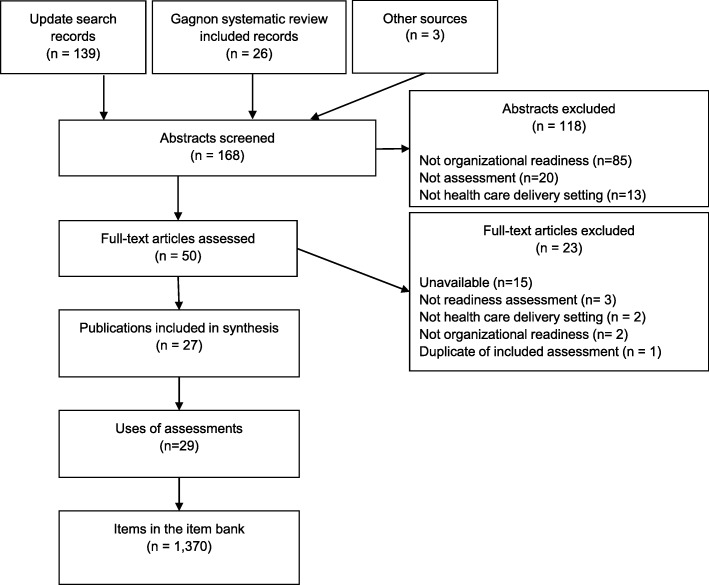
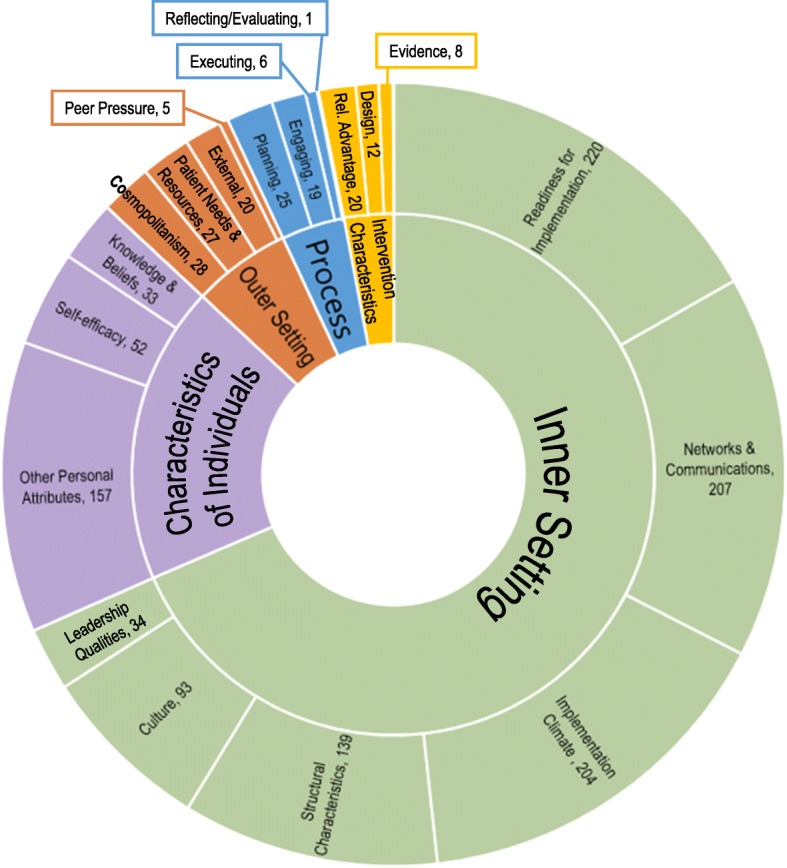
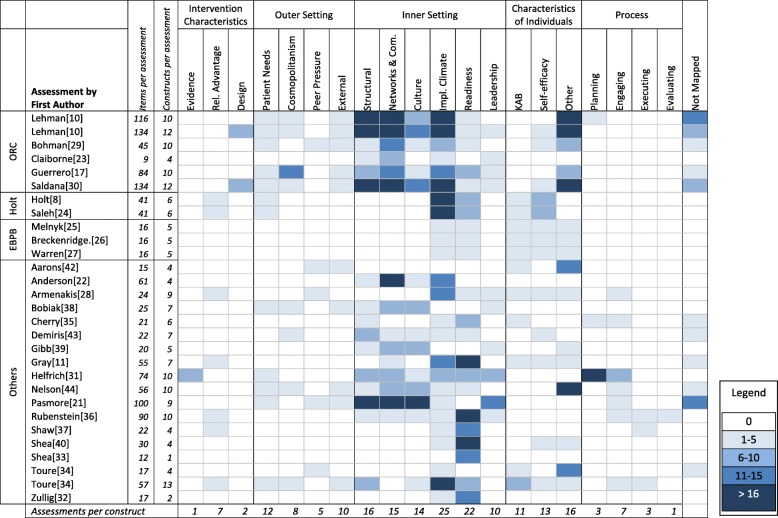
Background: Organizational readiness assessments have a history of being developed as important support tools for successful implementation. However, it remains unclear how best to operationalize readiness across varied projects or settings. We conducted a synthesis and content analysis of published readiness instruments to compare how investigators have operationalized the concept of organizational readiness for change. Methods: We identified readiness assessments using a systematic review and update search. We mapped individual assessment items to the Consolidated Framework for Implementation Research (CFIR), which identifies five domains affecting implementation (outer setting, inner setting, intervention characteristics, characteristics of individuals, and implementation process) and multiple constructs within each domain. Results: Of 1370 survey items, 897 (68%) mapped to the CFIR domain of inner setting, most commonly related to constructs of readiness for implementation (n = 220); networks and communication (n = 207); implementation climate (n = 204); structural characteristics (n = 139); and culture (n = 93). Two hundred forty-two items (18%) mapped to characteristics of individuals (mainly other personal attributes [n = 157] and self-efficacy [n = 52]); 80 (6%) mapped to outer setting; 51 (4%) mapped to implementation process; 40 (3%) mapped to intervention characteristics; and 60 (4%) did not map to CFIR constructs. Instruments were typically tailored to specific interventions or contexts. Discussion: Available readiness instruments predominantly focus on contextual factors within the organization and characteristics of individuals, but the specificity of most assessment items suggests a need to tailor items to the specific scenario in which an assessment is fielded. Readiness assessments must bridge the gap between measuring a theoretical construct and factors of importance to a particular implementation.
Overview
The claims and statistics of this paper haven’t been checked yet.
Free: it reads the open-access text and checks the first 5 claims that cite a source we can check. Create a free account to check every claim.
Integrity signals
Registry
Cites
Statistics
Figures
Verification
Claims the paper makes
The claims and statistics of this paper haven’t been checked yet.
Free: it reads the open-access text and checks the first 5 claims that cite a source we can check. Create a free account to check every claim.
Claims other papers make about this one
Each is checked against this paper’s own text: does it say what the citing paper says it does?
The cited source says what the claim attributes to it.
In the citing paper
“Some users recommended dividing the Inner Setting into multiple levels [52] to account for teams or units [53, 54].”
From The updated consolidated framework for implementation research based on user feedback (2022) · cites this paper as [53]
Self-check
Percentages, sums and reported differences re-computed from the paper’s own numbers.
The self-check needs the paper’s full text.
Citations
Cites
Three Approaches to Qualitative Content Analysis
Hsieh, H.-F., & Shannon, S. E. (2005) · Qualitative Health Research · doi:10.1177/1049732305276687 · Cited by 44,601
PRISMA-P Group, Moher, D., Shamseer, L., Clarke, M., Ghersi, D., Liberati, A., Petticrew, M., Shekelle, P., & Stewart, L. A. (2015) · Systematic Reviews · doi:10.1186/2046-4053-4-1 · Cited by 26,223
Damschroder, L. J., Aron, D. C., Keith, R. E., Kirsh, S. R., Alexander, J. A., & Lowery, J. C. (2009) · Implementation Science · doi:10.1186/1748-5908-4-50 · Cited by 14,496 · cited 6×
“values, and basic assumptions of a given organization” [13] contained 93 items that were never specific to a particular”
BackgroundMethodInfluentialDiffusion of Innovations in Service Organizations: Systematic Review and Recommendations
GREENHALGH, T., ROBERT, G., MACFARLANE, F., BATE, P., & KYRIAKIDOU, O. (2004) · The Milbank Quarterly · doi:10.1111/j.0887-378x.2004.00325.x · Cited by 7,448 · cited 1×
“Background The rapid growth of multi-disciplinary fields, including implementation science, brings along with it the propagation of more terminology [1, 2].”
BackgroundAdvancing a Conceptual Model of Evidence-Based Practice Implementation in Public Service Sectors
Aarons, G. A., Hurlburt, M., & Horwitz, S. M. (2011) · Administration and Policy in Mental Health and Mental Health Services Research · doi:10.1007/s10488-010-0327-7 · Cited by 3,240 · cited 1×
“And while the definition of organizational readiness for change can be either intervention-specific or more general, [7, 14, 44, 45] in developing measures authors chose to be intervention-specific for 23 of the 29 assessment uses we identified.”
BackgroundA theory of organizational readiness for change
Weiner, B. J. (2009) · Implementation Science · doi:10.1186/1748-5908-4-67 · Cited by 2,268
Wandersman, A., Duffy, J., Flaspohler, P., Noonan, R., Lubell, K., Stillman, L., Blachman, M., Dunville, R., & Saul, J. (2008) · American Journal of Community Psychology · doi:10.1007/s10464-008-9174-z · Cited by 1,339 · cited 1×
“And while the definition of organizational readiness for change can be either intervention-specific or more general, [7, 14, 44, 45] in developing measures authors chose to be intervention-specific for 23 of the 29 assessment uses we identified.”
BackgroundAarons, G. A. (2004) · Mental Health Services Research · doi:10.1023/b:mhsr.0000024351.12294.65 · Cited by 1,272
Readiness for Organizational Change: The Systematic Development of a Scale
Holt, D. T., Armenakis, A. A., Feild, H. S., & Harris, S. G. (2007) · The Journal of Applied Behavioral Science · doi:10.1177/0021886306295295 · Cited by 1,243
Interpretation of Educational Measurements
Freeman, F. S., & Kelley, T. L. (1928) · The American Journal of Psychology · doi:10.2307/1414476 · Cited by 877
Research works printed but not linked: 1
- Helfrich CD, Hannon PA, Harris JR, Kohn MJ, Hammerback K, Parrish AT, et al. Does readiness-to-change change readiness to implement wellness practices among work sites participating in a site-randomized implementation trial? Poster presentation at the 10th annual conference on the science of dissemination and implementation in health. Arlington; 2017.
Cited by
The updated consolidated framework for implementation research based on user feedback
Damschroder, L. J., Reardon, C. M., Widerquist, M. A. O., & Lowery, J. (2022) · Implementation Science · doi:10.1186/s13012-022-01245-0 · Cited by 4,452
“Domain level Some users recommended dividing the Inner Setting into multiple levels [52] to account for teams or units [53, 54].”
BackgroundDamschroder, L. J., Reardon, C. M., Opra Widerquist, M. A., & Lowery, J. (2022) · Implementation Science · doi:10.1186/s13012-021-01181-5 · Cited by 784
An artificial intelligence (AI)-readiness and adoption framework for AgriTech firms
Issa, H., Jabbouri, R., & Palmer, M. (2022) · Technological Forecasting and Social Change · doi:10.1016/j.techfore.2022.121874 · Cited by 165
Enhancing trust in AI through industry self-governance.
Roski, J., Maier, E. J., Vigilante, K., Kane, E. A., & Matheny, M. E. (2021) · Journal of the American Medical Informatics Association · doi:10.1093/jamia/ocab065 · Cited by 83
Kalbarczyk, A., Rodríguez, D., Mahendradhata, Y., Sarker, M., Seme, A., Majumdar, P., Akinyemi, O. O., Kayembe, P. K., & Alonge, O. (2020) · Health Policy and Planning · doi:10.1093/heapol/czaa188 · Cited by 67
“Three additional themes describing institutional drivers for con- ducting KT that cut across the CFIR domains emerged from the data: (1) soft-skills and the policy making process, (2) misalignment between institutional missions and incentives and (3) the role of in- ternal and external networks.”
BackgroundInfluentialWeiner, B. J., Mettert, K. D., Dorsey, C. N., Nolen, E. A., Stanick, C., Powell, B. J., & Lewis, C. C. (2020) · Implementation Research and Practice · doi:10.1177/2633489520933896 · Cited by 58
“A just-published review of organizational readiness for change measures used in health care reported similar findings (Miake-Lye et al., 2020).”
ResultHossain, M. K., Srivastava, A., Oliver, G., Islam, M. E., Jahan, N. A., Karim, R., Kanij, T., & Mahdi, T. H. (2024) · Business Process Management Journal · doi:10.1108/bpmj-11-2023-0914 · Cited by 76
Organizational readiness for change: A systematic review of the healthcare literature
Caci, L., Nyantakyi, E., Blum, K., Sonpar, A., Schultes, M.-T., Albers, B., & Clack, L. (2025) · Implementation Research and Practice · doi:10.1177/26334895251334536 · Cited by 95
“In a systematic review, Miake-Lye et al. (2020) identi fi ed 29 measures used for ORC assessments in health care.”
InfluentialRelation between Organizational Capacity for Change and Readiness for Change
Mladenova, I. (2022) · Administrative Sciences · doi:10.3390/admsci12040135 · Cited by 86
Issues and Implications of Readiness to Change
Alolabi, Y. A., Ayupp, K., & Dwaikat, M. A. (2021) · Administrative Sciences · doi:10.3390/admsci11040140 · Cited by 82
“Some leaders have charismatic traits that determine the extent to which they influence, mentor, and encourage their followers by inspiring them regarding the need for personal development and organizational development (Miake-Lye et al. 2020).”
BackgroundWalker, T. J., Brandt, H. M., Wandersman, A., Scaccia, J., Lamont, A. E., Workman, L. M., Dias, E., Diamond, P. M., Craig, D. W., & Fernández, M. E. (2020) · Implementation Science Communications · doi:10.1186/s43058-020-00088-4 · Cited by 53
“First, many readiness measures lack rigorous validation approaches [3, 33, 34].”
Lewis, C. C., Mettert, K., & Lyon, A. R. (2021) · Implementation Research and Practice · doi:10.1177/2633489521994197 · Cited by 38
“Of the 15 systemic reviews of implementation measures (J. D. Allen et al., 2017; Miake-Lye et al., 2020; Rabin et al., 2016; Willmeroth et al., 2019), only two explored measures of intervention/innovation characteristics (Chaudoir et al., identified measures of intervention characteristics, but…”
BackgroundChapman, A., Rankin, N. M., Jongebloed, H., Yoong, S. L., White, V., Livingston, P. M., Hutchinson, A. M., & Ugalde, A. (2023) · Systematic Reviews · doi:10.1186/s13643-023-02285-3 · Cited by 36
Assessing Organizational Readiness to Change through a Framework Applied to Hospitals
Gabutti, I., Colizzi, C., & Sanna, T. (2022) · Public Organization Review · doi:10.1007/s11115-022-00628-7 · Cited by 36
Cui, W., Liu, M. J., & Yuan, R. (2025) · Journal of Advertising Research · doi:10.1080/00218499.2024.2445362 · Cited by 63
McNett, M., Tucker, S., Zadvinskis, I. M., Tolles, D., Thomas, B. K., Gorsuch, P., & Gallagher‐Ford, L. (2022) · Global Implementation Research and Applications · doi:10.1007/s43477-022-00051-6 · Cited by 39
“Facilitators and barriers of the inner setting domain of the CFIR exert the most significant influence on EBP implementation, similar to results from a 2020 systematic review (Miake-Lye et al., 2020).”
ResultKononowech, J., Hagedorn, H., Hall, C., Helfrich, C. D., Lambert‐Kerzner, A., Miller, S. C., Sales, A. E., & Damschroder, L. J. (2021) · Implementation Science Communications · doi:10.1186/s43058-021-00121-0 · Cited by 37
Howell, D., Powis, M., Kirkby, R. L., Amernic, H., Moody, L., Bryant‐Lukosius, D., O’Brien, M. A., Rask, S., & Krzyzanowska, M. K. (2021) · BMJ Quality & Safety · doi:10.1136/bmjqs-2020-012051 · Cited by 42
Madrigal, L., Manders, O. C., Kegler, M. C., Haardörfer, R., Piper, S., Blais, L. M., Weber, M. B., & Escoffery, C. (2022) · Implementation Science Communications · doi:10.1186/s43058-022-00350-x · Cited by 34
“Measuring CFIR constructs quantitatively is a growing area that has great potential to assist with understanding the relationship between implementation factors and outcomes [46, 47].”
BackgroundBinSaeed, R. H., Grigorescu, A., Yousaf, Z., Condreа, E., & Nassani, A. A. (2023) · Systems · doi:10.3390/systems11060284 · Cited by 41
“The readiness of an organization is the changes in the key driving strength to modify the old-style processes in the corporate atmosphere [33].”
BackgroundKrahe, M. A., Baker, S., Woods, L., & Larkins, S. (2025) · Australian Journal of Rural Health · doi:10.1111/ajr.70045 · Cited by 35
“…particular ‘structural characteristics’ (i.e., size, type, staff, location) and ‘culture’ (i.e., values, beliefs, norms) reflect enduring and intrinsic aspects of the inner setting, while ‘compatibility’ is a dynamic construct directly related to the implementation of specific innovations [36–38].”
The Mechanisms of Implementation Support - Findings from a Systematic Integrative Review
Albers, B., Metz, A. J. R., Burke, K., Bührmann, L., Bartley, L., Driessen, P., & Varsi, C. (2021) · Research on Social Work Practice · doi:10.1177/10497315211042375 · Cited by 41
Allen, C. G., Cotter, M. M., Smith, R. A., & Watson, L. A. (2020) · Translational Behavioral Medicine · doi:10.1093/tbm/ibaa121 · Cited by 32
“, readiness for implementation, implementation climate, networks, and communication) and characteristics of individuals [37].”
BackgroundTowards the Achievement of Frugal Innovation: Exploring Major Antecedents among SMEs
Nassani, A. A., Sinisi, C. I., MIHAI, D. M., Pãunescu, L. M., Yousaf, Z., & Haffar, M. (2022) · Sustainability · doi:10.3390/su14074120 · Cited by 34
“Organizational readiness recognizes that organizations depend on existing resources and conditions to implement change and new projects [18].”
BackgroundHoutven, C. H. V., Drake, C., Malo, T. L., Decosimo, K. P., Tucker, M., Sullivan, C., Dadolf, J., Hughes, J. M., Christensen, L., Grubber, J. M., et al. (2023) · Implementation Science Communications · doi:10.1186/s43058-023-00447-x · Cited by 37
“Based on a 2020 systematic review, organizational readiness assessments [28, 44] have typically collected responses at the collective level of a team; however, we approached a centralized contact as a representative.”
BackgroundLeslie, H. H., West, R. L., Twine, R., Masilela, N., Steward, W. T., Kahn, K., & Lippman, S. A. (2020) · International Journal of Health Policy and Management · doi:10.34172/ijhpm.2020.223 · Cited by 30
“14,16 A brief measure of Organizational Readiness to Implement Change (ORIC), which contains two sub-scales that are tailored to assess commitment and efficacy related to implementation of a specific program, was developed in the United States and validated as a sensitive measure of organizational…”
Success Factors Affecting the Intention to Use Business Analytics: An Empirical Study
Min, H., Joo, H.-Y., & Choi, S. (2021) · Journal of Business Analytics · doi:10.1080/2573234x.2021.1943017 · Cited by 23
“When organisational readiness for change is high, organisational members are more likely to initiate change, exert greater effort, exhibit greater persistence, and display more cooperative behaviour (Miake-Lye et al., 2020; Weiner, 2009).”
BackgroundExploring the intersection of hermeneutics and implementation: a scoping review
MacLeod, M., McCaffrey, G., Wilson, E., Zimmer, L. V., Snadden, D., Zimmer, P., Jónatansdóttir, S., Fyfe, T., Koopmans, E., Ulrich, C., et al. (2023) · Systematic Reviews · doi:10.1186/s13643-023-02176-7 · Cited by 37
“Addressing the big issues: preparing the ground for implementing Many theories, models, and frameworks include preimplementation planning, a pre-implementation phase, or assessment of organizational readiness [56, 60, 61].”
BackgroundSerious Illness Care Programme—contextual factors and implementation strategies: a qualitative study
Paladino, J., Sanders, J. J., Kilpatrick, L., Prabhakar, R., Kumar, P. P., O’Connor, N. R., Durieux, B. N., Fromme, E. K., Benjamin, E. M., & Mitchell, S. E. (2022) · BMJ Supportive & Palliative Care · doi:10.1136/bmjspcare-2021-003401 · Cited by 23
“34 35 Future research can formally assess institutional context and culture related to serious illness communication to help teams identify programme fit and implementation readiness, inform programme improvements, adaptations and implementation strategies, and/or target specialties within which…”
BackgroundHayirli, T. C., Meara, J. G., Barash, D. M., Chirangi, B., Hellar, A. M., Kenemo, B., Kissima, I., Maongezi, S., Reynolds, C., Samky, H., et al. (2021) · International Journal of Surgery · doi:10.1016/j.ijsu.2021.105944 · Cited by 17
“Two recently published and very comprehensive systematic reviews assessing organizational readiness instruments proved most helpful in identifying domains and existing questionnaire items [18,24].”
BackgroundResnick, B. M., Zimmerman, S. I., Gaugler, J. E., Ouslander, J. G., Abrahamson, K. A., Brandt, N., Colon-Emeric, C. S., Galik, E. M., Gravenstein, S., Mody, L., et al. (2022) · Journal of the American Medical Directors Association · doi:10.1016/j.jamda.2021.12.011 · Cited by 15
Tal, E., Paul, R. A., Dorsey, M., & Madden, T. E. (2022) · Women s Health Issues · doi:10.1016/j.whi.2022.10.001 · Cited by 15
Soloe, C. S., Arena, L. C., Schlueter, D., Melillo, S. N., DeGroff, A. S., Tangka, F. K. L., Hoover, S., & Subramanian, S. (2022) · Implementation Science Communications · doi:10.1186/s43058-022-00347-6 · Cited by 15
Bast, L. S., Andersen, H. B., Andersen, A., Lauemøller, S. G., Bonnesen, C. T., & Krølner, R. F. (2021) · Prevention Science · doi:10.1007/s11121-020-01197-1 · Cited by 21
Quach, E. D., Kazis, L. E., Zhao, S., Ni, P., Clark, V. A., McDannold, S. E., & Hartmann, C. W. (2021) · BMC Health Services Research · doi:10.1186/s12913-021-06772-y · Cited by 21
“Psychological readiness comprises openness to change among frontline staff and managers and behavioral readiness to system resources, with readiness linked to adoption of change [10].”
BackgroundSubramanian, S., Tangka, F. K. L., Hoover, S., & DeGroff, A. S. (2022) · Implementation Science Communications · doi:10.1186/s43058-022-00353-8 · Cited by 15
“(1) Understand patient preferences for integrated screenings to ensure that individuals eligible for screening are comfortable discussing or receiving information for multiple cancer screenings simultaneously; [42, 43] (2) Explore provider attitudes and capacity to deliver messaging related to multiple cancers and ini…”
BackgroundCo-creating physical activity interventions: Findings from a multiple case study using mixed methods
Popp, J., Grüne, E., Carl, J., Semrau, J., & Pfeifer, K. (2022) · Frontiers in Public Health · doi:10.3389/fpubh.2022.975638 · Cited by 17
“(58) has shown that this organizational readiness assessment covers mainly the construct “readiness for implementation” as it is used in the Consolidated Framework for Implementation Research (CFIR; domain “inner setting”) (49).”
BackgroundMethodBriggs, S. M., Lipoff, J. B., & Collier, S. M. (2022) · JMIR Dermatology · doi:10.2196/33833 · Cited by 11
“When implementing novel health care technologies (including teledermatology technologies), organizational factors, such as organizational readiness for change, are important determinants of implementation success [16].”
BackgroundEditorial: The theory and pragmatics of power and relationships in implementation
Finley, E. P., Closser, S., Sarker, M., & Hamilton, A. B. (2023) · Frontiers in Health Services · doi:10.3389/frhs.2023.1168559 · Cited by 13
Self-citationFinley, E. P., Chrystal, J. G., Gable, A. R., Fletcher, E. H., Palma, A., Canelo, I. A., Oberman, R. S., Jackson, L., Lesser, R., Moin, T., et al. (2024) · Implementation Science Communications · doi:10.1186/s43058-024-00605-9 · Cited by 15
Self-citationBinSaeed, R. H., Grigorescu, A., Yousaf, Z., Radu, F., Nassani, A. A., & Tăbîrcă, A. I. (2023) · Sustainability · doi:10.3390/su151310090 · Cited by 17
Love, P., Laws, R., Taki, S., West, M. L., Hesketh, K. D., & Campbell, K. J. (2022) · Frontiers in Health Services · doi:10.3389/frhs.2022.1031628 · Cited by 10
“(66) mapped organizational readiness assessment instruments to the CFIR, and identified “readiness to implementation” as the most commonly reported construct.”
BackgroundKim, E., Boutain, D. M., Lim, S., Parker, S., Wang, D., Nofziger, R. M., & Weiner, B. J. (2022) · Journal of Advanced Nursing · doi:10.1111/jan.15276 · Cited by 9
Baidoo, D. K., & Nwagwu, W. E. (2024) · Library Management · doi:10.1108/lm-12-2023-0132 · Cited by 12
Ranjan, P., Usher, E. M., Bates, H. T., Zimmerman, E. K., Tyndall, J., Morris, C. J., Koontz, T. M., & Prokopy, L. S. (2022) · Journal of Hydrology · doi:10.1016/j.jhydrol.2022.127584 · Cited by 9
Mah, S., Teare, G. F., Law, J., & Adhikari, K. (2024) · BMC Health Services Research · doi:10.1186/s12913-024-10676-y · Cited by 10
“Utilizing a CFIR based readiness assessment provides a systems approach to assessing contextual factors of readiness [65, 66] compared to individual perceptions approach [67].”
BackgroundMethodInfluentialGoebel, M. C., Trautner, B. W., Wang, Y., Van, J. N., Dillon, L. M., Patel, P., Drekonja, D. M., Graber, C. J., Shukla, B. S., Lichtenberger, P., et al. (2020) · American Journal of Infection Control · doi:10.1016/j.ajic.2020.04.024 · Cited by 8
The ELIAS framework: A prescription for innovation and change
Persaud, D. D., & Murphy, M. (2020) · Healthcare Management Forum · doi:10.1177/0840470420950361 · Cited by 10
“Solutions represent a congruence between the resources of the organization; the organization’s culture; its strategic direction, and the criteria for success set out by stakeholders involved in solution generation.(23,29,31,32,35) Solutions must also demonstrate practice-based evidence Strategy”
BackgroundNguyen, X.-A., Luong, D., Le, T.-P.-T., Hoang, T.-D., & Tran, T.-G. (2022) · Asian Research Journal of Arts & Social Sciences · doi:10.9734/arjass/2022/v18i330351 · Cited by 12
“This research approach is based on Weiner's theory of ORC [30], which is established by focusing on the characteristics of each individual within an organisation [31].”
MethodRawal, S., Snead, C. A., Soiro, F. D., Lawrence, J., Rivers, B. M., & Young, H. N. (2025) · The Journal of Rural Health · doi:10.1111/jrh.12888 · Cited by 7
“43 “Compatibility” was evident with the alignment of DPP with churches’ mission to address community needs and improve health outcomes.”
Haavik, T. K., Kongsvik, T., & Vigen, M. G. (2023) · Journal of Risk Research · doi:10.1080/13669877.2023.2270663 · Cited by 9
“If previous changes are considered unnecessary, and the organization is considered not to have the necessary capacity to implement the change, the readiness for new changes is low (Miake-lye et al. 2020).”
BackgroundMoss, J. L., Stoltzfus, K. C., Popalis, M. L., Calo, W. A., & Kraschnewski, J. L. (2023) · BMC Health Services Research · doi:10.1186/s12913-022-08976-2 · Cited by 9
Boltz, M. P., Haitsma, K. S. V., Baier, R. R., Sefcik, J. S., Hodgson, N. A., Jao, Y., & Kolanowski, A. M. (2024) · Research in Gerontological Nursing · doi:10.3928/19404921-20240403-02 · Cited by 8
Connelly, D. M., Hay, M. E., Garnett, A., Hung, L., Yous, M., Furlan-Craievich, C., Snelgrove, S., Babcock, M., Ripley, J., Snobelen, N., et al. (2022) · The Gerontologist · doi:10.1093/geront/gnac154 · Cited by 9
Allen, B., & Urmanche, A. A. (2023) · Evaluation and Program Planning · doi:10.1016/j.evalprogplan.2023.102275 · Cited by 7
Czemiel-Grzybowska, W., Bąkowski, M., & Forfa, M. (2024) · Energies · doi:10.3390/en17235999 · Cited by 9
McNett, M., Tucker, S., Juckett, L., & Bunger, A. C. (2024) · Global Implementation Research and Applications · doi:10.1007/s43477-024-00122-w · Cited by 9
“…Climate Scale (ICS) (Ehrhart et al., 2014), Organizational Readiness to Change Assessment (ORCA) (Helfrich et al., 2009), Organizational Culture and Readiness Scale for System-Wide Integration of Evidence-based Practice (Melnyk et al., 2022 ), and several others (Miake-Lye et al., 2020).”
Determinants and facilitators of community coalition diffusion of prevention efforts
Moore, T. R., Pachucki, M. C., & Economos, C. D. (2024) · PLOS complex systems. · doi:10.1371/journal.pcsy.0000004 · Cited by 7
Corrente, M., Myles, S., Atanackovic, J., Ben-Ahmed, H. E., Benoit, C., McMillan, K., Price, S. L., Neiterman, E., Slofstra, K., & Bourgeault, I. L. (2024) · BMC Public Health · doi:10.1186/s12889-024-20039-1 · Cited by 6
“Individual worker and organizational readiness are critical and can depend on those in leadership positions to enable collective action for change [25, 26].”
BackgroundScott, K., Dawson, G., & Quach, J. (2024) · Journal of Educational Change · doi:10.1007/s10833-024-09521-0 · Cited by 7
“As Miake-Lye et al. (2020) note, due to the relatively recent development of the field, there are often significant issues with the terminology used in readiness for change models, frameworks and instruments with multiple instances of synonymy (when multiple names are used to refer to the same…”
Development and validation of the Readiness to Train Assessment Tool (RTAT)
Zlateva, I., Schiessl, A., Khalid, N., Bamrick, K., & Flinter, M. (2021) · BMC Health Services Research · doi:10.1186/s12913-021-06406-3 · Cited by 7
“We kept this definition more general and in line with the main constructs of the ORC theory (change commitment and change efficacy) [26], mainly because there is no consensus around a definition of organizational readiness for change [36].”
BackgroundMethodInfluentialResnick, B. M., Zimmerman, S. I., Gaugler, J. E., Ouslander, J. G., Abrahamson, K. A., Brandt, N., Colon-Emeric, C. S., Galik, E. M., Gravenstein, S., Mody, L., et al. (2022) · Journal of the American Geriatrics Society · doi:10.1111/jgs.17699 · Cited by 7
“Further to the point of matching the intervention with the setting, some have suggested assessing organizational readiness to determine the setting's readiness and capability to carry out the various elements of the pragmatic trial.(36) However, there is no uniform endorsement to limit intervention opportunities to th…”
BackgroundHurlocker, M. C., Moyers, T. B., Hatch, M. R., Curran, G. M., McCrady, B. S., Venner, K. L., & Witkiewitz, K. A. (2023) · Addiction Science & Clinical Practice · doi:10.1186/s13722-023-00412-y · Cited by 11
“…University-Organizational Readiness for Change (TCU-ORC), Readiness for Organizational Change (ROC), and Change Process Capability Questionnaire (CPCQ)— selected based on a systematic review of measures that capture implementation determinants across the five CFIR domains [49] (see Table 1).”
MethodSebastian, R. A., Gunderson, L. M., Ramos, M. M., & Willging, C. E. (2022) · Journal of Community Psychology · doi:10.1002/jcop.22937 · Cited by 8
Zbukvic, I., Nicholas, J., Hamilton, C., Manrique, P. C., Crlenjak, C., & Purcell, R. (2022) · Global Implementation Research and Applications · doi:10.1007/s43477-022-00058-z · Cited by 6
Diversity and Culturally Responsive Mental Health Practice
Murphy, R., & Higgins, A. (2022) · Springer eBooks · doi:10.1007/978-3-031-05536-2_13 · Cited by 6
Integration of hospital and community care for paediatric ophthalmology: A mixed‐methods study
Chan, S. C. Y., Shah, P. R., Tan, K., Ford, B., Webber, A. L., & Keay, L. J. (2023) · Ophthalmic and Physiological Optics · doi:10.1111/opo.13160 · Cited by 6
Natour, A. R. A., Al-Mawali, H. H., Zaidan, H., Meqbel, R., & Kawuq, S. (2024) · Discover Sustainability · doi:10.1007/s43621-024-00313-3 · Cited by 7
“Other literature focuses on the factors impacting the readiness to change instead of the change itself [21–23].”
Faris, M. M., Shepherd, H. L., Butow, P. N., Kelly, P. J., He, S., Rankin, N. M., Masya, L. M., The ADAPT Program Group, & Shaw, J. (2023) · BMC Health Services Research · doi:10.1186/s12913-023-09829-2 · Cited by 7
“Organisational readiness has been defined and measured in different ways [6].”
BackgroundEvaluating health organization readiness for implementing a learning health system: a scoping review
Giroux, C. M., Thomas, A., Bussières, A., Esfandiari, Z., George, N. C., Menescal, F. E. P. D. S., Bush, P. L., Alkhaldi, M., Talla, P. K., Couturier, Y., et al. (2025) · Health Research Policy and Systems · doi:10.1186/s12961-025-01432-7 · Cited by 6
“Weiner recommends adapting measures to the specific change under study [20], and systematic reviews suggest that broader readiness tools must be context-specific to be effective [27].”
Choi, K., Lindert, L., Schlomann, L., & Pfaff, H. (2022) · International Journal of Environmental Research and Public Health · doi:10.3390/ijerph19095782 · Cited by 4
“Lack of clarity about responsibilities [18,19], or even disregard for one’s own responsibilities, as well as confusion about the overall process, can negatively impact the implementation of change [20].”
BackgroundInfluentialThe ART of Readiness: A Practical Tool for Implementation Tailoring at the Activity Level
Scott, V. C., LaMarca, T. K., Hamm, D. W., Tolley, A. J., Rachel, S. A., & Wandersman, A. (2024) · Global Implementation Research and Applications · doi:10.1007/s43477-023-00115-1 · Cited by 7
“…in the way of feasible best practices, these strategies have been critiqued for being too “general” thus elucidating a gap in the literature related to the discrete activities necessary for tailored strategies to be successful (Engell et al., 2023; Howell et al., 2022; Miake-Lye et al., 2020).”
Subramanian, L., Desai, M. P., Miller, K. A., Jurczak, A., & Henrich, N. J. (2022) · The Joint Commission Journal on Quality and Patient Safety · doi:10.1016/j.jcjq.2022.01.007 · Cited by 6
Freeman, S., Zapata, S. O., & Sargent, M. J. (2025) · Sensors · doi:10.3390/s25216795 · Cited by 3
IJzerman, R. V. H., van der Vaart, R., Breeman, L. D., Kraaijenhagen, R. A., Evers, A. W. M., Reimer, W. J. M. S. O., & Janssen, V. R. (2025) · Health Education Research · doi:10.1093/her/cyaf001 · Cited by 6
“Finally, fostering a culture of innovation and support within healthcare organisations, where staff are encouraged and empowered to contribute ideas for enhancement, can further bolster the intervention’s maintenance within practice [41].”
Behavioral Foundations for CBPE: Using the BCW to Advance Individual Readiness to Change
Rhoney, D. H., Chen, A. M. H., Chung, E. P., Churchwell, M. D., Daugherty, K. K., Kleppinger, E. L., Nelson, N. R., Parker, D., Sibicky, S. L., Stowe, C. D., et al. (2025) · American Journal of Pharmaceutical Education · doi:10.1016/j.ajpe.2025.101470 · Cited by 8
Hohl, S. D., Melillo, S. N., Vu, T. T., Escoffery, C., DeGroff, A. S., Schlueter, D., Ross, L. W., Maxwell, A. E., Sharma, K. P., Boehm, J. E., et al. (2022) · Preventing Chronic Disease · doi:10.5888/pcd19.210395 · Cited by 3
Wilkinson, A., Higgs, C., Stokes, T., Dummer, J. F., & Hale, L. A. (2022) · Frontiers in Rehabilitation Sciences · doi:10.3389/fresc.2022.904007 · Cited by 4
“Miake-Lye, Delevan (98), in their systematic review of organizational readiness assessments mapped to the Consolidated Framework for Implementation Research (CFIR), suggest the seven most frequent CFIR constructs identified (readiness for implementation, implementation climate, other personal attributes, structural ch…”
BackgroundInfluentialLegenza, L. M., Coetzee, R., Rose, W. E., Esack, T., Crombie, K., Mina, M., Safdar, N., & Barnett, S. G. (2022) · Research in Social and Administrative Pharmacy · doi:10.1016/j.sapharm.2022.07.046 · Cited by 4
Esan, O. T., Maswime, S., & Blaauw, D. (2022) · BMJ Open · doi:10.1136/bmjopen-2022-065517 · Cited by 8
“We did not document the number that did not consent, but the majority of those who were approached consented and were interviewed.”
BackgroundGreiner, M. G., Shulman, M., Opara, O., Potter, K. M., Voronca, D., Tafessu, H. M., Hefner, K. R., Hamilton, A., Scheele, C., Ho, R., et al. (2023) · Contemporary Clinical Trials · doi:10.1016/j.cct.2023.107148 · Cited by 4
Min, H., & Joo, H.-Y. (2023) · Journal of Global Information Technology Management · doi:10.1080/1097198x.2023.2266969 · Cited by 4
Sirait, E. R. E., Zuiderwijk, A., & Janssen, M. (2025) · International Journal of Electronic Government Research · doi:10.4018/ijegr.391352 · Cited by 14
Hassett, L. M., Moseley, A. M., Nettlefold, L., Pearce, L. M. N., Franke, T., MACDONALD, H. M., Tiedemann, A., & McKay, H. A. (2025) · BMC Public Health · doi:10.1186/s12889-025-25745-y · Cited by 5
Adoption and Impact of Big Data Analytics in the Food Industry in South-Western Nigeria
Osakue, I., Muhyaddin, S., Kuka, C. S., Leyva-Hernández, S. N., Onyeagwibe, V., & Arzaba, J. C. H. (2026) · Businesses · doi:10.3390/businesses6020032 · Cited by 3
“Furthermore, Miake-Lye et al. (2020) found that readiness assessments often focus on contextual factors rather than structured frameworks.”
Resnick, B. M., Zimmerman, S. I., Gaugler, J. E., Ouslander, J. G., Abrahamson, K. A., Brandt, N., Colon-Emeric, C. S., Galik, E. M., Gravenstein, S., Mody, L., et al. (2022) · Geriatric Nursing · doi:10.1016/j.gerinurse.2022.02.007 · Cited by 3
Jones, S. M. W., Shrey, A., & Weiner, B. J. (2023) · Implementation Research and Practice · doi:10.1177/26334895231175527 · Cited by 2
“We started with items from one general review (Miake-Lye et al., 2020) and then included measures identified from two other reviews of determinant measures, specifically because these reviews identified which measures focused on intervention characteristics (Chaudoir et al., 2013; Lewis et al.,…”
MethodSteen, J. A., & Stewart, C. (2024) · Journal of Evidence-Based Social Work · doi:10.1080/26408066.2024.2409092 · Cited by 3
Mushi, N. L., Salukele, F. M., & Mwageni, N. F. (2025) · American Journal of Management · doi:10.33423/ajm.v25i3.7750 · Cited by 2
Jacobs, A., Pan, Y.-C., & Ho, Y.-C. (2023) · Journal of Global Information Technology Management · doi:10.1080/1097198x.2023.2200509 · Cited by 3
Lima, R. R., Oran, A. C., & França, C. (2024) · Simpósio Brasileiro de Engenharia de Software (SBES) · doi:10.5753/sbes.2024.3601 · Cited by 3
Trevena, L. J., Mac, O. A., Muscat, D. M., Bakhit, M., Shepherd, H. L., Dimopoulos-Bick, T. L., Osten, R., Hoffmann, T., & Thompson, R. (2021) · Research Square · doi:10.21203/rs.3.rs-493777/v1 · Cited by 2
Foundations for change management in integrating the arts into healthcare: An empirical study
MacRitchie, J., Short, A. E., Dion, S., & Chow, J. S. (2022) · Approaches An Interdisciplinary Journal of Music Therapy · doi:10.56883/aijmt.2024.62 · Cited by 2
Jones, S. M. W., & Weiner, B. J. (2024) · Translational Behavioral Medicine · doi:10.1093/tbm/ibae013 · Cited by 1
Dev, S., & Shidhaye, R. R. (2022) · Wellcome Open Research · doi:10.12688/wellcomeopenres.18602.1 · Cited by 1
Virtanen, L., Kaihlanen, A., Kainiemi, E., Saukkonen, P., Valtokari, M., Väre, A., Nurmi-Koikkalainen, P., & Heponiemi, T. (2024) · Finnish Journal of eHealth and eWelfare · doi:10.23996/fjhw.141124 · Cited by 1
Readiness of General Hospitals That Participate in Pediatric Quality Improvement Initiatives
Vaughan, J. H., Edwards, Y., Rodean, J., McCulloch, C. E., Gonzales, R., & Kaiser, S. V. (2025) · Hospital Pediatrics · doi:10.1542/hpeds.2024-007930 · Cited by 1
Duus, K. S., Brautsch, L. A. S., Bonnesen, C. T., Bast, L. S., Jørgensen, A., Sidenius, A., Klinker, C. D., & Krølner, R. F. (2025) · Global Implementation Research and Applications · doi:10.1007/s43477-025-00150-0 · Cited by 2
“…readi - ness is important to achieve successful implementation of school-based health-promoting interventions (Bast et al., 2021 ; Clift & Jensen, 2005; Drzensky et al., 2012; Fair et al., 2018 ; McLoughlin et al., 2020 ; Miake-Lye et al., 2020; Scaccia et al., 2015; Simpson, 2002; Weiner, 2009).”
Granberg, A., Lundqvist, L., Duberg, A., & Matérne, M. (2025) · BMC Health Services Research · doi:10.1186/s12913-025-12808-4 · Cited by 8
“For instance, leadership with consistent messaging and actions—such as sharing knowledge, providing opportunities, or providing social interactions among staff—has been shown to promote a sense of high readiness for implementation [17, 19].”
Sudarsono, J., Satibi, S., Lazuardi, L., & Widayanti, A. W. (2025) · Cost Effectiveness and Resource Allocation · doi:10.1186/s12962-025-00639-3 · Cited by 1
“Key factors include technical infrastructure, data security, specialist staff training, and managerial support [28, 29].”
Metadata
- Authors
- Miake-Lye, I. M., Delevan, D. M., Ganz, D. A., Mittman, B. S., & Finley, E. P.
- Affiliations
- University of California, Los Angeles (US)
- VA Greater Los Angeles Healthcare System (US)
- Kaiser Permanente (US)
- The University of Texas at San Antonio Health Science Center (US)
- Corresponding author
- Miake-Lye, Isomi M.
- Venue
- BMC Health Services Research
- Published
- 2020-02-11
- Volume
- 20
- Issue
- 1
- Pages
- 106-106
- ISSN
- 1472-6963 (ISSN-L)
- PMC
- PMC7014613
- OpenAlex
- W3008480173
- Semantic Scholar
- 7a4d19b5d33628b6c6ca988aea7e279110db3d84
- Cited by
- 170
- References
- 47
- Citations by year
- 2026: 23 · 2025: 33 · 2024: 31 · 2023: 21 · 2022: 40 · 2021: 15 · 2020: 7
- FWCI
- 3.94
- Type
- journal article
- Language
- en
- Open access
- gold
- doi.org
- Licence
- cc-by
- creativecommons.org/licenses/by/4.0/ (tdm)
- creativecommons.org/licenses/by/4.0/ (vor)
- Locations
- BMC Health Services Research (publishedVersion, cc-by)
- Europe PMC (PubMed Central) (publishedVersion, cc-by)
- PubMed Central (publishedVersion, cc-by)
- PubMed (publishedVersion)
- DOAJ (DOAJ: Directory of Open Access Journals) (submittedVersion, cc-by-sa)
- eScholarship (California Digital Library) (submittedVersion)
- eScholarship (California Digital Library) (submittedVersion, cc-by)
- Funders
- VA Quality Enhancement Research Initiative (QUE 15-276)
- Topics
- Health Sciences › Health Professions › General Health Professions › Health Policy Implementation Science
- Social Sciences › Business, Management and Accounting › Organizational Behavior and Human Resource Management › Organizational Change and Leadership
- Health Sciences › Health Professions › General Health Professions › Health Sciences Research and Education
- Keywords
- organizational preparedness, readiness assessment, Consolidated Framework for Implementation Research, inner setting, implementation climate, self-efficacy, organizational culture, implementation process, intervention characteristics, construct operationalization
- MeSH terms
- Humans, Organizational Innovation, Organizations, Surveys and Questionnaires, Randomized Controlled Trials as Topic
About these checks
Registry, retraction, Cites and statistics results are computed, not judged, with one exception: a printed reference that no index lists is read once by a model before it counts as a citation error. Claims are extracted by a model and kept only when their quote appears verbatim in the text; each cited source is then checked, with a model’s help, for whether it says what the claim relies on. Those verdicts can be wrong — read the claim’s quote and the cited source before relying on one.
Statistics and arithmetic are recomputed, not judged.
Confidence bands are shown only for fields calibrated on our annotated test set. None is calibrated yet, so no band is shown.
What counts as a claim ›How we measure confidence ›How we check this ›
Are you an author, or do you see a problem with this page? Request a review
Data sources
Bibliographic data: Semantic Scholar, OpenAlex, Crossref.
Contains information from the Semantic Scholar Academic Graph Datasets, made available under the ODC Attribution License (ODC-BY 1.0).
Semantic Scholar’s data is described in: Kinney, R., et al. (2023). The Semantic Scholar Open Data Platform. arXiv:2301.10140.
