

Self-admission in the treatment of eating disorders: an analysis of healthcare resource reallocation
Open accessThe DOI matches its Crossref record; 31 of the 31 references it cites were found in a registry or an index.
Abstract
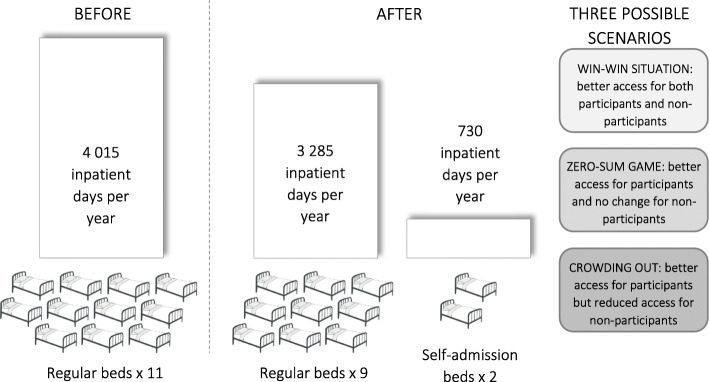
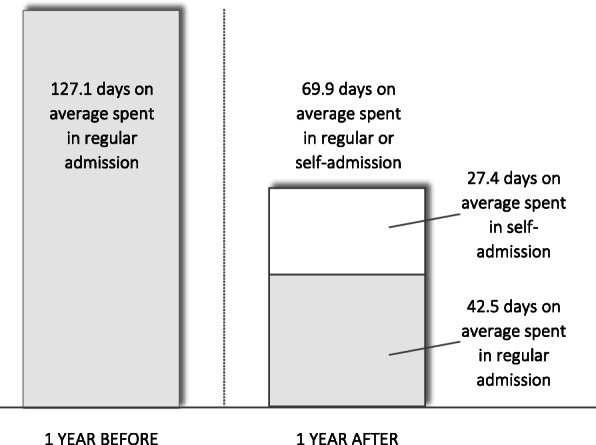
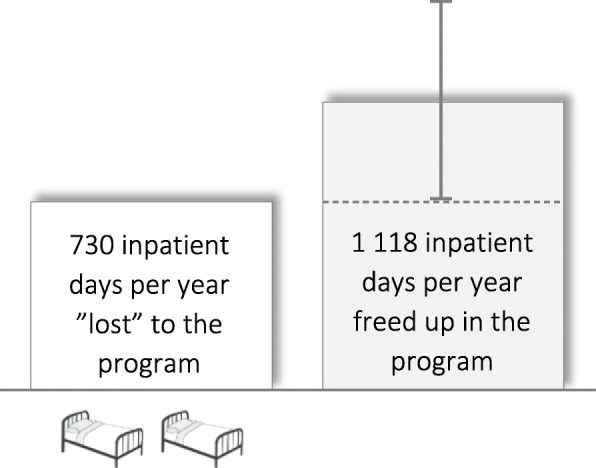
Background: Self-admission to psychiatric inpatient treatment is an innovative approach to healthcare rationing, based on reallocation of existing resources rather than on increased funding. In self-admission, patients with a history of high healthcare utilization are invited to decide for themselves when brief admission is warranted. Previous findings on patients with severe eating disorders indicate that self-admission reduces participants’ need for inpatient treatment, but that it does not alone lead to symptom remission. Methods: The aim of this study was to evaluate if, from a service provider perspective, the resource reallocation associated with self-admission is justified. The analysis makes use of data from a cohort study evaluating the one-year outcomes of self-admission at the Stockholm Centre for Eating Disorders. Results: Participants in the program reduced their need for regular specialist inpatient treatment by 67%. Thereby, hospital beds were made available for non-participants due to the removal of a yearly average of 13.2 high-utilizers from the regular waiting list. A sensitivity analysis showed that this “win-win situation” occurred within the entire 95% confidence interval of the inpatient treatment utilization reduction. Conclusions: For healthcare systems relying on rationing by waiting list, self-admission has the potential to reduce the need for hospitalization for patients with longstanding eating disorders, while also offering benefits in the form of increased available resources for other patients requiring hospitalization. Trial Registration: ClinicalTrials.gov ID: NCT02937259 (retrospectively registered 10/15/2016).
Overview
The claims and statistics of this paper haven’t been checked yet.
Free: it reads the open-access text and checks the first 5 claims that cite a source we can check. Create a free account to check every claim.
Integrity signals
Registry
Cites
Statistics
Figures
Verification
Claims the paper makes
The claims and statistics of this paper haven’t been checked yet.
Free: it reads the open-access text and checks the first 5 claims that cite a source we can check. Create a free account to check every claim.
Claims other papers make about this one
Each is checked against this paper’s own text: does it say what the citing paper says it does?
The cited source says what the claim attributes to it.
In the citing paper
“Previous studies on both adult and adolescent patients have demonstrated a reduced need for inpatient care with brief admissions [7,27,28,29].”
From Implementation of Brief Admission by Self-Referral in Child and Adolescent Psychiatry in Sweden: Insights from Implementers and Staff (2023) · cites this paper as [28]
Self-check
Percentages, sums and reported differences re-computed from the paper’s own numbers.
The self-check needs the paper’s full text.
Citations
Cites
External review and validation of the Swedish national inpatient register
Ludvigsson, J. F., Andersson, E., Ekbom, A., Feychting, M., Kim, J.-L., Reuterwall, C., Heurgren, M., & Olausson, P. O. (2011) · BMC Public Health · doi:10.1186/1471-2458-11-450 · Cited by 5,055
Arcelus, J., Mitchell, A. J., Wales, J., & Nielsen, S. (2011) · Archives of General Psychiatry · doi:10.1001/archgenpsychiatry.2011.74 · Cited by 2,864
Husereau, D., Drummond, M., Petrou, S., Carswell, C., Moher, D., Greenberg, D., Augustovski, F., Briggs, A. H., Mauskopf, J., & Loder, E. (2013) · Value in Health · doi:10.1016/j.jval.2013.02.002 · Cited by 1,998 · cited 1×
“In reporting our findings, we have adhered to the Consolidated Health Economic Evaluation Reporting Standards (CHEERS) statement [20].”
MethodRegisters of the Swedish total population and their use in medical research
Ludvigsson, J. F., Almqvist, C., Bonamy, A.-K. E., Ljung, R., Michaëlsson, K., Neovius, M., Stephansson, O., & Ye, W. (2016) · European Journal of Epidemiology · doi:10.1007/s10654-016-0117-y · Cited by 1,674
Davidson, L., & Roe, D. (2007) · Journal of Mental Health · doi:10.1080/09638230701482394 · Cited by 582
Recovery from anorexia nervosa and bulimia nervosa at 22-year follow-up
Eddy, K. T., Tabri, N., Thomas, J. J., Murray, H. B., Keshaviah, A., Hastings, E., Edkins, K., Krishna, M., Herzog, D. B., Keel, P. K., et al. (2017) · The Journal of Clinical Psychiatry · doi:10.4088/jcp.15m10393 · Cited by 535
Update on course and outcome in eating disorders
Keel, P. K., & Brown, T. A. (2010) · International Journal of Eating Disorders · doi:10.1002/eat.20810 · Cited by 458
Review of 103 Swedish Healthcare Quality Registries
Emilsson, L., Lindahl, B., Köster, M., Lambe, M., & Ludvigsson, J. F. (2015) · Journal of Internal Medicine · doi:10.1111/joim.12303 · Cited by 351
Using Cost-Effectiveness Analysis to Address Health Equity Concerns
Cookson, R., Mirelman, A. J., Griffin, S., Asaria, M., Dawkins, B., Norheim, O. F., Verguet, S., & J. Culyer, A. (2017) · Value in Health · doi:10.1016/j.jval.2016.11.027 · Cited by 327
Exploring Uncertainty in Cost-Effectiveness Analysis
Claxton, K. (2008) · PharmacoEconomics · doi:10.2165/00019053-200826090-00008 · Cited by 210
Research works printed but not linked: 2
- American Psychiatric Association. DSM-5: Diagnostic and Statistical Manual of Mental Illness, Fifth Edition. Washington, DC: American Psychiatry Publishing; 2013.
- Drummond MF Sculpher MJ Claxton K Stoddart GL Torrance GW Using clinical studies as vehicles for economic evaluation. Methods for the Economic Evaluation of Health Care Programmes 2015 4 Oxford Oxford University Press 267 310
Cited by
Johansson, B. A., Holmström, E., Eberhard, S., Lindgren, A., & Rask, O. (2023) · The Lancet Psychiatry · doi:10.1016/s2215-0366(23)00157-8 · Cited by 18
Eckerström, J., Rosendahl, I. K., Lindkvist, R., Amin, R., Carlborg, A., Flyckt, L., & Jayaram‐Lindström, N. (2024) · International Journal of Mental Health Nursing · doi:10.1111/inm.13371 · Cited by 16
Patient Experiences of Patient‐Initiated Brief Admission in Psychiatric Care: A Systematic Review
Värnå, E., Nederman, J., Saliba‐Gustafsson, E. A., & Eckerström, J. (2024) · International Journal of Mental Health Nursing · doi:10.1111/inm.13457 · Cited by 13
Moberg, J. (2025) · Journal of Eating Disorders · doi:10.1186/s40337-025-01283-1 · Cited by 11
Paaske, L. S., Sopina, L., Olsen, K. R., Thomsen, C. T., Benros, M. E., Nordentoft, M., & Hastrup, L. H. (2021) · Journal of Psychiatric Research · doi:10.1016/j.jpsychires.2021.10.032 · Cited by 9
Metadata
- Authors
- Strand, M., Bulik, C. M., Gustafsson, S. A., & Welch, E.
- Affiliations
- Karolinska Institutet (SE)
- University of North Carolina at Chapel Hill (US)
- Örebro University (SE)
- Region Stockholm (SE)
- Corresponding author
- Strand, Mattias
- Venue
- BMC Health Services Research
- Published
- 2021-05-17
- Volume
- 21
- Issue
- 1
- Pages
- 465-465
- ISSN
- 1472-6963 (ISSN-L)
- PMC
- PMC8130160
- OpenAlex
- W3163382290
- Cited by
- 10
- References
- 31
- Citations by year
- 2026: 2 · 2025: 3 · 2024: 2 · 2023: 2 · 2021: 1
- FWCI
- 0.85
- Type
- journal article
- Language
- en
- Open access
- gold
- doi.org
- Licence
- cc-by
- creativecommons.org/licenses/by/4.0 (tdm)
- creativecommons.org/licenses/by/4.0 (vor)
- Locations
- BMC Health Services Research (publishedVersion, cc-by)
- PubMed Central (publishedVersion, cc-by)
- PubMed (publishedVersion)
- DOAJ (DOAJ: Directory of Open Access Journals) (submittedVersion, cc-by-sa)
- Funders
- PRIO (n/a)
- ALF Medicin (n/a)
- Stiftelsen Krica (n/a)
- Psykiatrifonden (n/a)
- Värkstadsstiftelsen (n/a)
- Kvinnor & Hälsa (n/a)
- Fredrik & Ingrid Thurings Stiftelse (n/a)
- Vetenskapsrådet (538-2013-8864)
- Karolinska Institute
- Topics
- Social Sciences › Psychology › Clinical Psychology › Eating Disorders and Behaviors
- Social Sciences › Psychology › Clinical Psychology › Psychiatric care and mental health services
- Health Sciences › Medicine › Emergency Medicine › Emergency and Acute Care Studies
- Keywords
- eating disorders, health care rationing, healthcare resource reallocation, psychiatric inpatient treatment, hospital bed capacity, waiting lists, hospitalization reduction
- MeSH terms
- Feeding and Eating Disorders, Delivery of Health Care, Hospitalization, Humans, Inpatients, Cohort Studies
About these checks
Registry, retraction, Cites and statistics results are computed, not judged, with one exception: a printed reference that no index lists is read once by a model before it counts as a citation error. Claims are extracted by a model and kept only when their quote appears verbatim in the text; each cited source is then checked, with a model’s help, for whether it says what the claim relies on. Those verdicts can be wrong — read the claim’s quote and the cited source before relying on one.
Statistics and arithmetic are recomputed, not judged.
Confidence bands are shown only for fields calibrated on our annotated test set. None is calibrated yet, so no band is shown.
What counts as a claim ›How we measure confidence ›How we check this ›
Are you an author, or do you see a problem with this page? Request a review
How to cite
Cite CoChat for the checks on this page, and the paper for its own findings.
- This page
- CoChat. (2026). Citation check: Self-admission in the treatment of eating disorders: an analysis of healthcare resource reallocation. https://app.cochat.ai/papers/10.1186/s12913-021-06478-1
- The paper
- Strand, M., Bulik, C. M., Gustafsson, S. A., & Welch, E. (2021). Self-admission in the treatment of eating disorders: an analysis of healthcare resource reallocation. BMC Health Services Research. https://doi.org/10.1186/s12913-021-06478-1
Data sources
Bibliographic data: Semantic Scholar, OpenAlex, Crossref.
Contains information from the Semantic Scholar Academic Graph Datasets, made available under the ODC Attribution License (ODC-BY 1.0).
Semantic Scholar’s data is described in: Kinney, R., et al. (2023). The Semantic Scholar Open Data Platform. arXiv:2301.10140.
