

Development of an internet-delivered cognitive behavioral therapy program for use in combination with exercise therapy and education by patients at increased risk of chronic pain following total knee arthroplasty
Open accessThe DOI matches its Crossref record; 78 of the 79 references it cites were found in a registry or an index.
Abstract
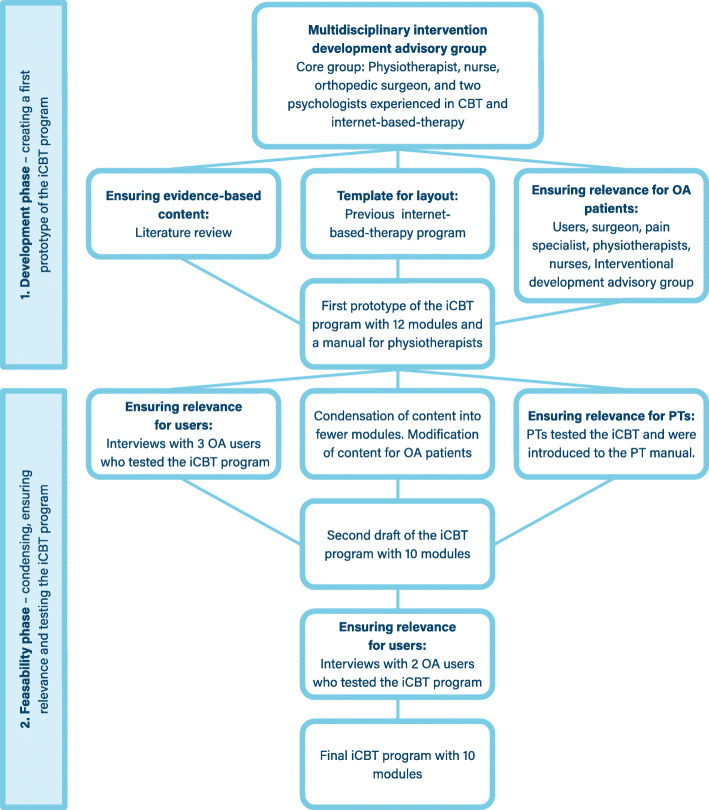
Background: Approximately 20% of patients experience chronic pain after total knee arthroplasty (TKA). Due to the growing number of TKA procedures, this will affect an increasing number of people worldwide. Catastrophic thinking, dysfunctional illness perception, poor mental health, anxiety and depression characterize these non-improvers, and indicate that these patients may need individualized treatment using a treatment approach based on the bio-psycho-social health model. The present study developed an internet-delivered cognitive behavioral therapy (iCBT) program to be combined with exercise therapy and education for patients with knee osteoarthritis (OA) at increased risk of chronic pain after TKA. Methods: The development process followed the first two phases of the UK Medical Research Council framework for complex interventions. In the development phase, the first prototype of the iCBT program was developed based on literature review, established iCBT programs and multidisciplinary workshops. The feasibility phase consisted of testing the program, interviewing users, condensing the program, and tailoring it to the patient group. A physiotherapist manual was developed and adapted to physiotherapists who will serve as mentors. Results: The development process resulted in an iCBT program consisting of 10 modules with educational texts, videos and exercises related to relevant topics such as goalsetting, stress and pain, lifestyle, automatic thoughts, mindfulness, selective attention, worry and rumination. A physiotherapist manual was developed to guide the physiotherapists in supporting the patients through the program and to optimize adherence to the program. Conclusions: The iCBT program is tailored to patients at risk of chronic pain following TKA, and may be useful as a supplement to surgery and/or exercise therapy. A multicentre RCT will evaluate the iCBT program in combination with an exercise therapy and education program. This novel intervention may be a valuable contribution to the treatment of OA patients at risk of chronic pain after TKA. Trial registration: The RCT is pre-registered at ClinicalTrials.gov: NCT03771430 11/12/2018.
Overview
The claims and statistics of this paper haven’t been checked yet.
Free: it reads the open-access text and checks the first 5 claims that cite a source we can check. Create a free account to check every claim.
Integrity signals
Registry
Cites
Statistics
Figures
Verification
Claims the paper makes
The claims and statistics of this paper haven’t been checked yet.
Free: it reads the open-access text and checks the first 5 claims that cite a source we can check. Create a free account to check every claim.
Claims other papers make about this one
Each is checked against this paper’s own text: does it say what the citing paper says it does?
The source backs part of the claim, not all of it — or backs it for a different population, condition or comparison.
In the citing paper
“Finally, Personas were seen as beneficial for prospective users (i.e., patients with chronic pain) as part of the intervention, as users could identify themselves with the Personas and Personas may highlight the relevance of the intervention or specific exercises (Rognsvag et al., 2021; Schubert et al., 2022).”
From Using Personas in the development of eHealth interventions for chronic pain: A scoping review and narrative synthesis (2023) · cites this paper as Rognsvag et al., 2021
Experimental — accuracy not yet measuredThe source backs part of the claim, not all of it — or backs it for a different population, condition or comparison.
In the citing paper
“Finally, two studies included Personas in the intervention (but not explicitly in the development process): “Persona […] appears in all modules throughout the program” (Rognsvag et al., 2021) and “Personas are introduced at the beginning; their answers and thoughts on exercises are displayed as encouraging examples” (Schubert et al., 2022)). However, no details were presented.”
From Using Personas in the development of eHealth interventions for chronic pain: A scoping review and narrative synthesis (2023) · cites this paper as Rognsvag et al., 2021
Experimental — accuracy not yet measuredThe cited source says what the claim attributes to it.
In the citing paper
“Two studies did not specify how Personas were created (Hochstenbach et al., 2017; Schubert et al., 2022) and two studies provided minimal detail, mentioning “typical patients” (Rognsvag et al., 2021), and “previous research and clinical expertise with persons with chronic pain and other stakeholders” (Turesson et al., 2022) as their source.”
From Using Personas in the development of eHealth interventions for chronic pain: A scoping review and narrative synthesis (2023) · cites this paper as Rognsvag et al., 2021
The cited source says what the claim attributes to it.
In the citing paper
“Three studies did not provide details other than “four Personas are introduced in the beginning [of the intervention]; their answers and thoughts on certain exercises are displayed as encouraging examples”(Schubert et al., 2022), “represent the patient population” (Hochstenbach et al., 2017), and “based on typical osteoarthritis or total knee arthroplasty patient” (Rognsvag et al., 2021).”
From Using Personas in the development of eHealth interventions for chronic pain: A scoping review and narrative synthesis (2023) · cites this paper as Rognsvag et al., 2021
Self-check
Percentages, sums and reported differences re-computed from the paper’s own numbers.
The self-check needs the paper’s full text.
Citations
Cites
Melzack, R., & Wall, P. D. (1965) · Science · doi:10.1126/science.150.3699.971 · Cited by 11,090 · cited 2×
“In later modules, participants learn about various forms of thinking errors, safety behaviors, internal dialogue, perceiving challenging situations as threats, losses or challenges, locus of control, stressful situations [24, 25, 65], and the gate control theory of pain [28].”
BackgroundDeveloping and evaluating complex interventions: the new Medical Research Council guidance
Craig, P., Dieppe, P., Macintyre, S., Michie, S., Nazareth, I., & Petticrew, M. (2008) · BMJ · doi:10.1136/bmj.a1655 · Cited by 10,995 · cited 1×
“The UK Medical Research Council (MRC) framework for complex interventions [48] served as a foundation for the program’s development process.”
MethodHoffmann, T. C., Glasziou, P. P., Boutron, I., Milne, R., Perera, R., Moher, D., Altman, D. G., Barbour, V., Macdonald, H., Johnston, M., et al. (2014) · BMJ · doi:10.1136/bmj.g1687 · Cited by 10,548 · cited 1×
“The iCBT program is presented according to the template for intervention description and replication (TIDieR) checklist and guide [64].”
MethodFear-avoidance and its consequences in chronic musculoskeletal pain: a state of the art.
Vlaeyen, J. W. S., & Linton, S. J. (2000) · Pain · doi:10.1016/s0304-3959(99)00242-0 · Cited by 4,931 · cited 1×
“[31] addresses a number of psychological factors that may impact pain intensity and disability, such as catastrophic thinking [32, 33], fearavoidance [34], low self-efficacy, helplessness and lack of perceived control [35–38], in addition to passive pain coping strategies [39].”
BackgroundMotivational Interviewing: Helping People Change
Tober, G. (2013) · Alcohol and Alcoholism · doi:10.1093/alcalc/agt010 · Cited by 4,268 · cited 1×
“Phase 2 resulted in a final version of the iCBT program consisting of ten modules (Table 3), accompanied by a physiotherapist manual (Table 4) containing a brief introduction to CBT and basic motivational interviewing (MI) [63] techniques, in addition to instructions for each module.”
MethodOARSI guidelines for the non-surgical management of knee, hip, and polyarticular osteoarthritis
Bannuru, R. R., Osani, M. C., Vaysbrot, E. E., Arden, N. K., Bennell, K., Bierma-Zeinstra, S. M. A., Kraus, V. B., Lohmander, L. S., Abbott, J. H., Bhandari, M., et al. (2019) · Osteoarthritis and Cartilage · doi:10.1016/j.joca.2019.06.011 · Cited by 3,542 · cited 3×
“Current treatment modalities for knee OA are based on the Osteoarthritis Research Society International (OARSI) recommendations for evidence-based treatment, which include education, exercise, lifestyle alterations, weight loss when relevant, and analgesics [14].”
BackgroundMethodThe Efficacy of Cognitive Behavioral Therapy: A Review of Meta-analyses
Hofmann, S. G., Asnaani, A., Vonk, I. J. J., Sawyer, A. T., & Fang, A. (2012) · Cognitive Therapy and Research · doi:10.1007/s10608-012-9476-1 · Cited by 3,445 · cited 2×
“The premise for CBT in relation to pain is to identify and modify pain-enhancing thinking patterns, or cognitions, maladaptive behavior and situations that contribute to the maintenance of psychological distress, which may lead to further progression of pain [30].”
BackgroundMelzack, R., & Wall, P. D. (1996) · Pain Forum · doi:10.1016/s1082-3174(96)80062-6 · Cited by 2,784
eHealth Literacy: Essential Skills for Consumer Health in a Networked World.
Norman, C. D., & Skinner, H. A. (2006) · Journal of Medical Internet Research · doi:10.2196/jmir.8.2.e9 · Cited by 2,643 · cited 1×
“For planning and conducting the interviews, Norman and Skinner’s eHealth literacy model [62] was employed.”
MethodKolasinski, S. L., Neogi, T., Hochberg, M. C., Oatis, C., Guyatt, G., Block, J., Callahan, L., Copenhaver, C., Dodge, C., Felson, D., et al. (2020) · Arthritis Care & Research · doi:10.1002/acr.24131 · Cited by 2,516
Research works printed but not linked: 2
- Turk DT Monarch ES Biopsychosocial perspective on chronic pain. Psychological approaches to pain management. 2nd ed 2002 New York Guilford Press
- Turk DC, Meichenbaum D, Genest M. Pain and Behavioural medicine: A cognitive Bahavioural Perspective. 2nd ed. New York: The Guilford Press; 1983.
Cited by
Bartels, S. L., Taygar, A. S., Johnsson, S. I., Petersson, S., Flink, I., Boersma, K., McCracken, L. M., & Wicksell, R. K. (2023) · Internet Interventions · doi:10.1016/j.invent.2023.100619 · Cited by 46
Kaynar, A. M., Lin, C., Sanchez, A. G., Lavage, D. R., Monroe, A., Zharichenko, N., Strassburger, M., Saucier, K., Groff, Y. J., Klatt, B. A., et al. (2023) · Trials · doi:10.1186/s13063-023-07634-0 · Cited by 22
“Rognsvåg et al. developed an Internet-delivered cognitive behavioral therapy program for use in combination with exercise and education in patients at increased risk of chronic pain following total knee arthroplasty [59].”
BackgroundLi, Y., Gu, Z., Ning, R., & Yin, H. (2023) · Journal of Orthopaedic Surgery and Research · doi:10.1186/s13018-023-03907-1 · Cited by 17
“In recent years, with the rapid development of the mobile internet, the application of mobile care in healthcare allows effective real-time information exchange and knowledge transfer, which overcomes the limitations of physical space and space [7], such as online platforms that allow patients to receive health educat…”
BackgroundZhu, D., Zhao, J., Wang, M., Cao, B., Zhang, W., Li, Y., Zhang, C., & Han, T. (2024) · JMIR mhealth and uhealth · doi:10.2196/53798 · Cited by 15
“Based on the interviews conducted for the qualitative study, issues were identified with the digital app user experience of KOA patients [52,56,62].”
BackgroundResultInfluentialUse of health self-management platform features: The case of a specialist ehealth app
Cenamor, J. (2022) · Technological Forecasting and Social Change · doi:10.1016/j.techfore.2022.122066 · Cited by 11
Metadata
- Authors
- Rognsvåg, T., Lindberg, M. F., Lerdal, A., Stubberud, J., Furnes, O., Holm, I., Indrekvam, K., Lau, B., Rudsengen, D., Skou, S. T., & Badawy, M.
- Affiliations
- Haukeland University Hospital (NO)
- University of Oslo (NO)
- Oslo University Hospital (NO)
- University of Southern Denmark (DK)
- Corresponding author
- Rognsvåg, Turid
- ORCID
- Venue
- BMC Health Services Research
- Published
- 2021-10-25
- Volume
- 21
- Issue
- 1
- Pages
- 1151-1151
- ISSN
- 1472-6963 (ISSN-L)
- PMC
- PMC8546935
- OpenAlex
- W3208312005
- Cited by
- 18
- References
- 79
- Citations by year
- 2026: 1 · 2025: 2 · 2024: 5 · 2023: 7 · 2022: 2
- FWCI
- 3.14
- Type
- journal article
- Language
- en
- Open access
- gold
- doi.org
- Licence
- cc-by
- creativecommons.org/licenses/by/4.0 (tdm)
- creativecommons.org/licenses/by/4.0 (vor)
- Locations
- BMC Health Services Research (publishedVersion, cc-by)
- Europe PMC (PubMed Central) (publishedVersion, other-oa)
- PubMed Central (publishedVersion, cc-by)
- PubMed (publishedVersion)
- University of Southern Denmark Research Portal (University of Southern Denmark) (publishedVersion)
- NORA - Norwegian Open Research Archives (submittedVersion, cc-by)
- DOAJ (DOAJ: Directory of Open Access Journals) (submittedVersion, cc-by-sa)
- University of Southern Denmark Research Portal (University of Southern Denmark) (submittedVersion, cc-by)
- Duo Research Archive (University of Oslo) (submittedVersion, cc-by)
- Funders
- European Commission (801790, HORIZON2020)
- Norges Forskningsråd (287816)
- Region Sjælland (801790)
- Helse Sør-Øst RHF (2018060)
- Topics
- Social Sciences › Psychology › Applied Psychology › Digital Mental Health Interventions
- Health Sciences › Health Professions › Physical Therapy, Sports Therapy and Rehabilitation › Musculoskeletal pain and rehabilitation
- Health Sciences › Medicine › Surgery › Total Knee Arthroplasty Outcomes
- Keywords
- internet-based cognitive behavioral therapy, total knee arthroplasty, knee osteoarthritis, exercise therapy, patient education, intervention development, biopsychosocial model, catastrophic thinking, illness perception, mindfulness, rumination
- MeSH terms
- Exercise Therapy, Humans, Cognitive Behavioral Therapy, Arthroplasty, Replacement, Knee, Internet, Chronic Pain
About these checks
Registry, retraction, Cites and statistics results are computed, not judged, with one exception: a printed reference that no index lists is read once by a model before it counts as a citation error. Claims are extracted by a model and kept only when their quote appears verbatim in the text; each cited source is then checked, with a model’s help, for whether it says what the claim relies on. Those verdicts can be wrong — read the claim’s quote and the cited source before relying on one.
Statistics and arithmetic are recomputed, not judged.
Confidence bands are shown only for fields calibrated on our annotated test set. None is calibrated yet, so no band is shown.
What counts as a claim ›How we measure confidence ›How we check this ›
Are you an author, or do you see a problem with this page? Request a review
Data sources
Bibliographic data: Semantic Scholar, OpenAlex, Crossref.
Contains information from the Semantic Scholar Academic Graph Datasets, made available under the ODC Attribution License (ODC-BY 1.0).
Semantic Scholar’s data is described in: Kinney, R., et al. (2023). The Semantic Scholar Open Data Platform. arXiv:2301.10140.
