

Targeted Interdisciplinary Model for Evaluation and Treatment of Neuropsychiatric Symptoms (TIME) in home care services: a cluster randomized feasibility trial.
Open accessThe DOI matches its Crossref record; 37 of the 39 references it cites were found in a registry or an index; 5 of the 11 sources its claims cite were checked for support.
Abstract
Background: Behavioral and psychological symptoms of dementia (BPSD) occur frequently in people with dementia and can contribute to an increased need for help and a reduced quality of life, but also predict early institutionalization. The Targeted Interdisciplinary Model for Evaluation and Treatment of Neuropsychiatric Symptoms (TIME) might be a useful personalized approach to BPSD in people with dementia. The main objective of this feasibility trial was to explore the trial design and methods along with the patients' and the home care staff's acceptance of the TIME intervention before developing a definitive trial. Additionally, we wanted to explore whether TIME could be appropriate for staff in home care services in their approach towards people with dementia with anxiety and depression. Methods: This was a 18-month feasibility trial using a parallel cluster randomized controlled design. Nine municipalities from the eastern part of Norway (clusters) — 40 people with dementia and 37 of their next of kin— were randomized to the TIME intervention or to treatment as usual. In addition, qualitative data as field notes were collected and summarized. Results: The staff in home care services experienced TIME as an appropriate method; in particular, the systematic approach to the patient's BPSD was experienced as useful. However, the completion of the assessment phase was considered exhaustive and time-consuming, and some of the staff found it challenging to find time for the case conferences. Conclusions: We consider that TIME, with some adjustments, could be useful for staff in home care services in cases where they face challenges in providing care and support to people with dementia. This feasibility trial indicates that we can move forward with a future definitive randomized controlled trial (RCT) to test the effect of TIME in people with dementia receiving home care services. Trial registration: ClinicalTrial.gov identifier: SI0303150608.
Overview
CoChat Summary
## TL;DR
This 18-month cluster randomized feasibility trial tested whether the TIME intervention could be implemented in home care services for people with dementia and affective symptoms. Staff found TIME useful and systematic, but the assessment phase and case conferences were time-consuming, and the study suggests a future definitive RCT is feasible with adjustments.
## Key findings
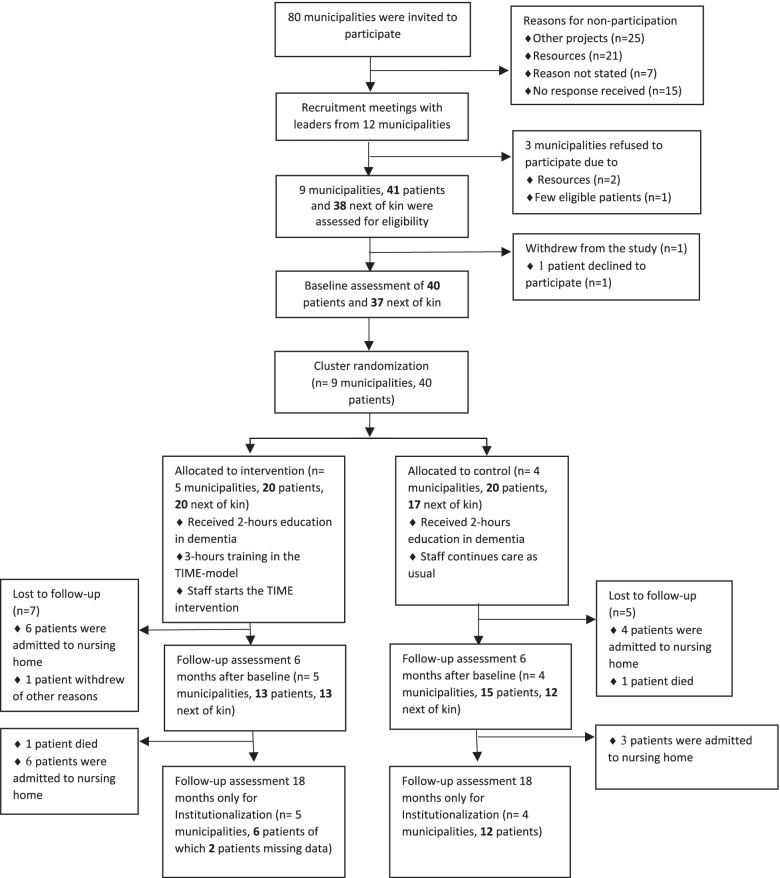
- Nine municipalities were randomized; 41 people with dementia and 38 next of kin were included, and 40 patients/37 next of kin were analyzed after one withdrawal before follow-up.
- Staff in home care services experienced TIME as an appropriate method, especially the systematic approach to BPSD; however, the assessment phase was “exhaustive and time-consuming,” and scheduling case conferences was challenging.
- For the 6-month primary outcome, between-group differences in change in depression symptoms (CSDD) were not significant.
- The only significant outcome difference reported was for the NPI-NH total score, and it favored the control group; 12 patients (30%) in the intervention group and 7 (17.5%) in the control group were admitted to nursing home by 18 months.
## Methods
- Parallel cluster randomized feasibility trial over 18 months, with nine municipalities in eastern Norway as clusters and allocation 1:1 to TIME or treatment as usual.
- Participants: 40 people with dementia and 37 next of kin; inclusion required dementia (CDR ≥ 1), at least 15 minutes/day of home care for the previous 4 weeks, and affective symptoms (NPI-NH affective subsyndrome ≥ 12).
- Main analysis used linear mixed models with random effects for patients nested within municipalities, adjusting for age and gender; qualitative field notes were also summarized to assess feasibility and acceptance.
## Limitations
- The paper states that recruiting enough municipalities was challenging and time-consuming, and that the intervention may have been too extensive for available resources in some municipalities.
- It states there was a large dropout during the trial period, and that the COVID-19 pandemic likely affected staffing and the ability to implement tailored measures.
- Evident from the text: the trial was not powered for effectiveness, so the outcome results have limited evidence value; also, the included sample was small and may not generalize well beyond municipalities willing and able to participate.
Model-written summary. Check it against the paper before relying on it.
Integrity signals
Registry
Cites
Statistics
Figures
Verification
Claims the paper makes
4 Valid · 0 Not valid · 4 Not checked · 57 Own results and interpretations
A result the paper reports from its own data — it cites no other source for it, so there is none to check. The quote shows it is in the paper.
In the paper
“Between-group differences in changes from the baseline to the 6-month follow-up for the primary outcome (i.e., symptoms of depression as measured by the CSDD scale) were not significant.”
§ Targeted Interdisciplinary Model for Evaluation and Treatment of Neuropsychiatric Symptoms (TIME) in home care services: a cluster randomized feasibility trial > Results > Outcome measures for anxiety and depression
plain- Asserted: passes — The authors put it forward as true.
- Checkable: passes — It can be checked against evidence.
- Load-bearing: passes — The paper’s conclusions depend on it.
- Based: passes — The paper gives a reason why it holds.
A result the paper reports from its own data — it cites no other source for it, so there is none to check. The quote shows it is in the paper.
In the paper
“The staff in home care services experienced TIME as an appropriate method; in particular, the systematic approach to the patient’s BPSD was experienced as useful.”
§ Targeted Interdisciplinary Model for Evaluation and Treatment of Neuropsychiatric Symptoms (TIME) in home care services: a cluster randomized feasibility trial > Abstract > Results
plain- Asserted: passes — The authors put it forward as true.
- Checkable: passes — It can be checked against evidence.
- Load-bearing: passes — The paper’s conclusions depend on it.
- Based: passes — The paper gives a reason why it holds.
A result the paper reports from its own data — it cites no other source for it, so there is none to check. The quote shows it is in the paper.
In the paper
“A few of the next of kin experienced that the baseline- and follow up interviews were perceived as an additional burden.”
§ Targeted Interdisciplinary Model for Evaluation and Treatment of Neuropsychiatric Symptoms (TIME) in home care services: a cluster randomized feasibility trial > Results > The feasibility of the study
plain- Asserted: passes — The authors put it forward as true.
- Checkable: passes — It can be checked against evidence.
- Load-bearing: unclear — It is unclear whether the paper’s conclusions depend on it.
- Based: passes — The paper gives a reason why it holds.
A result the paper reports from its own data — it cites no other source for it, so there is none to check. The quote shows it is in the paper.
In the paper
“The only significant difference was in change in the secondary outcome NPI-NH sum in favor of the control group.”
§ Targeted Interdisciplinary Model for Evaluation and Treatment of Neuropsychiatric Symptoms (TIME) in home care services: a cluster randomized feasibility trial > Results > Outcome measures for anxiety and depression
plain- Asserted: passes — The authors put it forward as true.
- Checkable: passes — It can be checked against evidence.
- Load-bearing: unclear — It is unclear whether the paper’s conclusions depend on it.
- Based: passes — The paper gives a reason why it holds.
A result the paper reports from its own data — it cites no other source for it, so there is none to check. The quote shows it is in the paper.
In the paper
“The systematic way of collaborating on the formulation of customized measures in these conferences was perceived by all staff as useful, even though the meetings were perceived as taking too much time for any single patient.”
§ Targeted Interdisciplinary Model for Evaluation and Treatment of Neuropsychiatric Symptoms (TIME) in home care services: a cluster randomized feasibility trial > Results > The feasibility of the study
plain- Asserted: passes — The authors put it forward as true.
- Checkable: passes — It can be checked against evidence.
- Load-bearing: unclear — It is unclear whether the paper’s conclusions depend on it.
- Based: passes — The paper gives a reason why it holds.
19 more claims
Create a free account to see all 65 claims and every source verdict.
- Probably not a substantial claim. 29
- It may state two separate claims as one. 15
- The quote only partly states this claim. 1
Self-check
Percentages, sums and reported differences re-computed from the paper’s own numbers.
Rated major: it would touch a result — a value a result rests on, reported and recomputed p-values on opposite sides of the significance level, two passages that conflict with no sign which is right, or a cited work retracted before this paper was published.
In the paper
“Admission to nursing home from baseline to 18 months follow up was 12 patients (30%) in the intervention group and 7 patients (17.5%) in the control group.”
§ Targeted Interdisciplinary Model for Evaluation and Treatment of Neuropsychiatric Symptoms (TIME) in home care services: a cluster randomized feasibility trial > Results > Patients
Reported 17.5 · recomputed 35
Cited works that were retracted
Works this paper cites that were later retracted, from the retraction notices publishers deposit. Major when the notice came out before this paper was published.
A note, not an issue: for example, a cited work that was retracted only after this paper was published, which its authors could not have known.
In the paper
“Livingston G Huntley J Sommerlad A Ames D Ballard C Banerjee S Dementia prevention, intervention, and care: 2020 report of the lancet commission Lancet (British edition) 2020 396 10248 413 446 PMC7392084 32738937”
Cited work 10.1016/s0140-6736(20)30367-6 · retracted 2023-05-01 · notice 10.1016/s2468-2667(23)00083-x · this paper published 2022-03-29
Citations
Cites
1 retracted
Dementia prevention, intervention, and care: 2020 report of the Lancet Commission
Livingston, G., Huntley, J., Sommerlad, A., Ames, D., Ballard, C., Banerjee, S., Brayne, C., Burns, A., Cohen-Mansfield, J., Cooper, C., et al. (2020) · The Lancet · doi:10.1016/s0140-6736(20)30367-6 · Cited by 10,430
Self-citationRetractedA New Clinical Scale for the Staging of Dementia
Hughes, C. P., Berg, L., Danziger, W., Coben, L. A., & Martin, R. L. (1982) · British Journal of Psychiatry · doi:10.1192/bjp.140.6.566 · Cited by 7,056
CONSORT 2010 statement: extension to randomised pilot and feasibility trials.
Eldridge, S. M., Chan, C. L., Campbell, M. J., Bond, C. M., Hopewell, S., Thabane, L., & Lancaster, G. A. (2016) · BMJ · doi:10.1136/bmj.i5239 · Cited by 3,404
9 Dementia reconsidered: the person comes first
Kitwood, T. (2011) · Adult lives · doi:10.56687/9781447300458-013 · Cited by 3,103
CONSORT 2010 statement: extension to randomised pilot and feasibility trials
on behalf of the PAFS consensus group, Eldridge, S. M., Chan, C. L., Campbell, M. J., Bond, C. M., Hopewell, S., Thabane, L., & Lancaster, G. A. (2016) · Pilot and Feasibility Studies · doi:10.1186/s40814-016-0105-8 · Cited by 2,843
Cornell scale for depression in dementia
Alexopoulos, G. S., Abrams, R. C., Young, R. C., & Shamoian, C. A. (1988) · Biological Psychiatry · doi:10.1016/0006-3223(88)90038-8 · Cited by 2,678
The Neuropsychiatric Inventory: Assessing psychopathology in dementia patients
Cummings, J. L. (1997) · Neurology · doi:10.1212/wnl.48.5_suppl_6.10s · Cited by 2,017
The PRECIS-2 tool: designing trials that are fit for purpose
Loudon, K., Treweek, S., Sullivan, F., Donnan, P., Thorpe, K. E., & Zwarenstein, M. (2015) · BMJ · doi:10.1136/bmj.h2147 · Cited by 1,846
Behavioral and psychological symptoms of dementia
Cerejeira, J., Lagarto, L., & Mukaetova-Ladinska, E. B. (2012) · Frontiers in Neurology · doi:10.3389/fneur.2012.00073 · Cited by 1,425
Assessment and management of behavioral and psychological symptoms of dementia
Kales, H. C., Gitlin, L. N., & Lyketsos, C. G. (2015) · BMJ · doi:10.1136/bmj.h369 · Cited by 1,247
Neuropsychiatric symptoms in Alzheimer's disease
Lyketsos, C. G., Carrillo, M. C., Ryan, J. M., Khachaturian, A. S., Trzepacz, P., Amatniek, J., Cedarbaum, J., Brashear, R., & Miller, D. S. (2011) · Alzheimer's & Dementia · doi:10.1016/j.jalz.2011.05.2410 · Cited by 1,139
What is person-centred care in dementia?
Brooker, D. (2003) · Reviews in Clinical Gerontology · doi:10.1017/s095925980400108x · Cited by 665
The Fundamentals of Person-Centered Care for Individuals With Dementia
Fazio, S., Pace, D., Flinner, J., & Kallmyer, B. (2018) · The Gerontologist · doi:10.1093/geront/gnx122 · Cited by 647
Finkel, S. I., Miller, S., Silva, J. C. E., Cohen, G., & Sartorius, N. (1997) · International Psychogeriatrics · doi:10.1017/s1041610297003943 · Cited by 620 · cited 3×
“Most people with dementia will experience BPSD during the course of the disease [9, 10, 14, 15].”
BackgroundGREENE, J. G., SMITH, R., GARDINER, M., & TIMBURY, G. C. (1982) · Age and Ageing · doi:10.1093/ageing/11.2.121 · Cited by 585
Kales, H. C., Gitlin, L. N., Lyketsos, C. G., & Dementia, T. D. E. P. O. T. A. A. M. O. T. N. S. O. (2014) · Journal of the American Geriatrics Society · doi:10.1111/jgs.12730 · Cited by 575 · cited 1×
“In addition, BPSD may be stressful for relatives [8–13] and challenging for health care staff to handle as they provide the necessary care and support [9, 13].”
Background(1989) · Medical Entomology and Zoology · Cited by 451
The quality of life in late-stage dementia (QUALID) scale.
Weiner, M., Martin‐Cook, K., Svetlik, D. A., Saine, K., Foster, B., & Fontaine, C. S. (2000) · PubMed · Cited by 379
Savva, G. M., Zaccai, J., Matthews, F. E., Davidson, J. E., McKeith, I., & Brayne, C. (2009) · British Journal of Psychiatry · doi:10.1192/bjp.bp.108.049619 · Cited by 369
Black, W., & Almeida, O. P. (2004) · International Psychogeriatrics · doi:10.1017/s1041610204000468 · Cited by 307
Longitudinal course of behavioural and psychological symptoms of dementia: systematic review
van der Linde, R. M., Dening, T., Stephan, B. C. M., Prina, A. M., Evans, E., & Brayne, C. (2016) · British Journal of Psychiatry · doi:10.1192/bjp.bp.114.148403 · Cited by 294
Mild Cognitive Impairment is Associated With Characteristic Neuropsychiatric Symptoms
Hwang, T. J., Masterman, D. L., Ortiz, F., Fairbanks, L. A., & Cummings, J. L. (2004) · Alzheimer Disease & Associated Disorders · doi:10.1097/00002093-200401000-00004 · Cited by 259
Neuropsychiatric symptoms as a predictor of caregiver burden in Alzheimer’s disease
Allegri, R., Sarasola, D., Serrano, C. M., Taragano, F. E., Arizaga, R. L., Butman, J., & Loñ, L. (2006) · Neuropsychiatric Disease and Treatment · doi:10.2147/ndt.a819 · Cited by 183
GjØra, L., Strand, B. H., Bergh, S., Borza, T., Brækhus, A., Engedal, K., Johannessen, A., Kvello-Alme, M., Krokstad, S., Livingston, G., et al. (2021) · Journal of Alzheimer’s Disease · doi:10.3233/jad-201275 · Cited by 183 · cited 1×
“In line with this, an approximately 130% increase of people with dementia is expected in Norway over the next 30 years [2].”
BackgroundSelf-citationClare, L., Kudlicka, A., Oyebode, J. R., Jones, R. W., Bayer, A., Leroi, I., Kopelman, M., James, I. A., Culverwell, A., Pool, J., et al. (2019) · International Journal of Geriatric Psychiatry · doi:10.1002/gps.5076 · Cited by 152
Chenoweth, L., Stein‐Parbury, J., Lapkin, S., Wang, A. Y., Liu, Z., & Williams, A. (2019) · PLoS ONE · doi:10.1371/journal.pone.0212686 · Cited by 152
Rokstad, A. M. M., Vatne, S., Engedal, K., & Selbæk, G. (2015) · Journal of Nursing Management · doi:10.1111/jonm.12072 · Cited by 115
Self-citationBarca, M. L., Engedal, K., & Selbæk, G. (2010) · Dementia and Geriatric Cognitive Disorders · doi:10.1159/000313533 · Cited by 114
Self-citationBehavioral and Psychological Symptoms of Dementia as a Risk Factor for Nursing Home Placement
Balestreri, L., Grossberg, A., & Grossberg, G. T. (2000) · International Psychogeriatrics · doi:10.1017/s1041610200006773 · Cited by 92
Lichtwarck, B., Selbaek, G., Kirkevold, Ø., Rokstad, A. M. M., Benth, J. Š., Lindstrøm, J. C., & Bergh, S. (2018) · The American Journal of Geriatric Psychiatry · doi:10.1016/j.jagp.2017.05.015 · Cited by 59
Self-citationWergeland, J. N., Selbæk, G., Høgset, L. D., Söderhamn, U., & Kirkevold, Ø. (2013) · International Psychogeriatrics · doi:10.1017/s1041610213002032 · Cited by 50
Self-citationRøen, I., Selbæk, G., Kirkevold, Ø., Engedal, K., Lerdal, A., & Bergh, S. (2015) · Dementia and Geriatric Cognitive Disorders · doi:10.1159/000437093 · Cited by 39
Self-citationGalindo-Garre, F., Volicer, L., & van der Steen, J. T. (2015) · Dementia and Geriatric Cognitive Disorders Extra · doi:10.1159/000369158 · Cited by 36
Lichtwarck, B., Myhre, J., Goyal, A. R., Rokstad, A. M. M., Selbaek, G., Kirkevold, Ø., & Bergh, S. (2019) · Aging & Mental Health · doi:10.1080/13607863.2018.1464116 · Cited by 29
Self-citationHoel, K.-A., Rokstad, A. M. M., Feiring, I. H., Lichtwarck, B., Selbæk, G., & Bergh, S. (2021) · Nursing Open · doi:10.1002/nop2.822 · Cited by 27 · cited 1×
“The schedule of the day and practical tasks might be prioritized over an individually tailored service [6], and this might challenge the services’ ability to manage behavioral and psychological symptoms of dementia (BPSD).”
BackgroundSelf-citationThe course of neuropsychiatric symptoms in patients with dementia in primary care
Borsje, P., Lucassen, P. L., Bor, H. H. J., Wetzels, R. B., Pot, A. M., & Koopmans, R. T. C. M. (2018) · Family Practice · doi:10.1093/fampra/cmy117 · Cited by 13
Assessment, management and support of people with dementia
Chaplin, S. (2018) · Prescriber · doi:10.1002/psb.1716 · Cited by 2
Research works printed but not linked: 1
- Lichtwarck B, Tverå A-M, Røen I. Targeted Interdisciplinary Model for Evaluation and Treatment of neuropsychiatric symtoms. Manual. 2015;2:2–30.
Cited by
Cooper, C., Zabihi, S., Akhtar, A., Lee, T. C., Isaaq, A., Novere, M. L., Barber, J., Lord, K., Rapaport, P., Banks, S., et al. (2024) · Age and Ageing · doi:10.1093/ageing/afae074 · Cited by 11
Væringstad, A., Dalbak, E. T. G., Holle, D., Myhre, J., Kirkevold, Ø., Bergh, S., & Lichtwarck, B. (2024) · Trials · doi:10.1186/s13063-024-08117-6 · Cited by 7
“A pilot study demonstrated the feasibility of the model in home care services [33].”
BackgroundMethodResultInfluentialSelf-citationDalbak, E. T. G., Væringstad, A., Lichtwarck, B., Myhre, J., Holle, D., Bergh, S., & Kirkevold, Ø. (2025) · Trials · doi:10.1186/s13063-025-08876-w · Cited by 3
“Modifications have been made after this feasibility pilot trial in the protocol for the effectiveness trial to achieve a more individual goal-oriented primary outcome, broader inclusion criteria and better tailored education and training for home care services [34].”
Self-citationHoel, K.-A., Lichtwarck, B., Væringstad, A., et al. (2022) · BMC Health Services Research · doi:10.1186/s12913-022-08308-4
Self-citation
Metadata
- Authors
- Hoel, K.-A., Lichtwarck, B., Væringstad, A., Feiring, I. H., Rokstad, A. M. M., Selbæk, G., Benth, J. Š., & Bergh, S.
- Affiliations
- University of Oslo (NO)
- Innlandet Hospital Trust (NO)
- Molde University College (NO)
- Oslo University Hospital (NO)
- Corresponding author
- Hoel, Kari-Anne
- ORCID
- Venue
- BMC Health Services Research
- Published
- 2022-03-29
- Volume
- 22
- Issue
- 1
- Pages
- 415-415
- ISSN
- 1472-6963 (ISSN-L)
- PMC
- PMC8961099
- OpenAlex
- W4220751132
- Cited by
- 7
- References
- 39
- Citations by year
- 2026: 1 · 2025: 1 · 2024: 4 · 2022: 1
- FWCI
- 0.98
- Type
- journal article
- Language
- en
- Update notices
- correction (2022-07-14)
- Open access
- gold
- doi.org
- Licence
- cc-by
- creativecommons.org/licenses/by/4.0 (tdm)
- creativecommons.org/licenses/by/4.0 (vor)
- Locations
- BMC Health Services Research (publishedVersion, cc-by)
- PubMed Central (publishedVersion, cc-by)
- PubMed (publishedVersion)
- DOAJ (DOAJ: Directory of Open Access Journals) (submittedVersion, cc-by-sa)
- NORA - Norwegian Open Research Archives (submittedVersion, cc-by)
- Funders
- Innlandet Hospital Trust, Norway
- Topics
- Health Sciences › Medicine › Psychiatry and Mental health › Dementia and Cognitive Impairment Research
- Health Sciences › Medicine › Geriatrics and Gerontology › Geriatric Care and Nursing Homes
- Health Sciences › Medicine › Public Health, Environmental and Occupational Health › Palliative Care and End-of-Life Issues
- Keywords
- behavioral and psychological symptoms of dementia, neuropsychiatric symptoms, dementia, home care, multidisciplinary care, anxiety, depression, case conferences, home care workers, feasibility, individualized care, institutionalization
- MeSH terms
- Anxiety Disorders, Dementia, Feasibility Studies, Home Care Services, Humans, Quality of Life
About these checks
Registry, retraction, Cites and statistics results are computed, not judged, with one exception: a printed reference that no index lists is read once by a model before it counts as a citation error. Claims are extracted by a model and kept only when their quote appears verbatim in the text; each cited source is then checked, with a model’s help, for whether it says what the claim relies on. Those verdicts can be wrong — read the claim’s quote and the cited source before relying on one.
The claim verdicts this report counts are experimental: their accuracy is not yet measured.
A language model drew the claims from the paper on 2026-10-11, under version 3 of the claim definition (model deepseek-v4.1-flash, prompt extract-v3).
A second model labelled each claim on 2026-10-11 (model jev-1.13-20260917, definition revision gold-guideline-v0.2).
Statistics and arithmetic are recomputed, not judged.
Confidence bands are shown only for fields calibrated on our annotated test set. None is calibrated yet, so no band is shown.
What counts as a claim ›How we measure confidence ›How we check this ›
Are you an author, or do you see a problem with this page? Request a review
Data sources
Bibliographic data: Semantic Scholar, OpenAlex, Crossref.
Contains information from the Semantic Scholar Academic Graph Datasets, made available under the ODC Attribution License (ODC-BY 1.0).
Semantic Scholar’s data is described in: Kinney, R., et al. (2023). The Semantic Scholar Open Data Platform. arXiv:2301.10140.
