

A qualitative study exploring the barriers to attending structured education programmes among adults with type 2 diabetes
Open accessThe DOI matches its Crossref record; 56 of the 57 references it cites were found in a registry or an index; none of the 76 sources its claims cite is checked for support yet.
Abstract
Background: Diabetes self-management education, a universally recommended component of diabetes care, aims to support self-management in people with type 2 diabetes. However, attendance is low (approx. 10%). Previous research investigating the reasons for low attendance have not yet linked findings to theory, making it difficult to translate findings into practice. This study explores why some adults with type 2 diabetes do not attend diabetes self-management education and considers how services can be adapted accordingly, using Andersen’s Behavioural Model of Health Service Utilisation as a framework. Methods: A cross-sectional semi-structured qualitative interview study was carried out. Semi-structured interviews were conducted by telephone with 14 adults with type 2 diabetes who had verbally declined their invitation to attend diabetes self-management education in Bath and North East Somerset, UK, within the last 2 years. Data were analysed using inductive thematic analysis before mapping the themes onto the factors of Andersen’s Behavioural Model. Results: Two main themes were identified: ‘perceived need’ and ‘practical barriers’. The former theme explored participants’ tendency to decline diabetes education when they perceived they did not need the programme. This perception tended to arise from participants’ high self-efficacy to manage their type 2 diabetes, the low priority they attributed to their condition and limited knowledge about the programme. The latter theme, ‘practical barriers’, explored the notion that some participants wanted to attend but were unable to due to other commitments and/or transportation issues in getting to the venue. Conclusions: All sub-themes resonated with one or more factors of Andersen’s Behavioural Model indicating that the model may help to elucidate attendance barriers and ways to improve services. To fully understand low attendance to diabetes education, the complex and individualised reasons for non-attendance must be recognised and a person-centred approach should be taken to understand people’s experience, needs and capabilities.
Overview
CoChat Summary
TL;DR
This qualitative interview study explored why adults with type 2 diabetes in Bath and North East Somerset declined structured diabetes education, identifying two themes: perceived need and practical barriers. Mapping these sub-themes onto Andersen’s Behavioural Model suggested the model can help explain non-attendance and that person-centred approaches are needed.
Key findings
- Two main themes were identified: ‘perceived need’ and ‘practical barriers’. Perceived need comprised self-efficacy to manage diabetes, low prioritisation of diabetes, and limited knowledge of DSME; practical barriers comprised programme schedule and transportation issues.
- Participants frequently declined because they believed they did not need DSME, often because they felt already well informed or had sufficient knowledge; some described non-attendance as freeing up space for others who “needed it more.”
- Low prioritisation was linked to comorbidities, denial/avoidance, and fatalism among older participants; limited knowledge about DSME content, referral, or benefits was often attributed to GPs/nurses, and nearly all with limited knowledge said more information would make attendance more likely.
- All sub-themes mapped onto at least one Andersen factor: self-efficacy (predisposing, enabling, need), low prioritisation (predisposing, need), limited knowledge (predisposing, enabling, need), programme schedule (enabling), and transportation (predisposing, enabling).
Methods
- Cross-sectional semi-structured qualitative interview study; telephone interviews conducted in June 2020 with 14 adults with type 2 diabetes in Bath and North East Somerset, UK, who had verbally declined their invitation to attend the DSME programme X-PERT within the last 2 years.
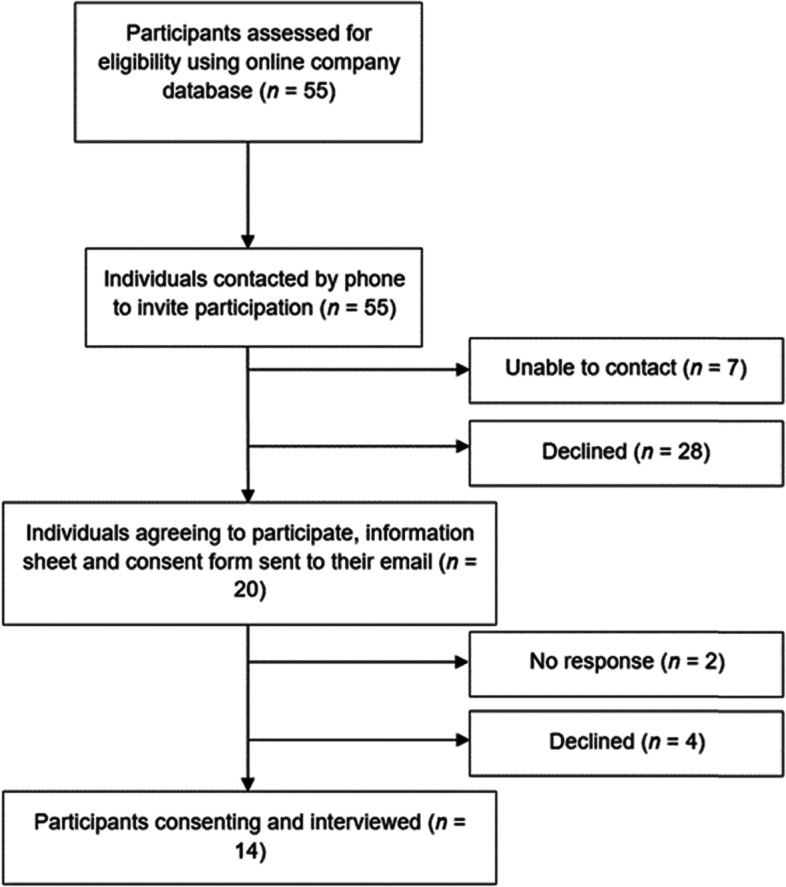
- Recruitment used convenience sampling: of 55 eligible individuals, 20 were willing to take part, 28 declined, and 7 could not be contacted; after further non-response/declines, 14 participants were interviewed. Interviews lasted on average 31 minutes (shortest 15; longest 52).
- Data were analysed using inductive reflexive thematic analysis (Braun and Clarke’s six phases), then sub-themes were mapped onto Andersen’s Behavioural Model of Health Service Utilisation; COREQ guided reporting.
Limitations
- Stated in the paper: participants were recruited by phoning eligible people, so individuals who declined participation and held highly negative attitudes toward their type 2 diabetes (e.g., shame, burden, unwillingness to talk about it) may not be fully captured; these attitudes may themselves be a barrier to attendance.
- Evident from the text: the sample was small (14), drawn from one UK region, and cross-sectional; interviews were conducted by telephone because of the COVID-19 pandemic, transcripts were not returned to participants, and participants were not asked for feedback on findings.
- Evident from the text: the sample was predominantly men (9/14) and most participants had BMI in obese categories (9 obese, 1 extremely obese, 3 overweight, 1 unwilling to provide), which may limit transferability.
Model-written summary. Check it against the paper before relying on it.
Integrity signals
Registry
Cites
Statistics
Figures
Verification
Claims the paper makes
0 Valid · 0 Not valid · 54 Not checked · 102 Own results and interpretations
A result the paper reports from its own data — it cites no other source for it, so there is none to check. The quote shows it is in the paper.
In the paper
“Difficulties travelling to DSME was another impediment to attendance, particularly if the individual had work commitments or needed public transport to get to the programme’s venue.”
§ A qualitative study exploring the barriers to attending structured education programmes among adults with type 2 diabetes > Results > Theme 2: practical barriers
plainstates a cause- Asserted: passes — The authors put it forward as true.
- Checkable: passes — It can be checked against evidence.
- Load-bearing: unclear — It is unclear whether the paper’s conclusions depend on it.
- Based: passes — The paper gives a reason why it holds.
A result the paper reports from its own data — it cites no other source for it, so there is none to check. The quote shows it is in the paper.
In the paper
“Individuals with comorbidities considered their comorbidity as more important or requiring more attention than their type 2 diabetes.”
§ A qualitative study exploring the barriers to attending structured education programmes among adults with type 2 diabetes > Results > Theme 1: perceived need
plain- Asserted: passes — The authors put it forward as true.
- Checkable: passes — It can be checked against evidence.
- Load-bearing: passes — The paper’s conclusions depend on it.
- Based: passes — The paper gives a reason why it holds.
A result the paper reports from its own data — it cites no other source for it, so there is none to check. The quote shows it is in the paper.
In the paper
“This perception tended to arise from participants’ high self-efficacy to manage their type 2 diabetes, the low priority they attributed to their condition and limited knowledge about the programme.”
§ A qualitative study exploring the barriers to attending structured education programmes among adults with type 2 diabetes > Abstract > Results
plainstates a possible cause- Asserted: passes — The authors put it forward as true.
- Checkable: passes — It can be checked against evidence.
- Load-bearing: unclear — It is unclear whether the paper’s conclusions depend on it.
- Based: passes — The paper gives a reason why it holds.
A result the paper reports from its own data — it cites no other source for it, so there is none to check. The quote shows it is in the paper.
In the paper
“Similarly, another barrier to attending DSME was the programme’s schedule which often impeded or interrupted individuals’ limited free time which they did not want to sacrifice.”
§ A qualitative study exploring the barriers to attending structured education programmes among adults with type 2 diabetes > Results > Theme 2: practical barriers
plainstates a cause- Asserted: passes — The authors put it forward as true.
- Checkable: passes — It can be checked against evidence.
- Load-bearing: unclear — It is unclear whether the paper’s conclusions depend on it.
- Based: passes — The paper gives a reason why it holds.
A result the paper reports from its own data — it cites no other source for it, so there is none to check. The quote shows it is in the paper.
In the paper
“A deficit of information about DSME was typically attributed to the GP or nurse caring for the individual.”
§ A qualitative study exploring the barriers to attending structured education programmes among adults with type 2 diabetes > Results > Theme 1: perceived need
plainstates an association- Asserted: passes — The authors put it forward as true.
- Checkable: passes — It can be checked against evidence.
- Load-bearing: passes — The paper’s conclusions depend on it.
- Based: passes — The paper gives a reason why it holds.
76 more claims
Create a free account to see all 156 claims and to verify the 72 references still open.
- It may state two separate claims as one. 32
- The quote only partly states this claim. 1
- Probably not a substantial claim. 49
Citations
Cites
Using thematic analysis in psychology
Braun, V., & Clarke, V. (2006) · Qualitative Research in Psychology · doi:10.1191/1478088706qp063oa · Cited by 194,414
Tong, A., Sainsbury, P., & Craig, J. (2007) · International Journal for Quality in Health Care · doi:10.1093/intqhc/mzm042 · Cited by 42,509
Reflecting on reflexive thematic analysis
Braun, V., & Clarke, V. (2019) · Qualitative Research in Sport, Exercise and Health · doi:10.1080/2159676x.2019.1628806 · Cited by 19,677 · cited 1×
“Analytic approach Data were analysed using reflexive thematic analysis to enable the identification of patterns/themes related to barriers to DSME attendance [24].”
MethodRevisiting the Behavioral Model and Access to Medical Care: Does it Matter?
Andersen, R. M. (1995) · Journal of Health and Social Behavior · doi:10.2307/2137284 · Cited by 9,831
Motivational Interviewing: Helping People Change
Tober, G. (2013) · Alcohol and Alcoholism · doi:10.1093/alcalc/agt010 · Cited by 4,268
The National Institute for Clinical Excellence
(2001) · Nursing Management · doi:10.7748/nm.8.2.39.s15 · Cited by 3,876
Societal and Individual Determinants of Medical Care Utilization in the United States
ANDERSEN, R., & NEWMAN, J. F. (2005) · The Milbank Quarterly · doi:10.1111/j.1468-0009.2005.00428.x · Cited by 3,611
(2013) · Cited by 2,393
Association of Health Literacy With Diabetes Outcomes
Schillinger, D. (2002) · JAMA · doi:10.1001/jama.288.4.475 · Cited by 1,938
Effectiveness of Self-Management Training in Type 2 Diabetes
Norris, S. L., Engelgau, M. M., & Venkat Narayan, K. M. (2001) · Diabetes Care · doi:10.2337/diacare.24.3.561 · Cited by 1,846 · cited 1×
“Systematic reviews with meta-analysis have also conferred similar positive effects [11, 12].”
BackgroundSelf-Management Education for Adults With Type 2 Diabetes
Norris, S. L., Lau, J., Smith, S. J., Schmid, C. H., & Engelgau, M. M. (2002) · Diabetes Care · doi:10.2337/diacare.25.7.1159 · Cited by 1,750 · cited 2×
“Systematic reviews with meta-analysis have also conferred similar positive effects [11, 12].”
BackgroundDepression and Diabetes: Impact of Depressive Symptoms on Adherence, Function, and Costs
Ciechanowski, P. S., Katon, W. J., & Russo, J. E. (2000) · Archives of Internal Medicine · doi:10.1001/archinte.160.21.3278 · Cited by 1,465 · cited 1×
“This emphasises the need to acknowledge (and manage) such comorbidities when individuals are referred to DSME – particularly given associations between greater life satisfaction and wellbeing and improved treatment adherence [40].”
BackgroundSteinsbekk, A., Rygg, L., Lisulo, M., Rise, M. B., & Fretheim, A. (2012) · BMC Health Services Research · doi:10.1186/1472-6963-12-213 · Cited by 660 · cited 2×
“Low DSME attendance is a major concern given that DSME can have positive effects on health outcomes [12, 13].”
BackgroundMotivational interviewing in health settings: a review
Britt, E., Hudson, S. M., & Blampied, N. M. (2004) · Patient Education and Counseling · doi:10.1016/s0738-3991(03)00141-1 · Cited by 575 · cited 1×
“Motivational interviewing which involves health professionals working alongside individuals to explore their views about their condition and behaviours, rather than immediately giving advice or referring them to DSME, may also help to better understand the unique views, needs and capabilities of the individual with co…”
BackgroundThe mental health comorbidities of diabetes
Ducat, L., Philipson, L. H., & Anderson, B. J. (2014) · JAMA · doi:10.1001/jama.2014.8040 · Cited by 402 · cited 1×
“Disease and treatment burden from comorbid conditions can also have significant detrimental impacts on mental health and wellbeing [39].”
BackgroundHealth Literacy and Health Outcomes in Diabetes: A Systematic Review
Al Sayah, F., Majumdar, S. R., Williams, B., Robertson, S., & Johnson, J. A. (2013) · Journal of General Internal Medicine · doi:10.1007/s11606-012-2241-z · Cited by 386
Burden of treatment for chronic illness: a concept analysis and review of the literature
Sav, A., King, M. A., Whitty, J. A., Kendall, E., McMillan, S. S., Kelly, F., Hunter, B., & Wheeler, A. J. (2015) · Health Expectations · doi:10.1111/hex.12046 · Cited by 385 · cited 1×
“This supports similar findings that the burden associated with having and managing a comorbidity can impede resources and motivation to manage one’s type 2 diabetes [36], particularly when the disease and treatment burdens are greater for the comorbid condition than the burdens of type 2 diabetes [37, 38].”
ResultStructured patient education: the Diabetes X‐PERT Programme makes a difference
Deakin, T. A., Cade, J. E., Williams, R., & Greenwood, D. C. (2006) · Diabetic Medicine · doi:10.1111/j.1464-5491.2006.01906.x · Cited by 374
Glycemic control and complications in type 2 diabetes mellitus
Stolar, M. (2010) · The American Journal of Medicine · doi:10.1016/j.amjmed.2009.12.004 · Cited by 356 · cited 1×
“When blood glucose levels rise above the normal threshold, this can lead to serious complications such as blindness, renal failure and amputation [5].”
BackgroundThe person-based approach to enhancing the acceptability and feasibility of interventions
Yardley, L., Ainsworth, B., Arden-Close, E., & Muller, I. (2015) · Pilot and Feasibility Studies · doi:10.1186/s40814-015-0033-z · Cited by 346
Self-citationKerr, E. A., Heisler, M., Krein, S. L., Kabeto, M., Langa, K. M., Weir, D., & Piette, J. D. (2007) · Journal of General Internal Medicine · doi:10.1007/s11606-007-0313-2 · Cited by 330 · cited 1×
“Attributing a low priority towards one’s type 2 diabetes has been cited as a key reason for non-attendance elsewhere in the literature [30, 35].”
BackgroundBains, S. S., & Egede, L. E. (2011) · Diabetes Technology & Therapeutics · doi:10.1089/dia.2010.0160 · Cited by 288
Barriers to self‐management of diabetes
Ahola, A. J., & Groop, P. ‐. (2013) · Diabetic Medicine · doi:10.1111/dme.12105 · Cited by 285
Horigan, G., Davies, M., Findlay‐White, F., Chaney, D., & Coates, V. (2017) · Diabetic Medicine · doi:10.1111/dme.13120 · Cited by 258
Glasgow, R. E., & Anderson, R. M. (1999) · Diabetes Care · doi:10.2337/diacare.22.12.2090 · Cited by 230
Patients' perspectives on diabetes health care education
Cooper, H. C. (2003) · Health Education Research · doi:10.1093/her/18.2.191 · Cited by 209
Wens, J., Vermeire, E., Van Royen, P., Sabbe, B., & Denekens, J. (2005) · BMC Family Practice · doi:10.1186/1471-2296-6-20 · Cited by 196
Diabetes Self-Management: Self-reported recommendations and patterns in a large population
Ruggiero, L., Glasgow, R., Dryfoos, J. M., Rossi, J. S., Prochaska, J. O., Orleans, C. T., Prokhorov, A. V., Rossi, S. R., Greene, G. W., Reed, G. R., et al. (1997) · Diabetes Care · doi:10.2337/diacare.20.4.568 · Cited by 190
Treatment burden and treatment fatigue as barriers to health.
Heckman, B. W., Mathew, A. R., & Carpenter, M. J. (2015) · Current Opinion in Psychology · doi:10.1016/j.copsyc.2015.03.004 · Cited by 179 · cited 1×
“This supports similar findings that the burden associated with having and managing a comorbidity can impede resources and motivation to manage one’s type 2 diabetes [36], particularly when the disease and treatment burdens are greater for the comorbid condition than the burdens of type 2 diabetes [37, 38].”
ResultAssociation Among Individual Deprivation, Glycemic Control, and Diabetes Complications
Bihan, H., Laurent, S., Sass, C., Nguyen, G., Huot, C., Moulin, J. J., Guegen, R., Le Toumelin, P., Le Clésiau, H., La Rosa, E., et al. (2005) · Diabetes Care · doi:10.2337/diacare.28.11.2680 · Cited by 175
Ethnicity and Type 2 diabetes in the UK
Goff, L. M. (2019) · Diabetic Medicine · doi:10.1111/dme.13895 · Cited by 160
Holtzman, C. W., Shea, J. A., Glanz, K., Jacobs, L. M., Gross, R., Hines, J., Mounzer, K., Samuel, R., Metlay, J. P., & Yehia, B. R. (2015) · AIDS Care · doi:10.1080/09540121.2015.1009362 · Cited by 156
Skinner, T. C., Carey, M. E., Cradock, S., Daly, H., Davies, M. J., Doherty, Y., Heller, S., Khunti, K., & Oliver, L. (2006) · Patient Education and Counseling · doi:10.1016/j.pec.2006.04.007 · Cited by 153
Diabetes Self-Management in African Americans: An Exploration of the Role of Fatalism
Egede, L. E., & Bonadonna, R. J. (2003) · The Science of Diabetes Self-Management and Care · doi:10.1177/014572170302900115 · Cited by 137
Health literacy: towards system level solutions
Greenhalgh, T. (2015) · BMJ · doi:10.1136/bmj.h1026 · Cited by 119
Nicolucci, A., Cavaliere, D., Scorpiglione, N., Carinci, F., Capani, F., Tognoni, G., & Benedetti, M. M. (1996) · Diabetes Care · doi:10.2337/diacare.19.9.927 · Cited by 112
van der Heide, I., Uiters, E., Rademakers, J., Struijs, J. N., Schuit, A. J., & Baan, C. A. (2014) · Journal of Health Communication · doi:10.1080/10810730.2014.936989 · Cited by 110
Rowsell, A., Muller, I., Murray, E., Little, P., Byrne, C. D., Ganahl, K., Müller, G., Gibney, S., Lyles, C. R., Lucas, A., et al. (2015) · Journal of Medical Internet Research · doi:10.2196/jmir.4999 · Cited by 106 · cited 1×
“) is provided in a format that is accessible and engaging to people with varying levels of health literacy [54].”
BackgroundAndersen, K. S., Ball, J. R., Cleary, P. D., Fox, D. M., Gottsegen, P. M., Gray, B. H., Stevens, R., & Stoeckle, J. D. (2005) · Milbank Quarterly · doi:10.1111/j.1468-0009.2005.00412.x · Cited by 104
Murray, E., Sweeting, M., Dack, C., Pal, K., Modrow, K., Hudda, M., Li, J., Ross, J., Alkhaldi, G., Barnard, M., et al. (2017) · BMJ Open · doi:10.1136/bmjopen-2017-016009 · Cited by 99
Self-citationGucciardi, E., DeMelo, M., Offenheim, A., & Stewart, D. E. (2008) · BMC Health Services Research · doi:10.1186/1472-6963-8-33 · Cited by 99
Winkley, K., Evwierhoma, C., Amiel, S. A., Lempp, H. K., Ismail, K., & Forbes, A. (2015) · Diabetic Medicine · doi:10.1111/dme.12556 · Cited by 91
Information given to patients before appointments and its effect on non-attendance rate
Hardy, K. J., O'Brien, S. V., & Furlong, N. J. (2001) · BMJ · doi:10.1136/bmj.323.7324.1298 · Cited by 91
Faulkner, S. L., & Trotter, S. P. (2017) · Wiley eBooks · doi:10.1002/9781118901731.iecrm0250 · Cited by 85
Li, J., Parrott, S., Sweeting, M., Farmer, A., Ross, J., Dack, C., Pal, K., Yardley, L., Barnard, M., Hudda, M., et al. (2018) · Journal of Medical Internet Research · doi:10.2196/jmir.9256 · Cited by 70
Self-citationRoss, J., Stevenson, F. A., Dack, C., Pal, K., May, C. R., Michie, S., Yardley, L., & Murray, E. (2019) · BMJ Open · doi:10.1136/bmjopen-2019-029961 · Cited by 57
Self-citationBeverly, E. A., Wray, L. A., Chiu, C. J., & Weinger, K. (2011) · Diabetic Medicine · doi:10.1111/j.1464-5491.2011.03282.x · Cited by 52
Strategies for Improving Participation in Diabetes Education. A Qualitative Study
Schäfer, I., Pawels, M., Küver, C., Pohontsch, N. J., Scherer, M., van den Bussche, H., & Kaduszkiewicz, H. (2014) · PLoS ONE · doi:10.1371/journal.pone.0095035 · Cited by 39
Rural Residents' Use of Cardiac Rehabilitation Programs
Johnson, J. E., Weinert, C., & Richardson, J. K. (1998) · Public Health Nursing · doi:10.1111/j.1525-1446.1998.tb00352.x · Cited by 38
Mc Sharry, J., Dinneen, S. F., Humphreys, M., O'Donnell, M., O'Hara, M. C., Smith, S. M., Winkley, K., & Byrne, M. (2019) · Diabetic Medicine · doi:10.1111/dme.13805 · Cited by 25
Malcolm, J. C., Maranger, J., Taljaard, M., Shah, B., Tailor, C., Liddy, C., Keely, E., & Ooi, T. C. (2013) · BMC Health Services Research · doi:10.1186/1472-6963-13-303 · Cited by 20
Coates, V., Slevin, M., Carey, M., Slater, P., & Davies, M. (2018) · Patient Education and Counseling · doi:10.1016/j.pec.2017.10.013 · Cited by 12
Gucciardi, E., Chan, V. W.-S., Lo, B. K. C., Fortugno, M., Horodezny, S., & Swartzack, S. (2012) · Canadian Journal of Diabetes · doi:10.1016/j.jcjd.2012.07.009 · Cited by 11
“What’s the Point?”: Understanding Why People With Type 2 Diabetes Decline Structured Education
Findlay-White, F., Slevin, M., Carey, M. E., & Coates, V. (2020) · Clinical Diabetes · doi:10.2337/cd19-0030 · Cited by 10
Winkley, K., Upsher, R., Keij, S. M., Chamley, M., Ismail, K., & Forbes, A. (2018) · Diabetic Medicine · doi:10.1111/dme.13637 · Cited by 10
Non‐attendance at the diabetic clinic
Lloyd, J., Sherriff, R., Fisher, M., & Burns‐Cox, C. (1990) · Practical Diabetes International · doi:10.1002/pdi.1960070516 · Cited by 10
The dynamics of coping and adaptating to the impact when diagnosed with diabetes
Lo, R., & MacLean, D. (2002) · Australian Journal of Advanced Nursing · doi:10.37464/2002.192.2384
Research works printed but not linked: 1
- Deakin T Structured education programmes improve control in diabetes J Diabetes Nurs 2012 16 7 266 272
Cited by
WhatsApp‐based intervention for people with type 2 diabetes: A randomized controlled trial
Yaagoob, E., Lee, R., Stubbs, M. A., Shuaib, F., Johar, R., & Chan, S. W. (2024) · Nursing and Health Sciences · doi:10.1111/nhs.13117 · Cited by 32
Tharakan, A., Hinz, E. M., Zhu, E., Denmeade, B., German, J., Huang, W. A., Brucker, A., RINKER, J. K., Memering, C. E., & Spratt, S. E. (2024) · Health Affairs Scholar · doi:10.1093/haschl/qxae097 · Cited by 30
Abu, S., & Llahana, S. (2025) · Primary care diabetes · doi:10.1016/j.pcd.2025.01.010 · Cited by 29
Shahabi, N. A., Hosseini, Z., Aghamolaei, T., Ghanbarnejad, A., & Behzad, A. (2022) · Trials · doi:10.1186/s13063-022-07027-9 · Cited by 17
Blythin, A. M., Elkes, J., van Lindholm, T., Bhogal, A., Wilkinson, T. M. A., Saville, C. E., & Kirk, A. (2023) · Digital Health · doi:10.1177/20552076221147109 · Cited by 16
Metadata
- Authors
- Coningsby, I., Ainsworth, B., & Dack, C.
- Affiliations
- Bath and North East Somerset Council (GB)
- University of Bath (GB)
- Corresponding author
- Ainsworth, Ben
- Venue
- BMC Health Services Research
- Published
- 2022-04-30
- Volume
- 22
- Issue
- 1
- Pages
- 584-584
- ISSN
- 1472-6963 (ISSN-L)
- PMC
- PMC9059690
- OpenAlex
- W4225271298
- Cited by
- 50
- References
- 56
- Citations by year
- 2026: 10 · 2025: 15 · 2024: 18 · 2023: 5 · 2022: 2
- FWCI
- 5.82
- Type
- journal article
- Language
- en
- Open access
- gold
- doi.org
- Licence
- cc-by
- creativecommons.org/licenses/by/4.0 (tdm)
- creativecommons.org/licenses/by/4.0 (vor)
- Locations
- BMC Health Services Research (publishedVersion, cc-by)
- PubMed Central (publishedVersion, cc-by)
- PubMed (publishedVersion)
- ePrints Soton (University of Southampton) (acceptedVersion)
- DOAJ (DOAJ: Directory of Open Access Journals) (submittedVersion, cc-by-sa)
- Topics
- Health Sciences › Medicine › Endocrinology, Diabetes and Metabolism › Diabetes Management and Education
- Health Sciences › Medicine › Endocrinology, Diabetes and Metabolism › Diabetes Management and Research
- Health Sciences › Nursing › Research and Theory › Health Education and Validation
- Keywords
- type 2 diabetes, diabetes self-management education, perceived need, self-efficacy, transportation barriers, person-centred care, health care utilization
- MeSH terms
- Self-Management, Adult, Cross-Sectional Studies, Diabetes Mellitus, Type 2, Educational Status, Humans, Qualitative Research
About these checks
Registry, retraction, Cites and statistics results are computed, not judged, with one exception: a printed reference that no index lists is read once by a model before it counts as a citation error. Claims are extracted by a model and kept only when their quote appears verbatim in the text; each cited source is then checked, with a model’s help, for whether it says what the claim relies on. Those verdicts can be wrong — read the claim’s quote and the cited source before relying on one.
A language model drew the claims from the paper on 2026-11-20, under version 3 of the claim definition (model deepseek-v4.1-flash, prompt extract-v3).
A second model labelled each claim on 2026-11-20 (model jev-1.13-20260917, definition revision gold-guideline-v0.2).
Statistics and arithmetic are recomputed, not judged.
Confidence bands are shown only for fields calibrated on our annotated test set. None is calibrated yet, so no band is shown.
What counts as a claim ›How we measure confidence ›How we check this ›
Are you an author, or do you see a problem with this page? Request a review
Data sources
Bibliographic data: Semantic Scholar, OpenAlex, Crossref.
Contains information from the Semantic Scholar Academic Graph Datasets, made available under the ODC Attribution License (ODC-BY 1.0).
Semantic Scholar’s data is described in: Kinney, R., et al. (2023). The Semantic Scholar Open Data Platform. arXiv:2301.10140.
