

Analyzing the determinants to accept a virtual assistant and use cases among cancer patients: a mixed methods study
Open accessThe DOI matches its Crossref record; 133 of the 135 references it cites were found in a registry or an index.
Abstract
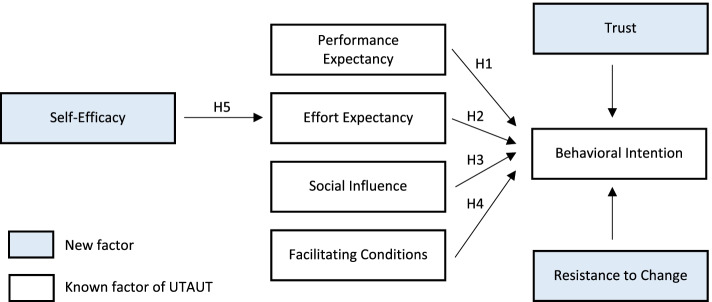
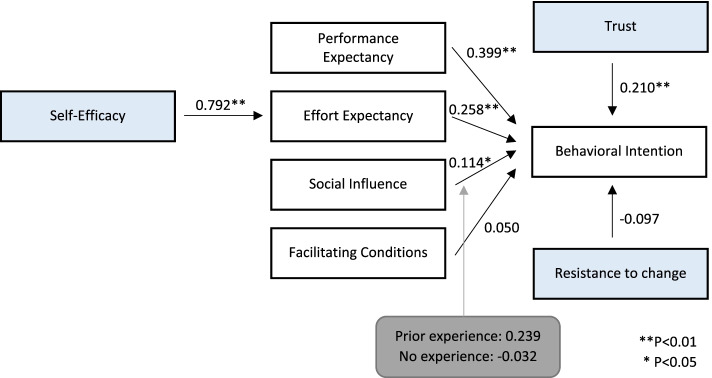
Background: Technological progress in artificial intelligence has led to the increasing popularity of virtual assistants, i.e., embodied or disembodied conversational agents that allow chatting with a technical system in a natural language. However, only little comprehensive research is conducted about patients' perceptions and possible applications of virtual assistant in healthcare with cancer patients. This research aims to investigate the key acceptance factors and value-adding use cases of a virtual assistant for patients diagnosed with cancer. Methods: Qualitative interviews with eight former patients and four doctors of a Dutch radiotherapy institute were conducted to determine what acceptance factors they find most important for a virtual assistant and gain insights into value-adding applications. The unified theory of acceptance and use of technology (UTAUT) was used to structure perceptions and was inductively modified as a result of the interviews. The subsequent research model was triangulated via an online survey with 127 respondents diagnosed with cancer. A structural equation model was used to determine the relevance of acceptance factors. Through a multigroup analysis, differences between sample subgroups were compared. Results: The interviews found support for all factors of the UTAUT: performance expectancy, effort expectancy, social influence and facilitating conditions. Additionally, self-efficacy, trust, and resistance to change, were added as an extension of the UTAUT. Former patients found a virtual assistant helpful in receiving information about logistic questions, treatment procedures, side effects, or scheduling appointments. The quantitative study found that the constructs performance expectancy (ß = 0.399), effort expectancy (ß = 0.258), social influence (ß = 0.114), and trust (ß = 0.210) significantly influenced behavioral intention to use a virtual assistant, explaining 80% of its variance. Self-efficacy (ß = 0.792) acts as antecedent of effort expectancy. Facilitating conditions and resistance to change were not found to have a significant relationship with user intention. Conclusions: Performance and effort expectancy are the leading determinants of virtual assistant acceptance. The latter is dependent on a patient’s self-efficacy. Therefore, including patients during the development and introduction of a VA in cancer treatment is important. The high relevance of trust indicates the need for a reliable, secure service that should be promoted as such. Social influence suggests using doctors in endorsing the VA.
Overview
The claims and statistics of this paper haven’t been checked yet.
Free: it reads the open-access text and checks the first 5 claims that cite a source we can check. Create a free account to check every claim.
Integrity signals
Registry
Cites
Statistics
Figures
Verification
Claims the paper makes
The claims and statistics of this paper haven’t been checked yet.
Free: it reads the open-access text and checks the first 5 claims that cite a source we can check. Create a free account to check every claim.
Claims other papers make about this one
Each is checked against this paper’s own text: does it say what the citing paper says it does?
In the citing paper
“Similarly, a study examining virtual assistants in the health care domain revealed a positive correlation between users’ trust in the technology and their willingness to use it for managing their health [32].”
From Investigating the impact of user trust on the adoption and use of ChatGPT: Survey analysis (2023) · cites this paper as [32]
Self-check
Percentages, sums and reported differences re-computed from the paper’s own numbers.
The self-check needs the paper’s full text.
Citations
Cites
Evaluating structural equation models with unobservable variables and measurement error
Fornell, C., & Larcker, D. F. (1981) · Journal of Marketing Research · doi:10.1177/002224378101800104 · Cited by 109,190 · cited 1×
“The Fornell-Larcker criterion was used for evaluation, specifying that the square root of the average variance extracted for each construct should be higher than its correlations with other constructs [90].”
MethodPodsakoff, P. M., MacKenzie, S. B., Lee, J.-Y., & Podsakoff, N. P. (2003) · Journal of Applied Psychology · doi:10.1037/0021-9010.88.5.879 · Cited by 82,194 · cited 1×
“Firstly, Harman’s one factor test was applied by performing an unrotated principal factor analysis on all the measurement items in our model [93].”
MethodPerceived usefulness, perceived ease of use, and user acceptance of information technology
Davis, F. D. (1989) · MIS Quarterly · doi:10.2307/249008 · Cited by 68,483 · cited 1×
“The weaker effect of effort expectancy compared to performance expectancy fits previous research [128] that found ease of use the secondary motivation to adopt a technology.”
ResultUser Acceptance of Information Technology: Toward A Unified View1
Venkatesh, V., Morris, M. G., Davis, G. B., & Davis, F. D. (2003) · MIS Quarterly · doi:10.2307/30036540 · Cited by 45,035 · cited 8×
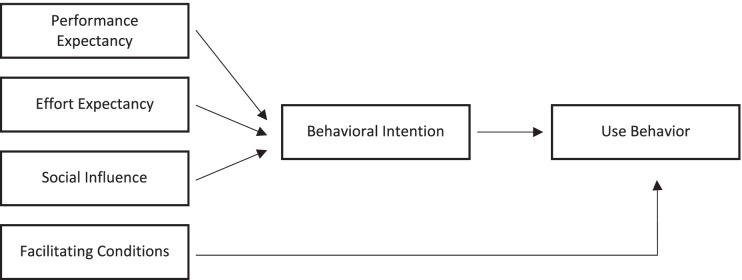
“…refers to the degree to which the participant perceives important others, i.e. the social environment, to advocate using a VA. Fourth, facilitating conditions are the degree to which someone believes organizational and technical resources are in place to assist the use of a technology [51].”
BackgroundMethodResultInfluentialStructural equation modeling in practice: A review and recommended two-step approach
Anderson, J. C., & Gerbing, D. W. (1988) · Psychological Bulletin · doi:10.1037/0033-2909.103.3.411 · Cited by 41,941 · cited 1×
“In the second stage the hypotheses were tested through the proposed structural model [92].”
Method(1998) · Sage eBooks · Cited by 38,631
A new criterion for assessing discriminant validity in variance-based structural equation modeling
Henseler, J., Ringle, C. M., & Sarstedt, M. (2015) · Journal of the Academy of Marketing Science · doi:10.1007/s11747-014-0403-8 · Cited by 38,459 · cited 3×
“This measure was found unsuitable for homogenous loading patterns [91].”
BackgroundMethodInfluentialResearch Design: Qualitative, Quantitative, and Mixed Methods Approaches
Creswell, J. W. (1994) · Cited by 35,508
On the Evaluation of Structural Equation Models
Bagozzi, R. P., & Yi, Y. (1988) · Journal of the Academy of Marketing Science · doi:10.1007/bf02723327 · Cited by 26,163 · cited 1×
“50, indicating that each construct explains more than half of the items’ variance [98, 119].”
Basics of Qualitative Research (3rd ed.): Techniques and Procedures for Developing Grounded Theory
Corbin, J., & Strauss, A. (2008) · SAGE · doi:10.4135/9781452230153 · Cited by 24,827
Research works printed but not linked: 5
- Napitupulu D Yacub R Putra A Factor Influencing of Telehealth Acceptance During COVID-19 Outbreak: Extending UTAUT Model Int J Intell Eng Syst 2021 14 3 267 281
- Reis L Maier C Mattke J Weitzel T Chatbots in Healthcare: Status Quo, Application Scenarios for Physicians and Patients and Future Directions Proceedings of the 28th European Conference on Information Systems (ECIS 2020
- Kock N Common Method Bias in PLS-SEM: A Full Collinearity Assessment Approach Int J E-Collab 2015 11 4 1 10
- Wong KKK Partial Least Squares Structural Equation Modeling (PLS-SEM) Techniques Using SmartPLS Mark Bull 2013 24 1 32
- Shockley-Zalabak P Ellis K Winograd G Organizational Trust: What It Means Why It Matters Organ Dev J 2000 18 4 35 48
Cited by
Choudhury, A., & Shamszare, H. (2023) · doi:10.2196/preprints.47184 · Cited by 473
Investigating the impact of user trust on the adoption and use of ChatGPT: Survey analysis
Choudhury, A., & Shamszare, H. (2023) · Journal of Medical Internet Research · doi:10.2196/47184 · Cited by 470
“Similarly, a study examining virtual assistants in the health care domain revealed a positive correlation between users’ trust in the technology and their willingness to use it for managing their health [32].”
Generative AI in medical practice: in-depth exploration of privacy and security challenges
Chen, Y., & Esmaeilzadeh, P. (2024) · Journal of Medical Internet Research · doi:10.2196/53008 · Cited by 353
“Companies such as Sensely and Woebot Health leverage these techniques to create virtual assistants that explain symptoms, provide health information, and offer screening triage advice through natural dialogue [24].”
Trust in and Acceptance of Artificial Intelligence Applications in Medicine: Mixed Methods Study
Shevtsova, D., Ahmed, A., Boot, I. W. A., Sanges, C., Hudecek, M., Jacobs, J. J. L., Hort, S., & Vrijhoef, H. J. M. (2024) · JMIR Human Factors · doi:10.2196/47031 · Cited by 124
Evaluating privacy, security, and trust perceptions in conversational AI: A systematic review
Leschanowsky, A., Rech, S., Popp, B., & Bäckström, T. (2024) · Computers in Human Behavior · doi:10.1016/j.chb.2024.108344 · Cited by 181
Li, L., Peng, W., & Rheu, M. M. J. (2024) · Telemedicine and e-Health · doi:10.1089/tmj.2023.0313 · Cited by 79
Yang, Y., Ngai, E. W. T., & Wang, L. (2024) · Information & Management · doi:10.1016/j.im.2024.103961 · Cited by 88
Antecedents of intention to use chatbots in service encounters: A meta‐analytic review
Gopinath, K., & Kasilingam, D. (2023) · International Journal of Consumer Studies · doi:10.1111/ijcs.12933 · Cited by 62
Su, J., Wang, Y., Liu, H., Zhang, Z., Wang, Z., & Li, Z. (2025) · Scientific Reports · doi:10.1038/s41598-025-01897-0 · Cited by 98
“…to adopt AMIADS, and it is also an intermediary between existing factors in the UTAUT and behavioral intentions to use AMIADS. van Bussel et al. 42 Virtual assistant UTAUT SEM The Netherlands Performance expectancy, effort expectancy, social influence, and trust significantly influence the…”
InfluentialUsers’ intention to adopt artificial intelligence-based chatbot: a meta-analysis
Li, B., Chen, Y., Liu, L., & Zheng, B. (2023) · Service Industries Journal · doi:10.1080/02642069.2023.2217756 · Cited by 70
Thanthrige, A. N. W., Lu, B., Sako, Z. Z., & Wickramasinghe, N. S. (2025) · Journal of Medical Internet Research · doi:10.2196/64524 · Cited by 63
Trkman, M., Popovič, A., & Trkman, P. (2022) · Government Information Quarterly · doi:10.1016/j.giq.2022.101787 · Cited by 51
Exploring Generative Artificial Intelligence Research: A Bibliometric Analysis Approach
Dwivedi, R., & Elluri, L. (2024) · IEEE Access · doi:10.1109/access.2024.3450629 · Cited by 52
“In short, by using generative AI, healthcare is becoming more efficient, precise, and tailored to each person, opening up new possibilities for how well we can be taken care of and how quickly we can find new treatments [116], [117].”
BackgroundA BERT-Based Chatbot to Support Cancer Treatment Follow-Up
Bappy, A. D., Mahmud, T., Kaiser, M., Hossain, M. S., & Andersson, K. (2024) · Communications in computer and information science · doi:10.1007/978-3-031-68639-9_4 · Cited by 33
He, X., Xi, Z., & Ding, H. (2023) · Journal of Medical Internet Research · doi:10.2196/50342 · Cited by 37
“%) studies [45,46] felt that AI was unable to understand emotion-related issues, especially mental health problems, and 2 (6”
InfluentialMayer, C. J., Mahal, J., Geisel, D., Geiger, E. J., Staatz, E., Zappel, M., Lerch, S. P., Ehrenthal, J. C., Walter, S., & Ditzen, B. (2024) · Computers in Human Behavior · doi:10.1016/j.chb.2024.108419 · Cited by 32
Hou, G., Li, X., & Wang, H. (2024) · Humanities and Social Sciences Communications · doi:10.1057/s41599-024-04232-6 · Cited by 24
“Therefore, trust is the most important factor in fl uencing the intention to use virtual health agents (van Bussel et al. 2022).”
A systematic review of AI-based chatbot usages in healthcare services
Jasim, K. M., Malathi, A., Bhardwaj, S., & Aw, E. C. (2025) · Journal of Health Organization and Management · doi:10.1108/jhom-12-2023-0376 · Cited by 29
Pandey, P., & Rai, A. K. (2023) · FIIB Business Review · doi:10.1177/23197145231196066 · Cited by 24
Deng, W., Yang, T., Deng, J., Liu, R., Sun, X., Li, G., & Wen, X. (2023) · Journal of Medical Internet Research · doi:10.2196/46621 · Cited by 22
“Recent research has also shown that performance expectancy and social influence are key variables in predicting behavioral intentions to use web-based assistants [55], wearable health technologies [56], and other health information systems and technologies [59].”
Cutaneous melanoma in older patients
Buja, A., Rugge, M., Trevisiol, C., Zanovello, A., Brazzale, A. R., Zorzi, M., Vecchiato, A., Fiore, P. D., Tropea, S., Rastrelli, M., et al. (2024) · BMC Geriatrics · doi:10.1186/s12877-024-04806-8 · Cited by 15
Shukla, V. K., Sudhi, M., Shetty, D. K., Banthia, S., Chandrasekar, P., Naik, N., Hameed, B. M. Z., Girisha, S., & Balakrishnan, J. M. (2023) · Engineered Science · doi:10.30919/es1009 · Cited by 19
Root, D. (2024) · AI & Society · doi:10.1007/s00146-024-01953-9 · Cited by 25
“Virtual assistants are a subgenre of chatbots, including Apple's Siri and Amazon's Alexa, which may be used as tools for information retrieval, care delivery, administrative tasks, and other similar operations (van Bussel et al. 2022).”
Patient Attitudes Toward Artificial Intelligence in Cancer Care: Scoping Review
Hilbers, D., Nekain, N., Bates, A. T., & Nuñez, J.-J. (2025) · JMIR Cancer · doi:10.2196/74010 · Cited by 19
Usage Intention of ChatGPT for Health in Turkey: An Extended Technology Acceptance Model
Argan, M., Gürbüz, B., Dursun, M., Dinç, H., & Tokay-Argan, M. (2024) · International journal of human computer interactions · doi:10.1080/10447318.2024.2426045 · Cited by 9
“A study examining patients’ and clinicians’ perceptions of chatbots, especially in the field of healthcare, revealed a relationship between users’ trust in AI-based healthcare chatbot services and their intentions to use them (Van Bussel et al., 2022).”
Borna, S., Gomez-Cabello, C. A., Pressman, S. M., Haider, S. A., Sehgal, A., Leibovich, B. C., Cole, D., & Forte, A. J. (2024) · European Journal of Investigation in Health Psychology and Education · doi:10.3390/ejihpe14050093 · Cited by 26
“This suggests that as virtual assistants become more user-friendly and provide accurate information, they are more likely to be embraced by this patient group [14].”
BackgroundEpizitone, A., Moyane, S. P., & Agbehadji, I. E. (2023) · Journal of Multidisciplinary Healthcare · doi:10.2147/jmdh.s433299 · Cited by 13
Song, L., Li, B., Wu, H., Wu, C., & Zhang, X. (2024) · PLoS ONE · doi:10.1371/journal.pone.0305944 · Cited by 12
Rosli, M. S., Saleh, N. S., Ali, A. M., & Bakar, S. A. (2026) · Journal for STEM Education Research · doi:10.1007/s41979-025-00171-2 · Cited by 14
Tran, M. D., Nguyen, K. H., Nguyen, H. T., Dinh, T. H. N., Leng, H. H. V., Tran, T., Ho, A., Ho, T. B. T., & Nguyen, D. N. (2025) · Higher Education Skills and Work-based Learning · doi:10.1108/heswbl-02-2025-0062 · Cited by 15
Romón, Í., González-Barrera, S., de Portugal, C. C., Ocio, E. M., & Sampedro, I. (2024) · Frontiers in Immunology · doi:10.3389/fimmu.2024.1366962 · Cited by 5
Alanzi, T. M., Almahdi, R., Alghanim, D., Almusmili, L., Saleh, A., Alanazi, S., Alshobaki, K., Attar, R. W., Qunais, A. A. A., Alzahrani, H., et al. (2023) · Cureus · doi:10.7759/cureus.49724 · Cited by 14
“Similar findings can be observed in studies [27-30], which highlighted that the perceived PE, FC, EE, and PI were identified to be strongly associated with the adoption of AI-enabled VAs.”
ResultGitonga, I., Desmond, D. M., & Maguire, R. (2024) · Journal of Cancer Survivorship · doi:10.1007/s11764-024-01615-1 · Cited by 8
Yang, X., Man, D., Yun, K., Zhang, S., & Han, X. (2023) · Research Square · doi:10.21203/rs.3.rs-3493725/v1 · Cited by 6
User Acceptance of Healthcare Robots Through Extended UTAUT2: A Mixed Method ApproachPreprint
Cannavacciuolo, L., Rippa, P., & Caputo, S. L. (2022) · Research Square · doi:10.21203/rs.3.rs-2326113/v1 · Cited by 2
Generative AI Health Assistants in Modern Healthcare: Drivers and Barriers to Adoption
Al-Lataifeh, Z., Harris, M. A., Smith, J., & Chin, A. G. (2025) · Information Systems Frontiers · doi:10.1007/s10796-025-10681-4 · Cited by 8
“HAs provide scalable capabilities to handle complex queries and understand medical terminology, treatment options, and personalized health advice (van Bussel et al., 2022 ).”
Virtual Assistants’ Response to Queries About Nicotine Replacement Therapy: A Mixed-Method Analysis
Amin, S., Uyeda, K., Pagano, I., Tabangcura, K. R., Taketa, R., Kawamoto, C. T., & Pokhrel, P. (2024) · Evaluation & the Health Professions · doi:10.1177/01632787241235689 · Cited by 3
Does Financial Literacy Matter in Cashless Payment Usage?
Bemby, F. A. W., & Qomariyah, A. (2023) · Jurnal Akuntansi dan Keuangan · doi:10.9744/jak.25.2.117-128 · Cited by 16
Yeung, N. C. Y., Lau, S. T. Y., Mak, W. W. S., Cheng, C., Chan, E. Y. Y., Siu, J. Y. M., & Cheung, P. S. Y. (2024) · JMIR Cancer · doi:10.2196/51072 · Cited by 2
“…findings have also been reported regarding the prediction of the acceptance of cancer patients in the Netherlands to use a virtual assistant in health care settings [49] and the acceptance of using a digital cardiac rehabilitation tool among patients with ischemic heart disease in Germany [50].”
BackgroundImpact of Artificial Intelligence on the Care of Terminally Ill Patients
Gonçalves, F., Gaudêncio, M., Nunes, S. B., Rêgo, F. M. P. D. S., & Nunes, R. (2026) · Healthcare · doi:10.3390/healthcare14050602 · Cited by 3
“Van Bussel et al. studied the factors that influenced the potential acceptance of a virtual assistant and found that performance, effort, and trust were key in the acceptance decision of the server [88].”
Artificial Intelligence in Medical Practice: A Comprehensive Overview
Kabilan, T. (2024) · International Journal of Science and Research (IJSR) · doi:10.21275/sr24720091104 · Cited by 2
Sakib, M. N., Islam, M., Fahlevi, M., Rahman, M. S., Younus, M., & Rahman, M. M. (2025) · Computers in Human Behavior Artificial Humans · doi:10.1016/j.chbah.2025.100204 · Cited by 10
Ghosh, R., You, C., Venkatakrishnan, R., & Lok, B. C. L. (2025) · International Conference on Human-Agent Interaction (HAI) · doi:10.1145/3765766.3765769 · Cited by 1
Chopra, R., Bhardwaj, S., & Arya, V. (2026) · Journal of Information Communication and Ethics in Society · doi:10.1108/jices-05-2025-0106 · Cited by 1
Yan, L., Bai, X., Lin, X., Lai, J., Sun, S., Chen, H., Liu, R., & Hu, R. (2026) · Healthcare · doi:10.3390/healthcare14070945 · Cited by 1
“This result supports the idea that perceived benefits are a core driver of adoption intention, a finding consistent with prior research on technology acceptance among patient groups [68].”
Lucchini, A., Bozzon, A., & Colombo, S. (2026) · CHI Conference on Human Factors in Computing Systems · doi:10.1145/3772318.3790698 · Cited by 2
Han, S. (2023) · Journal of innovation and development · doi:10.54097/jid.v2i2.6394 · Cited by 3
Thanthrige, A. N. W., Wickramasinghe, N. S., Lu, B., & Sako, Z. Z. (2024) · doi:10.2196/preprints.64524 · Cited by 1
Shen, Z., Shi, S., Mao, L., Li, C., & Xie, J. (2026) · Journal of Medical Internet Research · doi:10.2196/105599 · Cited by 2
Yang, X., Man, D., Yun, K., Zhang, S., & Han, X. (2023) · doi:10.2196/preprints.46626
"ChatGPT Goes to the Radiation Oncology Oral Board Exam"
Barbour, A. B. (2023) · Biomedical Journal of Scientific & Technical Research · doi:10.26717/bjstr.2023.52.008190
XXIX Italian Melanoma Intergroup National Congress | 29 September - 1 October 2023, Naples (Italy)
Intergroup, I. M. (2024) · Dermatology Reports · doi:10.4081/dr.2024.9975
Epizitone, A. (2024) · DUT Open Scholar (Durban University of Technology) · doi:10.51415/10321/5295
Yang, X., Man, D., Yun, K., Zhang, S., & Han, X. (2024) · doi:10.2196/preprints.63803
Patient Attitudes Toward Artificial Intelligence in Cancer Care: A Scoping ReviewPreprint
Hilbers, D., Nekain, N., Bates, A. T., & Nuñez, J.-J. (2025) · medRxiv · doi:10.1101/2025.03.15.25324029
“39,47,48 Future research should aim to incorporate more geographically diverse populations to ensure that AI implementation strategies reflect the values, concerns, and trust levels of patients across different healthcare settings.”
Understanding the Role of Training for Trust in AI-Based Cybersecurity
Gafni, R., & Aviv, I. (2025) · Informing Science and IT Education Conference · doi:10.28945/5576
AI-Based Chatbots for Education: A Framework for Ethical and Social Perspectives
Sivathanu, B., Nannaware, S. C., Pillai, R., & Abidi, N. (2025) · Advances in computational intelligence and robotics book series · doi:10.4018/979-8-3373-2185-1.ch007 · Cited by 1
Cabañero, C. P., Caemmerer, B., & Vizcarra, A. (2026) · Information and Computer Security · doi:10.1108/ics-07-2025-0231 · Cited by 1
Agent-Based Heuristics for Emotion Recognition in Mental Health
Tanguturi, M., Pulastya, G., Katakam, R. A., & Radha, D. (2026) · Lecture notes in networks and systems · doi:10.1007/978-3-032-18138-1_10
Luo, T., Tang, Q., Lu, J., Wang, A., Chen, G., Du, L., Chen, Y., & Li, Z. J. (2026) · BMC Health Services Research · doi:10.1186/s12913-026-14884-6
“Recent research has consistently highlighted the pivotal role of performance expectancy as a key variable in predicting behavioral intention to use internet hospitals [14], web-based assistants [67], and wearable health technologies [68].”
Laviola, F. A., Palese, B., Kim, S. T., & Cucari, N. (2026) · European Research on Management and Business Economics · doi:10.1016/j.iedeen.2026.100327
Metadata
- Authors
- van Bussel, M. J. P., Odekerken–Schröder, G. J., Ou, C., Swart, R. R., & Jacobs, M. J. G.
- Affiliations
- Tilburg University (NL)
- Maastricht University Medical Centre (NL)
- Venue
- BMC Health Services Research
- Published
- 2022-07-09
- Volume
- 22
- Issue
- 1
- Pages
- 890-890
- ISSN
- 1472-6963 (ISSN-L)
- PMC
- PMC9270807
- OpenAlex
- W4284965683
- Cited by
- 60
- References
- 132
- Citations by year
- 2026: 10 · 2025: 11 · 2024: 22 · 2023: 15 · 2022: 2
- FWCI
- 10.47
- Type
- journal article
- Language
- en
- Open access
- gold
- doi.org
- Licence
- cc-by
- creativecommons.org/licenses/by/4.0 (tdm)
- creativecommons.org/licenses/by/4.0 (vor)
- Locations
- BMC Health Services Research (publishedVersion, cc-by)
- PubMed Central (publishedVersion, cc-by)
- Research portal (Tilburg University) (publishedVersion, other-oa)
- Tilburg University Research Portal (publishedVersion, other-oa)
- PubMed (publishedVersion)
- Research Publications (Maastricht University) (publishedVersion, cc-by)
- Data Archiving and Networked Services (DANS) (submittedVersion, other-oa)
- DOAJ (DOAJ: Directory of Open Access Journals) (submittedVersion, cc-by-sa)
- Research Publications (Maastricht University) (submittedVersion, other-oa)
- Topics
- Social Sciences › Decision Sciences › Information Systems and Management › Technology Adoption and User Behaviour
- Health Sciences › Health Professions › General Health Professions › Mobile Health and mHealth Applications
- Health Sciences › Medicine › Public Health, Environmental and Occupational Health › Telemedicine and Telehealth Implementation
- Keywords
- virtual assistants, chatbots, cancer patients, technology acceptance, UTAUT, self-efficacy, trust, performance expectancy, effort expectancy, social influence, resistance to change, behavioral intention, radiotherapy, patient information
- MeSH terms
- Artificial Intelligence, Humans, Models, Theoretical, Neoplasms, Surveys and Questionnaires, Technology, Intention
About these checks
Registry, retraction, Cites and statistics results are computed, not judged, with one exception: a printed reference that no index lists is read once by a model before it counts as a citation error. Claims are extracted by a model and kept only when their quote appears verbatim in the text; each cited source is then checked, with a model’s help, for whether it says what the claim relies on. Those verdicts can be wrong — read the claim’s quote and the cited source before relying on one.
Statistics and arithmetic are recomputed, not judged.
Confidence bands are shown only for fields calibrated on our annotated test set. None is calibrated yet, so no band is shown.
What counts as a claim ›How we measure confidence ›How we check this ›
Are you an author, or do you see a problem with this page? Request a review
Data sources
Bibliographic data: Semantic Scholar, OpenAlex, Crossref.
Contains information from the Semantic Scholar Academic Graph Datasets, made available under the ODC Attribution License (ODC-BY 1.0).
Semantic Scholar’s data is described in: Kinney, R., et al. (2023). The Semantic Scholar Open Data Platform. arXiv:2301.10140.
