

Challenges to implementing artificial intelligence in healthcare: a qualitative interview study with healthcare leaders in Sweden
Open accessThe DOI matches its Crossref record; 72 of the 72 references it cites were found in a registry or an index.
Abstract
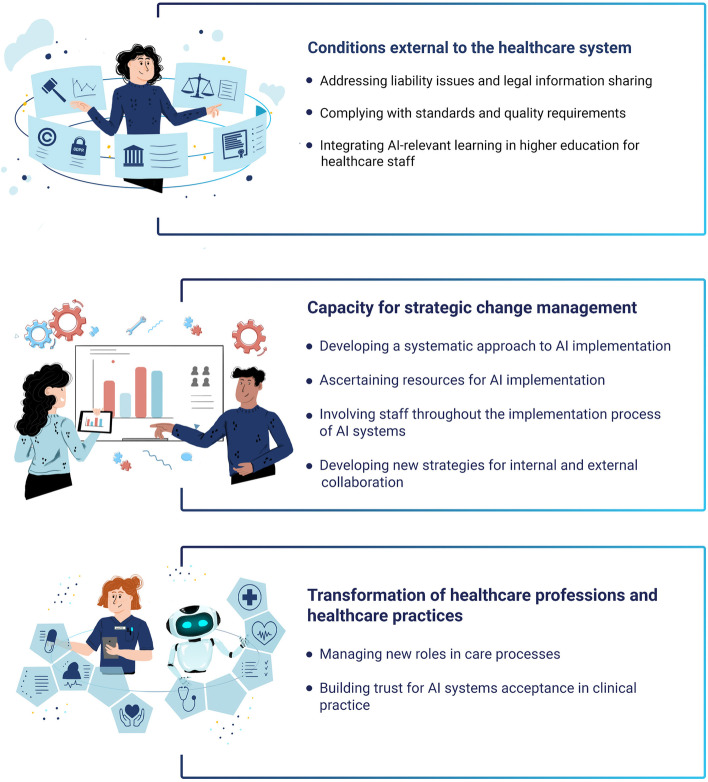
Background: Artificial intelligence (AI) for healthcare presents potential solutions to some of the challenges faced by health systems around the world. However, it is well established in implementation and innovation research that novel technologies are often resisted by healthcare leaders, which contributes to their slow and variable uptake. Although research on various stakeholders’ perspectives on AI implementation has been undertaken, very few studies have investigated leaders’ perspectives on the issue of AI implementation in healthcare. It is essential to understand the perspectives of healthcare leaders, because they have a key role in the implementation process of new technologies in healthcare. The aim of this study was to explore challenges perceived by leaders in a regional Swedish healthcare setting concerning the implementation of AI in healthcare. Methods: The study takes an explorative qualitative approach. Individual, semi-structured interviews were conducted from October 2020 to May 2021 with 26 healthcare leaders. The analysis was performed using qualitative content analysis, with an inductive approach. Results: The analysis yielded three categories, representing three types of challenge perceived to be linked with the implementation of AI in healthcare: 1) Conditions external to the healthcare system; 2) Capacity for strategic change management; 3) Transformation of healthcare professions and healthcare practice. Conclusions: In conclusion, healthcare leaders highlighted several implementation challenges in relation to AI within and beyond the healthcare system in general and their organisations in particular. The challenges comprised conditions external to the healthcare system, internal capacity for strategic change management, along with transformation of healthcare professions and healthcare practice. The results point to the need to develop implementation strategies across healthcare organisations to address challenges to AI-specific capacity building. Laws and policies are needed to regulate the design and execution of effective AI implementation strategies. There is a need to invest time and resources in implementation processes, with collaboration across healthcare, county councils, and industry partnerships.
Overview
The claims and statistics of this paper haven’t been checked yet.
Free: it reads the open-access text and checks the first 5 claims that cite a source we can check. Create a free account to check every claim.
Integrity signals
Registry
Cites
Statistics
Figures
Verification
Claims the paper makes
The claims and statistics of this paper haven’t been checked yet.
Free: it reads the open-access text and checks the first 5 claims that cite a source we can check. Create a free account to check every claim.
Claims other papers make about this one
Each is checked against this paper’s own text: does it say what the citing paper says it does?
The source backs part of the claim, not all of it — or backs it for a different population, condition or comparison.
In the citing paper
“This shared perspective resonates with prior research, underlining nurses' enthusiasm in exploring the potential contributions of AI to nursing practice [14,54].”
From Artificial intelligence in future nursing care: exploring perspectives of nursing professionals - a descriptive qualitative study (2024) · cites this paper as [54]
Experimental — accuracy not yet measuredThe source backs part of the claim, not all of it — or backs it for a different population, condition or comparison.
In the citing paper
“The availability of high-quality and annotated datasets is essential for training robust ML programs, but access to these datasets is often restricted due to patient privacy and security concerns [38].”
From Machine Learning in Maternity: Early Diagnosis of Placenta Accreta Spectrum (2026) · cites this paper as [38]
Experimental — accuracy not yet measuredThe cited source says what the claim attributes to it.
In the citing paper
“Effective implementation also depends on clinician training, as many ML tools require a foundational understanding of algorithmic outputs and limitations [38].”
From Machine Learning in Maternity: Early Diagnosis of Placenta Accreta Spectrum (2026) · cites this paper as [38]
In the citing paper
“Moreover, the participants' acknowledgment of the necessity for comprehensive training and continuous skill enhancement in AI integration is harmonious with research emphasizing the pivotal role of nursing education in effectively harnessing AI technologies [54].”
From Artificial intelligence in future nursing care: exploring perspectives of nursing professionals - a descriptive qualitative study (2024) · cites this paper as [54]
Self-check
Percentages, sums and reported differences re-computed from the paper’s own numbers.
The self-check needs the paper’s full text.
Citations
Cites
Tong, A., Sainsbury, P., & Craig, J. (2007) · International Journal for Quality in Health Care · doi:10.1093/intqhc/mzm042 · Cited by 42,509
Content Analysis: An Introduction to its Methodology.
Shelley, M., & Krippendorff, K. (1984) · Journal of the American Statistical Association · doi:10.2307/2288384 · Cited by 24,312
Graneheim, U. H., & Lundman, B. (2004) · Nurse Education Today · doi:10.1016/j.nedt.2003.10.001 · Cited by 20,772 · cited 1×
“In qualitative research, the concepts credibility, dependability, and transferability are used to describe different aspects of trustworthiness [72].”
Damschroder, L. J., Aron, D. C., Keith, R. E., Kirsh, S. R., Alexander, J. A., & Lowery, J. C. (2009) · Implementation Science · doi:10.1186/1748-5908-4-50 · Cited by 14,496 · cited 4×
“Our results relate well to the implementation science literature, identifying implementation challenges attributable to both external and internal conditions and circumstances [37, 68, 69] and the characteristics of the innovation [37, 63].”
BackgroundMethodResultInfluentialHigh-performance medicine: the convergence of human and artificial intelligence
Topol, E. J. (2019) · Nature Medicine · doi:10.1038/s41591-018-0300-7 · Cited by 10,450 · cited 1×
“Leader 9.”
Artificial intelligence in healthcare: past, present and future
Jiang, F., Jiang, Y., Zhi, H., Dong, Y., Li, H., Ma, S., Wang, Y., Dong, Q., Shen, H., & Wang, Y. (2017) · Stroke and Vascular Neurology · doi:10.1136/svn-2017-000101 · Cited by 4,837
The potential for artificial intelligence in healthcare
Davenport, T., & Kalakota, R. (2019) · Future Healthcare Journal · doi:10.7861/futurehosp.6-2-94 · Cited by 3,800 · cited 2×
“Even if the expectations for AI in healthcare are great [2], the potential of its use in healthcare is far from having been realized [5, 11, 12].”
BackgroundGluesing, J. C. (2012) · Leadership in Science and Technology: A Reference Handbook · doi:10.4135/9781412994231.n14 · Cited by 3,210
Methodological challenges in qualitative content analysis: A discussion paper
Graneheim, U. H., Lindgren, B.-M., & Lundman, B. (2017) · Nurse Education Today · doi:10.1016/j.nedt.2017.06.002 · Cited by 3,195
Cited by
Items 501–600 of 624
Horestani, M. K., Azimian, H. R., Ahmadnia, M., Shakerian, K., Azimian, Z., & Shakerian, B. (2026) · Journal of Multidisciplinary Care · doi:10.34172/jmdc.1410
Purandare, S. (2024) · African Journal of Biomedical Research · doi:10.53555/ajbr.v27i1.8334
Artificial Intelligence in the Healthcare Market: Opportunities and Threats
Szalonka, K., Blicharz, J. R., Błoński, K., Nowak, W., Wiśniewski, T., Żak, K., & Szalonka, A. (2026) · Productivity Press eBooks · doi:10.4324/9781003743804
Alami, H., Rivard, L., Niang, M., Savoldelli, M., Pérez, E. J., Sabio, R. P., Ahmed, M. A. A., & Dutech, M. (2026) · AI & Innovation · doi:10.20944/preprints202509.2222.v1
Riipa, M. B., Alam, M. S., Rony, M. K. K., Sizan, A. A., Dhar, S. R., Aric, M. S. H., Toma, J. A., Ahmed, H., & Sabeena, A. A. (2026) · Journal of Evaluation in Clinical Practice · doi:10.1111/jep.70717
Bridging gaps in health artificial intelligence: challenges in MDPI research articles
Bastian, I., Musyaffa, A. R., Nulhakim, L., Bahirah, N. P., & Dewi Agushinta, R. (2026) · IAES International Journal of Artificial Intelligence · doi:10.11591/ijai.v15.i4.pp3053-3067
Percepción y Adopción de la Inteligencia Artificial en una Institución Pública de Salud
Zepeda-Lugo, C., Castro, J. R. R., & Insfran-Rivarola, A. (2026) · Ciencia y reflexión : · doi:10.70747/cr.v5i2.1050
The use of artificial intelligence in assessing fever in the returning traveller: A scoping review
Gandhi, B., Morjaria, L., Illamperuma, I., Bhatt, M., & Kapoor, A. K. (2026) · PLOS Digital Health · doi:10.1371/journal.pdig.0001742
Sides, T. (2026) · Open Research Online (The Open University) · doi:10.21954/ou.ro.00109947
Alam, A. N. M. S., Rabbani, M. G., Hossain, G., & Prybutok, V. R. (2026) · Journal of Enterprise Information Management · doi:10.1108/jeim-06-2026-1124
Τεχνητή νοημοσύνη και βιωσιμότητα
Κατωμέρη, Σ. (2025) · Dione (University of Piraeus)
Signature patterns in digital representations of health before acute illness
Post, B. (2024) · Spiral (Imperial College London) · doi:10.25560/149050
Tekoäly kotihoidon asiakkaiden terveysriskien tunnistamisen ja hoitotyön päätöksenteon tukena
Turunen, J. (2025) · Theseus (Ammattikorkeakoulujen)
Využití umělé inteligence a vysvětlitelné umělé inteligence v biomedicíně: Klinická aplikace a výzvy
Mikulec, R. (2026) · DSpace VŠB-TUO (VŠB-TUO)
Gupta, P., & Roy, S. (2025) · Vidhyayana · doi:10.58213/vidhyayana.v10isi3.2223
Sustainable development and Health Sciences
Torres, E. R., Cardozo, G. T., & Gallego, T. A. C. (2023) · Health Leadership and Quality of Life · doi:10.56294/hl2023216
Etika Profesi Insinyur di Era Kecerdasan Buatan: Tantangan dan Tanggung Jawab Moral
Mukhlisin, M. (., Faraby, M. D. (., & Saraswati, R. A. (. (2025) · Neliti
Kaweekijmanee, K., & Chotchakornpant, K. (2025) · Local Administration Journal
Hosseine, M. M., & Demirovic, E. (2025) · DiVA (Digitala Vetenskapliga Arkivet)
The Influence of AI-Literate Leadership on AI Adoption in Healthcare Organizations
Almuhrij, A. (2025) · Scholarship - Claremont (Claremont Colleges) · doi:10.5642/cguetd.mnob8776
Mashhourinejad, P., Yeung, D. F., Tsang, M., Tsang, T. S. M., Gin, K., Jue, J., Sayre, E. C., & Luong, C. L. (2026) · CJC Open · doi:10.1016/j.cjco.2026.02.001
Dyer, S. S., Shannon, E., & Kraemer, J. (2026) · Cureus · doi:10.7759/cureus.107157
Asrar Mansoor Alrajhi, M. F. H. H., Hashim, F. H., Kashmeri, M. Y., Alshallqiti, A. M., Hakami, A. M., Alsulami, M. M., Alharbi, A. T., Fallatah, A. O., & Alghamdi, M. (2026) · The Review of Diabetic Studies · doi:10.70082/adc9ed59
McSwain, D. B. (2026) · Digital Commons - Gardner-Webb University (Gardner–Webb University)
Balancing Optimism with Strategy: Leadership in Public Sector Automation
Forsgren, M., Tafvelin, S., Stenling, A., & Haake, U. (2025) · Nordic Journal of Working Life Studies · doi:10.18291/njwls.161335
Jämförande analys av förklarande modeller för kliniska beslutsstödsystem
Ahmed, S. S. (2025) · Doria (University of Helsinki)
A collective case study of shared implementation leadership in nursing
Castiglione, S. A. (2025) · eScholarship@McGill (McGill) · doi:10.82308/1869
Hellstadius, C., & Tönnesen, E. (2025) · DiVA (Stockholm University)
Galetin, M., & Младенов, М. (2025) · Pravo - teorija i praksa · doi:10.5937/ptp2504042g
Ma, J. (2025) · Montana State University ScholarWorks (Montana State University)
Optimization of Emergency Services at Hospital Beatriz Ângelo
Falcato, M. M. C. (2025) · Portuguese National Funding Agency for Science, Research and Technology (RCAAP Project by FCT)
Norouzi, S. (2026) · DalSpace (Dalhousie University)
Digital Health and Wireless Solutions: Towards Trustworthy and Person-Centric Digital Health
Särestöniemi, M., Singh, D., Jarva, E., & Reponen, J. (2026) · Communications in computer and information science · doi:10.1007/978-3-032-28812-7
Framtida utvecklingsbehov för digitala vårdlösningar inom välfärdskontext
Williamsson, H. (2025) · Doria (University of Helsinki)
Björk, W. (2026) · Doria (University of Helsinki)
Contributions to AI research online diabetes diet consultation using an integrative cloud system
Shrivastava, V., & Tyagi, M. (2023) · International Journal of Engineering in Computer Science · doi:10.33545/26633582.2023.v5.i2a.114
Artificial Intelligence in Healthcare
Jansari, V. G. (2025) · Wiley eBooks · doi:10.1002/9781394257096.ch05
Artificial Intelligence Solutions in Finnish Health-Tech SMEs: Usage, Needs, and Challenges
Alnajjar, M. (2023) · Theseus (Ammattikorkeakoulujen)
Oad Fält, T. (2025) · DiVA (Linnaeus University)
AI-driven diagnostics: accuracy vs. ethical considerations
Ayoubi, S. (2025) · Theseus (Ammattikorkeakoulujen)
Tekoälyn vaikutukset terveydenhuollon johtamiseen : scoping review kirjallisuuskatsaus
Karlsson, A. (2024) · Theseus (Ammattikorkeakoulujen)
Transforming Public Healthcare through MedTech: A Multi-Method Qualitative Research
Kataria, A., Garg, R. J., Agrawal, G., & Sharma, D. (2026) · Health Marketing Quarterly · doi:10.1080/07359683.2026.2758036
Tobar, S. K. (2026) · Journal of Nursing Management · doi:10.1155/jonm/4870265
Automation to Innovation: How Ai Is Reshape Business Strategies and Economic Outcomes
Talluri, A. (2025) · European Economic Letters (EEL)
Key Challenges and Limitations of AI in Healthcare
Saxena, A. (2026) · International Journal for Research in Applied Science and Engineering Technology · doi:10.22214/ijraset.2026.82218
Muin, A., Afif, M., Hilmiyati, F., Ansori, A., & Wazin, W. (2026) · eJournal of Sunan Gunung Djati State Islamic University (Sunan Gunung Djati State Islamic University) · doi:10.15575/jpi.v12i2.51049
The challenges and opportunities of implementing AI in healthcare in the Västra Götaland region?
Yildirim, I. (2024) · University Library of Skövde (University of Skövde)
Synergies in streamlining: AI and Lean Management in Polish healthcare administration
Garski, J., & Walkowiak, D. (2026) · Scientific Reports · doi:10.1038/s41598-026-76304-3
Exploring human–AI collaboration for management control in public healthcare
Camilli, R., & Sforza, V. (2026) · International Journal of Public Sector Management · doi:10.1108/ijpsm-07-2026-0482
Abbas, S., Arif, A. R., & Asif, A. (2025) · Annual Methodological Archive Research Review · doi:10.63075/2daja711
Artificial intelligence and nursing in remote areas
Chingono, C. T., & Mhlanga, D. (2025) · Theseus (Ammattikorkeakoulujen)
Tekoälyn integroiminen sydän- ja verisuonitautien hoitoon
Ristolainen, E. (2025) · Tampere University Institutional Repository (Tampere University)
Talal Jahaz Almutairi, M. M. D. A., Essam Hamad Alhaisouni, B. M. G. A., & Faisal Mohammed S Alahmadi, T. A. A. (2024) · Evolutionary Studies in Imaginative Culture
Reconstructive surgery:Risk factors, outcomes and advanced indications
Sparenberg, S. (2024) · UvA-DARE (University of Amsterdam)
Artificiell Intelligens i sjukvården : Fördelar och utmaningar
O'Gorman, J., & Turesson, L. (2024) · DiVA (Linnaeus University)
Investigating Context in How Clinicians Make Sense of AI: Qualitative Interview Study
Mingels, S. M. B., Piehl, H., Fijten, R., Janssen, R., & Penders, B. (2026) · JMIR Human Factors · doi:10.2196/99117
Akmaikina, A. (2025) · Tampere University Institutional Repository (Tampere University)
Tillämpade intelligenta system inom välfärdsteknologi och digital hälsa. Nulägesanalys
Öling-Wärnå, V., & Westö, J. (2023) · Theseus (Ammattikorkeakoulujen)
Vision 2030–Aligned Governance Framework for Ethical Generative AI Adoption in Saudi Insurance
Albaroudi, E., Hejazi, S., Ahmed, I., Elbehairy, M., Hinnawi, M. N. E. A., & Hatamleh, M. (2026) · International Women in Data Science Conference at Prince Sultan University (WiDS PSU) · doi:10.1109/widspsu69342.2026.00024
Supporting information 2 of Implementing AI in healthcare—the relevance of trust: a scoping review
Steerling, E., Siira, E., Nilsen, P., Svedberg, P., & Nygren, J. (2023) · doi:10.3389/frhs.2023.1211150.s002
Self-citationThe impact of Artificial Intelligence on medicine: Applications, challenges and perspectives
Nava, C. F. G., Filho, D. R. S., Rodrigues, J. A. D. M., Alves, S. B., Bezerra, P. S., Barbosa, L. C., & Pinto, A. M. D. S. (2024) · International Journal of Science and Research Archive · doi:10.30574/ijsra.2024.13.2.2556
AI in helathcare 5.0: Opportunities and challenges
(2023) · International Research Journal of Modernization in Engineering Technology and Science · doi:10.56726/irjmets45942
Proceedings of the 7th National Big Data Health Science Conference
(2026) · BMC Proceedings · doi:10.1186/s12919-026-00400-5
Mejbel, M. K. (2026) · GPH-International Journal of Biological & Medicine Science · doi:10.5281/zenodo.23237036
Espérance, A. (2023) · KTH Publication Database DiVA (KTH Royal Institute of Technology)
Gbolahan Solomon, O. S. H. O., DIELI, O. J., Opara, E. U., & JUNAID, O. (2026) · Health Economics and Management Review · doi:10.61093/hem.7(3).37-50.2026
Galligani, I., & Ziglioli, G. (2026) · Edward Elgar Publishing eBooks · doi:10.4337/9781035361229.00018
Management and leadership in primary health care
Σοφία, Π. Α., & Σοφία, Π. Α. (2025) · University of Thessaly Institutional Repository (University of Thessaly)
AI translation tools and linguistic inclusion in healthcare
Praet, E. V., Delegrange, M., Decock, P., Debal, B., Smet, J., Wiest, F. D., & Bauwens, M. (2026) · Taal en tongval · doi:10.5117/tet2026.2.006.prae
Assessing the limitations of in-app interventions in addressing LLM-generated health misinformation
Riquelme, V., Balloli, V., Adam, H., Li, X., Miles, C., Solomon, L. M., Southworth, E., Peahl, A. F., Ghassemi, M., & Bondi, E. (2026) · Machine Learning Health · doi:10.1088/3049-477x/aea422
Salas, M. K., Masluhah, & Mahrus (2025) · MORFAI JOURNAL · doi:10.54443/morfai.v5i2.2939
Alam, M. Z., Halder, J. P., Sukhi, R. A., & Khatun, M. M. (2024) · Umsida Repository (Universitas Muhammadiyah Sidoarjo)
An empirical study on the use of AI for requirements engineering in Healthcare Projects
Ullah, A. (2025) · Tampere University Institutional Repository (Tampere University)
INTEGRATING EXCELLENCE: ENHANCING QUALITY OF CARE THROUGH HEALTHCARE SPECIALTIES COLLABORATION
Alotaibi, S. M. F., Alsubaie, B. A., Alshalawi, E. S., Almutairi, R. N., Al-Anazi, M. A. M., Aldawood, F., Abdullah, H. A. A., Alyateem, K. A., Alnas, F. A., Alotaibi, M. A. M., et al. (2022) · doi:10.53555/jptcp.v29i04.5953
Roksela, A. (2024) · Digital Library of the Silesian University of Technology (Silesian University of Technology)
Bridging Medical Licensing and Spatial Information: An Interactive WebGIS for Medan City
Sinaga, M. A. P., Lubis, H., Jalerajabi, P., & İbrahimov, T. (2026) · GeoEdu Insight Journal Geography and Education Geography · doi:10.37251/gedij.v1i2.3980
Faheem, M., & Iqbal, A. (2025) · International Journal of Science and Research Archive · doi:10.30574/ijsra.2025.16.1.2022
Rashvand, H., & Naderinasab, M. (2024) · Longevity · doi:10.61838/kman.longevity.2.3.4
Designing the optimal annual performance review for nurses: What is still missing?
Nashwan, A. J., & El‐Sayed, M. M. (2026) · Nursing · doi:10.1097/nsg.0000000000000359
AI Interview Assessment System
Holambe, S. R. P. D. S. N. (2026) · International Journal of Engineering Research and Science & Technology
Coce, N., Prutki, M., Filipović-Grčić, L., Mandić, T., & Kuhtić, I. (2024) · Liječnički vjesnik · doi:10.26800/lv-146-9-10-4
Game‐Theoretic Data‐Driven Sports Medicine
Singh, K., Gupta, A., Rajwar, K., Narooka, P., & Singh, S. (2026) · Wiley eBooks · doi:10.1002/9781394486472.ch23
Beyond Bedside Implementation: Why Procurement and Vendor Management Matter for Sustainable AI
Yu, L. (2026) · Nursing and Health Sciences · doi:10.1111/nhs.70384
Arginteanu, A.-M., Manea, D., & Belean, A. C. (2025) · New Trends in Sustainable Business and Consumption · doi:10.24818/basiq/2025/11/043
Duo, R., & Renó, B. (2025) · Anais do Congresso Brasileiro de Iniciação Científica · doi:10.5281/zenodo.17816658
กระบวนการนำนวัตกรรมปัญญาประดิษฐ์สำหรับวิเคราะห์ภาพถ่ายเอกซเรย์ทรวงอก มาใช้ในโรงพยาบาลรัฐของไทย
Kaweekijmanee, K., & Chotchakornpant, K. (2024) · Journal of Humanities and Social Sciences Nakhon Phanom University
O setor das farmácias comunitárias em Portugal : qual o papel do canal Online?
Carvalho, M. P. S. V. D. (2023) · Portuguese National Funding Agency for Science, Research and Technology (RCAAP Project by FCT)
Reply to: “AI Technologies for Patients With Immune-Related Adverse Events”
O’Reilly, D., O’Leary, C., & Naidoo, J. (2025) · Journal of Thoracic Oncology · doi:10.1016/j.jtho.2025.01.004
Towards Reliable Clinical Applications of AI Models in Radiotherapy
Wang, B. (2025) · SMU Scholar (Southern Methodist University)
New possibilities of application of computer tools and mathematical models
Стојановић, К. Н. (2026) · National Repository of Dissertations in Serbia
Qingyuan Xie1, 2. (2024) · Frontiers in Sport Research · doi:10.25236/fsr.2024.060410
POPULATION HEALTH BREAKTHROUGHS: HARNESSING AI FOR PREDICTIVE PUBLIC HEALTH OUTCOMES
Sitaraman, S. (2024) · INTERNATIONAL JOURNAL OF RESEARCH IN COMPUTER APPLICATIONS AND INFORMATION TECHNOLOGY · doi:10.34218/ijrcait_07_02_178
Surodina, S., Volkova, D., Abdul‐Rahman, A., & Borgo, R. (2025) · SSRN Electronic Journal · doi:10.2139/ssrn.5108312
Artificial intelligence in modern neurosurgery: new perspectives of laminoplasty
Urtaev, A. I., & Иваненко, А. В. (2024) · Российский нейрохирургический журнал им профессора А Л Поленова · doi:10.56618/2071-2693_2024_16_2_211
Metadata
- Authors
- Petersson, L., Larsson, I., Nygren, J. M., Nilsen, P., Neher, M., Reed, J. E., Tyskbo, D., & Svedberg, P.
- Affiliations
- Halmstad University (SE)
- Corresponding author
- Petersson, Lena
- ORCID
- Venue
- BMC Health Services Research
- Published
- 2022-07-01
- Volume
- 22
- Issue
- 1
- Pages
- 850-850
- ISSN
- 1472-6963 (ISSN-L)
- PMC
- PMC9250210
- OpenAlex
- W4283749268
- Semantic Scholar
- bb678afa2685e6493f9875b66ac2b32dce5e7e9b
- Cited by
- 434
- References
- 72
- Citations by year
- 2026: 85 · 2025: 170 · 2024: 133 · 2023: 42 · 2022: 4
- FWCI
- 26.31
- Type
- journal article
- Language
- en
- Open access
- gold
- doi.org
- Licence
- cc-by
- creativecommons.org/licenses/by/4.0 (tdm)
- creativecommons.org/licenses/by/4.0 (vor)
- Locations
- BMC Health Services Research (publishedVersion, cc-by)
- PubMed Central (publishedVersion, cc-by)
- PubMed (publishedVersion)
- Hogskolan Ihalmstad (Halmstad University) (submittedVersion, other-oa)
- DiVA (Linkoping University) (submittedVersion, other-oa)
- DOAJ (DOAJ: Directory of Open Access Journals) (submittedVersion)
- Funders
- VINNOVA (grant 2019-04526)
- Knowledge Foundation, Sweden (grant 20200208 01H)
- Carl Bennet AB (L2013/77)
- Halmstad University
- Topics
- Health Sciences › Medicine › Health Informatics › Artificial Intelligence in Healthcare and Education
- Health Sciences › Health Professions › General Health Professions › Health Policy Implementation Science
- Physical Sciences › Computer Science › Artificial Intelligence › Artificial Intelligence Applications
- Keywords
- artificial intelligence in healthcare, AI implementation, healthcare executives, implementation barriers, change management, health professions, implementation strategies
- MeSH terms
- Artificial Intelligence, Delivery of Health Care, Health Facilities, Humans, Sweden, Qualitative Research
About these checks
Registry, retraction, Cites and statistics results are computed, not judged, with one exception: a printed reference that no index lists is read once by a model before it counts as a citation error. Claims are extracted by a model and kept only when their quote appears verbatim in the text; each cited source is then checked, with a model’s help, for whether it says what the claim relies on. Those verdicts can be wrong — read the claim’s quote and the cited source before relying on one.
Statistics and arithmetic are recomputed, not judged.
Confidence bands are shown only for fields calibrated on our annotated test set. None is calibrated yet, so no band is shown.
What counts as a claim ›How we measure confidence ›How we check this ›
Are you an author, or do you see a problem with this page? Request a review
Data sources
Bibliographic data: Semantic Scholar, OpenAlex, Crossref.
Contains information from the Semantic Scholar Academic Graph Datasets, made available under the ODC Attribution License (ODC-BY 1.0).
Semantic Scholar’s data is described in: Kinney, R., et al. (2023). The Semantic Scholar Open Data Platform. arXiv:2301.10140.
