

Challenges to implementing artificial intelligence in healthcare: a qualitative interview study with healthcare leaders in Sweden
Open accessThe DOI matches its Crossref record; 72 of the 72 references it cites were found in a registry or an index.
Abstract
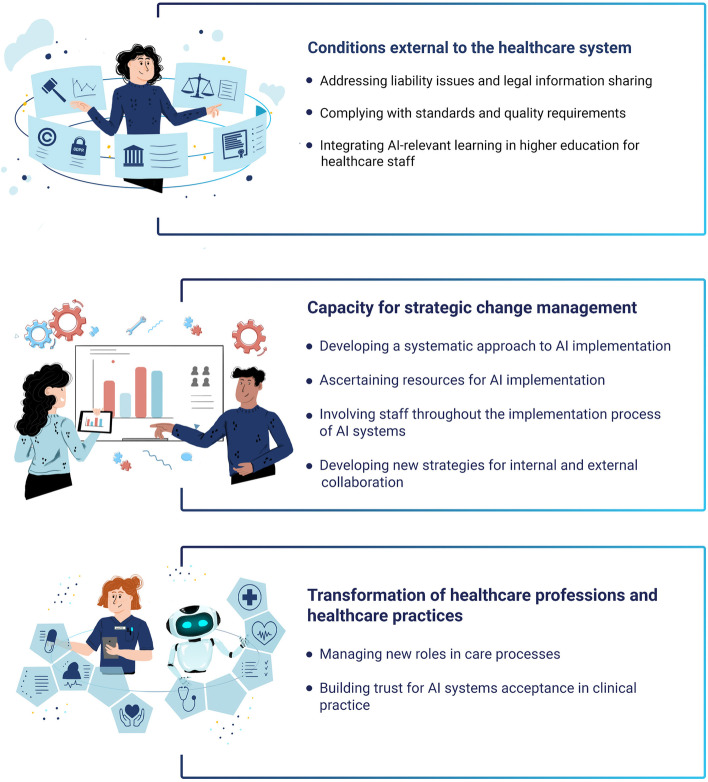
Background: Artificial intelligence (AI) for healthcare presents potential solutions to some of the challenges faced by health systems around the world. However, it is well established in implementation and innovation research that novel technologies are often resisted by healthcare leaders, which contributes to their slow and variable uptake. Although research on various stakeholders’ perspectives on AI implementation has been undertaken, very few studies have investigated leaders’ perspectives on the issue of AI implementation in healthcare. It is essential to understand the perspectives of healthcare leaders, because they have a key role in the implementation process of new technologies in healthcare. The aim of this study was to explore challenges perceived by leaders in a regional Swedish healthcare setting concerning the implementation of AI in healthcare. Methods: The study takes an explorative qualitative approach. Individual, semi-structured interviews were conducted from October 2020 to May 2021 with 26 healthcare leaders. The analysis was performed using qualitative content analysis, with an inductive approach. Results: The analysis yielded three categories, representing three types of challenge perceived to be linked with the implementation of AI in healthcare: 1) Conditions external to the healthcare system; 2) Capacity for strategic change management; 3) Transformation of healthcare professions and healthcare practice. Conclusions: In conclusion, healthcare leaders highlighted several implementation challenges in relation to AI within and beyond the healthcare system in general and their organisations in particular. The challenges comprised conditions external to the healthcare system, internal capacity for strategic change management, along with transformation of healthcare professions and healthcare practice. The results point to the need to develop implementation strategies across healthcare organisations to address challenges to AI-specific capacity building. Laws and policies are needed to regulate the design and execution of effective AI implementation strategies. There is a need to invest time and resources in implementation processes, with collaboration across healthcare, county councils, and industry partnerships.
Overview
The claims and statistics of this paper haven’t been checked yet.
Free: it reads the open-access text and checks the first 5 claims that cite a source we can check. Create a free account to check every claim.
Integrity signals
Registry
Cites
Statistics
Figures
Verification
Claims the paper makes
The claims and statistics of this paper haven’t been checked yet.
Free: it reads the open-access text and checks the first 5 claims that cite a source we can check. Create a free account to check every claim.
Claims other papers make about this one
Each is checked against this paper’s own text: does it say what the citing paper says it does?
The source backs part of the claim, not all of it — or backs it for a different population, condition or comparison.
In the citing paper
“This shared perspective resonates with prior research, underlining nurses' enthusiasm in exploring the potential contributions of AI to nursing practice [14,54].”
From Artificial intelligence in future nursing care: exploring perspectives of nursing professionals - a descriptive qualitative study (2024) · cites this paper as [54]
Experimental — accuracy not yet measuredThe source backs part of the claim, not all of it — or backs it for a different population, condition or comparison.
In the citing paper
“The availability of high-quality and annotated datasets is essential for training robust ML programs, but access to these datasets is often restricted due to patient privacy and security concerns [38].”
From Machine Learning in Maternity: Early Diagnosis of Placenta Accreta Spectrum (2026) · cites this paper as [38]
Experimental — accuracy not yet measuredThe cited source says what the claim attributes to it.
In the citing paper
“Effective implementation also depends on clinician training, as many ML tools require a foundational understanding of algorithmic outputs and limitations [38].”
From Machine Learning in Maternity: Early Diagnosis of Placenta Accreta Spectrum (2026) · cites this paper as [38]
In the citing paper
“Moreover, the participants' acknowledgment of the necessity for comprehensive training and continuous skill enhancement in AI integration is harmonious with research emphasizing the pivotal role of nursing education in effectively harnessing AI technologies [54].”
From Artificial intelligence in future nursing care: exploring perspectives of nursing professionals - a descriptive qualitative study (2024) · cites this paper as [54]
Self-check
Percentages, sums and reported differences re-computed from the paper’s own numbers.
The self-check needs the paper’s full text.
Citations
Cites
Tong, A., Sainsbury, P., & Craig, J. (2007) · International Journal for Quality in Health Care · doi:10.1093/intqhc/mzm042 · Cited by 42,509
Content Analysis: An Introduction to its Methodology.
Shelley, M., & Krippendorff, K. (1984) · Journal of the American Statistical Association · doi:10.2307/2288384 · Cited by 24,312
Graneheim, U. H., & Lundman, B. (2004) · Nurse Education Today · doi:10.1016/j.nedt.2003.10.001 · Cited by 20,772 · cited 1×
“In qualitative research, the concepts credibility, dependability, and transferability are used to describe different aspects of trustworthiness [72].”
Damschroder, L. J., Aron, D. C., Keith, R. E., Kirsh, S. R., Alexander, J. A., & Lowery, J. C. (2009) · Implementation Science · doi:10.1186/1748-5908-4-50 · Cited by 14,496 · cited 4×
“Our results relate well to the implementation science literature, identifying implementation challenges attributable to both external and internal conditions and circumstances [37, 68, 69] and the characteristics of the innovation [37, 63].”
BackgroundMethodResultInfluentialHigh-performance medicine: the convergence of human and artificial intelligence
Topol, E. J. (2019) · Nature Medicine · doi:10.1038/s41591-018-0300-7 · Cited by 10,450 · cited 1×
“Leader 9.”
Artificial intelligence in healthcare: past, present and future
Jiang, F., Jiang, Y., Zhi, H., Dong, Y., Li, H., Ma, S., Wang, Y., Dong, Q., Shen, H., & Wang, Y. (2017) · Stroke and Vascular Neurology · doi:10.1136/svn-2017-000101 · Cited by 4,837
The potential for artificial intelligence in healthcare
Davenport, T., & Kalakota, R. (2019) · Future Healthcare Journal · doi:10.7861/futurehosp.6-2-94 · Cited by 3,800 · cited 2×
“Even if the expectations for AI in healthcare are great [2], the potential of its use in healthcare is far from having been realized [5, 11, 12].”
BackgroundGluesing, J. C. (2012) · Leadership in Science and Technology: A Reference Handbook · doi:10.4135/9781412994231.n14 · Cited by 3,210
Methodological challenges in qualitative content analysis: A discussion paper
Graneheim, U. H., Lindgren, B.-M., & Lundman, B. (2017) · Nurse Education Today · doi:10.1016/j.nedt.2017.06.002 · Cited by 3,195
Cited by
Marques, L., Costa, B., Pereira, M., Silva, A., Santos, J., Saldanha, L., Silva, I., Magalhães, P., Schmidt, S., & Vale, N. (2024) · Pharmaceutics · doi:10.3390/pharmaceutics16030332 · Cited by 390
Faiyazuddin, M., Rahman, S. J. Q., Anand, G., Siddiqui, R. K., Mehta, R., Khatib, M. N., Gaidhane, S., Zahiruddin, Q. S., Hussain, A., & Sah, R. (2025) · Health Science Reports · doi:10.1002/hsr2.70312 · Cited by 242
Current AI technologies in cancer diagnostics and treatment
Tiwari, A., Mishra, S., & Kuo, T.-R. (2025) · Molecular Cancer · doi:10.1186/s12943-025-02369-9 · Cited by 207
Harishbhai Tilala, M., Kumar Chenchala, P., Choppadandi, A., Kaur, J., Naguri, S., Saoji, R., & Devaguptapu, B. (2024) · Cureus · doi:10.7759/cureus.62443 · Cited by 198
“These collaborations can also foster transparency and accountability in the deployment of AI and ML algorithms, promoting public trust and confidence in these technologies [44,45].”
BackgroundAI, Health, and Health Care Today and Tomorrow: The JAMA Summit Report on Artificial Intelligence
Angus, D. C., Khera, R., Lieu, T., Liu, V., Ahmad, F. S., Anderson, B., Bhavani, S. V., Bindman, A., Brennan, T., Celi, L. A., et al. (2025) · JAMA · doi:10.1001/jama.2025.18490 · Cited by 195
Rony, M. K. K., Kayesh, I., Bala, S. D., Akter, F., & Parvin, M. R. (2024) · Heliyon · doi:10.1016/j.heliyon.2024.e25718 · Cited by 190
“Moreover, the participants ’ acknowledgment of the necessity for comprehensive training and continuous skill enhancement in AI integration is harmonious with research emphasizing the pivotal role of nursing education in effectively harnessing AI technologies M.K.K. Rony et al. [54].”
ResultFountzilas, E., Pearce, T., Baysal, M. A., Chakraborty, A., & Tsimberidou, A. M. (2025) · npj Digital Medicine · doi:10.1038/s41746-025-01471-y · Cited by 190
Alhuwaydi, A. M. (2024) · Risk Management and Healthcare Policy · doi:10.2147/rmhp.s461562 · Cited by 187
Artificial intelligence in healthcare delivery: Prospects and pitfalls
Olawade, D. B., David-Olawade, A. C., Wada, O. Z., Asaolu, A. J., Adereni, T., & Ling, J. (2024) · Journal of Medicine, Surgery, and Public Health · doi:10.1016/j.glmedi.2024.100108 · Cited by 180
Nair, M., Svedberg, P., Larsson, I., & Nygren, J. M. (2024) · PLOS ONE · doi:10.1371/journal.pone.0305949 · Cited by 179
Self-citationStasevych, M., & Zvarych, V. I. (2023) · Big Data and Cognitive Computing · doi:10.3390/bdcc7030147 · Cited by 163
Implementing AI in healthcare—the relevance of trust: a scoping review
Steerling, E., Siira, E., Nilsén, P., Svedberg, P., & Nygren, J. (2023) · Frontiers in Health Services · doi:10.3389/frhs.2023.1211150 · Cited by 159
Self-citationMed-MoE: Mixture of Domain-Specific Experts for Lightweight Medical Vision-Language Models
Jiang, S., Zheng, T., Zhang, Y., Jin, Y., Li, Y., & Liu, Z. (2024) · Findings of the Association for Computational Linguistics: EMNLP (Findings of EMNLP) · doi:10.18653/v1/2024.findings-emnlp.221 · Cited by 155
AI in Thyroid Cancer Diagnosis: Techniques, Trends, and Future Directions
Habchi, Y., Himeur, Y., Kheddar, H., Boukabou, A., Atalla, S., Chouchane, A., Ouamane, A., & Mansoor, W. (2023) · Systems · doi:10.3390/systems11100519 · Cited by 155
Zahlan, A., Ranjan, R. P., & Hayes, D. (2023) · Technology in Society · doi:10.1016/j.techsoc.2023.102321 · Cited by 152
Madanchian, M., & Taherdoost, H. (2025) · Information · doi:10.3390/info16010051 · Cited by 148
Jacob, C., Brasier, N., Laurenzi, E., Heuss, S., Mougiakakou, S. G., Çöltekin, A., & Peter, M. K. (2025) · Journal of Medical Internet Research · doi:10.2196/67485 · Cited by 147
Patient Perspectives on the Use of Artificial Intelligence in Health Care: A Scoping Review
Moy, S., Irannejad, M., Manning, S. J., Farahani, M., Ahmed, Y., Gao, E., Prabhune, R., Lorenz, S., Mirza, R. M., & Klinger, C. A. (2024) · Journal of patient-centered research and reviews · doi:10.17294/2330-0698.2029 · Cited by 145
Ajmal, C. S., Yerram, S., Abishek, V. S., Nizam, V. P. M., Aglave, G., Patnam, J. D., Raghuvanshi, R. S., & Srivastava, S. (2025) · The AAPS Journal · doi:10.1208/s12248-024-01006-5 · Cited by 129
Alami, H., Lehoux, P., Papoutsi, C., Shaw, S. E., Fleet, R. P., & Fortin, J. (2024) · BMC Health Services Research · doi:10.1186/s12913-024-11112-x · Cited by 122
Transforming Dental Caries Diagnosis Through Artificial Intelligence-Based Techniques
Anil, S., Porwal, P., & Porwal, A. (2023) · Cureus · doi:10.7759/cureus.41694 · Cited by 109
El Arab, R. A., Abu-Mahfouz, M. S., Abuadas, F. H., Alzghoul, H., Almari, M., Ghannam, A., & Seweid, M. M. (2025) · Healthcare · doi:10.3390/healthcare13070701 · Cited by 108
Leadership for AI Transformation in Health Care Organization: Scoping Review
Sriharan, A., Sekercioglu, N., Mitchell, C., Senkaiahliyan, S., Hertelendy, A. J., Porter, T. H., & Banaszak‐Holl, J. (2024) · Journal of Medical Internet Research · doi:10.2196/54556 · Cited by 97
Botha, N. N., Segbedzi, C. E., Dumahasi, V. K., Maneen, S., Kodom, R. V., Tsedze, I. S., Akoto, L. A., Atsu, F. S., Lasim, O. U., & Ansah, E. W. (2024) · Archives of Public Health · doi:10.1186/s13690-024-01414-1 · Cited by 95
The evolving role of nursing informatics in the era of artificial intelligence
Nashwan, A. J., Cabrega, J. A., Othman, M. I., Khedr, M. A., Osman, Y. M., El‐Ashry, A. M., Naif, R., & Mousa, A. A. (2025) · International Nursing Review · doi:10.1111/inr.13084 · Cited by 93
Finkelstein, J., Gabriel, A. S., Schmer, S., Truong, T., & Dunn, A. S. (2024) · Journal of Medical Systems · doi:10.1007/s10916-024-02104-9 · Cited by 94
Rony, M. K. K., Akter, K., Nesa, L., Islam, M. T., Johra, F. T., Akter, F., Uddin, M. J., Begum, J., Noor, M. A., Ahmad, S., et al. (2024) · Heliyon · doi:10.1016/j.heliyon.2024.e40775 · Cited by 92
Chance, E. A., Florence, D., & Abdoul, I. S. (2024) · International Journal of Nursing Sciences · doi:10.1016/j.ijnss.2024.06.003 · Cited by 90
Amin, S. M., El‐Gazar, H. E., Zoromba, M. A., El‐Sayed, M. M., & Atta, M. H. R. (2024) · Journal of Advanced Nursing · doi:10.1111/jan.16435 · Cited by 86
The Impact and Issues of Artificial Intelligence in Nursing Science and Healthcare Settings
Pailaha, A. D. (2023) · SAGE Open Nursing · doi:10.1177/23779608231196847 · Cited by 85
Navigating AI unpredictability: Exploring technostress in AI-powered healthcare systems
Issa, H., Jaber, J., & Lakkis, H. (2024) · Technological Forecasting and Social Change · doi:10.1016/j.techfore.2024.123311 · Cited by 85
Rahim, A., Khatoon, R., Khan, T. A., Syed, K., Khan, I., Khalid, T., & Khalid, B. (2024) · Digital Health · doi:10.1177/20552076241291345 · Cited by 83
Gundlack, J., Thiel, C., Negash, S., Buch, C., Apfelbacher, T., Denny, K., Christoph, J., Mikolajczyk, R., Unverzagt, S., & Frese, T. (2025) · Journal of Medical Internet Research · doi:10.2196/70487 · Cited by 81
Badawy, W., Zinhom, H., & Shaban, M. (2025) · International Nursing Review · doi:10.1111/inr.13059 · Cited by 80
The Crucial Role of Interdisciplinary Conferences in Advancing Explainable AI in Healthcare
Patel, A., Gu, Q., Esper, R. N., Maeser, D., & Maeser, N. (2024) · BioMedInformatics · doi:10.3390/biomedinformatics4020075 · Cited by 78
From Machine Learning to Patient Outcomes: A Comprehensive Review of AI in Pancreatic Cancer
Tripathi, S., Tabari, A., Mansur, A., Dabbara, H., Bridge, C. P., & Daye, D. (2024) · Diagnostics · doi:10.3390/diagnostics14020174 · Cited by 76
Fazakarley, C.-A., Breen, M. A., Leeson, P., Thompson, B. T., & Williamson, V. (2023) · BMJ Open · doi:10.1136/bmjopen-2023-076950 · Cited by 75
Artificial Intelligence in Malnutrition: A Systematic Literature Review
Janssen, S. M. W., Bouzembrak, Y., & Tekinerdoğan, B. (2024) · Advances in Nutrition · doi:10.1016/j.advnut.2024.100264 · Cited by 71
Huang, L., Huhulea, E. N., Abraham, E., Bienenstock, R., Aifuwa, E., Hirani, R., Schulhof, A., Tiwari, R. K., & Etienne, M. (2025) · Medicina · doi:10.3390/medicina61020358 · Cited by 68
AI in Indian healthcare: From roadmap to reality
Das, S. K., Dasgupta, R. K., Roy, S. D., & Shil, D. (2024) · Intelligent Pharmacy · doi:10.1016/j.ipha.2024.02.005 · Cited by 68
Artificial intelligence governance framework for healthcare
Hassan, M., Borycki, E. M., & Kushniruk, A. W. (2025) · Healthcare Management Forum · doi:10.1177/08404704241291226 · Cited by 65
Ng, J. Y., Maduranayagam, S. G., Suthakar, N., Li, A., Lokker, C., Iorio, A., Haynes, R. B., & Moher, D. (2025) · The Lancet Digital Health · doi:10.1016/s2589-7500(24)00202-4 · Cited by 64
Preti, L. M., Ardito, V., Compagni, A., Petracca, F., & Cappellaro, G. (2024) · Journal of Medical Internet Research · doi:10.2196/55897 · Cited by 62
“…that the outer setting domain was largely overlooked, although prior studies have highlighted the importance of external factors, such as data privacy and security laws, ethical issues, regulatory frameworks, and medical liability, in implementing ML applications in clinical practice [5,76-78].”
Joshi, S. D., Urteaga, I., van Amsterdam, W. A. C., Hripcsak, G. M., Elias, P. A., Recht, B., Elhadad, N., Fackler, J. C., Sendak, M., Wiens, J., et al. (2025) · Journal of the American Medical Informatics Association · doi:10.1093/jamia/ocae301 · Cited by 57
Digital Competence among Healthcare Leaders: A Mixed‐Methods Systematic Review
Laakkonen, N., Jarva, E., Hammarén, M., Kanste, O. I., Kääriäinen, M., Oikarinen, A., & Mikkonen, K. (2024) · Journal of Nursing Management · doi:10.1155/2024/8435248 · Cited by 56
O'Reilly, D., McGrath, J., & Martin-Loeches, I. (2024) · Journal of Intensive Medicine · doi:10.1016/j.jointm.2023.10.001 · Cited by 55
Health Care Professionals’ Experience of Using AI: Systematic Review With Narrative Synthesis
Ayorinde, A., Mensah, D. O., Walsh, J., Ghosh, I., Ibrahim, S. A., Hogg, J., Peek, N., & Griffiths, F. (2024) · Journal of Medical Internet Research · doi:10.2196/55766 · Cited by 55
Artificial intelligence for access to primary healthcare in rural settings
Lamem, M. F. H., Sahid, M. I., & Ahmed, A. (2024) · Journal of Medicine Surgery and Public Health · doi:10.1016/j.glmedi.2024.100173 · Cited by 55
Yousif, M., Asghar, S., Akbar, J., Masood, I., Arshad, M. R., Naeem, J., Azam, A., & Iqbal, Z. (2024) · BMC Health Services Research · doi:10.1186/s12913-024-11667-9 · Cited by 53
Peek, N., Capurro, D., Rozova, V., & van der Veer, S. N. (2024) · Yearbook of Medical Informatics · doi:10.1055/s-0044-1800729 · Cited by 36
Change management and organizational performance: current key trends
Hasan, M. M., Aparisi-Torrijo, S., & González-Ladrón-de-Guevara, F. (2025) · Cogent Business & Management · doi:10.1080/23311975.2025.2478447 · Cited by 51
Alsaedi, A., Alneami, N. A., Almajnoni, F. S., Alamri, O., Aljohni, K., Alrwaily, M., Eid, M., Budayr, A., Alrehaili, M., Alghamdi, M., et al. (2024) · Nursing Reports · doi:10.3390/nursrep14040271 · Cited by 51
D'Amico, E., Belitski, M., Braga, A., & Savoie, R. A. (2025) · Journal of Technology Transfer · doi:10.1007/s10961-025-10217-7 · Cited by 31
Nair, M., Nygren, J., Nilsén, P., Gama, F., Neher, M., Larsson, I., & Svedberg, P. (2025) · Frontiers in Digital Health · doi:10.3389/fdgth.2025.1550459 · Cited by 50
Self-citationPerformance of multimodal artificial intelligence chatbots evaluated on clinical oncology cases
Chen, D., Huang, R. S., Jomy, J., Wong, P., Yan, M., Croke, J., Tong, D., Hope, A., Eng, L., & Raman, S. (2024) · JAMA Network Open · doi:10.1001/jamanetworkopen.2024.37711 · Cited by 49
Petersson, L., Vincent, K., Svedberg, P., Nygren, J., & Larsson, I. (2023) · Digital Health · doi:10.1177/20552076231206588 · Cited by 50
Self-citationLam, C., Wong, Y. L., Tang, Z., Hu, X., Nguyen, T. X., Yang, D., Zhang, S., Ding, J., Szeto, S., Ran, A. R., et al. (2024) · Diabetes Care · doi:10.2337/dc23-0993 · Cited by 49
The Use of Artificial Intelligence in Caries Detection: A Review
Al-Khalifa, K. S., Ahmed, W. M., Azhari, A. A., Qaw, M., Alsheikh, R., Alqudaihi, F., & Alfaraj, A. (2024) · Bioengineering · doi:10.3390/bioengineering11090936 · Cited by 48
“Educating the patient about the usage of their information for AI training can be a difficult task, and obtaining informed consent for the same is also challenging [70].”
BackgroundShams, A. M. (2024) · Diagnostics · doi:10.3390/diagnostics14192174 · Cited by 49
Čartolovni, A., Malešević, A., & Poslon, L. (2023) · DIGITAL HEALTH · doi:10.1177/20552076231220833 · Cited by 48
Pesapane, F., Hauglid, M. K., Fumagalli, M., Petersson, L., Parkar, A. P., Cassano, E., & Horgan, D. (2024) · European Journal of Radiology · doi:10.1016/j.ejrad.2024.111852 · Cited by 48
Self-citationOlawade, D. B., Weerasinghe, K., Teke, J., Msiska, M., Boussios, S., & Hatzidimitriadou, E. (2025) · International Journal of Medical Informatics · doi:10.1016/j.ijmedinf.2025.105909 · Cited by 47
Imrie, F., Cebere, B., McKinney, E. F., & van der Schaar, M. (2023) · PLOS Digital Health · doi:10.1371/journal.pdig.0000276 · Cited by 45
Neher, M., Petersson, L., Nygren, J. M., Svedberg, P., Larsson, I., & Nilsen, P. (2023) · Implementation Science Communications · doi:10.1186/s43058-023-00458-8 · Cited by 45
Self-citationIrgang, L., Sestino, A., Barth, H., & Holmén, M. (2025) · Technological Forecasting and Social Change · doi:10.1016/j.techfore.2024.123967 · Cited by 44
Critical review of self‐diagnosis of mental health conditions using artificial intelligence
Wimbarti, S., Kairupan, B. H. R., & Tallei, T. E. (2024) · International Journal of Mental Health Nursing · doi:10.1111/inm.13303 · Cited by 42
Dean, T., Seecheran, R. V., Badgett, R. G., Zackula, R., & Symons, J. (2024) · JAMIA Open · doi:10.1093/jamiaopen/ooae100 · Cited by 41
Göktepe, N., & Sarıköse, S. (2025) · International Nursing Review · doi:10.1111/inr.70043 · Cited by 41
Beyond implementation: the long-term economic impact of AI in healthcare
Meslamani, A. Z. A. (2023) · Journal of Medical Economics · doi:10.1080/13696998.2023.2285186 · Cited by 40
Implementation framework for AI deployment at scale in healthcare systems
Adnan, H. S., Shidani, A., Clifton, L., Bankhead, C. R., & Perera, R. (2025) · iScience · doi:10.1016/j.isci.2025.112406 · Cited by 39
Stogiannos, N., O’Regan, T., Scurr, E. D., Litosseliti, L., Pogose, M., Harvey, H., Kumar, A., Malik, R., Barnes, A., McEntee, M. F., et al. (2024) · Radiography · doi:10.1016/j.radi.2024.01.019 · Cited by 38
Kyambade, M., & Namatovu, A. (2025) · Leadership in health services · doi:10.1108/lhs-02-2025-0025 · Cited by 37
A Framework to Guide Implementation of AI in Health Care: Protocol for a Cocreation Research Project
Nilsen, P., Svedberg, P., Neher, M., Nair, M., Larsson, I., Petersson, L., & Nygren, J. (2023) · JMIR Research Protocols · doi:10.2196/50216 · Cited by 37
Self-citationSafety and Reliability of Artificial Intelligence Systems
Nguyễn, T. H., Saghir, A., Tran, K. D., Nguyen, D. H., Luong, N. A., & Tran, K. P. (2024) · Springer series in reliability engineering · doi:10.1007/978-3-031-71495-5_9 · Cited by 37
Tursynbek, A., Zhaksylykova, D., Cruz, J. P., & Balay‐odao, E. M. (2024) · Journal of Clinical Nursing · doi:10.1111/jocn.17584 · Cited by 37
Khan, S. D., Hoodbhoy, Z., Raja, M. H. R., Kim, J. Y., Hogg, H. D. J., Manji, A. A. A., Gulamali, F., Hasan, A., Shaikh, A., Tajuddin, S., et al. (2024) · PLOS Digital Health · doi:10.1371/journal.pdig.0000514 · Cited by 36
“Finding the most commonly evaluated domains to be Plan and Study is encouraging as the capacity for strategic change management has been identified as a major barrier to AI implementation in healthcare [8].”
BackgroundKatebi, M. S., Bahreini, M., Bagherzadeh, R., & Pouladi, S. (2025) · Journal of Nursing Management · doi:10.1155/jonm/2797535 · Cited by 36
Ma, Y., Zeng, Y., Liu, T., Sun, R., Xiao, M., & Wang, J. (2024) · Frontiers in Public Health · doi:10.3389/fpubh.2024.1475867 · Cited by 35
Parthasarathy, P. R., Patil, S. R., Dawasaz, A. A., Baig, F. A. H., & Karobari, M. I. (2024) · Cureus · doi:10.7759/cureus.55107 · Cited by 35
An explainable fast deep neural network for emotion recognition
Luzio, F. D., Rosato, A., & Panella, M. (2024) · Biomedical Signal Processing and Control · doi:10.1016/j.bspc.2024.107177 · Cited by 34
The Limitations of Artificial Intelligence in Head and Neck Oncology
Rao, K. N., Fernandez-Alvarez, V., Guntinas-Lichius, O., Sreeram, M. P., de Bree, R., Kowalski, L. P., Forastiere, A., Pace-Asciak, P., Rodrigo, J. P., Saba, N. F., et al. (2025) · Advances in Therapy · doi:10.1007/s12325-025-03198-4 · Cited by 33
Adhikari, S., Ahmad, I., Bajracharya, D. C., Khanal, B., Solomon, C., Jayaratne, K., Mamum, K. A. A., Talukder, M. S. H., Shakya, S., Manandhar, S., et al. (2025) · npj Digital Medicine · doi:10.1038/s41746-025-01534-0 · Cited by 33
Nesa, L., Rony, M. K. K., Chowdhury, S., Naznin, M. B., Halder, K., Ara, M. H., Akter, N. N., Mankhin, K., Shabnur, J. M., Alam, J., et al. (2025) · Journal of Evaluation in Clinical Practice · doi:10.1111/jep.70170 · Cited by 33
Adoption of Digital Therapeutics in Europe
Fassbender, A., Donde, S. S., Silva, M., Friganović, A., Stievano, A., Costa, E. M., Winders, T. A., & van Vugt, J. (2024) · Therapeutics and Clinical Risk Management · doi:10.2147/tcrm.s489873 · Cited by 33
Strategies for Implementing Machine Learning Algorithms in the Clinical Practice of Radiology
Chae, A., Yao, M. S., Sagreiya, H., Goldberg, A. D., Chatterjee, N. R., MacLean, M. T., Duda, J., Elahi, A., Borthakur, A., Ritchie, M. D., et al. (2024) · Radiology · doi:10.1148/radiol.223170 · Cited by 34
Reddy, S., & Shaikh, S. (2025) · Journal of Medical Artificial Intelligence · doi:10.21037/jmai-24-148 · Cited by 33
Okwor, I. A., Hitch, G., Hakkim, S., Akbar, S., Sookhoo, D., & Kainesie, J. (2024) · AI · doi:10.3390/ai5040095 · Cited by 32
“[Leader 2] [25] (p. 5–6).”
InfluentialMorales-García, W. C., Sairitupa-Sanchez, L. Z., Paredes, A. F., Pascual-Mariño, J., & Morales-García, M. (2025) · Data & Metadata · doi:10.56294/dm2025210 · Cited by 33
Alnasser, B. (2023) · E-Health Telecommunication Systems and Networks · doi:10.4236/etsn.2023.123003 · Cited by 32
Mehraeen, E., Siami, H., Montazeryan, S., Molavi, R., Feyzabadi, A., Parvizy, I., Masjedlu, Z. A., Dehkalani, M. N., Mahmoudi, S., & Ahmadipour, A. (2025) · Healthcare Technology Letters · doi:10.1049/htl2.70017 · Cited by 31
Park, J. S., Park, S.-Y., Moon, J. W., Kim, K., & Suh, D. I. (2025) · Journal of Medical Internet Research · doi:10.2196/66491 · Cited by 31
Kumar, G., Singh, R. K., Arya, V., & Mishra, S. K. (2024) · Global Journal of Flexible Systems Management · doi:10.1007/s40171-024-00373-4 · Cited by 30
Digital competencies for Singapore’s national medical school curriculum: a qualitative study
Zainal, H., Xin, X., Thumboo, J., & Yong, F. K. (2023) · Medical Education Online · doi:10.1080/10872981.2023.2211820 · Cited by 30
Reed, J. E., Svedberg, P., & Nygren, J. (2025) · Journal of Medical Internet Research · doi:10.2196/56836 · Cited by 30
Self-citationSiira, E., Tyskbo, D., & Nygren, J. (2024) · BMC Primary Care · doi:10.1186/s12875-024-02516-z · Cited by 29
“Keywords Implementation, Artificial intelligence, Medical history-taking, Triage, Primary care, Healthcare leaders advancements of AI in healthcare, its actual implementation remains uncharted territory, hindering the realization of its potential to improve healthcare delivery [39, 42, 43].”
BackgroundResultInfluentialSelf-citationAI and higher education: Understanding faculty roles in teaching, research, and administration
Spathopoulou, F., Pitychoutis, K. M., & Papakonstantinidis, S. (2025) · Contemporary Educational Technology · doi:10.30935/cedtech/17406 · Cited by 29
Patient Experiences with AI in Healthcare Settings
Hoseini, M. S. (2023) · AI and Tech in Behavioral and Social Sciences · doi:10.61838/kman.aitech.1.3.3 · Cited by 29
The Intersection of Generative AI and Healthcare: Addressing Challenges to Enhance Patient Care
Albaroudi, E., Mansouri, T., & Alameer, A. (2024) · International Women in Data Science Conference at Prince Sultan University (WiDS PSU) · doi:10.1109/wids-psu61003.2024.00039 · Cited by 29
AI model transferability in healthcare: a sociotechnical perspective
Wiesenfeld, B. M., Aphinyanaphongs, Y., & Nov, O. (2022) · Nature Machine Intelligence · doi:10.1038/s42256-022-00544-x · Cited by 29
Next-generation endoscopy in inflammatory bowel disease
Zammarchi, I., Santacroce, G., & Iacucci, M. (2023) · Diagnostics · doi:10.3390/diagnostics13152547 · Cited by 28
Metadata
- Authors
- Petersson, L., Larsson, I., Nygren, J. M., Nilsen, P., Neher, M., Reed, J. E., Tyskbo, D., & Svedberg, P.
- Affiliations
- Halmstad University (SE)
- Corresponding author
- Petersson, Lena
- ORCID
- Venue
- BMC Health Services Research
- Published
- 2022-07-01
- Volume
- 22
- Issue
- 1
- Pages
- 850-850
- ISSN
- 1472-6963 (ISSN-L)
- PMC
- PMC9250210
- OpenAlex
- W4283749268
- Semantic Scholar
- bb678afa2685e6493f9875b66ac2b32dce5e7e9b
- Cited by
- 434
- References
- 72
- Citations by year
- 2026: 85 · 2025: 170 · 2024: 133 · 2023: 42 · 2022: 4
- FWCI
- 26.31
- Type
- journal article
- Language
- en
- Open access
- gold
- doi.org
- Licence
- cc-by
- creativecommons.org/licenses/by/4.0 (tdm)
- creativecommons.org/licenses/by/4.0 (vor)
- Locations
- BMC Health Services Research (publishedVersion, cc-by)
- PubMed Central (publishedVersion, cc-by)
- PubMed (publishedVersion)
- Hogskolan Ihalmstad (Halmstad University) (submittedVersion, other-oa)
- DiVA (Linkoping University) (submittedVersion, other-oa)
- DOAJ (DOAJ: Directory of Open Access Journals) (submittedVersion)
- Funders
- VINNOVA (grant 2019-04526)
- Knowledge Foundation, Sweden (grant 20200208 01H)
- Carl Bennet AB (L2013/77)
- Halmstad University
- Topics
- Health Sciences › Medicine › Health Informatics › Artificial Intelligence in Healthcare and Education
- Health Sciences › Health Professions › General Health Professions › Health Policy Implementation Science
- Physical Sciences › Computer Science › Artificial Intelligence › Artificial Intelligence Applications
- Keywords
- artificial intelligence in healthcare, AI implementation, healthcare executives, implementation barriers, change management, health professions, implementation strategies
- MeSH terms
- Artificial Intelligence, Delivery of Health Care, Health Facilities, Humans, Sweden, Qualitative Research
About these checks
Registry, retraction, Cites and statistics results are computed, not judged, with one exception: a printed reference that no index lists is read once by a model before it counts as a citation error. Claims are extracted by a model and kept only when their quote appears verbatim in the text; each cited source is then checked, with a model’s help, for whether it says what the claim relies on. Those verdicts can be wrong — read the claim’s quote and the cited source before relying on one.
Statistics and arithmetic are recomputed, not judged.
Confidence bands are shown only for fields calibrated on our annotated test set. None is calibrated yet, so no band is shown.
What counts as a claim ›How we measure confidence ›How we check this ›
Are you an author, or do you see a problem with this page? Request a review
Data sources
Bibliographic data: Semantic Scholar, OpenAlex, Crossref.
Contains information from the Semantic Scholar Academic Graph Datasets, made available under the ODC Attribution License (ODC-BY 1.0).
Semantic Scholar’s data is described in: Kinney, R., et al. (2023). The Semantic Scholar Open Data Platform. arXiv:2301.10140.
