

Challenges to implementing artificial intelligence in healthcare: a qualitative interview study with healthcare leaders in Sweden
Open accessThe DOI matches its Crossref record; 72 of the 72 references it cites were found in a registry or an index.
Abstract
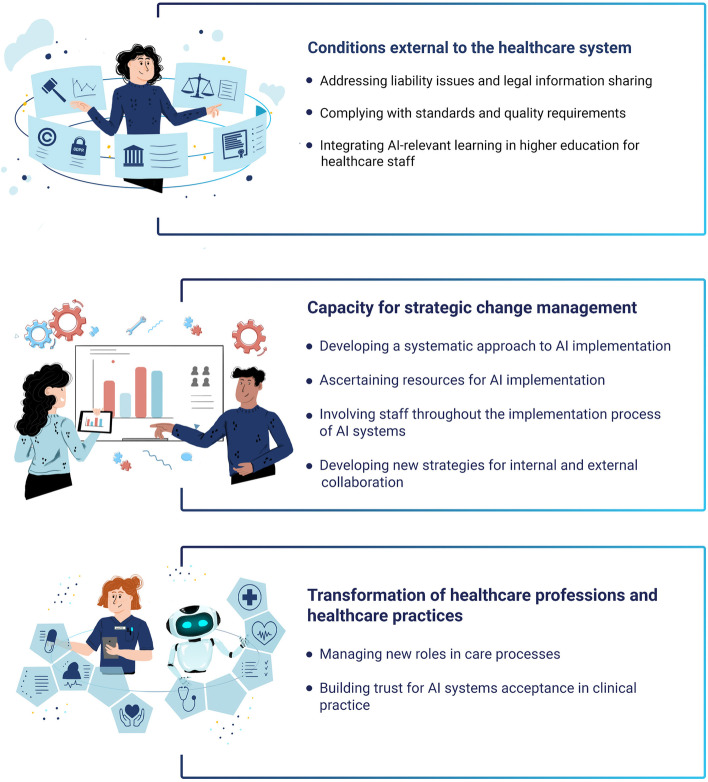
Background: Artificial intelligence (AI) for healthcare presents potential solutions to some of the challenges faced by health systems around the world. However, it is well established in implementation and innovation research that novel technologies are often resisted by healthcare leaders, which contributes to their slow and variable uptake. Although research on various stakeholders’ perspectives on AI implementation has been undertaken, very few studies have investigated leaders’ perspectives on the issue of AI implementation in healthcare. It is essential to understand the perspectives of healthcare leaders, because they have a key role in the implementation process of new technologies in healthcare. The aim of this study was to explore challenges perceived by leaders in a regional Swedish healthcare setting concerning the implementation of AI in healthcare. Methods: The study takes an explorative qualitative approach. Individual, semi-structured interviews were conducted from October 2020 to May 2021 with 26 healthcare leaders. The analysis was performed using qualitative content analysis, with an inductive approach. Results: The analysis yielded three categories, representing three types of challenge perceived to be linked with the implementation of AI in healthcare: 1) Conditions external to the healthcare system; 2) Capacity for strategic change management; 3) Transformation of healthcare professions and healthcare practice. Conclusions: In conclusion, healthcare leaders highlighted several implementation challenges in relation to AI within and beyond the healthcare system in general and their organisations in particular. The challenges comprised conditions external to the healthcare system, internal capacity for strategic change management, along with transformation of healthcare professions and healthcare practice. The results point to the need to develop implementation strategies across healthcare organisations to address challenges to AI-specific capacity building. Laws and policies are needed to regulate the design and execution of effective AI implementation strategies. There is a need to invest time and resources in implementation processes, with collaboration across healthcare, county councils, and industry partnerships.
Overview
The claims and statistics of this paper haven’t been checked yet.
Free: it reads the open-access text and checks the first 5 claims that cite a source we can check. Create a free account to check every claim.
Integrity signals
Registry
Cites
Statistics
Figures
Verification
Claims the paper makes
The claims and statistics of this paper haven’t been checked yet.
Free: it reads the open-access text and checks the first 5 claims that cite a source we can check. Create a free account to check every claim.
Claims other papers make about this one
Each is checked against this paper’s own text: does it say what the citing paper says it does?
The source backs part of the claim, not all of it — or backs it for a different population, condition or comparison.
In the citing paper
“This shared perspective resonates with prior research, underlining nurses' enthusiasm in exploring the potential contributions of AI to nursing practice [14,54].”
From Artificial intelligence in future nursing care: exploring perspectives of nursing professionals - a descriptive qualitative study (2024) · cites this paper as [54]
Experimental — accuracy not yet measuredThe source backs part of the claim, not all of it — or backs it for a different population, condition or comparison.
In the citing paper
“The availability of high-quality and annotated datasets is essential for training robust ML programs, but access to these datasets is often restricted due to patient privacy and security concerns [38].”
From Machine Learning in Maternity: Early Diagnosis of Placenta Accreta Spectrum (2026) · cites this paper as [38]
Experimental — accuracy not yet measuredThe cited source says what the claim attributes to it.
In the citing paper
“Effective implementation also depends on clinician training, as many ML tools require a foundational understanding of algorithmic outputs and limitations [38].”
From Machine Learning in Maternity: Early Diagnosis of Placenta Accreta Spectrum (2026) · cites this paper as [38]
In the citing paper
“Moreover, the participants' acknowledgment of the necessity for comprehensive training and continuous skill enhancement in AI integration is harmonious with research emphasizing the pivotal role of nursing education in effectively harnessing AI technologies [54].”
From Artificial intelligence in future nursing care: exploring perspectives of nursing professionals - a descriptive qualitative study (2024) · cites this paper as [54]
Self-check
Percentages, sums and reported differences re-computed from the paper’s own numbers.
The self-check needs the paper’s full text.
Citations
Cites
Tong, A., Sainsbury, P., & Craig, J. (2007) · International Journal for Quality in Health Care · doi:10.1093/intqhc/mzm042 · Cited by 42,509
Content Analysis: An Introduction to its Methodology.
Shelley, M., & Krippendorff, K. (1984) · Journal of the American Statistical Association · doi:10.2307/2288384 · Cited by 24,312
Graneheim, U. H., & Lundman, B. (2004) · Nurse Education Today · doi:10.1016/j.nedt.2003.10.001 · Cited by 20,772 · cited 1×
“In qualitative research, the concepts credibility, dependability, and transferability are used to describe different aspects of trustworthiness [72].”
Damschroder, L. J., Aron, D. C., Keith, R. E., Kirsh, S. R., Alexander, J. A., & Lowery, J. C. (2009) · Implementation Science · doi:10.1186/1748-5908-4-50 · Cited by 14,496 · cited 4×
“Our results relate well to the implementation science literature, identifying implementation challenges attributable to both external and internal conditions and circumstances [37, 68, 69] and the characteristics of the innovation [37, 63].”
BackgroundMethodResultInfluentialHigh-performance medicine: the convergence of human and artificial intelligence
Topol, E. J. (2019) · Nature Medicine · doi:10.1038/s41591-018-0300-7 · Cited by 10,450 · cited 1×
“Leader 9.”
Artificial intelligence in healthcare: past, present and future
Jiang, F., Jiang, Y., Zhi, H., Dong, Y., Li, H., Ma, S., Wang, Y., Dong, Q., Shen, H., & Wang, Y. (2017) · Stroke and Vascular Neurology · doi:10.1136/svn-2017-000101 · Cited by 4,837
The potential for artificial intelligence in healthcare
Davenport, T., & Kalakota, R. (2019) · Future Healthcare Journal · doi:10.7861/futurehosp.6-2-94 · Cited by 3,800 · cited 2×
“Even if the expectations for AI in healthcare are great [2], the potential of its use in healthcare is far from having been realized [5, 11, 12].”
BackgroundGluesing, J. C. (2012) · Leadership in Science and Technology: A Reference Handbook · doi:10.4135/9781412994231.n14 · Cited by 3,210
Methodological challenges in qualitative content analysis: A discussion paper
Graneheim, U. H., Lindgren, B.-M., & Lundman, B. (2017) · Nurse Education Today · doi:10.1016/j.nedt.2017.06.002 · Cited by 3,195
A theory of organizational readiness for change
Weiner, B. J. (2009) · Implementation Science · doi:10.1186/1748-5908-4-67 · Cited by 2,268
The practical implementation of artificial intelligence technologies in medicine
He, J., Baxter, S. L., Xu, J., Xu, J., Zhou, X., & Zhang, K. (2019) · Nature Medicine · doi:10.1038/s41591-018-0307-0 · Cited by 2,246 · cited 3×
“Most of the research on AI in healthcare focuses heavily on the development, validation, and evaluation of advanced analytical techniques, and the most significant clinical specialties for this are oncology, neurology, and cardiology [2, 3, 11, 13, 14].”
BackgroundArchibald, M. M., Ambagtsheer, R. C., Casey, M. G., & Lawless, M. (2019) · International Journal of Qualitative Methods · doi:10.1177/1609406919874596 · Cited by 2,164 · cited 1×
“However, according to Archibald et al. [73], distance interviewing with videoconferencing services, such as Microsoft Teams, could be beneficial and even preferred.”
BackgroundEnabling the implementation of evidence based practice: a conceptual framework.
Kitson, A., Harvey, G., & McCormack, B. (1998) · Quality in Health Care · doi:10.1136/qshc.7.3.149 · Cited by 1,985
Wandersman, A., Duffy, J., Flaspohler, P., Noonan, R., Lubell, K., Stillman, L., Blachman, M., Dunville, R., & Saul, J. (2008) · American Journal of Community Psychology · doi:10.1007/s10464-008-9174-z · Cited by 1,339
Teamwork in healthcare: Key discoveries enabling safer, high-quality care.
Rosen, M. A., DiazGranados, D., Dietz, A. S., Benishek, L. E., Thompson, D., Pronovost, P. J., & Weaver, S. J. (2018) · American Psychologist · doi:10.1037/amp0000298 · Cited by 1,283 · cited 1×
“This suggests the need for people who are conversant in languages of both stakeholder groups maybe necessary to facilitate communication and collaboration across professional boundaries [54].”
BackgroundInstitutional change and healthcare organizations: from professional dominance to managed care
(2000) · Choice Reviews Online · doi:10.5860/choice.38-2189 · Cited by 1,258
Flottorp, S. A., Oxman, A. D., Krause, J., Musila, N. R., Wensing, M., Godycki-Cwirko, M., Baker, R., & Eccles, M. P. (2013) · Implementation Science · doi:10.1186/1748-5908-8-35 · Cited by 1,138
Leadership style, organizational culture and performance: empirical evidence from UK companies
Ogbonna, E., & Harris, L. C. (2000) · The International Journal of Human Resource Management · doi:10.1080/09585190050075114 · Cited by 1,101
A compilation of strategies for implementing clinical innovations in health and mental health
Powell, B. J., McMillen, J. C., Proctor, E. K., Carpenter, C. R., Griffey, R. T., Bunger, A. C., Glass, J. E., & York, J. L. (2012) · Medical Care Research and Review · doi:10.1177/1077558711430690 · Cited by 1,069
Lee, D., & Yoon, S. N. (2021) · International Journal of Environmental Research and Public Health · doi:10.3390/ijerph18010271 · Cited by 1,017 · cited 1×
“Trust in relation to AI systems is well reflected on as a challenge in research in healthcare [30, 41, 64–66].”
Nilsen, P., & Bernhardsson, S. (2019) · BMC Health Services Research · doi:10.1186/s12913-019-4015-3 · Cited by 1,014 · cited 1×
“Based on literature from other scientific fields, we know that the leaders’interest and commitment is widely recognized as an important factor for successful implementation of new innovations and interventions [28, 29].”
BackgroundApplications of digital technology in COVID-19 pandemic planning and response
Whitelaw, S., Mamas, M. A., Topol, E., & Van Spall, H. G. C. (2020) · The Lancet Digital Health · doi:10.1016/s2589-7500(20)30142-4 · Cited by 992
Artificial Intelligence and Human Trust in Healthcare: Focus on Clinicians
Asan, O., Bayrak, A. E., & Choudhury, A. (2020) · Journal of Medical Internet Research · doi:10.2196/15154 · Cited by 825
Transparency and the black box problem: why we do not trust AI
von Eschenbach, W. J. (2021) · Philosophy & Technology · doi:10.1007/s13347-021-00477-0 · Cited by 786 · cited 1×
“the “black box” problem) might yield resistance to some AI systems [61].”
BackgroundEnhancing the Impact of Implementation Strategies in Healthcare: A Research Agenda
Powell, B. J., Fernandez, M. E., Williams, N. J., Aarons, G. A., Beidas, R. S., Lewis, C. C., McHugh, S. M., & Weiner, B. J. (2019) · Frontiers in Public Health · doi:10.3389/fpubh.2019.00003 · Cited by 775
Artificial Intelligence in Health Care: A Report From the National Academy of Medicine
Matheny, M. E., Whicher, D., & Thadaney Israni, S. (2020) · JAMA · doi:10.1001/jama.2019.21579 · Cited by 628 · cited 1×
“Trust in relation to AI systems is well reflected on as a challenge in research in healthcare [30, 41, 64–66].”
Artificial intelligence in healthcare: An essential guide for health leaders
Chen, M., & Decary, M. (2020) · Healthcare Management Forum · doi:10.1177/0840470419873123 · Cited by 538
Artificial intelligence in medicine: current trends and future possibilities
Buch, V. H., Ahmed, I., & Maruthappu, M. (2018) · British Journal of General Practice · doi:10.3399/bjgp18x695213 · Cited by 443
Role of artificial intelligence in patient safety outcomes: systematic literature review
Choudhury, A., & Asan, O. (2020) · JMIR Medical Informatics · doi:10.2196/18599 · Cited by 440
Artificial intelligence for good health: a scoping review of the ethics literature.
Murphy, K., Di Ruggiero, E., Upshur, R., Willison, D. J., Malhotra, N., Cai, J. C., Malhotra, N., Lui, V., & Gibson, J. (2021) · BMC Medical Ethics · doi:10.1186/s12910-021-00577-8 · Cited by 435
Li, S.-A., Jeffs, L., Barwick, M., & Stevens, B. (2018) · Systematic Reviews · doi:10.1186/s13643-018-0734-5 · Cited by 433 · cited 1×
“This problem is probably less apparent when implementing various evidence-based practices based on empirical research conducted according to well-established principles to be trustworthy [62].”
Role of Artificial Intelligence Applications in Real-Life Clinical Practice: Systematic Review
Yin, J., Ngiam, K. Y., & Teo, H. H. (2021) · Journal of Medical Internet Research · doi:10.2196/25759 · Cited by 419
Blase, K. A., Van Dyke, M., Fixsen, D. L., & Bailey, F. W. (2012) · Handbook of Implementation Science for Psychology in Education · doi:10.1017/cbo9781139013949.004 · Cited by 395
Artificial intelligence and the implementation challenge
Shaw, J., Rudzicz, F., Jamieson, T., & Goldfarb, A. (2019) · Journal of Medical Internet Research · doi:10.2196/13659 · Cited by 389 · cited 1×
“AI is thus not one single type of technology but rather many different types within various application areas, e.g., diagnosis and treatment, patient engagement and adherence, and administrative activities [5, 6].”
BackgroundA PRACTICAL IMPLEMENTATION SCIENCE HEURISTIC FOR ORGANIZATIONAL READINESS: R = MC2
Scaccia, J. P., Cook, B. S., Lamont, A., Wandersman, A., Castellow, J., Katz, J., & Beidas, R. S. (2015) · Journal of Community Psychology · doi:10.1002/jcop.21698 · Cited by 375
Acceptance and Resistance of New Digital Technologies in Medicine: Qualitative Study
Safi, S., Thiessen, T., & Schmailzl, K. J. (2018) · JMIR Research Protocols · doi:10.2196/11072 · Cited by 346 · cited 1×
“It is well established in implementation and innovation research that novel technologies, such as AI, are often resisted by healthcare leaders, which contributes to their slow and variable uptake [13, 24–26].”
BackgroundLeadership competencies for implementing planned organizational change
Battilana, J., Gilmartin, M., Sengul, M., Pache, A.-C., & Alexander, J. A. (2010) · The Leadership Quarterly · doi:10.1016/j.leaqua.2010.03.007 · Cited by 340
How the nursing profession should adapt for a digital future
Booth, R. G., Strudwick, G., McBride, S., O’Connor, S., & Solano López, A. L. (2021) · BMJ · doi:10.1136/bmj.n1190 · Cited by 330
Fernandes, M., Vieira, S. M., Leite, F., Palos, C., Finkelstein, S., & Sousa, J. M. C. (2020) · Artificial Intelligence in Medicine · doi:10.1016/j.artmed.2019.101762 · Cited by 312
Laï, M.-C., Brian, M., & Mamzer, M.-F. (2020) · Journal of Translational Medicine · doi:10.1186/s12967-019-02204-y · Cited by 294
Nelson, C. A., Pérez-Chada, L. M., Creadore, A., Li, S. J., Lo, K., Manjaly, P., Pournamdari, A. B., Tkachenko, E., Barbieri, J. S., Ko, J. M., et al. (2020) · JAMA Dermatology · doi:10.1001/jamadermatol.2019.5014 · Cited by 278 · cited 1×
“Research on various types of stakeholder perspectives on AI implementation in healthcare has been undertaken, including studies involving professionals [40–43], patients [44], and industry partners [42].”
BackgroundSystematic Review of Economic Impact Studies of Artificial Intelligence in Health Care
Wolff, J., Pauling, J., Keck, A., & Baumbach, J. (2020) · Journal of Medical Internet Research · doi:10.2196/16866 · Cited by 261
Predicted Influences of Artificial Intelligence on the Domains of Nursing: Scoping Review
Buchanan, C., Howitt, M. L., Wilson, R., Booth, R. G., Risling, T., & Bamford, M. (2020) · JMIR Nursing · doi:10.2196/23939 · Cited by 238 · cited 1×
“Their concerns are echoed in a review by Buchanan et al. [67], in which it was observed that the use of AI systems could serve to weaken the person-centred relationships between healthcare professionals and patients.”
BackgroundGama, F., Tyskbo, D., Nygren, J., Barlow, J., Reed, J., & Svedberg, P. (2022) · Journal of Medical Internet Research · doi:10.2196/32215 · Cited by 216 · cited 2×
“Likewise, based on a new literature study, we found no AI-specific implementation theories, frameworks, or models that could provide guidance for how leaders could facilitate the implementation and realize the potential of AI in healthcare [23].”
BackgroundSelf-citationMehta, N., Pandit, A., & Shukla, S. (2019) · Journal of Biomedical Informatics · doi:10.1016/j.jbi.2019.103311 · Cited by 204
Wangmo, T., Lipps, M., Kressig, R. W., & Ienca, M. (2019) · BMC Medical Ethics · doi:10.1186/s12910-019-0437-z · Cited by 199 · cited 1×
“Research on various types of stakeholder perspectives on AI implementation in healthcare has been undertaken, including studies involving professionals [40–43], patients [44], and industry partners [42].”
BackgroundReadmission prediction using deep learning on electronic health records
Ashfaq, A., Sant’Anna, A., Lingman, M., & Nowaczyk, S. (2019) · Journal of Biomedical Informatics · doi:10.1016/j.jbi.2019.103256 · Cited by 194 · cited 1×
“The county council under investigation has since 2016 invested financial, personnel and service resources to enable agile analysis (based on machine learning models) of clinical and administrative data of patients in health-care [49, 50].”
BackgroundDENTI, L., & HEMLIN, S. (2012) · International Journal of Innovation Management · doi:10.1142/s1363919612400075 · Cited by 191
Diprose, W. K., Buist, N., Hua, N., Thurier, Q., Shand, G., & Robinson, R. (2020) · Journal of the American Medical Informatics Association · doi:10.1093/jamia/ocz229 · Cited by 188
Stakeholder mapping for the governance of biosecurity: a literature review
Reed, M. S., & Curzon, R. (2015) · Journal of Integrative Environmental Sciences · doi:10.1080/1943815x.2014.975723 · Cited by 173
Loh, E. (2018) · BMJ Leader · doi:10.1136/leader-2018-000071 · Cited by 166
Simple rules for evidence translation in complex systems: A qualitative study
Reed, J. E., Howe, C., Doyle, C., & Bell, D. (2018) · BMC Medicine · doi:10.1186/s12916-018-1076-9 · Cited by 165
Self-citationShinners, L., Aggar, C., Grace, S., & Smith, S. (2020) · Health Informatics Journal · doi:10.1177/1460458219874641 · Cited by 148 · cited 1×
“Trust in relation to AI systems is well reflected on as a challenge in research in healthcare [30, 41, 64–66].”
BackgroundAlhashmi, S. F. S., Alshurideh, M. T., Kurdi, B. H. A., & Salloum, S. A. (2020) · Advances in intelligent systems and computing · doi:10.1007/978-3-030-44289-7_4 · Cited by 142
Alami, H., Lehoux, P., Denis, J.-L., Motulsky, A., Petitgand, C., Savoldelli, M., Rouquet, R., Gagnon, M.-P., Roy, D., & Fortin, J.-P. (2020) · Journal of Health Organization and Management · doi:10.1108/jhom-03-2020-0074 · Cited by 130
Nilsén, P., Schildmeijer, K. G. I., Ericsson, C., Seing, I., & Birken, S. A. (2019) · Implementation Science · doi:10.1186/s13012-019-0902-6 · Cited by 127
Ethical considerations about artificial intelligence for prognostication in intensive care
Beil, M., Proft, I., van Heerden, D., Sviri, S., & van Heerden, P. V. (2019) · Intensive Care Medicine Experimental · doi:10.1186/s40635-019-0286-6 · Cited by 124
Leadership in evidence-based practice: a systematic review
Reichenpfader, U., Carlfjord, S., & Nilsen, P. (2015) · Leadership in Health Services · doi:10.1108/lhs-08-2014-0061 · Cited by 122
Gooding, P., & Kariotis, T. (2021) · JMIR Mental Health · doi:10.2196/24668 · Cited by 100 · cited 2×
“The conclusion in newly published reviews addressing regulation, privacy and legal aspects [15, 16], ethics [16–18], clinical and patient outcomes [19–21] and economic impact [22], is that further research is needed in a real-world clinical setting although the clinical implementation of AI…”
BackgroundArtificial Intelligence: power for civilisation – and for better healthcare
Horgan, D., Romao, M., Morré, S. A., & Kalra, D. (2019) · Public Health Genomics · doi:10.1159/000504785 · Cited by 86 · cited 2×
“Most of the research on AI in healthcare focuses heavily on the development, validation, and evaluation of advanced analytical techniques, and the most significant clinical specialties for this are oncology, neurology, and cardiology [2, 3, 11, 13, 14].”
BackgroundHealth technology assessment frameworks for eHealth: A systematic review
Vis, C., Bührmann, L., Riper, H., & Ossebaard, H. C. (2020) · International Journal of Technology Assessment in Health Care · doi:10.1017/s026646232000015x · Cited by 83
Overview of theories, models and frameworks in implementation science
Nilsen, P. (2020) · Edward Elgar Publishing eBooks · doi:10.4337/9781788975995.00008 · Cited by 76
Self-citationDigital competence – A Key Competence for Todays and Future Physicians
Foadi, N., & Varghese, J. (2022) · Journal of European CME · doi:10.1080/21614083.2021.2015200 · Cited by 70
Cécile, P., Aude, M., Jean-Louis, D., & Catherine, R. (2020) · Studies in Health Technology and Informatics · doi:10.3233/shti200312 · Cited by 62 · cited 1×
“’s study [45] serves as a notable exception.”
BackgroundData Resource Profile: Regional healthcare information platform in Halland, Sweden
Ashfaq, A., Lönn, S., Nilsson, H., Eriksson, J. A., Kwatra, J., Yasin, Z. M., Slutzman, J. E., Wallenfeldt, T., Obermeyer, Z., Anderson, P. D., et al. (2020) · International Journal of Epidemiology · doi:10.1093/ije/dyz262 · Cited by 61
The Stakes of Uncertainty: Developing and Integrating Machine Learning in Clinical Care
ELISH, M. C. (2018) · Ethnographic Praxis in Industry Conference Proceedings · doi:10.1111/1559-8918.2018.01213 · Cited by 59 · cited 2×
“…challenges to the collaboration between the developers of AI systems and healthcare leaders if there is a cognitive dissonance about the nature and scope of the problem they are seeking to address, and the practical and technical details of both AI systems and healthcare operational issues [7].”
BackgroundPrinciples for Real-World Implementation of Bedside Predictive Analytics Monitoring
Moorman, L. P. (2021) · Applied Clinical Informatics · doi:10.1055/s-0041-1735183 · Cited by 26
Wärnestål, P., & Nygren, J. (2013) · ACM International Conference on Interaction Design and Children (IDC) · doi:10.1145/2485760.2485794 · Cited by 23
Self-citationThe perils of artificial intelligence in healthcare: Disease diagnosis and treatment
Jung, C. L. (2019) · Journal of Computational Biology and Bioinformatics Research · doi:10.5897/jcbbr2019.0122 · Cited by 15
AI Watch : AI Uptake in Health and Healthcare, 2020Preprint
de Nigris, S., Craglia, M., Daniel, N., Hradec, J., Gómez-González, E., Emilia, G. G., Miguel, V.-P. B., Righi, R., Giuditta, D. P., Montserrat, L. C., et al. (2020) · RePEc: Research Papers in Economics · doi:10.2760/948860 · Cited by 15
Nilsén, P., & Birken, S. A. (2020) · Edward Elgar Publishing eBooks · doi:10.4337/9781788975995.00006 · Cited by 7
Cited by
Marques, L., Costa, B., Pereira, M., Silva, A., Santos, J., Saldanha, L., Silva, I., Magalhães, P., Schmidt, S., & Vale, N. (2024) · Pharmaceutics · doi:10.3390/pharmaceutics16030332 · Cited by 390
Faiyazuddin, M., Rahman, S. J. Q., Anand, G., Siddiqui, R. K., Mehta, R., Khatib, M. N., Gaidhane, S., Zahiruddin, Q. S., Hussain, A., & Sah, R. (2025) · Health Science Reports · doi:10.1002/hsr2.70312 · Cited by 242
Current AI technologies in cancer diagnostics and treatment
Tiwari, A., Mishra, S., & Kuo, T.-R. (2025) · Molecular Cancer · doi:10.1186/s12943-025-02369-9 · Cited by 207
Harishbhai Tilala, M., Kumar Chenchala, P., Choppadandi, A., Kaur, J., Naguri, S., Saoji, R., & Devaguptapu, B. (2024) · Cureus · doi:10.7759/cureus.62443 · Cited by 198
AI, Health, and Health Care Today and Tomorrow: The JAMA Summit Report on Artificial Intelligence
Angus, D. C., Khera, R., Lieu, T., Liu, V., Ahmad, F. S., Anderson, B., Bhavani, S. V., Bindman, A., Brennan, T., Celi, L. A., et al. (2025) · JAMA · doi:10.1001/jama.2025.18490 · Cited by 195
Metadata
- Authors
- Petersson, L., Larsson, I., Nygren, J. M., Nilsen, P., Neher, M., Reed, J. E., Tyskbo, D., & Svedberg, P.
- Affiliations
- Halmstad University (SE)
- Corresponding author
- Petersson, Lena
- ORCID
- Venue
- BMC Health Services Research
- Published
- 2022-07-01
- Volume
- 22
- Issue
- 1
- Pages
- 850-850
- ISSN
- 1472-6963 (ISSN-L)
- PMC
- PMC9250210
- OpenAlex
- W4283749268
- Cited by
- 434
- References
- 72
- Citations by year
- 2026: 85 · 2025: 170 · 2024: 133 · 2023: 42 · 2022: 4
- FWCI
- 26.31
- Type
- journal article
- Language
- en
- Open access
- gold
- doi.org
- Licence
- cc-by
- creativecommons.org/licenses/by/4.0 (tdm)
- creativecommons.org/licenses/by/4.0 (vor)
- Locations
- BMC Health Services Research (publishedVersion, cc-by)
- PubMed Central (publishedVersion, cc-by)
- PubMed (publishedVersion)
- Hogskolan Ihalmstad (Halmstad University) (submittedVersion, other-oa)
- DiVA (Linkoping University) (submittedVersion, other-oa)
- DOAJ (DOAJ: Directory of Open Access Journals) (submittedVersion)
- Funders
- VINNOVA (grant 2019-04526)
- Knowledge Foundation, Sweden (grant 20200208 01H)
- Carl Bennet AB (L2013/77)
- Halmstad University
- Topics
- Health Sciences › Medicine › Health Informatics › Artificial Intelligence in Healthcare and Education
- Health Sciences › Health Professions › General Health Professions › Health Policy Implementation Science
- Physical Sciences › Computer Science › Artificial Intelligence › Artificial Intelligence Applications
- Keywords
- artificial intelligence in healthcare, AI implementation, healthcare executives, implementation barriers, change management, health professions, implementation strategies
- MeSH terms
- Artificial Intelligence, Delivery of Health Care, Health Facilities, Humans, Sweden, Qualitative Research
About these checks
Registry, retraction, Cites and statistics results are computed, not judged, with one exception: a printed reference that no index lists is read once by a model before it counts as a citation error. Claims are extracted by a model and kept only when their quote appears verbatim in the text; each cited source is then checked, with a model’s help, for whether it says what the claim relies on. Those verdicts can be wrong — read the claim’s quote and the cited source before relying on one.
Statistics and arithmetic are recomputed, not judged.
Confidence bands are shown only for fields calibrated on our annotated test set. None is calibrated yet, so no band is shown.
What counts as a claim ›How we measure confidence ›How we check this ›
Are you an author, or do you see a problem with this page? Request a review
Data sources
Bibliographic data: Semantic Scholar, OpenAlex, Crossref.
Contains information from the Semantic Scholar Academic Graph Datasets, made available under the ODC Attribution License (ODC-BY 1.0).
Semantic Scholar’s data is described in: Kinney, R., et al. (2023). The Semantic Scholar Open Data Platform. arXiv:2301.10140.
