

Challenges to implementing artificial intelligence in healthcare: a qualitative interview study with healthcare leaders in Sweden
Open accessThe DOI matches its Crossref record; 72 of the 72 references it cites were found in a registry or an index.
Abstract
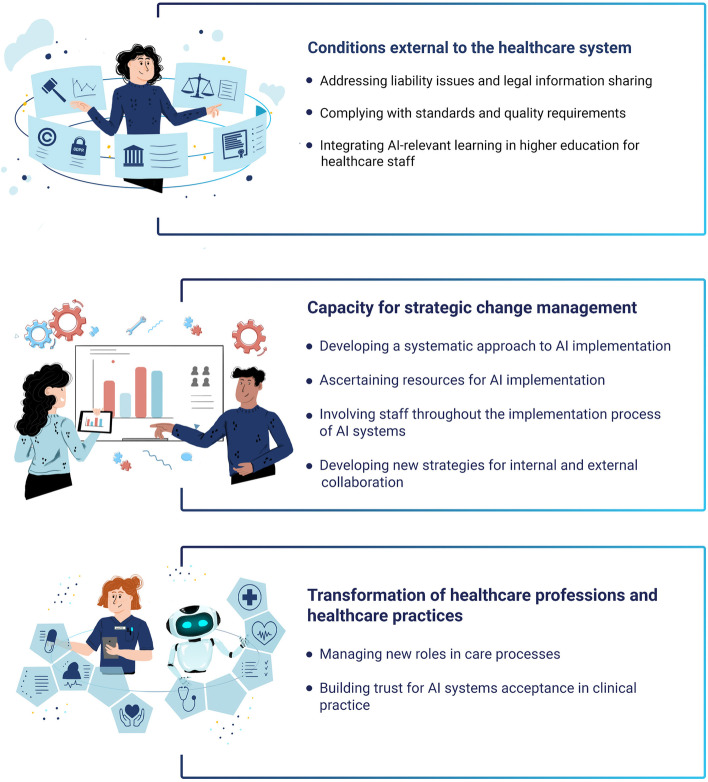
Background: Artificial intelligence (AI) for healthcare presents potential solutions to some of the challenges faced by health systems around the world. However, it is well established in implementation and innovation research that novel technologies are often resisted by healthcare leaders, which contributes to their slow and variable uptake. Although research on various stakeholders’ perspectives on AI implementation has been undertaken, very few studies have investigated leaders’ perspectives on the issue of AI implementation in healthcare. It is essential to understand the perspectives of healthcare leaders, because they have a key role in the implementation process of new technologies in healthcare. The aim of this study was to explore challenges perceived by leaders in a regional Swedish healthcare setting concerning the implementation of AI in healthcare. Methods: The study takes an explorative qualitative approach. Individual, semi-structured interviews were conducted from October 2020 to May 2021 with 26 healthcare leaders. The analysis was performed using qualitative content analysis, with an inductive approach. Results: The analysis yielded three categories, representing three types of challenge perceived to be linked with the implementation of AI in healthcare: 1) Conditions external to the healthcare system; 2) Capacity for strategic change management; 3) Transformation of healthcare professions and healthcare practice. Conclusions: In conclusion, healthcare leaders highlighted several implementation challenges in relation to AI within and beyond the healthcare system in general and their organisations in particular. The challenges comprised conditions external to the healthcare system, internal capacity for strategic change management, along with transformation of healthcare professions and healthcare practice. The results point to the need to develop implementation strategies across healthcare organisations to address challenges to AI-specific capacity building. Laws and policies are needed to regulate the design and execution of effective AI implementation strategies. There is a need to invest time and resources in implementation processes, with collaboration across healthcare, county councils, and industry partnerships.
Overview
The claims and statistics of this paper haven’t been checked yet.
Free: it reads the open-access text and checks the first 5 claims that cite a source we can check. Create a free account to check every claim.
Integrity signals
Registry
Cites
Statistics
Figures
Verification
Claims the paper makes
The claims and statistics of this paper haven’t been checked yet.
Free: it reads the open-access text and checks the first 5 claims that cite a source we can check. Create a free account to check every claim.
Claims other papers make about this one
Each is checked against this paper’s own text: does it say what the citing paper says it does?
The source backs part of the claim, not all of it — or backs it for a different population, condition or comparison.
In the citing paper
“This shared perspective resonates with prior research, underlining nurses' enthusiasm in exploring the potential contributions of AI to nursing practice [14,54].”
From Artificial intelligence in future nursing care: exploring perspectives of nursing professionals - a descriptive qualitative study (2024) · cites this paper as [54]
Experimental — accuracy not yet measuredThe source backs part of the claim, not all of it — or backs it for a different population, condition or comparison.
In the citing paper
“The availability of high-quality and annotated datasets is essential for training robust ML programs, but access to these datasets is often restricted due to patient privacy and security concerns [38].”
From Machine Learning in Maternity: Early Diagnosis of Placenta Accreta Spectrum (2026) · cites this paper as [38]
Experimental — accuracy not yet measuredThe cited source says what the claim attributes to it.
In the citing paper
“Effective implementation also depends on clinician training, as many ML tools require a foundational understanding of algorithmic outputs and limitations [38].”
From Machine Learning in Maternity: Early Diagnosis of Placenta Accreta Spectrum (2026) · cites this paper as [38]
In the citing paper
“Moreover, the participants' acknowledgment of the necessity for comprehensive training and continuous skill enhancement in AI integration is harmonious with research emphasizing the pivotal role of nursing education in effectively harnessing AI technologies [54].”
From Artificial intelligence in future nursing care: exploring perspectives of nursing professionals - a descriptive qualitative study (2024) · cites this paper as [54]
Self-check
Percentages, sums and reported differences re-computed from the paper’s own numbers.
The self-check needs the paper’s full text.
Citations
Cites
Tong, A., Sainsbury, P., & Craig, J. (2007) · International Journal for Quality in Health Care · doi:10.1093/intqhc/mzm042 · Cited by 42,509
Content Analysis: An Introduction to its Methodology.
Shelley, M., & Krippendorff, K. (1984) · Journal of the American Statistical Association · doi:10.2307/2288384 · Cited by 24,312
Graneheim, U. H., & Lundman, B. (2004) · Nurse Education Today · doi:10.1016/j.nedt.2003.10.001 · Cited by 20,772 · cited 1×
“In qualitative research, the concepts credibility, dependability, and transferability are used to describe different aspects of trustworthiness [72].”
Damschroder, L. J., Aron, D. C., Keith, R. E., Kirsh, S. R., Alexander, J. A., & Lowery, J. C. (2009) · Implementation Science · doi:10.1186/1748-5908-4-50 · Cited by 14,496 · cited 4×
“Our results relate well to the implementation science literature, identifying implementation challenges attributable to both external and internal conditions and circumstances [37, 68, 69] and the characteristics of the innovation [37, 63].”
BackgroundMethodResultInfluentialHigh-performance medicine: the convergence of human and artificial intelligence
Topol, E. J. (2019) · Nature Medicine · doi:10.1038/s41591-018-0300-7 · Cited by 10,450 · cited 1×
“Leader 9.”
Artificial intelligence in healthcare: past, present and future
Jiang, F., Jiang, Y., Zhi, H., Dong, Y., Li, H., Ma, S., Wang, Y., Dong, Q., Shen, H., & Wang, Y. (2017) · Stroke and Vascular Neurology · doi:10.1136/svn-2017-000101 · Cited by 4,837
The potential for artificial intelligence in healthcare
Davenport, T., & Kalakota, R. (2019) · Future Healthcare Journal · doi:10.7861/futurehosp.6-2-94 · Cited by 3,800 · cited 2×
“Even if the expectations for AI in healthcare are great [2], the potential of its use in healthcare is far from having been realized [5, 11, 12].”
BackgroundGluesing, J. C. (2012) · Leadership in Science and Technology: A Reference Handbook · doi:10.4135/9781412994231.n14 · Cited by 3,210
Methodological challenges in qualitative content analysis: A discussion paper
Graneheim, U. H., Lindgren, B.-M., & Lundman, B. (2017) · Nurse Education Today · doi:10.1016/j.nedt.2017.06.002 · Cited by 3,195
Cited by
Items 101–200 of 624
Siira, E., Johansson, H., & Nygren, J. (2025) · Journal of Medical Internet Research · doi:10.2196/53741 · Cited by 29
Self-citationArtificial intelligence in rehabilitation: a living systematic mapping review - first release
Morone, G., REHALISE Group, Carbonetti, R., Cinnera, A. M., Malfitano, C., Bisirri, A., & Negrini, F. (2025) · European Journal of Physical and Rehabilitation Medicine · doi:10.23736/s1973-9087.25.09331-1 · Cited by 28
Baraka, A. A. E., Alhijji, M. A. A., Alrajeh, R. A. I., Alotaibi, D. N. B., Bukhamis, S., Alsafraa, N. A. M., & Hassan, E. A. (2025) · International Nursing Review · doi:10.1111/inr.70035 · Cited by 28
Key drivers for the incorporation of artificial intelligence in humanitarian supply chain management
Karuppiah, K., Kandasamy, J., Rocha-Lona, L., Muñoz-Sánchez, C., & Joshi, R. (2025) · International Journal of Industrial Engineering and Operations Management · doi:10.1108/ijieom-12-2024-0082 · Cited by 28
Nair, M., Andersson, J., Nygren, J., & Lundgren, L. E. (2023) · JMIR Formative Research · doi:10.2196/47335 · Cited by 28
Self-citationArtificial Intelligence in Healthcare Sector: A Literature Review of the Adoption Challenges
Aldwean, A., & Tenney, D. (2024) · Open Journal of Business and Management · doi:10.4236/ojbm.2024.121009 · Cited by 29
Mansour, T., & Bick, M. (2024) · Digital Health · doi:10.1177/20552076241284936 · Cited by 27
Adopting Artificial Intelligence in Healthcare: A Narrative Review
Mouloudj, K., Vu Lan Oanh, L. E., Bouarar, A., Bouarar, A. C., Asanza, D. M., & Srivastava, M. (2023) · Advances in marketing, customer relationship management, and e-services book series · doi:10.4018/978-1-6684-9324-3.ch001 · Cited by 27
Shazril, M. H. S. E. M. A., Mashohor, S., Amran, M. E., Hafiz, N. F., Ali, A. M., Naseri, M. S. B., & Rasid, M. F. A. (2024) · IEEE Access · doi:10.1109/access.2024.3518516 · Cited by 26
Khosravi, M., Zare, Z., Mojtabaeian, S. M., & Izadi, R. (2024) · Journal of Public Health · doi:10.1007/s10389-024-02219-w · Cited by 25
Bridging Artificial Intelligence and Medical Education: Navigating the Alignment Paradox
Turner, L., Knopp, M. I., Mendonça, E. A., & Desai, S. V. (2025) · ATS Scholar · doi:10.34197/ats-scholar.2024-0086ps · Cited by 25
Tyskbo, D., & Nygren, J. (2024) · Social Science & Medicine · doi:10.1016/j.socscimed.2024.117298 · Cited by 25
Self-citationArtificial intelligence in respiratory care
Karthika, M., Sreedharan, J. K., Shevade, M., Mathew, C. S., & Ray, S. (2024) · Frontiers in Digital Health · doi:10.3389/fdgth.2024.1502434 · Cited by 24
Machine learning in cardiac surgery: a narrative review
Miles, T. J., & Ghanta, R. K. (2024) · Journal of Thoracic Disease · doi:10.21037/jtd-23-1659 · Cited by 25
Human-centric integrated change management framework for digital transformation in construction
Bidhendi, A., Poshdar, M., Jelodar, M. B., Rahimian, F. P., & González, V. A. (2025) · Engineering Construction & Architectural Management · doi:10.1108/ecam-02-2025-0312 · Cited by 24
Arboit, L., Schneider, D. N., Collins, T., Hashimoto, D. A., Perretta, S., Dallemagne, B., Marescaux, J., Mintz, Y., Nakajima, K., Diana, M., et al. (2025) · European Journal of Surgical Oncology · doi:10.1016/j.ejso.2025.110525 · Cited by 24
Lee, M. K., Allareddy, V., Rampa, S., Elnagar, M. H., Oubaidin, M., Yadav, S. K., & Venugopalan, S. R. (2024) · Seminars in Orthodontics · doi:10.1053/j.sodo.2024.01.005 · Cited by 24
Chi, M., Ren, S., Xu, Y., Chen, Y., & Wu, Y. (2025) · Journal of Retailing and Consumer Services · doi:10.1016/j.jretconser.2025.104424 · Cited by 24
Chatting with artificial intelligence to combat antibiotic resistance: Opportunities and challenges
Abavisani, M., Khoshrou, A., Foroushan, S. K., & Sahebkar, A. (2024) · Current Research in Biotechnology · doi:10.1016/j.crbiot.2024.100197 · Cited by 23
Human-centred AI for emergency cardiac care: Evaluating RAPIDx AI with PROLIFERATE_AI
de Plaza, M. A. P., Lambrakis, K., Marmolejo‐Ramos, F., Beleigoli, A. M. R., Archibald, M. M., Yadav, L., McMillan, P., Clark, R. A., Lawless, M., Morton, E. B., et al. (2025) · International Journal of Medical Informatics · doi:10.1016/j.ijmedinf.2025.105810 · Cited by 22
van Breugel, M., Greenhawt, M., Eguíluz‐Gracia, I., Torres, M. J., Anagnostou, A., & Koppelman, G. H. (2025) · Journal of Allergy and Clinical Immunology · doi:10.1016/j.jaci.2025.08.022 · Cited by 23
Teferi, B., Omar, M., Jeyakumar, T., Charow, R., Gillan, C., Jardine, J., Mattson, J., Dhalla, A., Koçak, S. A., Salhia, M., et al. (2023) · Education Sciences · doi:10.3390/educsci14010039 · Cited by 22
Global traumatic brain injury intracranial pressure: from monitoring to surgical decision
Zhang, D., Sheng, Y., Wang, C., Chen, W., & Shi, X. (2024) · Frontiers in Neurology · doi:10.3389/fneur.2024.1423329 · Cited by 22
Ong, W., Lee, A., Tan, W. C., Fong, K. T. D., Lai, D. D., Tan, Y. L., Low, X. Z., Ge, S., Makmur, A., Ong, S. J., et al. (2024) · Cancers · doi:10.3390/cancers16172988 · Cited by 21
Artificial Intelligence in migrant health: a critical perspective on opportunities and risks
Matlin, S. A., Claron, I. M. M., Merone, J., Netto, G., Takian, A., Zaman, M. H., & Saso, L. (2025) · The Lancet Regional Health - Europe · doi:10.1016/j.lanepe.2025.101421 · Cited by 21
Dehbaghi, H. A., & Khoshgard, K. (2025) · International Journal of Emergency Medicine · doi:10.1186/s12245-025-01049-1 · Cited by 21
Carrera, A., Manetti, S., & Lettieri, E. (2024) · BMC Health Services Research · doi:10.1186/s12913-024-10702-z · Cited by 20
Javed, H., Muqeet, H. A., Danesh, A., Rehman, A. U., Javed, T., & Bermak, A. (2024) · IEEE Access · doi:10.1109/access.2024.3443812 · Cited by 20
Singh, C. K., & Sodhi, K. K. (2024) · Critical Reviews in Microbiology · doi:10.1080/1040841x.2024.2429603 · Cited by 20
Zainal, H., Xin, X., Thumboo, J., & Yong, F. K. (2025) · JMIR Medical Education · doi:10.2196/64768 · Cited by 20
Khavandi, S., Zaghloul, F., Higham, A., Lim, E., de Pennington, N., & Celi, L. A. (2023) · JMIR Research Protocols · doi:10.2196/49374 · Cited by 21
Balay‐odao, E. M., Omirzakova, D., Bolla, S. R., Almazan, J. U., & Cruz, J. P. (2024) · AI & Society · doi:10.1007/s00146-024-01957-5 · Cited by 19
Epelde, F. (2024) · Hospitals · doi:10.3390/hospitals1020015 · Cited by 19
A Comprehensive Framework for Transparent and Explainable AI Sensors in Healthcare
Bouderhem, R. (2024) · International Electronic Conference on Sensors and Applications (ECSA) · doi:10.3390/ecsa-11-20524 · Cited by 19
The Impact of Artificial Intelligence on Allergy Diagnosis and Treatment
Khan, M., Banerjee, S., Muskawad, S., Maity, R., Chowdhury, S. R., Ejaz, R., Kuuzie, E., & Satnarine, T. (2024) · Current Allergy and Asthma Reports · doi:10.1007/s11882-024-01152-y · Cited by 19
Disrupt through digital: a study on the challenges faced when digitalizing R&D
Samra, A. E., James, A. D., & Malik, K. (2023) · R and D Management · doi:10.1111/radm.12637 · Cited by 19
Shukla, V. K., Sudhi, M., Shetty, D. K., Banthia, S., Chandrasekar, P., Naik, N., Hameed, B. M. Z., Girisha, S., & Balakrishnan, J. M. (2023) · Engineered Science · doi:10.30919/es1009 · Cited by 19
Artificial Intelligence in Healthcare: Current Trends and Future Directions
Samajdar, S. S., Chatterjee, R., Mukherjee, S., Dey, A., Saboo, B., Pal, J., Joshi, S., & Chatterjee, N. (2025) · Current Medical Issues · doi:10.4103/cmi.cmi_93_24 · Cited by 19
Wong, A. V.-K., Roslan, N. L., McDonald, R., Noor, J. M., Hutchings, S., D’costa, P., Via, G., & Corradi, F. (2025) · The Ultrasound Journal · doi:10.1186/s13089-025-00436-2 · Cited by 19
AI-driven innovation in healthcare product development : challenges and ethical implications
Kanagarajah, A. (2024) · LUTPub (LUT University) · Cited by 20
AI in situated action: a scoping review of ethnomethodological and conversation analytic studies
Mlynář, J., de Rijk, L., Liesenfeld, A., Stommel, W., & Albert, S. (2025) · AI & SOCIETY · doi:10.1007/s00146-024-01919-x · Cited by 18
“On the other hand, AI has nonetheless become a social object: something that can be talked about (e.g., Mlynář et al. 2022; Petersson et al. 2022), for example seen as a promise or a threat (e.g., Kotásek 2015; Smith 2019), or attributed with societal agency (e.g., Bellon and Velkovska 2023;…”
Persson, V., & Wickman, U. L. (2025) · Healthcare · doi:10.3390/healthcare13080950 · Cited by 18
How Interoperability Can Enable Artificial Intelligence in Clinical Applications
Rehburg, F., Graefe, A. S. L., Hübner, M. R., & Thun, S. (2024) · Studies in health technology and informatics · doi:10.3233/shti240485 · Cited by 18
Recent approaches of artificial intelligence in intensive care unit: A review
Havelikar, U. A., Bembde, A., Patil, D., Shinde, A., Sharma, R. K., Patel, V. P., & Chaudhari, N. B. (2025) · Intelligent Hospital · doi:10.1016/j.inhs.2025.100030 · Cited by 18
Steerling, E., Svedberg, P., Nilsén, P., Siira, E., & Nygren, J. (2025) · Frontiers in Digital Health · doi:10.3389/fdgth.2025.1565080 · Cited by 19
Self-citationRealizing the potential of AI in pharmacy practice: Barriers and pathways to adoption
Fahim, M. I. A., Tonny, T. S., & Noman, A. A. (2024) · Intelligent Pharmacy · doi:10.1016/j.ipha.2024.02.003 · Cited by 18
AI in Medical Questionnaires: Scoping Review
Luo, X., Li, Y. L., Xu, J., Zheng, Z., Ying, F., & Huang, G. (2025) · Journal of Medical Internet Research · doi:10.2196/72398 · Cited by 18
Seringa, J., Hirata, A., Pedro, A. R., Santana, R. M., & Magalhães, T. (2025) · Journal of Medical Internet Research · doi:10.2196/54990 · Cited by 18
Challenges and Solutions for Artificial Intelligence Adoption in Healthcare – A Literature Review
Doniņš, U., & Behmane, D. (2023) · Smart innovation, systems and technologies · doi:10.1007/978-981-99-3311-2_6 · Cited by 18
Kondo, T. S., Diwani, S. A., Nyamawe, A. S., & Mjahidi, M. M. (2023) · AI and Ethics · doi:10.1007/s43681-023-00359-5 · Cited by 17
Role of Artificial Intelligence in Clinical and Hospital Pharmacy
Sridhar, S. B., Karattuthodi, M. S., & Parakkal, S. A. (2024) · Nutritional neurosciences · doi:10.1007/978-981-97-2577-9_12 · Cited by 17
Transforming towards AI-augmented Healthcare: Experiences of physicians in Sweden
Ismail, M., Barth, H., Holmén, M., Petersson, L., & Irgang, L. (2025) · Technovation · doi:10.1016/j.technovation.2025.103333 · Cited by 17
Self-citationCognitive decline assessment in speakers of understudied languages
Hatahet, O., Röser, F., & Seghier, M. L. (2023) · Alzheimer s & Dementia Translational Research & Clinical Interventions · doi:10.1002/trc2.12432 · Cited by 17
Oleribe, O. O., Taylor-Robinson, A. W., Agala, V., Sobande, O. O., Izurieta, R., & Taylor-Robinson, S. D. (2025) · Journal of Medical Internet Research · doi:10.2196/70805 · Cited by 17
Almheiri, M. S. M. A., Bashir, H. A., Ojiako, U., Haridy, S., & Shamsuzzaman, M. (2024) · Water · doi:10.3390/w16233539 · Cited by 17
Ethical and regulatory considerations in AI-driven medical imaging: A perspective overview
Odezuligbo, I., Alade, O., & Chukwurah, E. F. (2024) · International Journal of Science and Research Archive · doi:10.30574/ijsra.2024.13.1.1739 · Cited by 17
Gemmano, C. G., Molinaro, D., Bellini, D., Simone, S. D., Giancaspro, M. L., Mondo, M., Buono, C., Barbieri, B., Spagnoli, P., & Manuti, A. (2026) · Behavioral Sciences · doi:10.3390/bs16020238 · Cited by 17
Larsson, I., Siira, E., Nygren, J., Petersson, L., Svedberg, P., Nilsén, P., & Neher, M. (2025) · BMC Family Practice · doi:10.1186/s12875-025-03057-9 · Cited by 16
Self-citationAI and stroke rehabilitation: The past, present and future
Zhang, Z., & Yu, L. (2025) · Regenesis repair rehabilitation. · doi:10.1016/j.rerere.2025.05.002 · Cited by 16
Ardito, V., Cappellaro, G., Compagni, A., Petracca, F., & Preti, L. M. (2025) · Digital Health · doi:10.1177/20552076251355680 · Cited by 16
Masawi, T. J., Miller, E. I., Rees, D. J., & Thomas, R. A. (2025) · Journal of Decision System · doi:10.1080/12460125.2025.2458874 · Cited by 16
Latt, P. M., Soe, N. N., Fairley, C. K., Chow, E. P. F., Johnson, C., Shah, P., Maatouk, I., Zhang, L., & Ong, J. J. (2025) · International Journal of Infectious Diseases · doi:10.1016/j.ijid.2025.107922 · Cited by 16
Technology’s Impact on Nurse Manager Practices
Sutton, T. (2025) · Nursing Administration Quarterly · doi:10.1097/naq.0000000000000705 · Cited by 16
Santiago-Torner, C., Marfil, J. A. C., & Tarrats-Pons, E. (2026) · Sustainability · doi:10.3390/su18084085 · Cited by 16
Adopting artificial intelligence driven technology in medical education
Abdekhoda, M., & Dehnad, A. (2024) · Interactive Technology and Smart Education · doi:10.1108/itse-12-2023-0240 · Cited by 15
Sallam, M., Khalil, R., & Sallam, M. (2024) · Mesopotamian Journal of Artificial Intelligence in Healthcare · doi:10.58496/mjaih/2024/010 · Cited by 15
Navigating the AI Revolution in Medicine—Adopting Strategies for Medical Education
Greengrass, C. J. (2024) · Medical Science Educator · doi:10.1007/s40670-024-02257-9 · Cited by 15
Management of polypharmacy through deprescribing in older patients: a review of the role of AI tools
Meslamani, A. Z. A. (2025) · Expert Review of Clinical Pharmacology · doi:10.1080/17512433.2025.2519648 · Cited by 15
Swart, R., Boersma, L. J., Fijten, R., van Elmpt, W., Cremers, H., & Jacobs, M. (2024) · JCO Clinical Cancer Informatics · doi:10.1200/cci.24.00101 · Cited by 15
OpenAI ChatGPT interprets Radiological Images: GPT-4 as a Medical Doctor for a Fast Check-UpPreprint
Aydın, Ö., & Karaarslan, E. (2025) · SSRN Electronic Journal · doi:10.2139/ssrn.5090227 · Cited by 15
Ng, J. Y., Krishnamurthy, M., Deol, G., Al-Khafaji, W. A.-Z., Balaji, V., Abebe, M., Adhvaryu, J., Karrthik, T., Mohanakanthan, P., Vellaparambil, A., et al. (2025) · Research Integrity and Peer Review · doi:10.1186/s41073-025-00178-8 · Cited by 14
Artificial Intelligence Platform Architecture for Hospital Systems: Systematic Review
Maimaitiaili, M., Jiamaliding, Y., Dai, G., Xiao, H., Kuerbanjiang, W., & Yi, Y. (2025) · Journal of Medical Internet Research · doi:10.2196/79788 · Cited by 14
“In this context, hospital executives do not have sensible roadmaps to translate fragmented digital environments into integrated AI platforms that are based on evidence [10].”
Ng, J. Y., Krishnamurthy, M., Deol, G., Al-Khafaji, W. A.-Z., Balaji, V., Abebe, M., Adhvaryu, J., Karrthik, T., Mohanakanthan, P., Vellaparambil, A., et al. (2025) · doi:10.1101/2025.05.26.25328101 · Cited by 14
Qualitative exploration of 3D printing in Swedish healthcare: perceived effects and barriers
Sag, O. M., Li, X., Åman, B., Thor, A. L. I., & Brantnell, A. (2024) · BMC Health Services Research · doi:10.1186/s12913-024-11975-0 · Cited by 14
Barański, J. (2024) · Przeglad Epidemiologiczny · doi:10.32394/pe/194484 · Cited by 5
Advancing cancer care: How artificial intelligence is transforming oncology pharmacy
Alnuhait, M. A., Shahbar, A. N., Alrumaih, I. A., Alzahrani, T., Alzahrani, A. M., Alanizi, A. H., Alrashed, M. A., Elrggal, M. E., Alhuthali, A., & Alsuhebany, N. (2024) · Informatics in Medicine Unlocked · doi:10.1016/j.imu.2024.101529 · Cited by 14
Artificial Intelligence: Trends and Challenges
Karthick, A. V., & Gopalsamy, S. (2022) · International Conference on Parallel, Distributed and Grid Computing (PDGC) · doi:10.1109/pdgc56933.2022.10053238 · Cited by 14
Qiu, X., Hu, B., Ke, J., Wang, M., Zeng, H., & Gu, J. (2025) · Aging Clinical and Experimental Research · doi:10.1007/s40520-025-03037-0 · Cited by 15
Güvey Emre, M., Esen, M. F., & Onganer, E. (2025) · INQUIRY The Journal of Health Care Organization Provision and Financing · doi:10.1177/00469580251376921 · Cited by 13
The Role of Artificial Intelligence in Obesity Medicine
Kim, D. W., Park, C.-Y., Shin, J., & Lee, H. J. (2024) · Endocrinology and Metabolism Clinics of North America · doi:10.1016/j.ecl.2024.10.008 · Cited by 13
Trang, T. T. N., Thắng, P. C., & Vo, T. A. (2025) · Computers in Human Behavior Reports · doi:10.1016/j.chbr.2025.100774 · Cited by 13
Sallam, M., Snygg, J., & Sallam, M. (2024) · Journal of Artificial Intelligence Machine Learning and Data Science · doi:10.51219/jaimld/mohammed-sallam/20 · Cited by 13
Żywiołek, J. (2024) · Scientific Papers of Silesian University of Technology Organization and Management Series · doi:10.29119/1641-3466.2024.197.37 · Cited by 13
Legal Responsibility of Health Professionals in Protecting Patient Data
Lakoro, D. D. K., Jumrati, & Jamaludin, A. (2025) · Research Horizon · doi:10.54518/rh.5.3.2025.657 · Cited by 13
Digitalization and Artificial Intelligence as Motivators for Healthcare Professionals
Karaferis, D. C., Dimitra, B., & Pollalis, Y. (2025) · Japan Journal of Research · doi:10.33425/2690-8077.1170 · Cited by 12
Ibrahim, A. M., Okesanya, O. J., Ukoaka, B. M., Ahmed, M. M., Idris, N. B., Bamilosin, S., Ogaya, J. B., & Lucero‐Prisno, D. E. (2025) · Discover Water · doi:10.1007/s43832-025-00206-0 · Cited by 12
Ardito, V., Cappellaro, G., Compagni, A., Petracca, F., & Preti, L. M. (2023) · JMIR Research Protocols · doi:10.2196/47971 · Cited by 12
Hassoon, A., Lin, C. F., Woo, H., Irimia, R. M., Marsteller, J. A., Li, A., Banderia, A., Leo, H., Peng, X., Rastall, D. P. W., et al. (2025) · Annals of Epidemiology · doi:10.1016/j.annepidem.2025.11.004 · Cited by 12
Vesperi, W., Ventura, M., Cristofaro, C. L., & Melina, A. M. (2025) · BMC Health Services Research · doi:10.1186/s12913-025-13302-7 · Cited by 12
Artificial intelligence for breast cancer management
Chua, B. N., Thng, D. K. H., Toh, T. B., & Ho, D. (2026) · Communications Medicine · doi:10.1038/s43856-025-01342-3 · Cited by 12
Effendy, C. A., Paramarta, V., & Purwanda, E. (2024) · Jurnal Review Pendidikan dan Pengajaran · Cited by 12
Määttä, M., Hammarén, M., Kuha, S., & Kanste, O. I. (2025) · Journal of Advanced Nursing · doi:10.1111/jan.17035 · Cited by 11
Nursing Students' Perception of and Readiness for Artificial Intelligence in Saudi Arabia
Bakarman, S. S., Alshammari, A., & Aboshaiqah, A. E. (2025) · Nursing Open · doi:10.1002/nop2.70386 · Cited by 11
Curiello, S., Iannuzzi, E., Meissner, D., & Nigro, C. (2025) · European Journal of Innovation Management · doi:10.1108/ejim-01-2024-0078 · Cited by 11
Orkaby, B., Kerner, E., Saban, M., & Levin, C. (2025) · BMC Nursing · doi:10.1186/s12912-025-03034-8 · Cited by 11
Abudalbouh, L. A. (2023) · International Journal of Health Sciences · doi:10.53730/ijhs.v7ns1.14313 · Cited by 11
Odion, S., & Addula, S. R. (2026) · Future Internet · doi:10.3390/fi18040209 · Cited by 11
Vidanage, K., Noor, N. M. M., & Sathsara, S. (2024) · International Journal of Information Technology · doi:10.1007/s41870-024-01900-3 · Cited by 11
Vemulapalli, S., Alenezi, F. A. M., Jeong, H. K., Giczewska, A., Chiswell, K., Douglas, P. S., Zhang, A. R., Shah, S. H., Henao, R., & Wang, A. (2025) · JACC Advances · doi:10.1016/j.jacadv.2025.101746 · Cited by 11
Aljabali, A. A. A., Obeid, M. A., El‐Tanani, M., Mishra, V. K., Mishra, Y., & Tambuwala, M. M. (2024) · Gene · doi:10.1016/j.gene.2024.148174 · Cited by 11
Metadata
- Authors
- Petersson, L., Larsson, I., Nygren, J. M., Nilsen, P., Neher, M., Reed, J. E., Tyskbo, D., & Svedberg, P.
- Affiliations
- Halmstad University (SE)
- Corresponding author
- Petersson, Lena
- ORCID
- Venue
- BMC Health Services Research
- Published
- 2022-07-01
- Volume
- 22
- Issue
- 1
- Pages
- 850-850
- ISSN
- 1472-6963 (ISSN-L)
- PMC
- PMC9250210
- OpenAlex
- W4283749268
- Semantic Scholar
- bb678afa2685e6493f9875b66ac2b32dce5e7e9b
- Cited by
- 434
- References
- 72
- Citations by year
- 2026: 85 · 2025: 170 · 2024: 133 · 2023: 42 · 2022: 4
- FWCI
- 26.31
- Type
- journal article
- Language
- en
- Open access
- gold
- doi.org
- Licence
- cc-by
- creativecommons.org/licenses/by/4.0 (tdm)
- creativecommons.org/licenses/by/4.0 (vor)
- Locations
- BMC Health Services Research (publishedVersion, cc-by)
- PubMed Central (publishedVersion, cc-by)
- PubMed (publishedVersion)
- Hogskolan Ihalmstad (Halmstad University) (submittedVersion, other-oa)
- DiVA (Linkoping University) (submittedVersion, other-oa)
- DOAJ (DOAJ: Directory of Open Access Journals) (submittedVersion)
- Funders
- VINNOVA (grant 2019-04526)
- Knowledge Foundation, Sweden (grant 20200208 01H)
- Carl Bennet AB (L2013/77)
- Halmstad University
- Topics
- Health Sciences › Medicine › Health Informatics › Artificial Intelligence in Healthcare and Education
- Health Sciences › Health Professions › General Health Professions › Health Policy Implementation Science
- Physical Sciences › Computer Science › Artificial Intelligence › Artificial Intelligence Applications
- Keywords
- artificial intelligence in healthcare, AI implementation, healthcare executives, implementation barriers, change management, health professions, implementation strategies
- MeSH terms
- Artificial Intelligence, Delivery of Health Care, Health Facilities, Humans, Sweden, Qualitative Research
About these checks
Registry, retraction, Cites and statistics results are computed, not judged, with one exception: a printed reference that no index lists is read once by a model before it counts as a citation error. Claims are extracted by a model and kept only when their quote appears verbatim in the text; each cited source is then checked, with a model’s help, for whether it says what the claim relies on. Those verdicts can be wrong — read the claim’s quote and the cited source before relying on one.
Statistics and arithmetic are recomputed, not judged.
Confidence bands are shown only for fields calibrated on our annotated test set. None is calibrated yet, so no band is shown.
What counts as a claim ›How we measure confidence ›How we check this ›
Are you an author, or do you see a problem with this page? Request a review
Data sources
Bibliographic data: Semantic Scholar, OpenAlex, Crossref.
Contains information from the Semantic Scholar Academic Graph Datasets, made available under the ODC Attribution License (ODC-BY 1.0).
Semantic Scholar’s data is described in: Kinney, R., et al. (2023). The Semantic Scholar Open Data Platform. arXiv:2301.10140.
