

Comparison of village dog and wolf genomes highlights the role of the neural crest in dog domestication
Open accessPublished version of a preprint
The DOI matches its Crossref record; 197 of the 199 references it cites were found in a registry or an index.
Abstract
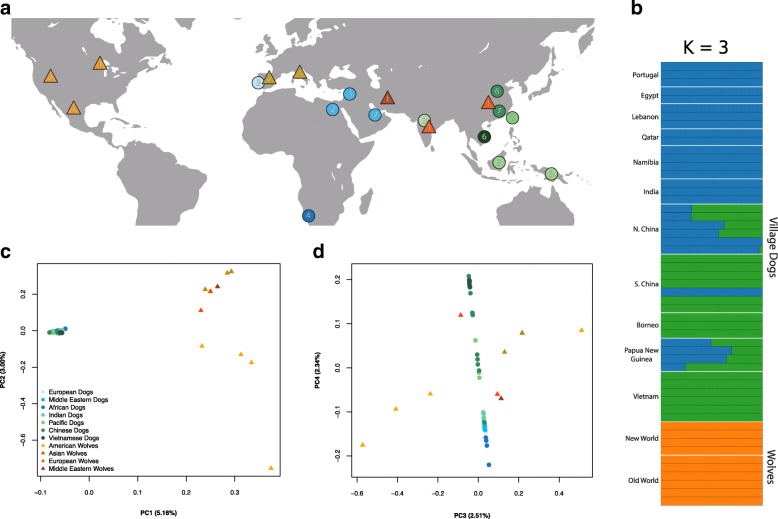
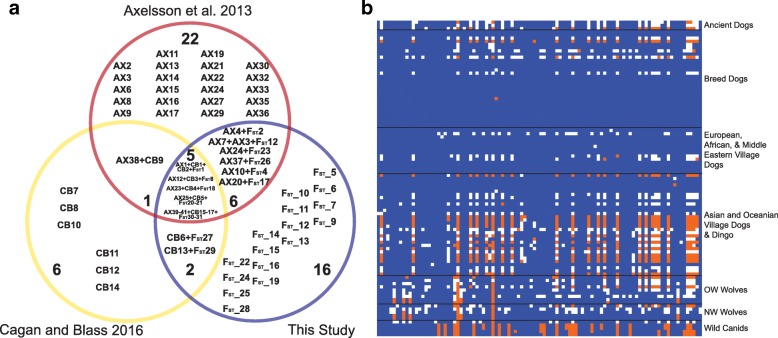
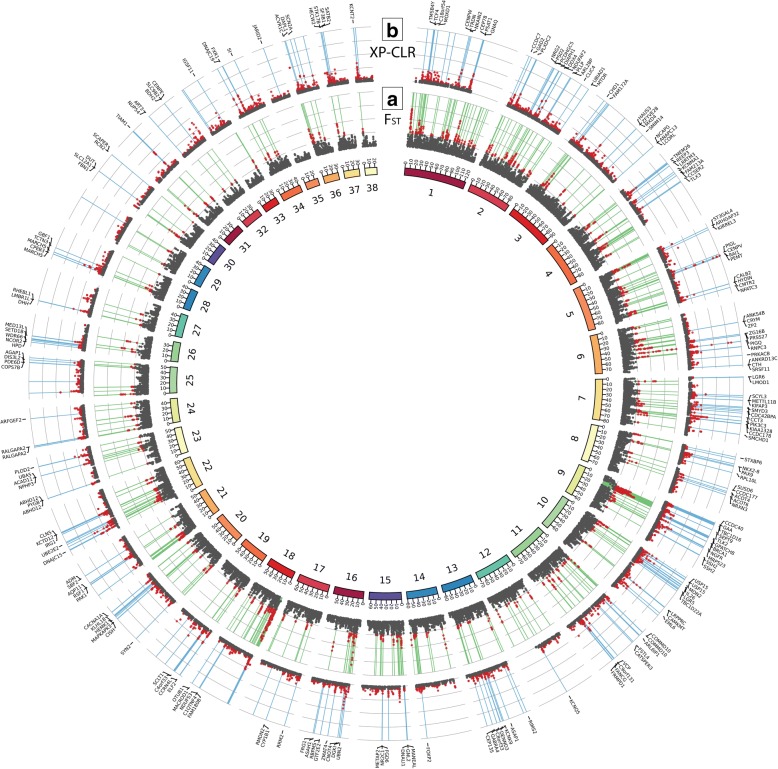
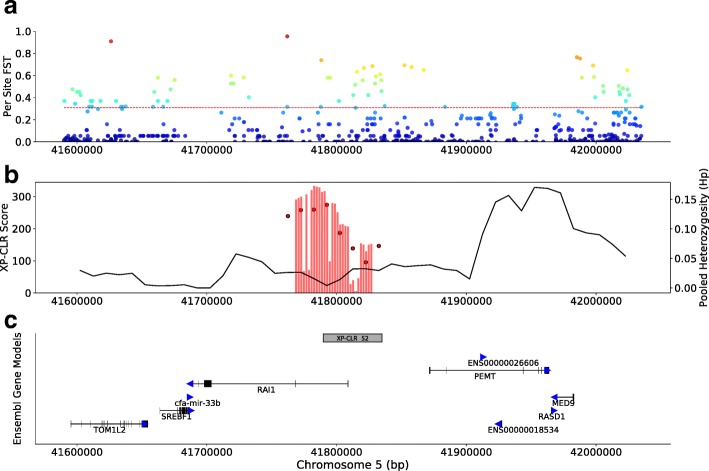
BACKGROUND: Domesticated from gray wolves between 10 and 40 kya in Eurasia, dogs display a vast array of phenotypes that differ from their ancestors, yet mirror other domesticated animal species, a phenomenon known as the domestication syndrome. Here, we use signatures persisting in dog genomes to identify genes and pathways possibly altered by the selective pressures of domestication. RESULTS: Whole-genome SNP analyses of 43 globally distributed village dogs and 10 wolves differentiated signatures resulting from domestication rather than breed formation. We identified 246 candidate domestication regions containing 10.8 Mb of genome sequence and 429 genes. The regions share haplotypes with ancient dogs, suggesting that the detected signals are not the result of recent selection. Gene enrichments highlight numerous genes linked to neural crest and central nervous system development as well as neurological function. Read depth analysis suggests that copy number variation played a minor role in dog domestication. CONCLUSIONS: Our results identify genes that act early in embryogenesis and can confer phenotypes distinguishing domesticated dogs from wolves, such as tameness, smaller jaws, floppy ears, and diminished craniofacial development as the targets of selection during domestication. These differences reflect the phenotypes of the domestication syndrome, which can be explained by alterations in the migration or activity of neural crest cells during development. We propose that initial selection during early dog domestication was for behavior, a trait influenced by genes which act in the neural crest, which secondarily gave rise to the phenotypes of modern dogs.
Overview
The claims and statistics of this paper haven’t been checked yet.
Free: it reads the open-access text and checks the first 5 claims that cite a source we can check. Create a free account to check every claim.
Integrity signals
Registry
Cites
Statistics
Figures
Verification
Claims the paper makes
The claims and statistics of this paper haven’t been checked yet.
Free: it reads the open-access text and checks the first 5 claims that cite a source we can check. Create a free account to check every claim.
Claims other papers make about this one
Each is checked against this paper’s own text: does it say what the citing paper says it does?
The cited source says what the claim attributes to it.
In the citing paper
“Recent genomic studies (Carneiro et al. 2014; Pendleton et al. 2018; Wang et al. 2018) have found evidence of selection at a few handfuls of genes that have molecular functions associated with the neural crest, but that in itself is not good evidence that neural crest cell proliferation and migration are underlying the domestication syndrome.”
From The neural crest cell hypothesis: no unified explanation for domestication (2021) · cites this paper as Pendleton et al. 2018
The cited source says what the claim attributes to it.
In the citing paper
“the neural-crest cell hypothesis of domestication assumes that a process of domestication leads to depigmentation rather than an intensification of pigmentation [40,41].”
From Are dark-eyed dogs favoured by humans? Domestication as a potential driver of iris colour difference between dogs and wolves (2023) · cites this paper as [41]
Self-check
Percentages, sums and reported differences re-computed from the paper’s own numbers.
The self-check needs the paper’s full text.
Citations
Cites
PLINK: a tool set for whole-genome association and population-based linkage analyses.
Purcell, S., Neale, B., Todd-Brown, K., Thomas, L., Ferreira, M. A. R., Bender, D., Maller, J., Sklar, P., de Bakker, P. I. W., Daly, M. J., et al. (2007) · The American Journal of Human Genetics · doi:10.1086/519795 · Cited by 34,089 · cited 1×
“1; [133]), where SNPs with an 530 R(2) value over 0.”
BackgroundThe Genome Analysis Toolkit: A MapReduce framework for analyzing next-generation DNA sequencing data
McKenna, A., Hanna, M., Banks, E., Sivachenko, A., Cibulskis, K., Kernytsky, A., Garimella, K., Altshuler, D., Gabriel, S., Daly, M., et al. (2010) · Genome Research · doi:10.1101/gr.107524.110 · Cited by 27,895
BEDTools: a flexible suite of utilities for comparing genomic features
Quinlan, A. R., & Hall, I. M. (2010) · Bioinformatics · doi:10.1093/bioinformatics/btq033 · Cited by 27,437
A global reference for human genetic variation
The 1000 Genomes Project Consortium, authors, C., Auton, A., Abecasis, G. R., Steering committee, Altshuler, D. M., Durbin, R. M., Abecasis, G. R., Bentley, D. R., Chakravarti, A., et al. (2015) · Nature · doi:10.1038/nature15393 · Cited by 18,247
The variant call format and VCFtools
Danecek, P., Auton, A., Abecasis, G., Albers, C. A., Banks, E., DePristo, M. A., Handsaker, R. E., Lunter, G., Marth, G. T., Sherry, S. T., et al. (2011) · Bioinformatics · doi:10.1093/bioinformatics/btr330 · Cited by 16,200
Fast model-based estimation of ancestry in unrelated individuals
Alexander, D. H., Novembre, J., & Lange, K. (2009) · Genome Research · doi:10.1101/gr.094052.109 · Cited by 9,898 · cited 4×
“Thirty-seven breed dogs, 45 village dogs, and 12 wolves were selected 527 from the samples described in Botigue et al. [34], and ADMIXTURE [132] was utilized to 528 estimate the levels of wolf-dog admixture within this subset.”
MethodInfluentialNear-optimal probabilistic RNA-seq quantification
Bray, N. L., Pimentel, H., Melsted, P., & Pachter, L. (2016) · Nature Biotechnology · doi:10.1038/nbt.3519 · Cited by 9,723
Primer3—new capabilities and interfaces
Untergasser, A., Cutcutache, I., Koressaar, T., Ye, J., Faircloth, B. C., Remm, M., & Rozen, S. G. (2012) · Nucleic Acids Research · doi:10.1093/nar/gks596 · Cited by 9,461
The Ensembl Variant Effect Predictor
McLaren, W., Gil, L., Hunt, S. E., Riat, H. S., Ritchie, G. R. S., Thormann, A., Flicek, P., & Cunningham, F. (2016) · Genome Biology · doi:10.1186/s13059-016-0974-4 · Cited by 8,099
A map of human genome variation from population-scale sequencing.
The 1000 Genomes Project Consortium (2010) · Nature · doi:10.1038/nature09534 · Cited by 7,877
Research works printed but not linked: 2
- Harlan JR. Crops and man. Foundation for modern Crop Science. Madison: American Society of Agronomy; 1975.
- Alexa A, Rahnenfuhrer J. topGO: enrichment analysis for gene ontology. R Packag Ver. 2010;2(0):1-26.
Cited by
Items 101–160 of 160
Domestication as a process generating phenotypic diversity
Trut, L. N., & Kharlamova, A. V. (2020) · Elsevier eBooks · doi:10.1016/b978-0-12-817996-3.00014-1 · Cited by 7
Range, F., & Marshall‐Pescini, S. (2022) · Fascinating life sciences · doi:10.1007/978-3-030-98411-3_11 · Cited by 8
Genetic diversity and regulatory features of human-specific NOTCH2NL duplications
Real, T. D., Hebbar, P., Yoo, D., Antonacci, F., Pačar, I., Dubocanin, D., Diekhans, M., Mikol, G. J., Popoola, O. G., Mallory, B. J., et al. (2026) · Cell Genomics · doi:10.1016/j.xgen.2026.101194 · Cited by 9
Zhu, Τ., Du, J., Song, H., Lei, C., Cen, Y., Wang, C.-H., & Li, S. (2024) · Scientific Reports · doi:10.1038/s41598-024-80904-2 · Cited by 8
Cocco, R., Arfuso, F., Giannetto, C., Piccione, G. G., Cesarani, A., Pulina, G., & Sechi, S. (2023) · Animals · doi:10.3390/ani13030411 · Cited by 6
Alexandrovich, Y. V., Antonov, E. V., Шихевич, С. Г., Kharlamova, A. V., Meister, L. V., Makovka, Y. V., Shepeleva, D. V., Gulevich, R. G., & Herbeck, Y. E. (2023) · Vavilov Journal of Genetics and Breeding · doi:10.18699/vjgb-23-76 · Cited by 5
“Note that genome-wide comparisons between village dogs and wolves and between humans and chimpanzees has also demonstrated differences in the atRA system (Theofanopoulou et al., 2017; Pendleton et al., 2018).”
BackgroundBenítez‐Burraco, A. (2019) · Molecular Syndromology · doi:10.1159/000505116 · Cited by 4
“…et al., 2013; Carneiro et al., 2014; Montague et al., 2014; Qanbari et al., 2014; Schubert et al., 2014; Wilkins et al., 2014; Wright et al., 2015; Cagan and Blass, 2016; Freedman et al., 2016; Zapata et al., 2016; Benítez-Burraco et al., 2017; Theofanopoulou et al., 2017; Pendleton et al., 2018].”
BackgroundDo Emotional Cues Influence the Performance of Domestic Dogs in an Observational Learning Task?
Albuquerque, N. D. S., Savalli, C., Cabral, F. G. D. S., & Resende, B. D. D. (2021) · Frontiers in Psychology · doi:10.3389/fpsyg.2021.615074 · Cited by 5
Are feralization and domestication truly mirror processes?
Niego, A., & Benítez‐Burraco, A. (2021) · Ethology Ecology & Evolution · doi:10.1080/03949370.2021.1975314 · Cited by 6
“…et al. 2013; Bellone et al. 2013; Carneiro et al. 2014; Montague et al. 2014; Qanbari et al. 2014; Schubert et al. 2014; Wilkins et al. 2014; Wright 2015; Cagan & Blass 2016; Freedman et al. 2016; Zapata et al. 2016; Benítez-Burraco et al. 2017; Theofanopoulou et al. 2017; Pendleton et al. 2018).”
BackgroundCairns, K. M., Letnic, M., Ritchie, E. G., Adams, J. W., Crowther, M. S., Dickman, C. R., Fillios, M. A., Pascoe, J., Smith, B. P., & Newsome, T. M. (2025) · Australian Mammalogy · doi:10.1071/am24052 · Cited by 6
Acquisition of ampliconic sequences marks a selfish mouse t-haplotype
Swanepoel, C. M., Wang, G., Zhang, L., Brändl, B., Bauer, H., Tsaytler, P. A., Müller, F. U., Herrmann, B. G., & Mueller, J. L. (2025) · Nature Communications · doi:10.1038/s41467-025-66616-9 · Cited by 6
Rando, H. M., Alexander, E. P., Preckler‐Quisquater, S., Quinn, C. B., Stutchman, J. T., Johnson, J. L., Bastounes, E. R., Horecka, B., Black, K. L., Robson, M. P., et al. (2024) · Journal of Heredity · doi:10.1093/jhered/esae022 · Cited by 3
An Evolutionary Perspective on Dog Behavioral Genetics
Lord, K. A., Chen, F. L., & Karlsson, E. K. (2024) · Annual Review of Animal Biosciences · doi:10.1146/annurev-animal-111523-101954 · Cited by 9
Multiple Origins and Genomic Basis of Complex Traits in Sighthounds
Li, W., Yan-hu, L., Li, J., Ding, M.-T., Adeola, A. C., Isakova, J. T., Aldashev, A. A., Peng, M., Huang, X., Xie, G., et al. (2023) · Molecular Biology and Evolution · doi:10.1093/molbev/msad158 · Cited by 6
“We set the nuclear mutation rate to 4 × 10⁻⁹ per site per generation (Raghavan et al. 2014; Pendleton et al. 2018) and assumed a generation time of 3 years.”
BackgroundA phylogenetic estimate of canine retrotransposition rates based on genome assembly comparisons
Blacksmith, M. S., Nguyen, A. K., Moran, J. V., & Kidd, J. M. (2026) · Mobile DNA · doi:10.1186/s13100-026-00397-w · Cited by 4
“The filtered low confidence regions included gaps, BISER [78] and/or fastCN [79] segmental duplications, and loci identified by tandem repeat finder (TRF) [98] in either the query or reference.”
Self-citationCao, R., ZHANG, M., Yi, C. H. E. N., Guanmei, H. O. U., Quansheng, L. I. U., ZHANG, J., & Zhang, Y. (2024) · Integrative Zoology · doi:10.1111/1749-4877.12829 · Cited by 4
Developmental instability in domesticated mammals
Wilson, L. A. B. (2021) · Journal of Experimental Zoology Part B Molecular and Developmental Evolution · doi:10.1002/jez.b.23108 · Cited by 3
Koller, D., Benítez‐Burraco, A., & Polimanti, R. A. (2023) · Human Genetics · doi:10.1007/s00439-023-02541-5 · Cited by 3
Hsu, W., Williamson, P., & Khatkar, M. S. (2023) · Animals · doi:10.3390/ani13071149 · Cited by 3
“Regulation of neural crest development requires a network of genes expressed early in embryogenesis that coordinate a multi-stage process, resulting in migration of NCCs to various sites in the developing embryo where they differentiate into a diverse array of cell types [52].”
BackgroundInfluentialA map of canine sequence variation relative to a Greenland wolf outgroup
Nguyen, A. K., Schall, P. Z., & Kidd, J. M. (2024) · Mammalian Genome · doi:10.1007/s00335-024-10056-1 · Cited by 6
“2 assembly were calculated using fastCN as previously described (Nguyen et al. 2024; Pendleton et al. 2018).”
Self-citationPerry, G. H. (2020) · Journal of Comparative Physiology A · doi:10.1007/s00359-020-01415-9 · Cited by 5
“As we continue to obtain more detailed understandings of the convergent genetic and molecular processes observed among domesticated taxa (e.g., Carneiro et al. 2014; Librado et al. 2017; Kukekova et al. 2018; Alberto et al. 2018; Pendleton et al. 2018; Wang et al. 2018), applying this knowledge to the potential study…”
BackgroundAbnormal features of human self‐domestication in bipolar disorder
Benítez‐Burraco, A., & Hansen, E. J. (2023) · European Journal of Neuroscience · doi:10.1111/ejn.15959 · Cited by 2
Dogs (Canis familiaris) distinguish conspecific emotional chemosignals
Wang, A., & Horowitz, A. (2026) · Scientific Reports · doi:10.1038/s41598-026-41426-1 · Cited by 2
An In-Depth Look at Fonni’s Dog Behavior under Different Outdoor Conditions
Cocco, R., Sechi, S., Giannetto, C., Rizzo, M., Piccione, G. G., & Arfuso, F. (2024) · Animals · doi:10.3390/ani14050678 · Cited by 2
Preckler‐Quisquater, S., Quinn, C. B., & Sacks, B. N. (2024) · Molecular Ecology · doi:10.1111/mec.17418 · Cited by 2
“…were previously associated with domestication and captive breeding in canids, as behavioural differentiation could act as a pre-zygotic barrier limiting gene flow (Axelsson et al., 2013; Hori et al., 2013; Kukekova et al., 2014, 2018; Pendleton et al., 2018; Trut et al., 2009; Wang et al., 2018 ).”
BackgroundPatterns of Raccoon Craniodental Morphology under Urbanization
Sluka, C. M., Clementz, M. T., Benson‐Amram, S., & Ben-David, M. A. (2025) · Integrative and Comparative Biology · doi:10.1093/icb/icaf094 · Cited by 2
Benítez‐Burraco, A., Uriagereka, J., & Nataf, S. (2023) · Development Genes and Evolution · doi:10.1007/s00427-023-00709-7 · Cited by 5
“…al. 2013; Bellone et al. 2013; Carneiro et al. 2014; Mon-tague et al. 2014; Qanbari et al. 2014; Schubert et al. 2014; Wilkins et al. 2014b; Wright 2015; Cagan and Blass 2016; Freedman et al. 2016; Zapata et al. 2016; Benítez-Burraco et al. 2017; Theofanopoulou et al. 2017; Pendleton et al. 2018).”
BackgroundMetabolomics shows the Australian dingo has a unique plasma profile
Yadav, S., Pickford, R., Zammit, R. A., & Ballard, J. W. O. (2021) · Scientific Reports · doi:10.1038/s41598-021-84411-6 · Cited by 2
Self-Domestication: From Analogy to Homology via GenomicsPreprint
Boeckx, C. A., Vitriolo, A., & Testa, G. (2022) · PsyArXiv (OSF Preprints) · doi:10.31234/osf.io/2crqf · Cited by 3
Local genetic adaptation to habitat in wild chimpanzeesPreprint
Ostridge, H. J., Fontsere, C., Lizano, E., Soto, D. C., Schmidt, J. M., Saxena, V., Álvarez-Estapé, M., Barratt, C. D., Gratton, P., Bocksberger, G., et al. (2024) · bioRxiv (Cold Spring Harbor Laboratory) · doi:10.1101/2024.07.09.601734 · Cited by 2
Neural crest cell biology shapes lizard skull evolution across evolutionary time scales
Horta-Lacueva, Q. J. B., Uller, T., Flecks, M., Gabelaia, M., Hipsley, C. A., Kirchner, M., Müller, J., & Feiner, N. (2025) · Evolution Letters · doi:10.1093/evlett/qraf050 · Cited by 3
“…of neural crest cells to variation relevant for the domestication syndrome, and regarding their role in structuring cranial variation as part of the suite of correlated traits ( Johnsson et al., 2021 ; Pendleton et al., 2018 ; Rubio & Summers, 2022 ; Wilkins et al., 2021 ; Le Verger et al., 2024 ).”
Fernández, P. L., Butler, B., Theis, H., Paulusch, S., Domenico, E. D., Weir, G. A., & Bell, A. M. (2026) · Pain · doi:10.1097/j.pain.0000000000004102 · Cited by 1
“We also hypothesized that a significant proportion of SSTR2+ neurons would express high levels of KIT and hence would belong to the PEP-KIT population.”
InfluentialAbuelanin, M., Kaya, G., Lake, J. A., Lambert, C. C., Wu, M. V., Berendzen, K. M., Wood, J., Krasheninnikova, K., Solomon, N. G., Donaldson, Z. R., et al. (2026) · Cell Genomics · doi:10.1016/j.xgen.2026.101336 · Cited by 1
From mind to genome: the effect of domestication on dog cognition and genetics
Ferrans, M., Salomons, H., & Hare, B. A. (2022) · Elsevier eBooks · doi:10.1016/b978-0-323-85752-9.00009-3 · Cited by 1
NUTRITIONAL PROBLEMS OF LARGE AND GIANT BREED DOGS. PART I. PUPPIES
Kępińska-Pacelik, J., & Biel, W. (2023) · Folia Pomeranae Universitatis Technologiae Stetinensis Agricultura Alimentaria Piscaria et Zootechnica · doi:10.21005/aapz2023.65.1.4 · Cited by 2
Jónás, D., Tátrai, K., Sándor, S., Egyed, B., & Kubinyi, E. (2024) · Animals · doi:10.3390/ani14182655 · Cited by 2
“We pooled together those genes that belonged to significant, highly positively correlated gene networks and obtained three joint modules from eight modules: M [1; 11], M [3; 5; 6] and M [2; 9; 12].”
BackgroundMethodInfluentialZhou, Q.-J., Liu, X., Zhang, L., Wang, R., Yin, T., Li, X., Li, G., He, Y., Ding, Z., Ma, P., et al. (2022) · bioRxiv (Cold Spring Harbor Laboratory) · doi:10.1101/2022.01.29.478120 · Cited by 1
Joint dog and wolf genealogies reveal the evolution of the canine genomePreprint
Rees, J., Sherman, M., Teofilov, D., Colomer-Vilaplana, A., Myers, S., Bergström, A., & Speidel, L. (2026) · bioRxiv (Cold Spring Harbor Laboratory) · doi:10.64898/2026.06.18.729863 · Cited by 3
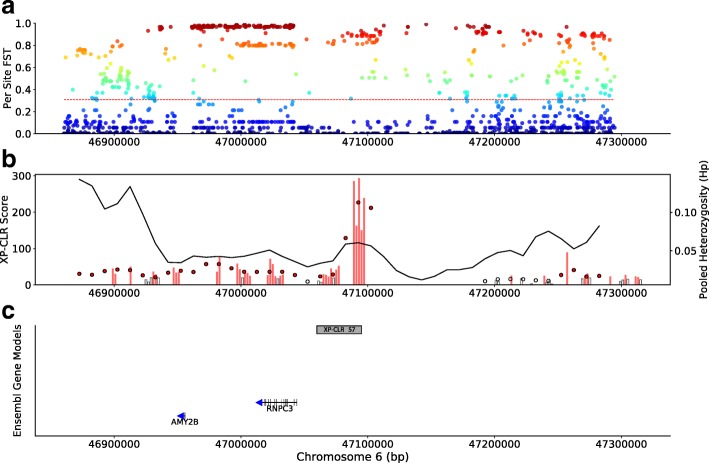
“While the region has repeatedly been identified in selection scans (Axelsson et al. 2013; Cagan and Blass 2016; Pendleton et al. 2018), the focal genealogy at the RNPC3 locus further reveals a clear history of introgression with the contributing lineage diverging approximately 3 million years ago…”
Adaptive introgression and the origin of dog starch digestionPreprint
Terai, Y., Okada, R., & Gojobori, J. (2026) · Research Square · doi:10.21203/rs.3.rs-9881348/v1 · Cited by 1
The relationships between tameness and social cognitive skills of domesticated animals
Nagayama, H., & Koide, T. (2019) · Japanese Journal of Animal Psychology · doi:10.2502/janip.69.1.13 · Cited by 1
Are feralization and domestication truly mirror processes?Preprint
Niego, A., & Benítez‐Burraco, A. (2021) · doi:10.31234/osf.io/px9hg
Dry Winter Escalates Need for Wet Monsoon
Guido, Z. (2011)
Mackiel, A. (2020) · Springer eBooks · doi:10.1007/978-3-319-47829-6_1818-1
Singh, B., Mal, G., Gautam, S. K., & Mukesh, M. (2019) · Springer eBooks · doi:10.1007/978-3-030-21309-1_32
Genetics of domesticated behavior in dogs and foxes
Kukekova, A. V., Trut, L. N., & Acland, G. M. (2022) · Elsevier eBooks · doi:10.1016/b978-0-323-85752-9.00007-x · Cited by 4
Mackiel, A. (2022) · Springer eBooks · doi:10.1007/978-3-319-55065-7_1818
Koller, D., Benítez‐Burraco, A., & Polimanti, R. A. (2022) · bioRxiv (Cold Spring Harbor Laboratory) · doi:10.1101/2022.09.26.509526
Intra- and inter-specific cortisol coregulation
Solman, C. L. (2023) · Cronfa (Swansea University) · doi:10.23889/suthesis.62704
Giant pandas in captivity undergo short-term adaptation in nerve-related pathways
Li, Y., Xu, W., Wang, J., Liu, H., Liu, J., Zhang, L., Hou, R., Shen, F., Liu, Y., & Cai, K. (2024) · BMC Zoology · doi:10.1186/s40850-024-00195-y
Self-citationLi, Y., Xu, W., Wang, J., Liu, H., Liu, J., Zhang, L., Hou, R., 沈富军, Liu, Y., & Cai, K. (2024) · Figshare · doi:10.6084/m9.figshare.25264411
Li, Y., Xu, W., Wang, J., Liu, H., Liu, J., Zhang, L., Hou, R., 沈富军, Liu, Y., & Cai, K. (2024) · Figshare · doi:10.6084/m9.figshare.26683492
Li, Y., Xu, W., Wang, J., Liu, H., Liu, J., Zhang, L., Hou, R., 沈富军, Liu, Y., & Cai, K. (2024) · Figshare · doi:10.6084/m9.figshare.25264277
Samaha, G., Wade, C. M., Mazrier, H., Grueber, C. E., & Haase, B. (2021) · Figshare · doi:10.6084/m9.figshare.15128160
Li, Y., Xu, W., Wang, J., Liu, H., Liu, J., Zhang, L., Hou, R., 沈富军, Liu, Y., & Cai, K. (2024) · Figshare · doi:10.6084/m9.figshare.26683489
Modelling population dynamics in presence of hybridization
Santostasi, N. L. (2020) · theses.fr (ABES) · doi:10.70675/9d674e1dz7e53z4750z8fd9zde1c8041cd74
Humphreys, S., Freire, R., Waran, N. K., & Randle, H. (2026) · Applied Animal Behaviour Science · doi:10.1016/j.applanim.2026.107057
RAI1 safeguards fidelity and tempo of human neurodevelopmental gene expressionPreprint
Zhou, B., Mohanty, S., Riggle, P., Tsukahara, T., Lin, G., Dang, L. T., Sutton, M. A., & Iwase, S. (2026) · bioRxiv (Cold Spring Harbor Laboratory) · doi:10.64898/2026.06.11.731717 · Cited by 1
“Interestingly, DNA sequence changes in canine RAI1 regulatory regions near its promoter have been linked to the domestication of dogs, during which many neural crest-associated morphological changes occurred (e.g., from a uniform pointy snout to diverse features across breeds) (49).”
Ancient DNA as a temporal lens: reconstructing evolution, migration, and disease dynamics
Akwo, A. U., Luvanga, J., & Ketu, K. V. (2026) · Journal of Genetic Engineering and Biotechnology · doi:10.1016/j.jgeb.2026.100778
“52,53 This illustrates that domestication, regardless of its diverse timeframes and demographic histories, frequently modifies common developmental and brain gene networks to yield analogous phenotypic results.”
Influencia de la tenencia de animales y su rol en la mejora de la salud mental
Jiménez‐Coello, M., Vanega-Romero, S., & Ortega‐Pacheco, A. (2025) · Ediciones Comunicación Científica eBooks · doi:10.52501/cc.369.09
Metadata
- Authors
- Pendleton, A. L., Shen, F., Taravella, A. M., Emery, S., Veeramah, K. R., Boyko, A. R., & Kidd, J. M.
- Affiliations
- University of Michigan (US)
- Stony Brook University (US)
- Cornell University (US)
- Corresponding author
- Kidd, Jeffrey M.
- Venue
- BMC Biology
- Published
- 2018-06-28
- Volume
- 16
- Issue
- 1
- Pages
- 64-64
- ISSN
- 1741-7007 (ISSN-L)
- PMC
- PMC6022502
- OpenAlex
- W2806382960
- Cited by
- 156
- References
- 199
- Citations by year
- 2026: 10 · 2025: 12 · 2024: 19 · 2023: 21 · 2022: 21 · 2021: 27 · 2020: 24 · 2019: 18 · 2018: 3
- FWCI
- 10.86
- Type
- journal article
- Language
- en
- Open access
- gold
- doi.org
- Licence
- cc-by
- creativecommons.org/licenses/by/4.0/ (tdm)
- creativecommons.org/licenses/by/4.0/ (vor)
- Locations
- BMC Biology (publishedVersion, cc-by)
- Europe PMC (PubMed Central) (publishedVersion, cc-by)
- PubMed Central (publishedVersion, cc-by)
- PubMed (publishedVersion)
- Deep Blue (University of Michigan) (submittedVersion)
- DOAJ (DOAJ: Directory of Open Access Journals) (submittedVersion, cc-by-sa)
- Funders
- National Institute of General Medical Sciences (R01GM103961)
- National Human Genome Research Institute (T32HG00040)
- Topics
- Life Sciences › Agricultural and Biological Sciences › Animal Science and Zoology › Human-Animal Interaction Studies
- Life Sciences › Biochemistry, Genetics and Molecular Biology › Genetics › Genetic and phenotypic traits in livestock
- Life Sciences › Biochemistry, Genetics and Molecular Biology › Genetics › Genetic Mapping and Diversity in Plants and Animals
- Keywords
- dog domestication, village dogs, gray wolves, domestication syndrome, neural crest, copy number variation, craniofacial development, tameness, behavioral selection, ancient dogs
- MeSH terms
- Domestication, Animals, Dogs, Haplotypes, Neural Crest, Phenotype, Selection, Genetic, Genetic Variation, Genome, Wolves, DNA Copy Number Variations
About these checks
Registry, retraction, Cites and statistics results are computed, not judged, with one exception: a printed reference that no index lists is read once by a model before it counts as a citation error. Claims are extracted by a model and kept only when their quote appears verbatim in the text; each cited source is then checked, with a model’s help, for whether it says what the claim relies on. Those verdicts can be wrong — read the claim’s quote and the cited source before relying on one.
Statistics and arithmetic are recomputed, not judged.
Confidence bands are shown only for fields calibrated on our annotated test set. None is calibrated yet, so no band is shown.
What counts as a claim ›How we measure confidence ›How we check this ›
Are you an author, or do you see a problem with this page? Request a review
Data sources
Bibliographic data: Semantic Scholar, OpenAlex, Crossref.
Contains information from the Semantic Scholar Academic Graph Datasets, made available under the ODC Attribution License (ODC-BY 1.0).
Semantic Scholar’s data is described in: Kinney, R., et al. (2023). The Semantic Scholar Open Data Platform. arXiv:2301.10140.
