

annATAC: automatic cell type annotation for scATAC-seq data based on language model
Open accessThe DOI matches its Crossref record; 49 of the 49 references it cites were found in a registry or an index.
Abstract
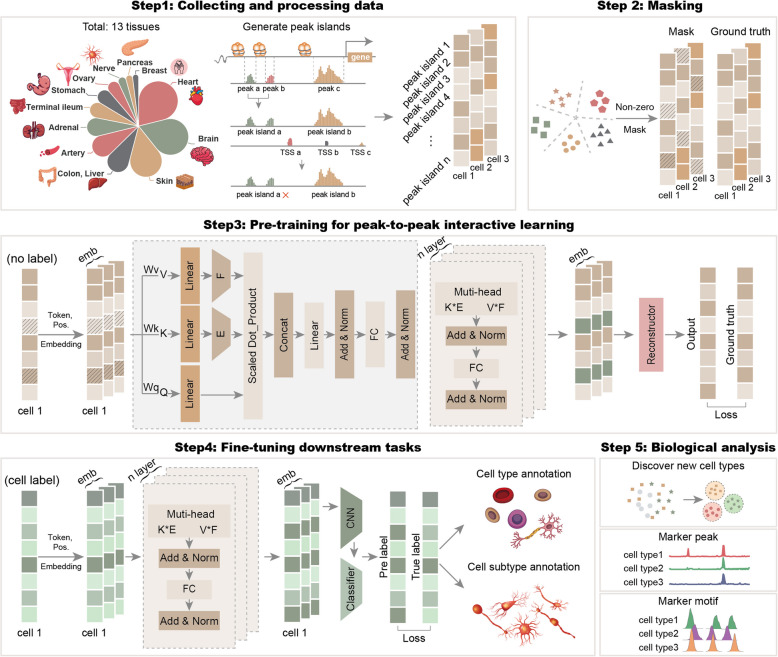
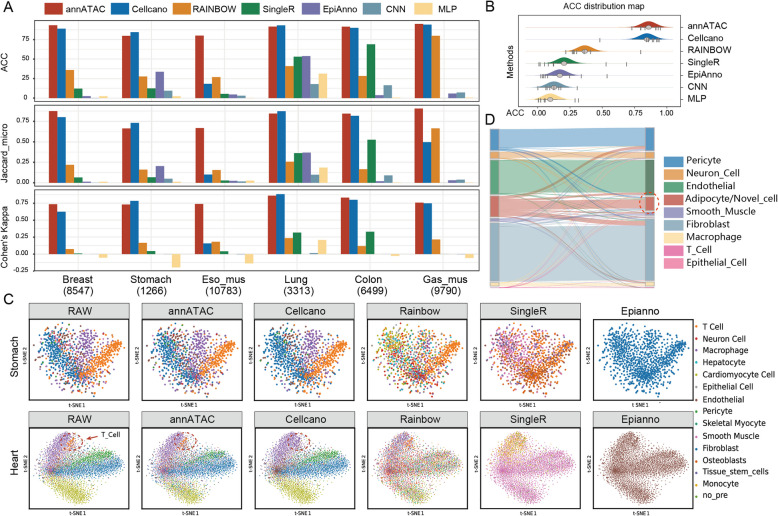
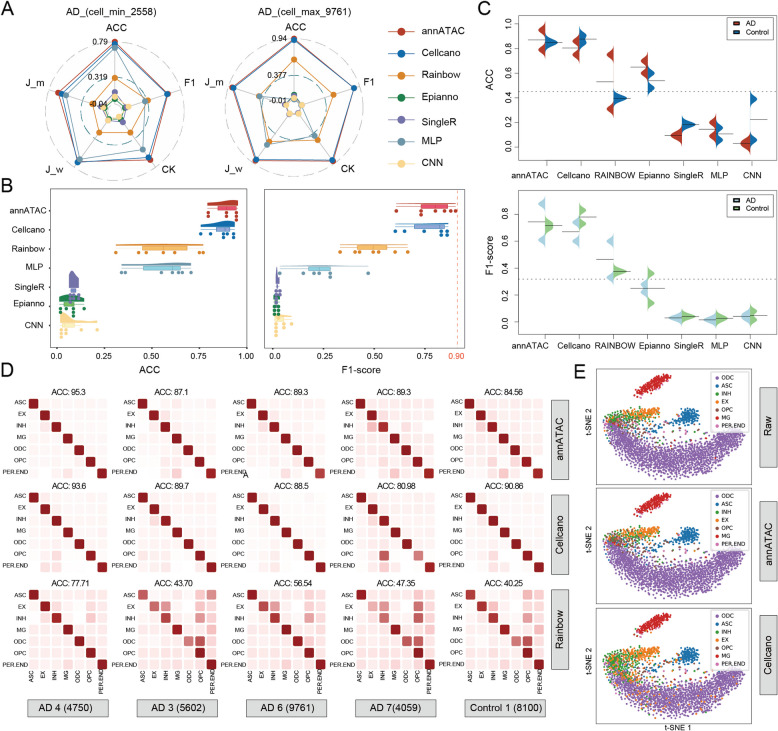
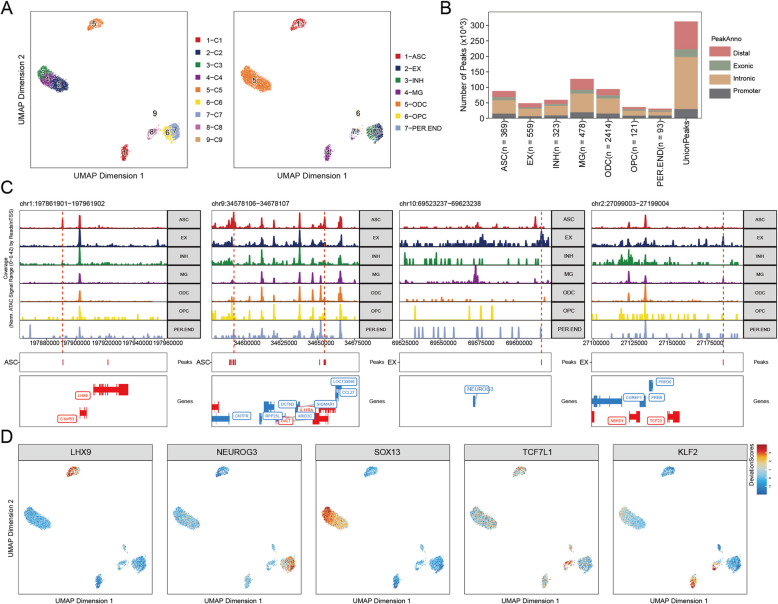
BACKGROUND: Cell type annotation serves as the cornerstone for downstream analysis of single cell data. Nevertheless, scATAC-seq data is characterized by high sparsity and dimensionality, presenting significant challenges to its annotation process. RESULTS: We introduce a novel method based on language model, named annATAC, which is designed for the automatic annotation of cell types in scATAC-seq data. This method primarily consists of three stages. During the pre-training stage, by training on a vast amount of unlabeled data, the model can learn the interaction relationships between peaks, thus building a preliminary understanding of the data features. Subsequently, in the fine-tuning stage, a small quantity of labeled data is utilized to conduct secondary training on the model, which enables the model to identify cell types accurately. Finally, in the prediction stage, the trained model is applied to annotate scATAC-seq data. CONCLUSIONS: Compared with other automatic annotation methods across multiple datasets, annATAC demonstrates superiority on the annotation performance. Further experiments have validated that annATAC holds great potential in identifying marker peaks and marker motifs. It is expected that annATAC will provide more profound and precise analysis outcomes for scATAC-seq research. As a result, it will effectively promote the progress of relevant biomedical research.
Overview
The claims and statistics of this paper haven’t been checked yet.
Free: it reads the open-access text and checks the first 5 claims that cite a source we can check. Create a free account to check every claim.
Integrity signals
Registry
Cites
Statistics
Figures
Verification
Claims the paper makes
The claims and statistics of this paper haven’t been checked yet.
Free: it reads the open-access text and checks the first 5 claims that cite a source we can check. Create a free account to check every claim.
Self-check
Percentages, sums and reported differences re-computed from the paper’s own numbers.
The self-check needs the paper’s full text.
Citations
Cites
Dictionary learning for integrative, multimodal and scalable single-cell analysis
Hao, Y., Stuart, T., Kowalski, M. H., Choudhary, S., Hoffman, P., Hartman, A., Srivastava, A., Molla, G., Madad, S., Fernandez-Granda, C., et al. (2024) · Nature Biotechnology · doi:10.1038/s41587-023-01767-y · Cited by 5,631 · cited 2×
“4A on the left side of the figure, the FindClusters function in the Seurat tool [26] was used for cell clustering.”
Aran, D., Looney, A. P., Liu, L., Wu, E., Fong, V., Hsu, A., Chak, S., Naikawadi, R. P., Wolters, P. J., Abate, A. R., et al. (2019) · Nature Immunology · doi:10.1038/s41590-018-0276-y · Cited by 4,984 · cited 2×
“Cell type annotation is the core of downstream single-cell data analysis [20, 21].”
Mapping and analysis of chromatin state dynamics in nine human cell types
Ernst, J., Kheradpour, P., Mikkelsen, T. S., Shoresh, N., Ward, L. D., Epstein, C. B., Zhang, X., Wang, L., Issner, R., Coyne, M., et al. (2011) · Nature · doi:10.1038/nature09906 · Cited by 2,898
Single-cell chromatin state analysis with Signac
Stuart, T., Srivastava, A., Madad, S., Lareau, C. A., & Satija, R. (2021) · Nature Methods · doi:10.1038/s41592-021-01282-5 · Cited by 1,769 · cited 1×
“For example, Seurat [26], ArchR [27], Signac [28], Ata-cAnnoR [29], and scJoint [30].”
ArchR is a scalable software package for integrative single-cell chromatin accessibility analysis
Granja, J. M., Corces, M. R., Pierce, S. E., Bagdatli, S. T., Choudhry, H., Chang, H. Y., & Greenleaf, W. J. (2021) · Nature Genetics · doi:10.1038/s41588-021-00790-6 · Cited by 1,392 · cited 3×
“Instead, they convert the data pattern with the help of tools like ArchR [27] or TF-IDF [34] to achieve annotation.”
Transfer learning enables predictions in network biology
Theodoris, C. V., Xiao, L., Chopra, A., Chaffin, M. D., Al Sayed, Z. R., Hill, M. C., Mantineo, H., Brydon, E. M., Zeng, Z., Liu, X. S., et al. (2023) · Nature · doi:10.1038/s41586-023-06139-9 · Cited by 1,193 · cited 1×
“Their core advantage lies in the ability to learn complex feature representations from a large amount of unlabeled data, refine potential patterns and regularities, and then fine-tune using a small amount of labeled data based on supervised learning to accurately annotate the unlabeled data [42–44].”
Large-scale foundation model on single-cell transcriptomics
Hao, M., Gong, J., Zeng, X., Liu, C., Guo, Y., Cheng, X., Wang, T., Ma, J., Zhang, X., & Song, L. (2024) · Nature Methods · doi:10.1038/s41592-024-02305-7 · Cited by 988
Higher-Order Inter-chromosomal Hubs Shape 3D Genome Organization in the Nucleus
Quinodoz, S. A., Ollikainen, N., Tabak, B., Palla, A., Schmidt, J. M., Detmar, E., Lai, M. M., Shishkin, A. A., Bhat, P., Takei, Y., et al. (2018) · Cell · doi:10.1016/j.cell.2018.05.024 · Cited by 892
SCENIC+: single-cell multiomic inference of enhancers and gene regulatory networks
Bravo González-Blas, C., De Winter, S., Hulselmans, G., Hecker, N., Matetovici, I., Christiaens, V., Poovathingal, S., Wouters, J., Aibar, S., & Aerts, S. (2023) · Nature Methods · doi:10.1038/s41592-023-01938-4 · Cited by 778
SCENIC+: single-cell multiomic inference of enhancers and gene regulatory networks
González-Blas, C. B., De Winter, S., Hulselmans, G., Hecker, N., Matetovici, I., Christiaens, V., Poovathingal, S., Wouters, J., Aibar, S., & Aerts, S. (2022) · doi:10.1101/2022.08.19.504505 · Cited by 778
A Single-Cell Atlas of In Vivo Mammalian Chromatin Accessibility
Cusanovich, D. A., Hill, A. J., Aghamirzaie, D., Daza, R. M., Pliner, H. A., Berletch, J. B., Filippova, G. N., Huang, X., Christiansen, L., DeWitt, W. S., et al. (2018) · Cell · doi:10.1016/j.cell.2018.06.052 · Cited by 759
Single-nucleus chromatin accessibility and transcriptomic characterization of Alzheimer’s disease
Morabito, S., Miyoshi, E., Michael, N., Shahin, S., Martini, A. C., Head, E., Silva, J., Leavy, K., Perez-Rosendahl, M., & Swarup, V. (2021) · Nature Genetics · doi:10.1038/s41588-021-00894-z · Cited by 643 · cited 2×
“The data for the cell sub-type annotation task came from a dataset of AD, which was composed of different Nerve cells [46], with a total of 41,796 cells (with cell labels).”
Large Scale Foundation Model on Single-cell Transcriptomics
Hao, M., Gong, J., Zeng, X., Liu, C., Guo, Y., Cheng, X., Wang, T., Ma, J., Song, L., & Zhang, X. (2023) · doi:10.1101/2023.05.29.542705 · Cited by 639
Yang, F., Wang, W., Wang, F., Fang, Y., Tang, D., Huang, J., Lu, H., & Yao, J. (2021) · doi:10.1101/2021.12.05.471261 · Cited by 617 · cited 1×
“Their core advantage lies in the ability to learn complex feature representations from a large amount of unlabeled data, refine potential patterns and regularities, and then fine-tune using a small amount of labeled data based on supervised learning to accurately annotate the unlabeled data [42–44].”
Self-citationA single-cell atlas of chromatin accessibility in the human genome
Zhang, K., Hocker, J. D., Miller, M., Hou, X., Chiou, J., Poirion, O. B., Qiu, Y., Li, Y. E., Gaulton, K. J., Wang, A., et al. (2021) · Cell · doi:10.1016/j.cell.2021.10.024 · Cited by 502
Droplet-based combinatorial indexing for massive-scale single-cell chromatin accessibility
Lareau, C. A., Duarte, F. M., Chew, J. G., Kartha, V. K., Burkett, Z. D., Kohlway, A. S., Pokholok, D., Aryee, M. J., Steemers, F. J., Lebofsky, R., et al. (2019) · Nature Biotechnology · doi:10.1038/s41587-019-0147-6 · Cited by 444
Corces, M. R., Shcherbina, A., Kundu, S., Gloudemans, M. J., Frésard, L., Granja, J. M., Louie, B. H., Eulalio, T., Shams, S., Bagdatli, S. T., et al. (2020) · Nature Genetics · doi:10.1038/s41588-020-00721-x · Cited by 358
Characterizing cis-regulatory elements using single-cell epigenomics
Preissl, S., Gaulton, K. J., & Ren, B. (2023) · Nature Reviews Genetics · doi:10.1038/s41576-022-00509-1 · Cited by 251 · cited 1×
“This diversity is attributed to the complex gene expression regulatory mechanisms, which involve interactions at multiple levels such as DNA methylation [3, 4], histone modification [5, 6], and the regulation of transcription factor activity [7–9].”
Clarke, Z. A., Andrews, T. S., Atif, J., Pouyabahar, D., Innes, B. T., MacParland, S. A., & Bader, G. D. (2021) · Nature Protocols · doi:10.1038/s41596-021-00534-0 · Cited by 226
SCALE method for single-cell ATAC-seq analysis via latent feature extraction
Xiong, L., Xu, K., Tian, K., Shao, Y., Tang, L., Gao, G., Zhang, M., Jiang, T., & Zhang, Q. C. (2019) · Nature Communications · doi:10.1038/s41467-019-12630-7 · Cited by 218
Over 1000 tools reveal trends in the single-cell RNA-seq analysis landscape
Zappia, L., & Theis, F. J. (2021) · Genome Biology · doi:10.1186/s13059-021-02519-4 · Cited by 174
scJoint integrates atlas-scale single-cell RNA-seq and ATAC-seq data with transfer learning
Lin, Y., Wu, T.-Y., Wan, S., Yang, J. Y. H., Wong, W. H., & Wang, Y. X. R. (2022) · Nature Biotechnology · doi:10.1038/s41587-021-01161-6 · Cited by 166
Tedesco, M., Giannese, F., Lazarević, D., Giansanti, V., Rosano, D., Monzani, S., Catalano, I., Grassi, E., Zanella, E. R., Botrugno, O. A., et al. (2021) · Nature Biotechnology · doi:10.1038/s41587-021-01031-1 · Cited by 129
Cell type annotation of single-cell chromatin accessibility data via supervised Bayesian embedding
Chen, X., Chen, S., Song, S., Gao, Z., Hou, L., Zhang, X., Lv, H., & Jiang, R. (2022) · Nature Machine Intelligence · doi:10.1038/s42256-021-00432-w · Cited by 98
Pastore, A., Gaiti, F., Lu, S. X., Brand, R. M., Kulm, S., Chaligne, R., Gu, H., Huang, K. Y., Stamenova, E. K., Béguelin, W., et al. (2019) · Nature Communications · doi:10.1038/s41467-019-09645-5 · Cited by 86
Cellcano: supervised cell type identification for single cell ATAC-seq data
Ma, W., Lu, J., & Wu, H. (2023) · Nature Communications · doi:10.1038/s41467-023-37439-3 · Cited by 59
scBridge embraces cell heterogeneity in single-cell RNA-seq and ATAC-seq data integration
Li, Y., Zhang, D., Yang, M., Peng, D., Yu, J., Liu, Y., Lv, J., Chen, L., & Peng, X. (2023) · Nature Communications · doi:10.1038/s41467-023-41795-5 · Cited by 49
Myers, B. L., Brayer, K. J., Paez-Beltran, L. E., Villicana, E., Keith, M. S., Suzuki, H., Newville, J., Anderson, R. H., Lo, Y., Mertz, C. M., et al. (2024) · Nature Communications · doi:10.1038/s41467-024-54750-9 · Cited by 47
Zhang, F., Feng, Y., Wang, J.-Y., Zhu, K., Wang, L., Yan, J., Li, X., Wang, J., Ge, W., Felici, M. D., et al. (2023) · Cell Death and Disease · doi:10.1038/s41419-023-05671-w · Cited by 45
Transcription Factor-mediated Epigenetic Reprogramming
Sindhu, C., Samavarchi‐Tehrani, P., & Meissner, A. (2012) · Journal of Biological Chemistry · doi:10.1074/jbc.r111.319046 · Cited by 37
The highly rugged yet navigable regulatory landscape of the bacterial transcription factor TetR
Westmann, C. A., Goldbach, L., & Wagner, A. (2024) · Nature Communications · doi:10.1038/s41467-024-54723-y · Cited by 34
Deciphering cell types by integrating scATAC-seq data with genome sequences
Zeng, Y., Luo, M., Shangguan, N., Shi, P., Feng, J., Xu, J., Chen, K., Lu, Y., Yu, W., & Yang, Y. (2024) · Nature Computational Science · doi:10.1038/s43588-024-00622-7 · Cited by 33
Advances in the multimodal analysis of the 3D chromatin structure and gene regulation
Han, M.-H., Park, J., & Park, M. (2024) · Experimental & Molecular Medicine · doi:10.1038/s12276-024-01246-7 · Cited by 32
scChIX-seq infers dynamic relationships between histone modifications in single cells
Yeung, J., Florescu, M., Zeller, P. J., de Barbanson, B., Wellenstein, M. D., & van Oudenaarden, A. (2023) · Nature Biotechnology · doi:10.1038/s41587-022-01560-3 · Cited by 31
H3K36 methylation regulates cell plasticity and regeneration in the intestinal epithelium
Swearingen, A. R., Meyer, A. R., Bussey-Sutton, C. R., O’Connor, E. S., Coradin, M., Coulombe, M., Riemondy, K. A., Potlapelly, S., Strahl, B. D., Hansson, G. C., et al. (2025) · Nature Cell Biology · doi:10.1038/s41556-024-01580-y · Cited by 25
The 3D genome and its impacts on human health and disease
Wang, S., Luo, Z., Liu, W., Hu, T., Zhao, Z., Rosenfeld, M. G., & Song, X. (2023) · Life Medicine · doi:10.1093/lifemedi/lnad012 · Cited by 23
Hu, H., & Quon, G. (2024) · Nature Communications · doi:10.1038/s41467-024-53971-2 · Cited by 23
Best practices for differential accessibility analysis in single-cell epigenomics
Teo, A. Y. Y., Squair, J. W., Courtine, G., & Skinnider, M. A. (2024) · Nature Communications · doi:10.1038/s41467-024-53089-5 · Cited by 22
Prediction of linear B-cell epitopes based on protein sequence features and BERT embeddings
Liu, F., Yuan, C., Chen, H., et al. (2024) · Scientific Reports · doi:10.1038/s41598-024-53028-w · Cited by 22
Scalable and unbiased sequence-informed embedding of single-cell ATAC-seq data with CellSpace
Tayyebi, Z., Pine, A. R., & Leslie, C. S. (2024) · Nature Methods · doi:10.1038/s41592-024-02274-x · Cited by 21
Transposons contribute to the acquisition of cell type-specific cis-elements in the brain
Sekine, K., Onoguchi, M., & Hamada, M. (2023) · Communications Biology · doi:10.1038/s42003-023-04989-7 · Cited by 18
Martino, D., Kresoje, N., Amenyogbe, N., Ben-Othman, R., Cai, B., Lo, M., Idoko, O. T., Odumade, O. A., Falsafi, R., Blimkie, T. M., et al. (2024) · Nature Communications · doi:10.1038/s41467-024-52283-9 · Cited by 17
Cell of origin epigenetic priming determines susceptibility to Tet2 mutation
Schiroli, G., Kartha, V. K., Duarte, F. M., Kristiansen, T. A., Mayerhofer, C., Shrestha, R., Earl, A., Hu, Y., Tay, T., Rhee, C., et al. (2024) · Nature Communications · doi:10.1038/s41467-024-48508-6 · Cited by 16
Zaim, S. R., Pebworth, M.-P., McGrath, I., Okada, L. Y., Weiss, M. D. A., Reading, J., Czartoski, J., Torgerson, T. R., McElrath, M. J., Bumol, T. F., et al. (2024) · Nature Communications · doi:10.1038/s41467-024-50612-6 · Cited by 13
AtacAnnoR: a reference-based annotation tool for single cell ATAC-seq data
Tian, L., Xie, Y., Xie, Z., Tian, J., & Tian, W. (2023) · Briefings in Bioinformatics · doi:10.1093/bib/bbad268 · Cited by 10
Zeng, R., Li, Z., Li, J., & Zhang, Q. (2025) · Scientific Reports · doi:10.1038/s41598-024-84105-9 · Cited by 7
Multimodal single cell analysis infers widespread enhancer co-activity in a lymphoblastoid cell line
Ziyani, C., Delaneau, O., & Ribeiro, D. M. (2023) · Communications Biology · doi:10.1038/s42003-023-04954-4 · Cited by 5
StructmRNA a BERT based model with dual level and conditional masking for mRNA representation
Nahali, S., Safari, L., Khanteymoori, A., & Huang, J. X. (2024) · Scientific Reports · doi:10.1038/s41598-024-77172-5 · Cited by 4
Li, S., Tang, S., Wang, Y., Li, S., Jia, Y., & Chen, S. (2024) · Quantitative Biology · doi:10.1002/qub2.33 · Cited by 4
Research works printed but not linked: 1
- Pedregosa F, Varoquaux G, Gramfort A, Michel V, Thirion B, Grisel O, et al. Scikit-learn: machine learning in Python. J Mach Learn Res. 2011;12:2825–30.
Cited by
Spatial pharmacology of anti-cancer immunomodulators: a comprehensive review
Chen, S., Tu, L., & Chen, Q. (2026) · Frontiers in Pharmacology · doi:10.3389/fphar.2026.1898418 · Cited by 1
“The annATAC tool uses a language model to annotate cell types from scATAC-seq data, outperforming other methods in accuracy (Cui et al., 2025).”
Metadata
- Authors
- Cui, L., Wang, F., Li, H., Liu, Q., Zhou, M., & Wang, G.
- Affiliations
- Northeast Forestry University (CN)
- Wenzhou Medical University (CN)
- University of Electronic Science and Technology of China (CN)
- Henan University (CN)
- Harbin Institute of Technology (CN)
- Corresponding author
- Wang, Guohua
- Venue
- BMC Biology
- Published
- 2025-05-28
- Volume
- 23
- Issue
- 1
- Pages
- 145-145
- ISSN
- 1741-7007 (ISSN-L)
- PMC
- PMC12121080
- OpenAlex
- W4410796331
- Cited by
- 3
- References
- 49
- Citations by year
- 2026: 3
- FWCI
- 0.90
- Type
- journal article
- Language
- en
- Open access
- gold
- doi.org
- Licence
- cc-by-nc-nd
- creativecommons.org/licenses/by-nc-nd/4.0 (tdm)
- creativecommons.org/licenses/by-nc-nd/4.0 (vor)
- Locations
- BMC Biology (publishedVersion, cc-by-nc-nd)
- PubMed Central (publishedVersion, cc-by-nc-nd)
- PubMed (publishedVersion)
- DOAJ (DOAJ: Directory of Open Access Journals) (submittedVersion, cc-by-sa)
- Funders
- National Natural Science Foundation of China (32400546, 62302342, 62450112)
- Topics
- Life Sciences › Biochemistry, Genetics and Molecular Biology › Molecular Biology › Single-cell and spatial transcriptomics
- Life Sciences › Biochemistry, Genetics and Molecular Biology › Molecular Biology › Genomics and Chromatin Dynamics
- Life Sciences › Biochemistry, Genetics and Molecular Biology › Molecular Biology › Gene Regulatory Network Analysis
- Keywords
- cell type annotation, single-cell ATAC-seq, language models, unsupervised pre-training, fine-tuning, single-cell chromatin accessibility
- MeSH terms
- Humans, Software, Molecular Sequence Annotation, Single-Cell Analysis
About these checks
Registry, retraction, Cites and statistics results are computed, not judged, with one exception: a printed reference that no index lists is read once by a model before it counts as a citation error. Claims are extracted by a model and kept only when their quote appears verbatim in the text; each cited source is then checked, with a model’s help, for whether it says what the claim relies on. Those verdicts can be wrong — read the claim’s quote and the cited source before relying on one.
Statistics and arithmetic are recomputed, not judged.
Confidence bands are shown only for fields calibrated on our annotated test set. None is calibrated yet, so no band is shown.
What counts as a claim ›How we measure confidence ›How we check this ›
Are you an author, or do you see a problem with this page? Request a review
Data sources
Bibliographic data: Semantic Scholar, OpenAlex, Crossref.
Contains information from the Semantic Scholar Academic Graph Datasets, made available under the ODC Attribution License (ODC-BY 1.0).
Semantic Scholar’s data is described in: Kinney, R., et al. (2023). The Semantic Scholar Open Data Platform. arXiv:2301.10140.
