

The DOI matches its Crossref record; 114 of the 114 references it cites were found in a registry or an index; 11 of the 16 sources its claims cite were checked for support.
Large-scale foundation model on single-cell transcriptomics
Open accessAbstract
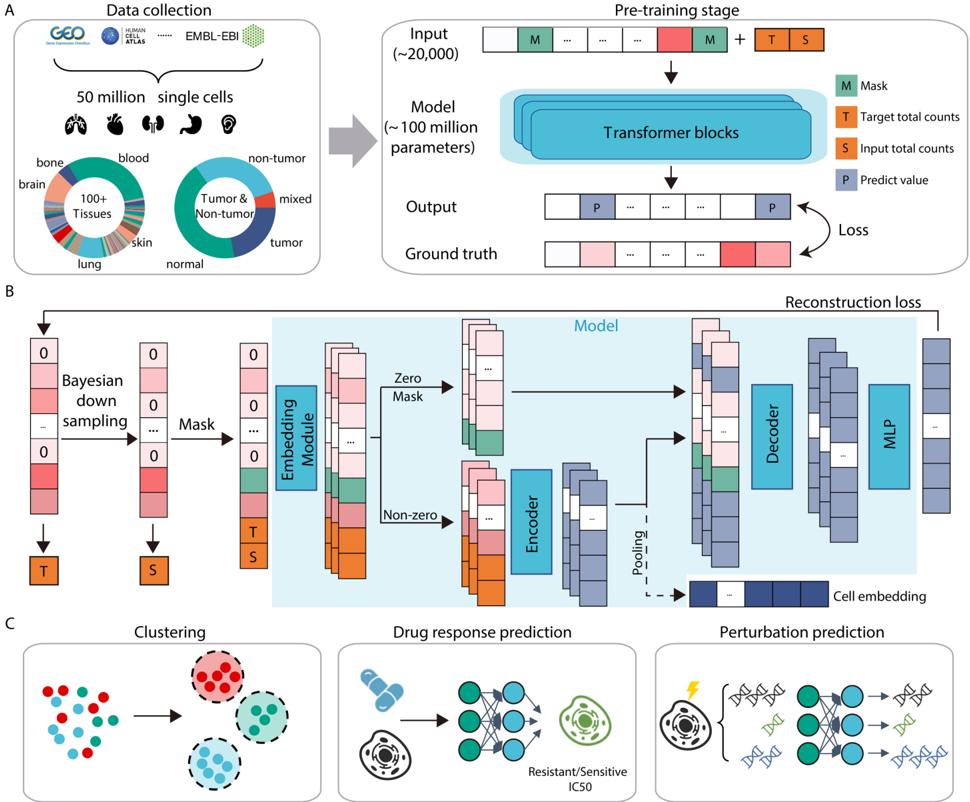
Large pretrained models have become foundation models leading to breakthroughs in natural language processing and related fields. Developing foundation models for deciphering the 'languages' of cells and facilitating biomedical research is promising yet challenging. Here we developed a large pretrained model scFoundation, also named 'xTrimoscFoundation α ', with 100 million parameters covering about 20,000 genes, pretrained on over 50 million human single-cell transcriptomic profiles. scFoundation is a large-scale model in terms of the size of trainable parameters, dimensionality of genes and volume of training data. Its asymmetric transformer-like architecture and pretraining task design empower effectively capturing complex context relations among genes in a variety of cell types and states. Experiments showed its merit as a foundation model that achieved state-of-the-art performances in a diverse array of single-cell analysis tasks such as gene expression enhancement, tissue drug response prediction, single-cell drug response classification, single-cell perturbation prediction, cell type annotation and gene module inference.
Overview
CoChat Summary
TL;DR
scFoundation is a 100M-parameter foundation model pretrained on over 50 million human single-cell transcriptomics profiles covering 19,264 genes. It achieves improved or state-of-the-art performance across gene expression enhancement, cancer drug response prediction, single-cell drug response classification, and perturbation prediction without fine-tuning the pretrained model.
Key findings
- Pretrained on >50 million human scRNA-seq profiles and 19,264 genes with 100M parameters, scFoundation is described as the largest model in parameter size, gene coverage, and data scale in the single-cell field.
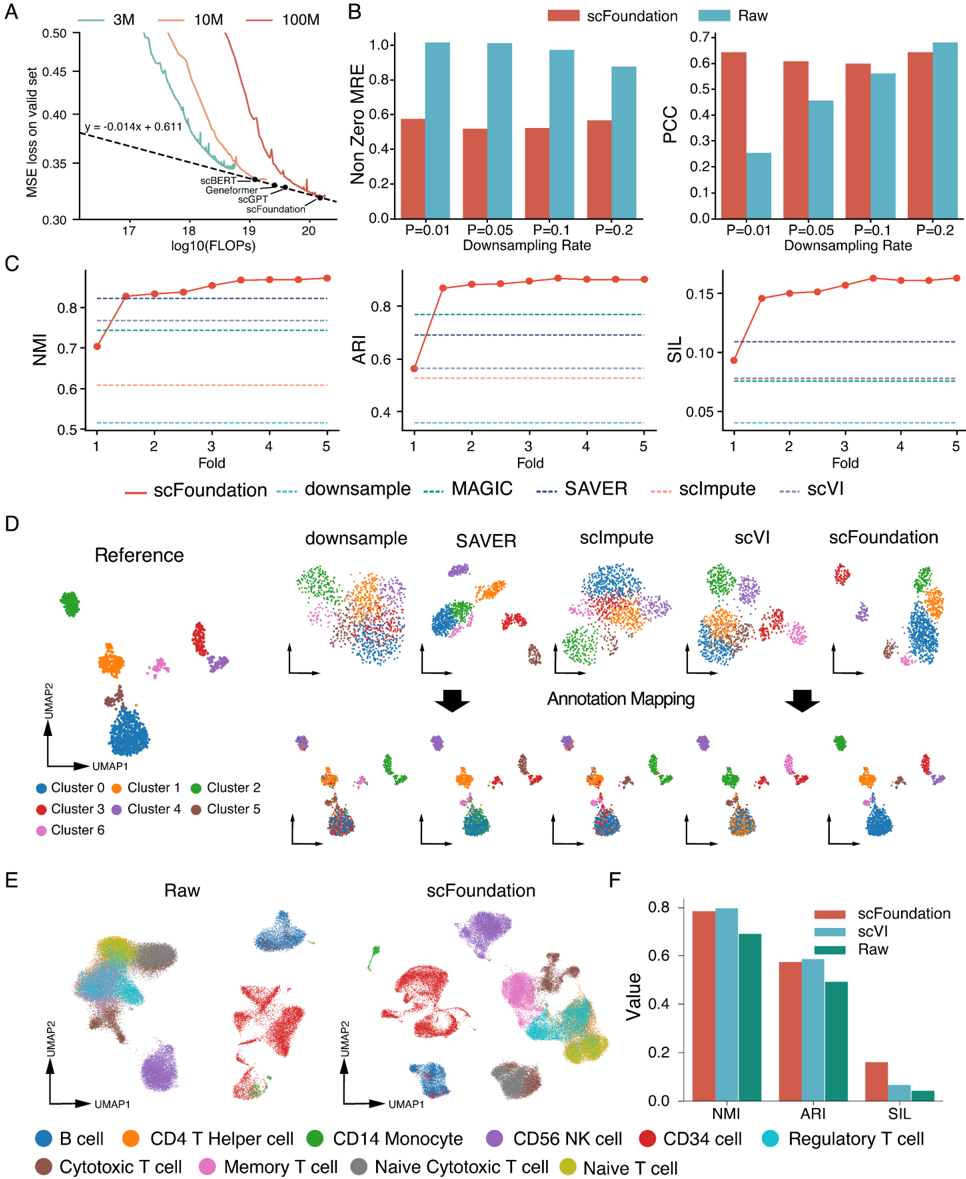
- For read-depth enhancement without fine-tuning, scFoundation reduced MAE and MRE by half versus the non-enhanced baseline; when downsampling was below 10%, baseline MRE was 97.5% while scFoundation maintained an MRE of 60%. On the Zheng68K PBMC dataset (~600,000 cells), scFoundation embeddings had comparable NMI and ARI to scVI and a higher SIL score.
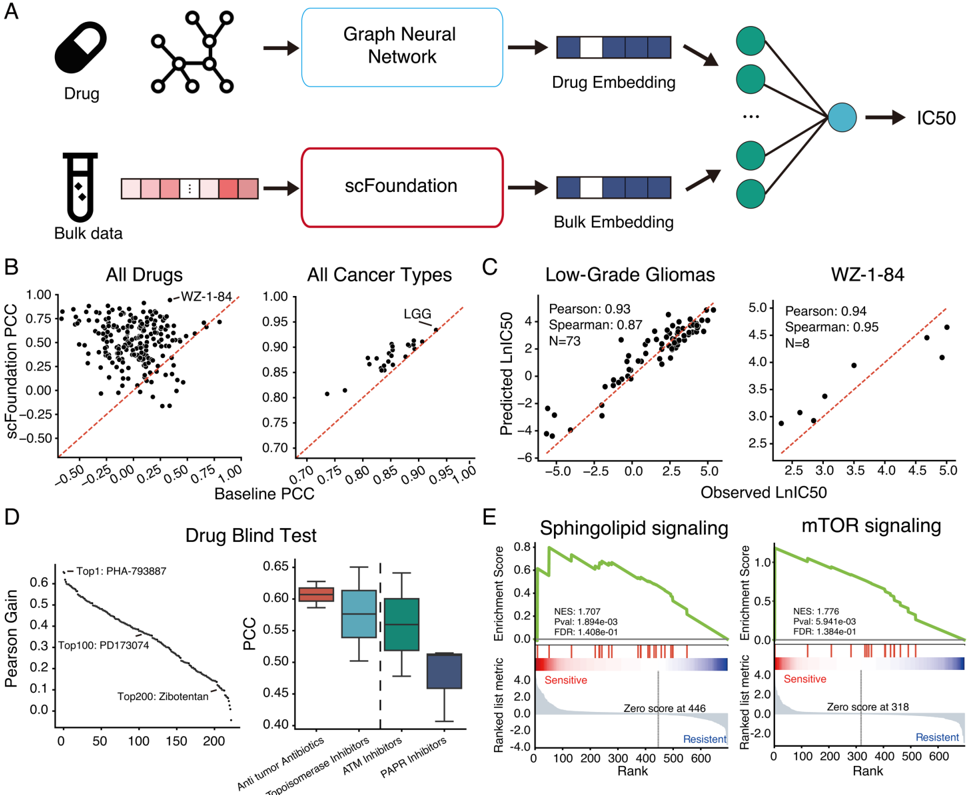
- In cancer drug response prediction with DeepCDR, scFoundation embeddings improved PCC for most drugs and all cancer types; in leave-one-drug-out blind tests, PHA-793887 improved from PCC 0.07 to 0.73 and Zobotentan from 0.49 to 0.64, with the best case achieving PCC above 0.93.
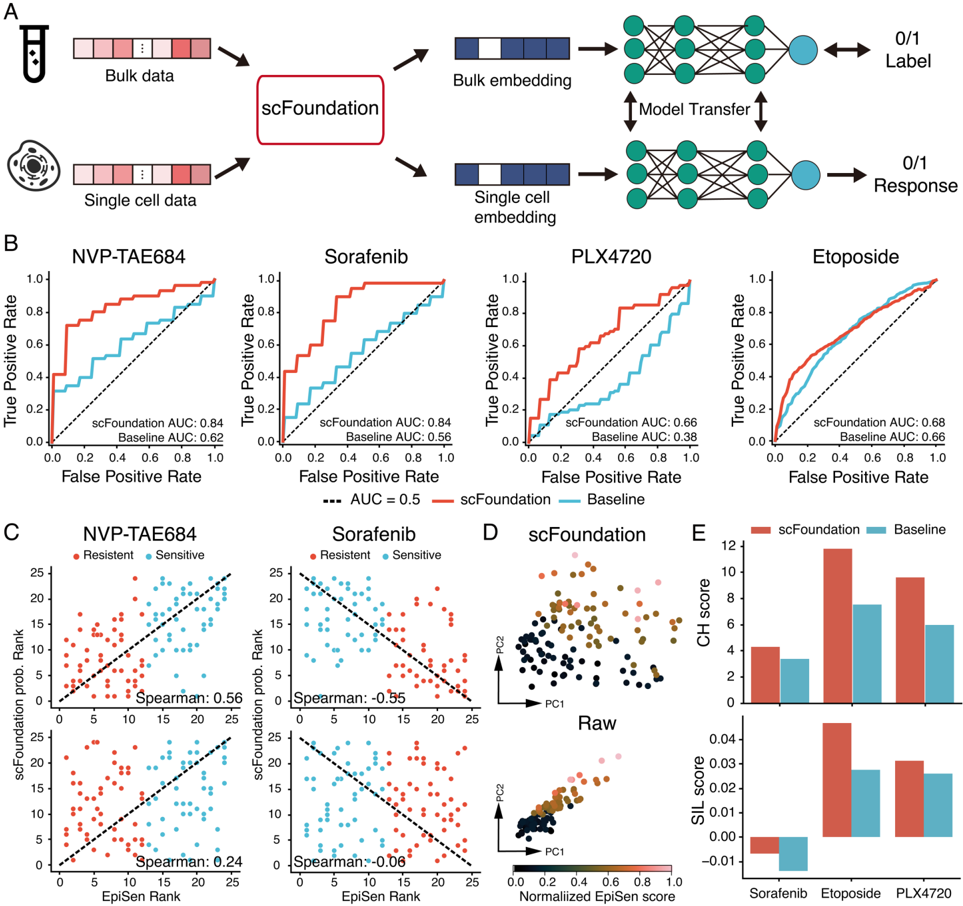
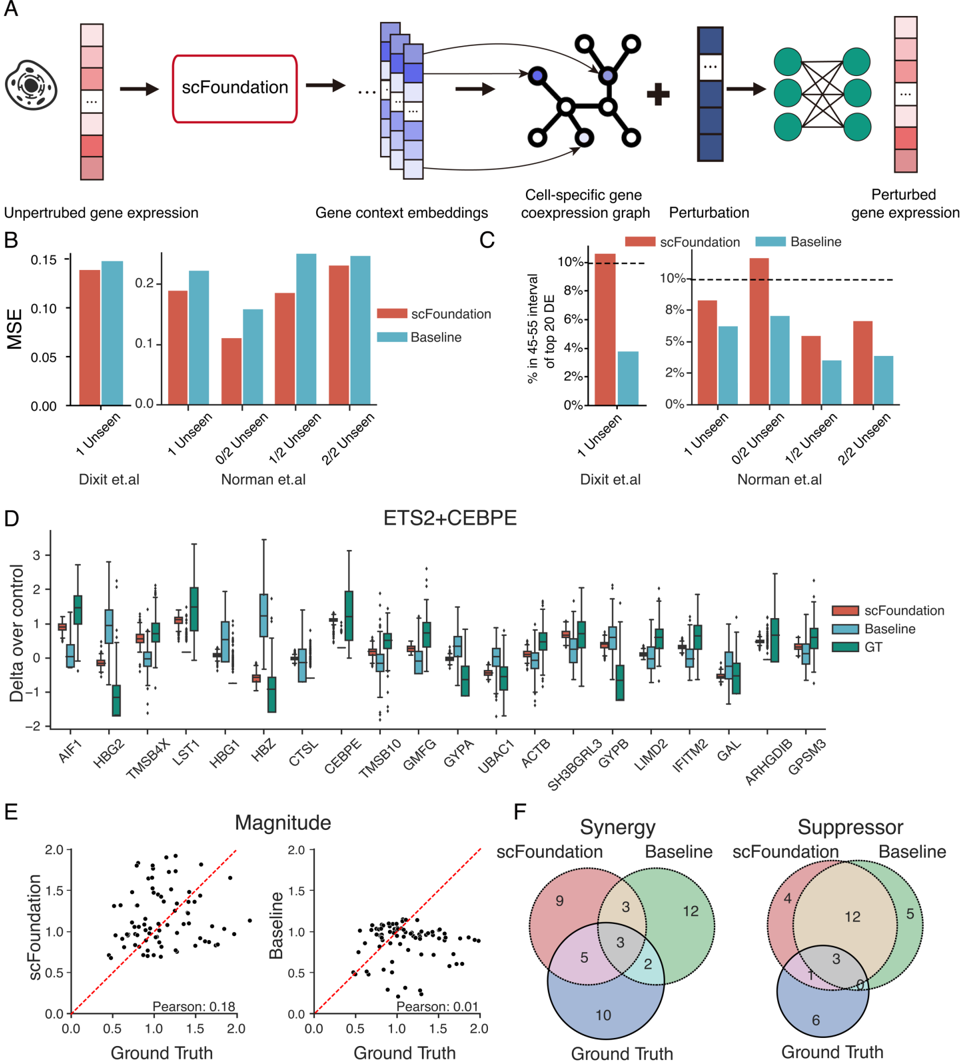
- In single-cell drug response classification, scFoundation embeddings achieved higher AUROC for all four tested drugs; for NVP-TAE684 and Sorafenib, AUROC improved by above 0.2, and Spearman correlations with EpiSen scores were 0.56 and −0.55 versus baseline 0.24 and −0.06. In perturbation prediction, scFoundation-combined GEARS achieved lower MSE on all 1-gene perturbation datasets and the lowest MSE in the 0/2 unseen 2-gene case.
Methods
- Model architecture: xTrimoGene, an asymmetric encoder-decoder transformer with an embedding module that converts continuous gene expression scalars into learnable embeddings; the encoder processes only non-zero and non-masked expressed genes, while the decoder integrates all genes.
- Pretraining data and task: over 50 million human scRNA-seq profiles collected from GEO, Single Cell Portal, HCA, EMBL-EBI, and other resources, aligned to 19,264 genes and filtered for cells with >200 expressed genes; read-depth-aware modeling used hierarchical Bayesian downsampling, 30% masking, and MSE regression loss with total count indicators T and S.
- Downstream evaluation: pretrained cell or gene embeddings were fed into DeepCDR, SCAD, and GEARS without fine-tuning the pretrained model; metrics included MAE, MRE, PCC, NMI, ARI, SIL, AUROC, MSE, and Spearman correlation.
Limitations
- The paper does not include an explicit limitations section.
- Evident from the text: pretraining used only human scRNA-seq data, so generalization to other species or multi-omics settings is not demonstrated.
- Evident from the text: downstream performance depends on existing task-specific models (DeepCDR, SCAD, GEARS) and public datasets, and the paper does not quantify residual batch effects or technical noise beyond describing read-depth-aware pretraining as a mitigation.
Model-written summary. Check it against the paper before relying on it.
Integrity signals
Registry
Cites
Statistics
Figures
Verification
Claims the paper makes
2 Valid · 7 Not valid · 2 Not checked · 74 Own results and interpretations
The cited sources that could be checked couldn’t confirm or dispute this claim.
In the paper
“We developed a new pre-training task called the read-depth-aware (RDA) modeling, which was an extension of masked language modeling 16 , considering single-cell gene expression data had a high variance in read depth, especially in the large-scale pre-training data.”
§ Large Scale Foundation Model on Single-cell Transcriptomics > The scFoundation pre-training framework
What the sources say
- Could not verifycites [16] Choromanski, K. et al. Rethinking attention with performers. Preprint at arXiv https://doi.org/10.48550/arXiv.2009.14794 (2022). sourceExperimental — accuracy not yet measured
The Experiments section (p. 6) mentions masked language modelling as a task used to evaluate Performers, but does not describe read-depth-aware modelling or an extension of that task. Searches for RDA, read depth, and single-cell gene expression found no passage addressing the attributed claim. (LLM, conf=0.75)
plain- Asserted: passes — The authors put it forward as true.
- Checkable: passes — It can be checked against evidence.
- Load-bearing: passes — The paper’s conclusions depend on it.
- Based: passes — The paper gives a reason why it holds.
- Could not verify
The cited sources that could be checked couldn’t confirm or dispute this claim.
In the paper
“Existing work had to restrict their models to a small list of selected genes.”
§ Large Scale Foundation Model on Single-cell Transcriptomics > Introduction
What the sources say
- Could not verifycites [8] Papatheodorou, I. et al. Expression Atlas update: from tissues to single cells. Nucleic Acids Res. 48, D77–D83 (2020). sourceExperimental — accuracy not yet measured
The Introduction describes Single Cell Expression Atlas as a source of expression matrices for downstream computational methods, and the Data analysis section describes its quantification pipeline. Neither addresses whether earlier pre-training models had to use a small, selected gene list. Searches for pre-training, model limitations, and gene selection found no passage supporting that claim. (LLM, conf=0.76)
- Not checked — no full text of the sourcecites [9] Svensson, V., Vento-Tormo, R. & Teichmann, S. A. Exponential scaling of single-cell RNA-seq in the past decade. Nat. Protoc. 13, 599–604 (2018). source
- Could not verifycites [10] Brown, T. B. et al. Language models are few-shot learners. Adv. Neural Inf. Process. Syst. 33, 1877–1901 (2020). sourceExperimental — accuracy not yet measured
The Introduction (p. 3) discusses pre-trained language models and task-specific datasets, not single-cell gene expression. Searches for single-cell gene expression, selected genes, and restrictions to a small gene list found no passage addressing the claim. (LLM, conf=0.78)
- Could not verifycites [11] Zhao, W. X. et al. A survey of large language models. Preprint at arXiv https://doi.org/10.48550/arXiv.2303.18223 (2023). sourceExperimental — accuracy not yet measured
The Pre-training section (p. 4) discusses language-model training corpora, not single-cell gene-expression data. Searches for “single-cell gene expression selected genes” and “gene expression genes” found no passage addressing whether earlier models were restricted to a small list of genes. (LLM, conf=0.76)
plainstates a cause- Asserted: passes — The authors put it forward as true.
- Checkable: passes — It can be checked against evidence.
- Load-bearing: passes — The paper’s conclusions depend on it.
- Based: passes — The paper gives a reason why it holds.
- Could not verify
The cited sources support only part of this claim — read each source’s verdict below.
In the paper
“We constructed a comprehensive single-cell gene expression data set by collecting data from all publicly available single-cell resources, including GEO 17 , Single Cell Portal, HCA 4 , EMBL-EBI 18 , etc.”
§ Large Scale Foundation Model on Single-cell Transcriptomics > The scFoundation pre-training framework
What the sources say
- Could not verifycites [17] Ma, X. et al. Luna: Linear Unified Nested Attention. Adv. Neural Inf. Process. Syst. 34, 2441–2453 (2021). sourceExperimental — accuracy not yet measured
Our copy of Luna (arXiv 2106.01540) is entirely about linear nested attention for sequence modelling; every data passage concerns NLP/vision benchmarks — the Abstract's three benchmarks, §4.1's Long Range Arena tasks (ListOps, Text, Retrieval, Image, Pathfinder), WMT'14 English-German (4.5M sentence pairs, Additional information), GLUE/QA (Table 6), and MLM pre-training on BookCorpus/Wikipedia/CC-News/OpenWebText/Stories. Nothing in it addresses single-cell gene expression, GEO, Single Cell Portal, HCA or EMBL-EBI (searched: 'single-cell gene expression dataset collection from public resources', 'scRNA-seq single cell RNA sequencing gene expression GEO Human Cell Atlas EMBL-EBI'). The cited sentence therefore cannot be checked against this source; our copy neither supports nor contradicts it. (LLM, conf=0.72)
- Partly supportedcites [4] Chen, S. et al. hECA: the cell-centric assembly of a cell atlas. iScience 25, 104318 (2022). sourceExperimental — accuracy not yet measured
The hECA 'Dataset collection' section (STAR Methods > Method details) does state the same ambition as the claim — 'collecting all accessible human single-cell data into a unified atlas' — and the Abstract/Introduction confirm it assembled a single-cell gene expression resource (1,093,299 cells, 116 published datasets, 38 organs) from scattered public data. But the realized scope is narrower than 'all publicly available single-cell resources': they selected 20–21 peer-reviewed studies, transcriptomic data of healthy donors only, and the Discussion concedes 'the number of cells in hECA v1.0 is still small and the coverage of organs and cell types is very limited'. Our copy also never lists Single Cell Portal, HCA, or EMBL-EBI as the repositories collected from (only GEO accessions and an NCBI BioProject appear, in the COVID-19 validation experiments), so that enumeration is not supported by this source. (LLM, conf=0.72)
- Partly supportedcites [18] Gong, J. et al. xTrimoGene: an efficient and scalable representation learner for single-cell RNA-seq data. Preprint at bioRxiv https://doi.org/10.1101/2023.03.24.534055 (2023). sourceExperimental — accuracy not yet measured
Our copy confirms the large curated pre-training data set: the Additional information section states 'we curated about 5 million scRNA-seq data for training' processed with a unified pipeline. However, it attributes collection to a single repository, not 'all publicly available single-cell resources': 'Recently, scRNA-seq data ... mostly has been uploaded to the Gene Expression Omnibus (GEO) repository ... We collected data from GEO' and 'all the scRNA-seq data are collected from the Gene Expression Omnibus (GEO) repository with a keyword searching and data retrieval process.' Searches for HCA / Human Cell Atlas, EMBL-EBI and Single Cell Portal returned no data-source passage in our copy, so the multi-resource scope the citing sentence claims is not supported by this paper. (LLM, conf=0.82)
plain- Asserted: passes — The authors put it forward as true.
- Checkable: passes — It can be checked against evidence.
- Load-bearing: passes — The paper’s conclusions depend on it.
- Based: passes — The paper gives a reason why it holds.
- Could not verify
A result the paper reports from its own data — it cites no other source for it, so there is none to check. The quote shows it is in the paper.
In the paper
“From a cell ontology perspective, the data encompassed almost all known human cell types and cell states.”
§ Large Scale Foundation Model on Single-cell Transcriptomics > The scFoundation pre-training framework
plain- Asserted: passes — The authors put it forward as true.
- Checkable: passes — It can be checked against evidence.
- Load-bearing: passes — The paper’s conclusions depend on it.
- Based: passes — The paper gives a reason why it holds.
A result the paper states — it cites no source for it, so there is none to check. The quote shows it is in the paper.
In the paper
“We observed that, based on scFoundation-predicted results, drugs belonging to chemotherapy, such as anti-tumor antibiotics and topoisomerase inhibitors, had a higher PCC than drugs belonging to targeted therapy, such as ATM and PARP inhibitors (Fig. 3C right).”
§ Large Scale Foundation Model on Single-cell Transcriptomics > scFoundation improves cancer drug response prediction
plainstates an association- Asserted: passes — The authors put it forward as true.
- Checkable: passes — It can be checked against evidence.
- Load-bearing: unclear — It is unclear whether the paper’s conclusions depend on it.
- Based: passes — The paper gives a reason why it holds.
37 more claims
Create a free account to see all 85 claims and to verify the 3 references still open.
- Probably not a substantial claim. 13
- It may state two separate claims as one. 36
- The quote only partly states this claim. 2
Claims other papers make about this one
Each is checked against this paper’s own text: does it say what the citing paper says it does?
The source backs part of the claim, not all of it — or backs it for a different population, condition or comparison.
In the citing paper
“Compared to tasks such as cell annotation and batch correction, perturbation prediction offers experimentally generated model input/output with well-defined objectives, making it a more robust benchmark for assessing foundation models (15, 20, 21).”
From A systematic comparison of single-cell perturbation response prediction models (2026) · cites this paper as [21]
Experimental — accuracy not yet measuredThe source backs part of the claim, not all of it — or backs it for a different population, condition or comparison.
In the citing paper
“These models are pre-trained on vast amounts (> 10 M examples) of unlabelled scRNA-seq data, with the aim that such large datasets allow the models to capture general principles of gene regulation and signalling.”
From Benchmarking foundation cell models for post-perturbation RNA-seq prediction (2025) · cites this paper as [7]
Experimental — accuracy not yet measuredIn the citing paper
“scFoundation [15] strengthens the modular design, aiming to combine different modules to adapt to a variety of single-cell tasks, and is very flexible and scalable.”
From Challenges in AI-driven Biomedical Multimodal Data Fusion and Analysis (2025) · cites this paper as [15]
Self-check
Percentages, sums and reported differences re-computed from the paper’s own numbers.
Each contradiction between two passages listed here was confirmed by an independent check.
Rated minor: it would not touch a result — a value no result rests on, a p-value that stays on the same side of the significance level, or a conflict that is clerical, resolved elsewhere in the paper, or outside its own findings.
In the paper
§ Large Scale Foundation Model on Single-cell Transcriptomics > scFoundation predicts more accurate perturbation responses
“the Adamson dataset 49 with 87 1-gene perturbations”
§ Large Scale Foundation Model on Single-cell Transcriptomics > References
“49. Rood, J. E., Maartens, A., Hupalowska, A., Teichmann, S. A. & Regev, A. Impact of the Human Cell Atlas on medicine. Nat Med 28, 2486-2496 (2022).”
Rated minor: it would not touch a result — a value no result rests on, a p-value that stays on the same side of the significance level, or a conflict that is clerical, resolved elsewhere in the paper, or outside its own findings.
In the paper
§ Large Scale Foundation Model on Single-cell Transcriptomics > scFoundation predicts more accurate perturbation responses
“We combined the scFoundation with an advanced model GEARS 51 for the perturbation prediction task.”
§ Large Scale Foundation Model on Single-cell Transcriptomics > References
“51. Dixit, A. et al. Perturb-Seq: Dissecting Molecular Circuits with Scalable Single-Cell RNA Profiling of Pooled Genetic Screens. Cell 167, 1853-1866.e17 (2016).”
Rated minor: it would not touch a result — a value no result rests on, a p-value that stays on the same side of the significance level, or a conflict that is clerical, resolved elsewhere in the paper, or outside its own findings.
In the paper
§ Large Scale Foundation Model on Single-cell Transcriptomics > scFoundation transfers bulk-level drug sensitivity prediction model to single-cell data
“based on the SCAD 44 downstream model.”
§ Large Scale Foundation Model on Single-cell Transcriptomics > References
“44. Jerby-Arnon, L. et al. A Cancer Cell Program Promotes T Cell Exclusion and Resistance to Checkpoint Blockade. Cell 175, 984-997.e24 (2018).”
Citations
Cites
BERT: Pre-training of Deep Bidirectional Transformers for Language Understanding
Devlin, J., Chang, M.-W., Lee, K., & Toutanova, K. (2018) · arXiv · doi:10.48550/arxiv.1810.04805 · Cited by 73,173
Scikit-learn: Machine Learning in Python
Pedregosa, F., Varoquaux, G., Gramfort, A., Michel, V., Thirion, B., Grisel, O., Blondel, M., Müller, A., Nothman, J., Louppe, G., et al. (2012) · arXiv · doi:10.48550/arxiv.1201.0490 · Cited by 71,016
Subramanian, A., Tamayo, P., Mootha, V. K., Mukherjee, S., Ebert, B. L., Gillette, M. A., Paulovich, A., Pomeroy, S. L., Golub, T. R., Lander, E. S., et al. (2005) · Proceedings of the National Academy of Sciences · doi:10.1073/pnas.0506580102 · Cited by 53,625
KEGG: Kyoto Encyclopedia of Genes and Genomes
Kanehisa, M. (2000) · Nucleic Acids Research · doi:10.1093/nar/28.1.27 · Cited by 37,077
KEGG: Kyoto Encyclopedia of Genes and Genomes
Ogata, H., Goto, S., Sato, K., Fujibuchi, W., Bono, H., & Kanehisa, M. (1999) · Nucleic Acids Research · doi:10.1093/nar/27.1.29 · Cited by 31,232 · cited 1×
“According to the Kyoto Encyclopedia of Genes and Genome database 41 , this pathway was related to sphingomyelin and its metabolism.”
Language Models are Few-Shot Learners
Brown, T. B., Mann, B., Ryder, N., Subbiah, M., Kaplan, J., Dhariwal, P., Neelakantan, A., Shyam, P., Sastry, G., Askell, A., et al. (2020) · arXiv · doi:10.48550/arxiv.2005.14165 · Cited by 23,372 · cited 5×
“Please refer to Supplementary Notes 9 and 10 for details of the sampling strategy and count indicators calculation.”
InfluentialIntegrated analysis of multimodal single-cell data
Hao, Y., Hao, S., Andersen-Nissen, E., Mauck, W. M., Zheng, S., Butler, A., Lee, M. J., Wilk, A. J., Darby, C., Zagar, M., et al. (2020) · doi:10.1101/2020.10.12.335331 · Cited by 15,508
Kaugeranna, R., Kaugeranna, E., & Aion, (. S. 4. 6. (2023) · DROPS (Schloss Dagstuhl – Leibniz Center for Informatics) · doi:10.4230/lipics.giscience.2023.43 · Cited by 13,690
Gene Expression Omnibus: NCBI gene expression and hybridization array data repository
Edgar, R. (2002) · Nucleic Acids Research · doi:10.1093/nar/30.1.207 · Cited by 13,288 · cited 3×
“…a comprehensive single-cell dataset by collecting data from all publicly available single-cell resources, including Gene Expression Omnibus (GEO) 22 , Single Cell Portal, HCA 3 , human Ensemble Cell Atlas (hECA) 4 , Deeply Integrated human Single-Cell Omics data (DISCO) 7 , European Molecular…”
Scaling Laws for Neural Language Models
Kaplan, J., McCandlish, S., Henighan, T., Brown, T. B., Chess, B., Child, R., Gray, S., Radford, A., Wu, J., & Amodei, D. (2020) · arXiv · doi:10.48550/arxiv.2001.08361 · Cited by 9,550 · cited 1×
“This is a large-scale model of large parameter size, gene coverage and data scale in the single-cell field.”
Research works printed but not linked: 3
- He, K. et al. in Proc. IEEE/CVF Conference on Computer Vision and Pattern Recognition 16000–16009 (IEEE, 2022).
- Devlin, J., Chang, M.-W., Lee, K. & Toutanova, K. in Proc. 2019 Conference of the North American Chapter of the Association for Computational Linguistics 4171–4186 (ACL, 2019).
- Saddoughi, S. A., Song, P. & Ogretmen, B. in Lipids in Health and Disease (eds Quinn, P. J. & Wang, X.) 413–440 (Springer, 2008).
Cited by
Profiling cell identity and tissue architecture with single-cell and spatial transcriptomics
Gulati, G. S., D’Silva, J. P., Liu, Y., Wang, L., & Newman, A. M. (2025) · Nature Reviews Molecular Cell Biology · doi:10.1038/s41580-024-00768-2 · Cited by 293
“…other datasets that resemble their input cell 254 , perform data integration across datasets 257,262 , transfer labels (such as cell types or states) from a labelled dataset to an unlabelled one 262–264 , or predict the effects of perturbations on the transcriptional state of a cell 251,258 (Fig.”
Baião, A. R., Cai, Z., Poulos, R. C., Robinson, P. J., Reddel, R. R., Zhong, Q., Vinga, S., & Gonçalves, E. (2025) · Briefings in Bioinformatics · doi:10.1093/bib/bbaf355 · Cited by 211
“In single-cell omics, scFoundation [182], pre-trained on tens of millions of scRNA-seq profiles, demonstrated strong performance across a variety of downstream tasks including cell type annotation, perturbation response prediction, and gene module inference.”
The diversification of methods for studying cell–cell interactions and communication
Armingol, E., Baghdassarian, H. M., & Lewis, N. E. (2024) · Nature Reviews Genetics · doi:10.1038/s41576-023-00685-8 · Cited by 201
Wu, Y., & Xie, L. (2025) · Computational and Structural Biotechnology Journal · doi:10.1016/j.csbj.2024.12.030 · Cited by 178
Transformers in single-cell omics: a review and new perspectives
Szałata, A., Hrovatin, K., Becker, S., Tejada-Lapuerta, A., Cui, H., Wang, B., & Theis, F. J. (2024) · Nature Methods · doi:10.1038/s41592-024-02353-z · Cited by 171
“Embeddings generated by transformers can also be used to inform other models that rely on predefined gene embeddings 26,39,45 , such as the perturbation response prediction model GEARS 46 .”
Influential
Metadata
- Authors
- Hao, M., Gong, J., Zeng, X., Liu, C., Guo, Y., Cheng, X., Wang, T., Ma, J., Zhang, X., & Song, L.
- Affiliations
- Tsinghua University (CN)
- Beijing National Research Center for Information Science and Technology (CN)
- Mohamed bin Zayed University of Artificial Intelligence (AE)
- Corresponding author
- Ma, Jianzhu
- Zhang, Xuegong
- Song, Le
- ORCID
- Venue
- Nature Methods
- Published
- 2024-06-06
- Volume
- 21
- Issue
- 8
- Pages
- 1481-1491
- ISSN
- 1548-7091 (ISSN-L)
- 1548-7105
- OpenAlex
- W4399387478
- Semantic Scholar
- c520d8a888355f7abb7728b2e2510fe7bc63f814
- Cited by
- 628
- References
- 93
- Citations by year
- 2026: 286 · 2025: 247 · 2024: 89
- FWCI
- 71.63
- Type
- journal article
- Language
- en
- Open access
- green
- doi.org
- Licence
- cc-by
- www.springernature.com/gp/researchers/text-and-data-mining (tdm)
- www.springernature.com/gp/researchers/text-and-data-mining (vor)
- Locations
- Nature Methods (publishedVersion)
- bioRxiv (Cold Spring Harbor Laboratory) (acceptedVersion, cc-by)
- PubMed (publishedVersion)
- Funders
- National Natural Science Foundation of China (61721003, 62250005)
- Tsinghua University
- Topics
- Life Sciences › Biochemistry, Genetics and Molecular Biology › Molecular Biology › Single-cell and spatial transcriptomics
- Life Sciences › Biochemistry, Genetics and Molecular Biology › Molecular Biology › Gene expression and cancer classification
- Life Sciences › Biochemistry, Genetics and Molecular Biology › Molecular Biology › Gene Regulatory Network Analysis
- Keywords
- single-cell transcriptomics, foundation models, transformer models, gene expression enhancement, drug response prediction, cell type annotation
- MeSH terms
- Algorithms, Humans, Computational Biology, Gene Expression Profiling, Single-Cell Analysis, Transcriptome
About these checks
Registry, retraction, Cites and statistics results are computed, not judged, with one exception: a printed reference that no index lists is read once by a model before it counts as a citation error. Claims are extracted by a model and kept only when their quote appears verbatim in the text; each cited source is then checked, with a model’s help, for whether it says what the claim relies on. Those verdicts can be wrong — read the claim’s quote and the cited source before relying on one.
The claim verdicts this report counts are experimental: their accuracy is not yet measured.
A language model drew the claims from the paper on 2026-11-10, under version 3 of the claim definition (model deepseek-v4.1-flash, prompt extract-v3).
A second model labelled each claim on 2026-11-10 (model jev-1.13-20260917, definition revision gold-guideline-v0.2).
Cited sources are checked with a language model’s help (gpt-6-sol and qwen3.8-omni-flash).
Statistics and arithmetic are recomputed, not judged.
Confidence bands are shown only for fields calibrated on our annotated test set. None is calibrated yet, so no band is shown.
What counts as a claim ›How we measure confidence ›How we check this ›
Are you an author, or do you see a problem with this page? Request a review
How to cite
Cite CoChat for the checks on this page, and the paper for its own findings.
- This page
- CoChat. (2026). Citation check: Large-scale foundation model on single-cell transcriptomics. https://app.cochat.ai/papers/10.1038/s41592-024-02305-7
- The paper
- Hao, M., Gong, J., Zeng, X., Liu, C., Guo, Y., Cheng, X., Wang, T., Ma, J., Zhang, X., & Song, L. (2024). Large-scale foundation model on single-cell transcriptomics. Nature Methods. https://doi.org/10.1038/s41592-024-02305-7
Data sources
Bibliographic data: Semantic Scholar, OpenAlex, Crossref.
Contains information from the Semantic Scholar Academic Graph Datasets, made available under the ODC Attribution License (ODC-BY 1.0).
Semantic Scholar’s data is described in: Kinney, R., et al. (2023). The Semantic Scholar Open Data Platform. arXiv:2301.10140.
