

The DOI matches its Crossref record; 36 of the 38 references it cites were found in a registry or an index.
Is a specialist breathlessness service more effective and cost-effective for patients with advanced cancer and their carers than standard care? Findings of a mixed-method randomised controlled trial
Open accessAbstract
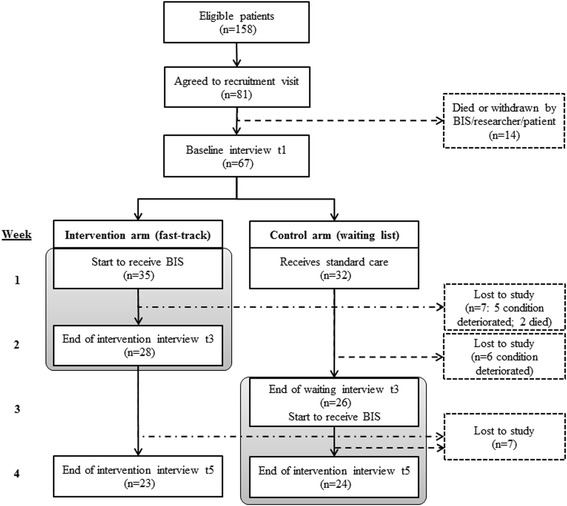
BACKGROUND: Breathlessness is common in advanced cancer. The Breathlessness Intervention Service (BIS) is a multi-disciplinary complex intervention theoretically underpinned by a palliative care approach, utilising evidence-based non-pharmacological and pharmacological interventions to support patients with advanced disease. We sought to establish whether BIS was more effective, and cost-effective, for patients with advanced cancer and their carers than standard care. METHODS: A single-centre Phase III fast-track single-blind mixed-method randomised controlled trial (RCT) of BIS versus standard care was conducted. Participants were randomised to one of two groups (randomly permuted blocks). A total of 67 patients referred to BIS were randomised (intervention arm n = 35; control arm n = 32 received BIS after a two-week wait); 54 completed to the key outcome measurement. The primary outcome measure was a 0 to 10 numerical rating scale for patient distress due to breathlessness at two-weeks. Secondary outcomes were evaluated using the Chronic Respiratory Questionnaire, Hospital Anxiety and Depression Scale, Client Services Receipt Inventory, EQ-5D and topic-guided interviews. RESULTS: BIS reduced patient distress due to breathlessness (primary outcome: -1.29; 95% CI -2.57 to -0.005; P = 0.049) significantly more than the control group; 94% of respondents reported a positive impact (51/53). BIS reduced fear and worry, and increased confidence in managing breathlessness. Patients and carers consistently identified specific and repeatable aspects of the BIS model and interventions that helped. How interventions were delivered was important. BIS legitimised breathlessness and increased knowledge whilst making patients and carers feel 'not alone'. BIS had a 66% likelihood of better outcomes in terms of reduced distress due to breathlessness at lower health/social care costs than standard care (81% with informal care costs included). CONCLUSIONS: BIS appears to be more effective and cost-effective in advanced cancer than standard care. TRIAL REGISTRATION: RCT registration at ClinicalTrials.gov NCT00678405 (May 2008) and Current Controlled Trials ISRCTN04119516 (December 2008).
Overview
The claims and statistics of this paper haven’t been checked yet.
Run the check — free, no account needed. It reads the open-access text and checks the sources it cites.
Integrity signals
Registry
Cites
Statistics
Figures
Verification
Claims the paper makes
The claims and statistics of this paper haven’t been checked yet.
Run the check — free, no account needed. It reads the open-access text and checks the sources it cites.
Claims other papers make about this one
Each is checked against this paper’s own text: does it say what the citing paper says it does?
The source backs part of the claim, not all of it — or backs it for a different population, condition or comparison.
In the citing paper
“This empirical model was developed by the Cambridge Breathlessness Intervention Service (CBIS), a multidisciplinary home-based intervention of proven cost-effectiveness.”
From The Breathing, Thinking, Functioning clinical model: a proposal to facilitate evidence-based breathlessness management in chronic respiratory disease (2017) · cites this paper as [25]
Experimental — accuracy not yet measuredThe source backs part of the claim, not all of it — or backs it for a different population, condition or comparison.
In the citing paper
“Such services provide a brief, cost-effective intervention that impacts positively on distress from breathlessness, mastery, quality of life, and even survival.”
From The Breathing, Thinking, Functioning clinical model: a proposal to facilitate evidence-based breathlessness management in chronic respiratory disease (2017) · cites this paper as [25]
Experimental — accuracy not yet measured
Self-check
Percentages, sums and reported differences re-computed from the paper’s own numbers.
The self-check needs the paper’s full text.
Citations
Cites
The Hospital Anxiety and Depression Scale
Zigmond, A. S., & Snaith, R. P. (1983) · Acta Psychiatrica Scandinavica · doi:10.1111/j.1600-0447.1983.tb09716.x · Cited by 47,139
(1990) · Cited by 24,217
EuroQol: a new facility for the measurement of health-related quality of life
(1990) · Health Policy · doi:10.1016/0168-8510(90)90421-9 · Cited by 15,736
Depression and quality of life in older persons: A review
Sivertsen, H., Bjørkløf, G. H., Engedal, K., Selbæk, G., & Helvik, A.-S. (2015) · Dementia and Geriatric Cognitive Disorders · doi:10.1159/000437299 · Cited by 14,152
Qualitative data analysis for applied policy research
(2002) · Analyzing Qualitative Data · doi:10.4324/9780203413081-14 · Cited by 4,964
Qualitative data analysis for applied policy research
Ritchie, J., & Spencer, L. (2010) · Analyzing qualitative data · doi:10.4324/9780203413081_chapter_9 · Cited by 4,800
Parshall, M. B., Schwartzstein, R. M., Adams, L., Banzett, R. B., Manning, H. L., Bourbeau, J., Calverley, P. M., Gift, A. G., Harver, A., Lareau, S. C., et al. (2012) · American Journal of Respiratory and Critical Care Medicine · doi:10.1164/rccm.201111-2042st · Cited by 1,844
A measure of quality of life for clinical trials in chronic lung disease
Guyatt, G. H., Berman, L. B., Townsend, M., Pugsley, S. O., & Chambers, L. W. (1987) · Thorax · doi:10.1136/thx.42.10.773 · Cited by 1,721
Economic Evaluation in Clinical Trials
Glick, H. A., Doshi, J. A., Sonnad, S. S., & Polsky, D. E. (2014) · Oxford University Press eBooks · doi:10.1093/med/9780199685028.001.0001 · Cited by 910
Normative data for the HADS from a large non-clinical sample
Crawford, J. R., Henry, J. D., Crombie, C., & Taylor, E. P. (2001) · British Journal of Clinical Psychology · doi:10.1348/014466501163904 · Cited by 815 · cited 2×
“30 SD of the norm distribution [35] and depression was comparable (higher by 0.”
Background
Research works printed but not linked: 2
- Booth S, Moffat C, Burkin J: The Cambridge BIS Manual - Building a Breathlessness Intervention Service. 2012, Cambridge University Hospitals NHS Foundation Trust, Cambridge
- Curtis L: Unit Costs of Health and Social Care. 2012, PSSRU, Canterbury
Cited by
Sorted by citations
FERRELL, B. R., Temel, J. S., Temin, S., Alesi, E. R., Balboni, T. A., Basch, E., Firn, J. I., Paice, J. A., Peppercorn, J. M., Phillips, T., et al. (2017) · Journal of Clinical Oncology · doi:10.1200/jco.2016.70.1474 · Cited by 2,148
Association Between Palliative Care and Patient and Caregiver Outcomes
Kavalieratos, D., Corbelli, J. A., Zhang, D., Dionne-Odom, J. N., Ernecoff, N. C., Hanmer, J., Hoydich, Z., Ikejiani, D. Z., Klein‐Fedyshin, M., Zimmermann, C., et al. (2016) · JAMA · doi:10.1001/jama.2016.16840 · Cited by 1,183
Towards an expert consensus to delineate a clinical syndrome of chronic breathlessness
Johnson, M. J., Yorke, J., Hansen-Flaschen, J. H., Lansing, R., Ekström, M. P., Similowski, T., & Currow, D. C. (2017) · European Respiratory Journal · doi:10.1183/13993003.02277-2016 · Cited by 297
Spathis, A., Booth, S., Moffat, C., Hurst, R., Ryan, R., Chin, C., & Burkin, J. (2017) · npj Primary Care Respiratory Medicine · doi:10.1038/s41533-017-0024-z · Cited by 226
“This empirical model was developed by the Cambridge Breathlessness Intervention Service (CBIS), a multidisciplinary homebased intervention of proven cost-effectiveness.(25) Each of the three domains is supported by research evidence, as described above, and the model is theoretically underpinned by a ‘vicious flower’…”
MethodSelf-citationBajwah, S., Oluyase, A. O., Yi, D., Gao, W., Evans, C., Grande, G., Todd, C. J., Costantini, M., Murtagh, F. E., & Higginson, I. J. (2020) · Cochrane Database of Systematic Reviews · doi:10.1002/14651858.cd012780.pub2 · Cited by 249
Self-citation
Metadata
- Authors
- Farquhar, M. C., Prevost, A. T., McCrone, P., Brafman-Price, B., Bentley, A., Higginson, I. J., Todd, C., & Booth, S.
- Affiliations
- University of Cambridge (GB)
- King's College London (GB)
- Cambridge University Hospitals NHS Foundation Trust (GB)
- University of Manchester (GB)
- Corresponding author
- Farquhar, Morag C
- ORCID
- Venue
- BMC Medicine
- Published
- 2014-10-31
- Volume
- 12
- Issue
- 1
- Pages
- 194-194
- ISSN
- 1741-7015 (ISSN-L)
- PMC
- PMC4222435
- OpenAlex
- W2070706399
- Cited by
- 201
- References
- 38
- Citations by year
- 2026: 5 · 2025: 8 · 2024: 12 · 2023: 5 · 2022: 21 · 2021: 16 · 2020: 22 · 2019: 24 · 2018: 19 · 2017: 21 · 2016: 32 · 2015: 14 · 2014: 1
- FWCI
- 22.56
- Type
- journal article
- Language
- en
- Open access
- gold
- doi.org
- Locations
- BMC Medicine (publishedVersion, cc-by)
- PubMed Central (publishedVersion, cc-by)
- PubMed (publishedVersion)
- UEA Digital Repository (University of East Anglia) (acceptedVersion)
- Apollo (University of Cambridge) (submittedVersion, cc-by)
- Research Portal (King's College London) (submittedVersion, cc-by)
- Research Explorer (The University of Manchester) (submittedVersion)
- Spiral (Imperial College London) (submittedVersion, cc-by)
- Funders
- Macmillan Cancer Support
- National Institute for Health and Care Research (PB-PG-0107-11134, NF-SI-0611-10209)
- University of Cambridge
- King's College London
- Cambridge University Hospitals
- Research for Patient Benefit Programme
- Topics
- Health Sciences › Medicine › Public Health, Environmental and Occupational Health › Palliative Care and End-of-Life Issues
- Health Sciences › Medicine › Public Health, Environmental and Occupational Health › Palliative and Oncologic Care
- Health Sciences › Medicine › Anesthesiology and Pain Medicine › Pain Management and Opioid Use
- Keywords
- dyspnea, advanced cancer, palliative care, caregivers, cost-effectiveness, non-pharmacological treatment, anxiety and depression, informal care costs
- MeSH terms
- Adult, Aged, Aged, 80 and over, Anxiety, Cost-Benefit Analysis, Dyspnea, Female, Humans, Male, Middle Aged, Neoplasms, Occupational Therapy, Palliative Care, Surveys and Questionnaires, Single-Blind Method, Caregivers, Health Care Costs, Outcome Assessment, Health Care, Physical Therapy Modalities
About these checks
Registry, retraction, Cites and statistics results are computed, not judged, with one exception: a printed reference that no index lists is read once by a model before it counts as a citation error. Claims are extracted by a model and kept only when their quote appears verbatim in the text; each cited source is then checked, with a model’s help, for whether it says what the claim relies on. Those verdicts can be wrong — read the claim’s quote and the cited source before relying on one.
Statistics and arithmetic are recomputed, not judged.
Confidence bands are shown only for fields calibrated on our annotated test set. None is calibrated yet, so no band is shown.
What counts as a claim ›How we measure confidence ›How we check this ›
Are you an author, or do you see a problem with this page? Request a review
