

The DOI matches its Crossref record; 102 of the 103 references it cites were found in a registry or an index.
Remembering the forgotten non-communicable diseases
Open accessAbstract
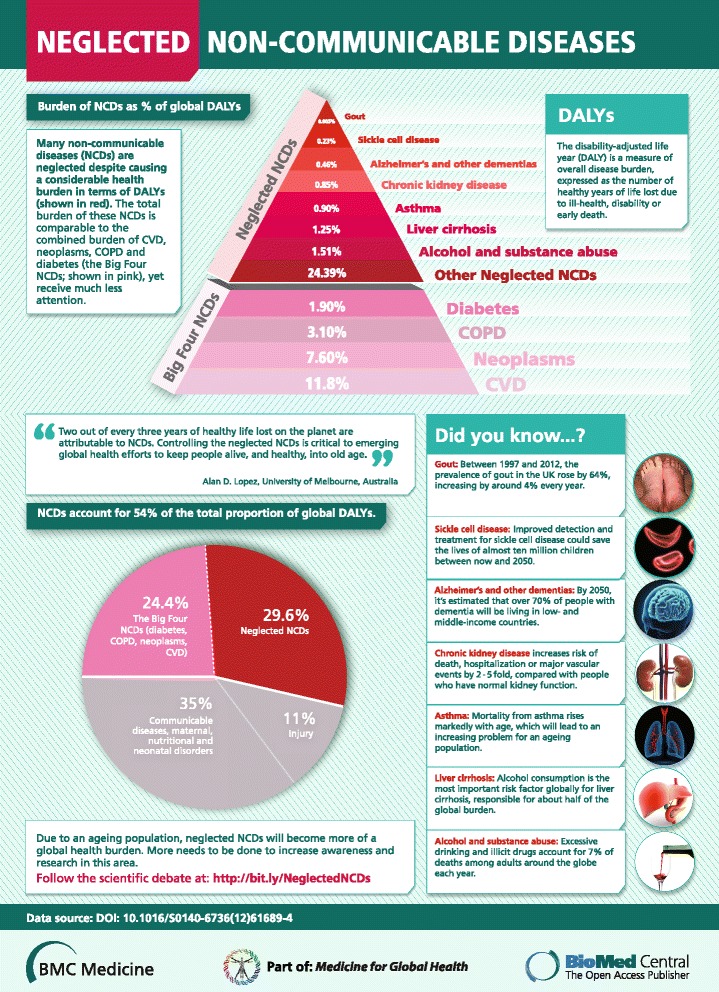
The forthcoming post-Millennium Development Goals era will bring about new challenges in global health. Low- and middle-income countries will have to contend with a dual burden of infectious and non-communicable diseases (NCDs). Some of these NCDs, such as neoplasms, COPD, cardiovascular diseases and diabetes, cause much health loss worldwide and are already widely recognised as doing so. However, 55% of the global NCD burden arises from other NCDs, which tend to be ignored in terms of premature mortality and quality of life reduction. Here, experts in some of these 'forgotten NCDs' review the clinical impact of these diseases along with the consequences of their ignoring their medical importance, and discuss ways in which they can be given higher global health priority in order to decrease the growing burden of disease and disability.
Overview
The claims and statistics of this paper haven’t been checked yet.
Run the check — free, no account needed. It reads the open-access text and checks the sources it cites.
Integrity signals
Registry
Cites
Statistics
Figures









Verification
Claims the paper makes
The claims and statistics of this paper haven’t been checked yet.
Run the check — free, no account needed. It reads the open-access text and checks the sources it cites.
Claims other papers make about this one
Each is checked against this paper’s own text: does it say what the citing paper says it does?
In the citing paper
“even though it has not been included into the WHO targets for non‐communicable disease 276.”
From The relationship between different dimensions of alcohol use and the burden of disease—an update (2017) · cites this paper as [276]
Self-check
Percentages, sums and reported differences re-computed from the paper’s own numbers.
The self-check needs the paper’s full text.
Citations
Cites
Lozano, R., Naghavi, M., Foreman, K., Lim, S., Shibuya, K., Aboyans, V., Abraham, J., Adair, T., Aggarwal, R., Ahn, S. Y., et al. (2012) · The Lancet · doi:10.1016/s0140-6736(12)61728-0 · Cited by 14,070
Self-citationLim, S. S., Vos, T., Flaxman, A. D., Danaei, G., Shibuya, K., Adair-Rohani, H., AlMazroa, M. A., Amann, M., Anderson, H. R., Andrews, K. G., et al. (2012) · The Lancet · doi:10.1016/s0140-6736(12)61766-8 · Cited by 11,805
Murray, C. J. L., Vos, T., Lozano, R., Naghavi, M., Flaxman, A. D., Michaud, C., Ezzati, M., Shibuya, K., Salomon, J. A., Abdalla, S., et al. (2012) · The Lancet · doi:10.1016/s0140-6736(12)61689-4 · Cited by 8,888
Self-citationVos, T., Flaxman, A. D., Naghavi, M., Lozano, R., Michaud, C., Ezzati, M., Shibuya, K., Salomon, J. A., Abdalla, S., Aboyans, V., et al. (2012) · The Lancet · doi:10.1016/s0140-6736(12)61729-2 · Cited by 8,291
Self-citationThe global prevalence of dementia: a systematic review and metaanalysis.
Prince, M., Bryce, R., Albanese, E., Wimo, A., Ribeiro, W., & Ferri, C. P. (2013) · Alzheimer's & Dementia · doi:10.1016/j.jalz.2012.11.007 · Cited by 4,941
Self-citationPrevalence of Chronic Kidney Disease in the United States
Coresh, J., Selvin, E., Stevens, L. A., Manzi, J., Kusek, J. W., Eggers, P., Van Lente, F., & Levey, A. S. (2007) · JAMA · doi:10.1001/jama.298.17.2038 · Cited by 4,895
Chronic kidney disease: global dimension and perspectives
Jha, V., Garcia-Garcia, G., Iseki, K., Li, Z., Naicker, S., Plattner, B., Saran, R., Wang, A. Y.-M., & Yang, C.-W. (2013) · The Lancet · doi:10.1016/s0140-6736(13)60687-x · Cited by 4,383
Asher, M. I., Montefort, S., Björkstén, B., Lai, C. K., Strachan, D. P., Weiland, S. K., & Williams, H. (2006) · The Lancet · doi:10.1016/s0140-6736(06)69283-0 · Cited by 4,223
Vernon, G. C., Baranova, A. V., & Younossi, Z. M. (2011) · Alimentary Pharmacology & Therapeutics · doi:10.1111/j.1365-2036.2011.04724.x · Cited by 3,116
The projected effect of risk factor reduction on Alzheimer's disease prevalence
Barnes, D. E., & Yaffe, K. S. (2011) · The Lancet Neurology · doi:10.1016/s1474-4422(11)70072-2 · Cited by 2,846
Research works printed but not linked: 1
- United Nations press office. Press conference on raising awareness of sickle-cell anaemia: [], [ http://www.un.org/News/briefings/docs/2009/090619_Anaemia.doc.htm ]
Cited by
Sorted by citations
Items 101–108 of 108
Idalsoaga, F. J., Singal, A. K., Arrese, M. A., & Arab, J. P. (2024) · Elsevier eBooks · doi:10.1016/b978-0-323-87031-3.00032-9
Policymaking Addressing Women and Behavioral Health
Hanson, A. R. M., & Levin, B. L. (2024) · Springer eBooks · doi:10.1007/978-3-031-58293-6_14
The Role of AI in Epidemiology: A Concise Academic Overview of Disease Prediction and Surveillance
Ilmaskal, R., & Daswito, R. (2025) · Journal of Health Sciences and Epidemiology · doi:10.62404/jhse.v3i1.77
Thomas, C., Gosling, J., Ashton, R. E. M., Owen, R., & Faghy, M. A. (2025) · Health Policy · doi:10.1016/j.healthpol.2025.105477
Odunyemi, A., Rahman, T., & Alam, K. (2024) · Figshare · doi:10.6084/m9.figshare.26610920
Gomez, K. U., McBride, O., Roberts, E., Angus, C., Keyes, K. M., Drummond, C., Buchan, I. E., Fleming, K., Gilmore, I. T., Donoghue, K., et al. (2024) · Figshare · doi:10.6084/m9.figshare.26566583
Ji, C., Zhao, S., Hu, Y., Wang, X., Zhang, M., Wang, L., Guo, H., & Lin, Y. (2026) · Geriatric Nursing · doi:10.1016/j.gerinurse.2026.104047
Byamukama, A., Atukunda, M., Arinitwe, E., Twinamatsiko, B., Mutabazi, A., Ayebare, M., Tindimwembwa, W., Asiimwe, A., Nangendo, J., Okello, E., et al. (2026) · BMC Health Services Research · doi:10.1186/s12913-026-14650-8
Metadata
- Authors
- Lopez, A. D., Williams, T. N., Levin, A., Tonelli, M., Singh, J. A., Burney, P. G., Rehm, J., Volkow, N. D., Koob, G., & Ferri, C. P.
- Affiliations
- Kenya Medical Research Institute (KE)
- University of British Columbia (CA)
- Mayo Clinic (US)
- Imperial College London (GB)
- Centre for Addiction and Mental Health (CA)
- National Institutes of Health (US)
- Hospital Alemão Oswaldo Cruz (BR)
- ORCID
- Venue
- BMC Medicine
- Published
- 2014-10-22
- Volume
- 12
- Issue
- 1
- Pages
- 200-200
- ISSN
- 1741-7015 (ISSN-L)
- PMC
- PMC4207624
- OpenAlex
- W2004073357
- Cited by
- 108
- References
- 103
- Citations by year
- 2026: 3 · 2025: 5 · 2024: 8 · 2023: 7 · 2022: 9 · 2021: 9 · 2020: 23 · 2019: 13 · 2018: 8 · 2017: 9 · 2016: 9 · 2015: 5
- FWCI
- 14.01
- Type
- journal article
- Language
- en
- Open access
- gold
- doi.org
- Locations
- BMC Medicine (publishedVersion, cc-by)
- Europe PMC (PubMed Central) (publishedVersion, cc-by)
- PubMed Central (publishedVersion, cc-by)
- PubMed (publishedVersion)
- TSpace (University of Toronto) (submittedVersion)
- Americanae (AECID Library) (submittedVersion, other-oa)
- Minerva Access (University of Melbourne) (submittedVersion, cc-by)
- LA Referencia (Red Federada de Repositorios Institucionales de Publicaciones Científicas) (submittedVersion, other-oa)
- Funders
- Patient-Centered Outcomes Research Institute (research contract CE-1304-6631, CE-1304-6631)
- Wellcome Trust (091758)
- National Institutes of Health (AR-060772)
- Agency for Healthcare Research and Quality (U19HS021110)
- National Institute on Aging (U01AG018947)
- National Cancer Institute (U10-CA-149950)
- National Institute of Arthritis and Musculoskeletal and Skin Diseases (U34AR062891, AR‐06‐0772, P50AR060772, P50 AR060772 and U34 AR062891)
- Topics
- Health Sciences › Medicine › Public Health, Environmental and Occupational Health › Global Health and Epidemiology
- Health Sciences › Medicine › Epidemiology › Healthcare Systems and Public Health
- Health Sciences › Medicine › Public Health, Environmental and Occupational Health › Global Public Health Policies and Epidemiology
- Keywords
- non-communicable diseases, neglected diseases, global health burden, disease burden, premature mortality, quality of life, health loss, low- and middle-income countries, global health priorities
- MeSH terms
- Adult, Cardiovascular Diseases, Diabetes Mellitus, Goals, Persons with Disabilities, Disabled Persons, Humans, Neoplasms, Poverty, Quality of Life, Global Health, Health Care Costs, Cost of Illness, Pulmonary Disease, Chronic Obstructive, Neglected Diseases
About these checks
Registry, retraction, Cites and statistics results are computed, not judged, with one exception: a printed reference that no index lists is read once by a model before it counts as a citation error. Claims are extracted by a model and kept only when their quote appears verbatim in the text; each cited source is then checked, with a model’s help, for whether it says what the claim relies on. Those verdicts can be wrong — read the claim’s quote and the cited source before relying on one.
Statistics and arithmetic are recomputed, not judged.
Confidence bands are shown only for fields calibrated on our annotated test set. None is calibrated yet, so no band is shown.
What counts as a claim ›How we measure confidence ›How we check this ›
Are you an author, or do you see a problem with this page? Request a review
