

Unaddressed privacy risks in accredited health and wellness apps: a cross-sectional systematic assessment
Open accessThe DOI matches its Crossref record; 24 of the 24 references it cites were found in a registry or an index.
Abstract
BACKGROUND: Poor information privacy practices have been identified in health apps. Medical app accreditation programs offer a mechanism for assuring the quality of apps; however, little is known about their ability to control information privacy risks. We aimed to assess the extent to which already-certified apps complied with data protection principles mandated by the largest national accreditation program. METHODS: Cross-sectional, systematic, 6-month assessment of 79 apps certified as clinically safe and trustworthy by the UK NHS Health Apps Library. Protocol-based testing was used to characterize personal information collection, local-device storage and information transmission. Observed information handling practices were compared against privacy policy commitments. RESULTS: The study revealed that 89% (n = 70/79) of apps transmitted information to online services. No app encrypted personal information stored locally. Furthermore, 66% (23/35) of apps sending identifying information over the Internet did not use encryption and 20% (7/35) did not have a privacy policy. Overall, 67% (53/79) of apps had some form of privacy policy. No app collected or transmitted information that a policy explicitly stated it would not; however, 78% (38/49) of information-transmitting apps with a policy did not describe the nature of personal information included in transmissions. Four apps sent both identifying and health information without encryption. Although the study was not designed to examine data handling after transmission to online services, security problems appeared to place users at risk of data theft in two cases. CONCLUSIONS: Systematic gaps in compliance with data protection principles in accredited health apps question whether certification programs relying substantially on developer disclosures can provide a trusted resource for patients and clinicians. Accreditation programs should, as a minimum, provide consistent and reliable warnings about possible threats and, ideally, require publishers to rectify vulnerabilities before apps are released.
Overview
The claims and statistics of this paper haven’t been checked yet.
Free: it reads the open-access text and checks the first 5 claims that cite a source we can check. Create a free account to check every claim.
Integrity signals
Registry
Cites
Statistics
Figures
Verification
Claims the paper makes
The claims and statistics of this paper haven’t been checked yet.
Free: it reads the open-access text and checks the first 5 claims that cite a source we can check. Create a free account to check every claim.
Claims other papers make about this one
Each is checked against this paper’s own text: does it say what the citing paper says it does?
The source backs part of the claim, not all of it — or backs it for a different population, condition or comparison.
In the citing paper
“Clinical endorsement of digital health products and services including systems for regulation and accreditation of technology and data enabled services is required and has been suggested previously [42], and a recent systematic review of the international literature on barriers and facilitators to patient and public involvement with digital health has suggested this is a key issue [43].”
From Readiness for Delivering Digital Health at Scale: Lessons From a Longitudinal Qualitative Evaluation of a National Digital Health Innovation Program in the United Kingdom (2017) · cites this paper as [42]
Experimental — accuracy not yet measuredThe source backs part of the claim, not all of it — or backs it for a different population, condition or comparison.
In the citing paper
“The current situation is alarming, as recent studies report on privacy violations being a common occurrence with health and wellbeing (HWB) applications [26], [27].”
From Security and Privacy of mHealth Applications: A Scoping Review (2020) · cites this paper as [26]
Experimental — accuracy not yet measuredThe source backs part of the claim, not all of it — or backs it for a different population, condition or comparison.
In the citing paper
“Only one-third of the apps available had a confidentiality policy, which, in most cases, was incomplete (e.g., no specification on the use of data by a third party or incomplete explanations of the process for requesting changes to registered data as allowed by law).”
From Mobile intervention for individuals with psychosis, dual disorders, and their common comorbidities: A literature review (2019) · cites this paper as [122]
Experimental — accuracy not yet measuredThe cited source says what the claim attributes to it.
In the citing paper
“The study also reports that a large number of applications stored and transmitted unencrypted personal information.”
From Mobile intervention for individuals with psychosis, dual disorders, and their common comorbidities: A literature review (2019) · cites this paper as [122]
The cited source says what the claim attributes to it.
In the citing paper
“Applications were evaluated based on their compliance with data collection/transmission/storage guidelines, confidentiality, privacy policy content, and the adequacy of these policies for the application’s actual behavior.”
From Mobile intervention for individuals with psychosis, dual disorders, and their common comorbidities: A literature review (2019) · cites this paper as [122]
3 more claims about this paper
Create a free account to see every claim other papers make about this one.
Self-check
Percentages, sums and reported differences re-computed from the paper’s own numbers.
The self-check needs the paper’s full text.
Citations
Cites
Information Privacy Research: an Interdisciplinary Review1
Smith, H. J., Dinev, T., & Xu, H. (2011) · MIS Quarterly · doi:10.2307/41409970 · Cited by 2,013 · cited 1×
“Health apps may put patient privacy, defined here as the right of individuals to con-trol how their information is collected and used [7] (other definitions are possible [8]), at risk in a number of ways [9].”
BackgroundInternet of Things – New security and privacy challenges
Weber, R. H. (2010) · Computer Law & Security Review · doi:10.1016/j.clsr.2009.11.008 · Cited by 1,454 · cited 1×
“Privacy issues are likely to only become more complex with the advent of wearable medical technologies, devices connected via the Internet of Things [45] and large-scale ‘ big data ’ analyses that combine information about individuals from multiple sources.”
BackgroundSecurity and Privacy Challenges in Cloud Computing Environments
Takabi, H., Joshi, J. B. D., & Ahn, G.-J. (2010) · IEEE Security & Privacy Magazine · doi:10.1109/msp.2010.186 · Cited by 1,319 · cited 1×
“These may arise as a result of technical and organizational challenges in ensuring the appropriate storage, handling and transfer of information held in online storage [55].”
BackgroundHealthcare in the pocket: Mapping the space of mobile-phone health interventions
Klasnja, P., & Pratt, W. (2012) · Journal of Biomedical Informatics · doi:10.1016/j.jbi.2011.08.017 · Cited by 970 · cited 1×
“Mobile apps – software programs running on devices like smartphones – offer a wide range of potential medical and health-related uses [1].”
BackgroundCan Mobile Health Technologies Transform Health Care?
Steinhubl, S. R., Muse, E. D., & Topol, E. J. (2013) · JAMA · doi:10.1001/jama.2013.281078 · Cited by 496
Availability and quality of mobile health app privacy policies
Sunyaev, A., Dehling, T., Taylor, P. L., & Mandl, K. D. (2015) · Journal of the American Medical Informatics Association · doi:10.1136/amiajnl-2013-002605 · Cited by 360 · cited 2×
“Recent Recent privacy-focused reviews of health and wellness apps available through generic app stores have consistently identified gaps in the extent to which data uses are fully documented and appropriate security mechanisms implemented [10 – 13].”
BackgroundMan-in-the-Middle Attack to the HTTPS Protocol
Callegati, F., Cerroni, W., & Ramilli, M. (2009) · IEEE Security & Privacy Magazine · doi:10.1109/msp.2009.12 · Cited by 347 · cited 1×
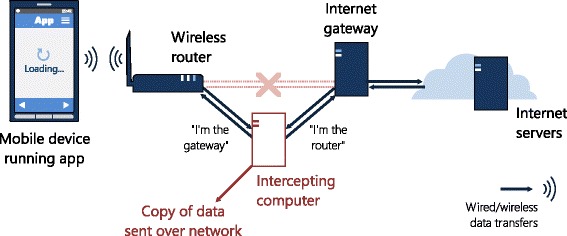
“By making a simple configuration change to the operating systems on each test device, we were able to intercept encrypted communications in addition to unsecured traffic (principles explained in Additional file 1: Figure AF2) [28].”
BackgroundPrivacy and Security in Mobile Health Apps: A Review and Recommendations
Martínez-Pérez, B., de la Torre-Díez, I., & López-Coronado, M. (2015) · Journal of Medical Systems · doi:10.1007/s10916-014-0181-3 · Cited by 342 · cited 3×
“and infrastructure designed to secure the online processing of clinical data [31, 44].”
BackgroundA Review on the State-of-the-Art Privacy-Preserving Approaches in the e-Health Clouds
Abbas, A., & Khan, S. U. (2014) · IEEE Journal of Biomedical and Health Informatics · doi:10.1109/jbhi.2014.2300846 · Cited by 331 · cited 1×
“Recent work has illustrated the scope for threats arising from online storage of health information and identified privacy-preserving strategies that could inform future studies that assess compliance more directly [56].”
BackgroundFor Telehealth To Succeed, Privacy And Security Risks Must Be Identified And Addressed
Hall, J. L., & McGraw, D. (2014) · Health Affairs · doi:10.1377/hlthaff.2013.0997 · Cited by 297 · cited 1×
“Because health and, in particular, wellness apps are often provided by organizations that are not traditional medical providers, they can sit outside the scope of existing legal and professional safeguards [50].”
BackgroundLeakiness and creepiness in app space: perceptions of privacy and mobile app use
Shklovski, I., Mainwaring, S. D., Skúladóttir, H. H., & Borgthorsson, H. (2014) · Proceedings of the SIGCHI Conference on Human Factors in Computing Systems · doi:10.1145/2556288.2557421 · Cited by 284 · cited 2×
“Users can struggle to accurately gauge privacy risks in general app stores [36, 37] and often report feeling un-comfortable about information sharing practices in otherwise valued apps [38].”
BackgroundOpen Web Application Security Project
Fox, D. (2006) · Datenschutz und Datensicherheit - DuD · doi:10.1007/s11623-006-0164-8 · Cited by 247 · cited 2×
“However, two apps revealed credentials anyway because the details had been captured in temporary files kept by the device, a phenomenon known as leakage [26].”
BackgroundDehling, T., Gao, F., Schneider, S., & Sunyaev, A. (2015) · JMIR mHealth and uHealth · doi:10.2196/mhealth.3672 · Cited by 243 · cited 1×
“Recent work has highlighted the potential challenge of defining appropriate governance standards for fast-changing and diverse technologies like health apps [11, 43].”
BackgroundFDA Regulation of Mobile Health Technologies
Cortez, N. G., Cohen, I. G., & Kesselheim, A. S. (2014) · New England Journal of Medicine · doi:10.1056/nejmhle1403384 · Cited by 224 · cited 1×
“Our findings suggest that privacy concerns should also routinely feature in discussions about future regulation of medical apps [51, 54], both as part of accreditation programs and in the wider marketplace.”
BackgroundAgaku, I. T., Adisa, A. O., Ayo-Yusuf, O. A., & Connolly, G. N. (2014) · Journal of the American Medical Informatics Association · doi:10.1136/amiajnl-2013-002079 · Cited by 179 · cited 1×
“Almost two-thirds of US adults asked about the electronic exchange of medical information in clinical settings identified privacy as a salient issue [35].”
BackgroundSecurity Concerns in Android mHealth Apps.
He, D., Naveed, M., Gunter, C. A., & Nahrstedt, K. (2014) · PubMed · Cited by 135
Yang, Y. T., & Silverman, R. D. (2014) · Health Affairs · doi:10.1377/hlthaff.2013.0958 · Cited by 111 · cited 2×
“However, these need to be able to adapt to the changing technical landscape, and there remain unresolved questions of liability [51].”
BackgroundA threat taxonomy for mHealth privacy
Kotz, D. (2011) · 2011 Third International Conference on Communication Systems and Networks (COMSNETS 2011) · doi:10.1109/comsnets.2011.5716518 · Cited by 101 · cited 3×
“These changes bring potential clinical benefits [5], but also expose new risks [6].”
BackgroundSecurity and Privacy Issues Related to the Use of Mobile Health Apps
Adhikari, R., Richards, D., & Scott, K. M. (2014) · Tuwhera (Auckland University of Technology) · Cited by 75
Your privacy is assured - of being disturbed: websites with and without privacy seals
LaRose, R., & Rifon, N. (2006) · New Media & Society · doi:10.1177/1461444806069652 · Cited by 65 · cited 1×
“Privacy badging of websites has been found to lead to modest benefits in the extent to which information uses and security arrangements are openly disclosed [19].”
BackgroundA Taxonomy of mHealth Apps -- Security and Privacy Concerns
Plachkinova, M., Andres, S., & Chatterjee, S. (2015) · 2015 48th Hawaii International Conference on System Sciences · doi:10.1109/hicss.2015.385 · Cited by 61 · cited 2×
“However, many of the privacy issues we identified are well-recognized [6, 43], addressed by best-practice guidelines targeting developers [31, 46 – 48], and required little technical knowledge to uncover.”
BackgroundHow Come I'm Allowing Strangers to Go Through My Phone? Smartphones and Privacy Expectations.Preprint
King, J. (2012) · SSRN Electronic Journal · doi:10.2139/ssrn.2493412 · Cited by 44 · cited 1×
“Users can struggle to accurately gauge privacy risks in general app stores [36, 37] and often report feeling un-comfortable about information sharing practices in otherwise valued apps [38].”
BackgroundImplementation of Mobile Health Tools
Huckvale, K., & Car, J. (2014) · JAMA · doi:10.1001/jama.2014.1106 · Cited by 11 · cited 1×
“If patients or the public are deterred from using apps because of questions of trust, then the potential clinical benefits of mobile health will not be realized [57].”
BackgroundSelf-citationZambrana-García, J. L., & Rivas‐Ruiz, F. (2012) · Gaceta Sanitaria · doi:10.1016/j.gaceta.2012.08.007 · Cited by 7
Research works printed but not linked: 4
- Cohn SP Privacy and confidentiality in the nationwide health information network 2006 Washington National Committee on Vital and Health Statistics
- England NHS Five year forward view 2014 London HM Government
- Information Commissioner’s Office Privacy notices code of practice 2010 Wilmslow Information Commissioner’s Office
- Federal Trade Commission Mobile privacy disclosures – building trust through transparency 2013 USA Federal Trade Commission
Cited by
Evaluating Digital Health Interventions
Murray, E., Hekler, E. B., Andersson, G., Collins, L. M., Doherty, A., Hollis, C., Rivera, D. E., West, R., & Wyatt, J. C. (2016) · American Journal of Preventive Medicine · doi:10.1016/j.amepre.2016.06.008 · Cited by 847
“A SMART is a special case of the factorial experiment involving randomization at several stages, where each stage corresponds to one of the decisions that must be made about adapting the intervention, and some or all of the randomization may be contingent on response to treatment.(35,47) System identification approach…”
Hollis, C., Falconer, C. J., Martin, J. L., Whittington, C., Stockton, S., Glazebrook, C., & Davies, E. B. (2017) · Journal of Child Psychology and Psychiatry · doi:10.1111/jcpp.12663 · Cited by 846
O’Connor, S., Hanlon, P., O’Donnell, C. A., Garcia, S., Glanville, J., & Mair, F. S. (2016) · BMC Medical Informatics and Decision Making · doi:10.1186/s12911-016-0359-3 · Cited by 636
The diverse domains of quantified selves: self-tracking modes and dataveillance
Lupton, D. (2016) · Economy and Society · doi:10.1080/03085147.2016.1143726 · Cited by 446
Consumer Mobile Health Apps: Current State, Barriers, and Future Directions
Kao, C., & Liebovitz, D. M. (2017) · PM&R · doi:10.1016/j.pmrj.2017.02.018 · Cited by 350
Metadata
- Authors
- Huckvale, K., Prieto, J. T., Tilney, M., Benghozi, P.-J., & Car, J.
- Affiliations
- Imperial College London (GB)
- Centre National de la Recherche Scientifique (FR)
- Nanyang Technological University (SG)
- Corresponding author
- Huckvale, Kit
- Prieto, José Tomás
- Venue
- BMC Medicine
- Published
- 2015-09-25
- Volume
- 13
- Issue
- 1
- Pages
- 214-214
- ISSN
- 1741-7015 (ISSN-L)
- PMC
- PMC4582624
- OpenAlex
- W2120522957
- Semantic Scholar
- 02749722c8bdfec410ef318feebd27c14cdd5e23
- Cited by
- 376
- References
- 24
- Citations by year
- 2026: 15 · 2025: 23 · 2024: 21 · 2023: 21 · 2022: 21 · 2021: 41 · 2020: 61 · 2019: 46 · 2018: 38 · 2017: 45 · 2016: 39 · 2015: 4
- FWCI
- 139.34
- Type
- journal article
- Language
- en
- Open access
- gold
- doi.org
- Licence
- Locations
- BMC Medicine (publishedVersion, cc-by)
- Europe PMC (PubMed Central) (publishedVersion, cc-by)
- PubMed Central (publishedVersion, cc-by)
- PubMed (publishedVersion)
- OAR@UM (University of Malta) (submittedVersion, other-oa)
- DR-NTU (Nanyang Technological University) (submittedVersion, cc-by)
- Minerva Access (University of Melbourne) (submittedVersion, cc-by)
- Spiral (Imperial College London) (submittedVersion, cc-by)
- Topics
- Social Sciences › Sociology and Political Science › Privacy, Security, and Data Protection
- Health Sciences › Health Professions › General Health Professions › Mobile Health and mHealth Applications
- Health Sciences › Health Professions › Health Information Management › Thoreau and American Literature
- Keywords
- health apps, wellness apps, data privacy, data protection, encryption, privacy policies, data transmission, personal health data, data theft, mobile application security
- MeSH terms
- Confidentiality, Cross-Sectional Studies, United Kingdom, Humans, National Health Programs, Software, Computer Security, Risk Assessment, Internet
About these checks
Registry, retraction, Cites and statistics results are computed, not judged, with one exception: a printed reference that no index lists is read once by a model before it counts as a citation error. Claims are extracted by a model and kept only when their quote appears verbatim in the text; each cited source is then checked, with a model’s help, for whether it says what the claim relies on. Those verdicts can be wrong — read the claim’s quote and the cited source before relying on one.
Statistics and arithmetic are recomputed, not judged.
Confidence bands are shown only for fields calibrated on our annotated test set. None is calibrated yet, so no band is shown.
What counts as a claim ›How we measure confidence ›How we check this ›
Are you an author, or do you see a problem with this page? Request a review
Data sources
Bibliographic data: Semantic Scholar, OpenAlex, Crossref.
Contains information from the Semantic Scholar Academic Graph Datasets, made available under the ODC Attribution License (ODC-BY 1.0).
Semantic Scholar’s data is described in: Kinney, R., et al. (2023). The Semantic Scholar Open Data Platform. arXiv:2301.10140.
