

Effects of testosterone treatment on body fat and lean mass in obese men on a hypocaloric diet: a randomised controlled trial
Open accessThe DOI matches its Crossref record; 38 of the 38 references it cites were found in a registry or an index.
Abstract
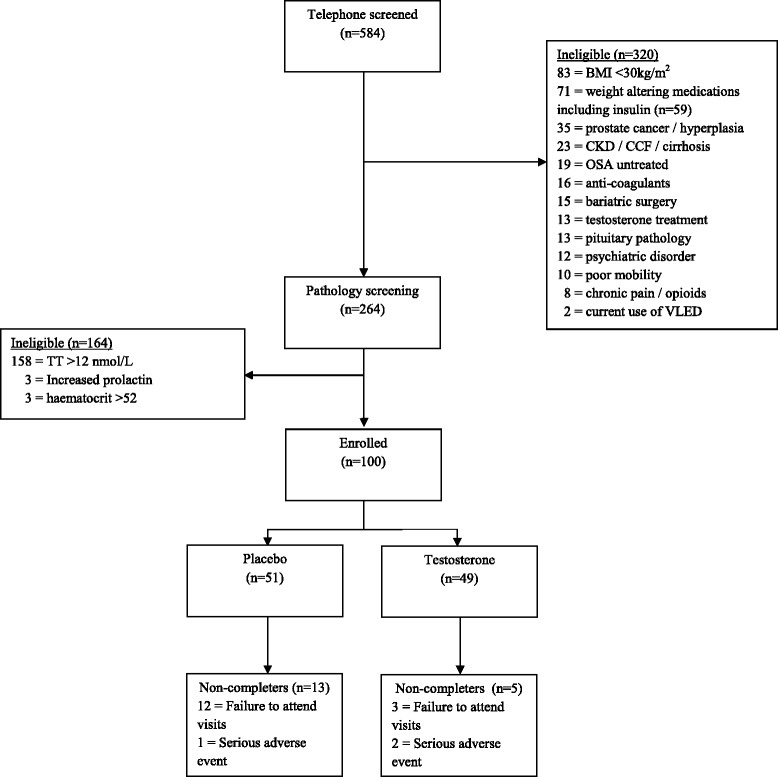
Whether testosterone treatment has benefits on body composition over and above caloric restriction in men is unknown. We hypothesised that testosterone treatment augments diet-induced loss of fat mass and prevents loss of muscle mass. We conducted a randomised double-blind, parallel, placebo controlled trial at a tertiary referral centre. A total of 100 obese men (body mass index ≥ 30 kg/m2) with a total testosterone level of or below 12 nmol/L and a median age of 53 years (interquartile range 47–60) receiving 10 weeks of a very low energy diet (VLED) followed by 46 weeks of weight maintenance were randomly assigned at baseline to 56 weeks of 10-weekly intramuscular testosterone undecanoate (n = 49, cases) or matching placebo (n = 51, controls). The main outcome measures were the between-group difference in fat and lean mass by dual-energy X-ray absorptiometry, and visceral fat area (computed tomography). A total of 82 men completed the study. At study end, compared to controls, cases had greater reductions in fat mass, with a mean adjusted between-group difference (MAD) of –2.9 kg (–5.7 to –0.2; P = 0.04), and in visceral fat (MAD –2678 mm2; –5180 to –176; P = 0.04). Although both groups lost the same lean mass following VLED (cases –3.9 kg (–5.3 to –2.6); controls –4.8 kg (–6.2 to –3.5), P = 0.36), cases regained lean mass (3.3 kg (1.9 to 4.7), P < 0.001) during weight maintenance, in contrast to controls (0.8 kg (–0.7 to 2.3), P = 0.29) so that, at study end, cases had an attenuated reduction in lean mass compared to controls (MAD 3.4 kg (1.3 to 5.5), P = 0.002). While dieting men receiving placebo lost both fat and lean mass, the weight loss with testosterone treatment was almost exclusively due to loss of body fat. clinicaltrials.gov, identifier NCT01616732 , registration date: June 8, 2012
Overview
The claims and statistics of this paper haven’t been checked yet.
Free: it reads the open-access text and checks the first 5 claims that cite a source we can check. Create a free account to check every claim.
Integrity signals
Registry
Cites
Statistics
Figures
Verification
Claims the paper makes
The claims and statistics of this paper haven’t been checked yet.
Free: it reads the open-access text and checks the first 5 claims that cite a source we can check. Create a free account to check every claim.
Claims other papers make about this one
Each is checked against this paper’s own text: does it say what the citing paper says it does?
The source backs part of the claim, not all of it — or backs it for a different population, condition or comparison.
In the citing paper
“Testosterone-treated participants also had greater lean mass regain during weight maintenance (mean between-group difference 3.4 kg; P = 0.002) following the very-low-energy diet, suggesting that weight loss was exclusively fat mass419.”
From Sarcopenic obesity in older adults: aetiology, epidemiology and treatment strategies (2018) · cites this paper as [419]
Experimental — accuracy not yet measuredThe source backs part of the claim, not all of it — or backs it for a different population, condition or comparison.
In the citing paper
“Over 56 weeks, testosterone-treated participants (mean age 53 years) had greater reductions in fat mass (mean between-group difference 2.9 kg; P = 0.04) and visceral fat (−2,678 mm2; P = 0.04) than controls.”
From Sarcopenic obesity in older adults: aetiology, epidemiology and treatment strategies (2018) · cites this paper as [419]
Experimental — accuracy not yet measuredThe cited source says what the claim attributes to it.
In the citing paper
“Therefore, the benefits reported with testosterone treatment in this cohort 91,101 cannot be extended to unselected obese men.”
From Hypogonadism and male obesity: Focus on unresolved questions (2018) · cites this paper as [91]
The cited source says what the claim attributes to it.
In the citing paper
“weight loss in testosterone-treated men was almost exclusively due to loss of body fat (51).”
From A Perspective on Middle-Aged and Older Men With Functional Hypogonadism: Focus on Holistic Management (2017) · cites this paper as [51]
The cited source says what the claim attributes to it.
In the citing paper
“an RCT in 100 middle-aged obese men with low testosterone subjected to a rigorous weight loss program has reported that although men receiving placebo lost both fat and lean body mass, testosterone treatment prevented the diet-associated loss of lean mass”
From A Perspective on Middle-Aged and Older Men With Functional Hypogonadism: Focus on Holistic Management (2017) · cites this paper as [51]
5 more claims about this paper
Create a free account to see every claim other papers make about this one.
Self-check
Percentages, sums and reported differences re-computed from the paper’s own numbers.
The self-check needs the paper’s full text.
Citations
Cites
A Critical Evaluation of Simple Methods for the Estimation of Free Testosterone in Serum
Vermeulen, A., Verdonck, L., & Kaufman, J. M. (1999) · The Journal of Clinical Endocrinology & Metabolism · doi:10.1210/jcem.84.10.6079 · Cited by 3,824 · cited 3×
“To confirm lowered levels, baseline TT was re-measured at study completion by validated LCMS/MS [12] from frozen baseline samples stored at –80 °C. SHBG was measured by electrochemiluminescence immunoassay (Roche Cobas C8000), Austin intra-assay CV of 3.4 % at 44 nmol/L. Free testosterone was calculated according to V…”
MethodInfluentialSystematic review and meta-analysis
(2019) · Providing Information for Health · doi:10.1201/9781315377315-19 · Cited by 2,659
Bhasin, S., Cunningham, G. R., Hayes, F. J., Matsumoto, A. M., Snyder, P. J., Swerdloff, R. S., & Montori, V. M. (2010) · The Journal of Clinical Endocrinology & Metabolism · doi:10.1210/jc.2009-2354 · Cited by 1,954 · cited 1×
“3 nmol/L) recommended for topical treatment [10].”
Identification of late-onset hypogonadism in middle-aged and elderly men
Wu, F. C. W., Tajar, A., Beynon, J. M., Pye, S. R., Silman, A. J., Finn, J. D., O'Neill, T. W., Bartfai, G., Casanueva, F. F., Forti, G., et al. (2010) · New England Journal of Medicine · doi:10.1056/nejmoa0911101 · Cited by 1,544 · cited 1×
“While TT may reflect adaptation to obesity-associated lowering of SHBG, it is important to emphasize that 97 % of our study population had a baseline free testosterone (calculated from LCMS/MS total testosterone) of less than 243 pmol/L, the lower limit reported for healthy young men [4], and 89 % a level of less than…”
BackgroundEffects of Testosterone Treatment in Older Men
Snyder, P. J., Bhasin, S., Cunningham, G. R., Matsumoto, A. M., Stephens-Shields, A. J., Cauley, J. A., Gill, T. M., Barrett-Connor, E., Swerdloff, R. S., Wang, C., et al. (2016) · New England Journal of Medicine · doi:10.1056/nejmoa1506119 · Cited by 890 · cited 1×
“Ten percent of the participants assigned to testosterone treatment had an increase of above 1 μg/L in PSA during the study, similar to the 6 % among men allocated to testosterone in the recent testosterone trials [32].”
ResultGonadal Steroids and Body Composition, Strength, and Sexual Function in Men
Finkelstein, J. S., Lee, H., Burnett-Bowie, S.-A. M., Pallais, J. C., Yu, E. W., Borges, L. F., Jones, B. F., Barry, C. V., Wulczyn, K. E., Thomas, B. J., et al. (2013) · New England Journal of Medicine · doi:10.1056/nejmoa1206168 · Cited by 782
robustlmm: An R Package for Robust Estimation of Linear Mixed-Effects Models
Koller, M. (2016) · Journal of Statistical Software · doi:10.18637/jss.v075.i06 · Cited by 713
Isidori, A. M., Giannetta, E., Greco, E. A., Gianfrilli, D., Bonifacio, V., Isidori, A., Lenzi, A., & Fabbri, A. (2005) · Clinical Endocrinology · doi:10.1111/j.1365-2265.2005.02339.x · Cited by 695 · cited 2×
“0 kg reduction reported in meta-analyses of RCTs not incorporating weight loss measures [18, 19].”
BackgroundSrinivas-Shankar, U., Roberts, S. A., Connolly, M. J., O'Connell, M. D. L., Adams, J. E., Oldham, J. A., & Wu, F. C. W. (2010) · The Journal of Clinical Endocrinology & Metabolism · doi:10.1210/jc.2009-1251 · Cited by 629 · cited 1×
“Previous studies have suggested that testosterone treatment improves physical performance primarily in frail, mobility-limited men [33, 34].”
BackgroundTajar, A., Forti, G., O'Neill, T. W., Lee, D. M., Silman, A. J., Finn, J. D., Bartfai, G., Boonen, S., Casanueva, F. F., Giwercman, A., et al. (2010) · The Journal of Clinical Endocrinology & Metabolism · doi:10.1210/jc.2009-1796 · Cited by 604 · cited 3×
“We selected participants based on a TT of less than 12 nmol/L to include men with modestly reduced levels typical of the majority of obese men [3].”
BackgroundMethod
Cited by
Sarcopenic obesity in older adults: aetiology, epidemiology and treatment strategies
Batsis, J. A., & Villareal, D. T. (2018) · Nature Reviews Endocrinology · doi:10.1038/s41574-018-0062-9 · Cited by 1,382
Wittert, G., Bracken, K., Robledo, K. P., Grossmann, M., Yeap, B. B., Handelsman, D. J., Stuckey, B., Conway, A., Inder, W., McLachlan, R., et al. (2021) · The Lancet Diabetes & Endocrinology · doi:10.1016/s2213-8587(20)30367-3 · Cited by 362
Self-citationSarcopenic obesity: epidemiology, pathophysiology, cardiovascular disease, mortality, and management
Wei, S., Nguyen, T. T., Zhang, Y., Ryu, D., & Gariani, K. (2023) · Frontiers in Endocrinology · doi:10.3389/fendo.2023.1185221 · Cited by 291
Caprio, M., Infante, M., Moriconi, E., Armani, A., Fabbri, A., Mantovani, G., Mariani, S., Lubrano, C., Poggiogalle, E., Migliaccio, S., et al. (2019) · Journal of Endocrinological Investigation · doi:10.1007/s40618-019-01061-2 · Cited by 283
Grossmann, M., & Matsumoto, A. M. (2017) · The Journal of Clinical Endocrinology & Metabolism · doi:10.1210/jc.2016-3580 · Cited by 246
“For example, an RCT in 100middle-aged obesemenwith low testosterone subjected to a rigorous weight loss program has reported that although men receiving placebo lost both fat and lean body mass, testosterone treatment prevented the diet-associated loss of lean mass, and weight loss in testosterone-treated men was almo…”
BackgroundSelf-citationEuropean Society of Endocrinology Clinical Practice Guideline: Endocrine work-up in obesity
Pasquali, R., Casanueva, F., Haluzik, M., van Hulsteijn, L., Ledoux, S., Monteiro, M. P., Salvador, J., Santini, F., Toplak, H., & Dekkers, O. M. (2020) · European Journal of Endocrinology · doi:10.1530/eje-19-0893 · Cited by 188
British Society for Sexual Medicine Guidelines on the Management of Erectile Dysfunction in Men—2017
Hackett, G., Kirby, M., Wylie, K., Heald, A., Ossei-Gerning, N., Edwards, D., & Muneer, A. (2018) · The Journal of Sexual Medicine · doi:10.1016/j.jsxm.2018.01.023 · Cited by 176
Hypogonadism and male obesity: Focus on unresolved questions
Grossmann, M. (2018) · Clinical Endocrinology · doi:10.1111/cen.13723 · Cited by 164
Self-citationTestosterone replacement therapy
Barbonetti, A., D’Andrea, S., & Francavilla, S. (2020) · Andrology · doi:10.1111/andr.12774 · Cited by 162
Hypogonadotropic Hypogonadism in Men With Diabesity
Dhindsa, S., Ghanim, H., Batra, M., & Dandona, P. (2018) · Diabetes Care · doi:10.2337/dc17-2510 · Cited by 158
Male Obesity-related Secondary Hypogonadism – Pathophysiology, Clinical Implications and Management
Fernandez, C. J., Department of Endocrinology & Metabolism, P. H., Chacko, E. C., Department of Endocrinology, J. G. H., Pappachan, J. M., & Department of Endocrinology & Metabolism, L. T. H. N. F. T. (2019) · European Endocrinology · doi:10.17925/ee.2019.15.2.83 · Cited by 145
“Although TRT did not augment diet-induced loss of fat mass, it prevented diet-induced loss of muscle mass.(82) These favourable effects of TRT on body composition may be due to androgen receptor signalling in adipocytes and myocytes and/or increased physical activity seen in testosterone replaced men.”
BackgroundHackett, G., Kirby, M., Edwards, D., Jones, T. H., Wylie, K., Ossei-Gerning, N., David, J., & Muneer, A. (2017) · The Journal of Sexual Medicine · doi:10.1016/j.jsxm.2017.10.067 · Cited by 143
“J Sex Med 2017;14:1504e1523 modification alone have failed to demonstrate effective improvement in clinical symptoms, even after more than 4 years, and patients need to be informed of this.(41,42,128) For sexual dysfunction, a patient’s desire to achieve a satisfactory sexual response is a major driver for T therapy i…”
BackgroundTraish, A. M., Haider, A., Haider, K. S., Doros, G., & Saad, F. (2017) · Journal of Cardiovascular Pharmacology and Therapeutics · doi:10.1177/1074248417691136 · Cited by 130
“control group, such as reported herein, provide critical information on the long-term safety and effectiveness in clinical practice, especially relevant information regarding adherence and health outcomes in the general population.(54,55,92,103,104) In contrast to the majority of studies, patients in the T-group achie…”
ResultObesity and male hypogonadism: Tales of a vicious cycle
Carrageta, D. F., Oliveira, P. F., Alves, M. G., & Monteiro, M. P. (2019) · Obesity Reviews · doi:10.1111/obr.12863 · Cited by 145
“Lifestyle intervention along with testosterone treatment was also attempted, although the results achieved were limited to moderate fat reduction, which were almost entirely regained after study completion.(130,131) Taking into account the limited evidence for the benefits of testosterone therapy together with the pot…”
ResultEffects of liraglutide on obesity-associated functional hypogonadism in men
Jensterle, M., Podbregar, A., Goricar, K., Gregoric, N., & Janez, A. (2019) · Endocrine Connections · doi:10.1530/ec-18-0514 · Cited by 101
Handelsman, D. J. (2021) · Endocrine Reviews · doi:10.1210/endrev/bnab001 · Cited by 113
Hackett, G. I., Kirby, M. G., Rees, R. W., Jones, T. H., Muneer, A., Livingston, M. A., Ossei‐Gerning, N., David, J., Foster, J., Kalra, P. A., et al. (2023) · The World Journal of Men s Health · doi:10.5534/wjmh.221027 · Cited by 108
Late‐onset hypogonadism: metabolic impact
Grossmann, M., Ng Tang Fui, M., & Cheung, A. S. (2020) · Andrology · doi:10.1111/andr.12705 · Cited by 95
Self-citationA randomized trial of adjunct testosterone for cancer‐related muscle loss in men and women
Wright, T. J., Dillon, E. L., Durham, W. J., Chamberlain, A., Randolph, K. M., Danesi, C., Horstman, A. M., Gilkison, C. R., Willis, M., Richardson, G., et al. (2018) · Journal of Cachexia, Sarcopenia and Muscle · doi:10.1002/jcsm.12295 · Cited by 89
Treatment of Functional Hypogonadism Besides Pharmacological Substitution
Corona, G., Rastrelli, G., Morelli, A., Sarchielli, E., Cipriani, S., Vignozzi, L., & Maggi, M. (2020) · The World Journal of Men's Health · doi:10.5534/wjmh.190061 · Cited by 87
“Ng Tang Fui et al (2016) [43] Melbourne, Australia RCT 49 54.”
BackgroundKim, H.-K., & Kim, C.-H. (2021) · Endocrinology and Metabolism · doi:10.3803/enm.2021.1348 · Cited by 96
“A few intervention studies to date have reported some benefits on body composition using myostatin inhibitors [83] or testosterone [84], but the effects on myosteatosis have not been explored yet.”
BackgroundTestosterone deficiency in men with Type 2 diabetes: pathophysiology and treatment
Gianatti, E., & Grossmann, M. (2019) · Diabetic Medicine · doi:10.1111/dme.13977 · Cited by 94
Self-citationRelationship between Testosterone and Sarcopenia in Older-Adult Men: A Narrative Review
Shigehara, K., Kato, Y., Izumi, K., & Mizokami, A. (2022) · Journal of Clinical Medicine · doi:10.3390/jcm11206202 · Cited by 92
“The other four studies, however, failed to demonstrate that TRT contributes to improving muscle mass or strength [65,66,71,78].”
ResultDiem, S. J., Greer, N. L., MacDonald, R. H., McKenzie, L. G., Dahm, P., Ercan-Fang, N. G., Estrada, A., Hemmy, L. S., Rosebush, C. E., Fink, H. A., et al. (2020) · Annals of Internal Medicine · doi:10.7326/m19-0830 · Cited by 80
“One (63, 64) reported similar effects on quality of life and sexual function to those in our pooled analyses.”
ResultBariatric surgery: remission of inflammation, cardiometabolic benefits, and common adverse effects
Biobaku, F., Ghanim, H., Monte, S. V., Caruana, J. A., & Dandona, P. (2020) · Journal of the Endocrine Society · doi:10.1210/jendso/bvaa049 · Cited by 68
“While the type of bariatric surgery and extent of weight loss considerably impacts the loss of free-fat mass including muscle [105], the associated hypogonadal state in obese men may also be a contributing factor [106].”
BackgroundEffects of lifelong testosterone exposure on health and disease using Mendelian randomization
Mohammadi‐Shemirani, P., Chong, M., Pigeyre, M., Morton, R. W., Gerstein, H. C., & Paré, G. (2020) · eLife · doi:10.7554/elife.58914 · Cited by 73
Testosterone a key factor in gender related metabolic syndrome
Bianchi, V. E., & Locatelli, V. (2018) · Obesity Reviews · doi:10.1111/obr.12633 · Cited by 79
Pasiakos, S. M., Berryman, C. E., Karl, J. P., Lieberman, H. R., Orr, J. S., Margolis, L. M., Caldwell, J. A., Young, A. J., Montano, M. A., Evans, W. J., et al. (2019) · eBioMedicine · doi:10.1016/j.ebiom.2019.07.059 · Cited by 54
“15 nmol/L) with exogenous testosterone during 56-wk of underfeeding resulted in significantly more fat mass and less lean body mass loss than those receiving placebo injections [10].”
BackgroundKirby, M., Hackett, G. I., & Ramachandran, S. (2019) · European Cardiology Review · doi:10.15420/ecr.2019.13.1 · Cited by 55
Giagulli, V. A., Castellana, M., Carbone, M. D., Pelusi, C., Ramunni, M. I., Pergola, G. D., Guastamacchia, E., & Triggiani, V. (2020) · Andrology · doi:10.1111/andr.12754 · Cited by 54
Kim, S. H., Park, J. J., Kim, K. H., Yang, H. J., Kim, D. S., Lee, C. H., Jeon, Y. S., Shim, S. R., & Kim, J. H. (2021) · International Urology and Nephrology · doi:10.1007/s11255-021-02876-w · Cited by 51
“Third, some studies combining TRT with other interventions were included, which could have a major impact on outcomes [19, 25].”
BackgroundThe role of leptin and low testosterone in obesity
Khodamoradi, K., Khosravizadeh, Z., Seetharam, D., Mallepalli, S. K. R., Farber, N., & Arora, H. (2022) · International Journal of Impotence Research · doi:10.1038/s41443-022-00534-y · Cited by 58
“Several authors have shown that obesity is one of the most important risk factors for the reduction of T levels, more important than age and other chronic diseases [179].”
BackgroundBenefits and Health Implications of Testosterone Therapy in Men With Testosterone Deficiency
Traish, A. M. (2017) · Sexual Medicine Reviews · doi:10.1016/j.sxmr.2017.10.001 · Cited by 48
Secondary male hypogonadism: A prevalent but overlooked comorbidity of obesity
Fernandez-Garcia, J.-C., Molina‐Vega, M., Muñoz-Garach, A., Damas-Fuentes, M., & Tinahones, F. J. (2018) · Asian Journal of Andrology · doi:10.4103/aja.aja_44_18 · Cited by 58
Yeap, B. B., & Wu, F. C. W. (2019) · Clinical Endocrinology · doi:10.1111/cen.13888 · Cited by 43
Ng Tang Fui, M., Hoermann, R., Prendergast, L. A., Zajac, J. D., & Grossmann, M. (2017) · International Journal of Obesity · doi:10.1038/ijo.2016.242 · Cited by 40
Self-citationFink, J. E., Matsumoto, M., & Tamura, Y. (2018) · Steroids · doi:10.1016/j.steroids.2018.08.002 · Cited by 50
Type 2 Diabetes and Testosterone Therapy
Hackett, G. I. (2018) · The World Journal of Men s Health · doi:10.5534/wjmh.180027 · Cited by 48
“And a placebo controlled randomized controlled trial (RCT) in obese hypogonadal men treated with severe weight reduction and either long acting testosterone undecanoate (TU) injections or placebo for 12 months, found that although weight and BMI loss was achieved in both groups, only the TU group preserved lean muscle…”
BackgroundMethodMetabolic Effects of Testosterone Therapy in Men with Type 2 Diabetes and Metabolic Syndrome
Hackett, G. I. (2019) · Sexual Medicine Reviews · doi:10.1016/j.sxmr.2018.12.004 · Cited by 41
Ng Tang Fui, M., Hoermann, R., Zajac, J. D., & Grossmann, M. (2017) · Clinical Endocrinology · doi:10.1111/cen.13385 · Cited by 37
Self-citationWittert, G., Atlantis, E., Allan, C., Bracken, K., Conway, A., Daniel, M., Gebski, V., Grossmann, M., Hague, W., Handelsman, D. J., et al. (2019) · Diabetes, Obesity and Metabolism · doi:10.1111/dom.13601 · Cited by 37
Self-citationLa Vignera, S., Cannarella, R., Galvano, F., Grillo, A., Aversa, A., Cimino, L., Magagnini, C. M., Mongioì, L. M., Condorelli, R. A., & Calogero, A. E. (2021) · Endocrine · doi:10.1007/s12020-020-02518-8 · Cited by 36
Functional hypogonadism among patients with obesity, diabetes, and metabolic syndrome
Louters, M., Pearlman, M., Solsrud, E., & Pearlman, A. (2022) · International Journal of Impotence Research · doi:10.1038/s41443-021-00496-7 · Cited by 32
Hackett, G. I., Cole, N., Mulay, A., Strange, R. C., & Ramachandran, S. (2018) · The World Journal of Men s Health · doi:10.5534/wjmh.180052m · Cited by 31
“A recent double blind RCT found that, in such men, intensive diet and exercise combined with placebo reduced both fat and lean mass, whereas in the testosterone group, the weight loss was almost exclusively body fat [14].”
BackgroundEMAS position statement: Testosterone replacement therapy in older men
Kanakis, G., Pofi, R., Goulis, D. G., Isidori, A. M., Armeni, E., Erel, C. T., Fistonić, I., Hillard, T., Hirschberg, A. L., Męczekalski, B., et al. (2023) · Maturitas · doi:10.1016/j.maturitas.2023.107854 · Cited by 40
“…obesity, two RCTs, that each included > 80 patients with hypogonadism (T 12 nmol/L), demonstrated that 3 and 6 months of TRT (undeca-noate in one study, gel in the other) reduced fat mass and increased lean body mass, compared with controls, but again without an effect on body weight [66,67].”
BackgroundMiller, C., Madden-Doyle, L., Jayasena, C., McIlroy, M., Sherlock, M., & O’Reilly, M. W. (2024) · European Journal of Endocrinology · doi:10.1093/ejendo/lvae128 · Cited by 28
Role of testosterone in cognition and mobility of aging men
Kaufman, J., & Lapauw, B. (2020) · Andrology · doi:10.1111/andr.12872 · Cited by 32
Grossmann, M., Jayasena, C. N., & Anawalt, B. D. (2023) · The Journal of Clinical Endocrinology & Metabolism · doi:10.1210/clinem/dgad180 · Cited by 27
Self-citationNg Tang Fui, M., Hoermann, R., Nolan, B., Clarke, M., Zajac, J. D., & Grossmann, M. (2018) · Scientific Reports · doi:10.1038/s41598-018-27481-3 · Cited by 24
Self-citationAcute testosterone administration does not affect muscle anabolism
Church, D. D., Pasiakos, S. M., Wolfe, R. R., & Ferrando, A. A. (2019) · Nutrition & Metabolism · doi:10.1186/s12986-019-0385-0 · Cited by 26
Lapauw, B., & Kaufman, J. (2020) · European Journal of Endocrinology · doi:10.1530/eje-20-0394 · Cited by 27
Apostolov, R., Gianatti, E., Wong, D. J., Kutaiba, N., Gow, P. J., Grossmann, M., & Sinclair, M. J. (2022) · World Journal of Hepatology · doi:10.4254/wjh.v14.i4.754 · Cited by 25
Self-citationFernández‐García, J. C., Barrios‐Rodríguez, R., Asenjo‐Plaza, M., Ramos‐Molina, B., Molina‐Vega, M., Guzmán-Guzmán, A., Moreno-León, L., Yubero‐Serrano, E. M., Ríus, F., Valdés, S., et al. (2022) · Metabolism · doi:10.1016/j.metabol.2022.155290 · Cited by 30
Cannarella, R., Gusmano, C., Leanza, C., Garofalo, V., Crafa, A., Barbagallo, F., Condorelli, R. A., Vignera, S. L., & Calogero, A. E. (2023) · Asian Journal of Andrology · doi:10.4103/aja202352 · Cited by 37
Obesity, Body Composition, and Sex Hormones: Implications for Cardiovascular Risk
Singh, P., Covassin, N., Marlatt, K. L., Gadde, K. M., & Heymsfield, S. B. (2021) · Comprehensive physiology · doi:10.1002/cphy.c210014 · Cited by 56
Dysregulation of the Hypothalamic-Pituitary-Testicular Axis due to Energy Deficit
Grossmann, M., & Wittert, G. A. (2021) · The Journal of Clinical Endocrinology & Metabolism · doi:10.1210/clinem/dgab517 · Cited by 24
Self-citationVenkatesh, V. S., Grossmann, M., Zajac, J. D., & Davey, R. A. (2022) · Obesity Reviews · doi:10.1111/obr.13429 · Cited by 22
“ment in men is depot specific remains unclear, with some studies reporting reductions occurring in subcutaneous(76,79) and others, in visceral fat depots.(60,86) The specific fat depot in which reductions are”
ResultSelf-citationMechanisms of Testosterone's Anabolic Effects on Muscle and Function: Controversies and New Insights
Bhasin, S., Wang, C., Chandra, M. R. G., Gagliano‐Jucá, T., & Jasuja, R. (2025) · Endocrine Reviews · doi:10.1210/endrev/bnaf041 · Cited by 32
Effect of Testosterone Treatment on Adipokines and Gut Hormones in Obese Men on a Hypocaloric Diet
Ng Tang Fui, M., Hoermann, R., & Grossmann, M. (2017) · Journal of the Endocrine Society · doi:10.1210/js.2017-00062 · Cited by 22
“In addition, all subjects received a VLED providing 640 kcal per day for 10 weeks, followed by a 46-week weight maintenance phase based on the Australian Commonwealth Scientific and Industrial Research Organization Total Wellbeing Diet [13].”
BackgroundMethodInfluentialSelf-citationTestosterone, Diabetes Risk, and Diabetes Prevention in Men
Yeap, B. B., & Wittert, G. (2022) · Endocrinology and Metabolism Clinics of North America · doi:10.1016/j.ecl.2021.11.004 · Cited by 21
Robledo, K. P., Marschner, I. C., Handelsman, D. J., Bracken, K., Stuckey, B. G. A., Yeap, B. B., Inder, W. J., Grossmann, M., Jesudason, D. R., Allan, C. A., et al. (2023) · European Journal of Endocrinology · doi:10.1093/ejendo/lvad074 · Cited by 23
Self-citationAnyiam, O., Rashid, R. S. A., Bhatti, A. I., Khan-Madni, S., Ogunyemi, O., Ardavani, A., & IDRIS, I. R. (2024) · Nutrients · doi:10.3390/nu16193328 · Cited by 24
“Seven studies included in the meta-analysis did not report the full data required [39,45,60,63–65,79 We also performed sensitivity analysis to determine whether the method of body composition assessment used in each study, or the measure of MM reported by studies, could have had a significant…”
Percent body fat was negatively correlated with Testosterone levels in male
Ma, H., Sun, J., Wu, X., Mao, J., & Han, Q. (2024) · PLoS ONE · doi:10.1371/journal.pone.0294567 · Cited by 24
Therapeutic and lifestyle approaches to obesity in older persons
Jiang, B. C., & Villareal, D. T. (2019) · Current Opinion in Clinical Nutrition & Metabolic Care · doi:10.1097/mco.0000000000000520 · Cited by 18
The medicalization of testosterone: reinventing the elixir of life
Gagliano‐Jucá, T., Álvarez, M., & Basaria, S. S. (2022) · Reviews in Endocrine and Metabolic Disorders · doi:10.1007/s11154-022-09751-8 · Cited by 16
González-Gil, A. M., Barnouin, Y., Celli, A., Viola, V., Villarreal, M. D., Nava, M. L. D., Sciuk, A., Qualls, C., Armamento‐Villareal, R., & Villareal, D. T. (2024) · The Journal of Clinical Endocrinology & Metabolism · doi:10.1210/clinem/dgae249 · Cited by 15
Hackett, G. I. (2017) · Sexual Medicine Reviews · doi:10.1016/j.sxmr.2017.02.002 · Cited by 13
“Preservation of lean muscle is an important component in CV performance and in the prevention of frailty in aging men and recent studies have suggested there is significant preservation of lean muscle mass in hypogonadal men treated with diet and TTh compared with diet alone (Figure 4).(49,50) Because loss of physical…”
BackgroundHan, S., Jeon, Y., Lee, T. Y., Park, G., Park, S., & Kim, S. C. (2022) · Scientific Reports · doi:10.1038/s41598-022-27182-y · Cited by 14
Erectile dysfunction and testosterone deficiency as cardiovascular risk factors?
Hackett, G. I., & Kirby, M. G. (2018) · International Journal of Clinical Practice · doi:10.1111/ijcp.13054 · Cited by 15
Mangolim, A. S., Brito, L. D. A. R., & Nogueira, V. D. S. N. (2018) · Medicine · doi:10.1097/md.0000000000010482 · Cited by 15
Management of male obesity-related secondary hypogonadism: A clinical update
Shenoy, M. T., Mondal, S., Fernandez, C. J., & Pappachan, J. M. (2024) · World Journal of Experimental Medicine · doi:10.5493/wjem.v14.i2.93689 · Cited by 14
Wh, K., Sithik, M. N. B. M., Khoo, J. K., Ooi, Y., Lim, Q., & Lim, L. (2022) · Journal of Diabetes Investigation · doi:10.1111/jdi.13903 · Cited by 13
Clifton, P. M. (2018) · Journal of the American Heart Association · doi:10.1161/jaha.118.008675 · Cited by 11
“Changes in fasting TG were related to changes in abdominal fat loss (P 0.017), arm lean loss (P=0.001), diabetes mellitus status (P 0.001), and leg fat loss (P=0.02) after adjustment for baseline TG.”
BackgroundInfluentialHoermann, R., Fui, M. N. T., Krakauer, J. C., Krakauer, N. Y., & Grossmann, M. (2019) · International Journal of Obesity · doi:10.1038/s41366-018-0311-y · Cited by 15
Self-citationTestosterone Therapy for Prevention and Treatment of Obesity in Men
Caliber, M., & Saad, F. (2020) · Androgens Clinical Research and Therapeutics · doi:10.1089/andro.2020.0010 · Cited by 11
“44 After 1 year of reduced caloric intake, the fraction of weight loss comprising FFM was 36.7% in men on placebo but only 5.3% in men on TTh.”
InfluentialSex-differential testosterone response to long-term weight loss
Brzozowska, M. M., Bliuc, D., Mazur, A., Baldock, P. A. J., Eisman, J. A., Greenfield, J. R., & Jacqueline R Center (2024) · International Journal of Obesity · doi:10.1038/s41366-024-01591-7 · Cited by 12
Grossmann, M., Fui, M. N. T., Hoermann, R., & Wittert, G. (2019) · Asian Journal of Andrology · doi:10.4103/aja.aja_96_19 · Cited by 10
Self-citationTestosterone Therapy and Glucose Homeostasis in Men with Testosterone Deficiency (Hypogonadism)
Saad, F. (2017) · Advances in experimental medicine and biology · doi:10.1007/978-3-319-70178-3_23 · Cited by 9
Caliber, M., & Hackett, G. I. (2019) · The Aging Male · doi:10.1080/13685538.2018.1549211 · Cited by 7
“[1] contributes important evidence to the growing number of studies showing that testosterone therapy should not be restricted to men with classical hypogonadism; all men with testosterone deficiency, regardless of cause, safely benefit from testosterone therapy.”
BackgroundMethodResultInfluentialRemission of type 2 diabetes in a hypogonadal man under long-term testosterone therapy
Haider, A., Haider, K. S., & Saad, F. (2017) · Endocrinology Diabetes and Metabolism Case Reports · doi:10.1530/edm-17-0084 · Cited by 7
Gutierrez, S. D., Da, S., Barbosa, L. P., dos Santos, P. W. D. S., Maciel, L. A., Leite, P. L. D. A., Rosa, T. D. S., Deus, L. A., Lewis, J. E., & Simões, H. G. (2021) · Journal of Clinical and Translational Research · doi:10.18053/jctres.07.202104.008 · Cited by 6
Testosterone and male rejuvenation
Helo, S., Thomas, P., & Tadros, N. N. (2019) · Panminerva Medica · doi:10.23736/s0031-0808.18.03513-9 · Cited by 5
Pal, P., Maranon, R. O., Gonzales, O. J. R., Speed, J. S., & Janorkar, A. V. (2024) · Molecular and Cellular Endocrinology · doi:10.1016/j.mce.2024.112249 · Cited by 5
Liang, G.-Q., Song, Y., Wang, X. D., Li, J., Shi, H., Zhu, Q., Zheng, J.-B., Yu, X., Zheng, L., Zhang, S., et al. (2021) · Sexual Health · doi:10.1071/sh20201 · Cited by 6
Wu, F. C. W. (2022) · Best Practice & Research Clinical Endocrinology & Metabolism · doi:10.1016/j.beem.2022.101626 · Cited by 6
Association between serum testosterone changes and parameters of the metabolic syndrome
Kuribayashi, S., Fukuhara, S., Kitakaze, H., Tsujimura, G., Imanaka, T., Ueda, N., Takezawa, K., Kiuchi, H., Tachi, A., Sakamoto, J., et al. (2024) · Endocrine Journal · doi:10.1507/endocrj.ej24-0106 · Cited by 5
Effect of Androgen Deficiency on the Condition of Carbohydrate Metabolism in Men
Mkrtumyan, A. M., Yegshatyan, L. V., & Shishkova, Y. A. (2020) · Effective Pharmacotherapy · doi:10.33978/2307-3586-2020-16-12-56-66 · Cited by 4
“При сочетании низкокалорийной диеты с терапией тестостероном масса тела снижается только за счет потери жировой массы [20, 29].”
Wittert, G., & Umapathysivam, M. M. (2024) · Current Opinion in Endocrinology Diabetes and Obesity · doi:10.1097/med.0000000000000884 · Cited by 5
Male hypogonadism is associated with obesity
Merzlova, P. Y., Bulgakova, S. V., Kurmaev, D. P., Sharonova, L. A., Dolgikh, Y. A., Treneva, E. V., & Kosareva, O. V. (2025) · Экспериментальная и клиническая гастроэнтерология · doi:10.31146/1682-8658-ecg-228-8-65-75 · Cited by 6
Features of hypogonadism in men with obesity
Морозова, Е. В., Rozhivanov, R. V., Романовна, Р. Е., Gaidaichuk, K. E., Andreeva, E. N., Mel'nichenko, G. A., & Mokrysheva, N. G. (2025) · Bulletin of Reproductive Health · doi:10.14341/brh12762 · Cited by 3
Unlocking the therapeutic potential and personalized therapy of testosterone: a comprehensive review
Reddy, A. V., Ramasamy, K., Rajendran, P., & Deva, R. (2024) · Drug Metabolism and Personalized Therapy · doi:10.1515/dmpt-2024-0035 · Cited by 2
Other Hormonal Therapies and Men's Health
Hawksworth, D. J., & Burnett, A. L. “. (2019) · Elsevier eBooks · doi:10.1016/b978-0-12-816665-9.00013-5 · Cited by 4
Negm, S. H. (2020) · مجلة الاقتصاد المنزلي · doi:10.21608/jhe.2020.116403 · Cited by 4
Benefits and Risks of Testosterone Therapy in Men With Testosterone Deficiency
Traish, A. M., & Morgentaler, A. (2019) · Elsevier eBooks · doi:10.1016/b978-0-12-813197-8.00018-x · Cited by 2
Modelling Metabolism Pathways using Graph Representation Learning for Fraud Detection in Sports
Rahman, M. R., Hussain, M., Piper, T., Geyer, H., Equey, T., Baume, N., Aikin, R. A., & Maaß, W. (2023) · IEEE International Conference on Digital Health (ICDH) · doi:10.1109/icdh60066.2023.00031 · Cited by 2
Feraco, A., Camajani, E., Muscogiuri, G., Barrea, L., Colao, A., & Caprio, M. (2026) · Current Obesity Reports · doi:10.1007/s13679-026-00695-7 · Cited by 2
Increasing skeletal muscle mass and strength during incretin-based weight loss
Mendias, C. L., & Awan, T. M. (2026) · Obesity Pillars · doi:10.1016/j.obpill.2026.100317 · Cited by 1
Laskin, G. R., Steiner, J. L., Berryman, C. E., & Gordon, B. S. (2023) · Biochemical and Biophysical Research Communications · doi:10.1016/j.bbrc.2023.10.005 · Cited by 1
Grossmann, M., & Wittert, G. (2024) · Annals of the New York Academy of Sciences · doi:10.1111/nyas.15188 · Cited by 3
Self-citation
Metadata
- Authors
- Ng Tang Fui, M., Prendergast, L. A., Dupuis, P., Raval, M., Strauss, B. J., Zajac, J. D., & Grossmann, M.
- Affiliations
- The University of Melbourne (AU)
- Austin Health (AU)
- Monash University (AU)
- Corresponding author
- Grossmann, Mathis
- Venue
- BMC Medicine
- Published
- 2016-10-07
- Volume
- 14
- Issue
- 1
- Pages
- 153-153
- ISSN
- 1741-7015 (ISSN-L)
- PMC
- PMC5054608
- OpenAlex
- W2527863576
- Cited by
- 124
- References
- 38
- Citations by year
- 2026: 11 · 2025: 9 · 2024: 12 · 2023: 9 · 2022: 14 · 2021: 9 · 2020: 14 · 2019: 18 · 2018: 17 · 2017: 10 · 2016: 1
- FWCI
- 15.41
- Type
- journal article
- Language
- en
- Open access
- gold
- doi.org
- Licence
- Locations
- BMC Medicine (publishedVersion, cc-by)
- PubMed Central (publishedVersion, cc-by)
- PubMed (publishedVersion)
- Monash University Research Portal (Monash University) (submittedVersion, other-oa)
- Figshare (submittedVersion, cc-by)
- Minerva Access (University of Melbourne) (submittedVersion, cc-by)
- La Trobe University (cc-by)
- Funders
- National Health and Medical Research Council (1055305, 1024139)
- Topics
- Health Sciences › Medicine › Endocrinology, Diabetes and Metabolism › Hormonal and reproductive studies
- Health Sciences › Medicine › Physiology (medical) › Nutrition and Health in Aging
- Life Sciences › Neuroscience › Endocrine and Autonomic Systems › Regulation of Appetite and Obesity
- Keywords
- testosterone undecanoate, testosterone replacement therapy, obesity, hypocaloric diet, very low calorie diet, body composition, fat mass, lean body mass, muscle mass, visceral fat, weight maintenance, men, hypogonadism, weight loss, dual-energy X-ray absorptiometry, computed tomography, intramuscular injection, weight regain
- MeSH terms
- Adipose Tissue, Body Composition, Body Weight, Combined Modality Therapy, Diet, Reducing, Double-Blind Method, Humans, Male, Middle Aged, Obesity, Testosterone, Absorptiometry, Photon
About these checks
Registry, retraction, Cites and statistics results are computed, not judged, with one exception: a printed reference that no index lists is read once by a model before it counts as a citation error. Claims are extracted by a model and kept only when their quote appears verbatim in the text; each cited source is then checked, with a model’s help, for whether it says what the claim relies on. Those verdicts can be wrong — read the claim’s quote and the cited source before relying on one.
Statistics and arithmetic are recomputed, not judged.
Confidence bands are shown only for fields calibrated on our annotated test set. None is calibrated yet, so no band is shown.
What counts as a claim ›How we measure confidence ›How we check this ›
Are you an author, or do you see a problem with this page? Request a review
Data sources
Bibliographic data: Semantic Scholar, OpenAlex, Crossref.
Contains information from the Semantic Scholar Academic Graph Datasets, made available under the ODC Attribution License (ODC-BY 1.0).
Semantic Scholar’s data is described in: Kinney, R., et al. (2023). The Semantic Scholar Open Data Platform. arXiv:2301.10140.
