

Effects of testosterone treatment on body fat and lean mass in obese men on a hypocaloric diet: a randomised controlled trial
Open accessThe DOI matches its Crossref record; 38 of the 38 references it cites were found in a registry or an index.
Abstract
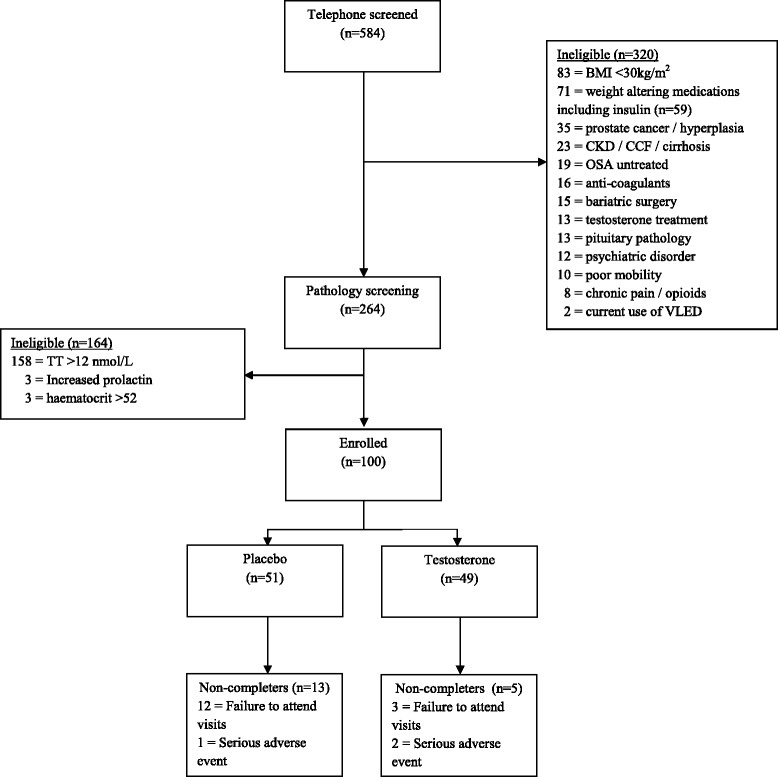
Whether testosterone treatment has benefits on body composition over and above caloric restriction in men is unknown. We hypothesised that testosterone treatment augments diet-induced loss of fat mass and prevents loss of muscle mass. We conducted a randomised double-blind, parallel, placebo controlled trial at a tertiary referral centre. A total of 100 obese men (body mass index ≥ 30 kg/m2) with a total testosterone level of or below 12 nmol/L and a median age of 53 years (interquartile range 47–60) receiving 10 weeks of a very low energy diet (VLED) followed by 46 weeks of weight maintenance were randomly assigned at baseline to 56 weeks of 10-weekly intramuscular testosterone undecanoate (n = 49, cases) or matching placebo (n = 51, controls). The main outcome measures were the between-group difference in fat and lean mass by dual-energy X-ray absorptiometry, and visceral fat area (computed tomography). A total of 82 men completed the study. At study end, compared to controls, cases had greater reductions in fat mass, with a mean adjusted between-group difference (MAD) of –2.9 kg (–5.7 to –0.2; P = 0.04), and in visceral fat (MAD –2678 mm2; –5180 to –176; P = 0.04). Although both groups lost the same lean mass following VLED (cases –3.9 kg (–5.3 to –2.6); controls –4.8 kg (–6.2 to –3.5), P = 0.36), cases regained lean mass (3.3 kg (1.9 to 4.7), P < 0.001) during weight maintenance, in contrast to controls (0.8 kg (–0.7 to 2.3), P = 0.29) so that, at study end, cases had an attenuated reduction in lean mass compared to controls (MAD 3.4 kg (1.3 to 5.5), P = 0.002). While dieting men receiving placebo lost both fat and lean mass, the weight loss with testosterone treatment was almost exclusively due to loss of body fat. clinicaltrials.gov, identifier NCT01616732 , registration date: June 8, 2012
Overview
The claims and statistics of this paper haven’t been checked yet.
Free: it reads the open-access text and checks the first 5 claims that cite a source we can check. Create a free account to check every claim.
Integrity signals
Registry
Cites
Statistics
Figures
Verification
Claims the paper makes
The claims and statistics of this paper haven’t been checked yet.
Free: it reads the open-access text and checks the first 5 claims that cite a source we can check. Create a free account to check every claim.
Claims other papers make about this one
Each is checked against this paper’s own text: does it say what the citing paper says it does?
The source backs part of the claim, not all of it — or backs it for a different population, condition or comparison.
In the citing paper
“Testosterone-treated participants also had greater lean mass regain during weight maintenance (mean between-group difference 3.4 kg; P = 0.002) following the very-low-energy diet, suggesting that weight loss was exclusively fat mass419.”
From Sarcopenic obesity in older adults: aetiology, epidemiology and treatment strategies (2018) · cites this paper as [419]
Experimental — accuracy not yet measuredThe source backs part of the claim, not all of it — or backs it for a different population, condition or comparison.
In the citing paper
“Over 56 weeks, testosterone-treated participants (mean age 53 years) had greater reductions in fat mass (mean between-group difference 2.9 kg; P = 0.04) and visceral fat (−2,678 mm2; P = 0.04) than controls.”
From Sarcopenic obesity in older adults: aetiology, epidemiology and treatment strategies (2018) · cites this paper as [419]
Experimental — accuracy not yet measuredThe cited source says what the claim attributes to it.
In the citing paper
“Therefore, the benefits reported with testosterone treatment in this cohort 91,101 cannot be extended to unselected obese men.”
From Hypogonadism and male obesity: Focus on unresolved questions (2018) · cites this paper as [91]
The cited source says what the claim attributes to it.
In the citing paper
“weight loss in testosterone-treated men was almost exclusively due to loss of body fat (51).”
From A Perspective on Middle-Aged and Older Men With Functional Hypogonadism: Focus on Holistic Management (2017) · cites this paper as [51]
The cited source says what the claim attributes to it.
In the citing paper
“an RCT in 100 middle-aged obese men with low testosterone subjected to a rigorous weight loss program has reported that although men receiving placebo lost both fat and lean body mass, testosterone treatment prevented the diet-associated loss of lean mass”
From A Perspective on Middle-Aged and Older Men With Functional Hypogonadism: Focus on Holistic Management (2017) · cites this paper as [51]
5 more claims about this paper
Create a free account to see every claim other papers make about this one.
Self-check
Percentages, sums and reported differences re-computed from the paper’s own numbers.
The self-check needs the paper’s full text.
Citations
Cites
A Critical Evaluation of Simple Methods for the Estimation of Free Testosterone in Serum
Vermeulen, A., Verdonck, L., & Kaufman, J. M. (1999) · The Journal of Clinical Endocrinology & Metabolism · doi:10.1210/jcem.84.10.6079 · Cited by 3,824 · cited 3×
“To confirm lowered levels, baseline TT was re-measured at study completion by validated LCMS/MS [12] from frozen baseline samples stored at –80 °C. SHBG was measured by electrochemiluminescence immunoassay (Roche Cobas C8000), Austin intra-assay CV of 3.4 % at 44 nmol/L. Free testosterone was calculated according to V…”
MethodInfluentialSystematic review and meta-analysis
(2019) · Providing Information for Health · doi:10.1201/9781315377315-19 · Cited by 2,659
Bhasin, S., Cunningham, G. R., Hayes, F. J., Matsumoto, A. M., Snyder, P. J., Swerdloff, R. S., & Montori, V. M. (2010) · The Journal of Clinical Endocrinology & Metabolism · doi:10.1210/jc.2009-2354 · Cited by 1,954 · cited 1×
“3 nmol/L) recommended for topical treatment [10].”
Identification of late-onset hypogonadism in middle-aged and elderly men
Wu, F. C. W., Tajar, A., Beynon, J. M., Pye, S. R., Silman, A. J., Finn, J. D., O'Neill, T. W., Bartfai, G., Casanueva, F. F., Forti, G., et al. (2010) · New England Journal of Medicine · doi:10.1056/nejmoa0911101 · Cited by 1,544 · cited 1×
“While TT may reflect adaptation to obesity-associated lowering of SHBG, it is important to emphasize that 97 % of our study population had a baseline free testosterone (calculated from LCMS/MS total testosterone) of less than 243 pmol/L, the lower limit reported for healthy young men [4], and 89 % a level of less than…”
BackgroundEffects of Testosterone Treatment in Older Men
Snyder, P. J., Bhasin, S., Cunningham, G. R., Matsumoto, A. M., Stephens-Shields, A. J., Cauley, J. A., Gill, T. M., Barrett-Connor, E., Swerdloff, R. S., Wang, C., et al. (2016) · New England Journal of Medicine · doi:10.1056/nejmoa1506119 · Cited by 890 · cited 1×
“Ten percent of the participants assigned to testosterone treatment had an increase of above 1 μg/L in PSA during the study, similar to the 6 % among men allocated to testosterone in the recent testosterone trials [32].”
ResultGonadal Steroids and Body Composition, Strength, and Sexual Function in Men
Finkelstein, J. S., Lee, H., Burnett-Bowie, S.-A. M., Pallais, J. C., Yu, E. W., Borges, L. F., Jones, B. F., Barry, C. V., Wulczyn, K. E., Thomas, B. J., et al. (2013) · New England Journal of Medicine · doi:10.1056/nejmoa1206168 · Cited by 782
robustlmm: An R Package for Robust Estimation of Linear Mixed-Effects Models
Koller, M. (2016) · Journal of Statistical Software · doi:10.18637/jss.v075.i06 · Cited by 713
Isidori, A. M., Giannetta, E., Greco, E. A., Gianfrilli, D., Bonifacio, V., Isidori, A., Lenzi, A., & Fabbri, A. (2005) · Clinical Endocrinology · doi:10.1111/j.1365-2265.2005.02339.x · Cited by 695 · cited 2×
“0 kg reduction reported in meta-analyses of RCTs not incorporating weight loss measures [18, 19].”
BackgroundSrinivas-Shankar, U., Roberts, S. A., Connolly, M. J., O'Connell, M. D. L., Adams, J. E., Oldham, J. A., & Wu, F. C. W. (2010) · The Journal of Clinical Endocrinology & Metabolism · doi:10.1210/jc.2009-1251 · Cited by 629 · cited 1×
“Previous studies have suggested that testosterone treatment improves physical performance primarily in frail, mobility-limited men [33, 34].”
BackgroundTajar, A., Forti, G., O'Neill, T. W., Lee, D. M., Silman, A. J., Finn, J. D., Bartfai, G., Boonen, S., Casanueva, F. F., Giwercman, A., et al. (2010) · The Journal of Clinical Endocrinology & Metabolism · doi:10.1210/jc.2009-1796 · Cited by 604 · cited 3×
“We selected participants based on a TT of less than 12 nmol/L to include men with modestly reduced levels typical of the majority of obese men [3].”
BackgroundMethodSingh, R., Artaza, J. N., Taylor, W. E., Gonzalez-Cadavid, N. F., & Bhasin, S. (2003) · Endocrinology · doi:10.1210/en.2003-0741 · Cited by 555 · cited 2×
“In addition, preclinical evidence has shown that testosterone deficiency promotes adipose tissue accumulation but reduces myogenesis via an androgen receptor mediated pathway [6].”
BackgroundEmmelot-Vonk, M. H., Verhaar, H. J. J., Nakhai Pour, H. R., Aleman, A., Lock, T. M. T. W., Bosch, J. L. H. R., Grobbee, D. E., & van der Schouw, Y. T. (2008) · JAMA · doi:10.1001/jama.2007.51 · Cited by 518 · cited 1×
“Previous RCTs of testosterone therapy, while not incorporating a weight loss program, did not find a consistent reduction in visceral fat [14, 15, 20, 21], most likely because of small trial size [15], use of oral testosterone therapy [20], or less precise methodology to quantify visceral adipose tissue [20].”
BackgroundCorona, G., Rastrelli, G., Monami, M., Saad, F., Luconi, M., Lucchese, M., Facchiano, E., Sforza, A., Forti, G., Mannucci, E., et al. (2013) · European Journal of Endocrinology · doi:10.1530/eje-12-0955 · Cited by 414
Weinheimer, E. M., Sands, L. P., & Campbell, W. W. (2010) · Nutrition Reviews · doi:10.1111/j.1753-4887.2010.00298.x · Cited by 391 · cited 3×
“Therefore, the benefit of energy restriction may be limited by loss of lean body mass [2].”
BackgroundBhasin, S., Pencina, M., Jasuja, G. K., Travison, T. G., Coviello, A., Orwoll, E., Wang, P. Y., Nielson, C., Wu, F., Tajar, A., et al. (2011) · The Journal of Clinical Endocrinology & Metabolism · doi:10.1210/jc.2010-3012 · Cited by 355
Low Testosterone in Men with Type 2 Diabetes: Significance and Treatment
Grossmann, M. (2011) · The Journal of Clinical Endocrinology & Metabolism · doi:10.1210/jc.2011-0118 · Cited by 350 · cited 1×
“This bidirectional relationship between lowered testosterone and obesity is supported by clinical studies – weight loss increases testosterone proportionally to weight loss [7] and testosterone treatment reduces body fat [8].”
BackgroundSelf-citationSinha-Hikim, I., Taylor, W. E., Gonzalez-Cadavid, N. F., Zheng, W., & Bhasin, S. (2004) · The Journal of Clinical Endocrinology & Metabolism · doi:10.1210/jc.2004-0084 · Cited by 312 · cited 1×
“Androgen receptor signalling in mature adipocytes promotes lipolysis [24] and activates anabolic pathways in myocytes [25].”
BackgroundDhindsa, S., Ghanim, H., Batra, M., Kuhadiya, N. D., Abuaysheh, S., Sandhu, S., Green, K., Makdissi, A., Hejna, J., Chaudhuri, A., et al. (2016) · Diabetes Care · doi:10.2337/dc15-1518 · Cited by 286 · cited 1×
“Previous RCTs of testosterone therapy, while not incorporating a weight loss program, did not find a consistent reduction in visceral fat [14, 15, 20, 21], most likely because of small trial size [15], use of oral testosterone therapy [20], or less precise methodology to quantify visceral adipose tissue [20].”
BackgroundNiskanen, L., Laaksonen, D. E., Punnonen, K., Mustajoki, P., Kaukua, J., & Rissanen, A. (2004) · Diabetes, Obesity and Metabolism · doi:10.1111/j.1462-8902.2004.00335.x · Cited by 275 · cited 1×
“Interestingly, the differences in body composition were evident despite the modest increase in endogenous testosterone levels in placebo-treated men similar to previous weight loss studies [22].”
ResultHarwood, D. T., & Handelsman, D. J. (2009) · Clinica Chimica Acta · doi:10.1016/j.cca.2009.09.003 · Cited by 243 · cited 6×
“Because liquid chromatographytandem mass spectroscopy (LCMS/MS) was not available for routine clinical use, TT was initially measured by electrochemiluminescence immunoassay used at the study hospital for routine clinical care (Roche Cobas C8000, Roche Diagnostics, Rotkreuz, Switzerland).”
MethodInfluentialRelationship Among Body Fat Percentage, Body Mass Index, and All-Cause Mortality: A Cohort Study
Padwal, R., Leslie, W. D., Lix, L. M., & Majumdar, S. R. (2016) · Annals of Internal Medicine · doi:10.7326/m15-1181 · Cited by 235 · cited 5×
“Subjects were randomly assigned in a concealed 1:1 allocation to either testosterone or placebo using a block of size four with equal probability to the two treatments within four strata accounting for BMI (≤ or > 37 kg/m2) and age (≤ or > 60 years).”
BackgroundInfluentialCorona, G., Giagulli, V. A., Maseroli, E., Vignozzi, L., Aversa, A., Zitzmann, M., Saad, F., Mannucci, E., & Maggi, M. (2016) · European Journal of Endocrinology · doi:10.1530/eje-15-0262 · Cited by 217 · cited 2×
“By contrast, previous RCTs examining the effects of testosterone on body composition recently meta-analysed [8] were neither designed for weight loss nor had obesity as a selection criterion.”
BackgroundResultThe Effects of Androgens on the Regulation of Lipolysis in Adipose Precursor Cells
XU, X., PERGOLA, G. D., & BJÖRNTORP, P. (1990) · Endocrinology · doi:10.1210/endo-126-2-1229 · Cited by 202 · cited 1×
“Androgen receptor signalling in mature adipocytes promotes lipolysis [24] and activates anabolic pathways in myocytes [25].”
BackgroundThe effect of rate of weight loss on long-term weight management: a randomised controlled trial
Purcell, K., Sumithran, P., Prendergast, L. A., Bouniu, C. J., Delbridge, E., & Proietto, J. (2014) · The Lancet Diabetes & Endocrinology · doi:10.1016/s2213-8587(14)70200-1 · Cited by 201 · cited 2×
“At the end of the initial 10-week VLED phase, while men lost substantial amounts of weight similar to previous successful VLED studies [11], there were no differences in weight loss or body composition changes between the two groups.”
MethodResultSelf-citationSchubert, M., Minnemann, T., Hübler, D., Rouskova, D., Christoph, A., Oettel, M., Ernst, M., Mellinger, U., Krone, W., & Jockenhövel, F. (2004) · The Journal of Clinical Endocrinology & Metabolism · doi:10.1210/jc.2004-0897 · Cited by 188 · cited 1×
“The 10-weekly interval, in line with the manufacturer’s recommendations (10–14 weeks), was chosen to ensure therapeutic trough levels of 10– 15 nmol/L [9] in obese men.”
MethodCorona, G., Giagulli, V. A., Maseroli, E., Vignozzi, L., Aversa, A., Zitzmann, M., Saad, F., Mannucci, E., & Maggi, M. (2016) · Journal of Endocrinological Investigation · doi:10.1007/s40618-016-0480-2 · Cited by 185
Meta-analysis of Observational Studies
Greenwood, D. C. (2012) · Modern Methods for Epidemiology · doi:10.1007/978-94-007-3024-3_10 · Cited by 179
Gianatti, E. J., Dupuis, P., Hoermann, R., Strauss, B. J., Wentworth, J. M., Zajac, J. D., & Grossmann, M. (2014) · Diabetes Care · doi:10.2337/dc13-2845 · Cited by 168 · cited 2×
“Metabolic parameters (fasting lipid profile, HbA1c, fasting glucose and c-peptide levels) and safety parameters (haemoglobin, haematocrit and prostate-specific antigen (PSA)) were measured at the study hospital with assay technology used for routine clinical care as described [14].”
BackgroundMethodSelf-citationSvartberg, J., Agledahl, I., Figenschau, Y., Sildnes, T., Waterloo, K., & Jorde, R. (2008) · International Journal of Impotence Research · doi:10.1038/ijir.2008.19 · Cited by 160 · cited 1×
“Previous RCTs of testosterone therapy, while not incorporating a weight loss program, did not find a consistent reduction in visceral fat [14, 15, 20, 21], most likely because of small trial size [15], use of oral testosterone therapy [20], or less precise methodology to quantify visceral adipose tissue [20].”
BackgroundTravison, T. G., Basaria, S., Storer, T. W., Jette, A. M., Miciek, R., Farwell, W. R., Choong, K., Lakshman, K., Mazer, N. A., Coviello, A. D., et al. (2011) · The Journals of Gerontology Series A: Biological Sciences and Medical Sciences · doi:10.1093/gerona/glr100 · Cited by 160 · cited 1×
“Previous studies have suggested that testosterone treatment improves physical performance primarily in frail, mobility-limited men [33, 34].”
BackgroundObesity and late-onset hypogonadism
Corona, G., Vignozzi, L., Sforza, A., Mannucci, E., & Maggi, M. (2015) · Molecular and Cellular Endocrinology · doi:10.1016/j.mce.2015.06.031 · Cited by 154 · cited 1×
“A recent meta-analysis of these studies [17] suggested that testosterone treatment may have added benefits on body composition, consistent with our findings.”
ResultO’Connor, D. B., Archer, J., & Wu, F. C. W. (2004) · The Journal of Clinical Endocrinology & Metabolism · doi:10.1210/jc.2003-031354 · Cited by 149 · cited 1×
“Testosterone may also have motivational effects leading to increased physical activity; in RCTs, testosterone treatment reduces fatigue and inertia [27], and androgen-deficient mice have decreased voluntary activity [28].”
BackgroundSchwingshackl, L., Dias, S., & Hoffmann, G. (2014) · Systematic Reviews · doi:10.1186/2046-4053-3-130 · Cited by 131 · cited 1×
“6 kg [30] but does not fully protect against the loss of lean mass that occurs with diet, reducing this by 50 % [2].”
BackgroundKhoo, J., Tian, H.-H., Tan, B., Chew, K., Ng, C.-S., Leong, D., Teo, R. C.-C., & Chen, R. Y.-T. (2013) · The Journal of Sexual Medicine · doi:10.1111/jsm.12154 · Cited by 101 · cited 11×
“By contrast, previous RCTs examining the effects of testosterone on body composition recently meta-analysed [8] were neither designed for weight loss nor had obesity as a selection criterion.”
BackgroundInfluentialPownall, H. J., Bray, G. A., Wagenknecht, L. E., Walkup, M. P., Heshka, S., Hubbard, V. S., Hill, J., Kahn, S. E., Nathan, D. M., Schwartz, A. V., et al. (2015) · Obesity · doi:10.1002/oby.21005 · Cited by 94
Rana, K., Fam, B. C., Clarke, M. V., Pang, T. P. S., Zajac, J. D., & MacLean, H. E. (2011) · American Journal of Physiology-Endocrinology and Metabolism · doi:10.1152/ajpendo.00584.2010 · Cited by 78 · cited 1×
“Testosterone may also have motivational effects leading to increased physical activity; in RCTs, testosterone treatment reduces fatigue and inertia [27], and androgen-deficient mice have decreased voluntary activity [28].”
BackgroundSelf-citationVeldhuis, J., Yang, R., Roelfsema, F., & Takahashi, P. (2016) · The Journal of Clinical Endocrinology & Metabolism · doi:10.1210/jc.2015-3611 · Cited by 65 · cited 1×
“While the exact mechanisms are not fully understood, experimental studies in humans suggest that fat-derived adipokines and pro-inflammatory mediators may play a role in this central gonadal axis suppression [5].”
BackgroundThe Brave New World of Function-Promoting Anabolic Therapies: Testosterone and Frailty
Bhasin, S. (2010) · The Journal of Clinical Endocrinology & Metabolism · doi:10.1210/jc.2009-2550 · Cited by 33 · cited 2×
“0 kg reduction reported in meta-analyses of RCTs not incorporating weight loss measures [18, 19].”
Background
Cited by
Sarcopenic obesity in older adults: aetiology, epidemiology and treatment strategies
Batsis, J. A., & Villareal, D. T. (2018) · Nature Reviews Endocrinology · doi:10.1038/s41574-018-0062-9 · Cited by 1,382
Wittert, G., Bracken, K., Robledo, K. P., Grossmann, M., Yeap, B. B., Handelsman, D. J., Stuckey, B., Conway, A., Inder, W., McLachlan, R., et al. (2021) · The Lancet Diabetes & Endocrinology · doi:10.1016/s2213-8587(20)30367-3 · Cited by 362
Self-citationSarcopenic obesity: epidemiology, pathophysiology, cardiovascular disease, mortality, and management
Wei, S., Nguyen, T. T., Zhang, Y., Ryu, D., & Gariani, K. (2023) · Frontiers in Endocrinology · doi:10.3389/fendo.2023.1185221 · Cited by 291
Caprio, M., Infante, M., Moriconi, E., Armani, A., Fabbri, A., Mantovani, G., Mariani, S., Lubrano, C., Poggiogalle, E., Migliaccio, S., et al. (2019) · Journal of Endocrinological Investigation · doi:10.1007/s40618-019-01061-2 · Cited by 283
Grossmann, M., & Matsumoto, A. M. (2017) · The Journal of Clinical Endocrinology & Metabolism · doi:10.1210/jc.2016-3580 · Cited by 246
“For example, an RCT in 100middle-aged obesemenwith low testosterone subjected to a rigorous weight loss program has reported that although men receiving placebo lost both fat and lean body mass, testosterone treatment prevented the diet-associated loss of lean mass, and weight loss in testosterone-treated men was almo…”
BackgroundSelf-citation
Metadata
- Authors
- Ng Tang Fui, M., Prendergast, L. A., Dupuis, P., Raval, M., Strauss, B. J., Zajac, J. D., & Grossmann, M.
- Affiliations
- The University of Melbourne (AU)
- Austin Health (AU)
- Monash University (AU)
- Corresponding author
- Grossmann, Mathis
- Venue
- BMC Medicine
- Published
- 2016-10-07
- Volume
- 14
- Issue
- 1
- Pages
- 153-153
- ISSN
- 1741-7015 (ISSN-L)
- PMC
- PMC5054608
- OpenAlex
- W2527863576
- Cited by
- 124
- References
- 38
- Citations by year
- 2026: 11 · 2025: 9 · 2024: 12 · 2023: 9 · 2022: 14 · 2021: 9 · 2020: 14 · 2019: 18 · 2018: 17 · 2017: 10 · 2016: 1
- FWCI
- 15.41
- Type
- journal article
- Language
- en
- Open access
- gold
- doi.org
- Licence
- Locations
- BMC Medicine (publishedVersion, cc-by)
- PubMed Central (publishedVersion, cc-by)
- PubMed (publishedVersion)
- Monash University Research Portal (Monash University) (submittedVersion, other-oa)
- Figshare (submittedVersion, cc-by)
- Minerva Access (University of Melbourne) (submittedVersion, cc-by)
- La Trobe University (cc-by)
- Funders
- National Health and Medical Research Council (1055305, 1024139)
- Topics
- Health Sciences › Medicine › Endocrinology, Diabetes and Metabolism › Hormonal and reproductive studies
- Health Sciences › Medicine › Physiology (medical) › Nutrition and Health in Aging
- Life Sciences › Neuroscience › Endocrine and Autonomic Systems › Regulation of Appetite and Obesity
- Keywords
- testosterone undecanoate, testosterone replacement therapy, obesity, hypocaloric diet, very low calorie diet, body composition, fat mass, lean body mass, muscle mass, visceral fat, weight maintenance, men, hypogonadism, weight loss, dual-energy X-ray absorptiometry, computed tomography, intramuscular injection, weight regain
- MeSH terms
- Adipose Tissue, Body Composition, Body Weight, Combined Modality Therapy, Diet, Reducing, Double-Blind Method, Humans, Male, Middle Aged, Obesity, Testosterone, Absorptiometry, Photon
About these checks
Registry, retraction, Cites and statistics results are computed, not judged, with one exception: a printed reference that no index lists is read once by a model before it counts as a citation error. Claims are extracted by a model and kept only when their quote appears verbatim in the text; each cited source is then checked, with a model’s help, for whether it says what the claim relies on. Those verdicts can be wrong — read the claim’s quote and the cited source before relying on one.
Statistics and arithmetic are recomputed, not judged.
Confidence bands are shown only for fields calibrated on our annotated test set. None is calibrated yet, so no band is shown.
What counts as a claim ›How we measure confidence ›How we check this ›
Are you an author, or do you see a problem with this page? Request a review
Data sources
Bibliographic data: Semantic Scholar, OpenAlex, Crossref.
Contains information from the Semantic Scholar Academic Graph Datasets, made available under the ODC Attribution License (ODC-BY 1.0).
Semantic Scholar’s data is described in: Kinney, R., et al. (2023). The Semantic Scholar Open Data Platform. arXiv:2301.10140.
