

Biological embedding of childhood adversity: from physiological mechanisms to clinical implications
Open accessThe DOI matches its Crossref record; 110 of the 111 references it cites were found in a registry or an index; 83 of the 145 sources its claims cite were checked for support.
Abstract
BACKGROUND: Adverse psychosocial exposures in early life, namely experiences such as child maltreatment, caregiver stress or depression, and domestic or community violence, have been associated in epidemiological studies with increased lifetime risk of adverse outcomes, including diabetes, heart disease, cancers, and psychiatric illnesses. Additional work has shed light on the potential molecular mechanisms by which early adversity becomes "biologically embedded" in altered physiology across body systems. This review surveys evidence on such mechanisms and calls on researchers, clinicians, policymakers, and other practitioners to act upon evidence. OBSERVATIONS: Childhood psychosocial adversity has wide-ranging effects on neural, endocrine, immune, and metabolic physiology. Molecular mechanisms broadly implicate disruption of central neural networks, neuroendocrine stress dysregulation, and chronic inflammation, among other changes. Physiological disruption predisposes individuals to common diseases across the life course. CONCLUSIONS: Reviewed evidence has important implications for clinical practice, biomedical research, and work across other sectors relevant to public health and child wellbeing. Warranted changes include increased clinical screening for exposures among children and adults, scale-up of effective interventions, policy advocacy, and ongoing research to develop new evidence-based response strategies.
Overview
CoChat Summary
TL;DR
This review synthesizes evidence that early psychosocial adversity becomes biologically embedded through neural, neuroendocrine, immune, metabolic, and gut microbial changes that raise lifelong disease risk. It argues for routine ELA screening, scale-up of effective interventions, continued biomarker/intervention research, and cross-sector policy action.
Key findings
- ELA is linked to changes across body systems: smaller prefrontal cortex gray matter and smaller hippocampal volumes in ELA-exposed adults, complex amygdala volumetric effects, altered amygdala reactivity/connectivity, HPA hyper- or hypo-reactivity, autonomic imbalance, chronic inflammation (e.g., elevated CRP, TNF-α, IL-6), immunosuppression, insulin resistance, dyslipidemia, and possible dysbiosis.
- The review reports that at least 44% of children in developed countries and 59% in developing countries had been victims of physical, emotional, or sexual violence or had witnessed domestic or community violence in the preceding year; depression is described as the leading cause of disease-related disability globally.
- It notes that the brain attains 80–90% of adult volume in the first 2 years of life, and the gut microbiome comprises nearly 100 trillion commensal microorganisms including over 1000 bacterial species.
- Proposed clinical/public health implications include routine screening for ELA in children and adults, scale-up of caregiving-focused and other effective interventions, development of targeted interventions and ELA biomarkers, and policy alignment across health, social services, education, justice, and child protection.
Methods
- Narrative review synthesizing human and animal evidence on biological embedding of postnatal psychosocial childhood adversity, referred to as “early life adversity” (ELA), using an aggregative approach; prenatal adversity and low childhood SES as a psychosocial adversity are not specifically examined.
- Literature was identified from PubMed, Medline, and PsycINFO using search terms for early-life timing and adverse exposures plus specific physiological axes; priority was given to recent studies, major reviews, and prospective human studies, with cross-sectional and animal studies included where prospective human evidence was unavailable.
- Evidence is organized by physiological axis (brain, neuroendocrine stress regulation, immune functioning, metabolic health, microbiome), with tables summarizing selected effects, effect modifiers, and proposed clinical implications; no meta-analysis is reported.
Limitations
- The paper states that causal demonstration is difficult amid social complexity, randomized controlled trials are often impossible or unethical, many studies rely on retrospective self-report of ELA that may agree only moderately with prospective measures and be more bias-prone, and aggregative conceptualization of ELA requires complementary work differentiating exposures by nature, timing, and intensity.
- The paper states that microbiome evidence is emergent and from animal models only to date, and that research directly linking ELA to altered metabolic physiology remains emergent.
- The text makes evident that this is a narrative review: no systematic screening, formal quality appraisal, or quantitative synthesis is reported, and conclusions emphasize direction of effects rather than effect sizes.
Model-written summary. Check it against the paper before relying on it.
Integrity signals
Registry
Cites
Statistics
Figures
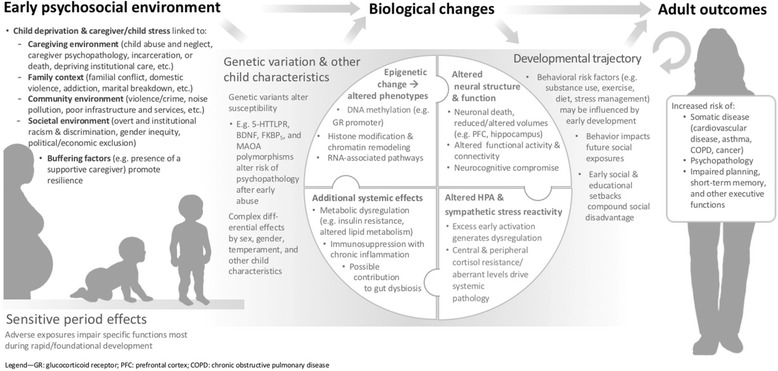
Verification
Claims the paper makes
44 Valid · 1 Not valid · 21 Not checked · 17 Own results and interpretations
The cited sources support only part of this claim — read each source’s verdict below.
In the paper
“Epidemiological studies have demonstrated that adverse childhood experiences, namely exposures such as neglect, abuse, caregiver mental illness, and family or community violence, predict poorer long-term outcomes across health and social domains.”
§ Biological embedding of childhood adversity: from physiological mechanisms to clinical implications > Background
What the sources say
- Partly supportedcites [1] Felitti VJ Anda RF Nordenberg D Williamson DF Spitz AM Edwards V Relationship of childhood abuse and household dysfunction to many of the leading causes of death in adults: The Adverse Childhood Experiences (ACE) Study Am J Prev Med 1998 14 4 245 58 10.1016/S0749-3797(98)00017-8 9635069 sourceExperimental — accuracy not yet measured
The Discussion reports strong long-term associations between childhood abuse or household dysfunction and adult health risks and diseases. But the paper’s Defining Childhood Exposures section does not include neglect or community violence among its measured exposures, and the reported outcomes do not establish the broader claim about social outcomes. The study describes associations rather than demonstrating that these experiences predict outcomes prospectively. (LLM, conf=0.86)
- Supportedcites [2] Liu Y Croft JB Chapman DP Perry GS Greenlund KJ Zhao G Edwards VJ Relationship between adverse childhood experiences and unemployment among adults from five U.S. states Soc Psychiatry Psychiatr Epidemiol 2013 48 3 357 69 10.1007/s00127-012-0554-1 22869349 PMC4539022 source
The Introduction (p. 1) defines ACEs as abuse, neglect, parental discord, witnessing domestic violence and growing up with a mentally ill, substance-abusing or incarcerated household member, then states that 'a great deal of evidence suggests that ACEs have been associated with chronic diseases, premature death, cigarette smoking, substance abuse, alcohol abuse, anxiety, and depression,' and that ACEs are linked to lower educational attainment, antisocial behavior, work absence, poor job performance and disability retirement — i.e. both health and social/economic domains. The Conclusions reinforce this ('ACEs are common and associated with adverse consequences during adulthood such as poor education, lack of needed social support, and unemployment'). The only slight slant is that our copy phrases these as associations from prior studies rather than as demonstrated prediction, and its ACE definition names domestic/parental violence rather than community violence; the substance of the attributed background statement is nonetheless stated. (LLM, conf=0.85)
- Partly supportedcites [3] Danese A Moffitt TE Harrington H Milne BJ Polanczyk G Pariante CM Adverse childhood experiences and adult risk factors for age-related disease: depression, inflammation, and clustering of metabolic risk markers Arch Pediatr Adolesc Med 2009 163 12 1135 43 10.1001/archpediatrics.2009.214 19996051 PMC3560401 sourceExperimental — accuracy not yet measured
The Results report that childhood socioeconomic disadvantage, maltreatment, and social isolation predicted adult depression, inflammation, and metabolic risk markers. The Methods include physical and sexual abuse among the maltreatment indicators. The paper does not report adult social outcomes or establish the claimed associations for caregiver mental illness or family or community violence. (LLM, conf=0.87)
- Supportedcites [4] Giovanelli A, Reynolds AJ, Mondi CF, Ou SR. Adverse childhood experiences and adult well-being in a low-income, urban cohort. Pediatrics. 2016;137(4):e20154016. doi:10.1542/peds.2015-4016. PMC4991352 26966132 source
The Results section reports that participants with two or more early-childhood ACEs had significantly worse outcomes including depression, high school graduation, juvenile arrest, and health-compromising behavior. The Conclusions section describes detrimental effects on adult well-being, including educational attainment and socioeconomic status. These passages support the attributed claim across health and social domains. (LLM, conf=0.92)
- Partly supportedcites [5] Flaherty EG Thompson R Dubowitz H Adverse childhood experiences and child health in early adolescence JAMA Pediatr 2013 167 7 622 9 10.1001/jamapediatrics.2013.22 23645114 PMC3732117 sourceExperimental — accuracy not yet measured
The Results and Discussion (page not available) link adverse childhood experiences to poorer physical health at age 14, particularly when adversity was recent. The Introduction also describes links to adolescent mental health and behavior, but this study does not establish long-term outcomes across both health and social domains. (LLM, conf=0.85)
- Partly supportedcites [6] Richards M Wadsworth MEJ Long term effects of early adversity on cognitive function Arch Dis Child 2004 89 10 922 7 10.1136/adc.2003.032490 15383435 PMC1719683 sourceExperimental — accuracy not yet measured
Richards & Wadsworth (2004) do report long-term associations between early adversity and poorer outcomes: the Abstract and DISCUSSION state that early adverse circumstances were strongly associated with lower cognitive ability in childhood and adolescence and were still detectable on measures of verbal ability, memory and speed/concentration in midlife, and with lower educational attainment. But the adversity they measured was material home conditions, parental divorce and maternal management/understanding in a single 1946 British birth cohort (n=1339) — not neglect, abuse, caregiver mental illness or family/community violence — and the outcomes are cognitive and educational only. The 'health and social domains' breadth is not their finding: the DISCUSSION says the implications of lower educational attainment for adult socioeconomic status and health 'are well known', crediting references 24–27 rather than reporting them, and they also note that long-term effects were mostly explained by childhood ability, attainment and adult social class, with no amplification across adulthood. (LLM, conf=0.72)
- Not checked — no full text of the sourcecites [7] Kelly-Irving M Mabile L Grosclaude P Lang T Delpierre C The embodiment of adverse childhood experiences and cancer development: potential biological mechanisms and pathways across the life course Int J Public Health 2013 58 3 11 10.1007/s00038-012-0370-0 22588310 source
- Partly supportedcites [8] Kelly-Irving M Lepage B Dedieu D Bartley M Blane D Grosclaude P Lang T Delpierre C Adverse childhood experiences and premature all-cause mortality Eur J Epidemiol 2013 28 1 14 10.1007/s10654-013-9832-9 23887883 PMC3787798 sourceExperimental — accuracy not yet measured
The Conclusion (page unavailable) identifies adverse childhood experiences as risk factors for long-term health and premature mortality. The Methods include neglect and household mental illness among the adversities considered, but the study defines its exposures primarily as intrafamilial; it does not establish community violence as an exposure or poorer social outcomes as a finding. Education and social class are considered as possible mediators, not outcomes. (LLM, conf=0.85)
boostedstates an association- Asserted: passes — The authors put it forward as true.
- Checkable: passes — It can be checked against evidence.
- Load-bearing: passes — The paper’s conclusions depend on it.
- Based: passes — The paper gives a reason why it holds.
- Partly supported
Every source the paper cites for this claim was checked and supports it.
In the paper
“Meanwhile, human and animal research has provided insights into candidate molecular mechanisms by which early adversity may become “biologically embedded” in disrupted physiology [10].”
§ Biological embedding of childhood adversity: from physiological mechanisms to clinical implications > Background
What the sources say
- Supportedcites [10] Hertzman C Putting the concept of biological embedding in historical perspective Proc Natl Acad Sci U S A 2012 109 Supplement 2 17160 7 10.1073/pnas.1202203109 23045673 PMC3477385 source
The “Animal Model of Biological Embedding” section describes epigenetic regulation of glucocorticoid-receptor expression as a potential mechanism linking early maternal care to altered stress reactivity. The “First Studies of Deep Archeology of Biological Embedding in Human Populations” section reports human evidence that early experiences are associated with DNA methylation and describes lasting effects on gene expression as plausible, while acknowledging gaps in the evidence. The claim’s use of “candidate” and “may” preserves that uncertainty. (LLM, conf=0.92)
hedgedstates a possible cause- Asserted: passes — The authors put it forward as true.
- Checkable: passes — It can be checked against evidence.
- Load-bearing: passes — The paper’s conclusions depend on it.
- Based: passes — The paper gives a reason why it holds.
- Supported
The cited sources support only part of this claim — read each source’s verdict below.
In the paper
“Extensive literature links ELA to pervasive, quantifiable variation in brain structure and function [15, 21, 24, 25].”
§ Biological embedding of childhood adversity: from physiological mechanisms to clinical implications > Biological embedding by physiological axis > Axis 1: The brain
What the sources say
- Partly supportedcites [15] McEwen BS Gianaros PJ Stress- and allostasis-induced brain plasticity Annu Rev Med 2011 62 431 45 10.1146/annurev-med-052209-100430 20707675 PMC4251716 sourceExperimental — accuracy not yet measured
The section “Brain Systems Mediating and Targeted by Allodynamic Processes” reports measurable differences in brain structure and function associated with stress, including gray-matter volume and amygdala reactivity. The passages concern chronic or other stressful experiences generally, not specifically early-life adversity (ELA), so they do not establish the claim at that level of specificity. Page numbers were not available in our copy. (LLM, conf=0.84)
- Supportedcites [21] Bick J Nelson CA Early adverse experiences and the developing brain Neuropsychopharmacology 2016 41 177 96 10.1038/npp.2015.252 26334107 PMC4677140 source
Our copy is a review that systematically documents such variation: the INTERIM SUMMARY: CHILDHOOD MALTREATMENT section states children exposed to early adverse rearing 'show neurodevelopmental alterations' in limbic structures 'both functionally and structurally', prefrontal cortex, subcortical regions and network pathways, and the parallel INSTITUTIONAL REARING summary lists amygdala, hippocampal, frontal, striatal and white-matter alterations. Structural connectivity sections report DTI-measured fronto-limbic, frontostriatal, language and sensory tract differences, and Tables 1-2 summarize sMRI/fMRI/DTI/EEG quantification, supporting 'quantifiable' and 'pervasive'. The paper does note variability in the direction of some findings, but the broad attribution of an extensive literature linking ELA to measurable brain structure and function differences is squarely supported. (LLM, conf=0.85)
- Supportedcites [24] Hart H Rubia K Neuroimaging of child abuse: a critical review Front Hum Neurosci 2012 6 52 10.3389/fnhum.2012.00052 22457645 PMC3307045 source
The Structural brain changes summary identifies differences across several brain regions and white-matter pathways associated with childhood maltreatment. The Functional brain differences summary reports that multiple imaging studies found altered activation in maltreated subjects. Together, these sections support a link between early-life adversity and measurable differences in brain structure and function; neither passage provides a page number. (LLM, conf=0.88)
- Not checked — no full text of the sourcecites [25] Nemeroff CB Paradise lost: the neurobiological and clinical consequences of child abuse and neglect Neuron 2016 89 892 909 10.1016/j.neuron.2016.01.019 26938439 source
boostedstates an association- Asserted: passes — The authors put it forward as true.
- Checkable: passes — It can be checked against evidence.
- Load-bearing: passes — The paper’s conclusions depend on it.
- Based: passes — The paper gives a reason why it holds.
- Partly supported
Every source the paper cites for this claim was checked and supports it.
In the paper
“While traditionally described in neurodevelopment [16], sensitive period effects have been suggested elsewhere, including in the immune [17] and metabolic [18] systems.”
§ Biological embedding of childhood adversity: from physiological mechanisms to clinical implications > Background > Biological embedding
What the sources say
- Supportedcites [17] Avitsur R Levy S Goren N Grinshpahet R Early adversity, immunity and infectious disease Stress 2015 18 3 289 96 10.3109/10253890.2015.1017464 25721541 source
The review's central thesis is time-specific (perinatal/neonatal) programming of immunity: the Abstract states that maternal psychosocial stress during pregnancy 'is associated with long lasting changes in immune function and disease resistance in the offspring,' and the Introduction frames the perinatal phase as a period of heightened sensitivity to environmental remodeling with persistent neuroendocrine, behavioral and metabolic programming. The Summary and future directions (p. 291) and the 'Neonatal psychosocial stress, immunity and infectious disease' section extend this to immune dysregulation ('the in utero or neonatal development of the HPA axis is reshaped by early adversity, resulting in immune dysregulation'; 'neonatal adversities are also associated with alterations in the development of the response to an immune challenge'). The paper applies the explicit 'sensitive/critical period' wording mainly to brain development, but it clearly treats the immune system as showing the same early-window effect, which is what the citing sentence attributes to it; the metabolic half of the sentence carries a separate citation and is not judged here. (LLM, conf=0.80)
- Supportedcites [18] Miller GE Chen E Parker KJ Psychological stress in childhood and susceptibility to the chronic diseases of aging: moving toward a model of behavioral and biological mechanisms Psychol Bull 2011 137 959 97 10.1037/a0024768 21787044 PMC3202072 source
This source supports the immune-system part of the sentence, to which citation [17] is attached. In “Limitations of the Model,” it reports initial evidence that ages 2–3 are a sensitive period for stress-related influences on immune responses; the separate metabolic-system citation [18] is not being judged here. (LLM, conf=0.93)
hedgedstates a possible cause- Asserted: passes — The authors put it forward as true.
- Checkable: passes — It can be checked against evidence.
- Load-bearing: unclear — It is unclear whether the paper’s conclusions depend on it.
- Based: passes — The paper gives a reason why it holds.
- Supported
The cited sources support only part of this claim — read each source’s verdict below.
In the paper
“Epigenetic processes represent a key family of mechanisms driving embedding.”
§ Biological embedding of childhood adversity: from physiological mechanisms to clinical implications > Background > Biological embedding
What the sources say
- Partly supportedcites [19] Essex MJ Boyce WT Hertzman C Lam LL Armstrong JM Neumann SM Kobor MS Epigenetic vestiges of early developmental adversity: childhood stress exposure and DNA methylation in adolescence Child Dev 2013 84 58 75 10.1111/j.1467-8624.2011.01641.x 21883162 PMC3235257 sourceExperimental — accuracy not yet measured
The “Biological embedding and the epigenome” section identifies epigenetic processes as potential mechanisms of biological embedding. It also says the underlying mechanisms have not been fully demonstrated and describes epigenetic involvement as a prospect or speculation, so it does not establish them as key mechanisms driving embedding. (LLM, conf=0.86)
plainstates a cause- Asserted: passes — The authors put it forward as true.
- Checkable: passes — It can be checked against evidence.
- Load-bearing: passes — The paper’s conclusions depend on it.
- Based: passes — The paper gives a reason why it holds.
- Partly supported
42 more claims · 23 with their cited sources checked
Create a free account to see all 83 claims and to verify the 15 references still open.
- It may state two separate claims as one. 26
- Probably not a substantial claim. 12
- The quote only partly states this claim. 1
Claims other papers make about this one
Each is checked against this paper’s own text: does it say what the citing paper says it does?
The cited source says what the claim attributes to it.
In the citing paper
“Evidence from neuroimaging studies suggests that a history of ELA can have a sustained impact on the integrity and function of the brain 9, 10, 11, 12, with brain regions associated with emotional regulation, cognitive modulation and feeding behaviours frequently implicated 12, 13, 14, 15, 16.”
From History of early life adversity is associated with increased food addiction and sex-specific alterations in reward network connectivity in obesity (2019) · cites this paper as [15]
In the citing paper
“One theory posits that adversity during childhood, a key neurodevelopmental period, may disrupt neuronal growth by making stress‐sensitive brain circuits vulnerable to the effects of glucocorticoids, inflammatory cytokines and excitatory microbial metabolites 15, 23.”
From History of early life adversity is associated with increased food addiction and sex-specific alterations in reward network connectivity in obesity (2019) · cites this paper as [15]
In the citing paper
“There is also evidence to suggest a role for changes in the brain's serotonergic signalling by ELA and that these alterations may contribute to obesity and food addiction 15.”
From History of early life adversity is associated with increased food addiction and sex-specific alterations in reward network connectivity in obesity (2019) · cites this paper as [15]
Self-check
Percentages, sums and reported differences re-computed from the paper’s own numbers.
Each contradiction between two passages listed here was confirmed by an independent check.
Rated minor: it would not touch a result — a value no result rests on, a p-value that stays on the same side of the significance level, or a conflict that is clerical, resolved elsewhere in the paper, or outside its own findings.
In the paper
§ Biological embedding of childhood adversity: from physiological mechanisms to clinical implications > Biological embedding by physiological axis
“McEwen, 2013 [50]”
§ Biological embedding of childhood adversity: from physiological mechanisms to clinical implications > References
“50. McEwen BS Brain on stress: How the social environment gets under the skin Proc Natl Acad Sci U S A 2012”
Rated minor: it would not touch a result — a value no result rests on, a p-value that stays on the same side of the significance level, or a conflict that is clerical, resolved elsewhere in the paper, or outside its own findings.
In the paper
§ Biological embedding of childhood adversity: from physiological mechanisms to clinical implications > Differential susceptibility to adversity
“HLA hypothalamic-pituitary-adrenal”
§ Biological embedding of childhood adversity: from physiological mechanisms to clinical implications > Biological embedding by physiological axis
“HPA hypothalamic-pituitary-adrenal”
Rated minor: it would not touch a result — a value no result rests on, a p-value that stays on the same side of the significance level, or a conflict that is clerical, resolved elsewhere in the paper, or outside its own findings.
In the paper
§ Biological embedding of childhood adversity: from physiological mechanisms to clinical implications > Biological embedding by physiological axis
“Nemeroff et al., 2016 [25]”
§ Biological embedding of childhood adversity: from physiological mechanisms to clinical implications > References
“25. Nemeroff CB Paradise lost: the neurobiological and clinical consequences of child abuse and neglect Neuron 2016”
Rated minor: it would not touch a result — a value no result rests on, a p-value that stays on the same side of the significance level, or a conflict that is clerical, resolved elsewhere in the paper, or outside its own findings.
In the paper
§ Biological embedding of childhood adversity: from physiological mechanisms to clinical implications > Biological embedding by physiological axis
“O’Mahony et al., 2015 [74]”
§ Biological embedding of childhood adversity: from physiological mechanisms to clinical implications > References
“74. O'Mahony SM Clarke G Dinan TG Cryan JF Early-life adversity and brain development: Is the microbiome a missing piece of the puzzle? Neuroscience 2017”
Citations
Cites
Felitti, V. J., Anda, R. F., Nordenberg, D., Williamson, D. F., Spitz, A. M., Edwards, V., Koss, M. P., & Marks, J. S. (1998) · American Journal of Preventive Medicine · doi:10.1016/s0749-3797(98)00017-8 · Cited by 18,943 · cited 5×
“Table 3 Proposed clinical implications of reviewed findings Practitioner activity Recommendations Recommended resources Understanding disease etiology and risk Consider how ELA contributes to a patient’s risk of common health problems, e.g.: • Mental health disorders: Depression, anxiety, substance use disorders, post…”
BackgroundInfluentialChild abuse: Adolescent records vs. adult recall
Femina, D. D., Yeager, C. A., & Lewis, D. O. (1990) · Child Abuse & Neglect · doi:10.1016/0145-2134(90)90033-p · Cited by 8,820
Central nervous system control of food intake
Schwartz, M. W., Woods, S. C., Porte, D., Seeley, R. J., & Baskin, D. G. (2000) · Nature · doi:10.1038/35007534 · Cited by 6,451 · cited 1×
“Feeding-related regulation involves, among other networks, dopaminergic reward pathways under top-down control by the PFC, and hypothalamic nuclei integrating nutrient signals to induce hunger or satiety, and systemic shifts between catabolism and anabolism [71].”
BackgroundMind-altering microorganisms: the impact of the gut microbiota on brain and behaviour
Cryan, J. F., & Dinan, T. G. (2012) · Nature Reviews Neuroscience · doi:10.1038/nrn3346 · Cited by 4,572
Depression, chronic diseases, and decrements in health: results from the World Health Surveys
Moussavi, S., Chatterji, S., Verdes, E., Tandon, A., Patel, V., & Ustun, B. (2007) · The Lancet · doi:10.1016/s0140-6736(07)61415-9 · Cited by 4,070 · cited 1×
“Caregiver poor mental health is also common, with depression currently representing the leading cause of disease-related disability globally [14].”
BackgroundSudo, N., Chida, Y., Aiba, Y., Sonoda, J., Oyama, N., Yu, X., Kubo, C., & Koga, Y. (2004) · The Journal of Physiology · doi:10.1113/jphysiol.2004.063388 · Cited by 2,735
Meaney, M. J. (2001) · Annual Review of Neuroscience · doi:10.1146/annurev.neuro.24.1.1161 · Cited by 2,708 · cited 1×
“, corticotropin-releasing factor (CRF), an HPA hormone and autonomic neurotransmitter) [43], suggesting potentially overlapping embedding pathways.”
BackgroundAdverse childhood experiences, allostasis, allostatic load and age-related disease
Danese, A., & McEwen, B. S. (2012) · Physiology & Behavior · doi:10.1016/j.physbeh.2011.08.019 · Cited by 2,140 · cited 7×
“Importantly, HPA hyper- and hyporeactivity both represent prototypical patterns associated with excess allostatic load, and both predict human stress-related chronic illnesses, including cardiovascular, metabolic, and psychiatric diseases linked epidemiologically to ELA [15, 29, 48].”
BackgroundInfluentialHeim, C. (2000) · JAMA · doi:10.1001/jama.284.5.592 · Cited by 1,968 · cited 1×
“Differential patterns of dysregulation may reflect variation in factors including timing and type of ELA [45], genotype [46], current age [29], and concurrent psychopathology [47].”
BackgroundSensitive periods in the development of the brain and behavior
Knudsen, E. I. (2004) · Journal of Cognitive Neuroscience · doi:10.1162/0898929042304796 · Cited by 1,842 · cited 1×
“, language exposure or caregiver interaction) during experience-dependent development is proposed to promote excessive synaptic pruning [33].”
Background
Research works printed but not linked: 6
- World Health Organization Adverse Childhood Experiences International Questionnaire (ACE-IQ) 2014 Geneva WHO
- American Academy of Pediatrics The Resilience Project 2016 Elk Grove Village, IL American Academy of Pediatrics
- Center on the Developing Child at Harvard University Fronteirs of Innovation: Innovation in Action 2016 Cambridge, MA Harvard University
- National Center for Medical Home Implementation Tools & Resources 2016 Elk Grove Village, IL American Academy of Pediatrics
- UNICEF Policy advocacy and partnerships for children's rights 2016 New York, NY UNICEF
- Children's Defense Fund Children's Defense Fund Campaigns 2016 Washington, DC Children's Defense Fund
Cited by
Items 101–200 of 638
Focusing on Racial, Historical and Intergenerational Trauma, and Resilience
Fortuna, L. R., Tobón, A. L., Anglero, Y. L., Postlethwaite, A., Porche, M. V. M., & Rothe, E. M. (2022) · Child and Adolescent Psychiatric Clinics of North America · doi:10.1016/j.chc.2021.11.004 · Cited by 41
Ye, M., Hessler, D., Ford, D., Benson, M., Koita, K., Bucci, M., Long, D., Harris, N. B., & Thakur, N. (2023) · BMC Pediatrics · doi:10.1186/s12887-023-04163-2 · Cited by 41
Alberti, A., Coelho, D. R. A., Vieira, W. F., Iser, B. P. M., Lampert, R., Traebert, E., da Silva, B. B., de Oliveira, B. H., Leão, G. M., de Souza, G., et al. (2024) · Biomedicines · doi:10.3390/biomedicines12091994 · Cited by 56
“These contribute to dysregulated stress responses, abnormal cortisol levels, compromised immune function, and increased inflammatory markers [61], such as elevated C-reactive protein, as well as an amplified amygdala response to emotionally negative stimuli, along with reduced gray matter volume in…”
BackgroundReid, M., Cooper, D. B., Lu, L. H., Iverson, G. L., & Kennedy, J. E. (2018) · Journal of Neurotrauma · doi:10.1089/neu.2017.5424 · Cited by 39
“…of this system results in an overabun-dance of inflammatory-and immune-related products that gradually degrade effective functioning of the body’s physiological systems, including metabolic, cardiovascular, endocrine, and autonomic systems (see Berens and associates 16 for a recent review).”
Adverse childhood experiences, adult trauma, and depressive symptom trajectories
Wilson-Genderson, M., Heid, A. R., Cartwright, F. P., & Pruchno, R. A. (2021) · Aging & Mental Health · doi:10.1080/13607863.2021.1978926 · Cited by 44
Neurobiological correlates of resilience during childhood and adolescence – A systematic review
Zhang, L., Rakesh, D., Cropley, V., & Whittle, S. (2023) · Clinical Psychology Review · doi:10.1016/j.cpr.2023.102333 · Cited by 33
Childhood adversity: A gateway to multimorbidity in older age?
Henchoz, Y., Seematter‐Bagnoud, L., Nanchen, D., Büla, C., von Gunten, A., Démonet, J., & Santos‐Eggimann, B. (2018) · Archives of Gerontology and Geriatrics · doi:10.1016/j.archger.2018.10.003 · Cited by 39
Quantity, timing, and type of childhood adversity and sleep quality in adulthood
Sheehan, C. M., Li, L., & Friedman, E. M. (2020) · Sleep Health · doi:10.1016/j.sleh.2020.01.010 · Cited by 38
“, hyperactivity)(16) and interfere with normal neurodevelopment in childhood and adolescence.(17) These changes may directly influence sleep-wake cycle and lead to sleep problems(18) or indirectly impact adult sleep through increasing the risk of psychiatric conditions such as depression and post-traumatic stress diso…”
BackgroundLai, J. C. L., Lee, D. Y. H., & Leung, M. O. Y. (2020) · International Journal of Environmental Research and Public Health · doi:10.3390/ijerph18010029 · Cited by 36
Molecular impacts of childhood abuse on the human brain
Ibrahim, P., Almeida, D. M., Nagy, C., & Turecki, G. (2021) · Neurobiology of Stress · doi:10.1016/j.ynstr.2021.100343 · Cited by 40
“, 1999), and its dysregulation upon exposure to early-life stress has also been studied (Berens et al., 2017).”
Social Inequalities in health: Challenges, knowledge gaps, key debates and the need for new data
Eikemo, T. A., & Øversveen, E. (2019) · Scandinavian Journal of Public Health · doi:10.1177/1403494819866416 · Cited by 38
“[18] Berens Ae, Jensen SkG and Nelson CA.”
BackgroundMian, O., Belsky, D. W., Cohen, A. A., Anderson, L. N., Gonzalez, A., Ma, J., Sloboda, D. M., Bowdish, D. M., & Verschoor, C. P. (2022) · Psychoneuroendocrinology · doi:10.1016/j.psyneuen.2022.105821 · Cited by 32
Quidé, Y., Girshkin, L., Watkeys, O. J., Carr, V. J., & Green, M. J. (2021) · European Archives of Psychiatry and Clinical Neuroscience · doi:10.1007/s00406-020-01190-3 · Cited by 32
Sonu, S. C., Marvin, D., & Moore, C. E. (2021) · Journal of Child & Adolescent Trauma · doi:10.1007/s40653-021-00363-z · Cited by 44
“…simply becomes a part of their past; rather, there are factors related to trauma that are insidious and if not addressed can change our physiology (Berens et al., 2017; Bucci et al., 2016; Danese et al., 2007; Danese et al., 2011; Danese & McEwen, 2012; De Bellis & Zisk, 2014; National Scientific…”
BackgroundFlotillin‐1 interacts with the serotonin transporter and modulates chronic corticosterone response
Reisinger, S. N., Kong, E., Molz, B., Humberg, T., Sideromenos, S., Cicvaric, A., Steinkellner, T., Yang, J., Cabatic, M., Monje, F. J., et al. (2018) · Genes Brain & Behavior · doi:10.1111/gbb.12482 · Cited by 29
Bessette, K. L., Karstens, A. J., Crane, N. A., Peters, A. T., Stange, J. P., Elverman, K. H., Morimoto, S. S., Weisenbach, S. L., & Langenecker, S. A. (2020) · Neuropsychology Review · doi:10.1007/s11065-019-09424-5 · Cited by 35
Martins, J., Czamara, D., Sauer, S., Rex‐Haffner, M., Dittrich, K., Dörr, P., de Punder, K., Overfeld, J., Knop, A. J. J., Dammering, F., et al. (2021) · Neurobiology of Stress · doi:10.1016/j.ynstr.2021.100336 · Cited by 37
“While these findings support some association between ELS and alterations in DNAm, the specificity to CM is often not clear as potential confounding by other life events, current symptoms, SES and other factors makes it difficult to attribute the findings solely to CM.”
BackgroundInfluentialBerens, A. E., Kumar, S., Tofail, F., Jensen, S. K. G., Alam, M., Haque, R., Kakon, S. H., Petri, W. A., & Nelson, C. A. (2019) · Pediatric Research · doi:10.1038/s41390-019-0431-7 · Cited by 31
Self-citationShephard, E., Fatori, D., Mauro, L. R., Filho, M. V. D. M., Hoexter, M. Q., Chiesa, A. M., Fracolli, L. A., Brentani, H., Ferraro, A. A., Nelson, C. A., et al. (2019) · Biological Psychiatry Cognitive Neuroscience and Neuroimaging · doi:10.1016/j.bpsc.2019.05.009 · Cited by 35
“One explanation for the latter question is that maternal psychopathology coupled with poverty and poor education alters early neurodevelopmental processes, particularly the formation of brain networks that provide the structure for acquiring motor, cognitive, and socioemotional skills (11).”
BackgroundSelf-citationThe Role of Childhood Adversity in the Development of Gestational Diabetes
Schoenaker, D. A. J. M., Callaway, L. K., & Mishra, G. D. (2019) · American Journal of Preventive Medicine · doi:10.1016/j.amepre.2019.04.028 · Cited by 32
Rubinstein, T. B., Bullock, D. R., Ardalan, K., Mowrey, W. B., Brown, N. M., Bauman, L. J., & Stein, R. E. K. (2020) · The Journal of Pediatrics · doi:10.1016/j.jpeds.2020.06.046 · Cited by 35
Bürgin, D., Boonmann, C., Schmeck, K., Schmid, M., Tripp, P., Nishimi, K. M., & O’Donovan, A. (2020) · Journal of Traumatic Stress · doi:10.1002/jts.22617 · Cited by 38
“The evidence for a life-course stress accumulation perspective is further supported by dose–dependent effects that link cumulative CA to later adverse outcomes (Anda et al., 2006; Berens et al., 2017; Dube et al., 2001, 2003; Felitti et al., 1998; Logan-Greene et al., 2014).”
ResultAschbacher, K., Hagan, M. J., Steine, I. M., Rivera, L. M., Cole, S. W., Baccarella, A., Epel, E. S., Lieberman, A. F., & Bush, N. R. (2021) · Translational Psychiatry · doi:10.1038/s41398-021-01498-1 · Cited by 33
(2024) · doi:10.7554/elife.92700 · Cited by 29
“…deprivation as two primary adverse experience dimensions that impact distinct neurobiological systems and lead to differential clinical outcomes ( Berens et al., 2017 ; Kuhlman et al., 2017 ; Machlin et al., 2019 ; McLaughlin et al., 2016 ; McLaughlin et al., 2014 ; Sheridan and McLaughlin, 2016…”
BackgroundMcCormack, C. A., Lauriola, V., Feng, T., Lee, S., Spann, M. N., Mitchell, A., Champagne, F. A., & Monk, C. E. (2020) · Brain Behavior and Immunity · doi:10.1016/j.bbi.2020.09.023 · Cited by 34
“Candidate mechanisms include wide-ranging and interactive effects of childhood adversity on behavior, stress physiology, endocrine functioning, neural pathways, immune functioning, chronic pain conditions, and allergies (Berens et al., 2017; McLaughlin et al., 2016).”
BackgroundLi, C., & Xiang, S. (2022) · The Journals of Gerontology Series B · doi:10.1093/geronb/gbac179 · Cited by 35
Dettmer, A. M., & Chusyd, D. E. (2023) · Neuroscience & Biobehavioral Reviews · doi:10.1016/j.neubiorev.2023.105297 · Cited by 34
Coffman, J. A. (2020) · Future Neurology · doi:10.2217/fnl-2019-0014 · Cited by 36
Yang, L., Hu, Y., Silventoinen, K., & Martikainen, P. (2020) · Journal of Epidemiology & Community Health · doi:10.1136/jech-2020-214633 · Cited by 29
Doi, S. K., & Fujiwara, T. (2019) · Journal of Affective Disorders · doi:10.1016/j.jad.2019.04.079 · Cited by 35
Childhood adversity and self-poisoning: A hospital case control study in Sri Lanka
Rajapakse, T. N., Russell, A. E., Kidger, J., Bandara, P., López-López, J. A., Senarathna, L., Metcalfe, C., Gunnell, D., & Knipe, D. W. (2020) · PLoS ONE · doi:10.1371/journal.pone.0242437 · Cited by 30
“activation of the ‘fight or flight’ response causing lasting changes in hypothalamic-pituitaryadrenal (HPA) axis functioning, which in turn impacts on multiple biological systems such as inflammation [42].”
BackgroundGirard‐Buttoz, C., Tkaczynski, P., Samuni, L., Fedurek, P., Gomes, C., Löhrich, T., Manin, V., Preis, A., Prince Dégny, V. A. L. E., Deschner, T., et al. (2021) · eLife · doi:10.7554/elife.64134 · Cited by 29
“The BEM provides a promising conceptual framework to investigate the mechanisms underlying the fitness costs of maternal loss or other forms of early- life adversity.”
BackgroundInfluentialBottaccioli, A. G., Bologna, M., & Bottaccioli, F. (2022) · International Journal of Molecular Sciences · doi:10.3390/ijms23073932 · Cited by 32
DNA methylation signatures of early-life adversity are exposure-dependent in wild baboons
Anderson, J. A., Lin, D., Lea, A. J., Johnston, R. A., Voyles, T., Akinyi, M. Y., Archie, E. A., Alberts, S. C., & Tung, J. (2024) · Proceedings of the National Academy of Sciences · doi:10.1073/pnas.2309469121 · Cited by 28
“Multiple mechanisms have been proposed to mediate the embedding process, including changes in neural connectivity, HPA axis signaling, and cell type composition (15, 16).”
BackgroundMargolis, E. T., & Gabard-Durnam, L. J. (2024) · Infancy · doi:10.1111/infa.12588 · Cited by 39
Flor, L. S., Stein, C., Gil, G., Khalil, M., Herbert, M. E., Aravkin, A. Y., Arrieta, A., Baeza, M. J., Bustreo, F., Cagney, J., et al. (2025) · Nature Human Behaviour · doi:10.1038/s41562-025-02143-3 · Cited by 47
“1 and Supplementary Tables 12 and 13).”
Adverse childhood experiences and cognitive function among adults with excess adiposity
Hawkins, M. A. W., Ciciolla, L. M., Colaizzi, J. M., Keirns, N. G., Smith, C. E., Stout, M. E., Addante, S., Armans, M., & Erato, G. (2019) · Obesity Science & Practice · doi:10.1002/osp4.385 · Cited by 27
Mountain, R. V., Zhu, Y., Pickett, O. R., Lussier, A. A., Goldstein, J. M., Roffman, J. L., Bidlack, F. B., & Dunn, E. C. (2021) · JAMA Network Open · doi:10.1001/jamanetworkopen.2021.29129 · Cited by 31
Zou, X., Zhao, J., Feng, A., Chan, K. H. K., Wu, W., Manson, J. E., Liu, S., & Li, J. (2024) · EClinicalMedicine · doi:10.1016/j.eclinm.2024.102458 · Cited by 34
Zhang, Z., Wang, W., Yuan, X., Wang, X., Luo, Y., Dou, L., Zhang, L., & Wu, M. (2024) · Psychiatry Research · doi:10.1016/j.psychres.2024.115832 · Cited by 31
Childhood Maltreatment Alters the Neural Processing of Chemosensory Stress Signals
Maier, A., Heinen-Ludwig, L., Güntürkün, O., Hurlemann, R., & Scheele, D. (2020) · Frontiers in Psychiatry · doi:10.3389/fpsyt.2020.00783 · Cited by 28
“Recent efforts to identify etiological mechanisms that mediate this association, suggest CM experiences become biologically embedded (3) in altered trajectories of neurodevelopment (4) and behavior (5).”
BackgroundRacine, N. M., McDonald, S., Chaput, K. H., Tough, S., & Madigan, S. L. (2021) · Journal of Women s Health · doi:10.1089/jwh.2020.8632 · Cited by 27
Wiss, D. A., Brewerton, T. D., & Tomiyama, A. J. (2021) · Eating and Weight Disorders - Studies on Anorexia Bulimia and Obesity · doi:10.1007/s40519-021-01293-3 · Cited by 30
Lunkenheimer, E. S., Busuito, A., Brown, K. M., Panlilio, C. C., & Skowron, E. A. (2019) · Child Maltreatment · doi:10.1177/1077559518824058 · Cited by 30
Childhood Exposure to Interparental Physical Violence and Adult Cardiovascular Disease
Cui, C., Liu, L., Li, H., Qi, Y., Song, J., Han, N., Wang, Z., Shang, X., Sheng, C., Balmer, L. A., et al. (2024) · JAMA Network Open · doi:10.1001/jamanetworkopen.2024.51806 · Cited by 31
Benjet, C. L., Axinn, W. G., Hermosilla, S., Schulz, P., Cole, F., Sampson, L., & Ghimire, D. J. (2020) · JAMA Network Open · doi:10.1001/jamanetworkopen.2020.19848 · Cited by 30
Hughes, R. C., Kitsao-Wekulo, P., Muendo, R., Bhopal, S., Kimani-Murage, E. W., Hill, Z. E., & Kirkwood, B. R. (2021) · Philosophical Transactions of the Royal Society B Biological Sciences · doi:10.1098/rstb.2020.0430 · Cited by 32
Fraiman, Y. S., Barrero‐Castillero, A., & Litt, J. S. (2022) · Seminars in Perinatology · doi:10.1016/j.semperi.2022.151660 · Cited by 31
Peckham, H. (2023) · Frontiers in Psychiatry · doi:10.3389/fpsyt.2023.1103718 · Cited by 45
Wen, S., Zhu, J., Han, X., Li, Y., Liu, H., Yang, H., Hou, C., Xu, S., Wang, J., Hu, Y., et al. (2024) · BMC Medicine · doi:10.1186/s12916-024-03271-9 · Cited by 31
“…of inflammation, nutrition, lipid, and glucose have been considered important to the associations between ACEs and the occurrence of diseases [27], we included C-reactive protein, total protein, Ca, Vitamin D, cholesterol, lipoprotein A, high-density lipoprotein (HDL), low-density…”
BackgroundInfluentialHeard‐Garris, N., Davis, M. M., Estabrook, R., Burns, J. L., Briggs‐Gowan, M. J., Allen, N. B., Carnethon, M. R., Aguayo, L., Wakschlag, L. S., & Penedo, F. J. (2019) · Brain Behavior & Immunity - Health · doi:10.1016/j.bbih.2019.100006 · Cited by 26
Carmeli, C., Steen, J., Petrović, D., Lepage, B., Delpierre, C., Kelly‐Irving, M., Bochud, M., Kivimäki, M., Vineis, P., & Stringhini, S. (2019) · Social Science & Medicine · doi:10.1016/j.socscimed.2019.112685 · Cited by 27
Neural and Molecular Mechanisms of Biological Embedding of Social Interactions
Traniello, I. M., & Robinson, G. E. (2021) · Annual Review of Neuroscience · doi:10.1146/annurev-neuro-092820-012959 · Cited by 23
Li, J., Pei, H., Yan, X., Wei, Y., Chen, G., & Pei, L. (2024) · The journal of nutrition health & aging · doi:10.1016/j.jnha.2024.100400 · Cited by 24
Apsley, A. T., Ye, Q., Etzel, L. C., Wolf, S. E., Hastings, W. J., Mattern, B. C., Siegel, S. R., & Shalev, I. (2023) · Epigenetics · doi:10.1080/15592294.2023.2230686 · Cited by 25
“Physiological stress responses are also modulated within individuals that have experienced early-life adversity (ELA) [21], including differences in gene expression [22].”
Gaston, S. A., McWhorter, K. L., Parks, C. G., D’Aloisio, A. A., Rojo‐Wissar, D. M., Sandler, D. P., & Jackson, C. L. (2020) · International Journal of Behavioral Medicine · doi:10.1007/s12529-020-09905-5 · Cited by 24
“For instance, early-life exposure to TCEs are thought to disrupt sleep in adulthood, in part, through neurobiological dysregulation, such as permanent or reversible alterations in corticotropin-releasing factor neurotransmission and other neurotransmitter systems involved in the hypothalamic-pituitary-adrenal axis str…”
BackgroundEarly adversity as the prototype gene × environment interaction in mental disorders?
Martins, J., Yusupov, N., Binder, E. B., Brückl, T. M., & Czamara, D. (2022) · Pharmacology Biochemistry and Behavior · doi:10.1016/j.pbb.2022.173371 · Cited by 22
Contemporary Developments and Perspectives in International Health Security - Volume 1
Stawicki, S. P., Firstenberg, M. S., Galwankar, S. C., Izurieta, R., & Papadimos, T. (2020) · IntechOpen eBooks · doi:10.5772/intechopen.84766 · Cited by 28
Early Life Adversity and Pubertal Timing: Implications for Cardiometabolic Health
Bleil, M. E., Spieker, S. J., Gregorich, S. E., Thomas, A. S., Hiatt, R. A., Appelhans, B. M., Roisman, G. I., & Booth‐LaForce, C. (2020) · Journal of Pediatric Psychology · doi:10.1093/jpepsy/jsaa082 · Cited by 27
“ELA exposures represent a range of experiences that threaten a child’s physical or emotional security and are hypothesized to disrupt typical development, thereby promoting underlying disease processes in neuroendocrine, immune, and metabolic systems (Berens et al., 2017).”
BackgroundVélez, M. L., Jordan, C. J., & Jansson, L. M. (2021) · Neurotoxicology and Teratology · doi:10.1016/j.ntt.2021.107032 · Cited by 24
Cheng, Y., Teng, H., Xiao, Y., Yao, M., Yin, J., & Sun, G. (2021) · Frontiers in Pediatrics · doi:10.3389/fped.2021.762684 · Cited by 29
Should we modulate the neonatal microbiome and what should be the goal?
van Best, N., Domínguez-Bello, M. G., Hornef, M. W., Jašarević, E., Korpela, K., & Lawley, T. D. (2022) · Microbiome · doi:10.1186/s40168-022-01281-4 · Cited by 23
“Offspring outcomes associated with these maternal exposures include higher risk for type 2 diabetes, obesity, cardiovascular disease, cancers, as well as neurodevelopmental and neuropsychiatric disorders [30, 31].”
BackgroundDuprey, E. B., Handley, E. D., Wyman, P. A., Ross, A. J., Cerulli, C., & Oshri, A. (2022) · Development and Psychopathology · doi:10.1017/s0954579422000414 · Cited by 26
Early Life Stress Detection Using Physiological Signals and Machine Learning Pipelines
Shahbazi, Z., & Byun, Y.-C. (2023) · Biology · doi:10.3390/biology12010091 · Cited by 26
“Epigenetic changes caused by “biological embedding” [4] of stress can increase health risks in later life [5].”
BackgroundSilveira, P. P., & Meaney, M. J. (2023) · Neurobiology of Disease · doi:10.1016/j.nbd.2023.106008 · Cited by 27
“Though the expression of numerous candidate genes has been explored in response to early adversity (Berens, 2017), genome-wide gene expression analysis has only recently been employed in this context (Layfield et al., 2021), and often subsequently trimmed to a predefined subset of genes.”
BackgroundChildhood trauma and glucose metabolism in patients with first-episode psychosis
Tosato, S., Bonetto, C., Tomassi, S., Zanardini, R., Faravelli, C., Bruschi, C., D’Agostino, A., Minelli, A., Scocco, P., Lasalvia, A., et al. (2019) · Psychoneuroendocrinology · doi:10.1016/j.psyneuen.2019.104536 · Cited by 26
Hagaman, A. K., Baranov, V., Chung, E. O., LeMasters, K. H., Andrabi, N., Bates, L. M., Rahman, A., Sikander, S., Turner, E. L., & Maselko, J. (2020) · Journal of Affective Disorders · doi:10.1016/j.jad.2020.07.053 · Cited by 25
“, obesity, mental illness, poor brain development, and chronic disease), suggesting early life biological embedding of adversity (Berens et al., 2017; Staufenbiel et al., 2013; Weinstock, 2005).”
BackgroundAlmuwaqqat, Z., Wittbrodt, M. T., Young, A., Lima, B. B., Hammadah, M., Garcia, M. C., Elon, L., Pearce, B. D., Hu, Y., Sullivan, S. M., et al. (2020) · JAMA Cardiology · doi:10.1001/jamacardio.2020.5749 · Cited by 24
Kell, P. A., Hellman, N. M., Huber, F. A., Lannon, E. W., Kuhn, B. L., Sturycz, C. A., Toledo, T. A., Demuth, M. J., Hahn, B. J., Shadlow, J. O., et al. (2021) · Journal of Pain · doi:10.1016/j.jpain.2021.03.146 · Cited by 28
Chia, A. Y. Y., Hartanto, A., Wan, T.-S., Teo, S. S. K., Sim, L., & Kasturiratna, K. T. A. S. (2025) · Psychiatry Research Communications · doi:10.1016/j.psycom.2025.100202 · Cited by 23
Özşahin, Z. (2020) · African Health Sciences · doi:10.4314/ahs.v20i3.25 · Cited by 21
Adverse Childhood Experiences: The Protective and Therapeutic Potential of Nature
Touloumakos, A. Κ., & Barrable, A. (2020) · Frontiers in Psychology · doi:10.3389/fpsyg.2020.597935 · Cited by 36
Vélez, M. L., Jordan, C. J., & Jansson, L. M. (2021) · Neurotoxicology and Teratology · doi:10.1016/j.ntt.2021.107020 · Cited by 26
El-Khoury, F., Rieckmann, A., Bengtsson, J., Melchior, M., & Rod, N. H. (2021) · Journal of Psychiatric Research · doi:10.1016/j.jpsychires.2021.02.034 · Cited by 21
“, 2010), notably the development of the hypothalamic–pituitary–adrenal (HPA) axis (Berens et al., 2017).”
BackgroundGilgoff, R., Mengelkoch, S., Elbers, J. M., Kotz, K. J., Radin, A. S., Pasumarthi, I., Murthy, R., Sindher, S., Harris, N. B., & Slavich, G. M. (2024) · Stress · doi:10.1080/10253890.2024.2327333 · Cited by 24
“…which signals the anterior pituitary release of adrenocorticotropin hormone (ActH), resulting in the release of cortisol from the adrenal cortex (Berens et al., 2017; Bucci et al., 2016). whereas the ANS response to a potential threat is within milliseconds to seconds, the downstream effects of…”
BackgroundHiyoshi, A., Berg, L., Grotta, A., Almquist, Y. B., & Rostila, M. (2021) · PLoS Medicine · doi:10.1371/journal.pmed.1003549 · Cited by 35
“Progression to higher education and obtaining advantageous jobs are less common in youth with experience of family disruption, including the death of a parent [27,54], and socioeconomic disadvantage has been linked to altered stress response [55], immune and metabolic physiology and an increased predisposition to infl…”
BackgroundUwizeye, G., Thayer, Z. M., DeVon, H. A., McCreary, L. L., McDade, T. W., Mukamana, D., Park, C. G., Patil, C. L., & Rutherford, J. N. (2021) · Social Science & Medicine · doi:10.1016/j.socscimed.2021.113938 · Cited by 21
Liu, S., Cui, Z., Duprey, E. B., Kogan, S. M., & Oshri, A. (2020) · Adversity and Resilience Science · doi:10.1007/s42844-020-00012-8 · Cited by 25
“Dysfunctional physiological stress reactivity subsequently contributes to impulsive decisionmaking, including the preference for smaller and immediate over larger but delayed rewards as measured by DRD (Berens et al., 2017; Oshri, Liu, et al., 2018).”
BackgroundChildhood experiences and frailty trajectory among middle-aged and older adults in China
Yan, Y., Cai, L., & Lü, N. (2022) · European Journal of Ageing · doi:10.1007/s10433-022-00746-7 · Cited by 23
“Low income, poor health and health care, and ACEs would impose a permanent and irreversible impact on children’s brain development, endocrine function, immunity, and metabolic physiology (Berens et al. 2017; Black et al. 2017; Oh et al. 2018).”
BackgroundRubeis, V. D., González, A., Tarride, J., Griffith, L. E., & Anderson, L. N. (2023) · International Journal of Epidemiology · doi:10.1093/ije/dyad054 · Cited by 22
“Future research should explore both sex and gender differences, as it is possible that there are differences in how ACEs are biologically or socially embedded, and that the physiological or societal changes that occur following adversity may differentially predispose someone to have an increased risk of disease develo…”
BackgroundDonovan, A., Assari, S., Grella, C. E., Shaheen, M. A., Richter, L., & Friedman, T. C. (2024) · Frontiers in Neuroendocrinology · doi:10.1016/j.yfrne.2024.101121 · Cited by 27
“…potentially toxic levels (McEwen & Akil, 2020), generating neuronal damage (Berens et al., 2017; Marceau et al., 2015), an increase in inflammation, and the early pubertal maturation and accelerated biological aging referred to as “ stress acceleration ” (Berens et al., 2017; Sumner et al., 2019).”
BackgroundGlackin, E. B., Hatch, V., Drury, S. S., & Gray, S. A. O. (2020) · Developmental Psychobiology · doi:10.1002/dev.22012 · Cited by 21
Caserini, C., Ferro, M., Nobile, M., Scaini, S., & Michelini, G. (2022) · Journal of Affective Disorders · doi:10.1016/j.jad.2022.11.001 · Cited by 20
Graf, A., Hansson, A. C., & Spanagel, R. (2024) · Biology of Sex Differences · doi:10.1186/s13293-024-00655-7 · Cited by 20
“Exposure to adolescent adversity can have long-lasting effects by rewiring critical neural pathways and these changes can become “biologically embedded” [10].”
BackgroundResponse to Commentaries: Life History Evolution, Causal Mechanisms, and Female Sexual Orientation
Luoto, S., Krams, I. A., & Rantala, M. J. (2019) · Archives of Sexual Behavior · doi:10.1007/s10508-019-1439-0 · Cited by 21
Sexual and physical abuse and depressive symptoms in the UK Biobank
Chaplin, A. B., Jones, P. B., & Khandaker, G. M. (2021) · BMC Psychiatry · doi:10.1186/s12888-021-03207-0 · Cited by 32
“Childhood sexual and physical abuse may become “biologically embedded” in the body via stress-response pathways [45, 46].”
BackgroundMultiomic biological approaches to the study of child abuse and neglect
Layfield, S., Duffy, L., Phillips, K., Lardenoije, R., Klengel, T., & Ressler, K. J. (2021) · Pharmacology Biochemistry and Behavior · doi:10.1016/j.pbb.2021.173271 · Cited by 27
Clusters of Adversity Types Among U.S. Youth: Associations With Mental Health
Grummitt, L. R., Keyes, K. M., Rajan, S., Kelly, E. V., Barrett, E. L., & Newton, N. C. (2022) · American Journal of Preventive Medicine · doi:10.1016/j.amepre.2022.03.016 · Cited by 20
Wood, S. K., Ford, K., Madden, H. C. E., Sharp, C., Hughes, K. E., & Bellis, M. A. (2022) · International Journal of Environmental Research and Public Health · doi:10.3390/ijerph19148869 · Cited by 28
“Toxic stress from ACE exposure in the absence of a caring adult is known to impact on a child’s neurological and biological functioning [29].”
BackgroundRek, S. V., Reinhard, M. A., Bühner, M., Freeman, D. H., Adorjan, K., Falkai, P., & Padberg, F. (2022) · Scientific Reports · doi:10.1038/s41598-022-13205-1 · Cited by 22
Howland, M. A. (2023) · Development and Psychopathology · doi:10.1017/s0954579423000998 · Cited by 26
“Altered activity HPA axis is considered a primary mechanism by which early life stress (ELS; e.g., deprivation, maltreatment) “ gets under the skin ” and impacts long-term health (Berens et al., 2017; Koss & Gunnar, 2018; McEwen, 2012; Miller et al., 2011).”
Albæk, A. U., Binder, P., & Milde, A. M. (2019) · Qualitative Health Research · doi:10.1177/1049732318825145 · Cited by 23
Dissociable impact of childhood trauma and deployment trauma on affective modulation of startle
Stout, D. M., Powell, S. B., Kangavary, A., Acheson, D. T., Nievergelt, C. M., Kash, T. P., Simmons, A. N., Baker, D. G., & Risbrough, V. B. (2021) · Neurobiology of Stress · doi:10.1016/j.ynstr.2021.100362 · Cited by 19
Chang, L., & Chiang, T. (2022) · Social Science & Medicine · doi:10.1016/j.socscimed.2022.115450 · Cited by 23
The Association between Adverse Childhood Experiences and Frailty: A Systematic Review
Tao, Y., Wang, H., Luo, J., Zhang, H., Zhang, W., Yu, M., Ji, S., Peng, S., & Zhang, X. (2024) · Journal of the American Medical Directors Association · doi:10.1016/j.jamda.2024.105042 · Cited by 19
Childhood hunger and depressive symptoms in adulthood: Findings from a population-based study
Stickley, A., & Leinsalu, M. (2017) · Journal of Affective Disorders · doi:10.1016/j.jad.2017.09.013 · Cited by 20
Early childhood family instability and immune system dysregulation in adolescence
Schmeer, K. K., Ford, J. L., & Browning, C. R. (2018) · Psychoneuroendocrinology · doi:10.1016/j.psyneuen.2018.12.014 · Cited by 18
“Higher stress during early childhood, in turn, may alter physiological processes, including immune system dysregulation, with potentially lasting effects (Berens et al., 2017).”
BackgroundHardcastle, K., Bellis, M. A., Sharp, C., & Hughes, K. E. (2020) · BMJ Open · doi:10.1136/bmjopen-2019-036239 · Cited by 19
Larger bilateral amygdalar volumes are associated with affective loss experiences
Acosta, H., Jansen, A., & Kircher, T. T. J. (2021) · Journal of Neuroscience Research · doi:10.1002/jnr.24835 · Cited by 18
“…of general stressful life events during the last 3 months (Papagni et al., 2011), higher perceived life stress during the past 20 years (Gianaros et al., 2007), childhood maltreatment (Berens et al., 2017; Hart & Rubia, 2012), and post- traumatic stress disorder (Bremner, 1999; Karl et al., 2006).”
BackgroundFortson, K., Rajbhandari‐Thapa, J., Ingels, J. B., Thapa, K., & Dube, S. R. (2021) · Journal of American College Health · doi:10.1080/07448481.2021.2002336 · Cited by 15
Metadata
- Authors
- Berens, A. E., Jensen, S. K. G., & Nelson, C. A.
- Affiliations
- Boston Children's Hospital (US)
- Corresponding author
- Nelson, Charles A.
- Venue
- BMC Medicine
- Published
- 2017-07-20
- Volume
- 15
- Issue
- 1
- Pages
- 135-135
- ISSN
- 1741-7015 (ISSN-L)
- PMC
- PMC5518144
- OpenAlex
- W2734488892
- Cited by
- 657
- References
- 111
- Citations by year
- 2026: 76 · 2025: 114 · 2024: 100 · 2023: 63 · 2022: 79 · 2021: 66 · 2020: 75 · 2019: 47 · 2018: 29 · 2017: 6
- FWCI
- 6.56
- Type
- journal article
- Language
- en
- Open access
- gold
- doi.org
- Licence
- cc-by
- creativecommons.org/licenses/by/4.0/ (tdm)
- Locations
- BMC Medicine (publishedVersion, cc-by)
- PubMed Central (publishedVersion, cc-by)
- PubMed (publishedVersion)
- Digital Access to Scholarship at Harvard (DASH) (Harvard University) (submittedVersion, cc-by)
- DOAJ (DOAJ: Directory of Open Access Journals) (submittedVersion, cc-by-sa)
- Funders
- Bill and Melinda Gates Foundation (OPP1111625)
- National Institutes of Health (OPP1111625)
- National Institute of Mental Health (R01MH078829)
- Eunice Kennedy Shriver National Institute of Child Health and Human Development (U54HD090255)
- Topics
- Social Sciences › Psychology › Clinical Psychology › Child Abuse and Trauma
- Life Sciences › Neuroscience › Behavioral Neuroscience › Stress Responses and Cortisol
- Health Sciences › Medicine › Pediatrics, Perinatology and Child Health › Birth, Development, and Health
- Keywords
- biological embedding, childhood adversity, child abuse, caregiver stress, domestic violence, community violence, chronic inflammation, immune system, metabolic physiology, artificial neural networks, disease risk, life course, clinical screening, intervention, public health policy
- MeSH terms
- Adult, Animals, Child, Child Abuse, Disease Susceptibility, Humans
About these checks
Registry, retraction, Cites and statistics results are computed, not judged, with one exception: a printed reference that no index lists is read once by a model before it counts as a citation error. Claims are extracted by a model and kept only when their quote appears verbatim in the text; each cited source is then checked, with a model’s help, for whether it says what the claim relies on. Those verdicts can be wrong — read the claim’s quote and the cited source before relying on one.
The claim verdicts this report counts are experimental: their accuracy is not yet measured.
A language model drew the claims from the paper on 2026-10-10, under version 3 of the claim definition (model deepseek-v4.1-flash, prompt extract-v3).
A second model labelled each claim on 2026-10-10 (model jev-1.13-20260917, definition revision gold-guideline-v0.2).
Cited sources are checked with a language model’s help (gpt-6-sol and qwen3.8-omni-flash).
Statistics and arithmetic are recomputed, not judged.
Confidence bands are shown only for fields calibrated on our annotated test set. None is calibrated yet, so no band is shown.
What counts as a claim ›How we measure confidence ›How we check this ›
Are you an author, or do you see a problem with this page? Request a review
Data sources
Bibliographic data: Semantic Scholar, OpenAlex, Crossref.
Contains information from the Semantic Scholar Academic Graph Datasets, made available under the ODC Attribution License (ODC-BY 1.0).
Semantic Scholar’s data is described in: Kinney, R., et al. (2023). The Semantic Scholar Open Data Platform. arXiv:2301.10140.
