

The DOI matches its Crossref record; 48 of the 48 references it cites were found in a registry or an index.
Metabolic characterization of menopause: cross-sectional and longitudinal evidence
Open accessPublished version of a preprint
Abstract
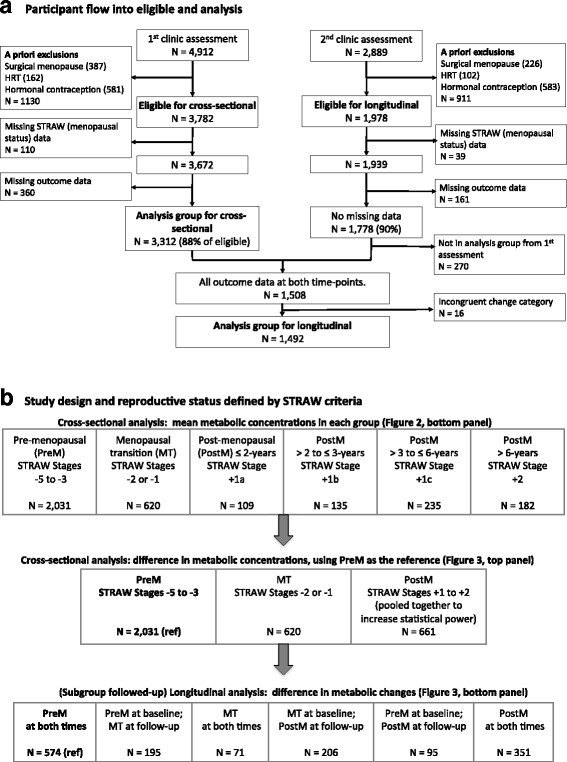
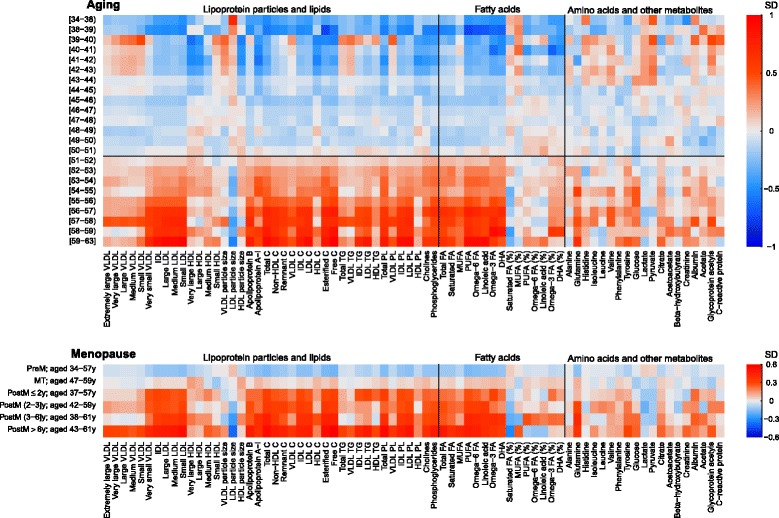
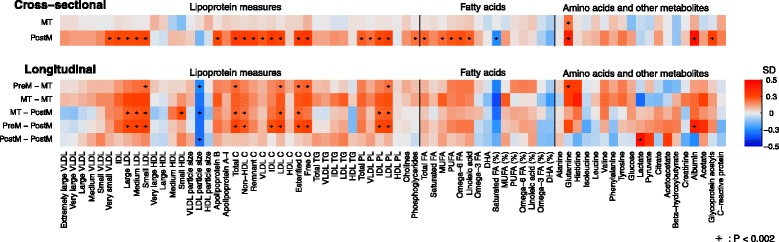
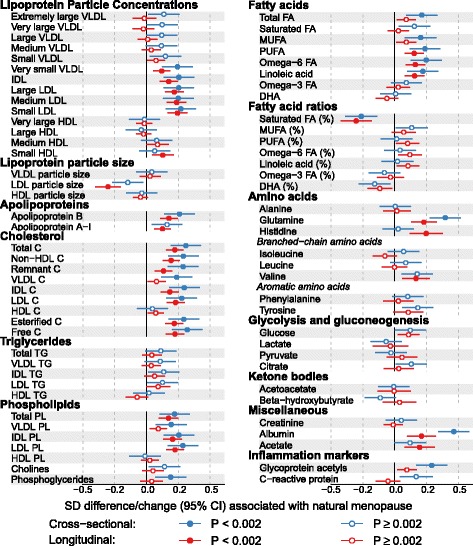
BACKGROUND: Women who experience menopause are at higher cardiometabolic risk and often display adverse changes in metabolic biomarkers compared with pre-menopausal women. It remains elusive whether the changes in cardiometabolic biomarkers during the menopausal transition are due to ovarian aging or chronological aging. Well-conducted longitudinal studies are required to determine this. The aim of this study was to explore the cross-sectional and longitudinal associations of reproductive status, defined according to the 2012 Stages of Reproductive Aging Workshop criteria, with 74 metabolic biomarkers, and establish whether any associations are independent of age-related changes. METHODS: We determined cross-sectional associations of reproductive status with metabolic profiling in 3,312 UK midlife women. In a subgroup of 1,492 women who had repeat assessments after 2.5 years, we assessed how the change in reproductive status was associated with the changes in metabolic biomarkers. Metabolic profiles were measured by high-throughput quantitative nuclear magnetic resonance metabolomics. In longitudinal analyses, we compared the change in metabolic biomarkers for each reproductive-status category change to that of the reference of being pre-menopausal at both time points. As all women aged by a similar amount during follow-up, these analyses contribute to distinguishing age-related changes from those related to change in reproductive status. RESULTS: Consistent cross-sectional and longitudinal associations of menopause with a wide range of metabolic biomarkers were observed, suggesting the transition to menopause induces multiple metabolic changes independent of chronological aging. The metabolic changes included increased concentrations of very small very low-density lipoproteins, intermediate-density lipoproteins, low-density lipoproteins (LDLs), remnant, and LDL cholesterol, and reduced LDL particle size, all toward an atherogenic lipoprotein profile. Increased inflammation was suggested via an inflammatory biomarker, glycoprotein acetyls, but not via C-reactive protein. Also, levels of glutamine and albumin increased during the transition. Most of these metabolic changes seen at the time of becoming post-menopausal remained or became slightly stronger during the post-menopausal years. CONCLUSIONS: The transition to post-menopause has effects on multiple circulating metabolic biomarkers, over and above the underlying age trajectory. The adverse changes in multiple apolipoprotein-B-containing lipoprotein subclasses and increased inflammation may underlie women's increased cardiometabolic risk in their post-menopausal years.
Overview
The claims and statistics of this paper haven’t been checked yet.
Run the check — free, no account needed. It reads the open-access text and checks the sources it cites.
Integrity signals
Registry
Cites
Statistics
Figures
Verification
Claims the paper makes
The claims and statistics of this paper haven’t been checked yet.
Run the check — free, no account needed. It reads the open-access text and checks the sources it cites.
Claims other papers make about this one
Each is checked against this paper’s own text: does it say what the citing paper says it does?
The check wasn’t confident either way, so it gives no verdict — never disputed.
In the citing paper
“Hormonal patterns during the luteal phase of the menstrual cycle also show changes with age, with greater absences of ovulatory cycles, while reductions in luteal phase progesterone become more common [107–109].”
From International society of sports nutrition position stand: nutritional concerns of the female athlete (2023) · cites this paper as [109]
Experimental — accuracy not yet measured
Self-check
Percentages, sums and reported differences re-computed from the paper’s own numbers.
The self-check needs the paper’s full text.
Citations
Cites
Mostly Harmless Econometrics: An Empiricist's Companion
Angrist, J. D., & Pischke, J.-S. (2008) · doi:10.2307/j.ctvcm4j72 · Cited by 5,051
Boyd, A., Golding, J., Macleod, J., Lawlor, D. A., Fraser, A., Henderson, J., Molloy, L., Ness, A., Ring, S., & Davey Smith, G. (2013) · International Journal of Epidemiology · doi:10.1093/ije/dys064 · Cited by 2,996
Self-citationCohort Profile: The Avon Longitudinal Study of Parents and Children: ALSPAC mothers cohort
Fraser, A., Macdonald-Wallis, C., Tilling, K., Boyd, A., Golding, J., Davey Smith, G., Henderson, J., Macleod, J., Molloy, L., Ness, A., et al. (2013) · International Journal of Epidemiology · doi:10.1093/ije/dys066 · Cited by 2,494
Self-citationExecutive summary of the Stages of Reproductive Aging Workshop + 10
Harlow, S. D., Gass, M. L. S., Hall, J. E., Lobo, R. A., Maki, P. M., Rebar, R. W., Sherman, S., Sluss, P. M., & de Villiers, T. J. (2012) · Menopause The Journal of The North American Menopause Society · doi:10.1097/gme.0b013e31824d8f40 · Cited by 1,800
Harlow, S. D., Gass, M. L. S., Hall, J. E., Lobo, R. A., Maki, P. M., Rebar, R. W., Sherman, S., Sluss, P. M., de Villiers, T. J., & for the STRAW + 10 Collaborative Group (2012) · The Journal of Clinical Endocrinology & Metabolism · doi:10.1210/jc.2011-3362 · Cited by 1,337
Chowdhury, R., Warnakula, S., Kunutsor, S., Crowe, F., Ward, H. A., Johnson, L., Franco, O. H., Butterworth, A. S., Forouhi, N. G., Thompson, S. G., et al. (2014) · Annals of Internal Medicine · doi:10.7326/m13-1788 · Cited by 1,139
Metabolomics in Prediabetes and Diabetes: A Systematic Review and Meta-analysis
Guasch‐Ferré, M., Hruby, A., Toledo, E., Clish, C. B., Martínez‐González, M. Á., Salas‐Salvadó, J., & Hu, F. B. (2016) · Diabetes Care · doi:10.2337/dc15-2251 · Cited by 916
Soininen, P., Kangas, A. J., Würtz, P., Suna, T., & Ala‐Korpela, M. (2015) · Circulation Cardiovascular Genetics · doi:10.1161/circgenetics.114.000216 · Cited by 910
Self-citationAtsma, F., Bartelink, M.-L. E. L., Grobbee, D. E., & van der Schouw, Y. T. (2006) · Menopause · doi:10.1097/01.gme.0000218683.97338.ea · Cited by 744
Kettunen, J., Demirkan, A., Würtz, P., Draisma, H. H. M., Haller, T., Rawal, R., Vaarhorst, A., Kangas, A. J., Lyytikäinen, L.-P., Pirinen, M., et al. (2016) · Nature Communications · doi:10.1038/ncomms11122 · Cited by 738
Self-citation
Cited by
Sorted by citations
Newman, C. B., Blaha, M. J., Boord, J. B., Cariou, B., Chait, A., Fein, H. G., Ginsberg, H. N., Goldberg, I. J., Murad, M. H., Subramanian, S., et al. (2020) · The Journal of Clinical Endocrinology & Metabolism · doi:10.1210/clinem/dgaa674 · Cited by 180
Beyene, H. B., Olshansky, G., Smith, A., Giles, C., Huynh, K., Cinel, M. A., Mellett, N. A., Cadby, G., Hung, J., Hui, J., et al. (2020) · PLoS Biology · doi:10.1371/journal.pbio.3000870 · Cited by 160
Rysz, J., Gluba-Brzózka, A., Rysz-Górzyńska, M., & Franczyk, B. (2020) · International Journal of Molecular Sciences · doi:10.3390/ijms21020601 · Cited by 123
Mattina, G. F., Lieshout, R. J. V., & Steiner, M. S. (2019) · Therapeutic Advances in Cardiovascular Disease · doi:10.1177/1753944719851950 · Cited by 106
Global epidemiology of breast cancer based on risk factors: a systematic review
Roheel, A., Khan, A., Anwar, F., Akbar, Z., Akhtar, M. F., Khan, M. I., Sohail, M. F., & Ahmad, R. (2023) · Frontiers in Oncology · doi:10.3389/fonc.2023.1240098 · Cited by 104
Metadata
- Authors
- Wang, Q., Ferreira, D. L. S., Nelson, S. M., Sattar, N., Ala-Korpela, M., & Lawlor, D. A.
- Affiliations
- University of Oulu (FI)
- University of Bristol (GB)
- University of Glasgow (GB)
- Corresponding author
- Lawlor, Debbie A.
- Venue
- BMC Medicine
- Published
- 2018-02-06
- Volume
- 16
- Issue
- 1
- Pages
- 17-17
- ISSN
- 1741-7015 (ISSN-L)
- PMC
- PMC5800033
- OpenAlex
- W2757552189
- Cited by
- 134
- References
- 48
- Citations by year
- 2026: 10 · 2025: 15 · 2024: 14 · 2023: 18 · 2022: 23 · 2021: 20 · 2020: 18 · 2019: 12 · 2018: 4
- FWCI
- 10.75
- Type
- journal article
- Language
- en
- Open access
- gold
- doi.org
- Licence
- cc-by
- Locations
- BMC Medicine (publishedVersion, cc-by)
- bioRxiv (Cold Spring Harbor Laboratory) (acceptedVersion, cc-by-nc-nd)
- PubMed Central (publishedVersion, cc-by)
- PubMed (publishedVersion)
- Bristol Research (University of Bristol) (publishedVersion, cc-by)
- ENLIGHTEN (Jurnal Bimbingan dan Konseling Islam) (acceptedVersion, cc-by-sa)
- UEF eRepo (University of Eastern Finland) (submittedVersion, cc-by)
- DOAJ (DOAJ: Directory of Open Access Journals) (submittedVersion, cc-by-sa)
- Explore Bristol Research (submittedVersion, cc-by)
- Funders
- British Heart Foundation (SP/07/008/24066)
- Wellcome (WT092830M)
- UK Medical Research Council (G1001357)
- Topics
- Health Sciences › Medicine › Endocrinology, Diabetes and Metabolism › Menopause: Health Impacts and Treatments
- Health Sciences › Medicine › Endocrinology, Diabetes and Metabolism › Diabetes, Cardiovascular Risks, and Lipoproteins
- Health Sciences › Medicine › Endocrinology, Diabetes and Metabolism › Hormonal and reproductive studies
- Keywords
- menopause, perimenopause, metabolic biomarkers, cardiometabolic risk, ovarian aging, chronological aging, lipoprotein profile, atherogenic lipoproteins, LDL particle size, remnant cholesterol, inflammation, glycoprotein acetyls, glutamine, albumin, postmenopausal women
- MeSH terms
- Adult, Aged, Cross-Sectional Studies, Female, Humans, Longitudinal Studies, Menopause, Middle Aged
About these checks
Registry, retraction, Cites and statistics results are computed, not judged, with one exception: a printed reference that no index lists is read once by a model before it counts as a citation error. Claims are extracted by a model and kept only when their quote appears verbatim in the text; each cited source is then checked, with a model’s help, for whether it says what the claim relies on. Those verdicts can be wrong — read the claim’s quote and the cited source before relying on one.
Statistics and arithmetic are recomputed, not judged.
Confidence bands are shown only for fields calibrated on our annotated test set. None is calibrated yet, so no band is shown.
What counts as a claim ›How we measure confidence ›How we check this ›
Are you an author, or do you see a problem with this page? Request a review
