

Translating evidence to patient care through caregivers: a systematic review of caregiver-mediated interventions
Open accessThe DOI matches its Crossref record; 82 of the 83 references it cites were found in a registry or an index; 3 of the 33 sources its claims cite were checked for support.
Abstract
BACKGROUND: Caregivers may promote the uptake of science into patient care and the practice of evidence-informed medicine. The purpose of this study was to determine whether caregiver-mediated (non-clinical caregiver-delivered) interventions are effective in improving patient, caregiver, provider, or health system outcomes. METHODS: We searched the MEDLINE, Embase, PsycINFO, Cumulative Index of Nursing and Allied Health, and Scopus databases from inception to February 27, 2017. Interventions (with a comparison group) reporting on a quality improvement intervention mediated by a caregiver and directed to a patient, in all ages and patient-care settings, were selected for inclusion. A three-category framework was developed to characterize caregiver-mediated interventions: inform (e.g., provide knowledge), activate (e.g., prompt action), and collaborate (e.g., lead to interaction between caregivers and other groups [e.g., care providers]). RESULTS: Fifty-six studies met the inclusion criteria, and 64% were randomized controlled trials (RCTs). The most commonly assessed outcomes were patient- (n = 40) and caregiver-oriented (n = 33); few health system- (n = 10) and provider-oriented (n = 2) outcomes were reported. Patient outcomes (e.g., satisfaction) were most improved by caregiver-mediated interventions that provided condition and treatment education (e.g., symptom management information) and practical condition-management support (e.g., practicing medication protocol). Caregiver outcomes (e.g., stress-related/psychiatric outcomes) were most improved by interventions that activated caregiver roles (e.g., monitoring blood glucose) and provided information related to that action (e.g., why and how to monitor). The risk of bias was generally high, and the overall quality of the evidence was low-moderate, based on Grading of Recommendations Assessment Development and Evaluation ratings. CONCLUSIONS: There is a large body of research, including many RCTs, to support the use of caregiver-mediated interventions that inform and activate caregivers to improve patient and caregiver outcomes. Select caregiver-mediated interventions improve patient (inform-activate) and caregiver (inform-activate-collaborate) outcomes and should be considered by all researchers implementing patient- and family-oriented research. SYSTEMATIC REVIEW: PROSPERO, CRD42016052509 .
Overview
CoChat Summary
TL;DR
This systematic review found 56 studies of caregiver-mediated interventions, mostly RCTs, showing that interventions which inform and activate caregivers are associated with improved patient and caregiver outcomes. Evidence for provider and health system outcomes was sparse, and the overall quality of evidence was low-to-moderate with generally high risk of bias.
Key findings
- Of 56 included studies, 64.3% (n = 36) were randomized controlled trials; patient-oriented outcomes were reported in 40 studies and caregiver-oriented outcomes in 33, while health system outcomes were reported in 10 and provider outcomes in only 2.
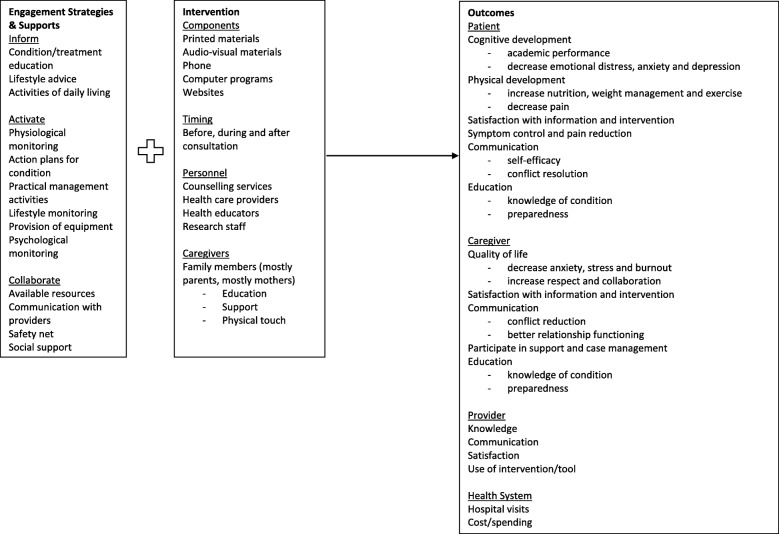
- Interventions were categorized as inform (98.2%, n = 55), activate (96.4%, n = 54), and collaborate (48.2%, n = 27); all were complex, with a median of 4 (IQR 2–6) engagement supports.
- Patient outcomes were most improved by condition/treatment education (inform) plus practical management (activate); caregiver outcomes were most improved by activate supports such as action plans, practical management, or lifestyle monitoring combined with inform supports.
- Across all studies, patient outcomes showed 24 statistically significant positive effects versus 16 no/mixed effects, and caregiver outcomes showed 22 positive versus 11 no/mixed; no studies reported harmful effects.
Methods
- Systematic review with an a priori PROSPERO protocol (CRD42016052509), reported per PRISMA; searches of MEDLINE, Embase, PsycINFO, CINAHL, and Scopus from inception to February 27, 2017.
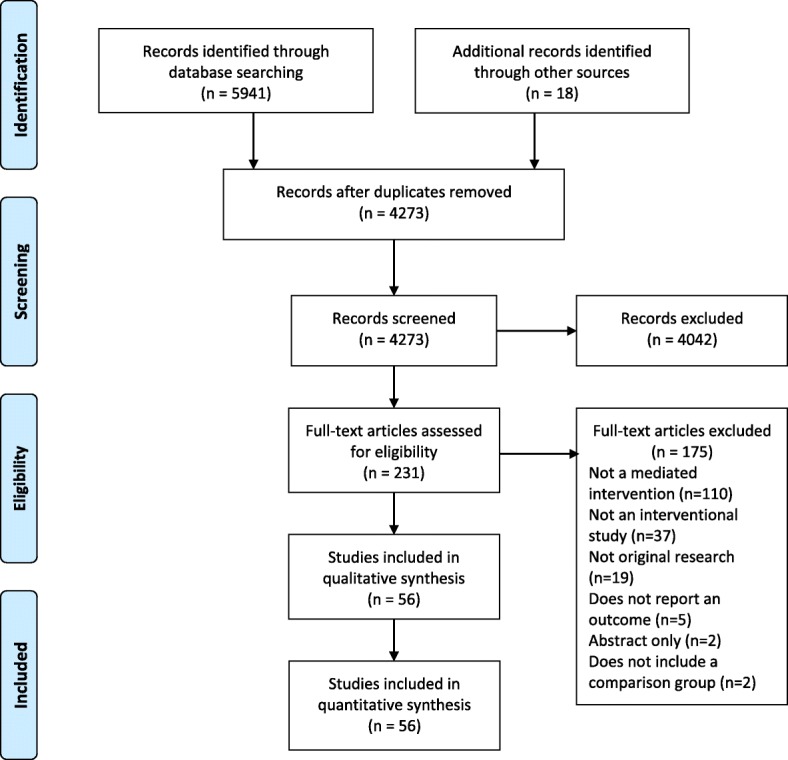
- Included interventional studies with a comparison group reporting on a caregiver-mediated intervention directed to a patient in any patient-care setting; 4273 unique abstracts were screened, 231 full texts reviewed, and 56 studies met inclusion criteria, with 18 additional studies found by hand searching.
- Data were synthesized descriptively because meta-analysis was not possible due to heterogeneity; interventions were classified using an inform/activate/collaborate framework, and risk of bias was assessed with the Cochrane tool and strength of evidence with GRADE.
Limitations
- The paper states that findings are limited by the methodological quality of included studies: no study had low overall risk of bias, 47 (83.9%) had high risk and 9 (16.1%) unclear risk, and GRADE strength was low-moderate, mainly due to lack of blinding.
- The paper states that it did not search gray literature, excluded home-based interventions (including many dementia caregiver studies), and could not determine which components of complex interventions were effective; lack of process evaluations also limited interpretation.
- Evident from the text: provider and health system outcomes were rarely measured, no included studies reported potential harms, and heterogeneity prevented meta-analysis.
Model-written summary. Check it against the paper before relying on it.
Integrity signals
Registry
Cites
Statistics
Figures
Verification
Claims the paper makes
2 Valid · 2 Not valid · 14 Not checked · 90 Own results and interpretations
The cited sources support only part of this claim — read each source’s verdict below.
In the paper
“Perceptions of PFCC and its benefits are high among patients and family members, though there are barriers to its implementation, including a purported lack of provider knowledge of PFCC, system barriers (e.g., lack of personnel, visiting hours), and a perceived increase in provider burden [3–5].”
§ Translating evidence to patient care through caregivers: a systematic review of caregiver-mediated interventions > Background
What the sources say
- Not checked — no full text of the sourcecites [3] Gasparini R Champagne M Stephany A Hudson J Fuchs MA Policy to practice: increased family presence and the impact on patient- and family-centered care adoption J Nurs Adm 2015 45 1 28 34 10.1097/NNA.0000000000000152 25479172 source
- Not checked — no full text of the sourcecites [4] Bauman G Watling CJ Hahn K Oncologists’ attitudes towards patient and family-centered care J Clin Oncol 2015 33 29_suppl 111 10.1200/jco.2015.33.29_suppl.51 source
- Partly supportedcites [5] Baird J Davies B Hinds PS Baggott C Rehm RS What impact do hospital and unit-based rules have upon patient and family-centered care in the pediatric intensive care unit? J Pediatr Nurs 2015 30 1 133 142 10.1016/j.pedn.2014.10.001 25450441 PMC4405525 sourceExperimental — accuracy not yet measured
The barriers half of the sentence is well represented in our copy: the Background states that 'implementation has remained a challenge in pediatric healthcare settings' and that 'traditional practices such as visitation restrictions and family exclusion from care planning...have limited the extent to which PFCC was achieved,' the Discussion describes nurses' role strain in 'the dualities of their role' and the fact that 'nurses have been given little guidance,' and the Implications section flags the extra staff/housekeeping burden that changes to eating and overnight-visitation rules would create. However, what our copy attributes to widespread acceptance is the concept of PFCC by professional organizations, government agencies and the field of pediatrics ('the gold standard in pediatrics...widely accepted'), not high perceptions of PFCC and its benefits among patients and family members; on families it says the opposite-leaning point that they report 'widely disparate experiences in the quality and family-centeredness of the care they receive.' So the first clause of the attributed sentence is not supported by this source. (LLM, conf=0.70)
plain- Asserted: passes — The authors put it forward as true.
- Checkable: passes — It can be checked against evidence.
- Load-bearing: unclear — It is unclear whether the paper’s conclusions depend on it.
- Based: passes — The paper gives a reason why it holds.
The cited sources support only part of this claim — read each source’s verdict below.
In the paper
“Providers represent an important mechanism for implementing PFCC research [4, 78, 79]”
§ Translating evidence to patient care through caregivers: a systematic review of caregiver-mediated interventions > Discussion
What the sources say
- Not checked — no full text of the sourcecites [4] Bauman G Watling CJ Hahn K Oncologists’ attitudes towards patient and family-centered care J Clin Oncol 2015 33 29_suppl 111 10.1200/jco.2015.33.29_suppl.51 source
- Partly supportedcites [78] Philibert I Patow C Cichon J Incorporating patient- and family-centered care into resident education: approaches, benefits, and challenges J Grad Med Educ 2011 3 2 272 278 10.4300/JGME-03-02-34 22655161 PMC3184917 sourceExperimental — accuracy not yet measured
Our copy supports the provider half of the attribution: the quoted participant statement in 'Current Status of PFCC at Participating Teaching Institutions' says the physician (or resident) 'isn't always the only healthcare provider of PFCC, but they are generally responsible for seeing that it occurs,' and 'Residents' Education About and Involvement in PFCC' plus the strategies sections treat residents/clinicians as the vehicle by which PFCC is embedded in day-to-day care and teaching. However, nothing in our copy frames providers as a mechanism for implementing PFCC RESEARCH — the paper reports a 2009 consensus conference on incorporating PFCC into GME/resident education, and it addresses implementation of PFCC as a care model, not of research findings. The 'research' element of the claim is therefore not supported by this source. (LLM, conf=0.70)
- Partly supportedcites [79] Ayub EM Sampayo EM Shah MI Doughty CB Prehospital Providers’ perceptions on providing patient and family centered care Prehosp Emerg Care 2017 21 2 233 241 10.1080/10903127.2016.1241326 27858502 sourceExperimental — accuracy not yet measured
Our copy supports providers' central role in delivering PFCC: the Introduction defines PFCC as grounded in partnerships among providers, patients and families and frames the gap as understanding EMS providers' attitudes, and the Conclusion states that incorporating the elicited strategies into EMS protocols may enhance PFCC. However, no passage describes providers as a mechanism for implementing PFCC *research*; the paper instead cites others for the research-priority point (the EMSC/NAEMT guideline calling for future studies on EMS providers' communication skills, and 'Pediatric Research Priorities in Prehospital Care' naming patient-family interaction as a priority study objective). Its own data are also confined to prehospital EMTs/paramedics debriefing simulated pediatric emergencies, narrower than the unqualified 'providers' in the claim. (LLM, conf=0.70)
plainstates a cause- Asserted: passes — The authors put it forward as true.
- Checkable: passes — It can be checked against evidence.
- Load-bearing: unclear — It is unclear whether the paper’s conclusions depend on it.
- Based: passes — The paper gives a reason why it holds.
The paper states this without a source or data behind it here, so there is nothing to check it against. The quote shows it is in the paper.
In the paper
“For interventions conducted in the community (either partially or fully), it appears that collaborate engagement supports are necessary to improve outcomes.”
§ Translating evidence to patient care through caregivers: a systematic review of caregiver-mediated interventions > Discussion
hedgedstates a possible cause- Asserted: passes — The authors put it forward as true.
- Checkable: passes — It can be checked against evidence.
- Load-bearing: passes — The paper’s conclusions depend on it.
- Based: unclear — It is unclear why the paper says it holds.
A result the paper states — it cites no source for it, so there is none to check. The quote shows it is in the paper.
In the paper
“At this time, there have been few evaluations of interventions using inform-collaborate (e.g., providing information to support activities of daily living and a list of available resources) or activate-collaborate (e.g., creating action plans specific to a medical condition and the provision of contact information for extra support) engagement strategies.”
§ Translating evidence to patient care through caregivers: a systematic review of caregiver-mediated interventions > Discussion
plain- Asserted: passes — The authors put it forward as true.
- Checkable: passes — It can be checked against evidence.
- Load-bearing: unclear — It is unclear whether the paper’s conclusions depend on it.
- Based: passes — The paper gives a reason why it holds.
A result the paper reports from its own data — it cites no other source for it, so there is none to check. The quote shows it is in the paper.
In the paper
“Interventions with social support and safety net engagement supports (collaborate) tended to improve health system outcomes.”
§ Translating evidence to patient care through caregivers: a systematic review of caregiver-mediated interventions > Results > Outcomes
hedgedstates a possible cause- Asserted: passes — The authors put it forward as true.
- Checkable: passes — It can be checked against evidence.
- Load-bearing: passes — The paper’s conclusions depend on it.
- Based: passes — The paper gives a reason why it holds.
55 more claims
Create a free account to see all 108 claims and to verify the 22 references still open.
- It may state two separate claims as one. 31
- Probably not a substantial claim. 21
- The quote only partly states this claim. 1
Self-check
Percentages, sums and reported differences re-computed from the paper’s own numbers.
Each contradiction between two passages listed here was confirmed by an independent check.
Rated minor: it would not touch a result — a value no result rests on, a p-value that stays on the same side of the significance level, or a conflict that is clerical, resolved elsewhere in the paper, or outside its own findings.
In the paper
§ Translating evidence to patient care through caregivers: a systematic review of caregiver-mediated interventions > Results > Patient population
“than patient (n = 8), health system (n = 4), and provider (n = 1) outcomes.”
§ Translating evidence to patient care through caregivers: a systematic review of caregiver-mediated interventions > Results > Location of patient care
“| Older adults | 3⇑3⇔ | 9⇑3⇔ |”
Rated minor: it would not touch a result — a value no result rests on, a p-value that stays on the same side of the significance level, or a conflict that is clerical, resolved elsewhere in the paper, or outside its own findings.
In the paper
§ Translating evidence to patient care through caregivers: a systematic review of caregiver-mediated interventions > Results > Patient population
“Caregiver outcomes were reported in more studies of older adults (n = 13)”
§ Translating evidence to patient care through caregivers: a systematic review of caregiver-mediated interventions > Results > Location of patient care
“| Older adults | 3⇑3⇔ | 9⇑3⇔ |”
Rated minor: it would not touch a result — a value no result rests on, a p-value that stays on the same side of the significance level, or a conflict that is clerical, resolved elsewhere in the paper, or outside its own findings.
In the paper
§ Translating evidence to patient care through caregivers: a systematic review of caregiver-mediated interventions > Results > Description of included studies
“conducted in outpatient settings (including primary care and the community) (n = 33)”
§ Translating evidence to patient care through caregivers: a systematic review of caregiver-mediated interventions > Results > Location of patient care
“In outpatient settings (including primary care and the community) (n = 39)”
Citations
Cites
Preferred Reporting Items for Systematic Reviews and Meta-Analyses: the PRISMA statement
Moher, D., Liberati, A., Tetzlaff, J., Altman, D. G., & for the PRISMA Group (2009) · BMJ · doi:10.1136/bmj.b2535 · Cited by 83,823
Preferred reporting items for systematic reviews and meta-analyses: the PRISMA Statement.
(2009) · PubMed Central · Cited by 44,859
The Cochrane Collaboration's tool for assessing risk of bias in randomised trials
Higgins, J. P. T., Altman, D. G., Gotzsche, P. C., Juni, P., Moher, D., Oxman, A. D., Savovic, J., Schulz, K. F., Weeks, L., Sterne, J. A. C., et al. (2011) · BMJ · doi:10.1136/bmj.d5928 · Cited by 33,817
Dermyshi, E., Wang, Y., Yan, C., Hong, W., Qiu, G., Gong, X., & Zhang, T. (2017) · Neonatology · doi:10.1159/000454668 · Cited by 24,451
GRADE: an emerging consensus on rating quality of evidence and strength of recommendations
Guyatt, G. H., Oxman, A. D., Vist, G. E., Kunz, R., Falck-Ytter, Y., Alonso-Coello, P., & Schünemann, H. J. (2008) · BMJ · doi:10.1136/bmj.39489.470347.ad · Cited by 23,305
Developing and evaluating complex interventions: the new Medical Research Council guidance
Craig, P., Dieppe, P., Macintyre, S., Michie, S., Nazareth, I., & Petticrew, M. (2008) · BMJ · doi:10.1136/bmj.a1655 · Cited by 10,995
From best evidence to best practice: effective implementation of change in patients' care
Grol, R., & Grimshaw, J. (2003) · The Lancet · doi:10.1016/s0140-6736(03)14546-1 · Cited by 4,531
Effect of clinical guidelines on medical practice: a systematic review of rigorous evaluations
Grimshaw, J. M., & Russell, I. T. (1993) · The Lancet · doi:10.1016/0140-6736(93)92244-n · Cited by 2,770
Mittelman, M. S. (1996) · JAMA · doi:10.1001/jama.1996.03540210033030 · Cited by 826
Callahan, C. M., Boustani, M. A., Unverzagt, F. W., Austrom, M. G., Damush, T. M., Perkins, A. J., Fultz, B. A., Hui, S. L., Counsell, S. R., & Hendrie, H. C. (2006) · JAMA · doi:10.1001/jama.295.18.2148 · Cited by 798
Melnyk, B. M., Feinstein, N. F., Alpert-Gillis, L., Fairbanks, E., Crean, H. F., Sinkin, R. A., Stone, P. W., Small, L., Tu, X., & Gross, S. J. (2006) · Pediatrics · doi:10.1542/peds.2005-2580 · Cited by 623
Taylor, S. J., Pinnock, H., Epiphaniou, E., Pearce, G., Parke, H. L., Schwappach, A., Purushotham, N., Jacob, S., Griffiths, C. J., Greenhalgh, T., et al. (2014) · Health Services and Delivery Research · doi:10.3310/hsdr02530 · Cited by 431
Effectiveness of a home program intervention for young children with autism.
Ozonoff, S., & Cathcart, K. (1998) · Journal of Autism and Developmental Disorders · doi:10.1023/a:1026006818310 · Cited by 415
Melnyk, B. M., Alpert-Gillis, L., Feinstein, N. F., Crean, H. F., Johnson, J., Fairbanks, E., Small, L., Rubenstein, J., Slota, M., & Corbo-Richert, B. (2004) · Pediatrics · doi:10.1542/peds.113.6.e597 · Cited by 402
Anderson, B. J., Brackett, J., Ho, J., & Laffel, L. M. (1999) · Diabetes Care · doi:10.2337/diacare.22.5.713 · Cited by 397
Reporting methods of blinding in randomized trials assessing nonpharmacological treatments
Boutron, I., Guittet, L., Estellat, C., Moher, D., Hróbjartsson, A., & Ravaud, P. (2007) · PLoS Medicine · doi:10.1371/journal.pmed.0040061 · Cited by 389
Golley, R. K., Magarey, A. M., Baur, L. A., Steinbeck, K. S., & Daniels, L. A. (2007) · Pediatrics · doi:10.1542/peds.2006-1746 · Cited by 244
Nine-Year Outcome of the Vermont Intervention Program for Low Birth Weight Infants
Achenbach, T. M., Howell, C. T., Aoki, M. F., & Rauh, V. A. (1993) · Pediatrics · doi:10.1542/peds.91.1.45 · Cited by 226
Randomized Controlled Trial of a Comprehensive Stroke Education Program for Patients and Caregivers
Rodgers, H., Atkinson, C., Bond, S., Suddes, M., Dobson, R., & Curless, R. (1999) · Stroke · doi:10.1161/01.str.30.12.2585 · Cited by 226
Positive Effects of a Nursing Intervention on Family-Centered Care in Adult Critical Care
Mitchell, M., Chaboyer, W., Burmeister, E., & Foster, M. (2009) · American Journal of Critical Care · doi:10.4037/ajcc2009226 · Cited by 199
Melnyk, B. M., Alpert‐Gillis, L., Feinstein, N. F., Fairbanks, E., Schultz‐Czarniak, J., Hust, D., Sherman, L., LeMoine, C., Moldenhauer, Z., Small, L., et al. (2001) · Research in Nursing & Health · doi:10.1002/nur.1038 · Cited by 194
Parent-Reported Outcomes of a Shared Decision-Making Portal in Asthma: A Practice-Based RCT
Fiks, A. G., Mayne, S. L., Karavite, D. J., Suh, A., O’Hara, R., Localio, A. R., Ross, M., & Grundmeier, R. W. (2015) · Pediatrics · doi:10.1542/peds.2014-3167 · Cited by 160
Holditch-Davis, D., White-Traut, R. C., Levy, J. A., O'Shea, T. M., Geraldo, V., & David, R. J. (2014) · Infant Behavior and Development · doi:10.1016/j.infbeh.2014.08.005 · Cited by 153
Early Home Intervention with Low-Birth-Weight Infants and Their Parents
Barrera, M. E., Rosenbaum, P., & Cunningham, C. E. (1986) · Child Development · doi:10.1111/j.1467-8624.1986.tb00003.x · Cited by 140
Gitlin, L. N., Reever, K., Dennis, M. P., Mathieu, E., & Hauck, W. W. (2006) · The Gerontologist · doi:10.1093/geront/46.5.630 · Cited by 128
Bass, D. M., Judge, K. S., Lynn Snow, A., Wilson, N. L., Morgan, R., Looman, W. J., McCarthy, C. A., Maslow, K., Moye, J. A., Randazzo, R., et al. (2013) · Journal of the American Geriatrics Society · doi:10.1111/jgs.12362 · Cited by 120
Galvin, R., Cusack, T., O'Grady, E., Murphy, T. B., & Stokes, E. (2011) · Stroke · doi:10.1161/strokeaha.110.594689 · Cited by 119
Wang, T.-C., Tsai, A. C.-H., Wang, J., Lin, Y., Lin, K., Chen, J. J., Lin, B. Y., & Lin, T. C. (2014) · Neurorehabilitation and neural repair · doi:10.1177/1545968314532030 · Cited by 109
Grover, M., Naumann, U., Mohammad-Dar, L., Glennon, D., Ringwood, S., Eisler, I., Williams, C., Treasure, J., & Schmidt, U. (2011) · Psychological Medicine · doi:10.1017/s0033291711000766 · Cited by 108
Eloniemi‐Sulkava, U., Saarenheimo, M., Laakkonen, M., Pietilä, M., Savikko, N., Kautiainen, H., Tilvis, R. S., & Pitkälä, K. H. (2009) · Journal of the American Geriatrics Society · doi:10.1111/j.1532-5415.2009.02564.x · Cited by 100
Pediatric Physical Therapy in Infancy: From Nightmare to Dream? A Two-Arm Randomized Trial
Blauw-Hospers, C. H., Dirks, T., Hulshof, L. J., Bos, A. F., & Hadders-Algra, M. (2011) · Physical Therapy · doi:10.2522/ptj.20100205 · Cited by 99
Effects of a Triadic Parent-Implemented Home-Based Communication Intervention for Toddlers
Brown, J. A., & Woods, J. J. (2015) · Journal of Early Intervention · doi:10.1177/1053815115589350 · Cited by 98
An Intervention Program for Mothers of Low-Birthweight Infants: Preliminary Results
Nurcombe, B., Howell, D. C., Rauh, V., Teti, D. M., Ruoff, P., & BRENNAN, J. (1984) · Journal of the American Academy of Child Psychiatry · doi:10.1016/s0002-7138(09)60511-2 · Cited by 94
Latino Families, Primary Care, and Childhood Obesity
Boudreau, A. D. A., Kurowski, D. S., Gonzalez, W. I., Dimond, M. A., & Oreskovic, N. M. (2013) · American Journal of Preventive Medicine · doi:10.1016/j.amepre.2012.11.026 · Cited by 94
Boltz, M., Resnick, B., Chippendale, T., & Galvin, J. (2014) · Journal of the American Geriatrics Society · doi:10.1111/jgs.13139 · Cited by 90
Small-group, interactive education and the effect on asthma control by children and their families
Watson, W. T. A., Gillespie, C., Thomas, N., Filuk, S., McColm, J., Piwniuk, M. P., & Becker, A. B. (2009) · Canadian Medical Association Journal · doi:10.1503/cmaj.080947 · Cited by 88
Dam, A. E. H., van Boxtel, M. P. J., Rozendaal, N., Verhey, F. R. J., & de Vugt, M. E. (2017) · PLOS ONE · doi:10.1371/journal.pone.0183386 · Cited by 83
Fortinsky, R. H., Kulldorff, M., Kleppinger, A., & Kenyon-Pesce, L. (2009) · Aging & Mental Health · doi:10.1080/13607860902746160 · Cited by 81
Father’s role in parent training for children with developmental delay.
Bagner, D. M. (2013) · Journal of Family Psychology · doi:10.1037/a0033465 · Cited by 79
Gagliardi, A. R., Légaré, F., Brouwers, M. C., Webster, F., Badley, E., & Straus, S. (2015) · Implementation Science · doi:10.1186/s13012-016-0389-3 · Cited by 71
Family intervention to control type 2 diabetes: a controlled clinical trial
Garcia-Huidobro, D., Bittner, M., Brahm, P., & Puschel, K. (2011) · Family Practice · doi:10.1093/fampra/cmq069 · Cited by 69
Toye, C. M., Parsons, R. W., Slatyer, S., Aoun, S. M., Moorin, R. E., Osseiran‐Moisson, R., & Hill, K. (2016) · International Journal of Nursing Studies · doi:10.1016/j.ijnurstu.2016.09.012 · Cited by 68
Mueser, K. T., Glynn, S. M., Cather, C., Xie, H., Zarate, R., Smith, L. F., Clark, R. E., Gottlieb, J. D., Wolfe, R., & Feldman, J. (2013) · Schizophrenia Bulletin · doi:10.1093/schbul/sbr203 · Cited by 67
Implicación familiar en los cuidados del paciente crítico
Martínez, M. D. C. R., Morilla, F. R., Pino, A., Almenara, M. I. M., Bannik, J. T., Caballero, L. J. F., Macías, G. C., Bernet, L. A., & Almeida, C. (2003) · Enfermería Intensiva · doi:10.1016/s1130-2399(03)78114-0 · Cited by 62
Compromised Autonomy and the Seriously Ill Patient
Tonelli, M. R., & Misak, C. J. (2010) · Chest · doi:10.1378/chest.09-1574 · Cited by 57
Specificity of Preventative Pediatric Intervention Effects in Early Infancy
Beeghly, M., Brazelton, T. B., Flannery, K. A., Nugent, J. K., BARRETT, D. E., & Tronick, E. Z. (1995) · Journal of Developmental & Behavioral Pediatrics · doi:10.1097/00004703-199506000-00003 · Cited by 56
The Impact of Family Engagement on Anxiety Levels in a Cardiothoracic Intensive Care Unit
Skoog, M., Milner, K. A., Gatti-Petito, J., & Dintyala, K. (2016) · Critical Care Nurse · doi:10.4037/ccn2016246 · Cited by 52
Li, H., Melnyk, B. M., McCann, R., Chatcheydang, J., Koulouglioti, C., Nichols, L. W., Lee, M., & Ghassemi, A. (2003) · Research in Nursing & Health · doi:10.1002/nur.10091 · Cited by 51
Using motivational interviewing for weight feedback to parents of young children
Dawson, A. M., Brown, D. A., Cox, A., Williams, S., Treacy, L., Haszard, J. J., Meredith-Jones, K. A., Hargreaves, E. A., Taylor, B. J., Ross, J., et al. (2014) · Journal of Paediatrics and Child Health · doi:10.1111/jpc.12518 · Cited by 48
Robinson, J. K., Turrisi, R., & Stapleton, J. L. (2006) · Journal of the American Academy of Dermatology · doi:10.1016/j.jaad.2006.10.028 · Cited by 47
Baird, J., Davies, B., Hinds, P. S., Baggott, C., & Rehm, R. S. (2015) · Journal of Pediatric Nursing · doi:10.1016/j.pedn.2014.10.001 · Cited by 45
Telephone Coaching for Parents of Children With Asthma: Impact and Lessons Learned
Garbutt, J. M., Banister, C., Highstein, G., Sterkel, R., Epstein, J., Bruns, J., Swerczek, L., Wells, S., Waterman, B., Strunk, R. C., et al. (2010) · Archives of Pediatrics & Adolescent Medicine · doi:10.1001/archpediatrics.2010.91 · Cited by 41
Mavandadi, S., Wright, E. M., Graydon, M. M., Oslin, D. W., & Wray, L. O. (2017) · Psychological Services · doi:10.1037/ser0000118 · Cited by 39
Gomez, D., Bridges, A. J., Andrews, A. R., Cavell, T. A., Pastrana, F. A., Gregus, S. J., & Ojeda, C. A. (2014) · Cognitive and Behavioral Practice · doi:10.1016/j.cbpra.2014.04.003 · Cited by 37
Fortinsky, R. H., Unson, C. G., & García, R. I. L. (2002) · Dementia · doi:10.1177/147130120200100208 · Cited by 34
Prehospital Providers' Perceptions on Providing Patient and Family Centered Care
Ayub, E. M., Sampayo, E. M., Shah, M. I., & Doughty, C. B. (2017) · Prehospital Emergency Care · doi:10.1080/10903127.2016.1241326 · Cited by 33
Assessing Willingness to Care for Persons With AIDS: Validation of a New Measure
Abell, N. (2001) · Research on Social Work Practice · doi:10.1177/104973150101100108 · Cited by 30
Nelson, K. A., Highstein, G. R., Garbutt, J., Trinkaus, K., Fisher, E. B., Smith, S. R., & Strunk, R. C. (2011) · Archives of Pediatrics & Adolescent Medicine · doi:10.1001/archpediatrics.2011.57 · Cited by 29
Tantirangsee, N., Assanangkornchai, S., & Marsden, J. (2014) · Journal of Substance Abuse Treatment · doi:10.1016/j.jsat.2014.10.011 · Cited by 26
Guiding Mothers' Management of Health Problems of Very Low Birth‐Weight Infants
Pridham, K. A., Krolikowski, M. M., Limbo, R. K., Paradowski, J., Rudd, N., Meurer, J., Uttech, A., & Henriques, J. B. (2006) · Public Health Nursing · doi:10.1111/j.1525-1446.2006.230302.x · Cited by 26
Philibert, I., Patow, C., & Cichon, J. (2011) · Journal of Graduate Medical Education · doi:10.4300/jgme-03-02-34 · Cited by 25
Nayeri, N. D., Mohammadi, S., Razi, S. P., & Kazemnejad, A. (2014) · PubMed · doi:10.1080/10376178.2014.11081910 · Cited by 23
Shyu, Y. L. (2000) · Journal of Advanced Nursing · doi:10.1046/j.1365-2648.2000.01462.x · Cited by 23
Ribera, L. F., Cabezas, A. P., Ferrer, P. A., Guevara, M. V., Tortosa, A., & Aparicio, M. V. C. (2015) · BMC Nursing · doi:10.1186/1472-6955-14-s1-s5 · Cited by 21
Rexhaj, S., Leclerc, C., Bonsack, C., Golay, P., & Favrod, J. (2017) · Frontiers in Psychiatry · doi:10.3389/fpsyt.2017.00178 · Cited by 21
Butz, A. M., Kub, J. E., Donithan, M., James, N. T., Thompson, R. E., Bellin, M. H., Tsoukleris, M. G., & Bollinger, M. E. (2010) · Journal of Asthma · doi:10.3109/02770901003692793 · Cited by 21
Interactive Support Interventions for Caregivers of Asthmatic Children
Chen, S.-H., Huang, J.-L., Yeh, K.-W., & Tsai, Y.-F. (2013) · Journal of Asthma · doi:10.3109/02770903.2013.794236 · Cited by 20
Gasparini, R., Champagne, M., Stephany, A., Hudson, J., & Fuchs, M. A. (2015) · JONA: The Journal of Nursing Administration · doi:10.1097/nna.0000000000000152 · Cited by 20
Rodríguez-Gonzalo, A., García-Martí, C., Ocaña-Colorado, A., de Micheo, M. J. B., & Morel-Fernández, S. (2015) · BMC Nursing · doi:10.1186/s12912-015-0055-0 · Cited by 19
Sun, G., & Hsu, M. (2016) · International Journal of Nursing Studies · doi:10.1016/j.ijnurstu.2016.03.002 · Cited by 19
Helgadóttir, H. L., & Wilson, M. E. (2013) · Pain Management Nursing · doi:10.1016/j.pmn.2013.07.001 · Cited by 18
A primary care intervention to improve weight in obese children: A feasibility study
Tyler, D. O., & Horner, S. D. (2015) · Journal of the American Association of Nurse Practitioners · doi:10.1002/2327-6924.12246 · Cited by 16
Randomized trial of a health communication intervention for parents of children with asthma
Horn, I. B., Mitchell, S., Gillespie, C. W., Burke, K. M., Godoy, L., & Teach, S. J. (2014) · Journal of Asthma · doi:10.3109/02770903.2014.930881 · Cited by 13
Berthelsen, C. B., & Kristensson, J. (2016) · Journal of Advanced Nursing · doi:10.1111/jan.13091 · Cited by 12
Stöckle, H. S., Haarmann-Doetkotte, S., Bausewein, C., & Fegg, M. J. (2016) · BMC Palliative Care · doi:10.1186/s12904-016-0160-1 · Cited by 10
Des parents co-thérapeutes, une solution gagnante pour le traitement des enfants autistes
Sénéchal, C., Larivée, S. J., & Thermidor, G. (2013) · Annales Médico-psychologiques revue psychiatrique · doi:10.1016/j.amp.2012.11.013 · Cited by 9
[Lowering incidence of cerebral palsy of premature infants through early intervention].
Xiu-lan, B. (2005) · PubMed · Cited by 6
Souaiby, L., Choueifati, D., Kerbage, H., & Richa, S. (2016) · Annales Médico-psychologiques revue psychiatrique · doi:10.1016/j.amp.2015.03.031 · Cited by 3
Bauman, J. R., Schleicher, S., Nipp, R. D., El-Jawahri, A., Pirl, W. F., Greer, J. A., & Temel, J. S. (2015) · Journal of Clinical Oncology · doi:10.1200/jco.2015.33.29_suppl.51 · Cited by 3
Oncologists' attitudes towards patient and family-centered care.
Nguyen, T. K., Bauman, G. S., Watling, C. J., & Hahn, K. M. E. (2015) · Journal of Clinical Oncology · doi:10.1200/jco.2015.33.29_suppl.111 · Cited by 2
(1998) · Europe PMC (PubMed Central)
(1995) · PubMed
Research works printed but not linked: 1
- Alliance FC Selected caregiver assessment measures: a resource inventory for practitioners 2012 2
Cited by
Tur‐Sinai, A., Teti, A., Rommel, A., Hlebec, V., & Lamura, G. (2020) · International Journal of Environmental Research and Public Health · doi:10.3390/ijerph17249531 · Cited by 155
Acknowledging cancer as a family disease: A systematic review of family care in the cancer setting
Coyne, E., Heynsbergh, N., & Dieperink, K. B. (2020) · European Journal of Oncology Nursing · doi:10.1016/j.ejon.2020.101841 · Cited by 111
Sypes, E. E., de Grood, C., Whalen-Browne, L., Clement, F. M., Leigh, J. P., Niven, D. J., & Stelfox, H. T. (2020) · BMC Medicine · doi:10.1186/s12916-020-01567-0 · Cited by 103
Self-citationCherak, S. J., Rosgen, B. K., Amarbayan, M. M., Wollny, K., Doig, C. J., Patten, S. B., Stelfox, H. T., & Fiest, K. M. (2021) · Critical Care Medicine · doi:10.1097/ccm.0000000000005011 · Cited by 56
Self-citationMoss, S. J., Wollny, K., Poulin, T. G., Cook, D. J., Stelfox, H. T., Ordons, A. R. D., & Fiest, K. M. (2021) · BMC Palliative Care · doi:10.1186/s12904-021-00763-w · Cited by 44
Self-citation
Metadata
- Authors
- Fiest, K. M., McIntosh, C. J., Demiantschuk, D., Leigh, J. P., & Stelfox, H. T.
- Affiliations
- University of Calgary (CA)
- Corresponding author
- Fiest, Kirsten M.
- Venue
- BMC Medicine
- Published
- 2018-07-12
- Volume
- 16
- Issue
- 1
- Pages
- 105-105
- ISSN
- 1741-7015 (ISSN-L)
- PMC
- PMC6042352
- OpenAlex
- W2811013981
- Cited by
- 88
- References
- 83
- Citations by year
- 2026: 10 · 2025: 13 · 2024: 5 · 2023: 9 · 2022: 20 · 2021: 7 · 2020: 17 · 2019: 4 · 2018: 2
- FWCI
- 1.42
- Type
- journal article
- Language
- en
- Open access
- gold
- doi.org
- Licence
- cc-by
- creativecommons.org/licenses/by/4.0/ (tdm)
- Locations
- BMC Medicine (publishedVersion, cc-by)
- Europe PMC (PubMed Central) (publishedVersion, cc-by)
- PubMed (publishedVersion)
- PubMed Central (publishedVersion, cc-by)
- Libraries and Cultural Resources (University of Calgary) (publishedVersion, cc-by)
- DOAJ (DOAJ: Directory of Open Access Journals) (submittedVersion, cc-by-sa)
- Libraries and Cultural Resources (University of Calgary) (submittedVersion)
- Libraries and Cultural Resources (University of Calgary) (submittedVersion, cc-by)
- Funders
- Canadian Institutes of Health Research
- Topics
- Health Sciences › Nursing › Research and Theory › Nursing care and research
- Health Sciences › Health Professions › General Health Professions › Health Policy Implementation Science
- Health Sciences › Health Professions › General Health Professions › Health Sciences Research and Education
- Keywords
- caregiver-mediated intervention, evidence translation, patient outcomes, caregiver outcomes, patient satisfaction, caregiver education, symptom management, medication adherence, caregiver stress, family-centered care, quality improvement intervention
- MeSH terms
- Patient Care, Humans, Caregivers
About these checks
Registry, retraction, Cites and statistics results are computed, not judged, with one exception: a printed reference that no index lists is read once by a model before it counts as a citation error. Claims are extracted by a model and kept only when their quote appears verbatim in the text; each cited source is then checked, with a model’s help, for whether it says what the claim relies on. Those verdicts can be wrong — read the claim’s quote and the cited source before relying on one.
The claim verdicts this report counts are experimental: their accuracy is not yet measured.
A language model drew the claims from the paper on 2026-11-16, under version 3 of the claim definition (model deepseek-v4.1-flash, prompt extract-v3).
A second model labelled each claim on 2026-11-16 (model jev-1.13-20260917, definition revision gold-guideline-v0.2).
Cited sources are checked with a language model’s help (qwen3.8-omni-flash).
Statistics and arithmetic are recomputed, not judged.
Confidence bands are shown only for fields calibrated on our annotated test set. None is calibrated yet, so no band is shown.
What counts as a claim ›How we measure confidence ›How we check this ›
Are you an author, or do you see a problem with this page? Request a review
Data sources
Bibliographic data: Semantic Scholar, OpenAlex, Crossref.
Contains information from the Semantic Scholar Academic Graph Datasets, made available under the ODC Attribution License (ODC-BY 1.0).
Semantic Scholar’s data is described in: Kinney, R., et al. (2023). The Semantic Scholar Open Data Platform. arXiv:2301.10140.
