

Calibration: the Achilles heel of predictive analytics
Open accessThe DOI matches its Crossref record; 41 of the 41 references it cites were found in a registry or an index.
Abstract
Background: The assessment of calibration performance of risk prediction models based on regression or more flexible machine learning algorithms receives little attention. Main text: Herein, we argue that this needs to change immediately because poorly calibrated algorithms can be misleading and potentially harmful for clinical decision-making. We summarize how to avoid poor calibration at algorithm development and how to assess calibration at algorithm validation, emphasizing balance between model complexity and the available sample size. At external validation, calibration curves require sufficiently large samples. Algorithm updating should be considered for appropriate support of clinical practice. Conclusion: Efforts are required to avoid poor calibration when developing prediction models, to evaluate calibration when validating models, and to update models when indicated. The ultimate aim is to optimize the utility of predictive analytics for shared decision-making and patient counseling.
Overview
The claims and statistics of this paper haven’t been checked yet.
Free: it reads the open-access text and checks the first 5 claims that cite a source we can check. Create a free account to check every claim.
Integrity signals
Registry
Cites
Statistics
Figures
Verification
Claims the paper makes
The claims and statistics of this paper haven’t been checked yet.
Free: it reads the open-access text and checks the first 5 claims that cite a source we can check. Create a free account to check every claim.
Claims other papers make about this one
Each is checked against this paper’s own text: does it say what the citing paper says it does?
The cited source doesn’t support the claim as written.
In the citing paper
“Miscalibration is a distinct hazard from inaccuracy [3].”
From Do Calibrated-Probability Claims Hold Up in Clinical Diagnosis? A Pre-registered Evaluation of a Decision Model Against Frontier Language Models (2026) · cites this paper as [3]
Checked by a reasoning model — may be wrong.
Experimental — accuracy not yet measuredThe source backs part of the claim, not all of it — or backs it for a different population, condition or comparison.
In the citing paper
“Challenges remain related to generalisability across institutions, alert fatigue, and calibration drift over time [19,20].”
From Artificial Intelligence in Clinical Decision-Making: A Comprehensive Review of Diagnostic, Prognostic, and Therapeutic Applications, Validation Gaps, Bias, and Deployment Challenges (2026) · cites this paper as [20]
Experimental — accuracy not yet measuredThe source backs part of the claim, not all of it — or backs it for a different population, condition or comparison.
In the citing paper
“Such a system works only if the probabilities are calibrated, meaning that a stated probability matches how often the model is actually right [3].”
From Do Calibrated-Probability Claims Hold Up in Clinical Diagnosis? A Pre-registered Evaluation of a Decision Model Against Frontier Language Models (2026) · cites this paper as [3]
Experimental — accuracy not yet measuredThe cited source says what the claim attributes to it.
In the citing paper
“Still, AIPM updating, site-specific training or recalibration might be needed to adapt an existing AIPM to a different healthcare setting3,5,9,60,68,72.”
From Guidelines and quality criteria for artificial intelligence-based prediction models in healthcare: a scoping review (2022) · cites this paper as [60]
The cited source says what the claim attributes to it.
In the citing paper
“Increasing emphasis has therefore been placed on model calibration, which examines whether predicated probabilities correspond to true clinical risk [73].”
From Artificial Intelligence in Dermatopathology: An Update and Review of the Current Literature (2026) · cites this paper as [73]
7 more claims about this paper
Create a free account to see every claim other papers make about this one.
Self-check
Percentages, sums and reported differences re-computed from the paper’s own numbers.
The self-check needs the paper’s full text.
Citations
Cites
Bray, F., Ferlay, J., Soerjomataram, I., Siegel, R. L., Torre, L. A., & Jemal, A. (2018) · CA: A Cancer Journal for Clinicians · doi:10.3322/caac.21492 · Cited by 84,109 · cited 1×
“Often, patient characteristics and disease incidence or prevalence rates vary greatly between health centers, regions, and countries [16].”
BackgroundMoons, K. G. M., Altman, D. G., Reitsma, J. B., Ioannidis, J. P. A., Macaskill, P., Steyerberg, E. W., Vickers, A. J., Ransohoff, D. F., & Collins, G. S. (2015) · Annals of Internal Medicine · doi:10.7326/m14-0698 · Cited by 5,147 · cited 2×
“Reporting on calibration performance is recommended by the TRIPOD (Transparent Reporting of a multivariable prediction model for Individual Prognosis Or Diagnosis) guidelines for prediction modeling studies [12].”
BackgroundMethodSelf-citationClinical Prediction Models: A Practical Approach to Development, Validation, and Updating
Steyerberg, E. W. (2019) · Statistics for Biology and Health · doi:10.1007/978-3-030-16399-0 · Cited by 3,281
Self-citationChristodoulou, E., Ma, J., Collins, G. S., Steyerberg, E. W., Verbakel, J. Y., & Van Calster, B. (2019) · Journal of Clinical Epidemiology · doi:10.1016/j.jclinepi.2019.02.004 · Cited by 2,119
Self-citationSteyerberg, E. W. (2009) · Statistics for Biology and Health · doi:10.1007/978-0-387-77244-8 · Cited by 1,491
Self-citationRiley, R. D., Snell, K. I., Ensor, J., Burke, D. L., Harrell Jr, F. E., Moons, K. G., & Collins, G. S. (2019) · Statistics in Medicine · doi:10.1002/sim.7992 · Cited by 1,409 · cited 1×
“It is important to prespecify the modeling strategy and to ensure that sample size is sufficient for the number of considered predictors [30, 31].”
BackgroundA calibration hierarchy for risk models was defined: from utopia to empirical data
Van Calster, B., Nieboer, D., Vergouwe, Y., De Cock, B., Pencina, M. J., & Steyerberg, E. W. (2016) · Journal of Clinical Epidemiology · doi:10.1016/j.jclinepi.2015.12.005 · Cited by 910 · cited 6×
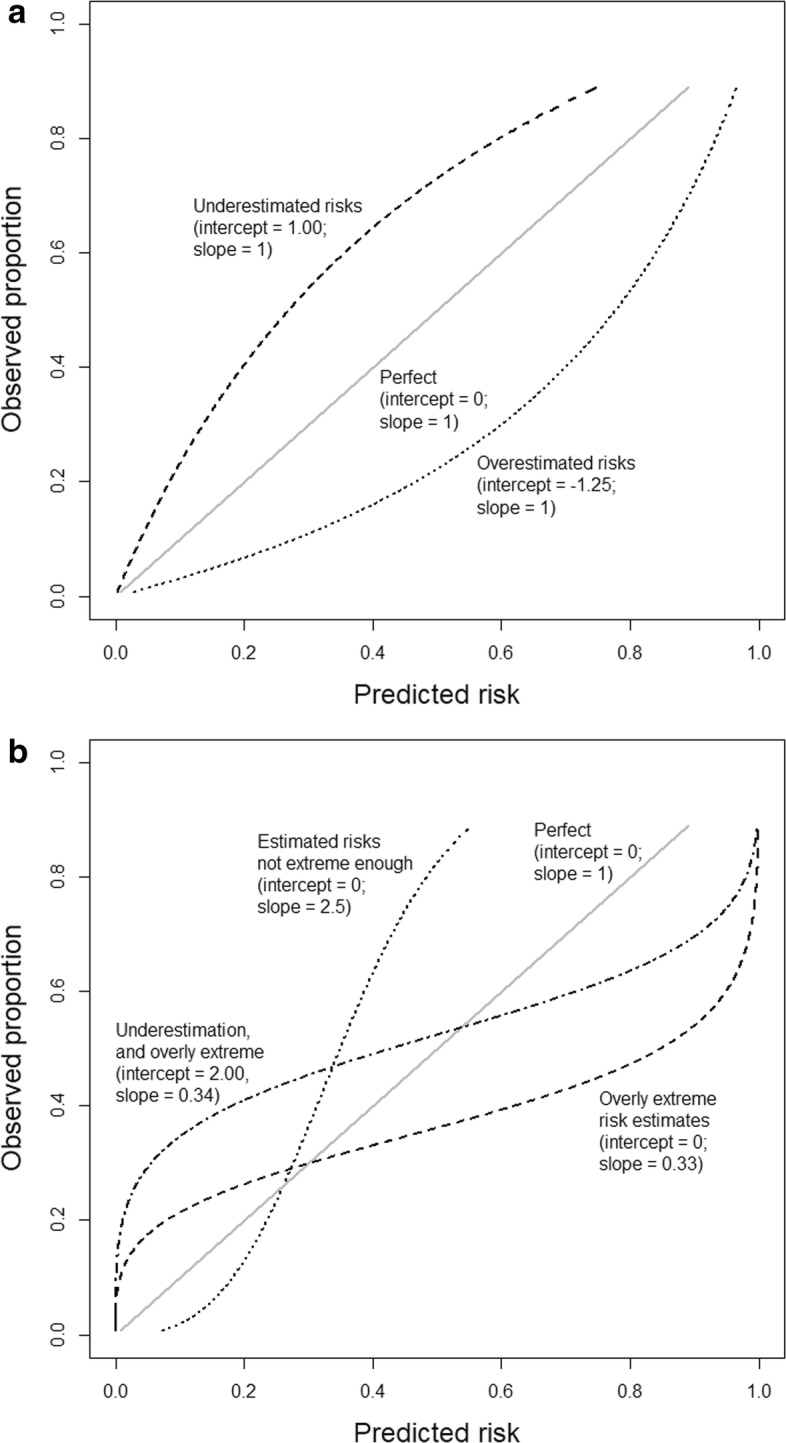
“The accuracy of risk estimates, relating to the agreement between the estimated and observed number of events, is called ‘ calibration ’ [4].”
BackgroundMethodInfluentialSelf-citationMoore, R. G., McMeekin, D. S., Brown, A. K., DiSilvestro, P., Miller, M. C., Allard, W. J., Gajewski, W., Kurman, R., Bast, R. C., & Skates, S. J. (2009) · Gynecologic Oncology · doi:10.1016/j.ygyno.2008.08.031 · Cited by 875 · cited 1×
“The concepts explained in this section are illustrated in Additional 1, with the validation of the Risk of Ovarian Malignancy Algorithm (ROMA) for the diagnosis of ovarian malignancy in women with an ovarian tumor selected for surgical removal [28]; further details can be found elsewhere [1, 4, 29].”
MethodSample size for binary logistic prediction models: Beyond events per variable criteria
van Smeden, M., Moons, K. G., de Groot, J. A., Collins, G. S., Altman, D. G., Eijkemans, M. J., & Reitsma, J. B. (2019) · Statistical Methods in Medical Research · doi:10.1177/0962280218784726 · Cited by 791 · cited 1×
“It is important to prespecify the modeling strategy and to ensure that sample size is sufficient for the number of considered predictors [30, 31].”
BackgroundA Deep Learning Mammography-based Model for Improved Breast Cancer Risk Prediction
Yala, A., Lehman, C., Schuster, T., Portnoi, T., & Barzilay, R. (2019) · Radiology · doi:10.1148/radiol.2019182716 · Cited by 758 · cited 1×
“Calibration is especially important when the aim is to support decision-making, even when discrimination is moderate such as for breast cancer prediction models [13].”
BackgroundCollins, G. S., de Groot, J. A., Dutton, S., Omar, O., Shanyinde, M., Tajar, A., Voysey, M., Wharton, R., Yu, L.-M., Moons, K. G., et al. (2014) · BMC Medical Research Methodology · doi:10.1186/1471-2288-14-40 · Cited by 729 · cited 1×
“Systematic reviews have found that calibration is assessed far less often than discrimination [2, 3, 5 – 7], which is problematic since poor calibration can make predictions misleading [8].”
BackgroundReporting and Methods in Clinical Prediction Research: A Systematic Review
Bouwmeester, W., Zuithoff, N. P. A., Mallett, S., Geerlings, M. I., Vergouwe, Y., Steyerberg, E. W., Altman, D. G., & Moons, K. G. M. (2012) · PLoS Medicine · doi:10.1371/journal.pmed.1001221 · Cited by 600 · cited 1×
“Systematic reviews have found that calibration is assessed far less often than discrimination [2, 3, 5 – 7], which is problematic since poor calibration can make predictions misleading [8].”
BackgroundSelf-citationRiley, R. D., Ensor, J., Snell, K. I. E., Debray, T. P. A., Altman, D. G., Moons, K. G. M., & Collins, G. S. (2016) · BMJ · doi:10.1136/bmj.i3140 · Cited by 585 · cited 1×
“For example, university hospitals may treat more patients with the event of interest than regional hospitals; such heterogeneity between settings can affect risk estimates and their calibration [18].”
BackgroundSteyerberg, E. W., Borsboom, G. J. J. M., van Houwelingen, H. C., Eijkemans, M. J. C., & Habbema, J. D. F. (2004) · Statistics in Medicine · doi:10.1002/sim.1844 · Cited by 552 · cited 1×
“Updating of regression-based algorithms may start with changing the intercept to correct calibration-in-the-large [34].”
Self-citationCalibration of Risk Prediction Models: Impact on Decision-Analytic Performance
Van Calster, B., & Vickers, A. J. (2015) · Medical Decision Making · doi:10.1177/0272989x14547233 · Cited by 371
Austin, P. C., & Steyerberg, E. W. (2014) · Statistics in Medicine · doi:10.1002/sim.5941 · Cited by 362 · cited 1×
“The concepts explained in this section are illustrated in Additional 1, with the validation of the Risk of Ovarian Malignancy Algorithm (ROMA) for the diagnosis of ovarian malignancy in women with an ovarian tumor selected for surgical removal [28]; further details can be found elsewhere [1, 4, 29].”
MethodSelf-citationGenders, T. S. S., Steyerberg, E. W., Hunink, M. G. M., Nieman, K., Galema, T. W., Mollet, N. R., Feyter, P. J. D., Krestin, G. P., Alkadhi, H., Leschka, S., et al. (2012) · BMJ · doi:10.1136/bmj.e3485 · Cited by 314
Self-citationCalibration drift in regression and machine learning models for acute kidney injury
Davis, S. E., Lasko, T. A., Chen, G., Siew, E. D., & Matheny, M. E. (2017) · Journal of the American Medical Informatics Association · doi:10.1093/jamia/ocx030 · Cited by 312 · cited 2×
“When we find poorly calibrated predictions at validation, algorithm updating should be considered to provide more accurate predictions for new patients from the validation setting [1, 20].”
BackgroundMethodPrediction of Indolent Prostate Cancer: Validation and Updating of a Prognostic Nomogram
Steyerberg, E. W., Roobol, M. J., Kattan, M. W., van der Kwast, T. H., de Koning, H. J., & Schröder, F. H. (2007) · Journal of Urology · doi:10.1016/j.juro.2006.08.068 · Cited by 304 · cited 1×
“The predictors in the algorithm may explain a part of the heterogeneity, but often differences between predictors will not explain all differences between settings [19].”
BackgroundSelf-citationCollins, G. S., & Altman, D. G. (2012) · BMJ · doi:10.1136/bmj.e4181 · Cited by 244 · cited 1×
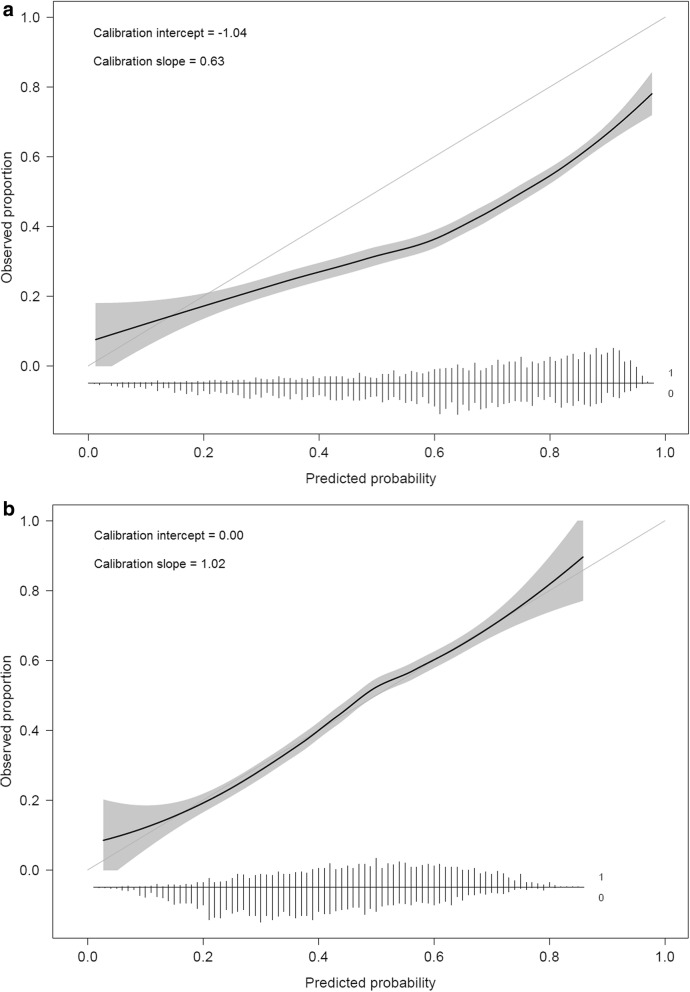
“An external validation study of these models in 2 million patients from the United Kingdom indicated that QRISK2 – 2011 was well calibrated and had an AUC of 0.771, whereas NICE Framingham was overestimating risk, with an AUC of 0.776 [15].”
MethodInfluentialBig Data and Predictive Analytics: Recalibrating Expectations
Shah, N. D., Steyerberg, E. W., & Kent, D. M. (2018) · JAMA · doi:10.1001/jama.2018.5602 · Cited by 241 · cited 1×
“Calibration has therefore been labeled the ‘ Achilles heel ’ of predictive analytics [11].”
BackgroundSelf-citationPrognostic models in obstetrics: available, but far from applicable
Kleinrouweler, C. E., Cheong-See, F. M., Collins, G. S., Kwee, A., Thangaratinam, S., Khan, K. S., Mol, B. W. J., Pajkrt, E., Moons, K. G. M., & Schuit, E. (2016) · American Journal of Obstetrics and Gynecology · doi:10.1016/j.ajog.2015.06.013 · Cited by 193 · cited 2×
“…have gained popularity in recent years, with numerous publications focusing on models that estimate patients ’ risk of a disease or a future health state (the ‘ event ’ ) based on classical regression algorithms or modern flexible machine learning or artificial intelligence algorithms [1 – 3].”
BackgroundMoons, K. G. M., Donders, A. R. T., Steyerberg, E. W., & Harrell, F. E. (2004) · Journal of Clinical Epidemiology · doi:10.1016/j.jclinepi.2004.01.020 · Cited by 178 · cited 1×
“In smaller datasets, procedures that aim to prevent overfitting should be considered, e.g., using penalized regression techniques such as Ridge or Lasso regression [32] or using simpler models.”
MethodSelf-citationPoor performance of clinical prediction models: the harm of commonly applied methods
Steyerberg, E. W., Uno, H., Ioannidis, J. P. A., van Calster, B., Ukaegbu, C., Dhingra, T., Syngal, S., & Kastrinos, F. (2018) · Journal of Clinical Epidemiology · doi:10.1016/j.jclinepi.2017.11.013 · Cited by 168
Self-citationA review of statistical updating methods for clinical prediction models
Su, T.-L., Jaki, T., Hickey, G. L., Buchan, I., & Sperrin, M. (2018) · Statistical Methods in Medical Research · doi:10.1177/0962280215626466 · Cited by 147 · cited 1×
“Full refitting of the algorithm, as in the case study below, will improve calibration if the validation sample is relatively large [35].”
MethodPredicting the chance of live birth for women undergoing IVF: a novel pretreatment counselling tool
Dhillon‐Smith, R. K., McLernon, D. J., Smith, P., Fishel, S. B., Dowell, K., Deeks, J. J., Bhattacharya, S., & Coomarasamy, A. (2015) · Human Reproduction · doi:10.1093/humrep/dev268 · Cited by 134 · cited 1×
“Take, for example, a prediction model that predicts the chance that in vitro fertilization (IVF) treatment leads to a live birth [14].”
BackgroundSelf-citationTesta, A., Kaijser, J., Wynants, L., Fischerova, D., Van Holsbeke, C., Franchi, D., Savelli, L., Epstein, E., Czekierdowski, A., Guerriero, S., et al. (2014) · British Journal of Cancer · doi:10.1038/bjc.2014.333 · Cited by 123
Self-citationLuijken, K., Groenwold, R. H. H., Van Calster, B., Steyerberg, E. W., & van Smeden, M. (2019) · Statistics in Medicine · doi:10.1002/sim.8183 · Cited by 121 · cited 1×
“, measurements of a predictor are systemically more biased upward in a different setting), this affects the predicted risks and thus calibration of an algorithm [27].”
BackgroundSelf-citationVan Calster, B., van Smeden, M., De Cock, B., & Steyerberg, E. W. (2020) · Statistical Methods in Medical Research · doi:10.1177/0962280220921415 · Cited by 120
Self-citationLeijdekkers, J. A., Eijkemans, M. J. C., van Tilborg, T. C., Oudshoorn, S. C., McLernon, D. J., Bhattacharya, S., Mol, B. W., Broekmans, F. J., Torrance, H. L., & OPTIMIST group (2018) · Human Reproduction · doi:10.1093/humrep/dey263 · Cited by 88 · cited 1×
“…has been a drive in Europe to lower the number of embryos transferred in IVF and improvements in IVF cryopreservation technology led to an increase in embryo freezing and storage for subsequent transfer [22]; such evolutions may change the calibration of algorithms that predict IVF success [23].”
BackgroundSelf-citationA spline-based tool to assess and visualize the calibration of multiclass risk predictions
Van Hoorde, K., Van Huffel, S., Timmerman, D., Bourne, T., & Van Calster, B. (2015) · Journal of Biomedical Informatics · doi:10.1016/j.jbi.2014.12.016 · Cited by 85 · cited 1×
“Previous work has highlighted that the use of different types of algorithms, varying from regression to flexible machine learning approaches, can lead to models that suffer greatly from poor calibration [9, 10].”
Backgroundvan der Ploeg, T., Nieboer, D., & Steyerberg, E. W. (2016) · Journal of Clinical Epidemiology · doi:10.1016/j.jclinepi.2016.03.002 · Cited by 68 · cited 1×
“Previous work has highlighted that the use of different types of algorithms, varying from regression to flexible machine learning approaches, can lead to models that suffer greatly from poor calibration [9, 10].”
BackgroundSelf-citationDynamic Prediction Modeling Approaches for Cardiac Surgery
Hickey, G. L., Grant, S. W., Caiado, C., Kendall, S., Dunning, J., Poullis, M., Buchan, I., & Bridgewater, B. (2013) · Circulation: Cardiovascular Quality and Outcomes · doi:10.1161/circoutcomes.111.000012 · Cited by 58 · cited 1×
“Continuous updating strategies are also gaining in popularity; such strategies dynamically address shifts in the target population over time [36].”
BackgroundTufts PACE Clinical Predictive Model Registry: update 1990 through 2015
Wessler, B. S., Paulus, J., Lundquist, C. M., Ajlan, M., Natto, Z., Janes, W. A., Jethmalani, N., Raman, G., Lutz, J. S., & Kent, D. M. (2017) · Diagnostic and Prognostic Research · doi:10.1186/s41512-017-0021-2 · Cited by 55
Riley, R. D. (2019) · Statistics in Medicine · doi:10.1002/sim.8409 · Cited by 44
Comparison of two models predicting IVF success; the effect of time trends on model performance
te Velde, E. R., Nieboer, D., Lintsen, A. M., Braat, D. D. M., Eijkemans, M. J. C., Habbema, J. D. F., & Vergouwe, Y. (2014) · Human Reproduction · doi:10.1093/humrep/det393 · Cited by 43 · cited 1×
“…has been a drive in Europe to lower the number of embryos transferred in IVF and improvements in IVF cryopreservation technology led to an increase in embryo freezing and storage for subsequent transfer [22]; such evolutions may change the calibration of algorithms that predict IVF success [23].”
BackgroundThai, T. N., & Ebell, M. H. (2019) · Resuscitation · doi:10.1016/j.resuscitation.2019.05.002 · Cited by 41
Screening for data clustering in multicenter studies: the residual intraclass correlation
Wynants, L., Timmerman, D., Bourne, T., Van Huffel, S., & Van Calster, B. (2013) · BMC Medical Research Methodology · doi:10.1186/1471-2288-13-128 · Cited by 26 · cited 1×
“Apart from statistical overfitting, medical data usually contain measurement error, for example, biomarker expressions vary with assay kits and ultrasound measurement of tumor vascularity has inter-and intra-observer variability [25, 26].”
BackgroundSelf-citationMurthy, V., Rishi, A., Gupta, S., Kannan, S., Mahantshetty, U. M., Tongaonkar, H. B., Bakshi, G., Prabhash, K., Bhanushali, P. B., Shinde, B., et al. (2015) · Clinical Biochemistry · doi:10.1016/j.clinbiochem.2015.10.013 · Cited by 24 · cited 1×
“Apart from statistical overfitting, medical data usually contain measurement error, for example, biomarker expressions vary with assay kits and ultrasound measurement of tumor vascularity has inter-and intra-observer variability [25, 26].”
BackgroundEdlinger, M., Wanitschek, M. M., Dörler, J., Ulmer, H., Alber, H. F., & Steyerberg, E. W. (2017) · BMJ Open · doi:10.1136/bmjopen-2016-014467 · Cited by 16 · cited 2×
“[38], which was published under the Creative Commons Attribution Non Commercial (CC BY-NC 4.”
BackgroundSelf-citationCALSTER, B. V., van Smeden, M., & Steyerberg, E. W. (2019) · arXiv (Cornell University) · doi:10.48550/arxiv.1907.11493 · Cited by 1 · cited 1×
“However, using models that are too simple can backfire (Additional file 1), and penalization does not offer a miracle solution for uncertainty in small datasets [33].”
MethodSelf-citation
Cited by
Wynants, L., Van Calster, B., Bonten, M. M., Collins, G. S., Debray, T. P., De Vos, M., Haller, M. C., Heinze, G., Moons, K. G., Riley, R. D., et al. (2020) · doi:10.1101/2020.03.24.20041020 · Cited by 3,070
Self-citationMoons, K. G. M., Damen, J. A. A., Kaul, T., Hooft, L., Andaur Navarro, C., Dhiman, P., Beam, A. L., Van Calster, B., Celi, L. A., Denaxas, S., et al. (2025) · BMJ · doi:10.1136/bmj-2024-082505 · Cited by 1,069
Self-citationMachine learning for medical imaging: methodological failures and recommendations for the future
Varoquaux, G., & Cheplygina, V. (2022) · npj Digital Medicine · doi:10.1038/s41746-022-00592-y · Cited by 656
Evaluation of clinical prediction models (part 2): how to undertake an external validation study
Riley, R. D., Archer, L., Snell, K. I. E., Ensor, J., Dhiman, P., Martin, G. P., Bonnett, L. J., & Collins, G. S. (2024) · BMJ · doi:10.1136/bmj-2023-074820 · Cited by 401
Rajula, H. S. R., Verlato, G., Manchia, M., Antonucci, N., & Fanos, V. (2020) · Medicina · doi:10.3390/medicina56090455 · Cited by 606
“Possibly much bigger sample sizes are required to gain reliable (calibrated) risk predictions [44] than reliable (diagnostic) classifications.”
Background
Metadata
- Authors
- On behalf of Topic Group ‘Evaluating diagnostic tests and prediction models’ of the STRATOS initiative, Van Calster, B., McLernon, D. J., van Smeden, M., Wynants, L., & Steyerberg, E. W.
- Affiliations
- KU Leuven (BE)
- University of Aberdeen (GB)
- Leiden University Medical Center (NL)
- Venue
- BMC Medicine
- Published
- 2019-12
- Volume
- 17
- Issue
- 1
- Pages
- 230-230
- ISSN
- 1741-7015 (ISSN-L)
- PMC
- PMC6912996
- OpenAlex
- W2996480032
- Cited by
- 2,650
- References
- 39
- Citations by year
- 2026: 1224 · 2025: 379 · 2024: 291 · 2023: 283 · 2022: 262 · 2021: 159 · 2020: 51
- FWCI
- 93.43
- Type
- journal article
- Language
- en
- Open access
- gold
- doi.org
- Licence
- cc-by
- creativecommons.org/licenses/by/4.0/ (tdm)
- creativecommons.org/licenses/by/4.0/ (vor, 15 d)
- Locations
- BMC Medicine (publishedVersion, cc-by)
- Europe PMC (PubMed Central) (publishedVersion, cc-by)
- PubMed Central (publishedVersion, cc-by)
- PubMed (publishedVersion)
- Research Publications (Maastricht University) (publishedVersion, cc-by)
- Aberdeen University Research Archive (Aberdeen University) (submittedVersion, cc-by-nc)
- Lirias (submittedVersion, cc-by-nc)
- Pure Amsterdam UMC (submittedVersion, cc-by-nc)
- Data Archiving and Networked Services (DANS) (submittedVersion, other-oa)
- Data Archiving and Networked Services (DANS) (submittedVersion)
- Leiden Repository (Leiden University) (submittedVersion)
- DOAJ (DOAJ: Directory of Open Access Journals) (submittedVersion, cc-by-sa)
- Utrecht University Repository (Utrecht University) (submittedVersion, other-oa)
- University of Birmingham Research Portal (University of Birmingham) (submittedVersion, other-oa)
- Research Publications (Maastricht University) (submittedVersion, other-oa)
- Funders
- Fonds Wetenschappelijk Onderzoek (G0B4716N)
- Onderzoeksraad, KU Leuven (C24/15/037)
- Topics
- Physical Sciences › Mathematics › Statistics and Probability › Statistical Methods in Epidemiology
- Health Sciences › Health Professions › Health Information Management › Artificial Intelligence in Healthcare
- Physical Sciences › Computer Science › Artificial Intelligence › Machine Learning in Healthcare
- Keywords
- model calibration, risk prediction model, predictive analytics, calibration curve, external validation, model updating, clinical decision-making, shared decision-making, sample size, model complexity
- MeSH terms
- Machine Learning, Adult, Aged, Algorithms, Calibration, Humans, Male, Middle Aged, Predictive Value of Tests
About these checks
Registry, retraction, Cites and statistics results are computed, not judged, with one exception: a printed reference that no index lists is read once by a model before it counts as a citation error. Claims are extracted by a model and kept only when their quote appears verbatim in the text; each cited source is then checked, with a model’s help, for whether it says what the claim relies on. Those verdicts can be wrong — read the claim’s quote and the cited source before relying on one.
Statistics and arithmetic are recomputed, not judged.
Confidence bands are shown only for fields calibrated on our annotated test set. None is calibrated yet, so no band is shown.
What counts as a claim ›How we measure confidence ›How we check this ›
Are you an author, or do you see a problem with this page? Request a review
Data sources
Bibliographic data: Semantic Scholar, OpenAlex, Crossref.
Contains information from the Semantic Scholar Academic Graph Datasets, made available under the ODC Attribution License (ODC-BY 1.0).
Semantic Scholar’s data is described in: Kinney, R., et al. (2023). The Semantic Scholar Open Data Platform. arXiv:2301.10140.
