

The DOI matches its Crossref record; 53 of the 53 references it cites were found in a registry or an index.
The research burden of randomized controlled trial participation: a systematic thematic synthesis of qualitative evidence
Open accessAbstract
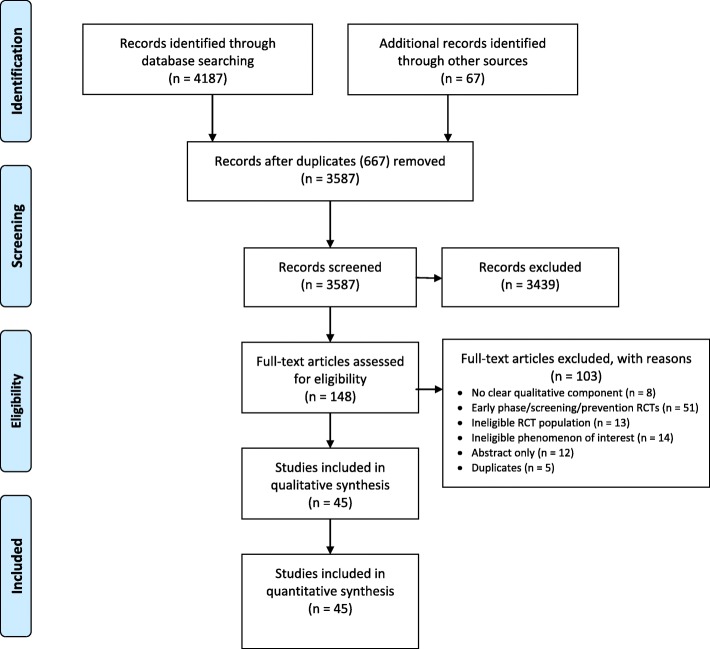
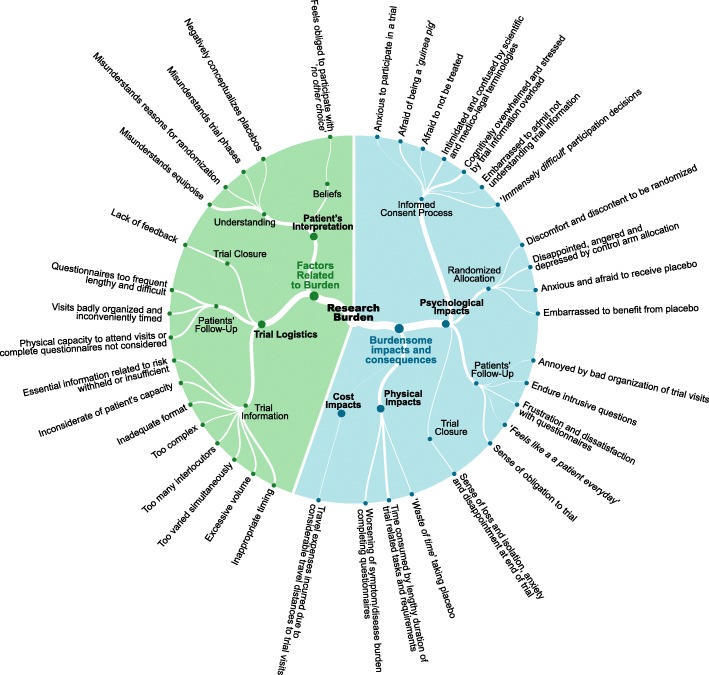
BACKGROUND: Participation in randomized controlled trials (RCTs) may be quite demanding and could represent an important burden for patients. We aimed to explore this research burden (i.e., the psychological, physical, and financial burdens) experienced by patients through their participation in a RCT. METHODS: We conducted a systematic review of qualitative studies exploring adult patients' experiences with RCT participation. We searched MEDLINE (PubMed), CINAHL, PSYCHINFO, and Embase (search date March 2018) for eligible reports. Qualitative data coding and indexing were assisted by NVivo. The quality of reports was assessed by using the Critical Appraisal Skills Program (CASP) tool. RESULTS: We included 45 qualitative studies that involved 1732 RCT participants. Important psychological burdens were identified at every stage of the trial process. Participants reported feeling anxiety and being afraid of "being a 'guinea pig'" and described undergoing randomization and allocation to a placebo as particularly difficult resulting in disappointment, anger, and depression. Patients' follow-up and trial closure were also responsible for a wide range of psychological, physical, and financial burdens. Furthermore, factors related to burdensome impacts and consequences were discerned. These factors involved trial information, poorly organized and too-demanding follow-up, and lack of appropriate management when the patient's participation ended. Trial participation was also associated with beneficial effects such as the satisfaction of feeling "useful," gaining "a sense of control," and receiving special attention. CONCLUSIONS: Our finding provides a detailed description of research burden across the whole RCT process. Many of the burdens described could be anticipated, and some avoided in a movement toward minimally disruptive clinical research. Such an approach could improve trial recruitment and retention. REVIEW REGISTRATION: PROSPERO CRD42018098994.
Overview
The claims and statistics of this paper haven’t been checked yet.
Run the check — free, no account needed. It reads the open-access text and checks the sources it cites.
Integrity signals
Registry
Cites
Statistics
Figures
Verification
Claims the paper makes
The claims and statistics of this paper haven’t been checked yet.
Run the check — free, no account needed. It reads the open-access text and checks the sources it cites.
Claims other papers make about this one
Each is checked against this paper’s own text: does it say what the citing paper says it does?
The source backs part of the claim, not all of it — or backs it for a different population, condition or comparison.
In the citing paper
“The feasibility of participant recruitment and retention in RCTs can differ from that in one-group pretest-posttest design studies due to additional psychological burdens in participants that arise from the RCT process, such as a lack of control and anxiety that result from random allocation and disappointment when allocated to a less favorable control group condition”
From The feasibility and preliminary effects of a pilot randomized controlled trial: Videoconferencing acceptance and commitment therapy in distressed family caregivers of people with dementia. (2023) · cites this paper as Naidoo et al., 2020
Experimental — accuracy not yet measured
Self-check
Percentages, sums and reported differences re-computed from the paper’s own numbers.
The self-check needs the paper’s full text.
Citations
Cites
Preferred Reporting Items for Systematic Reviews and Meta-Analyses: the PRISMA statement
Moher, D., Liberati, A., Tetzlaff, J., Altman, D. G., & for the PRISMA Group (2009) · BMJ · doi:10.1136/bmj.b2535 · Cited by 83,823
Preferred Reporting Items for Systematic Reviews and Meta-Analyses: The PRISMA Statement
Moher, D., Liberati, A., Tetzlaff, J., Altman, D. G., & The PRISMA Group (2009) · PLoS Medicine · doi:10.1371/journal.pmed.1000097 · Cited by 64,042 · cited 1×
“To ensure transparency, we adhered to the reporting guidelines set out by PRISMA [10] and ENTREQ (Additional file 1) [11].”
Preferred reporting items for systematic reviews and meta-analyses: the PRISMA Statement.
(2009) · PubMed Central · Cited by 44,859
Methods for the thematic synthesis of qualitative research in systematic reviews
Thomas, J., & Harden, A. (2008) · BMC Medical Research Methodology · doi:10.1186/1471-2288-8-45 · Cited by 9,312
Enhancing transparency in reporting the synthesis of qualitative research: ENTREQ
Tong, A., Flemming, K., McInnes, E., Oliver, S., & Craig, J. (2012) · BMC Medical Research Methodology · doi:10.1186/1471-2288-12-181 · Cited by 3,569
Qualitative Research: Rigour and qualitative research
Mays, N., & Pope, C. (1995) · BMJ · doi:10.1136/bmj.311.6997.109 · Cited by 2,715
Methley, A. M., Campbell, S., Chew-Graham, C., McNally, R., & Cheraghi-Sohi, S. (2014) · BMC Health Services Research · doi:10.1186/s12913-014-0579-0 · Cited by 2,706
External validity of randomised controlled trials: “To whom do the results of this trial apply?”
Rothwell, P. M. (2005) · The Lancet · doi:10.1016/s0140-6736(04)17670-8 · Cited by 2,544
Chlebowski, R. T., Hendrix, S. L., Langer, R. D., Stefanick, M. L., Gass, M. L. S., Lane, D. S., Rodabough, R. J., Gilligan, M. A., Cyr, M. G., Thomson, C. A., et al. (2003) · JAMA · doi:10.1001/jama.289.24.3243 · Cited by 1,871
Patient engagement in research: a systematic review
Domecq, J. P., Prutsky, G., Elraiyah, T., Wang, Z., Nabhan, M., Shippee, N., Brito, J. P., Boehmer, K., Hasan, R., Firwana, B., et al. (2014) · BMC Health Services Research · doi:10.1186/1472-6963-14-89 · Cited by 1,773
Research works printed but not linked: 2
- Booth A: Chapter 3: searching for studies. In: Supplementary guidance for inclusion of qualitative research in Cochrane systematic reviews of interventions. Edited by Noyes J BA, Hannes K, Harden A, Harris J, Lewin S, Lockwood C, vol. version 1 (updated August 2011): Cochrane Collaboration Qualitative Methods Group, 2011; 2011.
- Lingler JH, Schmidt KL, Gentry AL, Hu L, Terhorst LA. A new measure of research participant burden: brief report. J Empir Res Hum Res Ethics. 2014;9(4):46–9. · DOI
Cited by
Sorted by citations
Items 101–144 of 144
Quantifying Participant Burden In Clinical Trials: Data From Prostate Cancer RctsPreprint
Shiely, F., Gallagher, K., & Dorgan, A. (2022) · Research Square · doi:10.21203/rs.3.rs-1339592/v1
Recruitment, Retention, and Follow-Up: Frustration or Bliss
Baker, F. A. (2022) · Springer eBooks · doi:10.1007/978-3-031-18085-9_6
Kamisato, A., Hong, H., & Okubo, S. (2023) · Asian Bioethics Review · doi:10.1007/s41649-023-00247-4
“For instance, in a study by Naidoo et al. on patients that participated in a randomized clinical trial, when providing IC, respondents felt fear of becoming “guinea pigs,” intimidated and confused by specialized terminology, and disappointment, anger, and depression at the prospect of allocation into the control group…”
BackgroundBritish Medical Journal Publishing Group (2023) · BMJ Open · doi:10.1136/bmjopen-2021-055521corr2
Yeh, Y., Lemos, R. F., Craft, W. H., Tomlinson, D. C., Dwyer, C. L., Turner, J. K., & Bickel, W. K. (2023) · The Psychological Record · doi:10.1007/s40732-023-00566-w
“Using only an open-ended question and a comprehension check in a survey may reduce participants’ burden, a constant concern among researchers (Cameron et al., 2020; Getz et al., 2020; Naidoo et al., 2020).”
BackgroundBaseline higher hair cortisol moderated some effects in a healthy lifestyle intervention
Ling, J., Ordway, M. R., & Zhang, N. (2024) · Psychoneuroendocrinology · doi:10.1016/j.psyneuen.2024.107058
Socio-Economic Aspects of the Development of Medical Information Technologies in Russia
Игоревна, Н. В., Николаевич, К. А., & Butkova, T. V. (2024) · City Healthcare · doi:10.47619/2713-2617.zm.2024.v.5i2;103-114
Singh, J., Feeny, D. H., Ganann, R., Lavis, J. N., Lokker, C., Mbuagbaw, L. C. E., Qutob, M., Samaan, Z., Sutton, A., Walli-Attaei, M., et al. (2025) · PLoS ONE · doi:10.1371/journal.pone.0322118
“These are salient factors for lifestyle interventions targeting mental health outcomes that require more time and effort compared to pharmacological interventions [37,38].”
Sanchez, C. M. P. (2025) · Cancer Nursing Practice · doi:10.7748/cnp.2025.e1884
The end of a participant's research journey: the expected path and the alternatives
Pluess-Hall, H. (2025) · British Journal of Nursing · doi:10.12968/bjon.2025.0021
Hikaka, J., Cavadino, A., Ihimaera, L., Taylor, L. M., Maxwell-Crawford, K., Merito, P., Vercoe, H., Li, M., Kool, B., Parsons, J., et al. (2025) · Journal of the Royal Society of New Zealand · doi:10.1080/03036758.2025.2525222
“Many participants who did not complete the post-intervention assessments continued to participate, suggesting intervention acceptability but that the burden of the assessment may deter participation, a common issue with intervention research (Naidoo et al. 2020).”
Research Burden in Pediatric Cancer: A Mixed Methods Study From the PediQUEST Response Trial
Tsuchiyose, E. A., Feifer, D., Merz, A. F., Avery, M. E., Eche, I. J., Awofeso, O. M., Orellana, L., Becker, D., Feudtner, C., Freedman, J. L., et al. (2025) · Journal of Pain and Symptom Management · doi:10.1016/j.jpainsymman.2025.08.032 · Cited by 1
Tanner, D. B., Dhillon, J., McIntire, R., Waters, P., Shepard, S., Wise, A., Heigle, B., Hartwell, M. L., & Vassar, M. B. (2023) · Journal of the American Osteopathic Academy of Orthopedics · doi:10.70709/li73bwps
Kise, N. J., Gay, C., Lerdal, A., Lindberg, M. F., Nerhus, T. K., Rognsvåg, T., Aamodt, A., & Heir, S. (2025) · Research Square · doi:10.21203/rs.3.rs-6843171/v1
Rønsbo, T. N., Laigaard, J., Pedersen, C., Mathiesen, O., & Karlsen, A. P. H. (2021) · Figshare · doi:10.6084/m9.figshare.14423328
Rønsbo, T. N., Laigaard, J., Pedersen, C., Mathiesen, O., & Karlsen, A. P. H. (2021) · Figshare · doi:10.6084/m9.figshare.14423337
Hanlon, P., Butterly, E. W., Shah, A. S. V., Hannigan, L. J., Wild, S. H., Guthrie, B., Mair, F. S., Dias, S., Welton, N. J., & McAllister, D. (2022) · Figshare · doi:10.6084/m9.figshare.21427306
Hanlon, P., Butterly, E. W., Shah, A. S. V., Hannigan, L. J., Wild, S. H., Guthrie, B., Mair, F. S., Dias, S., Welton, N. J., & McAllister, D. (2022) · Figshare · doi:10.6084/m9.figshare.21427300
Rønsbo, T. N., Laigaard, J., Pedersen, C., Mathiesen, O., & Karlsen, A. P. H. (2021) · Figshare · doi:10.6084/m9.figshare.14423334
Hanlon, P., Butterly, E. W., Shah, A. S. V., Hannigan, L. J., Wild, S. H., Guthrie, B., Mair, F. S., Dias, S., Welton, N. J., & McAllister, D. (2022) · Figshare · doi:10.6084/m9.figshare.21427303
Rønsbo, T. N., Laigaard, J., Pedersen, C., Mathiesen, O., & Karlsen, A. P. H. (2021) · Figshare · doi:10.6084/m9.figshare.14423331
Hanlon, P., Butterly, E. W., Shah, A. S. V., Hannigan, L. J., Wild, S. H., Guthrie, B., Mair, F. S., Dias, S., Welton, N. J., & McAllister, D. (2022) · Figshare · doi:10.6084/m9.figshare.21427297
Lucas, P., Boyd, S. C., Milloy, M.-J., & Walsh, Z. (2021) · Figshare · doi:10.6084/m9.figshare.15071182
Czwikla, J., Herzberg, A., Kapp, S., Kloep, S., Rothgang, H., Nitschke, I., Haffner, C., & Hoffmann, F. (2022) · Figshare · doi:10.6084/m9.figshare.20279281
Gamble, E., Heavin, C., & Linehan, C. (2026) · medRxiv · doi:10.64898/2026.01.12.26343978
Pluess-Hall, H., Menzies, J. C., & Smith, P. C. (2026) · Trials · doi:10.1186/s13063-026-09441-9
“Participating in clinical research is not without burden [29], and this study shows that terminating participation does not immediately remove this; it is important to ensure that support for participants does not end abruptly if their clinical trial does.”
Köppe, J., Schiel, A. E., Gerlinger, C., Götte, H., Edelmann, D., & Erdmann, S. (2026) · Das Gesundheitswesen · doi:10.1055/a-2736-6561
“…a treatment group or the concern about receiving suboptimal treatment, if assigned to the control group, can be an additional burden for patients [31], thus reducing the attractiveness and ultimately the sample size of an RCT. Studies have shown that the public perceives random assignment in…”
Kopanz, J., Zuidgeest, M. G. P., Rutgrink, L., Keighron, C., Grobbee, D. E., & Lagerwaard, B. (2026) · Trials · doi:10.1186/s13063-026-09616-4
“Trial participation can be perceived as burdensome by participants due to, for example, difficulties in understanding trial information, the time commitments required, interference with everyday life responsibilities, and timing and location of trial visits [1, 16–19].”
Kise, N. J., Eliassen, S., Gay, C., Lerdal, A., Lindberg, M. F., Nerhus, T. K., Rognsvåg, T., Aamodt, A., & Heir, S. (2026) · Acta Orthopaedica · doi:10.2340/17453674.2026.45869
“The physical, psychological, and financial burdens on patients from participating in RCTs is well known [ 31 ] and largely explains the patients’ decision not to participate.”
Haque, N. B., Kreps, F., Lystad, R. P., Braithwaite, J., & Mitchell, R. J. (2026) · Journal of Spinal Cord Medicine · doi:10.1080/10790268.2026.2663666
Martín-Cañavate, R., Castro, A. P.-D., Puett, C., Trigo, E., Faria, M. L., Silva-Gerardo, A., Vargas, A., Molina, I., & Custodio, E. (2026) · Maternal and Child Nutrition · doi:10.1111/mcn.70199
“Participation in these interventions entails an opportunity cost, an aspect that remains relatively underexplored despite its equity implications (Batura et al. 2015; Naidoo et al. 2020).”
Waselewski, M. E., Eazer, L. A., Farrell, K., Jones, J., & Chang, T. (2026) · Contemporary Clinical Trials · doi:10.1016/j.cct.2026.108363
Dubich, T., van Iersel, T. M., Mirdamadi, K., & van Hoogdalem, E. (2026) · Clinical Pharmacokinetics · doi:10.1007/s40262-026-01657-x
Reflections on public involvement: Adoptees shaping trauma‑informed early life adversity researchPreprint
Komarnyckyj, M., Manohar, S., Keisha, M., Evans, J. C., Kay, C., Krol, R., Shepherd, R., & Elliott, R. (2026) · Research Square · doi:10.21203/rs.3.rs-9900345/v1
Belnap, M. A., Witkiewitz, K. A., Schacht, J. P., Anton, R. F., Aldridge, A., Nieto, S. J., & Ray, L. A. (2026) · Alcoholism Clinical and Experimental Research · doi:10.1111/acer.70306
“Longer RCTs place greater demands on participants, researchers, and sponsors, resulting in increased burden and cost (Naidoo et al. 2020; Zweben et al. 2009).”
How Lived Experience Advisory Groups Contribute to the Design and Conduct of Mental Health Research
Evans, J., Keightley, S., Sweeney, A., Hill, R., Khayri, E., Markham, S., & Wykes, T. (2026) · Health Expectations · doi:10.1111/hex.70722
“Our results confirm the importance of clarity and transparency throughout research processes to ensure that participants fully understand what their involvement entails [22].”
Ward, L., & Gardner, B. (2026) · Applied Sciences · doi:10.3390/app16136539
Patients’ Perspectives and Experiences of Participating in Anesthesia Research: A Qualitative Study
Pennington, B. R. T., Janda, A. M., Rosen, S., Alrubaie, N., Percich, J., Kumar, S., Kheterpal, S., Avidan, M. S., & Politi, M. C. (2026) · Anesthesia & Analgesia · doi:10.1213/ane.0000000000008173
Chu, J., Glinsky, J. V., Liu, H., Rimmer, C., Roberts, S., Tamburella, F., Lincoln, C., Denis, S., Chen, L. W., Rainey, D., et al. (2026) · Spinal Cord · doi:10.1038/s41393-026-01256-4
von Vogelsang, A., & Svensson, M. A. (2026) · Journal of Spinal Cord Medicine · doi:10.1080/10790268.2026.2713311
Tomschi, F., & Hilberg, T. (2026) · Journal of Back and Musculoskeletal Rehabilitation · doi:10.1177/10538127261479036
“4,5 In our study, lumbar PPT was the only outcome showing a signi fi cant group-by-time interaction, whereas pain intensity and disability did not differ signi fi cantly between groups.”
Schouten, T. J., Gabrio, A., Cals, J., & Spigt, M. (2026) · Clinical Trials · doi:10.1177/17407745261467982
Myhrer, M., Aars, N. A., Ibrahim, A., Steen, K. S., Mykletun, A., & Brinchmann, B. (2026) · Research Square · doi:10.21203/rs.3.rs-9823328/v1
Seynaeve, M., Schneider, L., Roullier, I., Lazenby, K., Lilley, C., Lobo, S., Ermakova, A. O., Wells, H., Cleare, A. J., & Rucker, J. (2026) · Frontiers in Psychiatry · doi:10.3389/fpsyt.2026.1682810
Metadata
- Authors
- Naidoo, N., Nguyen, V. T., Ravaud, P., Young, B., Amiel, P., Schanté, D., Clarke, M., & Boutron, I.
- Affiliations
- Inserm (FR)
- University of Liverpool (GB)
- Institut National du Cancer (FR)
- Queen's University Belfast (GB)
- Corresponding author
- Boutron, Isabelle
- ORCID
- Venue
- BMC Medicine
- Published
- 2020-01-20
- Volume
- 18
- Issue
- 1
- Pages
- 6-6
- ISSN
- 1741-7015 (ISSN-L)
- PMC
- PMC6970283
- OpenAlex
- W2999900278
- Cited by
- 144
- References
- 53
- Citations by year
- 2026: 27 · 2025: 22 · 2024: 19 · 2023: 18 · 2022: 22 · 2021: 30 · 2020: 6
- FWCI
- 3.18
- Type
- journal article
- Language
- en
- Open access
- gold
- doi.org
- Locations
- BMC Medicine (publishedVersion, cc-by)
- PubMed Central (publishedVersion, cc-by)
- PubMed (publishedVersion)
- HAL (submittedVersion, cc-by)
- DOAJ (DOAJ: Directory of Open Access Journals) (submittedVersion)
- Columbia Academic Commons (Columbia University)
- Funders
- Institut National Du Cancer
- Topics
- Health Sciences › Medicine › Public Health, Environmental and Occupational Health › Ethics in Clinical Research
- Health Sciences › Health Professions › General Health Professions › Health Policy Implementation Science
- Health Sciences › Health Professions › General Health Professions › Mental Health and Patient Involvement
- Keywords
- research burden, randomized controlled trials, patient experience, psychological burden, physical burden, financial burden, trial follow-up, trial closure, randomization, trial recruitment, trial retention
- MeSH terms
- Humans, Volunteers, Randomized Controlled Trials as Topic, Cost of Illness, Qualitative Research
About these checks
Registry, retraction, Cites and statistics results are computed, not judged, with one exception: a printed reference that no index lists is read once by a model before it counts as a citation error. Claims are extracted by a model and kept only when their quote appears verbatim in the text; each cited source is then checked, with a model’s help, for whether it says what the claim relies on. Those verdicts can be wrong — read the claim’s quote and the cited source before relying on one.
Statistics and arithmetic are recomputed, not judged.
Confidence bands are shown only for fields calibrated on our annotated test set. None is calibrated yet, so no band is shown.
What counts as a claim ›How we measure confidence ›How we check this ›
Are you an author, or do you see a problem with this page? Request a review
