

The DOI matches its Crossref record; 128 of the 128 references it cites were found in a registry or an index.
A complex systems approach to the study of change in psychotherapy
Open accessAbstract
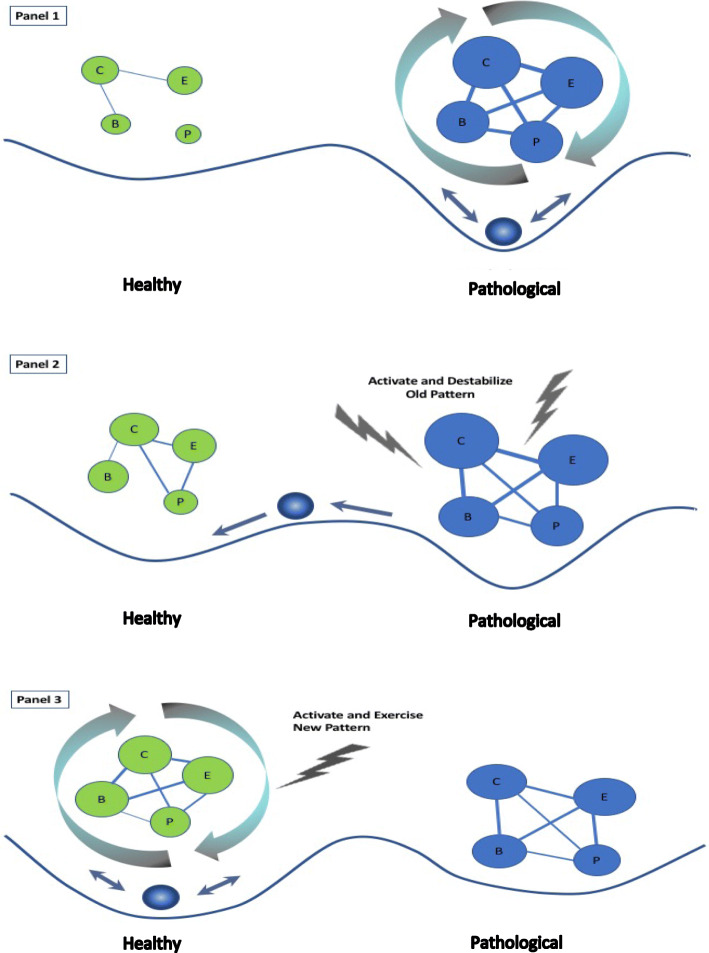
BACKGROUND: A growing body of research highlights the limitations of traditional methods for studying the process of change in psychotherapy. The science of complex systems offers a useful paradigm for studying patterns of psychopathology and the development of more functional patterns in psychotherapy. Some basic principles of change are presented from subdisciplines of complexity science that are particularly relevant to psychotherapy: dynamical systems theory, synergetics, and network theory. Two early warning signs of system transition that have been identified across sciences (critical fluctuations and critical slowing) are also described. The network destabilization and transition (NDT) model of therapeutic change is presented as a conceptual framework to import these principles to psychotherapy research and to suggest future research directions. DISCUSSION: A complex systems approach has a number of implications for psychotherapy research. We describe important design considerations, targets for research, and analytic tools that can be used to conduct this type of research. CONCLUSIONS: A complex systems approach to psychotherapy research is both viable and necessary to more fully capture the dynamics of human change processes. Research to date suggests that the process of change in psychotherapy can be nonlinear and that periods of increased variability and critical slowing might be early warning signals of transition in psychotherapy, as they are in other systems in nature. Psychotherapy research has been limited by small samples and infrequent assessment, but ambulatory and electronic methods now allow researchers to more fully realize the potential of concepts and methods from complexity science.
Overview
The claims and statistics of this paper haven’t been checked yet.
Run the check — free, no account needed. It reads the open-access text and checks the sources it cites.
Integrity signals
Registry
Cites
Statistics
Figures
Verification
Claims the paper makes
The claims and statistics of this paper haven’t been checked yet.
Run the check — free, no account needed. It reads the open-access text and checks the sources it cites.
Claims other papers make about this one
Each is checked against this paper’s own text: does it say what the citing paper says it does?
The cited source says what the claim attributes to it.
In the citing paper
“Modeling downstream mechanisms will likely require complex approaches such as network analytic frameworks”
From Measuring the active elements of cognitive-behavioral therapies (2023) · cites this paper as Hayes & Andrews, 2020
Self-check
Percentages, sums and reported differences re-computed from the paper’s own numbers.
The self-check needs the paper’s full text.
Citations
Cites
Estimating psychological networks and their accuracy: A tutorial paper
Epskamp, S., Borsboom, D., & Fried, E. I. (2018) · Behavior Research Methods · doi:10.3758/s13428-017-0862-1 · Cited by 5,715
Early-warning signals for critical transitions
Scheffer, M., Bascompte, J., Brock, W. A., Brovkin, V., Carpenter, S. R., Dakos, V., Held, H., van Nes, E. H., Rietkerk, M., & Sugihara, G. (2009) · Nature · doi:10.1038/nature08227 · Cited by 4,854
Network analysis: An integrative approach to the structure of psychopathology
Borsboom, D., & Cramer, A. O. J. (2013) · Annual Review of Clinical Psychology · doi:10.1146/annurev-clinpsy-050212-185608 · Cited by 4,359
A dynamic systems approach to the development of cognition and action
Thelen, E., & Smith, L. B. (1996) · Computers & Mathematics with Applications · doi:10.1016/s0898-1221(96)90021-8 · Cited by 3,454
Hölzel, B. K., Lazar, S. W., Gard, T., Schuman-Olivier, Z., Vago, D. R., & Ott, U. (2011) · Perspectives on Psychological Science · doi:10.1177/1745691611419671 · Cited by 3,024
Dynamic patterns: The self-organization of brain and behavior
(1997) · Computers & Mathematics with Applications · doi:10.1016/s0898-1221(97)90151-6 · Cited by 2,857
Positive Emotions Trigger Upward Spirals Toward Emotional Well-Being
Fredrickson, B. L., & Joiner, T. (2002) · Psychological Science · doi:10.1111/1467-9280.00431 · Cited by 2,655
Maximizing exposure therapy: An inhibitory learning approach
Craske, M. G., Treanor, M., Conway, C. C., Zbozinek, T., & Vervliet, B. (2014) · Behaviour Research and Therapy · doi:10.1016/j.brat.2014.04.006 · Cited by 2,339
Anticipating Critical Transitions
Scheffer, M., Carpenter, S. R., Lenton, T. M., Bascompte, J., Brock, W., Dakos, V., van de Koppel, J., van de Leemput, I. A., Levin, S. A., van Nes, E. H., et al. (2012) · Science · doi:10.1126/science.1225244 · Cited by 2,208
Nahum-Shani, I., Smith, S. N., Spring, B. J., Collins, L. M., Witkiewitz, K., Tewari, A., & Murphy, S. A. (2018) · Annals of Behavioral Medicine · doi:10.1007/s12160-016-9830-8 · Cited by 2,171
Research works printed but not linked: 2
- Schiepek G, Aichhorn W, Schöller H. Monitoring change dynamics - a nonlinear approach to psychotherapy feedback. Chaos Complex Lett. 2017;11(3):355–75.
- Ruwaard J, Kooistra L, Thong M. Early warning signs of depression. In: Ecological momentary assessment in mental health research: a practical introduction, with examples in R. 1st ed. Amsterdam: APH Mental Health; 2018.
Cited by
Sorted by citations
Items 101–149 of 149
Bossenbroek, R., Gmelin, J.-O. H., Olthof, M., Knot-Dickscheit, J., Hasselman, F., Poelen, E., & Lichtwarck‐Aschoff, A. (2025) · Children and Youth Services Review · doi:10.1016/j.childyouth.2025.108720 · Cited by 1
Argungu, Z. M., Alhaiti, A., & Jibreel, E. A. (2025) · International Journal of Social Psychiatry · doi:10.1177/00207640251405457 · Cited by 1
“For instance, in a randomized controlled trial, Hayes and Andrews (2020) investigated the effects of MBCT in a sample of 45 patients with non-melancholic major depression (MD).”
Snuggerud, T. R., Ulitzsch, E., Nordahl, H., Vrabel, K. R., Hoffart, A., Ebrahimi, O. V., Lüdtke, O., Nestler, S., & Johnson, S. U. (2026) · Journal of Anxiety Disorders · doi:10.1016/j.janxdis.2026.103136 · Cited by 1
Yaşar, A. B., & Gündüz, A. (2026) · Frontiers in Psychiatry · doi:10.3389/fpsyt.2026.1748511 · Cited by 1
“…of the Smart Therapy framework acknowledges a principle well-established in systems theory but frequently neglected in individually oriented clinical practice: the individual cannot be treated in isolation from the relational systems that maintain, modify, or exacerbate their psychopathology (66).”
Systems-based psychiatry: insights from psychedelic research on mechanisms of healing
Shannon, S., & Weil, A. (2026) · Frontiers in Psychiatry · doi:10.3389/fpsyt.2026.1789902 · Cited by 1
Aesthetic multimodality of speech and gesture: Towards its functional framework
Kiose, M. I., Leonteva, A., & Agafonova, O. V. (2022) · Languages and Modalities · doi:10.3897/lamo.2.78840 · Cited by 1
The Application of Exposure Principles to the Treatment of Depression
Hayes, A. M., Yasinski, C. W., & Alpert, E. (2022) · Springer eBooks · doi:10.1007/978-3-031-04927-9_17 · Cited by 1
Self-citationStewart, C., Muvuka, B., Hutwagner, W., McCollum, H., Dyer, W. K., & Ryan, E. R. (2023) · Journal of Regional Medical Campuses · doi:10.24926/jrmc.v6i3.5157 · Cited by 1
Studying Nonlinear Change in Music Therapy Applying Dynamic Systems Theory
Antichi, L., Giannini, M., & Edwards, J. M. (2023) · Journal of Music Therapy · doi:10.1093/jmt/thad010 · Cited by 1
Development of a Clinical Data Model Addressing the Nursing Focus “Anxiety”
Sampaio, F., Gonçalves, P., Vieira‐Marques, P., Sequeira, C., & Lluch‐Canut, T. (2022) · CIN Computers Informatics Nursing · doi:10.1097/cin.0000000000000863 · Cited by 1
Helmich, M. A. (2022) · University of Groningen research database (University of Groningen / Centre for Information Technology) · doi:10.33612/diss.200101721 · Cited by 2
Computational models in psychiatry: a toy-model to apprehend the dynamics of psychiatric disordersPreprint
Gauld, C., & Depannemaecker, D. (2022) · doi:10.31234/osf.io/qzvpg · Cited by 1
Psychological systems perspectives on resilience
Rivers, C. T., & Phillips, W. H. (2022) · Elsevier eBooks · doi:10.1016/b978-0-323-91497-0.00134-x · Cited by 1
Hulsmans, D. H. G., Otten, R., Poelen, E. A. P., van Vonderen, A., Daalmans, S., Hasselman, F., Olthof, M., & Lichtwarck‐Aschoff, A. (2023) · Research Square · doi:10.21203/rs.3.rs-3358763/v1 · Cited by 1
Li, Y., Hu, A., Ding, Y., Tang, X., Jiang, X., Leng, Y., Chen, M., Hofmann, S. G., & Liu, X. (2026) · Behavior Therapy · doi:10.1016/j.beth.2025.11.006
Kongerslev, M., Storebø, O. J., & Simonsen, E. H. (2021) · Psyke & Logos · doi:10.7146/pl.v42i1.128764 · Cited by 1
“Vi ved ganske enkelt ikke ret meget om, hvad det egentlig er, der virker i en terapisession, og dermed hvad vi skal gøre mere eller mindre af (Hayes & Andrews, 2020).”
BackgroundThe Study of Mediators and Mechanisms in Psychotherapy Research
Andrews, L. A., Curtiss, J. E., & Hayes, A. M. (2021) · Elsevier eBooks · doi:10.1016/b978-0-12-818697-8.00220-x · Cited by 1
Self-citationHoffart, A., Skjerdingstad, N., Freichel, R., Mansueto, A. C., Johnson, S. U., Epskamp, S., & Ebrahimi, O. V. (2023) · doi:10.31234/osf.io/nq8h9
Resurrecting Gaia: Harnessing the Free Energy Principle to Preserve Life as We Know ItPreprint
Montgomery, C., & Hipólito, I. (2023) · doi:10.31234/osf.io/5tm9w
Complex Adaptive Systems and Psychophysiological Data - An Exploratory Approach
Dair, Z., Dockray, S., & O’Reilly, R. (2023) · Irish Conference on Artificial Intelligence and Cognitive Science (AICS) · doi:10.1109/aics60730.2023.10470799
“The adoption of CAS in alternate fields has demonstrated efficacy in generating insights for psychotherapy, behavioural and social contexts [24]–[26].”
BackgroundMethodWhite, B. P., Clark, A., GUÉNIN--CARLUT, A., Constant, A., & Paolo, L. D. D. (2024) · doi:10.31234/osf.io/avjx4
de Felice, G., & Pincus, D. (2024) · Psychiatry International · doi:10.3390/psychiatryint5040054
What personality can teach us about mental health
Plutynski, A., & Pouncey, C. L. (2025) · Philosophical Psychology · doi:10.1080/09515089.2025.2455393
“Inherent disposition (high sensitivity, anxiety), combined with various environmental factors or adverse personal history, may lead some to avoid certain social settings or interactions (Hayes & Andrews, 2020).”
Groeneveld, M., & Harper, T. (2024) · PsyArXiv (OSF Preprints) · doi:10.31234/osf.io/aps5g_v1
Groeneveld, M., & Harper, T. (2025) · PsyArXiv (OSF Preprints) · doi:10.31234/osf.io/aps5g_v3
Tashevski, A. (2025) · SSRN Electronic Journal · doi:10.2139/ssrn.5255884
Groeneveld, M., & Harper, T. (2025) · PsyArXiv (OSF Preprints) · doi:10.31234/osf.io/aps5g_v4
Recursive Frame Analysis as a Method of Psychotherapy Change Process Research
Zatloukal, L., Jurníčková, P., & Szczepkowski, J. (2025) · Contemporary Family Therapy · doi:10.1007/s10591-025-09754-y
“It also draws upon complex systems theories, which some authors regard as highly vital for research on change processes (Hayes & Andrews, 2020; Schiepek et al., 2015, 2019).”
Kabrel, M., & Aru, J. (2025) · Perspectives on Psychological Science · doi:10.1177/17456916251378430 · Cited by 1
“For instance, a depressed person, especially if depression is recurrent, may have negative self-referential thoughts and a tendency to come back to them even after an intervention directed at belief modification (Hayes & Andrews, 2020).”
InfluentialMaliqi, R., Uka, F., Uka, E., Musliu, A., Sopjani, V., Zharku, L., Bajrami, A., Statovci, A., Rexha, F., Baliu, L., et al. (2025) · Journal of Contemporary Psychotherapy · doi:10.1007/s10879-025-09707-4
“Participants’ struggles did not van-ish but became manageable, reflecting a central finding on psychotherapy research: healing involves gradual reductions in symptoms by developing new coping strategies rather than complete eradication of difficulties (Hayes & Andrews, 2020).”
Hulsmans, D. H. G., Otten, R., Poelen, E. A. P., van Vonderen, A., Daalmans, S., Hasselman, F., Olthof, M., & Lichtwarck‐Aschoff, A. (2024) · Figshare · doi:10.6084/m9.figshare.26723765
Hulsmans, D. H. G., Otten, R., Poelen, E. A. P., van Vonderen, A., Daalmans, S., Hasselman, F., Olthof, M., & Lichtwarck‐Aschoff, A. (2024) · Figshare · doi:10.6084/m9.figshare.26723762
Bos, F. M., Schreuder, M. J., George, S. V., Doornbos, B., Bruggeman, R., van der Krieke, L., Haarman, B. C. M., Wichers, M., & Snippe, E. (2022) · Figshare · doi:10.6084/m9.figshare.19568752
Schismogenesis in anxiety spectrum disorders: a biopsychosocial perspective
García-Toro, M., & Gómez-Juanes, R. (2026) · Frontiers in Psychiatry · doi:10.3389/fpsyt.2025.1667066
Overcoming alliance barriers in complex cases: the Newcastle Complexity Model
Barton, S. B., Armstrong, P. V., Holland, S., Langley, L., Mofrad, L., Stalker, M., Tyson-Adams, H., & Whitton, D. (2026) · The Cognitive Behaviour Therapist · doi:10.1017/s1754470x25100433
“When neither the personal nor task alliance reach threshold, the client cannot benefit from treatment and it is essential to prioritise alliance building in this situation (Binnie, 2012; Hayes and Andrews, 2020).”
Complex systems approach to social science
Olthof, M. (2026) · Elsevier eBooks · doi:10.1016/b978-0-443-26629-4.00253-7
Analyzing the item-level effects of emotion regulation through a complex systems approach
Zadehparizi, R., Kianimoghadam, A. S., Mohajerin, B., Arani, A. M., Bakhtiari, M., & Hashemi, M. (2026) · Journal of Education and Health Promotion · doi:10.4103/jehp.jehp_1708_24
“[11] This perspective allows us to uncover previously unexplored dynamics and understand how the regulation of emotions unfolds in a real‑world context.”
Florio, E., Biasetti, S. R., & Piazzalunga, I. (2026) · Frontiers in Child and Adolescent Psychiatry · doi:10.3389/frcha.2026.1800848
“…system — therefore more readily incorporated into it — and culminates in a more explicit perturbing (112) but plausible (113) reversal, conceptualizable as a destabilizing jolt that disrupts an entrenched meaning pattern and facilitates transition toward a more functional alternative (114).”
Dream processes and affect regulation in psychotherapy: a longitudinal clinical case study
Bíró, D., Osváth, P., & Mészáros, M. (2026) · Research in Psychotherapy Psychopathology Process and Outcome · doi:10.4081/ripppo.2026.895
“Psychotherapeutic change rarely follows a strictly linear trajectory and often involves oscillations between periods of regression and progress (Hayes et al. , 2007; Hayes & Andrews, 2020; Schiepek, 2009).”
Sarapultsev, A., Komelkova, M. V., Gusev, E., Hu, D., & Черешнев, В. А. (2026) · European Journal of Trauma & Dissociation · doi:10.1016/j.ejtd.2026.100738
Ng, Y. H., Juan, W., & Chow, A. Y. M. (2026) · Social Science & Medicine · doi:10.1016/j.socscimed.2026.119676
Hawkins, R., & Meier, S. (2026) · Springer eBooks · doi:10.1007/978-3-032-33611-8_4
A Mechanistic Model of Symptom Dynamics: Implications for Statistical Network Analyses
Park, K., Waldorp, L., & de Vasconcelos, V. V. L. (2026) · Multivariate Behavioral Research · doi:10.1080/00273171.2026.2710730 · Cited by 4
Hurtado-Martínez, C., Botella, L., Sanfeliciano, A., Aranda‐Escolástico, E., & Saúl, L. Á. (2026) · European Journal of Investigation in Health Psychology and Education · doi:10.3390/ejihpe16080117
van Wyk, H., & Nel, J. A. (2026) · South African Journal of Psychology · doi:10.1177/00812463261474384
“Ultimately, merging complex systems thinking (Dahia & Szabo, 2024; Hayes & Andrews, 2020; Hofkirchner & Schafranek, 2011; Liu & Barabási, 2016; Ryan, 2011; Sawyer, 2022) with psychological expertise, the 16Q framework offers a stronger and more promising pathway for globally addressing hate crimes…”
Ian Hacking and science policy: styles of reasoning and looping effects in psychotherapy
Shaw, J. (2026) · Philosophical Psychology · doi:10.1080/09515089.2026.2731259
Psikolojik Danışma Sürecinin Kaos Teorisi Çerçevesinde İncelenmesi: Bir Olgubilim Çalışması
Aydin, N., Özdemir, A., & Öztabak, M. Ü. (2026) · Ayna Klinik Psikoloji Dergisi · doi:10.31682/ayna.1837575
Pérez-Barrero, A., Pérez‐Esteban, A., Díez-Gómez, A., Pérez‐Albéniz, A., Al‐Halabí, S., Lucas‐Molina, B., Inchausti-Gómez, F., & Fonseca‐Pedrero, E. (2026) · Frontiers in Psychology · doi:10.3389/fpsyg.2026.1918211
“The findings of this study are consistent with the growing call for complex dynamic systems models, staging approaches, and transdi-agnostic frameworks in the understanding and prevention of suicidal behaviour (Hayes and Andrews, 2020; Nelson et al., 2017; Rief et al., 2023).”
Metadata
- Authors
- Hayes, A. M., & Andrews, L. A.
- Affiliations
- University of Delaware (US)
- Corresponding author
- Hayes, Adele M.
- Venue
- BMC Medicine
- Published
- 2020-07-14
- Volume
- 18
- Issue
- 1
- Pages
- 197-197
- ISSN
- 1741-7015 (ISSN-L)
- PMC
- PMC7359463
- OpenAlex
- W3042416448
- Cited by
- 149
- References
- 128
- Citations by year
- 2026: 25 · 2025: 31 · 2024: 25 · 2023: 33 · 2022: 22 · 2021: 11 · 2020: 2
- FWCI
- 6.81
- Type
- journal article
- Language
- en
- Open access
- gold
- doi.org
- Locations
- BMC Medicine (publishedVersion, cc-by)
- PubMed Central (publishedVersion, cc-by)
- PubMed (publishedVersion)
- DOAJ (DOAJ: Directory of Open Access Journals) (submittedVersion, cc-by-sa)
- Funders
- Foundation for the National Institutes of Health (R21-MH062662, R01-MH086558)
- Topics
- Social Sciences › Psychology › Clinical Psychology › Psychotherapy Techniques and Applications
- Social Sciences › Psychology › Experimental and Cognitive Psychology › Mental Health Research Topics
- Social Sciences › Education › Chaos, Complexity, and Education
- Keywords
- psychotherapeutic change, complex systems, dynamical systems theory, synergetics, network theory, critical slowing down, critical fluctuations, early warning indicators, system transition, nonlinear dynamics, psychopathology, ambulatory assessment, digital assessment
- MeSH terms
- Delivery of Health Care, Feedback, Humans, Psychotherapy
About these checks
Registry, retraction, Cites and statistics results are computed, not judged, with one exception: a printed reference that no index lists is read once by a model before it counts as a citation error. Claims are extracted by a model and kept only when their quote appears verbatim in the text; each cited source is then checked, with a model’s help, for whether it says what the claim relies on. Those verdicts can be wrong — read the claim’s quote and the cited source before relying on one.
Statistics and arithmetic are recomputed, not judged.
Confidence bands are shown only for fields calibrated on our annotated test set. None is calibrated yet, so no band is shown.
What counts as a claim ›How we measure confidence ›How we check this ›
Are you an author, or do you see a problem with this page? Request a review
