

The DOI matches its Crossref record; 128 of the 128 references it cites were found in a registry or an index.
A complex systems approach to the study of change in psychotherapy
Open accessAbstract
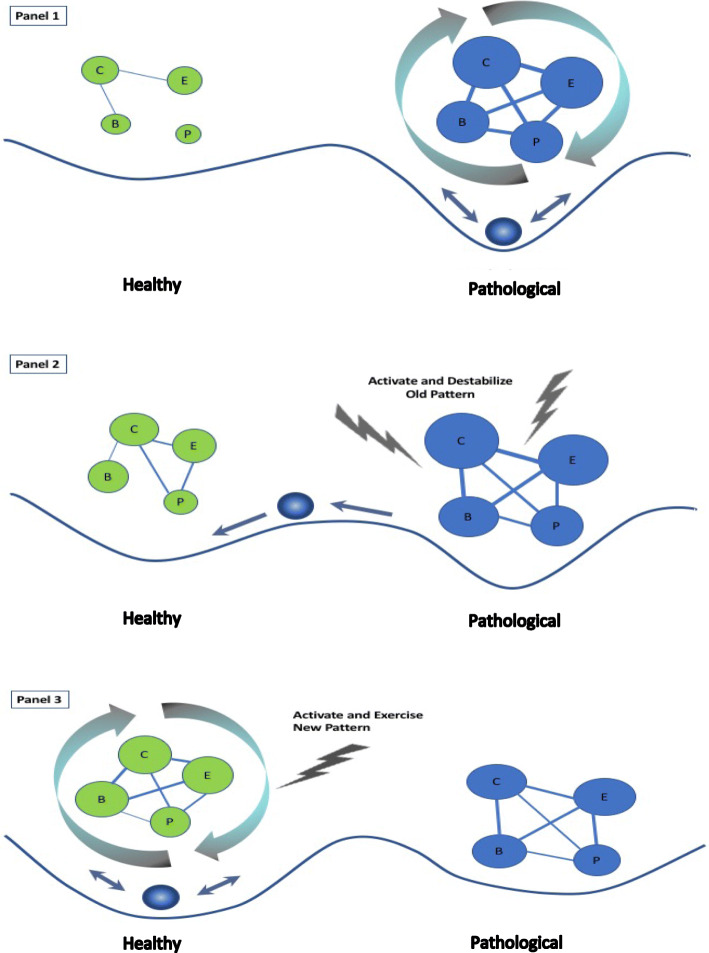
BACKGROUND: A growing body of research highlights the limitations of traditional methods for studying the process of change in psychotherapy. The science of complex systems offers a useful paradigm for studying patterns of psychopathology and the development of more functional patterns in psychotherapy. Some basic principles of change are presented from subdisciplines of complexity science that are particularly relevant to psychotherapy: dynamical systems theory, synergetics, and network theory. Two early warning signs of system transition that have been identified across sciences (critical fluctuations and critical slowing) are also described. The network destabilization and transition (NDT) model of therapeutic change is presented as a conceptual framework to import these principles to psychotherapy research and to suggest future research directions. DISCUSSION: A complex systems approach has a number of implications for psychotherapy research. We describe important design considerations, targets for research, and analytic tools that can be used to conduct this type of research. CONCLUSIONS: A complex systems approach to psychotherapy research is both viable and necessary to more fully capture the dynamics of human change processes. Research to date suggests that the process of change in psychotherapy can be nonlinear and that periods of increased variability and critical slowing might be early warning signals of transition in psychotherapy, as they are in other systems in nature. Psychotherapy research has been limited by small samples and infrequent assessment, but ambulatory and electronic methods now allow researchers to more fully realize the potential of concepts and methods from complexity science.
Overview
The claims and statistics of this paper haven’t been checked yet.
Run the check — free, no account needed. It reads the open-access text and checks the sources it cites.
Integrity signals
Registry
Cites
Statistics
Figures
Verification
Claims the paper makes
The claims and statistics of this paper haven’t been checked yet.
Run the check — free, no account needed. It reads the open-access text and checks the sources it cites.
Claims other papers make about this one
Each is checked against this paper’s own text: does it say what the citing paper says it does?
The cited source says what the claim attributes to it.
In the citing paper
“Modeling downstream mechanisms will likely require complex approaches such as network analytic frameworks”
From Measuring the active elements of cognitive-behavioral therapies (2023) · cites this paper as Hayes & Andrews, 2020
Self-check
Percentages, sums and reported differences re-computed from the paper’s own numbers.
The self-check needs the paper’s full text.
Citations
Cites
Estimating psychological networks and their accuracy: A tutorial paper
Epskamp, S., Borsboom, D., & Fried, E. I. (2018) · Behavior Research Methods · doi:10.3758/s13428-017-0862-1 · Cited by 5,715
Early-warning signals for critical transitions
Scheffer, M., Bascompte, J., Brock, W. A., Brovkin, V., Carpenter, S. R., Dakos, V., Held, H., van Nes, E. H., Rietkerk, M., & Sugihara, G. (2009) · Nature · doi:10.1038/nature08227 · Cited by 4,854
Network analysis: An integrative approach to the structure of psychopathology
Borsboom, D., & Cramer, A. O. J. (2013) · Annual Review of Clinical Psychology · doi:10.1146/annurev-clinpsy-050212-185608 · Cited by 4,359
A dynamic systems approach to the development of cognition and action
Thelen, E., & Smith, L. B. (1996) · Computers & Mathematics with Applications · doi:10.1016/s0898-1221(96)90021-8 · Cited by 3,454
Hölzel, B. K., Lazar, S. W., Gard, T., Schuman-Olivier, Z., Vago, D. R., & Ott, U. (2011) · Perspectives on Psychological Science · doi:10.1177/1745691611419671 · Cited by 3,024
Dynamic patterns: The self-organization of brain and behavior
(1997) · Computers & Mathematics with Applications · doi:10.1016/s0898-1221(97)90151-6 · Cited by 2,857
Positive Emotions Trigger Upward Spirals Toward Emotional Well-Being
Fredrickson, B. L., & Joiner, T. (2002) · Psychological Science · doi:10.1111/1467-9280.00431 · Cited by 2,655
Maximizing exposure therapy: An inhibitory learning approach
Craske, M. G., Treanor, M., Conway, C. C., Zbozinek, T., & Vervliet, B. (2014) · Behaviour Research and Therapy · doi:10.1016/j.brat.2014.04.006 · Cited by 2,339
Anticipating Critical Transitions
Scheffer, M., Carpenter, S. R., Lenton, T. M., Bascompte, J., Brock, W., Dakos, V., van de Koppel, J., van de Leemput, I. A., Levin, S. A., van Nes, E. H., et al. (2012) · Science · doi:10.1126/science.1225244 · Cited by 2,208
Nahum-Shani, I., Smith, S. N., Spring, B. J., Collins, L. M., Witkiewitz, K., Tewari, A., & Murphy, S. A. (2018) · Annals of Behavioral Medicine · doi:10.1007/s12160-016-9830-8 · Cited by 2,171
Australian vegetated coastal ecosystems as global hotspots for climate change mitigation
Serrano, Ó., Lovelock, C. E., Atwood, T. B., Macreadie, P. I., Canto, R., Phinn, S., Arias‐Ortiz, A., Bai, L., Baldock, J., Bedulli, C., et al. (2019) · Nature Communications · doi:10.1038/s41467-019-12176-8 · Cited by 1,193
Dakos, V., Carpenter, S. R., Brock, W. A., Ellison, A. M., Guttal, V., Ives, A. R., Kéfi, S., Livina, V., Seekell, D. A., van Nes, E. H., et al. (2012) · PLoS ONE · doi:10.1371/journal.pone.0041010 · Cited by 1,151
Mental disorders as networks of problems: a review of recent insights
Fried, E. I., van Borkulo, C. D., Cramer, A. O. J., Boschloo, L., Schoevers, R. A., & Borsboom, D. (2016) · Social Psychiatry and Psychiatric Epidemiology · doi:10.1007/s00127-016-1319-z · Cited by 1,144
Dynamic patterns: the self-organization of brain and behavior
(1995) · Choice Reviews Online · doi:10.5860/choice.33-1521 · Cited by 1,143
Lack of group-to-individual generalizability is a threat to human subjects research
Fisher, A. J., Medaglia, J. D., & Jeronimus, B. F. (2018) · Proceedings of the National Academy of Sciences · doi:10.1073/pnas.1711978115 · Cited by 1,099
Garland, E. L., Fredrickson, B., Kring, A. M., Johnson, D. P., Meyer, P. S., & Penn, D. L. (2010) · Clinical Psychology Review · doi:10.1016/j.cpr.2010.03.002 · Cited by 1,035
Moving Forward: Challenges and Directions for Psychopathological Network Theory and Methodology
Fried, E. I., & Cramer, A. O. J. (2017) · Perspectives on Psychological Science · doi:10.1177/1745691617705892 · Cited by 1,008
Robinaugh, D. J., Hoekstra, R. H. A., Toner, E. R., & Borsboom, D. (2020) · Psychological Medicine · doi:10.1017/s0033291719003404 · Cited by 861
Sudden gains and critical sessions in cognitive-behavioral therapy for depression.
Tang, T. Z., & DeRubeis, R. J. (1999) · Journal of Consulting and Clinical Psychology · doi:10.1037/0022-006x.67.6.894 · Cited by 684
The Lancet Psychiatry Commission on psychological treatments research in tomorrow's science
Holmes, E. A., Ghaderi, A., Harmer, C. J., Ramchandani, P. G., Cuijpers, P., Morrison, A. P., Roiser, J. P., Bockting, C. L. H., O'Connor, R. C., Shafran, R., et al. (2018) · The Lancet Psychiatry · doi:10.1016/s2215-0366(17)30513-8 · Cited by 624
Multistability and metastability: understanding dynamic coordination in the brain
Kelso, J. A. S. (2012) · Philosophical Transactions of the Royal Society B Biological Sciences · doi:10.1098/rstb.2011.0351 · Cited by 604
Major Depression as a Complex Dynamic System
Cramer, A. O. J., van Borkulo, C. D., Giltay, E. J., van der Maas, H. L. J., Kendler, K. S., Scheffer, M., & Borsboom, D. (2016) · PLoS ONE · doi:10.1371/journal.pone.0167490 · Cited by 599
Hayes, A. M., Laurenceau, J., Feldman, G. C., Strauss, J. L., & Cardaciotto, L. (2007) · Clinical Psychology Review · doi:10.1016/j.cpr.2007.01.008 · Cited by 573
Self-citationFlickering gives early warning signals of a critical transition to a eutrophic lake state
Wang, R., Dearing, J. A., Langdon, P. G., Zhang, E., Yang, X., Dakos, V., & Scheffer, M. (2012) · Nature · doi:10.1038/nature11655 · Cited by 517
The Study of Psychopathology from the Network Analysis Perspective: A Systematic Review
Contreras, A., Nieto, I., Valiente, C., Espinosa, R., & Vázquez, C. (2019) · Psychotherapy and Psychosomatics · doi:10.1159/000497425 · Cited by 482
Stuck in a rut: rethinking depression and its treatment
Holtzheimer, P. E., & Mayberg, H. S. (2010) · Trends in Neurosciences · doi:10.1016/j.tins.2010.10.004 · Cited by 456
Craske, M. G., Meuret, A. E., Ritz, T., Treanor, M., Dour, H., & Rosenfield, D. (2019) · Journal of Consulting and Clinical Psychology · doi:10.1037/ccp0000396 · Cited by 451
Understanding cognitive behaviour therapy: A retrieval competition account
Brewin, C. R. (2006) · Behaviour Research and Therapy · doi:10.1016/j.brat.2006.02.005 · Cited by 425
Critical Slowing Down as a Personalized Early Warning Signal for Depression
Wichers, M., Groot, P. C., & Psychosystems, E. G. (2016) · Psychotherapy and Psychosomatics · doi:10.1159/000441458 · Cited by 399
Quantifying resilience of humans and other animals
Scheffer, M., Bolhuis, J. E., Borsboom, D., Buchman, T. G., Gijzel, S. M. W., Goulson, D., Kammenga, J. E., Kemp, B., van de Leemput, I. A., Levin, S. A., et al. (2018) · Proceedings of the National Academy of Sciences · doi:10.1073/pnas.1810630115 · Cited by 381
A Dynamic Systems Approach to the Development of Cognition and Action
(1995) · Journal of Cognitive Neuroscience · doi:10.1162/jocn.1995.7.4.512 · Cited by 379
Moving From Static to Dynamic Models of the Onset of Mental Disorder
Nelson, B., McGorry, P. D., Wichers, M., Wigman, J. T. W., & Hartmann, J. (2017) · JAMA Psychiatry · doi:10.1001/jamapsychiatry.2017.0001 · Cited by 378
A complex network perspective on clinical science
Hofmann, S. G., Curtiss, J., & McNally, R. J. (2016) · Perspectives on Psychological Science · doi:10.1177/1745691616639283 · Cited by 366
Costantini, G., Richetin, J., Preti, E., Casini, E., Epskamp, S., & Perugini, M. (2017) · Personality and Individual Differences · doi:10.1016/j.paid.2017.06.011 · Cited by 312
Personalized Models of Psychopathology
Wright, A. G. C., & Woods, W. C. (2020) · Annual Review of Clinical Psychology · doi:10.1146/annurev-clinpsy-102419-125032 · Cited by 308
Sudden gains and critical sessions in cognitive-behavioral therapy for depression
Tang, T. Z., & DeRubeis, R. (1999) · Journal of Consulting and Clinical Psychology · doi:10.1037//0022-006x.67.6.894 · Cited by 284
Toward a dynamic model of psychological assessment: Implications for personalized care.
Fisher, A. J. (2015) · Journal of Consulting and Clinical Psychology · doi:10.1037/ccp0000026 · Cited by 271
Strauss, J. L., Hayes, A. M., Johnson, S. L., Newman, C. F., Brown, G. K., Barber, J. P., Laurenceau, J., & Beck, A. T. (2006) · Journal of Consulting and Clinical Psychology · doi:10.1037/0022-006x.74.2.337 · Cited by 238
Self-citationMcCullough, J. P. (1992) · The Journal of Nervous and Mental Disease · doi:10.1097/00005053-199208000-00013 · Cited by 228
Micro-Level Affect Dynamics in Psychopathology Viewed From Complex Dynamical System Theory
Wichers, M., Wigman, J. T. W., & Myin‐Germeys, I. (2015) · Emotion Review · doi:10.1177/1754073915590623 · Cited by 223
Depression as a systemic syndrome: mapping the feedback loops of major depressive disorder
Wittenborn, A. K., Rahmandad, H., Rick, J., & Hosseinichimeh, N. (2016) · Psychological Medicine · doi:10.1017/s0033291715002044 · Cited by 207
Garland, E. L., Geschwind, N., Peeters, F., & Wichers, M. (2015) · Frontiers in Psychology · doi:10.3389/fpsyg.2015.00015 · Cited by 199
Discontinuities and cognitive changes in an exposure-based cognitive therapy for depression
Hayes, A. M., Feldman, G. C., Beevers, C. G., Laurenceau, J.-P., Cardaciotto, L., & Lewis-Smith, J. (2007) · Journal of Consulting and Clinical Psychology · doi:10.1037/0022-006x.75.3.409 · Cited by 198
Self-citationKiesler, D. J. (2017) · Routledge eBooks · doi:10.4324/9781315134246 · Cited by 193
Jacoby, R. J., & Abramowitz, J. S. (2016) · Clinical Psychology Review · doi:10.1016/j.cpr.2016.07.001 · Cited by 188
Blanken, T. F., Van Der Zweerde, T., Van Straten, A., Van Someren, E. J. W., Borsboom, D., & Lancee, J. (2019) · Psychotherapy and Psychosomatics · doi:10.1159/000495045 · Cited by 187
Maximizing exposure therapy An inhibitory learning approach
Pittig, A., Stevens, S., Vervliet, B., Treanor, M., Conway, C., Zbozinek, T. D., & Craske, M. G. (2015) · Kölner Universitäts PublikationsServer (Universität zu Köln) · Cited by 182
A Model of Socioemotional Flexibility at Three Time Scales
Hollenstein, T., Lichtwarck‐Aschoff, A., & Potworowski, G. A. (2013) · Emotion Review · doi:10.1177/1754073913484181 · Cited by 174
Olthof, M., Hasselman, F., Strunk, G., van Rooij, M., Aas, B., Helmich, M. A., Schiepek, G., & Lichtwarck-Aschoff, A. (2020) · Clinical Psychological Science · doi:10.1177/2167702619865969 · Cited by 146
Hayes, A. M., Yasinski, C. W., Barnes, J. B., & Bockting, C. (2015) · Clinical Psychology Review · doi:10.1016/j.cpr.2015.06.007 · Cited by 143
Self-citationSchiepek, G. K., & Strunk, G. (2010) · Biological Cybernetics · doi:10.1007/s00422-009-0362-1 · Cited by 143
Dynamic emotional processing in experiential therapy: Two steps forward, one step back.
Pascual‐Leone, A. (2009) · Journal of Consulting and Clinical Psychology · doi:10.1037/a0014488 · Cited by 141
Witherington, D. C. (2011) · Human Development · doi:10.1159/000326814 · Cited by 134
Flickering as an early warning signal
Dakos, V., van Nes, E. H., & Scheffer, M. (2013) · Theoretical Ecology · doi:10.1007/s12080-013-0186-4 · Cited by 131
Gelo, O. C. G., & Salvatore, S. (2016) · Journal of Counseling Psychology · doi:10.1037/cou0000150 · Cited by 131
Hayes, A. M., & Strauss, J. L. (1998) · Journal of Consulting and Clinical Psychology · doi:10.1037/0022-006x.66.6.939 · Cited by 127
Self-citationHayes, A. M., & Strauss, J. L. (1998) · Journal of Consulting and Clinical Psychology · doi:10.1037//0022-006x.66.6.939 · Cited by 123
Self-citationHollenstein, T. (2012) · Springer eBooks · doi:10.1007/978-1-4614-5007-8 · Cited by 116
Exposure and reorganization: The what and how of effective psychotherapy
Carey, T. A. (2011) · Clinical Psychology Review · doi:10.1016/j.cpr.2010.04.004 · Cited by 112
Hoorelbeke, K., Marchetti, I., Schryver, M. D., & Koster, E. H. W. (2016) · Journal of Affective Disorders · doi:10.1016/j.jad.2016.02.001 · Cited by 110
Early warning signals of recovery in complex systems
Clements, C. F., Mccarthy, M. A., & Blanchard, J. L. (2019) · Nature Communications · doi:10.1038/s41467-019-09684-y · Cited by 108
Psychotherapy Is Chaotic—(Not Only) in a Computational World
Schiepek, G. K., Viol, K., Aichhorn, W., Hütt, M. ‐., Sungler, K., Pincus, D., & Schöller, H. J. (2017) · Frontiers in Psychology · doi:10.3389/fpsyg.2017.00379 · Cited by 99
Ricard, B. J., Marsch, L. A., Crosier, B. S., & Hassanpour, S. (2018) · Journal of Medical Internet Research · doi:10.2196/11817 · Cited by 99
Burger, J., van der Veen, D. C., Robinaugh, D. J., Quax, R., Riese, H., Schoevers, R. A., & Epskamp, S. (2020) · BMC Medicine · doi:10.1186/s12916-020-01558-1 · Cited by 99
Sudden gains in cognitive–behavior therapy for treatment-resistant depression: Processes of change.
Abel, A., Hayes, A. M., Henley, W., & Kuyken, W. (2016) · Journal of Consulting and Clinical Psychology · doi:10.1037/ccp0000101 · Cited by 92
Self-citationSelf-organization in psychotherapy: testing the synergetic model of change processes
Schiepek, G. K., Tominschek, I., & Heinzel, S. (2014) · Frontiers in Psychology · doi:10.3389/fpsyg.2014.01089 · Cited by 91
Slowing Down of Recovery as Generic Risk Marker for Acute Severity Transitions in Chronic Diseases
Olde Rikkert, M. G. M., Dakos, V., Buchman, T. G., Boer, R. D., Glass, L., Cramer, A. O. J., Levin, S., van Nes, E., Sugihara, G., Ferrari, M. D., et al. (2016) · Critical Care Medicine · doi:10.1097/ccm.0000000000001564 · Cited by 91
Integrative Psychotherapy: A Feedback-Driven Dynamic Systems Approach
Schiepek, G. K., Eckert, H., Aas, B., Wallot, S., & Wallot, A. (2015) · Hogrefe Publishing eBooks · doi:10.1027/00472-000 · Cited by 91
Snippe, E., Viechtbauer, W., Geschwind, N., Klippel, A., de Jonge, P., & Wichers, M. (2017) · Scientific Reports · doi:10.1038/srep46523 · Cited by 91
A Clinician’s Primer for Idiographic Research: Considerations and Recommendations
Piccirillo, M. L., Beck, E. D., & Rodebaugh, T. L. (2019) · Behavior Therapy · doi:10.1016/j.beth.2019.02.002 · Cited by 90
The Intrinsic Dynamics of Psychological Process
Vallacher, R. R., van Geert, P. L. C., & Nowak, A. K. (2015) · Current Directions in Psychological Science · doi:10.1177/0963721414551571 · Cited by 85
Wichers, M., Schreuder, M. J., Goekoop, R., & Groen, R. N. (2018) · Psychological Medicine · doi:10.1017/s0033291718002064 · Cited by 81
Geschwind, N., Arntz, A., Bannink, F., & Peeters, F. (2019) · Behaviour Research and Therapy · doi:10.1016/j.brat.2019.03.005 · Cited by 79
Olthof, M., Hasselman, F., Strunk, G., Aas, B., Schiepek, G. K., & Lichtwarck‐Aschoff, A. (2019) · Psychotherapy Research · doi:10.1080/10503307.2019.1633484 · Cited by 78
A meta-analysis of sudden gains in psychotherapy: Outcome and moderators.
Shalom, J. G., & Aderka, I. M. (2020) · Clinical Psychology Review · doi:10.1016/j.cpr.2020.101827 · Cited by 77
Ekkers, W., Korrelboom, K., Huijbrechts, I., Smits, N., Cuijpers, P., & van der Gaag, M. (2011) · Behaviour Research and Therapy · doi:10.1016/j.brat.2011.05.010 · Cited by 75
Kowalik, Z. J., Schiepek, G. K., Kumpf, K., Roberts, L. E., & Elbert, T. R. (1997) · Psychotherapy Research · doi:10.1080/10503309712331331973 · Cited by 72
Salvatore, S., & Tschacher, W. (2012) · Frontiers in Psychology · doi:10.3389/fpsyg.2012.00253 · Cited by 71
Hosenfeld, B., Bos, E. H., Wardenaar, K. J., Conradi, H. J., van der Maas, H. L. J., Visser, I., & de Jonge, P. (2015) · BMC Psychiatry · doi:10.1186/s12888-015-0596-5 · Cited by 71
Yasinski, C. W., Hayes, A. M., Ready, C. B., Abel, A., Görg, N., & Kuyken, W. (2019) · Psychotherapy Research · doi:10.1080/10503307.2019.1699972 · Cited by 71
Self-citationDunn, B. D., Widnall, E., Reed, N., Owens, C., Campbell, J., & Kuyken, W. (2019) · Behaviour Research and Therapy · doi:10.1016/j.brat.2019.103418 · Cited by 70
Lichtwarck‐Aschoff, A., Hasselman, F., Cox, R. F. A., Pepler, D. J., & Granic, I. (2012) · PubMed · Cited by 69
Development and initial implementation of the Dynamic Assessment Treatment Algorithm (DATA)
Fernandez, K. C., Fisher, A. J., & Chi, C. (2017) · PLOS ONE · doi:10.1371/journal.pone.0178806 · Cited by 68
Linguistic analysis of patients with mood and anxiety disorders during cognitive behavioral therapy
Sonnenschein, A. R., Hofmann, S. G., Ziegelmayer, T., & Lutz, W. (2018) · Cognitive Behaviour Therapy · doi:10.1080/16506073.2017.1419505 · Cited by 68
Haken, H. (1992) · Springer series in synergetics · doi:10.1007/978-3-642-77534-5_2 · Cited by 66
Pattern destabilization and emotional processing in cognitive therapy for personality disorders
Hayes, A. M., & Yasinski, C. W. (2015) · Frontiers in Psychology · doi:10.3389/fpsyg.2015.00107 · Cited by 64
Self-citationIn and out of schizophrenia: Activation and deactivation of the negative and positive schemas
Beck, A. T., Himelstein, R., & Grant, P. M. (2017) · Schizophrenia Research · doi:10.1016/j.schres.2017.10.046 · Cited by 62
Vittengl, J. R., Clark, L. A., Thase, M. E., & Jarrett, R. B. (2013) · Journal of Consulting and Clinical Psychology · doi:10.1037/a0032879 · Cited by 61
Schiepek, G. K., Kowalik, Z. J., Schütz, A., Köhler, M., Richter, K., Strunk, G., Mühlnickel, W., & Elbert, T. R. (1997) · Psychotherapy Research · doi:10.1080/10503309712331331953 · Cited by 59
Personality development in psychotherapy: a synergetic model of state-trait dynamics
Schöller, H. J., Viol, K., Aichhorn, W., Hütt, M. ‐., & Schiepek, G. K. (2018) · Cognitive Neurodynamics · doi:10.1007/s11571-018-9488-y · Cited by 57
Bruijniks, S. J. E., DeRubeis, R. J., Hollon, S. D., & Huibers, M. J. H. (2019) · Clinical Psychological Science · doi:10.1177/2167702619830391 · Cited by 57
Heinzel, S., Tominschek, I., & Schiepek, G. K. (2014) · PubMed · Cited by 54
The cusp catastrophe model as cross-sectional and longitudinal mixture structural equation models.
Chow, S., Witkiewitz, K. A., Grasman, R. P. P. P., & Maisto, S. A. (2015) · Psychological Methods · doi:10.1037/a0038962 · Cited by 50
Instabilities and phase transitions in human brain and behavior
Kelso (2010) · Frontiers in Human Neuroscience · doi:10.3389/fnhum.2010.00023 · Cited by 49
Nonlinear Dynamics: Theoretical Perspectives and Application to Suicidology
Schiepek, G. K., Fartacek, C., Sturm, J., Kralovec, K., Fartacek, R. R., & Plöderl, M. (2011) · Suicide and Life-Threatening Behavior · doi:10.1111/j.1943-278x.2011.00062.x · Cited by 49
Kostrubiec, V., Tallet, J., & Zanone, P. (2005) · Experimental Brain Research · doi:10.1007/s00221-005-0208-6 · Cited by 47
Tschacher, W., & Haken, H. (2019) · Springer eBooks · doi:10.1007/978-3-030-12748-0 · Cited by 46
Ready, C. B., Hayes, A. M., Yasinski, C. W., Webb, C. P. M., Gallop, R., Deblinger, E., & Laurenceau, J. (2015) · Behavior Therapy · doi:10.1016/j.beth.2015.03.004 · Cited by 45
Self-citationZainal, N. H., & Newman, M. G. (2019) · Journal of Abnormal Psychology · doi:10.1037/abn0000428 · Cited by 45
Dynamic Pattern Formation: A Primer
Kelso, J. A. S., Ding, M., & Schöner, G. (1993) · The MIT Press eBooks · doi:10.7551/mitpress/2523.003.0006 · Cited by 44
Schiepek, G. K., Gelo, O. C. G., Viol, K., Kratzer, L., Orsucci, F. F., de Felice, G., Stöger‐Schmidinger, B., Sammet, I., Aichhorn, W., & Schöller, H. J. (2020) · Counselling and Psychotherapy Research · doi:10.1002/capr.12300 · Cited by 43
Shalom, J. G., Gilboa‐Schechtman, E., Atzil–Slonim, D., Bar‐Kalifa, E., Hasson‐Ohayon, I., van Oppen, P., van Balkom, A. J. L. M., & Aderka, I. M. (2018) · Journal of Consulting and Clinical Psychology · doi:10.1037/ccp0000344 · Cited by 40
Holtforth, M. G., Hayes, A. M., Sutter, M., Wilm, K., Schmied, E., Laurenceau, J., & Caspar, F. (2012) · Psychotherapy and Psychosomatics · doi:10.1159/000336813 · Cited by 39
Self-citationHitchcock, C., Gormley, S., Rees, C., Rodrigues, E., Gillard, J., Panesar, I., Wright, I. M., Hammond, E. R., Watson, P., Werner‐Seidler, A., et al. (2018) · Behaviour Research and Therapy · doi:10.1016/j.brat.2018.08.008 · Cited by 38
Hosseinichimeh, N., Wittenborn, A. K., Rick, J., Jalali, M. S., & Rahmandad, H. (2018) · PLoS ONE · doi:10.1371/journal.pone.0204389 · Cited by 38
A Comparison of Methods for Estimating Change in Drinking following Alcohol Treatment
Witkiewitz, K. A., Maisto, S. A., & Donovan, D. M. (2010) · Alcoholism Clinical and Experimental Research · doi:10.1111/j.1530-0277.2010.01308.x · Cited by 36
Cabrieto, J., Adolf, J. K., Tuerlinckx, F., Kuppens, P., & Ceulemans, E. (2018) · Scientific Reports · doi:10.1038/s41598-018-33819-8 · Cited by 34
Hoffart, A., & Johnson, S. U. (2020) · Clinical Psychological Science · doi:10.1177/2167702620901744 · Cited by 31
Ellison, W. D., Levy, K. N., Newman, M. G., Pincus, A. L., Wilson, S. J., & Molenaar, P. C. M. (2019) · Personality Disorders Theory Research and Treatment · doi:10.1037/per0000363 · Cited by 29
Vittengl, J. R., Clark, L. A., Thase, M. E., & Jarrett, R. B. (2016) · Behaviour Research and Therapy · doi:10.1016/j.brat.2016.08.008 · Cited by 27
Tschacher, W., & Haken, H. (2019) · Psychotherapy Research · doi:10.1080/10503307.2019.1685139 · Cited by 26
Helmich, M. A., Snippe, E., Kunkels, Y. K., Riese, H., Smit, A. C., & Wichers, M. (2021) · doi:10.31234/osf.io/fertq · Cited by 24
Coherence, Complexity, and Information Flow: Self-Organizing Processes in Psychotherapy
Pincus, D. (2008) · Cambridge University Press eBooks · doi:10.1017/cbo9781139058544.012 · Cited by 23
Mining concepts of health responsibility using text mining and exploratory graph analysis
Kjellström, S., & Golino, H. F. (2018) · Scandinavian Journal of Occupational Therapy · doi:10.1080/11038128.2018.1455896 · Cited by 20
Andrews, L. A., Hayes, A. M., Abel, A., & Kuyken, W. (2020) · Journal of Consulting and Clinical Psychology · doi:10.1037/ccp0000467 · Cited by 20
Self-citationPascual‐Leone, A., Yeryomenko, N., Sawashima, T., & Warwar, S. H. (2017) · Psychotherapy Research · doi:10.1080/10503307.2017.1315779 · Cited by 18
The Role of Self-Injury in Behavioral Flexibility and Resilience
Pincus, D., Eberle, K., Walder, C. S., Kemp, A. S., Sandman, C. A., & Lenjavi, M. (2013) · PsycEXTRA Dataset · doi:10.1037/e634192013-034 · Cited by 16
Self-Organization in Psychotherapy
Goudsmit, A. L. (1989) · Recent research in psychology · doi:10.1007/978-3-642-48704-0 · Cited by 16
A Fast-Slow Dynamical System Model of Addiction: Predicting Relapse Frequency
Duncan, J. P., Aubele-Futch, T., & McGrath, M. (2019) · SIAM Journal on Applied Dynamical Systems · doi:10.1137/18m121410x · Cited by 16
How to modify psychopathological states? Hypotheses based on complex systems theory
Haken, H., & Tschacher, W. (n.d.) · PubMed · doi:10.7892/boris.108121 · Cited by 15
Strunk, G., & Lichtwarck‐Aschoff, A. (2019) · Journal for Person-Oriented Research · doi:10.17505/jpor.2019.08 · Cited by 15
Altman, A. D., Shapiro, L. A., & Fisher, A. (2020) · Frontiers in Psychology · doi:10.3389/fpsyg.2020.00782 · Cited by 14
Lichtwarck‐Aschoff, A., & van Rooij, M. M. J. W. (2019) · Clinical Psychology & Psychotherapy · doi:10.1002/cpp.2383 · Cited by 10
Schöller, H. J., Viol, K., Goditsch, H., Aichhorn, W., Hütt, M. ‐., & Schiepek, G. K. (2019) · PubMed · Cited by 10
Self-Organization in Social Groups
Tschacher, W., Brunner, E. J., & Schiepek, G. K. (1992) · Springer series in synergetics · doi:10.1007/978-3-642-77534-5_19 · Cited by 9
Pincus, D. (2019) · PubMed · Cited by 4
Causation and Chance: Integrating the Dynamical Systems Approach with Statistical Thinking
Tschacher, W., & Haken, H. (2019) · Springer eBooks · doi:10.1007/978-3-030-12748-0_1 · Cited by 2
Interventions in Psychotherapy
Tschacher, W., & Haken, H. (2019) · Springer eBooks · doi:10.1007/978-3-030-12748-0_3 · Cited by 1
Research works printed but not linked: 2
- Schiepek G, Aichhorn W, Schöller H. Monitoring change dynamics - a nonlinear approach to psychotherapy feedback. Chaos Complex Lett. 2017;11(3):355–75.
- Ruwaard J, Kooistra L, Thong M. Early warning signs of depression. In: Ecological momentary assessment in mental health research: a practical introduction, with examples in R. 1st ed. Amsterdam: APH Mental Health; 2018.
Cited by
Sorted by citations
Modeling psychopathology: From data models to formal theories.
Haslbeck, J. M. B., Ryan, O., Robinaugh, D. J., Waldorp, L., & Borsboom, D. (2021) · Psychological Methods · doi:10.1037/met0000303 · Cited by 253
Roefs, A., Fried, E. I., Kindt, M., Martijn, C., Elzinga, B., Evers, A. W. M., Wiers, R. W., Borsboom, D., & Jansen, A. (2022) · Behaviour Research and Therapy · doi:10.1016/j.brat.2022.104096 · Cited by 185
“It is embedded in a wider framework of systems science and network science (e.g., Hayes, 2020; Robinaugh, Hoekstra, Toner, & Borsboom, 2020; Schiepek, 2009, 2020).”
BackgroundSystems all the way down: embracing complexity in mental health research
Fried, E. I., & Robinaugh, D. J. (2020) · BMC Medicine · doi:10.1186/s12916-020-01668-w · Cited by 176
Complexity theory of psychopathology.
Olthof, M., Hasselman, F., Oude Maatman, F., Bosman, A. M. T., & Lichtwarck-Aschoff, A. (2023) · Journal of Psychopathology and Clinical Science · doi:10.1037/abn0000740 · Cited by 131
van der Velden, A. M., Scholl, J., Elmholdt, E.-M., Fjorback, L. O., Harmer, C. J., Lazar, S. W., O’Toole, M. S., Smallwood, J., Roepstorff, A., & Kuyken, W. (2023) · Biological Psychiatry · doi:10.1016/j.biopsych.2022.06.038 · Cited by 83
Metadata
- Authors
- Hayes, A. M., & Andrews, L. A.
- Affiliations
- University of Delaware (US)
- Corresponding author
- Hayes, Adele M.
- Venue
- BMC Medicine
- Published
- 2020-07-14
- Volume
- 18
- Issue
- 1
- Pages
- 197-197
- ISSN
- 1741-7015 (ISSN-L)
- PMC
- PMC7359463
- OpenAlex
- W3042416448
- Cited by
- 149
- References
- 128
- Citations by year
- 2026: 25 · 2025: 31 · 2024: 25 · 2023: 33 · 2022: 22 · 2021: 11 · 2020: 2
- FWCI
- 6.81
- Type
- journal article
- Language
- en
- Open access
- gold
- doi.org
- Locations
- BMC Medicine (publishedVersion, cc-by)
- PubMed Central (publishedVersion, cc-by)
- PubMed (publishedVersion)
- DOAJ (DOAJ: Directory of Open Access Journals) (submittedVersion, cc-by-sa)
- Funders
- Foundation for the National Institutes of Health (R21-MH062662, R01-MH086558)
- Topics
- Social Sciences › Psychology › Clinical Psychology › Psychotherapy Techniques and Applications
- Social Sciences › Psychology › Experimental and Cognitive Psychology › Mental Health Research Topics
- Social Sciences › Education › Chaos, Complexity, and Education
- Keywords
- psychotherapeutic change, complex systems, dynamical systems theory, synergetics, network theory, critical slowing down, critical fluctuations, early warning indicators, system transition, nonlinear dynamics, psychopathology, ambulatory assessment, digital assessment
- MeSH terms
- Delivery of Health Care, Feedback, Humans, Psychotherapy
About these checks
Registry, retraction, Cites and statistics results are computed, not judged, with one exception: a printed reference that no index lists is read once by a model before it counts as a citation error. Claims are extracted by a model and kept only when their quote appears verbatim in the text; each cited source is then checked, with a model’s help, for whether it says what the claim relies on. Those verdicts can be wrong — read the claim’s quote and the cited source before relying on one.
Statistics and arithmetic are recomputed, not judged.
Confidence bands are shown only for fields calibrated on our annotated test set. None is calibrated yet, so no band is shown.
What counts as a claim ›How we measure confidence ›How we check this ›
Are you an author, or do you see a problem with this page? Request a review
