

Response to COVID-19 in South Korea and implications for lifting stringent interventions
Open accessThe DOI matches its Crossref record; 16 of the 16 references it cites were found in a registry or an index.
Abstract
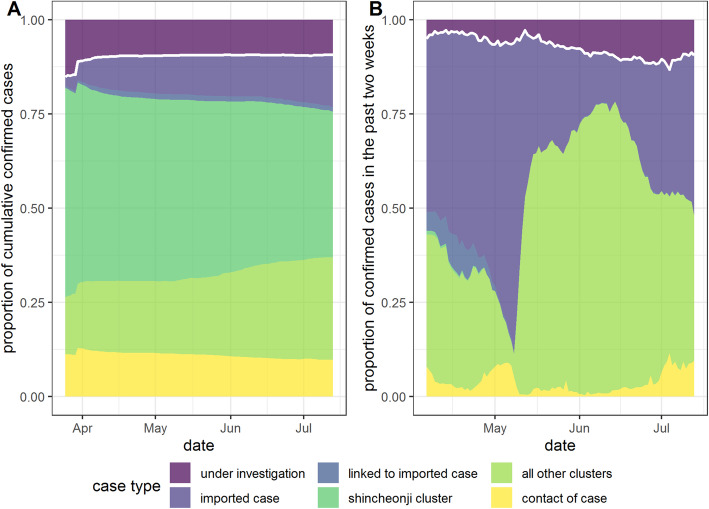
Background: After experiencing a sharp growth in COVID-19 cases early in the pandemic, South Korea rapidly controlled transmission while implementing less stringent national social distancing measures than countries in Europe and the USA. This has led to substantial interest in their “test, trace, isolate” strategy. However, it is important to understand the epidemiological peculiarities of South Korea’s outbreak and characterise their response before attempting to emulate these measures elsewhere. Methods: We systematically extracted numbers of suspected cases tested, PCR-confirmed cases, deaths, isolated confirmed cases, and numbers of confirmed cases with an identified epidemiological link from publicly available data. We estimated the time-varying reproduction number, R t , using an established Bayesian framework, and reviewed the package of interventions implemented by South Korea using our extracted data, plus published literature and government sources. Results: We estimated that after the initial rapid growth in cases, R t dropped below one in early April before increasing to a maximum of 1.94 (95%CrI, 1.64–2.27) in May following outbreaks in Seoul Metropolitan Region. By mid-June, R t was back below one where it remained until the end of our study (July 13th). Despite less stringent “lockdown” measures, strong social distancing measures were implemented in high-incidence areas and studies measured a considerable national decrease in movement in late February. Testing the capacity was swiftly increased, and protocols were in place to isolate suspected and confirmed cases quickly; however, we could not estimate the delay to isolation using our data. Accounting for just 10% of cases, individual case-based contact tracing picked up a relatively minor proportion of total cases, with cluster investigations accounting for 66%. Conclusions: Whilst early adoption of testing and contact tracing is likely to be important for South Korea’s successful outbreak control, other factors including regional implementation of strong social distancing measures likely also contributed. The high volume of testing and the low number of deaths suggest that South Korea experienced a small epidemic relative to other countries. Caution is needed in attempting to replicate the South Korean response in populations with larger more geographically widespread epidemics where finding, testing, and isolating cases that are linked to clusters may be more difficult.
Overview
The claims and statistics of this paper haven’t been checked yet.
Free: it reads the open-access text and checks the first 5 claims that cite a source we can check. Create a free account to check every claim.
Integrity signals
Registry
Cites
Statistics
Figures
Verification
Claims the paper makes
The claims and statistics of this paper haven’t been checked yet.
Free: it reads the open-access text and checks the first 5 claims that cite a source we can check. Create a free account to check every claim.
Claims other papers make about this one
Each is checked against this paper’s own text: does it say what the citing paper says it does?
The source backs part of the claim, not all of it — or backs it for a different population, condition or comparison.
In the citing paper
“The COVID-19 pandemic has been controlled in Korea without a nationwide lockdown or drastic social distancing policies, unlike Europe and the United States [36].”
From Depression, anxiety, and stress in Korean general population during the COVID-19 pandemic. (2022) · cites this paper as [36]
Experimental — accuracy not yet measured
Self-check
Percentages, sums and reported differences re-computed from the paper’s own numbers.
The self-check needs the paper’s full text.
Citations
Cites
R: A Language and Environment for Statistical Computing
R Core Team (2025) · doi:10.32614/r.manuals · Cited by 352,181
Estimating the effects of non-pharmaceutical interventions on COVID-19 in Europe
Flaxman, S., Mishra, S., Gandy, A., Unwin, H. J. T., Mellan, T. A., Coupland, H., Whittaker, C., Zhu, H., Berah, T., Eaton, J. W., et al. (2020) · Nature · doi:10.1038/s41586-020-2405-7 · Cited by 3,350
Self-citationA New Framework and Software to Estimate Time-Varying Reproduction Numbers During Epidemics
Cori, A., Ferguson, N. M., Fraser, C., & Cauchemez, S. (2013) · American Journal of Epidemiology · doi:10.1093/aje/kwt133 · Cited by 1,530
Self-citationContact Tracing during Coronavirus Disease Outbreak, South Korea, 2020
Park, Y. J., Choe, Y. J., Park, O., Park, S. Y., Kim, Y.-M., Kim, J., Kweon, S., Woo, Y., Gwack, J., Kim, S. S., et al. (2020) · Emerging Infectious Diseases · doi:10.3201/eid2610.201315 · Cited by 500
Improved inference of time-varying reproduction numbers during infectious disease outbreaks
Thompson, R. N., Stockwin, J. E., van Gaalen, R. D., Polonsky, J. A., Kamvar, Z. N., Demarsh, P. A., Dahlqwist, E., Li, S., Miguel, E., Jombart, T., et al. (2019) · Epidemics · doi:10.1016/j.epidem.2019.100356 · Cited by 492 · cited 1×
“Our method accounts for imported cases, which would otherwise tend to inflate Rt, as previously described [40], and Fig.”
MethodCoronavirus Disease Outbreak in Call Center, South Korea
Park, S. Y., Kim, Y.-M., Yi, S., Lee, S., Na, B.-J., Kim, C. B., Kim, J.-I., Kim, H. S., Kim, Y. B., Park, Y., et al. (2020) · Emerging Infectious Diseases · doi:10.3201/eid2608.201274 · Cited by 467
Preliminary epidemiological assessment of MERS-CoV outbreak in South Korea, May to June 2015
Cowling, B. J., Park, M., Fang, V. J., Wu, P., Leung, G. M., & Wu, J. T. (2015) · Eurosurveillance · doi:10.2807/1560-7917.es2015.20.25.21163 · Cited by 323
Ki, M. (2020) · Epidemiology and Health · doi:10.4178/epih.e2020007 · Cited by 242
West African Ebola Epidemic after One Year — Slowing but Not Yet under Control
WHO Ebola Response Team (2015) · New England Journal of Medicine · doi:10.1056/nejmc1414992 · Cited by 187
West African Ebola epidemic after one year — slowing but not yet under control
Nouvellet, P. (2015) · Sussex Research Online (University of Sussex) · Cited by 162
Self-citationEarly Epidemiological and Clinical Characteristics of 28 Cases of Coronavirus Disease in South Korea
COVID-19 National Emergency Response Center, E. A. C. M. T. (2020) · Osong Public Health and Research Perspectives · doi:10.24171/j.phrp.2020.11.1.03 · Cited by 124
Potential Role of Social Distancing in Mitigating Spread of Coronavirus Disease, South Korea
Park, S. W., Sun, K., Viboud, C. G., Grenfell, B. T., & Dushoff, J. G. (2020) · Emerging infectious diseases · doi:10.3201/eid2611.201099 · Cited by 71
Kim, S. I., & Lee, J. (2020) · Journal of Korean Medical Science · doi:10.3346/jkms.2020.35.e154 · Cited by 62
Park, S. W., Sun, K., Viboud, C. G., et al. (2020) · medRxiv · doi:10.1101/2020.03.27.20045815 · Cited by 36
RcppRoll: Efficient Rolling / Windowed Operations
Ushey, K. (2013) · doi:10.32614/cran.package.rcpproll · Cited by 15
Reduction in time delay of isolation in COVID-19 cases in South KoreaPreprint
Ryu, S., Jang, C., & Kim, B. (2020) · medRxiv · doi:10.1101/2020.04.03.20051847 · Cited by 3
Research works printed but not linked: 48
- European Centre for Disease Prevention and Control COVID-19 situation update worldwide, as of 5 August 2020 2020
- Korea Centers for Disease Control and Prevention. The first imported case of the novel coronavirus (2019-nCoV) in Korea | Press Release | News Room: KCDC. https://www.cdc.go.kr/board/board.es?mid=a30402000000&bid=0030&act=view&list_no=365797&tag=&nPage=1. Accessed 21 Jan 2020.
- The Government of the Republic of Korea Tackling COVID-19 the Government of the Republic of Korea 2020
- Korea Centers for Disease Control and Prevention The updates of COVID-19 in Republic of Korea as of 24 February 2020 2020
- Ministry of Health & Welfare. Press release 2020-02-23 Briefing on the pan-governmental meeting for COVID-19 2020. https://www.mohw.go.kr/eng/nw/nw0101vw.jsp?PAR_MENU_ID=1007&MENU_ID=100701&page=1&CONT_SEQ=353124. Accessed 7 Aug 2020.
- Korea Centers for Disease Control & Prevention The updates of COVID-19 in Republic of Korea, 10 May 2020 2020
- Korea Center for Disease Control & Prevention Updates on COVID-19 in Republic of Korea, 13 May 2020 2020
- Korea Centers for Disease Control & Prevention Updates on COVID-19 in Republic of Korea, 5 June 2020 2020
- Korea Centers for Disease Control & Prevention Updates on COVID-19 in Republic of Korea, 12 June 2020 2020
- Korea Centers for Disease Control & Prevention Updates on COVID-19 in Republic of Korea, 23 June 2020 2020
- Korea Centers for Disease Control & Prevention Updates on COVID-19 in Republic of Korea 27 March 2020 2020
- Korea Centers for Disease Control & Prevention Updates on COVID-19 in Republic of Korea, 24 June 2020 2020
- Korea Centers for Disease Control & Prevention Updates on COVID-19 in Republic of Korea, 1 July 2020 2020
- Korea Centers for Disease Control & Prevention Updates on COVID-19 in Republic of Korea, 4 July 2020 2020
- Korea Centers for Disease Control & Prevention Updates on COVID-19 in Republic of Korea, 10 July 2020 2020
- Korea Centers for Disease Control & Prevention Updates on COVID-19 in Republic of Korea, 13 July 2020 2020
- Korea Centers for Disease Control and Prevention Updates on COVID-19 in Republic of Korea, 21 April 2020 2020
- Korea Centers for Disease Control and Prevention Updates on COVID-19 in Republic of Korea, 24 April 2020 2020
- Korea Centers for Disease Control and Prevention Coronavirus infection-19 domestic outbreak status (April 30th regular briefing) 2020
- Korea Centers for Disease Control and Prevention Updates on COVID-19 in Republic of Korea 8 May 2020 2020
- Korea Centers for Disease Control & Prevention Updates on COVID-19 in Republic of Korea, 18 May 2020 2020
- Korea Centers for Disease Control & Prevention Updates on COVID-19 in Republic of Korea 1 April 2020 2020
- Korea Centers for Disease Control & Prevention The updates of COVID-19 in Republic of Korea, 4 April 2020 2020
- Ministry of Education The new school year begins with online classes 2020
- Centers for Disease Control & Prevention Updates on COVID-19 in Republic of Korea, 9 April 2020 2020
- Korea Centers for Disease Control and Prevention Updates on COVID-19 in Republic of Korea 20 April 2020 2020
- Korea Centers for Disease Control and Prevention Updates on COVID-19 in Republic of Korea 6 May 2020 2020
- Korea Centers for Disease Control and Prevention Updates on COVID-19 in Republic of Korea 11 May 2020 2020
- World Health Organization WHO Public Health and Social Measures Database 2020
- Korea Centers for Disease Control and Prevention. List | Press Release | News Room: KCDC. https://www.cdc.go.kr/board/board.es?mid=a30402000000&bid=0030. Accessed 21 May 2020.
- FitzJohn R Ashton R Hill A Eden M Hinsley H Russell E orderly: lightweight reproducible reporting. R package version 1.1.29 2020
- Cori A EpiEstim: estimate time varying reproduction numbers from epidemic curves. R package version 2.2–1 2019
- Korea Ministy of Health and Welfare Ministry of Health & Welfare: extending intensive “social distancing” for another 2 weeks 2020-04-07 2020
- Korea Centers for Disease Control and Prevention Coronavirus infectious diseases-19 regular disaster prevention headquarters regular briefing (April 19) 2020
- Korea Centers for Disease Control & Prevention Coronavirus disease-19 (COVID-19) public advice & notice enhanced social distancing campaign 2020
- Korea Centers for Disease Control and Prevention Coronavirus infectious diseases-19 regular disaster safety headquarters regular briefing (April 27) 2020
- Korea Centers for Disease Control and Prevention Updates on COVID-19 in Republic of Korea, 28 May 2020 2020
- Korea Centers for Disease Control & Prevention Updates on COVID-19 in Republic of Korea, 15 June 2020 2020
- Korea Centers for Disease Control & Prevention Coronavirus disease-19 (COVID-19) patient treatment & management 2020
- Korean Ministry of Health & Welfare Ministry of Health & Welfare: (2.9) IMS meeting for novel coronavirus presided over by the prime minister 2020
- City G Press releases: Goyang city starts operating the nation’s first “Goyang relief car selected medical center”... From the car to quickly and safely from reception to examination and prescription 2020
- Korea Centers for Disease Control and Prevention The case definition of 2019 novel coronavirus will be expanded 2020
- Korea Centers for Disease Control and Prevention The updates of COVID-19 in Republic of Korea 19 February 2020 2020
- Korea Centers for Disease Control and Prevention The updates of COVID-19 in Republic of Korea 22 February, 2020 2020
- Ministry of Health Korea Coronavirus infection-19 Korea Quarantine System 2020
- Korea Centers for Disease Control and Prevention The updates on COVID-19 in Korea as of 31 March 2020
- Technology Review South Korea is watching quarantined citizens with a smartphone app | MIT Technology Review 2020
- Korean Ministry of Health and Welfare Regular briefing of central disaster and safety countermeasure headquarters on COVID-19 April 27 2020
Cited by
Testing at scale during the COVID-19 pandemic
Mercer, T. R., & Salit, M. (2021) · Nature Reviews Genetics · doi:10.1038/s41576-021-00360-w · Cited by 387
Chang, J.-J., Ji, Y., Li, Y.-H., Pan, H.-F., & Su, P.-Y. (2021) · Journal of Affective Disorders · doi:10.1016/j.jad.2021.05.109 · Cited by 275
Papoutsi, E., Giannakoulis, V. G., Xourgia, E., Routsi, C., Kotanidou, A., & Siempos, I. I. (2021) · Critical Care · doi:10.1186/s13054-021-03540-6 · Cited by 234
Digitalization impacts the COVID-19 pandemic and the stringency of government measures
Heinrichs, H., Mueller, F., Rohfleisch, L., Schulz, V., Talbot, S. R., & Kiessling, F. M. (2022) · Scientific Reports · doi:10.1038/s41598-022-24726-0 · Cited by 141
Zapata-Cuervo, N., Montes-Guerra, M. I., Shin, H. H., Jeong, M., & Cho, M. (2021) · Journal of Hospitality & Tourism Education · doi:10.1080/10963758.2021.1907195 · Cited by 143
“Toward the end of 2019, the unprecedented novel coronavirus, called COVID-19, outbroke in Wuhan, China, and, in a shorter period, it spread worldwide, resulting in taking more than a million people’s lives and halting all humans’ social and economic activities (Shereen et al., 2020).”
BackgroundInfluential
Metadata
- Authors
- Dighe, A., Cattarino, L., Cuomo-Dannenburg, G., Skarp, J., Imai, N., Bhatia, S., Gaythorpe, K. A. M., Ainslie, K. E. C., Baguelin, M., Bhatt, S., Boonyasiri, A., Brazeau, N. F., Cooper, L. V., Coupland, H., Cucunuba, Z., Dorigatti, I., Eales, O. D., van Elsland, S. L., FitzJohn, R. G., Green, W. D., Haw, D. J., Hinsley, W., Knock, E., Laydon, D. J., Mellan, T., Mishra, S., Nedjati-Gilani, G., Nouvellet, P., Pons-Salort, M., Thompson, H. A., Unwin, H. J. T., Verity, R., Vollmer, M. A. C., Walters, C. E., Watson, O. J., Whittaker, C., Whittles, L. K., Ghani, A. C., Donnelly, C. A., Ferguson, N. M., & Riley, S.
- Affiliations
- Imperial College London (GB)
- University of Sussex (GB)
- Brown University (US)
- University of Oxford (GB)
- Corresponding author
- Dighe, Amy
- Ferguson, Neil M.
- Riley, Steven
- ORCID
- Dighe, Amy
- Cattarino, Lorenzo
- Cuomo-Dannenburg, Gina
- Skarp, Janetta
- Imai, Natsuko
- Bhatia, Sangeeta
- Gaythorpe, Katy A. M.
- Ainslie, Kylie E. C.
- Baguelin, Marc
- Bhatt, Samir
- Boonyasiri, Adhiratha
- Brazeau, Nicholas F.
- Cooper, Laura V.
- Coupland, Helen
- Dorigatti, Ilaria
- Eales, Oliver D.
- FitzJohn, Richard G.
- Green, William D.
- Haw, David J.
- Hinsley, Wes
- Knock, Edward
- Laydon, Daniel J.
- Mellan, Thomas
- Mishra, Swapnil
- Nedjati-Gilani, Gemma
- Nouvellet, Pierre
- Pons-Salort, Margarita
- Thompson, Hayley A.
- Unwin, H. Juliette T.
- Verity, Robert
- Vollmer, Michaela A. C.
- Walters, Caroline E.
- Watson, Oliver J.
- Whittaker, Charles
- Whittles, Lilith K.
- Ghani, Azra C.
- Donnelly, Christl A.
- Ferguson, Neil M.
- Riley, Steven
- Venue
- BMC Medicine
- Published
- 2020-10-09
- Volume
- 18
- Issue
- 1
- Pages
- 321-321
- ISSN
- 1741-7015 (ISSN-L)
- PMC
- PMC7544529
- OpenAlex
- W3092065193
- Cited by
- 188
- References
- 16
- Citations by year
- 2026: 6 · 2025: 10 · 2024: 19 · 2023: 30 · 2022: 57 · 2021: 58 · 2020: 8
- FWCI
- 6.08
- Type
- journal article
- Language
- en
- Open access
- gold
- doi.org
- Licence
- cc-by
- creativecommons.org/licenses/by/4.0 (tdm)
- creativecommons.org/licenses/by/4.0 (vor)
- Locations
- BMC Medicine (publishedVersion, cc-by)
- PubMed Central (publishedVersion, cc-by)
- PubMed (publishedVersion)
- DOAJ (DOAJ: Directory of Open Access Journals) (submittedVersion, cc-by-sa)
- Explore Bristol Research (submittedVersion)
- Bristol Research (University of Bristol) (submittedVersion)
- Spiral (Imperial College London) (submittedVersion, other-oa)
- Funders
- Wellcome Trust
- Medical Research Council
- Department for International Development
- National Institute for Health Research
- Abdul Latif Jameel Foundation
- Topics
- Physical Sciences › Mathematics › Modeling and Simulation › COVID-19 epidemiological studies
- Physical Sciences › Computer Science › Information Systems › COVID-19 Digital Contact Tracing
- Social Sciences › Sociology and Political Science › COVID-19 Prevention and Impact
- Keywords
- COVID-19 pandemic, South Korea, social distancing, contact tracing, cluster investigation, time-varying reproduction number, epidemic control, lockdown
- MeSH terms
- Betacoronavirus, COVID-19, SARS-CoV-2, COVID-19 Testing, Bayes Theorem, Disease Outbreaks, Humans, Pneumonia, Viral, Quarantine, Contact Tracing, Coronavirus Infections, Clinical Laboratory Techniques, Republic of Korea, Pandemics
About these checks
Registry, retraction, Cites and statistics results are computed, not judged, with one exception: a printed reference that no index lists is read once by a model before it counts as a citation error. Claims are extracted by a model and kept only when their quote appears verbatim in the text; each cited source is then checked, with a model’s help, for whether it says what the claim relies on. Those verdicts can be wrong — read the claim’s quote and the cited source before relying on one.
Statistics and arithmetic are recomputed, not judged.
Confidence bands are shown only for fields calibrated on our annotated test set. None is calibrated yet, so no band is shown.
What counts as a claim ›How we measure confidence ›How we check this ›
Are you an author, or do you see a problem with this page? Request a review
Data sources
Bibliographic data: Semantic Scholar, OpenAlex, Crossref.
Contains information from the Semantic Scholar Academic Graph Datasets, made available under the ODC Attribution License (ODC-BY 1.0).
Semantic Scholar’s data is described in: Kinney, R., et al. (2023). The Semantic Scholar Open Data Platform. arXiv:2301.10140.
