

Short-chain fatty acid concentrations in the incidence and risk-stratification of colorectal cancer: a systematic review and meta-analysis
Open accessPublished version of a preprint
The DOI matches its Crossref record; 79 of the 79 references it cites were found in a registry or an index.
Abstract
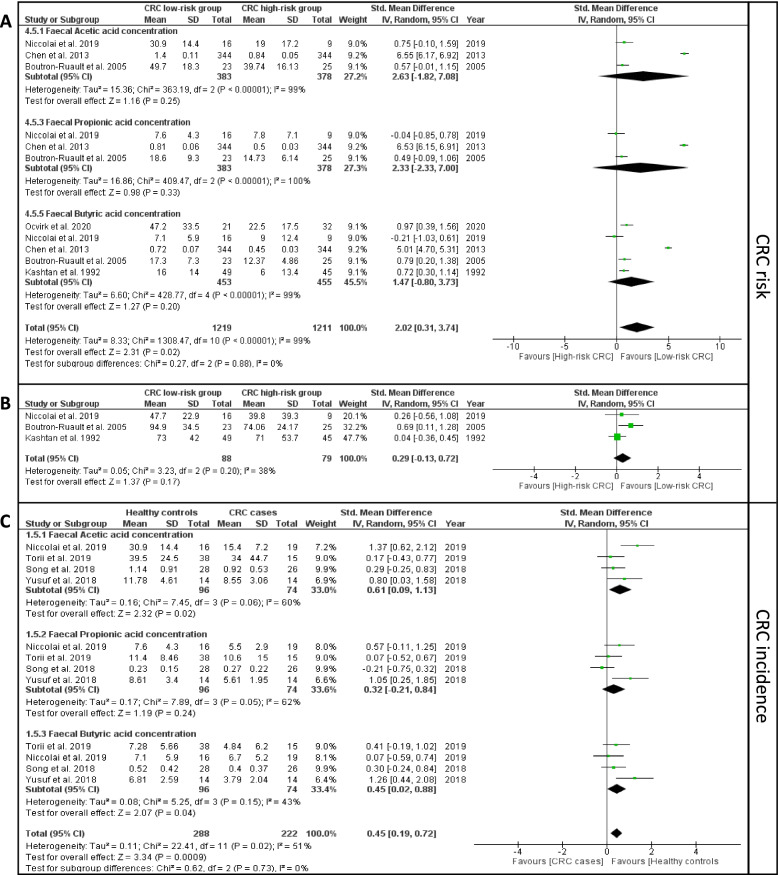
Background: The beneficial role of gut microbiota and bacterial metabolites, including short-chain fatty acids (SCFAs), is well recognized, although the available literature around their role in colorectal cancer (CRC) has been inconsistent. Methods: We performed a systematic review and meta-analysis to examine the associations of fecal SCFA concentrations to the incidence and risk of CRC. Data extraction through Medline, Embase, and Web of Science was carried out from database conception to June 29, 2022. Predefined inclusion/exclusion criteria led to the selection of 17 case-control and six cross-sectional studies for quality assessment and analyses. Studies were categorized for CRC risk or incidence, and RevMan 5.4 was used to perform the meta-analyses. Standardized mean differences (SMD) with 95% confidence intervals (CI) were calculated using a random-effects model. Studies lacking quantitation were included in qualitative analyses. Results: Combined analysis of acetic, propionic, and butyric acid revealed significantly lower concentrations of these SCFAs in individuals with a high-risk of CRC (SMD = 2.02, 95% CI 0.31 to 3.74, P = 0.02). Additionally, CRC incidence was higher in individuals with lower levels of SCFAs (SMD = 0.45, 95% CI 0.19 to 0.72, P = 0.0009), compared to healthy individuals. Qualitative analyses identified 70.4% of studies reporting significantly lower concentrations of fecal acetic, propionic, butyric acid, or total SCFAs in those at higher risk of CRC, while 66.7% reported significantly lower concentrations of fecal acetic and butyric acid in CRC patients compared to healthy controls. Conclusions: Overall, lower fecal concentrations of the three major SCFAs are associated with higher risk of CRC and incidence of CRC.
Overview
The claims and statistics of this paper haven’t been checked yet.
Free: it reads the open-access text and checks the first 5 claims that cite a source we can check. Create a free account to check every claim.
Integrity signals
Registry
Cites
Statistics
Figures
Verification
Claims the paper makes
The claims and statistics of this paper haven’t been checked yet.
Free: it reads the open-access text and checks the first 5 claims that cite a source we can check. Create a free account to check every claim.
Claims other papers make about this one
Each is checked against this paper’s own text: does it say what the citing paper says it does?
In the citing paper
“Clinically, measurement of fecal SCFAs or their ratios is an emerging approach for functional characterization of dysbiosis in diseases like IBD and colorectal cancer (CRC).128,129”
From Gut dysbiosis in oncology: a risk factor for immunoresistance (2026) · doi:10.1038/s41422-025-01212-6 · cites this paper as [128]
Self-check
Percentages, sums and reported differences re-computed from the paper’s own numbers.
The self-check needs the paper’s full text.
Citations
Cites
1 retracted
Wang, X., Wang, J. P., Rao, B., & Deng, L. (2017) · Experimental and Therapeutic Medicine · doi:10.3892/etm.2017.4367 · Cited by 81 · cited 1×
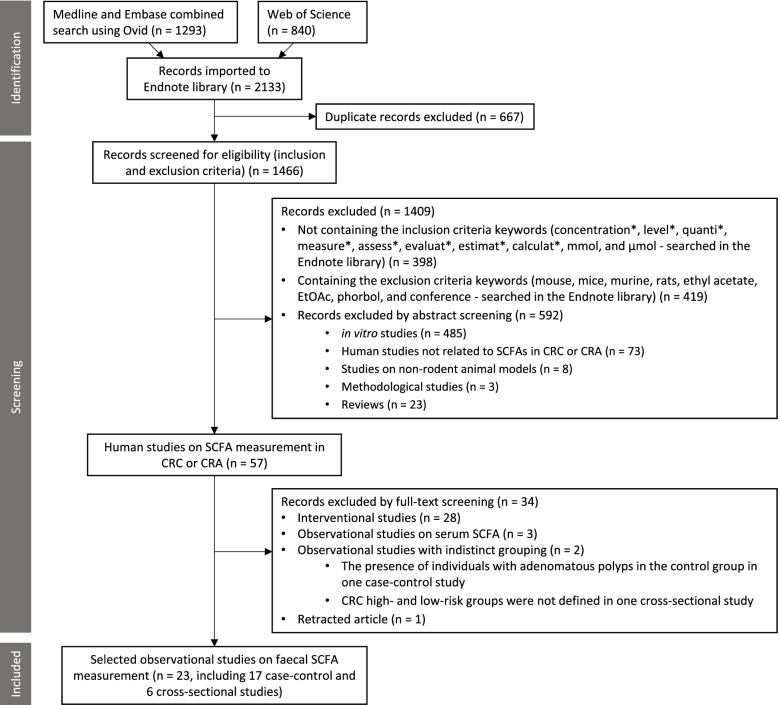
“Of these 28 were interventional studies, three were observational studies on serum SCFA [47–49], two studies had indistinct grouping (one case-control study with the presence of individuals with adenomatous polyps in the healthy control group [50] and one cross-sectional study with no clear definition of CRC high- and…”
BackgroundRetractedSung, H., Ferlay, J., Siegel, R. L., Laversanne, M., Soerjomataram, I., Jemal, A., & Bray, F. (2021) · CA: A Cancer Journal for Clinicians · doi:10.3322/caac.21660 · Cited by 108,699 · cited 1×
“4%) leading cause of cancer-related death [1].”
The PRISMA 2020 statement: An updated guideline for reporting systematic reviews
Page, M. J., McKenzie, J. E., Bossuyt, P. M., Boutron, I., Hoffmann, T. C., Mulrow, C. D., Shamseer, L., Tetzlaff, J. M., Akl, E. A., Brennan, S. E., et al. (2021) · BMJ · doi:10.1136/bmj.n71 · Cited by 108,283
(2014) · Medical Entomology and Zoology · Cited by 17,633
Global patterns and trends in colorectal cancer incidence and mortality
Arnold, M., Sierra, M. S., Laversanne, M., Soerjomataram, I., Jemal, A., & Bray, F. (2017) · Gut · doi:10.1136/gutjnl-2015-310912 · Cited by 5,228
Dekker, E., Tanis, P. J., Vleugels, J. L. A., Kasi, P. M., & Wallace, M. B. (2019) · The Lancet · doi:10.1016/s0140-6736(19)32319-0 · Cited by 4,974
Parada Venegas, D., De la Fuente, M. K., Landskron, G., González, M. J., Quera, R., Dijkstra, G., Harmsen, H. J. M., Faber, K. N., & Hermoso, M. A. (2019) · Frontiers in Immunology · doi:10.3389/fimmu.2019.00277 · Cited by 3,820 · cited 3×
“In line with the protective role of fecal SCFAs against the development of gut diseases [15, 16], and the protective effect of dietary fibers against CRC risk and/or incidence [9–11], we determined that the combined fecal concentration of the three major SCFA molecules was significantly lower not only in CRC patients…”
BackgroundScreening for Colorectal Cancer: US Preventive Services Task Force Recommendation Statement
US Preventive Services Task Force, Bibbins-Domingo, K., Grossman, D. C., Curry, S. J., Davidson, K. W., Epling, J. W., García, F. A. R., Gillman, M. W., Harper, D. M., Kemper, A. R., et al. (2016) · JAMA · doi:10.1001/jama.2016.5989 · Cited by 2,509
Screening for Colorectal Cancer: US Preventive Services Task Force Recommendation Statement
US Preventive Services Task Force, Davidson, K. W., Barry, M. J., Mangione, C. M., Cabana, M., Caughey, A. B., Davis, E. M., Donahue, K. E., Doubeni, C. A., Krist, A. H., et al. (2021) · JAMA · doi:10.1001/jama.2021.6238 · Cited by 2,034
Bile acid-microbiota crosstalk in gastrointestinal inflammation and carcinogenesis
Jia, W., Xie, G., & Jia, W. (2018) · Nature Reviews Gastroenterology & Hepatology · doi:10.1038/nrgastro.2017.119 · Cited by 1,924
Research works printed but not linked: 1
- Moola S, Munn Z, Tufanaru C, Aromataris E, Sears K, Sfetcu R, et al. Systematic reviews of etiology and risk. In: JBI manual for evidence synthesis [Internet]. JBI; 2020. Available from: https:// synth esism anual. jbi. global.
Cited by
Facchin, S., Bertin, L., Bonazzi, E., Lorenzon, G., De Barba, C., Barberio, B., Zingone, F., Maniero, D., Scarpa, M., Ruffolo, C., et al. (2024) · Life · doi:10.3390/life14050559 · Cited by 380
“A systematic review and meta-analysis by Alvandi et al., explored the role of fecal SCFAs in CRC incidence and risk stratification [149].”
BackgroundShort-chain fatty acids and insulin sensitivity: a systematic review and meta-analysis
Pham, N. H. T., Joglekar, M. V., Wong, W. K. M., Nassif, N. T., Simpson, A. M., & Hardikar, A. A. (2023) · Nutrition Reviews · doi:10.1093/nutrit/nuad042 · Cited by 164
“77 Larger clinical studies investigating the effects of these fermented beverages and food products are warranted.”
BackgroundSelf-citationRole of short‐chain fatty acids in host physiology
Liu, M., Lu, Y., Xue, G., Han, L., Jia, H., Wang, Z., Zhang, J., Liu, P., Yang, C., & Zhou, Y. (2024) · Animal Models and Experimental Medicine · doi:10.1002/ame2.12464 · Cited by 132
Kalkan, A. E., BinMowyna, M. N., Raposo, A., Ahmad, M. F., Ahmed, F., Otayf, A. Y., Carrascosa, C., Saraiva, A., & Karav, S. (2025) · Nutrients · doi:10.3390/nu17081305 · Cited by 135
“…further human studies, the administration of 4 g of sodium butyrate daily to obese individuals diagnosed with various metabolic disorders caused enhanced innate immune memory for LPS and increased IL-6 and Pam3CSK4-induced TNF-α responses, while also reducing oxidized low-density lipoprotein…”
Dong, Y., Zhang, K., Wei, J., Ding, Y., Wang, X., Hou, H., Wu, J., Liu, T., Wang, B., & Cao, H. (2023) · Frontiers in Immunology · doi:10.3389/fimmu.2023.1158200 · Cited by 107
The role of the gut microbiota in tumor, immunity, and immunotherapy
Xie, Y., & Liu, F. (2024) · Frontiers in Immunology · doi:10.3389/fimmu.2024.1410928 · Cited by 77
Wei, J., Zheng, Z., Hou, X., Jia, F., Yuan, Y., Yuan, F., He, F., Hu, L., & Zhao, L. (2023) · Journal of Ethnopharmacology · doi:10.1016/j.jep.2023.116866 · Cited by 73
Almanza‐Aguilera, E., Cano, A., Gil‐Lespinard, M., Burguera, N., Zamora‐Ros, R., Agudo, A., & Farràs, M. (2023) · Seminars in Cancer Biology · doi:10.1016/j.semcancer.2023.08.001 · Cited by 67
“These levels and their impact on health are sometimes controversial but, low SCFA concentrations are associated with higher CRC risk [194,195].”
Epigenetic Alteration in Colorectal Cancer: Potential Diagnostic and Prognostic Implications
Cao, Q., Tian, Y., Deng, Z., Yang, F., & Chen, E. (2024) · International Journal of Molecular Sciences · doi:10.3390/ijms25063358 · Cited by 60
“…that 70.4% of high-risk CRC individuals exhibited significantly decreased concentrations of acetate, propionate, butyrate, or total SCFAs in their feces, while 66.7% of CRC patients had significantly lower concentrations of acetate and butyrate in their feces compared to healthy controls [195].”
BackgroundInfluentialFecal Microbiota Transplantation: Insights into Colon Carcinogenesis and Immune Regulation
Brusnic, O., Onișor, D. M., Boicean, A., Hasegan, A. G., Ichim, C., Guzun, A., Chicea, R., Todor, S. B., Vintilă, B. I., Anderco, P., et al. (2024) · Journal of Clinical Medicine · doi:10.3390/jcm13216578 · Cited by 61
“From a metabolic point of view, short-chain fatty acids (SCFAs) reduce the risk of developing colorectal cancer by maintaining an intact intestinal function, their main representative in this regard being butyrate, obtained from dietary fiber by fermentation [33].”
BackgroundFibres and Colorectal Cancer: Clinical and Molecular Evidence
Celiberto, F., Aloisio, A., Girardi, B., Pricci, M., Iannone, A., Russo, F., Riezzo, G., D’Attoma, B., Ierardi, E., Losurdo, G., et al. (2023) · International Journal of Molecular Sciences · doi:10.3390/ijms241713501 · Cited by 65
“In conclusion, lower fecal concentrations of the three major SCFAs were associated with higher risk of CRC and incidence of CRC [22].”
BackgroundGarvey, M. (2024) · Biomedicines · doi:10.3390/biomedicines12040740 · Cited by 62
Zhao, Y., Chen, J., Qin, Y., Yuan, J., Zheng, Y., Ma, R., Liu, F., & Zhao, J. (2025) · Journal of Nutrition and Metabolism · doi:10.1155/jnme/8870958 · Cited by 58
Lu, S., Wang, C., Ma, J., & Wang, Y. (2024) · Frontiers in Immunology · doi:10.3389/fimmu.2024.1456030 · Cited by 56
Probiotic-Derived Bioactive Compounds in Colorectal Cancer Treatment
Thoda, C., & Touraki, M. (2023) · Microorganisms · doi:10.3390/microorganisms11081898 · Cited by 58
Postbiotics as Adjuvant Therapy in Cancer Care
Balendra, V., Rosenfeld, R., Amoroso, C., Castagnone, C., Rossino, M. G., Garrone, O., & Ghidini, M. (2024) · Nutrients · doi:10.3390/nu16152400 · Cited by 46
Chaľová, P., Ťažký, A., Škultéty, Ľ., Minichová, L., Chovanec, M., Čierniková, S., Mikuš, P., & Piešťanský, J. (2023) · Frontiers in Oncology · doi:10.3389/fonc.2023.1110235 · Cited by 43
Metabolic interactions: how gut microbial metabolites influence colorectal cancer
Cao, Q., Yang, M., & Chen, M. (2025) · Frontiers in Microbiology · doi:10.3389/fmicb.2025.1611698 · Cited by 42
Chen, N., Chan, C. K., Khan, F. U., Makhijani, P., Valentino, T. R., Winer, S., Luk, C. T., & Winer, D. A. (2026) · Ageing Research Reviews · doi:10.1016/j.arr.2026.103036 · Cited by 42
Intestinal dysbiosis and colorectal cancer
Kang, Z., Jiang, S., Fang, J., & Chen, H. (2025) · Chinese Medical Journal · doi:10.1097/cm9.0000000000003617 · Cited by 38
“[99,100] Protective or oncogenic roles SCFAs, particularly butyrate, have protective effects on CRC. Butyrate suppresses cancer cell growth while R y u e t a l [ 103 ] 2022 B u t y r a t e G u t m i c r ob i o t a ( g e n e r a l ) M ou s e m od e l s t r e a t e d w i t h ox a li p l a t i n ; CRC…”
Antioxidant Role of Probiotics in Inflammation-Induced Colorectal Cancer
Hamamah, S., Lobiuc, A., & Covașă, M. (2024) · International Journal of Molecular Sciences · doi:10.3390/ijms25169026 · Cited by 36
“A meta-analysis study showed that lower fecal concentrations of acetate, propionate, and butyrate are associated with a higher risk of developing CRC [174].”
BackgroundThe Crucial Roles of Diet, Microbiota, and Postbiotics in Colorectal Cancer
Kuru-Yaşar, R., & Üstün‐Aytekin, Ö. (2024) · Current Nutrition Reports · doi:10.1007/s13668-024-00525-z · Cited by 35
Distinctive tumorigenic significance and innovative oncology targets of SUMOylation
Zhou, H., Deng, N., Li, Y., Hu, X., Xue, Y., Jia, S., Zheng, C., Gao, S., Wu, H., & Li, K. (2024) · Theranostics · doi:10.7150/thno.97162 · Cited by 29
“However, the abundance of SCFAs and SCFA-producing bacteria is tremendously shrunk in CRC [93], with low fecal SCFA concentration associated with a higher CRC incidence [94].”
BackgroundGut dysbiosis in oncology: a risk factor for immunoresistance
(2026) · doi:10.1038/s41422-025-01212-6 · Cited by 24
Lai, X., Liu, B., Wan, Y., Zhou, P., Li, W., Hu, W., & Gong, W. (2024) · International Immunopharmacology · doi:10.1016/j.intimp.2024.113683 · Cited by 26
Liu, Z., Jiang, Y., Fan, Q., Li, S., & Wang, Y. (2025) · Journal of Inflammation Research · doi:10.2147/jir.s540163 · Cited by 28
Fructooligosaccharides (FOSs): A Condensed Overview
Fernandes, P. C. D. B. (2025) · Compounds · doi:10.3390/compounds5020008 · Cited by 22
“A recent meta-analysis, which ultimately considered 17 case-control and 6 cross-sectional studies, established that the fecal concentrations of SCFAs, namely, acetic, propionic, and butyric acids, correlated inversely with both the risk and incidence of colorectal cancer [136].”
New Insights and Strategies in the Nutritional Reformulation of Meat Products Toward Healthier Foods
Ayuso, P., García-Pérez, P., & Nieto, G. (2025) · Molecules · doi:10.3390/molecules30122565 · Cited by 26
Gut microbiota: Impact on 5-fluorouracil efficacy and toxicity
Lo, E. K. K., Leung, H. K. M., Zhang, F., & El-Nezami, H. S. (2023) · Current Opinion in Toxicology · doi:10.1016/j.cotox.2023.100423 · Cited by 24
Duan, J., Du, P., Jiang, T., Ma, X., Sun, J., Liang, J., Wang, J., & Liu, C. (2024) · Ecotoxicology and Environmental Safety · doi:10.1016/j.ecoenv.2024.116548 · Cited by 22
Shewry, P. R., Brouns, F. J. P. H., Dunn, J., Hood, J., Burridge, A. J., America, A. H. P., Gilissen, L. J. W., Proos-Huijsmans, Z. A. M., van Straaten, J. P., Jonkers, D. M. A. E., et al. (2023) · Food Chemistry · doi:10.1016/j.foodchem.2023.136312 · Cited by 21
Yang, S., Wang, Y., Sheng, L., Cui, W., & Ma, C. (2025) · Scientific Reports · doi:10.1038/s41598-024-84801-6 · Cited by 20
Kwao‐Zigah, G., Bediako‐Bowan, A., Boateng, P. A., Aryee, G. K., Abbang, S. M., Atampugbire, G. A., Quaye, O., & Tagoe, E. A. (2024) · Cancer Control · doi:10.1177/10732748241263650 · Cited by 19
Gupta, P., Dutta, S., Dutta, K., Bhattacharjee, P., Hazra, A., & Jash, R. (2025) · Molecular and Cellular Biochemistry · doi:10.1007/s11010-025-05397-7 · Cited by 17
He, Y., Peng, K., Tan, J., Hao, Y., Zhang, S., Gao, C., & Li, L. (2025) · Nutrients · doi:10.3390/nu17223552 · Cited by 16
“In addition, some studies have small sample sizes (e.g., an Indonesian case–control study with n = 28) and indirect SCFA detection (e.g., the UK Biobank relies on genetic scores for prediction, with an R 2 value of only 0.12), which further increases the uncertainty of conclusions [25,34–36].”
InfluentialZhu, J., Liu, H., Yang, L., Fang, Z., Fu, R., Chen, J., Liu, S., & Fei, B. (2023) · Journal of Medical Microbiology · doi:10.1099/jmm.0.001692 · Cited by 15
Li, X., Wu, D., Li, Q., Gu, J., Gao, W., Zhu, X., Yin, W., Zhu, R., Zhu, L., & Jiao, N. (2023) · Physiological Genomics · doi:10.1152/physiolgenomics.00103.2023 · Cited by 15
Daniel, N., Farinella, R., Chatziioannou, A. C., Jenab, M., Mayén, A., Rizzato, C., Belluomini, F., Canzian, F., Tavanti, A., Keski‐Rahkonen, P., et al. (2024) · Scientific Reports · doi:10.1038/s41598-024-77431-5 · Cited by 18
“Additionally, the concentration of many bacteria-related circulating metabolites has been associated with increased or decreased risk of gastrointestinal (GI) cancers including secondary bile acids 17–21 , amino acid derivatives 22 , tryptophan derivatives 23 and short-chain fatty acids (SCFAs) 24 .”
BackgroundZhang, Y., Dong, L., Dai, X., Huang, Y., Gao, Y., & Wang, F. (2024) · Discover Oncology · doi:10.1007/s12672-024-00897-2 · Cited by 16
Papadimitriou, N., Kim, A., Kawaguchi, E. S., Morrison, J. L., Díez‐Obrero, V., Albanes, D., Berndt, S. I., Bezieau, S., Bien, S. A., Bishop, D. T., et al. (2024) · EBioMedicine · doi:10.1016/j.ebiom.2024.105146 · Cited by 19
Microbiome and Diet in Colon Cancer Development and Treatment
Kato, I., & Sun, J. (2023) · The Cancer Journal · doi:10.1097/ppo.0000000000000649 · Cited by 16
“A meta-analysis of fecal SCFAs summarizing 4 recent cross-sectional studies, which involved 14 to 26 CRC patients and 14 to 38 control subjects, found significantly lower fecal acetate and butyrate concentrations in CRC patients compared with control subjects.(52) The retrospective nature of the latter studies certain…”
ResultDeciphering the impact of dietary habits and behavioral patterns on colorectal cancer
Yuan, Q., Liu, J., Wang, X., Du, C., Zhang, Y., Lin, L., Wang, C., & Hong, Z. (2025) · International Journal of Surgery · doi:10.1097/js9.0000000000002229 · Cited by 14
“The gut microbiota can further metabolize dietary fiber into short-chain fatty acids, which exert anti-inflammatory and anti-cancer effects [ 88 ] .”
Profir, M., Roşu, O., Creţoiu, S. M., & Gașpar, B. S. (2024) · Microorganisms · doi:10.3390/microorganisms12050955 · Cited by 12
“The increased levels of SCFAs have a protective role on intestinal health, and the decreased concentrations of butyrate, propionate, and acetate have been associated with an increased risk of developing colorectal cancer [105].”
Oliero, M., Cuisiniere, T., Ajayi, A. S., Gerkins, C., Hajjar, R., Fragoso, G., Calvé, A., Rendos, H. V., Mathieu‐Denoncourt, A., Dagbert, F., et al. (2024) · Cancer Research Communications · doi:10.1158/2767-9764.crc-23-0355 · Cited by 12
“Interestingly, lower acetate levels have been reported in individuals at higher risk of developing colorectal cancer as well as in patients with colorectal cancer (67), as acetate has been shown to induce growth arrest (68) and apoptosis (69) in colon cancer cells.”
BackgroundYang, S., Hao, S., Ye, H., & Zhang, X. (2023) · Frontiers in Cellular and Infection Microbiology · doi:10.3389/fcimb.2023.1083987 · Cited by 10
“A meta-analysis showed that lower fecal concentrations of three major SCFAs (acetic acid, propionic acid, and butyric acid) were associated with a higher risk of CRC (Alvandi et al., 2022).”
BackgroundTailor-made Biochar enhances the anti-tumour effects of butyrate-glycerides in colorectal cancer
Fei, L., Propato, A. P., Lotti, G., Nardini, P., Guasti, D., Polvani, S., Bani, D., Galli, A., Casini, D., Cantini, G., et al. (2025) · Biomedicine & Pharmacotherapy · doi:10.1016/j.biopha.2025.117900 · Cited by 10
Sylwestrzak, T., Ciosek, M., Pastuszak, K., & Jastrzębski, T. (2025) · Journal of Clinical Medicine · doi:10.3390/jcm14248949 · Cited by 9
“Previous work from Alvandi et al. [6] identified consistent decreases in the combined fecal concentration of acetate, propionate, and butyrate in CRC patients compared with healthy controls, and similar reductions among individuals at increased CRC risk.”
Modulation of Gut Microbial Biomarkers and Metabolites in Cancer Management by Tea Compounds
Leung, H. K. M., Lo, E. K. K., Zhang, F., Felicianna, Ismaiah, M. J., Chen, C., & El-Nezami, H. S. (2024) · International Journal of Molecular Sciences · doi:10.3390/ijms25126348 · Cited by 12
“…of non-digestible SCFAs are the major metabolites produced in the gut that have promising e ff ects in the management of breast, colorectal, lung, liver, and prostate cancers [120-122]. promising effects in the management of breast, colorectal, lung, liver, and prostate cancers [120–122].”
BackgroundPropionate suppresses colitis-associated colorectal cancer in mice by Or51e2
Kim, J. S., Jeong, M.-Y., Yoon, Y. E., Kim, Y., Lee, I., Choi, J., Lee, H. L., Shin, M., Hong, S., Chi, S., et al. (2025) · Biomedicine & Pharmacotherapy · doi:10.1016/j.biopha.2025.118268 · Cited by 9
Hussan, H., Clinton, S. K., Grainger, E. M., Webb, M. Z., Wang, C., Webb, A., NEEDLEMAN, B. J., Noria, S. F., Zhu, J., Choueiry, F., et al. (2023) · Gut Microbes · doi:10.1080/19490976.2023.2255345 · Cited by 8
Maukonen, M., Koponen, K. K., Havulinna, A. S., Kaartinen, N. E., Niiranen, T., Méric, G., Pajari, A., Knight, R. D., Salomaa, V. V., & Männistö, S. (2024) · European Journal of Nutrition · doi:10.1007/s00394-024-03406-x · Cited by 8
The role of physical activity and epigenetic changes in colorectal cancer prevention
Sun, Y., Keat, O. B., & Rajabi, S. (2025) · Cancer Cell International · doi:10.1186/s12935-025-03872-1 · Cited by 8
Li, X., Xie, M., Kang, J. X., Chen, Y., Han, J., Chen, Y., Chen, Q., Yu, T., Liu, S., Ouyang, Z., et al. (2026) · Gut · doi:10.1136/gutjnl-2025-336025 · Cited by 8
“25 26 Here, we found that B. catenulatum or acetate could directly kill CRC cells by suppressing proliferation and inducing apoptosis, while showing no effects on normal colon epithelial cells.”
Alves, S., Santos‐Pereira, C., Oliveira, C. S., Preto, A., Chaves, S. R., & Côrte‐Real, M. (2024) · Biomolecules · doi:10.3390/biom14040473 · Cited by 9
“Differences in intestinal microbiota composition have been reported between patients with CRC and healthy individuals, and the reduced production of microbiota-derived short-chain fatty acids (SCFAs), namely acetate, butyrate, and propionate, is linked to a high CRC risk [5,6].”
BackgroundState of omics-based microbial diagnostics of CRC
Prusa, J., Gorelik, M. G., Blake, K. S., & Dantas, G. A. (2025) · Gut Microbes · doi:10.1080/19490976.2025.2526132 · Cited by 7
“Namely the most accurate classification occurs between CRC, especially later-stage disease, versus CRA or healthy individuals, as compared to classification between CRA and healthy individuals.”
InfluentialAdvancements in Understanding and Preventing Obesity-Related Colon Cancer
Shieh, C., Thompson, H. J., McLaughlin, E. M., Chiang, C., & Hussan, H. (2024) · The Cancer Journal · doi:10.1097/ppo.0000000000000744 · Cited by 5
Xia, D., Jin, L., Wang, B., Jin, Y., Qun, Z., Xu, J., & Chen, S. (2025) · Scientific Reports · doi:10.1038/s41598-024-84294-3 · Cited by 5
“A comprehensive meta-analysis has revealed significantly reduced concentrations of acetic, propionic, and butyric acids—short-chain fatty acids (SCFAs)—in individuals with a high risk of CRC, compared to healthy individuals, with CRC incidence being higher among those with lower levels of SCFAs 28 .”
Saha, J., & Goswami, R. (2025) · Probiotics and Antimicrobial Proteins · doi:10.1007/s12602-025-10807-9 · Cited by 9
Gut microbiota and diet in colorectal cancer: Converging determinants of carcinogenesis
Thakur, B. K., Choudhury, S. R., Turpin, W., & Martín, A. (2026) · Gut Microbes · doi:10.1080/19490976.2026.2664684 · Cited by 4
“163 Besides being the preferred energy source for colonocytes, a number of studies have shown the anti-inflammatory and anti-neoplastic properties of butyrate through its ability to reduce cellular proliferation to induce apoptosis.”
Gut microbiota in health and disease
Li, Y. N., Xiao, X., Jiang, X., Li, X., WANG, W., & Lin, R. (2026) · Molecular Biomedicine · doi:10.1186/s43556-026-00512-6 · Cited by 8
“Consist-ently, butyrate-producing bacteria and fecal butyrate levels are reduced in CRC [203], and lower SCFA levels are associated with increased CRC risk [204].”
Iwasaka, C., Ninomiya, Y., Nakagata, T., Nanri, H., Watanabe, D., Ohno, H., Tanisawa, K., Konishi, K., Murakami, H., Tsunematsu, Y., et al. (2023) · Scientific Reports · doi:10.1038/s41598-023-47442-9 · Cited by 4
“A recent meta-analysis revealed that lower fecal SCFA concentrations correlate with a higher risk and incidence of CRC 23 .”
Sharma, D., Ramadass, B., Callary, S. A., Meade, A., Dash, R. J., Clothier, R. J., Atkins, G. J., Solomon, L. B., & Ramasamy, B. (2024) · Nutrition Journal · doi:10.1186/s12937-024-01034-z · Cited by 4
“These SCFAs, in turn, stimulate the growth and activity of ‘ben-eficial’ bacteria in the large intestine and have independent health-conferring properties [23, 24].”
BackgroundFunctional regulation of cytotoxic T Cells by gut microbial metabolites
Kim, C. H. (2025) · Gut Microbes Reports · doi:10.1080/29933935.2025.2454002 · Cited by 6
Epigenetics, Microbiota, and Breast Cancer: A Systematic Review
Soldado-Gordillo, A., & Álvarez‐Mercado, A. I. (2024) · Life · doi:10.3390/life14060705 · Cited by 5
“Concerning the cell cycle arrest triggered by low or medium levels of BS and PS, it could be explained by the decrease that these SCFAs could cause in the cell cycle regulatory proteins, which has been demonstrated concerning BS in previous studies conducted on colon carcinoma cells [39,40].”
ResultMicrobiota in cancer care: Clinical prospects
Li-Hua, P., & Bajinka, O. (2025) · Pathology - Research and Practice · doi:10.1016/j.prp.2025.156235 · Cited by 4
Bernabé, B. P., Oliveira, M. L., Wolf, P. G., McLeod, A., Gabel, K., Cares, K., Robinson, N., DiPiazza, B., Varady, K. A., & Tussing-Humphreys, L. M. (2025) · Endocrinology and Metabolism Clinics of North America · doi:10.1016/j.ecl.2024.10.007 · Cited by 4
Mast cell metabolism in cancer: an underexplored frontier demanding more attention
Frossi, B., Scialpi, G. B., Tonon, S., & Jachetti, E. (2025) · Frontiers in Immunology · doi:10.3389/fimmu.2025.1693954 · Cited by 3
Lan, T., Hou, Q., Zhao, H., Luan, Y., Shi, Y., Hu, S., Wang, N., Yan, S., Gong, X., & Song, Y. (2025) · Frontiers in Microbiology · doi:10.3389/fmicb.2025.1654227 · Cited by 2
Sun, B., & Wang, T. (2026) · Frontiers in Immunology · doi:10.3389/fimmu.2026.1768792 · Cited by 4
Eysha, M., Fouani, M., Munir, M., Black, M., Long, A., Elchouemi, M., Singh, S., & Abid, M. B. (2026) · Frontiers in Cellular and Infection Microbiology · doi:10.3389/fcimb.2026.1787954 · Cited by 2
Short-chain fatty acids and their impact on human health – a review
Czachajda, M., Góral, A., Duszyńska, K., Dolepski, K., Żuk, K., & Firlej, E. (2024) · Medycyna Ogólna i Nauki o Zdrowiu · doi:10.26444/monz/190750 · Cited by 3
Sleep duration, selected circulating biomarkers, and colorectal cancer risk
Rossi, M., Pauletto, A., Mignozzi, S., Bertuccio, P., Tsilidis, K. K., Mutignani, M., Cintolo, M., Cottone, I., Penagini, R., Vecchi, M. L., et al. (2026) · European Journal of Cancer Prevention · doi:10.1097/cej.0000000000000993 · Cited by 3
Prangthip, P., & Chaikham, P. (2025) · Applied Food Research · doi:10.1016/j.afres.2025.101514 · Cited by 1
Yerlikaya, F. H., Topkafa, M., Köksal, H., Maçin, S., Yormaz, S., Sivrikaya, A., Abuşoğlu, S., Onmaz, D. E., Arslan, U., & Çiftçi, N. (2026) · Bratislavské lekárske listy/Bratislava medical journal · doi:10.1007/s44411-026-00523-3 · Cited by 2
Enhanced fructooligosaccharides synthesis by engineered Trichoderma atroviride β-fructofuranosidase
Narmontaite, E., Plou, F. J., & Fernández‐Lobato, M. (2026) · Applied Microbiology and Biotechnology · doi:10.1007/s00253-026-13748-7 · Cited by 1
“…al. 2021), decrease serum levels of cholesterol and triglycerides, show low carcinogenicity (Bhadra et al. 2022), reduce the risk of colon cancer (Alvandi et al. 2022; Bytautaitė et al. 2024), improve mental health (Taylor and Holscher 2020; Zhang et al. 2020), and even decrease…”
The gut microbiome and colorectal cancer
Dietz, M. A., Subramanian, S., & Staley, C. M. (2026) · Clinical Microbiology Reviews · doi:10.1128/cmr.00332-25 · Cited by 1
Mikrobiom und gastrointestinale Erkrankungen
Ammer‐Herrmenau, C., & Hamm, J. (2023) · Springer Reference Medizin · doi:10.1007/978-3-642-54676-1_578-1
崔, 可. (2024) · Advances in Clinical Medicine · doi:10.12677/acm.2024.143926
Yerlikaya, F. H., Topkafa, M., Köksal, H., Maçin, S., Yormaz, S., Sivrikaya, A., Abuşoğlu, S., Onmaz, D. E., Arslan, U., & Çiftçi, N. (2024) · Research Square · doi:10.21203/rs.3.rs-5145862/v1
Mendes, I., & Vale, N. (2024) · Future Pharmacology · doi:10.3390/futurepharmacol4040049 · Cited by 1
“A comprehensive study conducted by Henricks et al. [84] elucidates the feasibility of employing genotype-guided dosing within clinical practice.”
Liao, X., Liu, M., Hong, C., Liu, Y., Li, Q., Chen, Y., Zhang, T., Chen, H., & Fu, S. (2025) · BMC Gastroenterology · doi:10.1186/s12876-025-04153-x · Cited by 1
“Previous studies have shown that blood lipid levels, such as unsaturated fatty acids and lipoproteins, contribute to the onset and progression of colorectal cancer [25, 26].”
Qi Ling1, 2. (2025) · Frontiers in Medical Science Research · doi:10.25236/fmsr.2025.070401
Koller, K. R., Wilson, A. S., Eberhart, B. L., Day, G. M., Lee, F. R., Perez, M. R., Thomas, T. K., & O’Keefe, S. J. (2025) · International Journal of Circumpolar Health · doi:10.1080/22423982.2025.2561283
“These SCFA provide food for the bacteria and exerts regulatory effects on colonic mucosa by reducing inflammation, promoting apoptosis, and decreasing proliferation potentially inhibiting cancer development [9,10].”
New algorithm to predict colorectal cancer based on fecal volatile organic compounds profile
Ripoll, L., Gisbert, H., Rubio, I., Guill‐Berbegal, D., Canals, A., Jover, R., & Vidal, L. (2025) · Computers in Biology and Medicine · doi:10.1016/j.compbiomed.2025.111093
Narmontaite, E., Ruiz-Nuñez, M., Plou, F. J., Fernández‐Lobato, M., & Sanz‐Aparicio, J. (2026) · International Journal of Biological Macromolecules · doi:10.1016/j.ijbiomac.2026.150552
Huang, C., Shen, M.-H., Lien, H.-H., Lai, C., Chang, K., Ku, W., Chyuan, I., Chang, S.-C., Shih, Y.-H., Lee, S.-Y., et al. (2026) · Research Square · doi:10.21203/rs.3.rs-9004103/v1
Microbiome-based interventions for colorectal cancer prevention and treatment
Abdullah, N. A., Jayasurya, J. V., Shri, M. P. L., Thatcher, R. M., Dalbayrak, B., Arısan, E. D., Ambika, S., & Manojkumar, Y. (2026) · Elsevier eBooks · doi:10.1016/b978-0-443-40483-2.00034-0
Anti-Cancer Effects of Quercetin: What Role Does the Gut Microbiota Play?
Yi, G., Liu, Y., Li, G., & Chang, K. (2026) · Molecules · doi:10.3390/molecules31091456
“In contrast, short-chain fatty acids (SCFAs), which exhibit a range of health benefits and are generated through the fermentation of dietary fiber by gut microbiota, are markedly reduced in cancer patients [60,84,85].”
IMPACT OF GUT MICROBIOTA ON COLORECTAL CARCINOGENESIS AND OPPORTUNITIES FOR THERAPEUTIC MODULATION
Sydor, M., Plizga, W., Lepa, Z., & Bułat, A. (2026) · International Journal of Innovative Technologies in Social Science · doi:10.31435/ijitss.1(49).2026.4884
Daniel, N., Papadimitriou, N., Chatziioannou, A. C., Jenab, M., Mayén, A., Keski‐Rahkonen, P., Fedirko, V., Hassan, M. M., & Hughes, D. J. (2026) · Digestive and Liver Disease · doi:10.1016/j.dld.2026.05.008
Pulses and Cancer Outcomes: A Scoping Review of Human Studies on Risk Reduction
Nawi, M. N. M., Ibrahim, N., Tay, B. Y., Rashed, A. A., & Balasubramaniam, V. R. M. T. (2026) · Nutrients · doi:10.3390/nu18132064
Földvári-Nagy, K. C., Al-Gharati, Y. Z., Veres, D. S., Schnabel, T., Lenti, K., Éliás, A. J., & Földvári-Nagy, L. (2026) · Nutrition Journal · doi:10.1186/s12937-026-01364-0
“In comparison to healthy patients, those at risk of developing colorectal cancer (CRC) had considerably lower concentrations of the three major faecal SCFAs, according to a recent systematic review and meta-analysis [30].”
NLRP6 as a candidate segmental barrier to carcinogenesis in the human gut: a hypothesis
Luengo‐Gil, G., Arroyo-Rodríguez, A. B., Hurtado-López, A. M., García‐Solano, J., Conesa‐Zamora, P., & Tapia‐Abellán, A. (2026) · Frontiers in Immunology · doi:10.3389/fimmu.2026.1823134
刘文明, Liu, J., Chen, Y., Lu, G., Shen, J., Zheng, X., & Wei, X. (2026) · Frontiers in Microbiology · doi:10.3389/fmicb.2026.1887252
Caputo, L., Bellis, F. D., Luparelli, A. V., Quintieri, L., & Monaci, L. (2026) · Sustainable Food Technology · doi:10.1039/d6fb00079g
Kim, H., & Diederich, M. F. (2026) · Biochemical Pharmacology · doi:10.1016/j.bcp.2026.118369
Benidovskaya, E., Huyghe, N. D., Giolito, M. V., Coulie, P. G., & den Eynde, M. V. (2026) · Cancers · doi:10.3390/cancers18162651
Pianka, M.-L., Zhang, X., & Stein‐Thoeringer, C. K. (2026) · Gut Microbes · doi:10.1080/19490976.2026.2718561
Hilliard, M. A., Oliver, A. S., Wilson, S. M. G., Shahab‐Ferdows, S., Hampel, D., Bennett, B. J., Allen, L. H., & Lemay, D. G. (2026) · Gut Microbes · doi:10.1080/19490976.2026.2718567
“Reduced fecal SCFA concentrations are associated with states of dysbiosis in inflammatory bowel disease, 73,74 colorectal cancer, 75 diabetes, 76-78 kidney disease, 79 and hypertension.”
Berawi, K. N., Putri, Y. N., Adiva, M., Yonata, A., & Rahayu, I. D. (2026) · Jurnal Ilmu Medis Indonesia · doi:10.35912/jimi.v6.n1.p1-18.2026
“Evidence supports the beneficial role of butyrate in CRC prevention and supportive care (Kaźmierczak-Siedlecka et al., 2022; Liu et al., 2024), although heterogeneous associations between fecal SCFAs and CRC limit causal inference (Alvandi et al., 2022).”
Metadata
- Authors
- Alvandi, E., Wong, W. K. M., Joglekar, M. V., Spring, K. J., & Hardikar, A. A.
- Affiliations
- Western Sydney University (AU)
- UNSW Sydney (AU)
- Roskilde University (DK)
- Corresponding author
- Spring, Kevin J.
- Hardikar, Anandwardhan A.
- Venue
- BMC Medicine
- Published
- 2022-10-03
- Volume
- 20
- Issue
- 1
- Pages
- 323-323
- ISSN
- 1741-7015 (ISSN-L)
- PMC
- PMC9528142
- OpenAlex
- W4299878807
- Semantic Scholar
- ed42b4e44ed01936934be8b3d6debc8bbefc67ca
- Cited by
- 101
- References
- 79
- Citations by year
- 2026: 28 · 2025: 28 · 2024: 29 · 2023: 16
- FWCI
- 1.90
- Type
- journal article
- Language
- en
- Open access
- gold
- doi.org
- Licence
- cc-by
- creativecommons.org/licenses/by/4.0 (tdm)
- creativecommons.org/licenses/by/4.0 (vor)
- Locations
- BMC Medicine (publishedVersion, cc-by)
- medRxiv (acceptedVersion)
- PubMed Central (publishedVersion, cc-by)
- PubMed (publishedVersion)
- RUCforsk (Roskilde University) (acceptedVersion, other-oa)
- DOAJ (DOAJ: Directory of Open Access Journals) (submittedVersion, cc-by-sa)
- Funders
- Leona M. and Harry B. Helmsley Charitable Trust (2018 PG-T1D009)
- Danish Diabetes Academy (NNF17SA0031406])
- Novo Nordisk (NNF17SA0031406)
- Novo Nordisk Fonden (#NNF17SA0031406)
- Western Sydney University
- Topics
- Life Sciences › Biochemistry, Genetics and Molecular Biology › Molecular Biology › Gut microbiota and health
- Health Sciences › Medicine › Oncology › Colorectal Cancer Screening and Detection
- Health Sciences › Medicine › Public Health, Environmental and Occupational Health › Nutritional Studies and Diet
- Keywords
- short-chain fatty acids, colorectal cancer, acetic acid, propionic acid, butyrate, gut microbiota, bacterial metabolites, colorectal cancer risk, colorectal cancer incidence, risk stratification
- MeSH terms
- Butyrates, Cross-Sectional Studies, Fatty Acids, Volatile, Feces, Humans, Colorectal Neoplasms, Incidence
About these checks
Registry, retraction, Cites and statistics results are computed, not judged, with one exception: a printed reference that no index lists is read once by a model before it counts as a citation error. Claims are extracted by a model and kept only when their quote appears verbatim in the text; each cited source is then checked, with a model’s help, for whether it says what the claim relies on. Those verdicts can be wrong — read the claim’s quote and the cited source before relying on one.
Statistics and arithmetic are recomputed, not judged.
Confidence bands are shown only for fields calibrated on our annotated test set. None is calibrated yet, so no band is shown.
What counts as a claim ›How we measure confidence ›How we check this ›
Are you an author, or do you see a problem with this page? Request a review
Data sources
Bibliographic data: Semantic Scholar, OpenAlex, Crossref.
Contains information from the Semantic Scholar Academic Graph Datasets, made available under the ODC Attribution License (ODC-BY 1.0).
Semantic Scholar’s data is described in: Kinney, R., et al. (2023). The Semantic Scholar Open Data Platform. arXiv:2301.10140.
