

Short-chain fatty acid concentrations in the incidence and risk-stratification of colorectal cancer: a systematic review and meta-analysis
Open accessPublished version of a preprint
The DOI matches its Crossref record; 79 of the 79 references it cites were found in a registry or an index.
Abstract
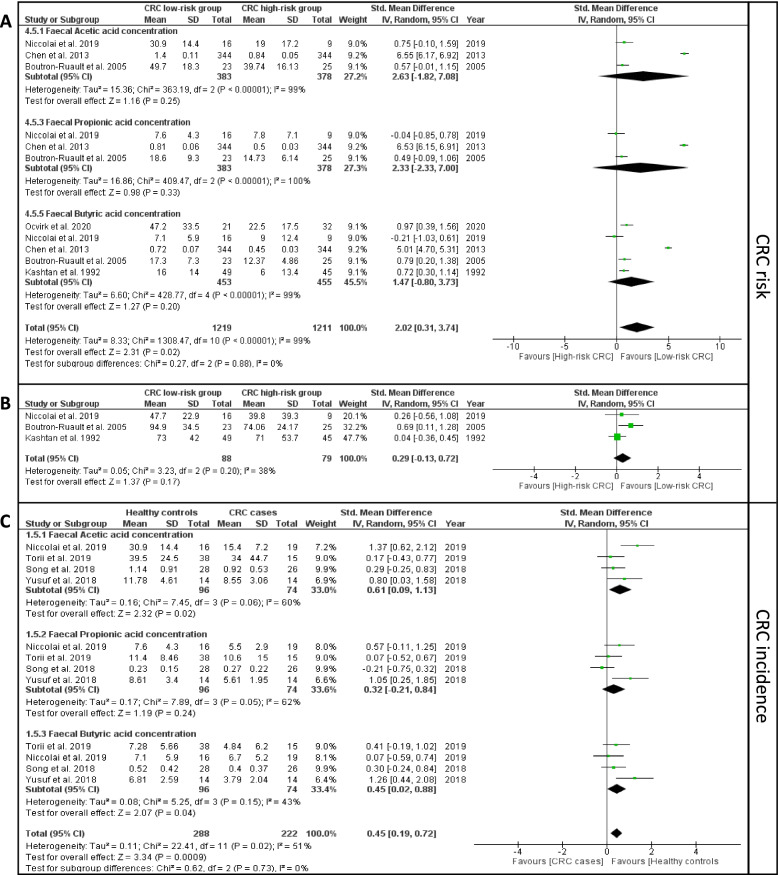
Background: The beneficial role of gut microbiota and bacterial metabolites, including short-chain fatty acids (SCFAs), is well recognized, although the available literature around their role in colorectal cancer (CRC) has been inconsistent. Methods: We performed a systematic review and meta-analysis to examine the associations of fecal SCFA concentrations to the incidence and risk of CRC. Data extraction through Medline, Embase, and Web of Science was carried out from database conception to June 29, 2022. Predefined inclusion/exclusion criteria led to the selection of 17 case-control and six cross-sectional studies for quality assessment and analyses. Studies were categorized for CRC risk or incidence, and RevMan 5.4 was used to perform the meta-analyses. Standardized mean differences (SMD) with 95% confidence intervals (CI) were calculated using a random-effects model. Studies lacking quantitation were included in qualitative analyses. Results: Combined analysis of acetic, propionic, and butyric acid revealed significantly lower concentrations of these SCFAs in individuals with a high-risk of CRC (SMD = 2.02, 95% CI 0.31 to 3.74, P = 0.02). Additionally, CRC incidence was higher in individuals with lower levels of SCFAs (SMD = 0.45, 95% CI 0.19 to 0.72, P = 0.0009), compared to healthy individuals. Qualitative analyses identified 70.4% of studies reporting significantly lower concentrations of fecal acetic, propionic, butyric acid, or total SCFAs in those at higher risk of CRC, while 66.7% reported significantly lower concentrations of fecal acetic and butyric acid in CRC patients compared to healthy controls. Conclusions: Overall, lower fecal concentrations of the three major SCFAs are associated with higher risk of CRC and incidence of CRC.
Overview
The claims and statistics of this paper haven’t been checked yet.
Free: it reads the open-access text and checks the first 5 claims that cite a source we can check. Create a free account to check every claim.
Integrity signals
Registry
Cites
Statistics
Figures
Verification
Claims the paper makes
The claims and statistics of this paper haven’t been checked yet.
Free: it reads the open-access text and checks the first 5 claims that cite a source we can check. Create a free account to check every claim.
Claims other papers make about this one
Each is checked against this paper’s own text: does it say what the citing paper says it does?
In the citing paper
“Clinically, measurement of fecal SCFAs or their ratios is an emerging approach for functional characterization of dysbiosis in diseases like IBD and colorectal cancer (CRC).128,129”
From Gut dysbiosis in oncology: a risk factor for immunoresistance (2026) · doi:10.1038/s41422-025-01212-6 · cites this paper as [128]
Self-check
Percentages, sums and reported differences re-computed from the paper’s own numbers.
The self-check needs the paper’s full text.
Citations
Cites
1 retracted
Wang, X., Wang, J. P., Rao, B., & Deng, L. (2017) · Experimental and Therapeutic Medicine · doi:10.3892/etm.2017.4367 · Cited by 81 · cited 1×
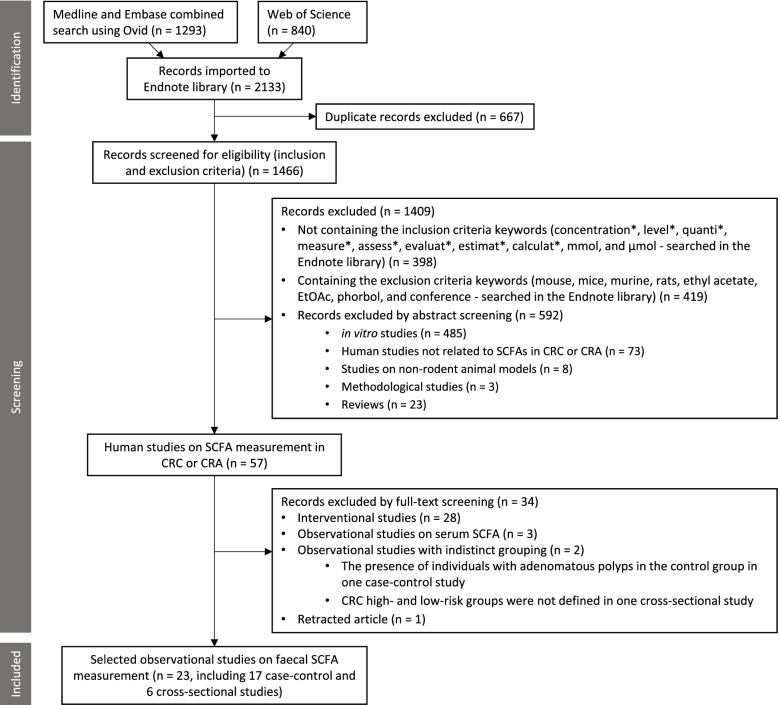
“Of these 28 were interventional studies, three were observational studies on serum SCFA [47–49], two studies had indistinct grouping (one case-control study with the presence of individuals with adenomatous polyps in the healthy control group [50] and one cross-sectional study with no clear definition of CRC high- and…”
BackgroundRetractedSung, H., Ferlay, J., Siegel, R. L., Laversanne, M., Soerjomataram, I., Jemal, A., & Bray, F. (2021) · CA: A Cancer Journal for Clinicians · doi:10.3322/caac.21660 · Cited by 108,699 · cited 1×
“4%) leading cause of cancer-related death [1].”
The PRISMA 2020 statement: An updated guideline for reporting systematic reviews
Page, M. J., McKenzie, J. E., Bossuyt, P. M., Boutron, I., Hoffmann, T. C., Mulrow, C. D., Shamseer, L., Tetzlaff, J. M., Akl, E. A., Brennan, S. E., et al. (2021) · BMJ · doi:10.1136/bmj.n71 · Cited by 108,283
(2014) · Medical Entomology and Zoology · Cited by 17,633
Global patterns and trends in colorectal cancer incidence and mortality
Arnold, M., Sierra, M. S., Laversanne, M., Soerjomataram, I., Jemal, A., & Bray, F. (2017) · Gut · doi:10.1136/gutjnl-2015-310912 · Cited by 5,228
Dekker, E., Tanis, P. J., Vleugels, J. L. A., Kasi, P. M., & Wallace, M. B. (2019) · The Lancet · doi:10.1016/s0140-6736(19)32319-0 · Cited by 4,974
Parada Venegas, D., De la Fuente, M. K., Landskron, G., González, M. J., Quera, R., Dijkstra, G., Harmsen, H. J. M., Faber, K. N., & Hermoso, M. A. (2019) · Frontiers in Immunology · doi:10.3389/fimmu.2019.00277 · Cited by 3,820 · cited 3×
“In line with the protective role of fecal SCFAs against the development of gut diseases [15, 16], and the protective effect of dietary fibers against CRC risk and/or incidence [9–11], we determined that the combined fecal concentration of the three major SCFA molecules was significantly lower not only in CRC patients…”
BackgroundScreening for Colorectal Cancer: US Preventive Services Task Force Recommendation Statement
US Preventive Services Task Force, Bibbins-Domingo, K., Grossman, D. C., Curry, S. J., Davidson, K. W., Epling, J. W., García, F. A. R., Gillman, M. W., Harper, D. M., Kemper, A. R., et al. (2016) · JAMA · doi:10.1001/jama.2016.5989 · Cited by 2,509
Screening for Colorectal Cancer: US Preventive Services Task Force Recommendation Statement
US Preventive Services Task Force, Davidson, K. W., Barry, M. J., Mangione, C. M., Cabana, M., Caughey, A. B., Davis, E. M., Donahue, K. E., Doubeni, C. A., Krist, A. H., et al. (2021) · JAMA · doi:10.1001/jama.2021.6238 · Cited by 2,034
Bile acid-microbiota crosstalk in gastrointestinal inflammation and carcinogenesis
Jia, W., Xie, G., & Jia, W. (2018) · Nature Reviews Gastroenterology & Hepatology · doi:10.1038/nrgastro.2017.119 · Cited by 1,924
Analysing Data and Undertaking Meta‐Analyses
Deeks, J. J., Higgins, J. P., & Altman, D. G. (2008) · Cochrane Handbook for Systematic Reviews of Interventions · doi:10.1002/9780470712184.ch9 · Cited by 1,800
Ma, L.-L., Wang, Y.-Y., Yang, Z.-H., Huang, D., Weng, H., & Zeng, X.-T. (2020) · Military Medical Research · doi:10.1186/s40779-020-00238-8 · Cited by 1,648 · cited 1×
“Evaluation of six cross-sectional studies was performed using the Joanna Briggs Institute (JBI) Critical Appraisal Checklist tool [44], as recommended [45].”
MethodColorectal Carcinoma: A General Overview and Future Perspectives in Colorectal Cancer
Mármol, I., Sánchez-de-Diego, C., Pradilla Dieste, A., Cerrada, E., & Rodriguez Yoldi, M. (2017) · International Journal of Molecular Sciences · doi:10.3390/ijms18010197 · Cited by 1,525
Methodology series module 3: Cross-sectional studies
Setia, M. (2016) · Indian Journal of Dermatology · doi:10.4103/0019-5154.182410 · Cited by 1,393 · cited 1×
“Similarly, the results of the crosssectional studies could be affected by bidirectional relationship [69] and confounding factors.”
ResultGut microbiota in colorectal cancer: mechanisms of action and clinical applications
Wong, S. H., & Yu, J. (2019) · Nature Reviews Gastroenterology & Hepatology · doi:10.1038/s41575-019-0209-8 · Cited by 1,331
Chapter 7: Systematic reviews of etiology and risk
(2020) · JBI Manual for Evidence Synthesis · doi:10.46658/jbimes-20-08 · Cited by 1,268
Diet, microorganisms and their metabolites, and colon cancer
O'Keefe, S. J. D. (2016) · Nature Reviews Gastroenterology & Hepatology · doi:10.1038/nrgastro.2016.165 · Cited by 1,100 · cited 4×
“Gut microbiota constitutes the largest community of commensal microorganisms in the body, which mainly resides in the lower small intestine and colon [6, 12, 13].”
BackgroundInfluentialRed and Processed Meat and Colorectal Cancer Incidence: Meta-Analysis of Prospective Studies
Chan, D. S. M., Lau, R., Aune, D., Vieira, R., Greenwood, D. C., Kampman, E., & Norat, T. (2011) · PLoS ONE · doi:10.1371/journal.pone.0020456 · Cited by 903 · cited 1×
“According to several meta-analyses, high consumption of processed and unprocessed meat is related to high CRC risk [7, 8], and high fiber intake is suggested as a protective factor against CRC progression and incidence [9–11].”
BackgroundIncreasing incidence of colorectal cancer in young adults in Europe over the last 25 years
Vuik, F. E., Nieuwenburg, S. A., Bardou, M., Lansdorp-Vogelaar, I., Dinis-Ribeiro, M., Bento, M. J., Zadnik, V., Pellisé, M., Esteban, L., Kaminski, M. F., et al. (2019) · Gut · doi:10.1136/gutjnl-2018-317592 · Cited by 886
Liu, P., Wang, Y., Yang, G., Zhang, Q., Meng, L., Xin, Y., & Jiang, X. (2021) · Pharmacological Research · doi:10.1016/j.phrs.2021.105420 · Cited by 761 · cited 3×
“In line with the protective role of fecal SCFAs against the development of gut diseases [15, 16], and the protective effect of dietary fibers against CRC risk and/or incidence [9–11], we determined that the combined fecal concentration of the three major SCFA molecules was significantly lower not only in CRC patients…”
BackgroundInfluence of the Gut Microbiome, Diet, and Environment on Risk of Colorectal Cancer
Song, M., Chan, A. T., & Sun, J. (2020) · Gastroenterology · doi:10.1053/j.gastro.2019.06.048 · Cited by 752
Rising incidence of early-onset colorectal cancer — a call to action
Akimoto, N., Ugai, T., Zhong, R., Hamada, T., Fujiyoshi, K., Giannakis, M., Wu, K., Cao, Y., Ng, K., & Ogino, S. (2021) · Nature Reviews Clinical Oncology · doi:10.1038/s41571-020-00445-1 · Cited by 728 · cited 2×
“aged 20-49 years has increased over the past decade in the USA, Australia, and Europe (Akimoto et al. 2021; Burnett-Hartman et al. 2021; Saad El Din et al. 2020; Vuik et al. 2019).”
BackgroundMuka, T., Glisic, M., Milic, J., Verhoog, S., Bohlius, J., Bramer, W., Chowdhury, R., & Franco, O. H. (2020) · European Journal of Epidemiology · doi:10.1007/s10654-019-00576-5 · Cited by 660 · cited 2×
“Methods We used Preferred Reporting Items for Systematic Reviews and Meta-Analyses (PRISMA) 2020 guideline [41, 42] to systematically search and extract data from primary human studies with SCFA measurement in CRC risk or incidence.”
MethodParada Venegas, D., De la Fuente, M. K., Landskron, G., González, M. J., Quera, R., Dijkstra, G., Harmsen, H. J. M., Faber, K. N., & Hermoso, M. A. (2019) · Frontiers in Immunology · doi:10.3389/fimmu.2019.01486 · Cited by 654
Ou, J., Carbonero, F., Zoetendal, E. G., DeLany, J. P., Wang, M., Newton, K., Gaskins, H. R., & O’Keefe, S. J. (2013) · The American Journal of Clinical Nutrition · doi:10.3945/ajcn.112.056689 · Cited by 646
Stool microbiome and metabolome differences between colorectal cancer patients and healthy adults
Weir, T. L., Manter, D. K., Sheflin, A. M., Barnett, B. A., Heuberger, A. L., & Ryan, E. P. (2013) · PLoS ONE · doi:10.1371/journal.pone.0070803 · Cited by 642 · cited 1×
“In addition to the SCFAs assessed in this systematic review, other metabolites such as bile acids were also measured in six of the selected studies [20, 30, 32, 35, 36, 39].”
BackgroundPathways of Colorectal Carcinogenesis
Nguyen, L. H., Goel, A., & Chung, D. C. (2020) · Gastroenterology · doi:10.1053/j.gastro.2019.08.059 · Cited by 606 · cited 1×
“Colorectal cancer develops from precursor lesions collectively known as colorectal adenomas (CRA), in the form of adenomatous polyps or to a lesser extent (10–20%) serrated polyps [3, 4].”
BackgroundGill, P. A., van Zelm, M. C., Muir, J. G., & Gibson, P. R. (2018) · Alimentary Pharmacology & Therapeutics · doi:10.1111/apt.14689 · Cited by 520 · cited 1×
“This could be due to other SCFA molecules such as valeric, isobutyric, and iso-valeric acid being included in total SCFA measurements; the latter two are the branched SCFAs mainly produced via fermentation of branched amino acids in the colon and not from non-digestible carbohydrates [59, 60].”
Backgroundvan der Beek, C. M., Dejong, C. H. C., Troost, F. J., Masclee, A. A. M., & Lenaerts, K. (2017) · Nutrition Reviews · doi:10.1093/nutrit/nuw067 · Cited by 343
Chen, H.-M., Yu, Y.-N., Wang, J.-L., Lin, Y.-W., Kong, X., Yang, C.-Q., Yang, L., Liu, Z.-J., Yuan, Y.-Z., Liu, F., et al. (2013) · The American Journal of Clinical Nutrition · doi:10.3945/ajcn.112.046607 · Cited by 321 · cited 1×
“Only a few studies assessed in this systematic review provided information on the dietary difference between groups [19, 21, 35, 36, 40].”
BackgroundRios-Covian, D., González, S., Nogacka, A. M., Arboleya, S., Salazar, N., Gueimonde, M., & de los Reyes-Gavilán, C. G. (2020) · Frontiers in Microbiology · doi:10.3389/fmicb.2020.00973 · Cited by 316
Burnett-Hartman, A. N., Lee, J. K., Demb, J., & Gupta, S. (2021) · Gastroenterology · doi:10.1053/j.gastro.2020.12.068 · Cited by 298 · cited 2×
“aged 20-49 years has increased over the past decade in the USA, Australia, and Europe (Akimoto et al. 2021; Burnett-Hartman et al. 2021; Saad El Din et al. 2020; Vuik et al. 2019).”
BackgroundThe association of diet, gut microbiota and colorectal cancer: what we eat may imply what we get
Yang, J., & Yu, J. (2018) · Protein & Cell · doi:10.1007/s13238-018-0543-6 · Cited by 275 · cited 2×
“Gut microbiota constitutes the largest community of commensal microorganisms in the body, which mainly resides in the lower small intestine and colon [6, 12, 13].”
BackgroundImperiale, T. F., Gruber, R. N., Stump, T. E., Emmett, T. W., & Monahan, P. O. (2019) · Annals of Internal Medicine · doi:10.7326/m18-2390 · Cited by 244
Baena, R., & Salinas, P. (2015) · Maturitas · doi:10.1016/j.maturitas.2014.12.017 · Cited by 219 · cited 1×
“Family history [66], diet, and lifestyle [67] are known factors contributing to CRC incidence.”
BackgroundAlexander, C., Swanson, K. S., Fahey, G. C., & Garleb, K. A. (2019) · Advances in Nutrition · doi:10.1093/advances/nmz004 · Cited by 212 · cited 2×
“Among the three major SCFA molecules, butyric acid is also considered as one of the main energy sources for colonocytes [12, 14, 17].”
BackgroundRole of colonic microbiota in colorectal carcinogenesis: A systematic review
Borges Canha, M. (2015) · Revista Española de Enfermedades Digestivas · doi:10.17235/reed.2015.3830/2015 · Cited by 193 · cited 1×
“In addition, several meta-analyses (Supplementary Table 4) have assessed the role of colonic microbiota (Borges-Canha et al. 2015), non-digestible carbohydrates (Rao et al.”
BackgroundMetabolite profiling of fecal water extracts from human colorectal cancer
Monleón, D., Morales, J. M., Barrasa, A., López, J. A., Vázquez, C., & Celda, B. (2009) · NMR in Biomedicine · doi:10.1002/nbm.1345 · Cited by 186
Ohigashi, S., Sudo, K., Kobayashi, D., Takahashi, O., Takahashi, T., Asahara, T., Nomoto, K., & Onodera, H. (2013) · Digestive Diseases and Sciences · doi:10.1007/s10620-012-2526-4 · Cited by 180
Trends in the epidemiology of young-onset colorectal cancer: a worldwide systematic review
Saad El Din, K., Loree, J. M., Sayre, E. C., Gill, S., Brown, C. J., Dau, H., & De Vera, M. A. (2020) · BMC Cancer · doi:10.1186/s12885-020-06766-9 · Cited by 176
Products of the Colonic Microbiota Mediate the Effects of Diet on Colon Cancer Risk ,
O'Keefe, S. J. D., Ou, J., Aufreiter, S., O'Connor, D., Sharma, S., Sepulveda, J., Fukuwatari, T., Shibata, K., & Mawhinney, T. (2009) · The Journal of Nutrition · doi:10.3945/jn.109.104380 · Cited by 162
Zhuang, X., Li, T., Li, M., Huang, S., Qiu, Y., Feng, R., Zhang, S., Chen, M., Xiong, L., & Zeng, Z. (2019) · Inflammatory Bowel Diseases · doi:10.1093/ibd/izz188 · Cited by 152 · cited 4×
“In addition, several meta-analyses (Additional file 1: Table S4) have assessed the role of colonic microbiota [54], non-digestible carbohydrates [55] and dietary fiber in colorectal carcinoma [11, 56] or adenoma [9, 10] as well as the alteration of SCFAs in irritable bowel syndrome (IBS) [57], or inflammatory bowel di…”
BackgroundInfluentialMethodology series module 2: Case-control studies
Setia, M. S. (2016) · Indian Journal of Dermatology · doi:10.4103/0019-5154.177773 · Cited by 149 · cited 1×
“Case-control studies are inherently prone to recall bias and appropriate matching of case and control groups [68].”
BackgroundOu, J., DeLany, J. P., Zhang, M., Sharma, S., & O’Keefe, S. J. D. (2012) · Nutrition and Cancer · doi:10.1080/01635581.2012.630164 · Cited by 144 · cited 2×
“Among the bile acids investigated, a significantly higher fecal concentration of deoxycholic acid in the CRC high- versus low-risk group was reported in three studies [35, 36, 39].”
BackgroundResultRole of bile acids in colon carcinogenesis
Nguyen, T. T., Ung, T. T., Kim, N. H., & Jung, Y. D. (2018) · World Journal of Clinical Cases · doi:10.12998/wjcc.v6.i13.577 · Cited by 143
Jodal, H. C., Helsingen, L. M., Anderson, J. C., Lytvyn, L., Vandvik, P. O., & Emilsson, L. (2019) · BMJ Open · doi:10.1136/bmjopen-2019-032773 · Cited by 143
Evaluation and comparison of short chain fatty acids composition in gut diseases
Niccolai, E., Baldi, S., Ricci, F., Russo, E., Nannini, G., Menicatti, M., Poli, G., Taddei, A., Bartolucci, G., Calabrò, A. S., et al. (2019) · World Journal of Gastroenterology · doi:10.3748/wjg.v25.i36.5543 · Cited by 139
Sun, Q., Jia, Q., Song, L., & Duan, L. (2019) · Medicine · doi:10.1097/md.0000000000014513 · Cited by 138 · cited 5×
“The meta-analysis on IBS revealed a significantly higher concentration of fecal propionic acid in these patients in comparison to healthy controls [57].”
BackgroundInfluentialRed and processed meat consumption and colorectal cancer risk: a systematic review and meta-analysis
Zhao, Z., Feng, Q., Yin, Z., Shuang, J., Bai, B., Yu, P., Guo, M., & Zhao, Q. (2017) · Oncotarget · doi:10.18632/oncotarget.20667 · Cited by 132
Use of Family History and Genetic Testing to Determine Risk of Colorectal Cancer
Kastrinos, F., Samadder, N. J., & Burt, R. W. (2019) · Gastroenterology · doi:10.1053/j.gastro.2019.11.029 · Cited by 129 · cited 1×
“Family history [66], diet, and lifestyle [67] are known factors contributing to CRC incidence.”
BackgroundWeaver, G. A., Krause, J. A., Miller, T. L., & Wolin, M. J. (1988) · Gut · doi:10.1136/gut.29.11.1539 · Cited by 126
Lin, Y., Ma, C., Liu, C., Wang, Z., Yang, J., Liu, X., Shen, Z., & Wu, R. (2016) · Oncotarget · doi:10.18632/oncotarget.8762 · Cited by 126
Fiber, Fat, and Colorectal Cancer: New Insight into Modifiable Dietary Risk Factors
Ocvirk, S., Wilson, A. S., Appolonia, C. N., Thomas, T. K., & O’Keefe, S. J. (2019) · Current Gastroenterology Reports · doi:10.1007/s11894-019-0725-2 · Cited by 119
Fecal microbes, short chain fatty acids, and colorectal cancer across racial/ethnic groups
Hester, C. M. (2015) · World Journal of Gastroenterology · doi:10.3748/wjg.v21.i9.2759 · Cited by 93
Is dietary fibre truly protective against colon cancer? A systematic review and meta-analysis
Gianfredi, V., Salvatori, T., Villarini, M., Moretti, M., Nucci, D., & Realdon, S. (2018) · International Journal of Food Sciences and Nutrition · doi:10.1080/09637486.2018.1446917 · Cited by 93 · cited 2×
“In addition, several meta-analyses (Additional file 1: Table S4) have assessed the role of colonic microbiota [54], non-digestible carbohydrates [55] and dietary fiber in colorectal carcinoma [11, 56] or adenoma [9, 10] as well as the alteration of SCFAs in irritable bowel syndrome (IBS) [57], or inflammatory bowel di…”
BackgroundResultDietary fiber intake and risks of proximal and distal colon cancers: A meta-analysis
Ma, Y., Hu, M., Zhou, L., Ling, S., Li, Y., Kong, B., & Huang, P. (2018) · Medicine · doi:10.1097/md.0000000000011678 · Cited by 91
Ocvirk, S., Wilson, A. S., Posma, J. M., Li, J. V., Koller, K. R., Day, G. M., Flanagan, C. A., Otto, E., Sacco, P. E., Sacco, F. D., et al. (2019) · American Journal of Clinical Nutrition · doi:10.1093/ajcn/nqz301 · Cited by 88 · cited 4×
“Another study [35] reported the numeric values of butyric acid concentration and other SCFA molecules in graphs and hence was included in both quantitative (for butyric acid) and qualitative data (for acetic acid, propionic acid and total SCFA).”
BackgroundResultInfluentialTowards Novel Non-Invasive Colorectal Cancer Screening Methods: A Comprehensive Review
Ferrari, A., Neefs, I., Hoeck, S., Peeters, M., & Van Hal, G. (2021) · Cancers · doi:10.3390/cancers13081820 · Cited by 80 · cited 3×
“in combination with or as an alternative to the commonly used non-invasive and current CRC screening methods (Anghel et al. 2021; Ferrari et al. 2021), to improve specificity and sensitivity of current screening, as well as for potential early detection of CRA.”
BackgroundMethodInfluentialBoutron-Ruault, M.-C., Marteau, P., Lavergne-Slove, A., Myara, A., Gerhardt, M.-F., Franchisseur, C., Bornet, F., & ., T. E. S. G. (2005) · Nutrition and Cancer · doi:10.1207/s15327914nc5302_5 · Cited by 72 · cited 1×
“Age was matched in some of the studies (Boutron-Ruault et al. 2005; Lin et al. 2019; S. J. D. O'Keefe et al. 2009; Ou et al. 2013; Ou et al. 2012; E. M. Song et al. 2018), although the male-to-female ratio was not similar between the study groups in most studies (Table 1).”
ResultBaldi, S., Menicatti, M., Nannini, G., Niccolai, E., Russo, E., Ricci, F., Pallecchi, M., Romano, F., Pedone, M., Poli, G., et al. (2021) · Nutrients · doi:10.3390/nu13030742 · Cited by 65 · cited 1×
“Of these 27 were interventional studies, one was an observational study on serum SCFA (Baldi et al. 2021) and”
BackgroundColonic fermentation and markers of colorectal-cancer risk
Kashtan, H., Štern, H., Jenkins, D., Jenkins, A., Thompson, L., Hay, K. D., Marcon, N. E., Minkin, S., & Wr, B. (1992) · American Journal of Clinical Nutrition · doi:10.1093/ajcn/55.3.723 · Cited by 59
Oh, H., Kim, H., Lee, D. H., Lee, A., Giovannucci, E. L., Kang, S.-S., & Keum, N. (2019) · British Journal of Nutrition · doi:10.1017/s0007114519001454 · Cited by 58 · cited 2×
“In addition, several meta-analyses (Additional file 1: Table S4) have assessed the role of colonic microbiota [54], non-digestible carbohydrates [55] and dietary fiber in colorectal carcinoma [11, 56] or adenoma [9, 10] as well as the alteration of SCFAs in irritable bowel syndrome (IBS) [57], or inflammatory bowel di…”
BackgroundResultLin, Y., Ma, C., Bezabeh, T., Wang, Z., Liang, J., Huang, Y., Zhao, J., Liu, X., Ye, W., Tang, W., et al. (2019) · International Journal of Cancer · doi:10.1002/ijc.32190 · Cited by 57
Nucci, D., Fatigoni, C., Salvatori, T., Nardi, M., Realdon, S., & Gianfredi, V. (2021) · International Journal of Environmental Research and Public Health · doi:10.3390/ijerph18084168 · Cited by 51 · cited 2×
“In addition, several meta-analyses (Additional file 1: Table S4) have assessed the role of colonic microbiota [54], non-digestible carbohydrates [55] and dietary fiber in colorectal carcinoma [11, 56] or adenoma [9, 10] as well as the alteration of SCFAs in irritable bowel syndrome (IBS) [57], or inflammatory bowel di…”
BackgroundResultSze, M. A., Topçuoğlu, B. D., Lesniak, N. A., Ruffin, M. T., & Schloss, P. D. (2019) · mBio · doi:10.1128/mbio.01454-19 · Cited by 50
Fecal Fatty Acid Profiling as a Potential New Screening Biomarker in Patients with Colorectal Cancer
Song, E. M., Byeon, J., Lee, S., Yoo, H. J., Kim, S. J., Lee, S.-H., Chang, K., Hwang, S. W., Yang, D., & Jeong, J. (2018) · Digestive Diseases and Sciences · doi:10.1007/s10620-018-4982-y · Cited by 49
Shuwen, H., Miao, D., Quan, Q., Wei, W., Zhongshan, Z., Chun, Z., & Xi, Y. (2019) · Journal of Cancer Research and Clinical Oncology · doi:10.1007/s00432-019-02997-x · Cited by 42 · cited 1×
“Another systematic review on the food-microorganism-SCFA axis, without any meta-analysis, concluded that most evidence demonstrated higher SCFA levels in individuals at risk of CRC compared to healthy individuals [61], which contrasts with findings in our systematic Table 2 Summary of the outcomes of each meta-analysi…”
ResultFecal short chain fatty acids in South African Urban Africans and whites
Segal, I., Hassan, H., Walker, A. R. P., Becker, P., & Braganza, J. (1995) · Diseases of the Colon & Rectum · doi:10.1007/bf02048031 · Cited by 41 · cited 1×
“Of these 28 were interventional studies, three were observational studies on serum SCFA [47–49], two studies had indistinct grouping (one case-control study with the presence of individuals with adenomatous polyps in the healthy control group [50] and one cross-sectional study with no clear definition of CRC high- and…”
BackgroundKatsidzira, L., Ocvirk, S., Wilson, A. S., Li, J. V., Mahachi, C. B., Soni, D., DeLany, J. P., Nicholson, J. K., Zoetendal, E. G., & O’Keefe, S. J. (2019) · Nutrition and Cancer · doi:10.1080/01635581.2019.1602659 · Cited by 40 · cited 3×
“Only a few studies assessed in this systematic review provided information on the dietary difference between groups [19, 21, 35, 36, 40].”
BackgroundResultPromising Epigenetic Biomarkers for the Early Detection of Colorectal Cancer: A Systematic Review
Anghel, S. A., Ioniță-Mîndrican, C.-B., Luca, I., & Pop, A. L. (2021) · Cancers · doi:10.3390/cancers13194965 · Cited by 38 · cited 1×
“Fecal SCFA could be considered as a potential non-invasive biomarker to be measured in combination with or as an alternative to the commonly used noninvasive and current CRC screening methods [74, 77], to improve specificity and sensitivity of current screening, as well as for potential early detection of CRA.”
Method1H NMR Spectroscopy of Fecal Extracts Enables Detection of Advanced Colorectal Neoplasia
Amiot, A., Dona, A. C., Wijeyesekera, A., Tournigand, C., Baumgaertner, I., Lebaleur, Y., Sobhani, I., & Holmes, E. C. (2015) · Journal of Proteome Research · doi:10.1021/acs.jproteome.5b00277 · Cited by 36 · cited 1×
“two studies had indistinct grouping (one case-control study with the presence of individuals with adenomatous polyps in the healthy control group (Amiot et al. 2015) and one crosssectional study with no clear definition of CRC high- and low-risk group (Segal et al.”
The Level Short Chain Fatty Acids and HSP 70 in Colorectal Cancer and Non-Colorectal Cancer
Yusuf, F., Adewiah, S., & Fatchiyah, F. (2018) · Acta Informatica Medica · doi:10.5455/aim.2018.26.160-163 · Cited by 36
Bacteroides, butyric acid and t10,c12-CLA changes in colorectal adenomatous polyp patients
Chen, C., Niu, M., Pan, J., Du, N., Liu, S., Li, H., He, Q., Mao, J., Duan, Y., & Du, Y. (2021) · Gut Pathogens · doi:10.1186/s13099-020-00395-0 · Cited by 34
Genua, F., Mirković, B., Mullee, A., Levý, M., Gallagher, W. M., Vodička, P., & Hughes, D. J. (2021) · Clinical Nutrition ESPEN · doi:10.1016/j.clnesp.2021.09.740 · Cited by 28
Bartolucci, G., Pallecchi, M., Menicatti, M., Moracci, L., Pucciarelli, S., Agostini, M., & Crotti, S. (2022) · Journal of Pharmaceutical and Biomedical Analysis · doi:10.1016/j.jpba.2022.114762 · Cited by 21
Nannini, G., Meoni, G., Tenori, L., Ringressi, M. N., Taddei, A., Niccolai, E., Baldi, S., Russo, E., Luchinat, C., & Amedei, A. (2021) · World Journal of Gastroenterology · doi:10.3748/wjg.v27.i38.6430 · Cited by 20 · cited 1×
“One study [34] reported values that could not be converted to mean and SD for the meta-analysis and was therefore only included in our qualitative analysis.”
BackgroundNon-Digestible Carbohydrate and the Risk of Colorectal Neoplasia: A Systematic Review
Rao, M., Gao, C., Hou, J., Gu, J., Law, B. Y. K., & Xu, Y. (2020) · Nutrition and Cancer · doi:10.1080/01635581.2020.1742360 · Cited by 14 · cited 4×
“In addition, several meta-analyses (Additional file 1: Table S4) have assessed the role of colonic microbiota [54], non-digestible carbohydrates [55] and dietary fiber in colorectal carcinoma [11, 56] or adenoma [9, 10] as well as the alteration of SCFAs in irritable bowel syndrome (IBS) [57], or inflammatory bowel di…”
BackgroundInfluentialBridges, K. M., Díaz, F. J., Wang, Z., Ahmed, I., Sullivan, D. K., Umar, S., Buckles, D. C., Greiner, K. A., & Hester, C. M. (2018) · Genes · doi:10.3390/genes9030119 · Cited by 14 · cited 2×
“Only a few studies assessed in this systematic review provided information on the dietary difference between groups [19, 21, 35, 36, 40].”
BackgroundTORII, T., Kanemitsu, K., & Hagiwara, A. (2019) · Chromatography · doi:10.15583/jpchrom.2018.022 · Cited by 9
Research works printed but not linked: 1
- Moola S, Munn Z, Tufanaru C, Aromataris E, Sears K, Sfetcu R, et al. Systematic reviews of etiology and risk. In: JBI manual for evidence synthesis [Internet]. JBI; 2020. Available from: https:// synth esism anual. jbi. global.
Cited by
Facchin, S., Bertin, L., Bonazzi, E., Lorenzon, G., De Barba, C., Barberio, B., Zingone, F., Maniero, D., Scarpa, M., Ruffolo, C., et al. (2024) · Life · doi:10.3390/life14050559 · Cited by 380
“A systematic review and meta-analysis by Alvandi et al., explored the role of fecal SCFAs in CRC incidence and risk stratification [149].”
BackgroundShort-chain fatty acids and insulin sensitivity: a systematic review and meta-analysis
Pham, N. H. T., Joglekar, M. V., Wong, W. K. M., Nassif, N. T., Simpson, A. M., & Hardikar, A. A. (2023) · Nutrition Reviews · doi:10.1093/nutrit/nuad042 · Cited by 164
“77 Larger clinical studies investigating the effects of these fermented beverages and food products are warranted.”
BackgroundSelf-citationRole of short‐chain fatty acids in host physiology
Liu, M., Lu, Y., Xue, G., Han, L., Jia, H., Wang, Z., Zhang, J., Liu, P., Yang, C., & Zhou, Y. (2024) · Animal Models and Experimental Medicine · doi:10.1002/ame2.12464 · Cited by 132
Kalkan, A. E., BinMowyna, M. N., Raposo, A., Ahmad, M. F., Ahmed, F., Otayf, A. Y., Carrascosa, C., Saraiva, A., & Karav, S. (2025) · Nutrients · doi:10.3390/nu17081305 · Cited by 135
“…further human studies, the administration of 4 g of sodium butyrate daily to obese individuals diagnosed with various metabolic disorders caused enhanced innate immune memory for LPS and increased IL-6 and Pam3CSK4-induced TNF-α responses, while also reducing oxidized low-density lipoprotein…”
Dong, Y., Zhang, K., Wei, J., Ding, Y., Wang, X., Hou, H., Wu, J., Liu, T., Wang, B., & Cao, H. (2023) · Frontiers in Immunology · doi:10.3389/fimmu.2023.1158200 · Cited by 107
Metadata
- Authors
- Alvandi, E., Wong, W. K. M., Joglekar, M. V., Spring, K. J., & Hardikar, A. A.
- Affiliations
- Western Sydney University (AU)
- UNSW Sydney (AU)
- Roskilde University (DK)
- Corresponding author
- Spring, Kevin J.
- Hardikar, Anandwardhan A.
- Venue
- BMC Medicine
- Published
- 2022-10-03
- Volume
- 20
- Issue
- 1
- Pages
- 323-323
- ISSN
- 1741-7015 (ISSN-L)
- PMC
- PMC9528142
- OpenAlex
- W4299878807
- Cited by
- 101
- References
- 79
- Citations by year
- 2026: 28 · 2025: 28 · 2024: 29 · 2023: 16
- FWCI
- 1.90
- Type
- journal article
- Language
- en
- Open access
- gold
- doi.org
- Licence
- cc-by
- creativecommons.org/licenses/by/4.0 (tdm)
- creativecommons.org/licenses/by/4.0 (vor)
- Locations
- BMC Medicine (publishedVersion, cc-by)
- medRxiv (acceptedVersion)
- PubMed Central (publishedVersion, cc-by)
- PubMed (publishedVersion)
- RUCforsk (Roskilde University) (acceptedVersion, other-oa)
- DOAJ (DOAJ: Directory of Open Access Journals) (submittedVersion, cc-by-sa)
- Funders
- Leona M. and Harry B. Helmsley Charitable Trust (2018 PG-T1D009)
- Danish Diabetes Academy (NNF17SA0031406])
- Novo Nordisk (NNF17SA0031406)
- Novo Nordisk Fonden (#NNF17SA0031406)
- Western Sydney University
- Topics
- Life Sciences › Biochemistry, Genetics and Molecular Biology › Molecular Biology › Gut microbiota and health
- Health Sciences › Medicine › Oncology › Colorectal Cancer Screening and Detection
- Health Sciences › Medicine › Public Health, Environmental and Occupational Health › Nutritional Studies and Diet
- Keywords
- short-chain fatty acids, colorectal cancer, acetic acid, propionic acid, butyrate, gut microbiota, bacterial metabolites, colorectal cancer risk, colorectal cancer incidence, risk stratification
- MeSH terms
- Butyrates, Cross-Sectional Studies, Fatty Acids, Volatile, Feces, Humans, Colorectal Neoplasms, Incidence
About these checks
Registry, retraction, Cites and statistics results are computed, not judged, with one exception: a printed reference that no index lists is read once by a model before it counts as a citation error. Claims are extracted by a model and kept only when their quote appears verbatim in the text; each cited source is then checked, with a model’s help, for whether it says what the claim relies on. Those verdicts can be wrong — read the claim’s quote and the cited source before relying on one.
Statistics and arithmetic are recomputed, not judged.
Confidence bands are shown only for fields calibrated on our annotated test set. None is calibrated yet, so no band is shown.
What counts as a claim ›How we measure confidence ›How we check this ›
Are you an author, or do you see a problem with this page? Request a review
Data sources
Bibliographic data: Semantic Scholar, OpenAlex, Crossref.
Contains information from the Semantic Scholar Academic Graph Datasets, made available under the ODC Attribution License (ODC-BY 1.0).
Semantic Scholar’s data is described in: Kinney, R., et al. (2023). The Semantic Scholar Open Data Platform. arXiv:2301.10140.
