

Glucagon-like peptide-1 receptor agonists and diabetic retinopathy: nationwide cohort and Mendelian randomization studies
Open accessThe DOI matches its Crossref record; 35 of the 35 references it cites were found in a registry or an index.
Abstract
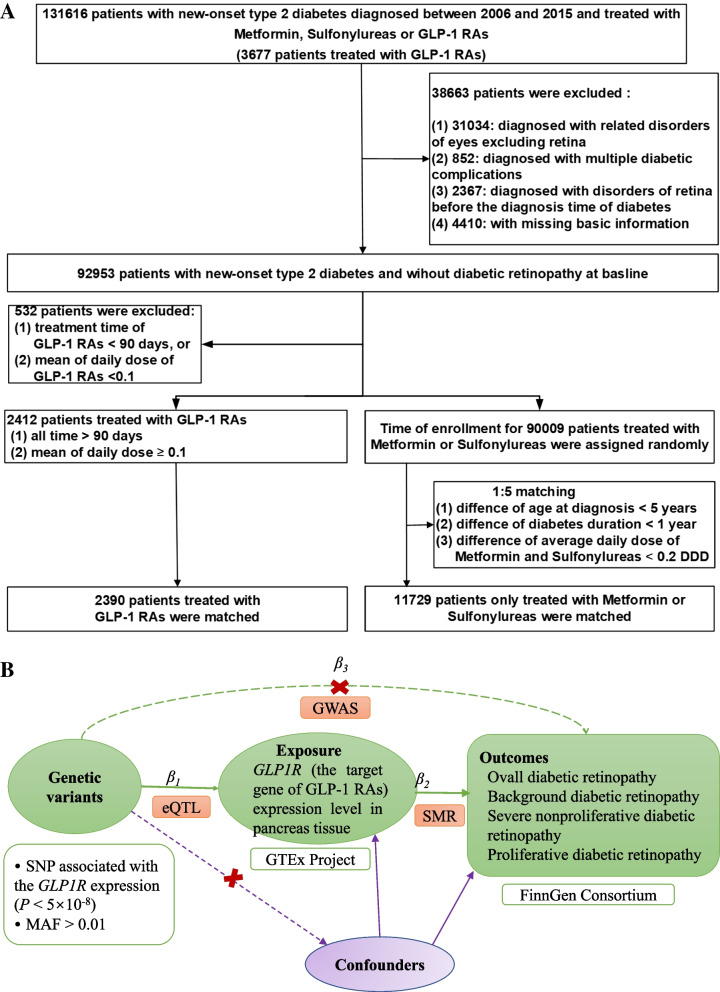
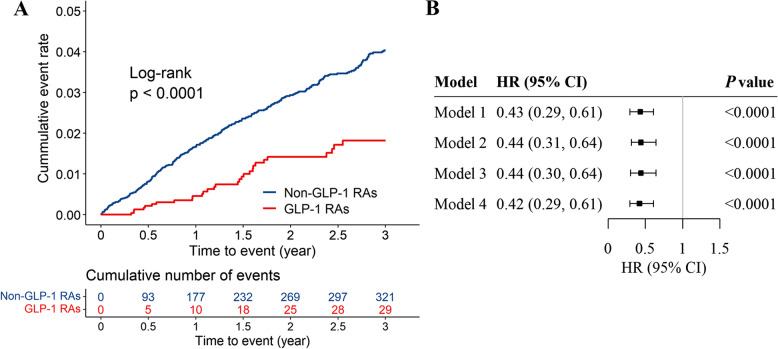
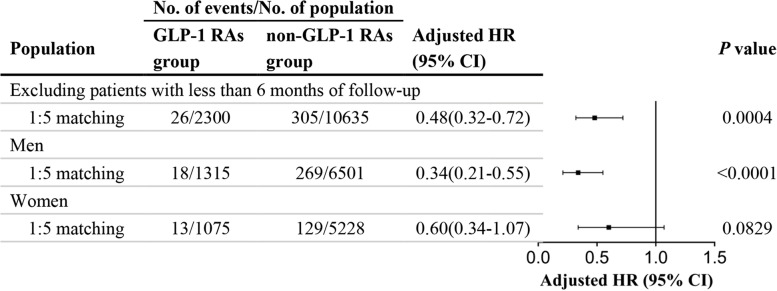
Background: The ability of glucagon-like peptide-1 receptor agonists (GLP-1 RAs) to decrease certain microvascular events has called for the investigation of GLP-1 RAs against diabetic retinopathy (DR), but the evidence is limited. By combining data from observational and Mendelian randomization (MR) studies, we aimed to investigate whether GLP-1 RAs decrease the risk of DR. Methods: We combined data from several Swedish Registers and identified patients with incident type 2 diabetes being treated with GLP-1 RAs between 2006 and 2015, and matched them to diabetic patients who did not use GLP-1 RAs as the comparisons. The Cox proportional hazards models were applied to assess the risk of DR. We further performed the summary-data-based MR (SMR) analyses based on the Genotype-Tissue Expression databases and the Genome-Wide Association Study of DR from the FinnGen consortium. Results: A total of 2390 diabetic patients were treated with GLP-1 RAs and the incidence of DR was 5.97 per 1000 person-years. Compared with diabetic patients who did not use GLP-1 RAs having an incidence of 12.85 per 1000 person-years, the adjusted hazard ratio (HR) of DR was 0.42 [95% confidence interval (CI), 0.29–0.61]. Genetically-predicted GLP1R expression (the target of GLP-1 RAs) showed an inverse association with background [odds ratio (OR)=0.83, 95% CI, 0.71–0.97] and severe nonproliferative DR (OR=0.72, 95% CI, 0.53–0.98), and a non-significant association with overall (OR=0.97, 95% CI, 0.92–1.03) and proliferative DR (OR=0.98, 95% CI, 0.91–1.05). Conclusions: Both observational and mendelian randomization analyses showed a significantly lower risk of DR for patients treated with GLP-1 RAs, which calls for further studies to validate these findings.
Overview
The claims and statistics of this paper haven’t been checked yet.
Free: it reads the open-access text and checks the first 5 claims that cite a source we can check. Create a free account to check every claim.
Integrity signals
Registry
Cites
Statistics
Figures
Verification
Claims the paper makes
The claims and statistics of this paper haven’t been checked yet.
Free: it reads the open-access text and checks the first 5 claims that cite a source we can check. Create a free account to check every claim.
Claims other papers make about this one
Each is checked against this paper’s own text: does it say what the citing paper says it does?
The cited source says what the claim attributes to it.
In the citing paper
“Several large real‐world studies have examined the association between GLP‐1RA and retinopathy, with apparently conflicting results in three recent large cohort studies, 115 , 118 , 119 leaving the question unsettled.”
From Real‐world evidence on the utilization, clinical and comparative effectiveness, and adverse effects of newer GLP ‐ 1RA ‐based weight‐loss therapies (2025) · cites this paper as [115]
The cited source says what the claim attributes to it.
In the citing paper
“The SUSTAIN‐6 trial of semaglutide for T2D suggested a potential link of this GLP‐1RA with worsening diabetic retinopathy, 114 which was not observed in, for example, the liraglutide or dulaglutide trials. 115”
From Real‐world evidence on the utilization, clinical and comparative effectiveness, and adverse effects of newer GLP ‐ 1RA ‐based weight‐loss therapies (2025) · cites this paper as [115]
Self-check
Percentages, sums and reported differences re-computed from the paper’s own numbers.
The self-check needs the paper’s full text.
Citations
Cites
Liraglutide and Cardiovascular Outcomes in Type 2 Diabetes
Marso, S. P., Daniels, G. H., Brown-Frandsen, K., Kristensen, P., Mann, J. F. E., Nauck, M. A., Nissen, S. E., Pocock, S., Poulter, N. R., Ravn, L. S., et al. (2016) · New England Journal of Medicine · doi:10.1056/nejmoa1603827 · Cited by 7,629 · cited 3×
“However, the REWIND [8] and LEADER [10] trials reported null findings between GLP-1 RAs and DR.”
MethodResultSemaglutide and Cardiovascular Outcomes in Patients with Type 2 Diabetes
Marso, S. P., Bain, S. C., Consoli, A., Eliaschewitz, F. G., Jódar, E., Leiter, L. A., Lingvay, I., Rosenstock, J., Seufert, J., Warren, M. L., et al. (2016) · New England Journal of Medicine · doi:10.1056/nejmoa1607141 · Cited by 6,900 · cited 3×
“In the REWIND study, DR was defined as photocoagulation, anti-vascular endothelial growth factor therapy, or vitrectomy [8], whereas DR was determined when patients had vitreous hemorrhage, the onset of diabetes-related blindness, and the need for treatment with an intravitreal agent or retinal photocoagulation in the…”
MethodResultSensitivity analysis in observational research: Introducing the E-value
VanderWeele, T. J., & Ding, P. (2017) · Annals of Internal Medicine · doi:10.7326/m16-2607 · Cited by 6,350 · cited 1×
“Fourth, to assess the influence of unmeasured confounding, the E value was calculated based on the estimated HR for DR [30].”
MethodThe GTEx Consortium atlas of genetic regulatory effects across human tissues
The GTEx Consortium, Aguet, F., Anand, S., Ardlie, K. G., Gabriel, S., Getz, G. A., Graubert, A., Hadley, K., Handsaker, R. E., Huang, K. H., et al. (2020) · Science · doi:10.1126/science.aaz1776 · Cited by 5,547
External review and validation of the Swedish national inpatient register
Ludvigsson, J. F., Andersson, E., Ekbom, A., Feychting, M., Kim, J.-L., Reuterwall, C., Heurgren, M., & Olausson, P. O. (2011) · BMC Public Health · doi:10.1186/1471-2458-11-450 · Cited by 5,055 · cited 1×
“However, the positive predictive value of the diagnosis in the Swedish Patient Register was generally very high (ranging between 85 and 95%) based on the previous report [40].”
BackgroundCosentino, F., Grant, P. J., Aboyans, V., Bailey, C. J., Ceriello, A., Delgado, V., Federici, M., Filippatos, G., Grobbee, D. E., Hansen, T. B., et al. (2020) · European Heart Journal · doi:10.1093/eurheartj/ehz486 · Cited by 4,763
Integration of summary data from GWAS and eQTL studies predicts complex trait gene targets
Zhu, Z., Zhang, F., Hu, H., Bakshi, A., Robinson, M. R., Powell, J. E., Montgomery, G. W., Goddard, M. E., Wray, N. R., Visscher, P. M., et al. (2016) · Nature Genetics · doi:10.1038/ng.3538 · Cited by 3,352
Gerstein, H. C., Colhoun, H. M., Dagenais, G. R., Diaz, R., Lakshmanan, M., Pais, P., Probstfield, J., Riesmeyer, J. S., Riddle, M. C., Rydén, L., et al. (2019) · The Lancet · doi:10.1016/s0140-6736(19)31149-3 · Cited by 3,163
Global Prevalence of Diabetic Retinopathy and Projection of Burden through 2045
Teo, Z. L., Tham, Y.-C., Yu, M., Chee, M. L., Rim, T. H., Cheung, N., Bikbov, M. M., Wang, Y. X., Tang, Y., Lu, Y., et al. (2021) · Ophthalmology · doi:10.1016/j.ophtha.2021.04.027 · Cited by 2,420
Effects of once-weekly exenatide on cardiovascular outcomes in type 2 diabetes
Holman, R. R., Bethel, M. A., Mentz, R. J., Thompson, V. P., Lokhnygina, Y., Buse, J. B., Chan, J. C., Choi, J., Gustavson, S. M., Iqbal, N., et al. (2017) · New England Journal of Medicine · doi:10.1056/nejmoa1612917 · Cited by 2,162
Wettermark, B., Hammar, N., MichaelFored, C., Leimanis, A., Otterblad Olausson, P., Bergman, U., Persson, I., Sundström, A., Westerholm, B., & Rosén, M. (2007) · Pharmacoepidemiology and Drug Safety · doi:10.1002/pds.1294 · Cited by 1,887
Antonetti, D. A., Klein, R., & Gardner, T. W. (2012) · New England Journal of Medicine · doi:10.1056/nejmra1005073 · Cited by 1,659
9. Pharmacologic Approaches to Glycemic Treatment: Standards of Medical Care in Diabetes—2022
American Diabetes Association Professional Practice Committee (2022) · Diabetes Care · doi:10.2337/dc22-s009 · Cited by 1,555
Diabetic retinopathy: current understanding, mechanisms, and treatment strategies
Duh, E. J., Sun, J. K., & Stitt, A. W. (2017) · JCI Insight · doi:10.1172/jci.insight.93751 · Cited by 1,057 · cited 1×
“Furthermore, there have been prior studies found that the onset of DR was associated with the pathology of the retinal neurovascular unit [35, 36].”
BackgroundIncretin hormones: Their role in health and disease
Nauck, M. A., & Meier, J. J. (2018) · Diabetes, Obesity and Metabolism · doi:10.1111/dom.13129 · Cited by 950 · cited 1×
“Glucagon-like peptide-1 receptor agonists (GLP-1 RAs) have been shown to reduce glycated hemoglobin levels via regulation of incretin function without secondary effects such as weight gain and hypoglycemia [4, 5].”
BackgroundDiabetic Retinopathy Preferred Practice Pattern®
Flaxel, C. J., Adelman, R. A., Bailey, S. T., Fawzi, A., Lim, J. I., Vemulakonda, G. A., & Ying, G.-S. (2020) · Ophthalmology · doi:10.1016/j.ophtha.2019.09.025 · Cited by 717
Neurodegeneration in the diabetic eye: new insights and therapeutic perspectives
Simó, R., & Hernández, C. (2014) · Trends in Endocrinology & Metabolism · doi:10.1016/j.tem.2013.09.005 · Cited by 490
Using genetic data to strengthen causal inference in observational research
Pingault, J.-B., O’Reilly, P. F., Schoeler, T., Ploubidis, G. B., Rijsdijk, F., & Dudbridge, F. (2018) · Nature Reviews Genetics · doi:10.1038/s41576-018-0020-3 · Cited by 444 · cited 1×
“Additionally, we adopted another study design, the Mendelian randomization (MR) analysis, to provide more reliable insights into causal associations of GLP-1 RAs with different severity of DR [19, 20].”
MethodGLP-1 receptor agonists (GLP-1RAs): cardiovascular actions and therapeutic potential
Ma, X., Liu, Z., Ilyas, I., Little, P. J., Kamato, D., Sahebka, A., Chen, Z., Luo, S., Zheng, X., Weng, J., et al. (2021) · International Journal of Biological Sciences · doi:10.7150/ijbs.59965 · Cited by 299
Hernández, C., Bogdanov, P., Corraliza, L., García-Ramírez, M., Solà-Adell, C., Arranz, J. A., Arroba, A. I., Valverde, A. M., & Simó, R. (2016) · Diabetes · doi:10.2337/db15-0443 · Cited by 267
The Genotype-Tissue Expression (GTEx) project
Lonsdale, J., Thomas, J., Salvatore, M., Phillips, R., Lo, E., Shad, S., Hasz, R., Walters, G., Garcia, F., Young, N., et al. (2013) · Nature Genetics · doi:10.1038/ng.2653 · Cited by 263
Safi, S. Z., Qvist, R., Kumar, S., Batumalaie, K., & Ismail, I. S. B. (2014) · BioMed Research International · doi:10.1155/2014/801269 · Cited by 257
Diabetic retinopathy: loss of neuroretinal adaptation to the diabetic metabolic environment
Abcouwer, S. F., & Gardner, T. W. (2014) · Annals of the New York Academy of Sciences · doi:10.1111/nyas.12412 · Cited by 254
Gaspari, T., Liu, H., Welungoda, I., Hu, Y., Widdop, R. E., Knudsen, L. B., Simpson, R. W., & Dear, A. E. (2011) · Diabetes and Vascular Disease Research · doi:10.1177/1479164111404257 · Cited by 202
Potential Role of Glucagon-Like Peptide-1 (GLP-1) in Neuroprotection
Hölscher, C. (2012) · CNS Drugs · doi:10.2165/11635890-000000000-00000 · Cited by 191
Sterling, J. K., Adetunji, M. O., Guttha, S., Bargoud, A. R., Uyhazi, K. E., Ross, A. G., Dunaief, J. L., & Cui, Q. N. (2020) · Cell Reports · doi:10.1016/j.celrep.2020.108271 · Cited by 148 · cited 1×
“Furthermore, there have been prior studies found that the onset of DR was associated with the pathology of the retinal neurovascular unit [35, 36].”
BackgroundJi, J., Sundquist, K., Sundquist, J., & Hemminki, K. (2012) · International Journal of Cancer · doi:10.1002/ijc.27462 · Cited by 108
Self-citationGaborit, B., Julla, J.-B., Besbes, S., Proust, M., Vincentelli, C., Alos, B., Ancel, P., Alzaid, F., Garcia, R., Mailly, P., et al. (2020) · The Journal of Clinical Endocrinology & Metabolism · doi:10.1210/clinem/dgz069 · Cited by 95
GLP-1R as a Target for the Treatment of Diabetic Retinopathy: Friend or Foe?
Simó, R., & Hernández, C. (2017) · Diabetes · doi:10.2337/db16-1364 · Cited by 86
Cai, X., Li, J., Wang, M., She, M., Tang, Y., Li, J., Li, H., & Hui, H. (2017) · International Journal of Medical Sciences · doi:10.7150/ijms.20962 · Cited by 82
Glucagon-like peptide 1 receptor agonists and the risk of incident diabetic retinopathy
Douros, A., Filion, K. B., Yin, H., Yu, O. H., Etminan, M., Udell, J. A., & Azoulay, L. (2018) · Diabetes Care · doi:10.2337/dc17-2280 · Cited by 70
Diabetic retinopathy: research to clinical practice
Shah, A. R., & Gardner, T. W. (2017) · Clinical Diabetes and Endocrinology · doi:10.1186/s40842-017-0047-y · Cited by 62
The impact of improved glycaemic control with GLP-1 receptor agonist therapy on diabetic retinopathy
Varadhan, L., Humphreys, T., Walker, A. B., & Varughese, G. I. (2014) · Diabetes Research and Clinical Practice · doi:10.1016/j.diabres.2013.12.041 · Cited by 50
Wang, T., Lu, W., Tang, H., Buse, J. B., Stürmer, T., & Gower, E. W. (2018) · Diabetes Care · doi:10.2337/dc18-1893 · Cited by 28
Ueda, P., Pasternak, B., Eliasson, B., Svensson, A.-M., Franzén, S., Gudbjörnsdottir, S., Hveem, K., Jonasson, C., Melbye, M., & Svanström, H. (2019) · Diabetes Care · doi:10.2337/dc18-2532 · Cited by 24
Cited by
Inter-organ crosstalk during development and progression of type 2 diabetes mellitus
Xourafa, G., Korbmacher, M., & Roden, M. (2024) · Nature Reviews Endocrinology · doi:10.1038/s41574-023-00898-1 · Cited by 274
Thomsen, R. W., Mailhac, A., Løhde, J. B., & Pottegård, A. (2025) · Diabetes Obesity and Metabolism · doi:10.1111/dom.16364 · Cited by 207
Tan, X., Liu, R., Zhao, D., He, Z., Liu, R., Zheng, M., Li, Q., Wang, Q., Liu, D., Feng, F., et al. (2023) · Journal of Advanced Research · doi:10.1016/j.jare.2023.02.016 · Cited by 96
Eleftheriadou, A., Riley, D., Zhao, S. S., Austin, P., Hernández, G., Lip, G. Y. H., Jackson, T. L., Wilding, J. P. H., & Alam, U. (2024) · Diabetologia · doi:10.1007/s00125-024-06132-5 · Cited by 73
Research progress and applications of genome‐wide association study in farm animals
Tan, X., He, Z., Fahey, A. G., Zhao, G., Liu, R., & Wen, J. (2023) · Animal Research and One Health · doi:10.1002/aro2.14 · Cited by 67
Metadata
- Authors
- Zheng, D., Li, N., Hou, R., Zhang, X., Wu, L., Sundquist, J., Sundquist, K., & Ji, J.
- Affiliations
- Capital Medical University (CN)
- Shimane University (JP)
- Lund University (SE)
- Corresponding author
- Zhang, Xiaoyu
- Ji, Jianguang
- Venue
- BMC Medicine
- Published
- 2023-02-03
- Volume
- 21
- Issue
- 1
- Pages
- 40-40
- ISSN
- 1741-7015 (ISSN-L)
- PMC
- PMC9898966
- OpenAlex
- W4319078643
- Semantic Scholar
- 8742db5e3b8d668c66c2d696ad5f1836002db2f0
- Cited by
- 74
- References
- 35
- Citations by year
- 2026: 25 · 2025: 23 · 2024: 17 · 2023: 9
- FWCI
- 15.09
- Type
- journal article
- Language
- en
- Open access
- gold
- doi.org
- Licence
- cc-by
- creativecommons.org/licenses/by/4.0 (tdm)
- creativecommons.org/licenses/by/4.0 (vor)
- Locations
- BMC Medicine (publishedVersion, cc-by)
- PubMed Central (publishedVersion, cc-by)
- PubMed (publishedVersion)
- DOAJ (DOAJ: Directory of Open Access Journals) (submittedVersion, cc-by-sa)
- Lund University Publications (Lund University) (submittedVersion)
- Funders
- Lund University
- Topics
- Health Sciences › Medicine › Endocrinology, Diabetes and Metabolism › Diabetes Treatment and Management
- Health Sciences › Medicine › Ophthalmology › Retinal Diseases and Treatments
- Health Sciences › Medicine › Endocrinology, Diabetes and Metabolism › Diabetes Management and Research
- Keywords
- GLP-1 receptor agonists, diabetic retinopathy, type 2 diabetes, non-proliferative diabetic retinopathy, proliferative diabetic retinopathy, microvascular complications
- MeSH terms
- Glucagon-Like Peptide-1 Receptor, Glucagon-Like Peptide-1 Receptor Agonists, Diabetes Mellitus, Type 2, Diabetic Retinopathy, Humans, Hypoglycemic Agents, Glucagon-Like Peptide 1, Genome-Wide Association Study, Mendelian Randomization Analysis
About these checks
Registry, retraction, Cites and statistics results are computed, not judged, with one exception: a printed reference that no index lists is read once by a model before it counts as a citation error. Claims are extracted by a model and kept only when their quote appears verbatim in the text; each cited source is then checked, with a model’s help, for whether it says what the claim relies on. Those verdicts can be wrong — read the claim’s quote and the cited source before relying on one.
Statistics and arithmetic are recomputed, not judged.
Confidence bands are shown only for fields calibrated on our annotated test set. None is calibrated yet, so no band is shown.
What counts as a claim ›How we measure confidence ›How we check this ›
Are you an author, or do you see a problem with this page? Request a review
Data sources
Bibliographic data: Semantic Scholar, OpenAlex, Crossref.
Contains information from the Semantic Scholar Academic Graph Datasets, made available under the ODC Attribution License (ODC-BY 1.0).
Semantic Scholar’s data is described in: Kinney, R., et al. (2023). The Semantic Scholar Open Data Platform. arXiv:2301.10140.
