

Efficacy of virtual reality for pain relief in medical procedures: a systematic review and meta-analysis
Open accessThe DOI matches its Crossref record; 178 of the 179 references it cites were found in a registry or an index.
Abstract
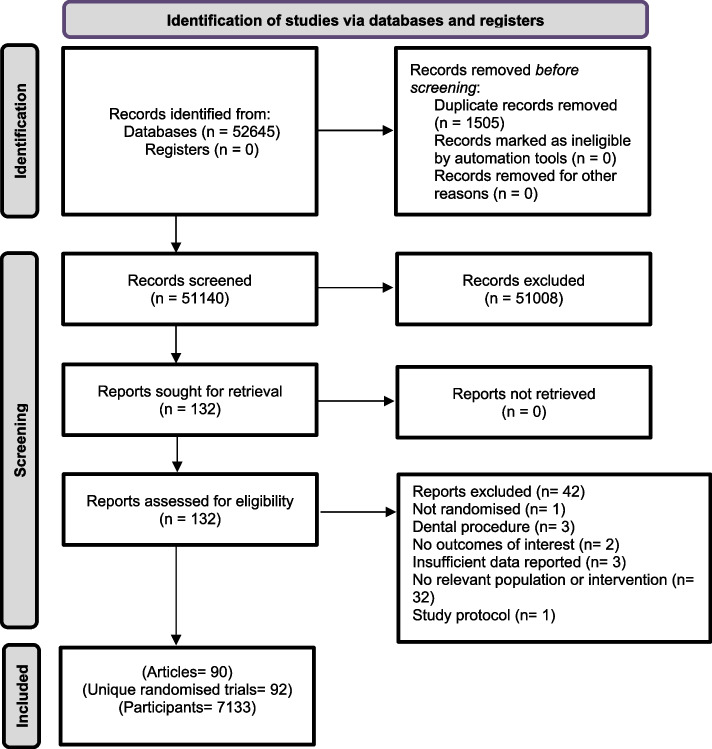
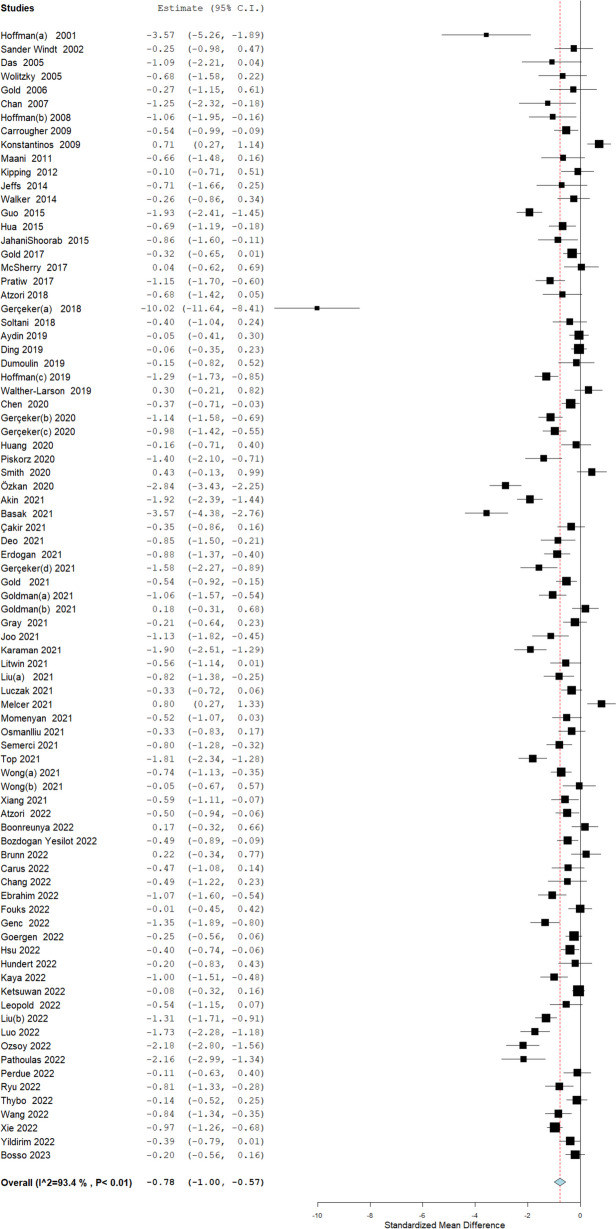
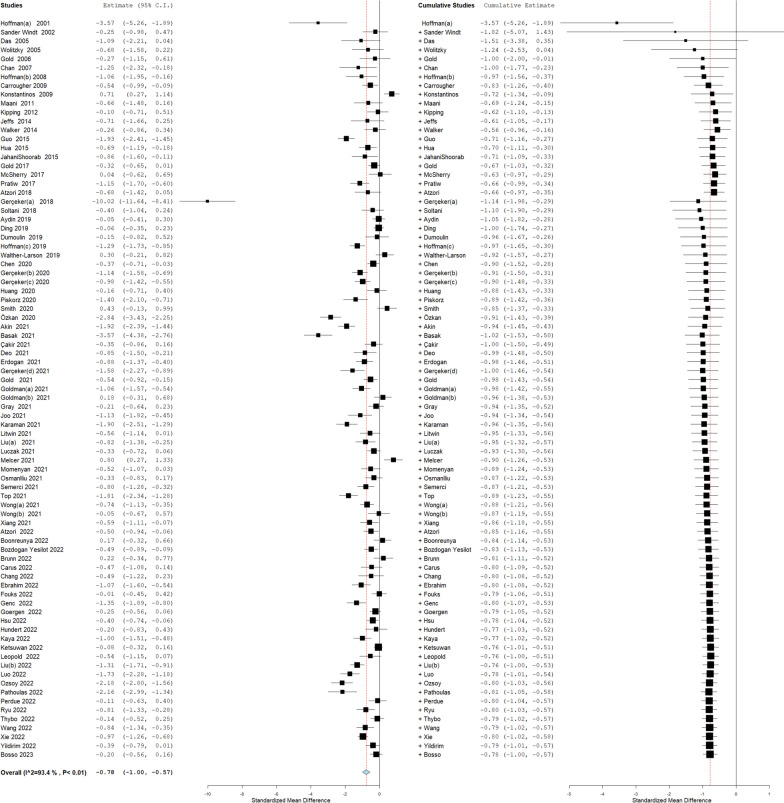
Background: Effective pain control is crucial to optimise the success of medical procedures. Immersive virtual reality (VR) technology could offer an effective non-invasive, non-pharmacological option to distract patients and reduce their experience of pain. We aimed to evaluate the efficacy of Immersive virtual reality (VR) technology in reducing patient’s pain perception during various medical procedures by conducting a systematic review and meta-analysis. Methods: We searched MEDLINE, EMBASE, CENTRAL, CINAHL, and SIGLE until December 2022 for all randomised clinical trials (RCT) evaluating any type of VR in patients undergoing any medical procedure. We conducted a random effect meta-analysis summarising standardised mean differences (SMD) with 95% confidence intervals (CI). We evaluated heterogeneity using I 2 and explored it using subgroup and meta-regression analyses. Results: In total, we included 92 RCTs ( n = 7133 participants). There was a significant reduction in pain scores with VR across all medical procedures ( n = 83, SMD − 0.78, 95% CI − 1.00 to − 0.57, I 2 = 93%, p = < 0.01). Subgroup analysis showed varied reduction in pain scores across trial designs [crossover ( n = 13, SMD − 0.86, 95% CI − 1.23 to − 0.49, I 2 = 72%, p = < 0.01) vs parallel RCTs ( n = 70, SMD − 0.77, 95% CI − 1.01 to − 0.52, I 2 = 90%, p = < 0.01)]; participant age groups [paediatric ( n = 43, SMD − 0.91, 95% CI − 1.26 to − 0.56, I 2 = 87%, p = < 0.01) vs adults ( n = 40, SMD − 0.66, 95% CI − 0.94 to − 0.39, I 2 = 89%, p = < 0.01)] or procedures [venepuncture ( n = 32, SMD − 0.99, 95% CI − 1.52 to − 0.46, I 2 = 90%, p = < 0.01) vs childbirth ( n = 7, SMD − 0.99, 95% CI − 1.59 to − 0.38, I 2 = 88%, p = < 0.01) vs minimally invasive medical procedures ( n = 25, SMD − 0.51, 95% CI − 0.79 to − 0.23, I 2 = 85%, p = < 0.01) vs dressing changes in burn patients ( n = 19, SMD − 0.8, 95% CI − 1.16 to − 0.45, I 2 = 87%, p = < 0.01)]. We explored heterogeneity using meta-regression which showed no significant impact of different covariates including crossover trials ( p = 0.53), minimally invasive procedures ( p = 0.37), and among paediatric participants ( p = 0.27). Cumulative meta-analysis showed no change in overall effect estimates with the additional RCTs since 2018. Conclusions: Immersive VR technology offers effective pain control across various medical procedures, albeit statistical heterogeneity. Further research is needed to inform the safe adoption of this technology across different medical disciplines.
Overview
The claims and statistics of this paper haven’t been checked yet.
Free: it reads the open-access text and checks the first 5 claims that cite a source we can check. Create a free account to check every claim.
Integrity signals
Registry
Cites
Statistics
Figures
Verification
Claims the paper makes
The claims and statistics of this paper haven’t been checked yet.
Free: it reads the open-access text and checks the first 5 claims that cite a source we can check. Create a free account to check every claim.
Claims other papers make about this one
Each is checked against this paper’s own text: does it say what the citing paper says it does?
The check wasn’t confident either way, so it gives no verdict — never disputed.
In the citing paper
“However, no significant age differences were found in our study, consistent with other research.46”
From A Pilot Study of Virtual Reality in Hemodialysis for Mitigating Pain and Anxiety: User Experiences and Perceptions (2025) · cites this paper as [46]
Experimental — accuracy not yet measured
Self-check
Percentages, sums and reported differences re-computed from the paper’s own numbers.
The self-check needs the paper’s full text.
Citations
Cites
The PRISMA 2020 Statement: An Updated Guideline for Reporting Systematic Reviews
Page, M. J., McKenzie, J. E., Bossuyt, P. M., Boutron, I., Hoffmann, T. C., Mulrow, C. D., Shamseer, L., Tetzlaff, J. M., Akl, E. A., Brennan, S. E., et al. (2021) · International Journal of Surgery · doi:10.1016/j.ijsu.2021.105906 · Cited by 11,748
A Nonparametric “Trim and Fill” Method of Accounting for Publication Bias in Meta-Analysis
Duval, S., & Tweedie, R. (2000) · Journal of the American Statistical Association · doi:10.1080/01621459.2000.10473905 · Cited by 2,955 · cited 1×
“Where publication bias was detected, we explore potential impact using the trim and fill method [56] to estimate and adjust for the number and outcomes of missing studies in the meta-analysis.”
MethodAssessing risk of bias in a randomized trial
Higgins, J. P., Savović, J., Page, M. J., Elbers, R. G., & Sterne, J. A. (2019) · Cochrane Handbook for Systematic Reviews of Interventions · doi:10.1002/9781119536604.ch8 · Cited by 1,765 · cited 1×
“We assessed the risk of bias in included trials in duplicate (JJT, RP, AK, DP, MPR, SH) using the Cochrane Risk of Bias assessment tool 2.0 [51].”
MethodInfluentialCipresso, P., Giglioli, I. A. C., Raya, M. A., & Riva, G. (2018) · Frontiers in Psychology · doi:10.3389/fpsyg.2018.02086 · Cited by 1,131
Sterne, J. A. C., & Harbord, R. M. (2004) · The Stata Journal: Promoting communications on statistics and Stata · doi:10.1177/1536867x0400400204 · Cited by 708 · cited 1×
“We also investigated the risk of publication bias using Egger’s test, a funnel plot, and Galbraith plot to identify potential outliers [55].”
MethodA review of immersive virtual reality serious games to enhance learning and training
Checa, D., & Bustillo, A. (2020) · Multimedia Tools and Applications · doi:10.1007/s11042-019-08348-9 · Cited by 693
Gordon, D. B., Dahl, J. L., Miaskowski, C., McCarberg, B., Todd, K. H., Paice, J. A., Lipman, A. G., Bookbinder, M., Sanders, S. H., Turk, D. C., et al. (2005) · Archives of Internal Medicine · doi:10.1001/archinte.165.14.1574 · Cited by 687
Opioids and the treatment of chronic pain: Controversies, current status, and future directions.
Rosenblum, A., Marsch, L. A., Joseph, H., & Portenoy, R. K. (2008) · Experimental and Clinical Psychopharmacology · doi:10.1037/a0013628 · Cited by 643
Systematic Review and Meta-analysis of Virtual Reality in Pediatrics: Effects on Pain and Anxiety
Eijlers, R., Utens, E. M. W. J., Staals, L. M., de Nijs, P. F. A., Berghmans, J. M., Wijnen, R. M. H., Hillegers, M. H. J., Dierckx, B., & Legerstee, J. S. (2019) · Anesthesia & Analgesia · doi:10.1213/ane.0000000000004165 · Cited by 605
Application of virtual reality technology in clinical medicine.
Li, L., Yu, F., Shi, D., Shi, J., Tian, Z., Yang, J., Wang, X., & Jiang, Q. (2017) · Europe PMC (PubMed Central) · Cited by 597
Research works printed but not linked: 1
- Sherman WR Craig AB Understanding virtual reality: Interface, application, and design: Morgan Kaufmann 2018
Cited by
Hu, S., Song, D., Wan, S., Zhang, S., Luo, C., Li, N., Liu, G., Vasconcelos, J. D. G. E. S., de Carvalho, L. L. C., Neobísi, E., et al. (2025) · Frontiers in Public Health · doi:10.3389/fpubh.2025.1646802 · Cited by 83
A synthesis of meta-analyses of immersive virtual reality interventions in pain
Rooney, T., Sharpe, L., Winiarski, N., Todd, J., Colagiuri, B., Ryckeghem, D. M. L. V., Crombez, G., & Michalski, S. C. (2025) · Clinical Psychology Review · doi:10.1016/j.cpr.2025.102566 · Cited by 30
Virtual Reality for Postoperative Pain Management: A Review of Current Evidence
Malik, A., Elshazly, T. B., Pokuri, K., Apai, C., Rothkrug, A., Hasoon, J. J., Chung, M., Ye, Z., Bhayani, S., Kaye, A. D., et al. (2024) · Current Pain and Headache Reports · doi:10.1007/s11916-024-01308-5 · Cited by 26
Device associated complications in the intensive care unit
Hixson, R., Schwab, K. E., Melamed, K. H., & Qadir, N. (2024) · BMJ · doi:10.1136/bmj-2023-077318 · Cited by 24
Extended reality in anesthesia: a narrative review
Han, S., Kiroff, K. L., & Kinjo, S. (2025) · Korean Journal of Anesthesiology · doi:10.4097/kja.24687 · Cited by 10
Metadata
- Authors
- Teh, J. J., Pascoe, D. J., Hafeji, S., Parchure, R., Koczoski, A., Rimmer, M. P., Khan, K. S., & Al Wattar, B. H.
- Affiliations
- Imperial College London (GB)
- University of St Andrews (GB)
- University College London (GB)
- St John's Hospital (GB)
- Universidad de Granada (ES)
- Corresponding author
- Rimmer, Michael P.
- Venue
- BMC Medicine
- Published
- 2024-02-14
- Volume
- 22
- Issue
- 1
- Pages
- 64-64
- ISSN
- 1741-7015 (ISSN-L)
- PMC
- PMC10865524
- OpenAlex
- W4391818233
- Cited by
- 132
- References
- 179
- Citations by year
- 2026: 60 · 2025: 45 · 2024: 27
- FWCI
- 15.62
- Type
- journal article
- Language
- en
- Open access
- gold
- doi.org
- Licence
- cc-by
- creativecommons.org/licenses/by/4.0 (tdm)
- creativecommons.org/licenses/by/4.0 (vor)
- Locations
- BMC Medicine (publishedVersion, cc-by)
- PubMed Central (publishedVersion, cc-by)
- PubMed (publishedVersion)
- Institutional Repository of the University of Granada (University of Granada) (submittedVersion, cc-by)
- DOAJ (DOAJ: Directory of Open Access Journals) (submittedVersion)
- Edinburgh Research Explorer (University of Edinburgh) (submittedVersion, cc-by)
- Funders
- Universidad de Granada
- Medical Research Council (MR/N022556/1)
- Topics
- Health Sciences › Medicine › Pediatrics, Perinatology and Child Health › Pediatric Pain Management Techniques
- Physical Sciences › Computer Science › Human-Computer Interaction › Virtual Reality Applications and Impacts
- Health Sciences › Medicine › Anesthesiology and Pain Medicine › Pain Management and Treatment
- Keywords
- virtual reality, analgesia, procedural pain, distraction therapy, non-pharmacological analgesia, medical procedures, pediatric patients, venipuncture, needle insertion, pain scores, subgroup analysis, meta-regression, effect size heterogeneity, standardized mean difference
- MeSH terms
- Virtual Reality, Adult, Child, Humans, Pain, Pain Management
About these checks
Registry, retraction, Cites and statistics results are computed, not judged, with one exception: a printed reference that no index lists is read once by a model before it counts as a citation error. Claims are extracted by a model and kept only when their quote appears verbatim in the text; each cited source is then checked, with a model’s help, for whether it says what the claim relies on. Those verdicts can be wrong — read the claim’s quote and the cited source before relying on one.
Statistics and arithmetic are recomputed, not judged.
Confidence bands are shown only for fields calibrated on our annotated test set. None is calibrated yet, so no band is shown.
What counts as a claim ›How we measure confidence ›How we check this ›
Are you an author, or do you see a problem with this page? Request a review
How to cite
Cite CoChat for the checks on this page, and the paper for its own findings.
- This page
- CoChat. (2026). Citation check: Efficacy of virtual reality for pain relief in medical procedures: a systematic review and meta-analysis. https://app.cochat.ai/papers/10.1186/s12916-024-03266-6
- The paper
- Teh, J. J., Pascoe, D. J., Hafeji, S., Parchure, R., Koczoski, A., Rimmer, M. P., Khan, K. S., & Al Wattar, B. H. (2024). Efficacy of virtual reality for pain relief in medical procedures: a systematic review and meta-analysis. BMC Medicine. https://doi.org/10.1186/s12916-024-03266-6
Data sources
Bibliographic data: Semantic Scholar, OpenAlex, Crossref.
Contains information from the Semantic Scholar Academic Graph Datasets, made available under the ODC Attribution License (ODC-BY 1.0).
Semantic Scholar’s data is described in: Kinney, R., et al. (2023). The Semantic Scholar Open Data Platform. arXiv:2301.10140.
