

The DOI matches its Crossref record; 161 of the 161 references it cites were found in a registry or an index.
Functional roles and networks of non-coding RNAs in the pathogenesis of neurodegenerative diseases
Open accessAbstract
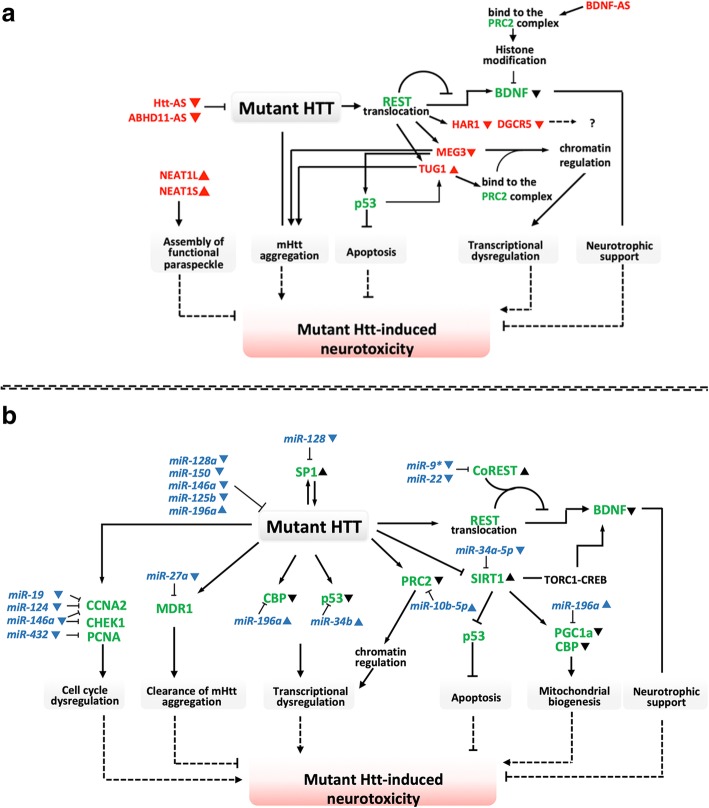
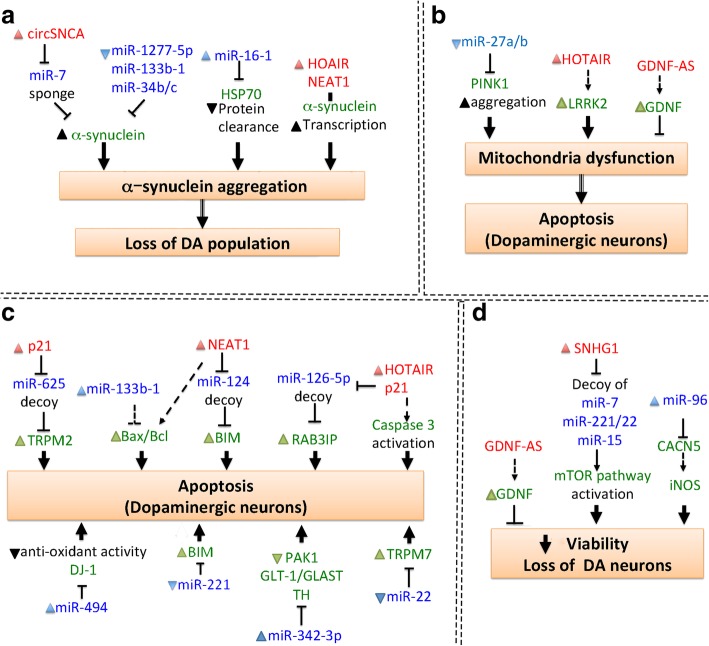
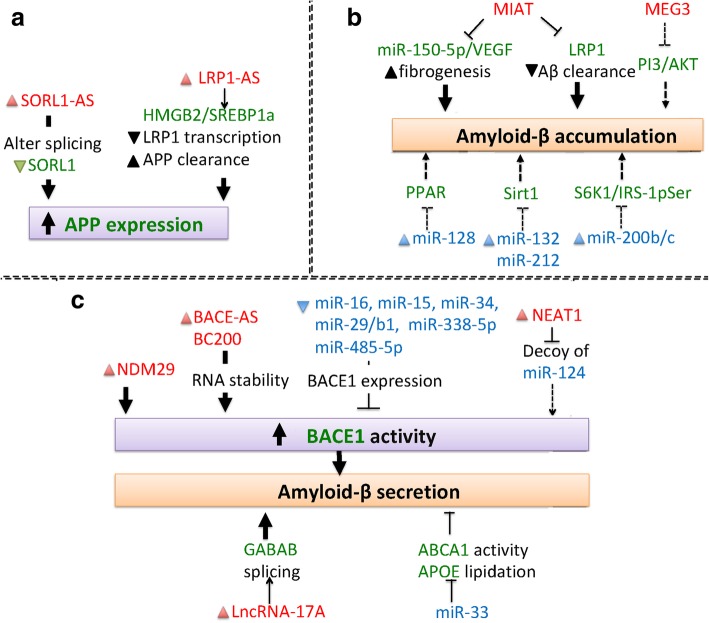
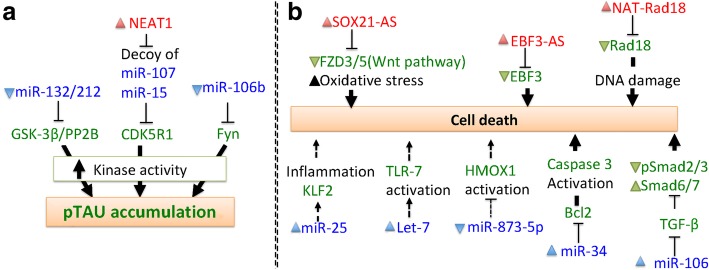
Recent transcriptome analyses have revealed that noncoding RNAs (ncRNAs) are broadly expressed in mammalian cells and abundant in the CNS, with tissue and cell type-specific expression patterns. Moreover, ncRNAs have been found to intricately and dynamically regulate various signaling pathways in neurodegeneration. As such, some antisense transcripts and microRNAs are known to directly affect neurodegeneration in disease contexts. The functions of ncRNAs in pathogenesis are unique for each disorder, as are the pertinent networks of ncRNA/miRNA/mRNA that mediate these functions. Thus, further understanding of ncRNA biogenesis and effects might aid the discovery of diagnostic biomarkers or development of effective therapeutics for neurodegenerative disorders. Here, we review the ncRNAs that have so far been identified in major neurodegenerative disease etiology and the mechanisms that link ncRNAs with disease-specific phenotypes, such as HTT aggregation in HD, α-synuclein in PD, and Aβ plaques and hyperphosphorylated Tau in AD. We also summarize the known lncRNA/miRNA/mRNA networks that participate in neurodegenerative diseases, and we discuss ncRNA-related treatments shown to delay disease onset and prolong lifespan in rodent models.
Overview
The claims and statistics of this paper haven’t been checked yet.
Run the check — free, no account needed. It reads the open-access text and checks the sources it cites.
Integrity signals
Registry
Cites
Statistics
Figures
Verification
Claims the paper makes
The claims and statistics of this paper haven’t been checked yet.
Run the check — free, no account needed. It reads the open-access text and checks the sources it cites.
Claims other papers make about this one
Each is checked against this paper’s own text: does it say what the citing paper says it does?
The source backs part of the claim, not all of it — or backs it for a different population, condition or comparison.
In the citing paper
“ncRNAs may influence the pathophysiology of depression by regulating neuronal function, neurotransmitter release, and microglia (Fig. 4).213,221,222”
From Epigenetic regulation in major depression and other stress-related disorders: molecular mechanisms, clinical relevance and therapeutic potential (2023) · cites this paper as [222]
Experimental — accuracy not yet measured
Self-check
Percentages, sums and reported differences re-computed from the paper’s own numbers.
The self-check needs the paper’s full text.
Citations
Cites
1 retracted
Liu, Y., Zhang, Y., Liu, P., Bai, H., Li, X., Xiao, J., Yuan, Q., Geng, S., Yin, H., Zhang, H., et al. (2019) · European Journal of Pharmacology · doi:10.1016/j.ejphar.2018.11.004 · Cited by 45
RetractedDauer, W., & Przedborski, S. (2003) · Neuron · doi:10.1016/s0896-6273(03)00568-3 · Cited by 5,469
The biogenesis, biology and characterization of circular RNAs
Kristensen, L. S., Andersen, M. S., Stagsted, L. V. W., Ebbesen, K. K., Hansen, T. B., & Kjems, J. (2019) · Nature Reviews Genetics · doi:10.1038/s41576-019-0158-7 · Cited by 4,823
Khalil, A. M., Guttman, M., Huarte, M., Garber, M., Raj, A., Rivea Morales, D., Thomas, K., Presser, A., Bernstein, B. E., van Oudenaarden, A., et al. (2009) · Proceedings of the National Academy of Sciences · doi:10.1073/pnas.0904715106 · Cited by 2,872
(2012) · The Scientific World JOURNAL · doi:10.1100/tswj · Cited by 2,600
Karran, E., Mercken, M., & Strooper, B. D. (2011) · Nature Reviews Drug Discovery · doi:10.1038/nrd3505 · Cited by 2,188
Cellular functions of long noncoding RNAs
Yao, R.-W., Wang, Y., & Chen, L. (2019) · Nature Cell Biology · doi:10.1038/s41556-019-0311-8 · Cited by 1,404
Characterizing the RNA targets and position-dependent splicing regulation by TDP-43
Tollervey, J. R., Curk, T., Rogelj, B., Briese, M., Cereda, M., Kayikci, M., König, J., Hortobágyi, T., Nishimura, A. L., Župunski, V., et al. (2011) · Nature Neuroscience · doi:10.1038/nn.2778 · Cited by 1,165
RNA therapeutics: beyond RNA interference and antisense oligonucleotides
Kole, R., Krainer, A. R., & Altman, S. (2012) · Nature Reviews Drug Discovery · doi:10.1038/nrd3625 · Cited by 1,152
Specific expression of long noncoding RNAs in the mouse brain
Mercer, T. R., Dinger, M. E., Sunkin, S. M., Mehler, M. F., & Mattick, J. S. (2008) · Proceedings of the National Academy of Sciences · doi:10.1073/pnas.0706729105 · Cited by 1,103
Cited by
Sorted by citations
Aging Hallmarks and the Role of Oxidative Stress
Maldonado, E., Morales, S., Urbina, F., & Solari, A. (2023) · Antioxidants · doi:10.3390/antiox12030651 · Cited by 491
Yuan, M., Yang, B., Rothschild, G., Mann, J. J., Sanford, L. D., Tang, X., Huang, C., Wang, C., & Zhang, W. (2023) · Signal Transduction and Targeted Therapy · doi:10.1038/s41392-023-01519-z · Cited by 246
“213,221,222 miRNAs and the development of depression MicroRNA molecules are highly conserved small (21 – 24 nucleotides) RNA molecules.”
BackgroundLoganathan, T., & Doss, C. G. P. (2023) · Functional & Integrative Genomics · doi:10.1007/s10142-022-00947-4 · Cited by 196
Exosomes: Potential Disease Biomarkers and New Therapeutic Targets
Mosquera-Heredia, M. I., Morales, L. C., Vidal, O. M., Barceló, E., Silvera-Redondo, C. A., Velez, J. I., & Garavito, P. (2021) · Biomedicines · doi:10.3390/biomedicines9081061 · Cited by 173
Blood-Based Biomarkers for Alzheimer’s Disease Diagnosis and Progression: An Overview
Varesi, A., Carrara, A., Pires, V. G., Floris, V., Pierella, E., Savioli, G., Prasad, S., Esposito, C., Ricevuti, G., Chirumbolo, S., et al. (2022) · Cells · doi:10.3390/cells11081367 · Cited by 150
Metadata
- Authors
- Wu, Y.-Y., & Kuo, H.-C.
- Affiliations
- Institute of Cellular and Organismic Biology, Academia Sinica (TW)
- National Taiwan University (TW)
- Corresponding author
- Kuo, Hung-Chih
- ORCID
- Wu, Yi-Ying
- Venue
- Journal of Biomedical Science
- Published
- 2020-04-07
- Volume
- 27
- Issue
- 1
- Pages
- 49-49
- ISSN
- 1021-7770 (ISSN-L)
- 1423-0127
- PMC
- PMC7140545
- OpenAlex
- W3015066166
- Cited by
- 213
- References
- 161
- Citations by year
- 2026: 8 · 2025: 22 · 2024: 39 · 2023: 54 · 2022: 35 · 2021: 43 · 2020: 11
- FWCI
- 3.95
- Type
- journal article
- Language
- en
- Open access
- diamond
- doi.org
- Locations
- Journal of Biomedical Science (publishedVersion, cc-by)
- PubMed Central (publishedVersion, cc-by)
- PubMed (publishedVersion)
- DOAJ (DOAJ: Directory of Open Access Journals) (submittedVersion, cc-by-sa)
- Funders
- Academia Sinica (AS-106-TP-B13, AS-SUMMIT-108)
- Ministry of Science and Technology (MOST 106-0210-01-15-02, 108-3114-Y-001-002, MOST 107-0210-01-19-01)
- Topics
- Life Sciences › Biochemistry, Genetics and Molecular Biology › Cancer Research › Cancer-related molecular mechanisms research
- Life Sciences › Biochemistry, Genetics and Molecular Biology › Cancer Research › MicroRNA in disease regulation
- Life Sciences › Neuroscience › Neurology › Neuroinflammation and Neurodegeneration Mechanisms
- Keywords
- non-coding RNA, neurodegenerative diseases, long non-coding RNA, microRNA, antisense transcripts, lncRNA-miRNA-mRNA network, Huntington's disease, alpha-synuclein, Parkinson's disease, Alzheimer's disease, amyloid plaques, tau hyperphosphorylation, disease biomarkers
- MeSH terms
- Animals, Humans, Biomarkers, Neurodegenerative Diseases, Gene Expression Profiling, RNA, Untranslated, Mice, Rats
About these checks
Registry, retraction, Cites and statistics results are computed, not judged, with one exception: a printed reference that no index lists is read once by a model before it counts as a citation error. Claims are extracted by a model and kept only when their quote appears verbatim in the text; each cited source is then checked, with a model’s help, for whether it says what the claim relies on. Those verdicts can be wrong — read the claim’s quote and the cited source before relying on one.
Statistics and arithmetic are recomputed, not judged.
Confidence bands are shown only for fields calibrated on our annotated test set. None is calibrated yet, so no band is shown.
What counts as a claim ›How we measure confidence ›How we check this ›
Are you an author, or do you see a problem with this page? Request a review
