

The DOI matches its Crossref record; 27 of the 27 references it cites were found in a registry or an index.
Prevalence and management of severe asthma in primary care: an observational cohort study in Sweden (PACEHR)
Open accessAbstract
BACKGROUND: Severe and uncontrolled asthma is associated with increased risk of exacerbations and death. A substantial proportion of asthma patients have poor asthma control, and a concurrent COPD diagnosis often increases disease burden. The objective of the study was to describe the prevalence and managemant of severe asthma in a Swedish asthma popuöation. METHODS: In this observational cohort study, primary care medical records data (2006-2013) from 36 primary health care centers were linked to data from national mandatory Swedish health registries. The studied population (>18 years) had a record of drug collection for obstructive pulmonary disease (ATC code R03) during 2011-2012, and a physician diagnosed asthma (ICD-10 code J45-J46) prior to drug collection. Severe asthma was classified as collection of high dose inhaled steroid (> 800 budesonide or equivalent per day) and leukotriene receptor antagonist and/or long-acting beta-agonist. Poor asthma control was defined as either collection of ≥600 doses of short-acting beta-agonists, and/or ≥1 exacerbation(s) during the year post index date. RESULTS: A total of 18,724 asthma patients (mean 49 years, 62.8% women) were included, of whom 17,934 (95.8%) had mild to moderate and 790 (4.2%) had severe asthma. Exacerbations were more prevalent in severe asthma (2.59 [2.41-2.79], Relative Risk [95% confidence interval]; p < 0.001). Poor asthma control was observed for 28.2% of the patients with mild to moderate asthma and for more than half (53.6%) of the patients with severe asthma (<0.001). Prior to index, one in five severe asthma patients had had a contact with secondary care and one third with primary care. A concurrent COPD diagnosis increased disease burden. CONCLUSION: Severe asthma was found in 4.2% of asthma patients in Sweden, more than half of them had poor asthma control, and most patients had no regular health care contacts.
Overview
The claims and statistics of this paper haven’t been checked yet.
Run the check — free, no account needed. It reads the open-access text and checks the sources it cites.
Integrity signals
Registry
Cites
Statistics
Figures
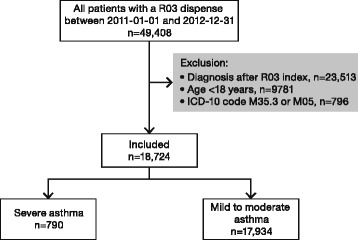
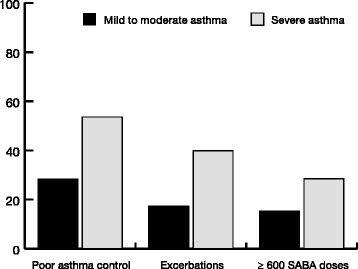
Verification
Claims the paper makes
The claims and statistics of this paper haven’t been checked yet.
Run the check — free, no account needed. It reads the open-access text and checks the sources it cites.
Claims other papers make about this one
Each is checked against this paper’s own text: does it say what the citing paper says it does?
In the citing paper
“For example, in has been reported that 4.2% of Swedish adult asthmatic patients in primary care settings have severe disease (36).”
From Epidemiology of Asthma in Children and Adults (2019) · cites this paper as [36]
Self-check
Percentages, sums and reported differences re-computed from the paper’s own numbers.
The self-check needs the paper’s full text.
Citations
Cites
GLOBAL STRATEGY FOR ASTHMA MANAGEMENT AND PREVENTION
PAUWELS, R. A. (1996) · Arerugī/Arerugi · doi:10.15036/arerugi.45.792 · Cited by 9,997
International ERS/ATS guidelines on definition, evaluation and treatment of severe asthma
Chung, K. F., Wenzel, S. E., Brozek, J. L., Bush, A., Castro, M., Sterk, P. J., Adcock, I. M., Bateman, E. D., Bel, E. H., Bleecker, E. R., et al. (2014) · European Respiratory Journal · doi:10.1183/09031936.00202013 · Cited by 3,926 · cited 3×
“Most patients with asthma have a mild or moderate disease and data on the prevalence of severe asthma is sparse but reports indicate between 5 and 10% of the asthmatic populations to have had severe disease [8, 10].”
BackgroundClinical management of asthma in 1999: the Asthma Insights and Reality in Europe (AIRE) study
Rabe, K. F., Vermeire, P., Soriano, J. B., & Maier, W. (2000) · European Respiratory Journal · doi:10.1183/09031936.00.16580200 · Cited by 1,024
The prevalence of severe refractory asthma
Hekking, P.-P. W., Wener, R. R. L., Amelink, M., Zwinderman, A. H., Bouvy, M. L., & Bel, E. H. (2014) · Journal of Allergy and Clinical Immunology · doi:10.1016/j.jaci.2014.08.042 · Cited by 815 · cited 1×
“6% of patients with asthma had severe refractory asthma [17], but lower than in another study which reported a prevalence of 8.”
ResultAttitudes and actions of asthma patients on regular maintenance therapy: the INSPIRE study
Partridge, M. R., van der Molen, T., Myrseth, S.-E., & Busse, W. W. (2006) · BMC Pulmonary Medicine · doi:10.1186/1471-2466-6-13 · Cited by 497 · cited 2×
“This is in agreement with previous studies in which approximately half of patients reported daytime symptoms or were regarded as having uncontrolled asthma as assessed by the Asthma Control Questionnaire [3, 4].”
BackgroundResultAdherence to inhaled therapies, health outcomes and costs in patients with asthma and COPD
Mäkelä, M. J., Backer, V., Hedegaard, M. S., & Larsson, K. (2013) · Respiratory Medicine · doi:10.1016/j.rmed.2013.04.005 · Cited by 485 · cited 2×
“We also conclude that 5 to 15% of the patients with severe asthma did not collect inhaled steroids which most likely contributes to the increased costs as it is well known that poor adherence to asthma treatment is associated with increased health care costs [12].”
BackgroundInhaled corticosteroids in COPD and the risk of serious pneumonia
Suissa, S., Patenaude, V., Lapi, F., & Ernst, P. (2013) · Thorax · doi:10.1136/thoraxjnl-2012-202872 · Cited by 440 · cited 1×
“Treatment with ICS increases the risk of pneumonia in COPD [21] although there are intra-class differences between different steroids [22, 23].”
BackgroundInhaled steroids and risk of pneumonia for chronic obstructive pulmonary disease
Kew, K. M., & Seniukovich, A. (2014) · Cochrane Database of Systematic Reviews · doi:10.1002/14651858.cd010115.pub2 · Cited by 395 · cited 1×
“Treatment with ICS increases the risk of pneumonia in COPD [21] although there are intra-class differences between different steroids [22, 23].”
BackgroundBel, E. H., Sousa, A. R., Fleming, L., Bush, A., Chung, K. F., Versnel, J., Wagener, A. H., Wagers, S. S., Sterk, P. J., & Compton, C. (2010) · Thorax · doi:10.1136/thx.2010.153643 · Cited by 341 · cited 1×
“2%, which is somewhat lower than the commonly reported prevalence of 5–-10% [15, 16].”
BackgroundSevere asthma in adults: What are the important questions?
Chanez, P., Wenzel, S. E., Anderson, G. P., Antó, J. M., Bel, E. H., Boulet, L., Brightling, C. E., Busse, W. W., Castro, M., Dahlén, B., et al. (2007) · Journal of Allergy and Clinical Immunology · doi:10.1016/j.jaci.2006.11.702 · Cited by 281 · cited 1×
“Most patients with asthma have a mild or moderate disease and data on the prevalence of severe asthma is sparse but reports indicate between 5 and 10% of the asthmatic populations to have had severe disease [8, 10].”
Background
Cited by
Sorted by citations
Epidemiology of Asthma in Children and Adults
Dharmage, S. C., Perret, J. L., & Custovic, A. (2019) · Frontiers in Pediatrics · doi:10.3389/fped.2019.00246 · Cited by 1,200
“2% of Swedish adult asthmatic patients in primary care settings have severe disease (36).”
BackgroundNwaru, B. I., Ekström, M. P., Hasvold, P., Wiklund, F., Telg, G., & Janson, C. (2020) · European Respiratory Journal · doi:10.1183/13993003.01872-2019 · Cited by 472
Canonica, G. W., Colombo, G. L., Bruno, G. M., Matteo, S. D., Martinotti, C., Blasi, F., Bucca, C. B., Crimi, N., Paggiaro, P., Pelaia, G., et al. (2019) · World Allergy Organization Journal · doi:10.1016/j.waojou.2018.12.001 · Cited by 120
Severe Asthma in a General Population Study: Prevalence and Clinical Characteristics
Rönnebjerg, L., Axelsson, M., Kankaanranta, H., Bäckman, H., Rådinger, M., Lundbäck, B., & Ekerljung, L. (2021) · Journal of Asthma and Allergy · doi:10.2147/jaa.s327659 · Cited by 110
“This finding is supported by another Swedish study of severe asthma, showing even fewer had annual follow-ups.(14) Among asthmatics in Finland, the follow-ups occurred generally every third year.”
ResultLee, H. J., Ryu, J., Nam, E., Chung, S. J., Yeo, Y., Park, D. W., Park, T. S., Moon, J., Kim, T., Sohn, J. W., et al. (2019) · European Respiratory Journal · doi:10.1183/13993003.00804-2019 · Cited by 100
Metadata
- Authors
- Larsson, K., Ställberg, B., Lisspers, K., Telg, G., Johansson, G., Thuresson, M., & Janson, C.
- Affiliations
- Karolinska Institutet (SE)
- Uppsala University (SE)
- AstraZeneca (Sweden) (SE)
- Statisticon (Sweden) (SE)
- Corresponding author
- Larsson, Kjell
- ORCID
- Venue
- Respiratory Research
- Published
- 2018-01-18
- Volume
- 19
- Issue
- 1
- Pages
- 12-12
- ISSN
- 1465-9921 (ISSN-L)
- 1465-993X
- PMC
- PMC5774144
- OpenAlex
- W2794020024
- Cited by
- 100
- References
- 27
- Citations by year
- 2026: 7 · 2025: 9 · 2024: 8 · 2023: 8 · 2022: 13 · 2021: 13 · 2020: 26 · 2019: 12 · 2018: 4
- FWCI
- 9.60
- Type
- journal article
- Language
- en
- Open access
- gold
- doi.org
- Licence
- cc-by
- Locations
- Respiratory Research (publishedVersion, cc-by)
- PubMed Central (publishedVersion, cc-by)
- PubMed (publishedVersion)
- DOAJ (DOAJ: Directory of Open Access Journals) (submittedVersion, cc-by-sa)
- Funders
- AstraZeneca
- Topics
- Health Sciences › Medicine › Pulmonary and Respiratory Medicine › Asthma and respiratory diseases
- Health Sciences › Medicine › Pulmonary and Respiratory Medicine › Chronic Obstructive Pulmonary Disease (COPD) Research
- Health Sciences › Medicine › Public Health, Environmental and Occupational Health › Occupational exposure and asthma
- Keywords
- severe asthma, asthma prevalence, asthma control, asthma exacerbations, COPD comorbidities, primary care, asthma management, inhaled corticosteroids, leukotriene receptor antagonists, long-acting beta2-agonists, short-acting beta2-agonists, health care utilization, disease burden
- MeSH terms
- Adult, Aged, Aged, 80 and over, Asthma, Female, Humans, Male, Middle Aged, Primary Health Care, Registries, Severity of Illness Index, Sweden, Cohort Studies, Prevalence, Anti-Asthmatic Agents, Disease Management
About these checks
Registry, retraction, Cites and statistics results are computed, not judged, with one exception: a printed reference that no index lists is read once by a model before it counts as a citation error. Claims are extracted by a model and kept only when their quote appears verbatim in the text; each cited source is then checked, with a model’s help, for whether it says what the claim relies on. Those verdicts can be wrong — read the claim’s quote and the cited source before relying on one.
Statistics and arithmetic are recomputed, not judged.
Confidence bands are shown only for fields calibrated on our annotated test set. None is calibrated yet, so no band is shown.
What counts as a claim ›How we measure confidence ›How we check this ›
Are you an author, or do you see a problem with this page? Request a review
