

Effects of 6-month eicosapentaenoic acid treatment on postprandial hyperglycemia, hyperlipidemia, insulin secretion ability, and concomitant endothelial dysfunction among newly-diagnosed impaired glucose metabolism patients with coronary artery disease. An open label, single blinded, prospective randomized controlled trial
Open accessThe DOI matches its Crossref record; 49 of the 49 references it cites were found in a registry or an index.
Abstract
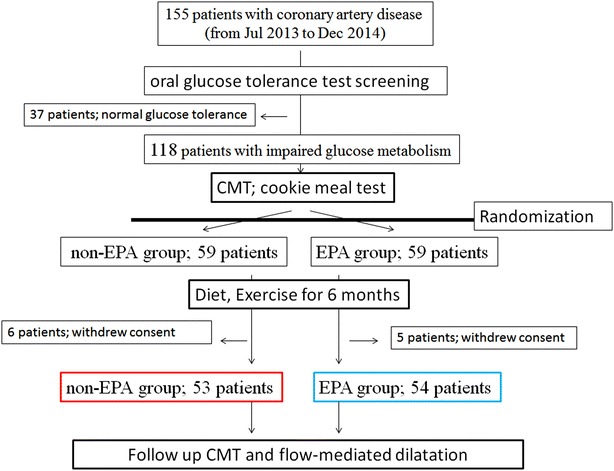
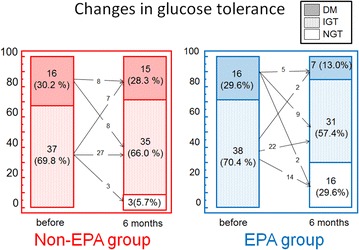
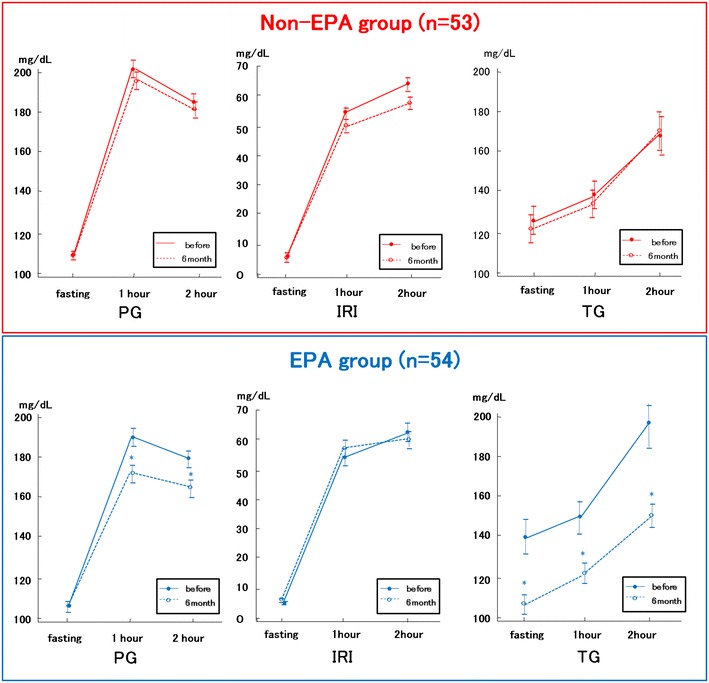
BACKGROUND: Recent experimental studies have revealed that n-3 fatty acids, such as eicosapentaenoic acid (EPA) regulate postprandial insulin secretion, and correct postprandial glucose and lipid abnormalities. However, the effects of 6-month EPA treatment on postprandial hyperglycemia and hyperlipidemia, insulin secretion, and concomitant endothelial dysfunction remain unknown in patients with impaired glucose metabolism (IGM) and coronary artery disease (CAD). METHODS AND RESULTS: We randomized 107 newly diagnosed IGM patients with CAD to receive either 1800 mg/day of EPA (EPA group, n = 53) or no EPA (n = 54). Cookie meal testing (carbohydrates: 75 g, fat: 28.5 g) and endothelial function testing using fasting-state flow-mediated dilatation (FMD) were performed before and after 6 months of treatment. The primary outcome of this study was changes in postprandial glycemic and triglyceridemic control and secondary outcomes were improvement of insulin secretion and endothelial dysfunction. After 6 months, the EPA group exhibited significant improvements in EPA/arachidonic acid, fasting triglyceride (TG), and high-density lipoprotein cholesterol (HDL-C). The EPA group also exhibited significant decreases in the incremental TG peak, area under the curve (AUC) for postprandial TG, incremental glucose peak, AUC for postprandial glucose, and improvements in glycometabolism categorization. No significant changes were observed for hemoglobin A1c and fasting plasma glucose levels. The EPA group exhibited a significant increase in AUC-immune reactive insulin/AUC-plasma glucose ratio (which indicates postprandial insulin secretory ability) and significant improvements in FMD. Multiple regression analysis revealed that decreases in the TG/HDL-C ratio and incremental TG peak were independent predictors of FMD improvement in the EPA group. CONCLUSIONS: EPA corrected postprandial hypertriglyceridemia, hyperglycemia and insulin secretion ability. This amelioration of several metabolic abnormalities was accompanied by recovery of concomitant endothelial dysfunction in newly diagnosed IGM patients with CAD. Clinical Trial Registration UMIN Registry number: UMIN000011265 ( https://www.upload.umin.ac.jp/cgi-open-bin/ctr/ctr.cgi?function=brows&action=brows&type=summary&recptno=R000013200&language=E ).
Overview
The claims and statistics of this paper haven’t been checked yet.
Free: it reads the open-access text and checks the first 5 claims that cite a source we can check. Create a free account to check every claim.
Integrity signals
Registry
Cites
Statistics
Figures
Verification
Claims the paper makes
The claims and statistics of this paper haven’t been checked yet.
Free: it reads the open-access text and checks the first 5 claims that cite a source we can check. Create a free account to check every claim.
Claims other papers make about this one
Each is checked against this paper’s own text: does it say what the citing paper says it does?
The source backs part of the claim, not all of it — or backs it for a different population, condition or comparison.
In the citing paper
“In a single-blinded RCT design in Asia, 107 subjects with newly diagnosed impaired glucose metabolism and coronary heart disease (CHD) supplemented with 1,800 mg/day of eicosapentaenoic acid (EPA) experienced improved postprandial triglycerides, glycemia, insulin secretion ability, and endothelial function over a 6-month period (68).”
From Nutrition Therapy for Adults With Diabetes or Prediabetes: A Consensus Report (2019) · cites this paper as [68]
Experimental — accuracy not yet measured
Self-check
Percentages, sums and reported differences re-computed from the paper’s own numbers.
The self-check needs the paper’s full text.
Citations
Cites
Yokoyama, M., Origasa, H., Matsuzaki, M., Matsuzawa, Y., Saito, Y., Ishikawa, Y., Oikawa, S., Sasaki, J., Hishida, H., Itakura, H., et al. (2007) · The Lancet · doi:10.1016/s0140-6736(07)60527-3 · Cited by 2,516
Self-citationOh, D. Y., Talukdar, S., Bae, E. J., Imamura, T., Morinaga, H., Fan, W., Li, P., Lu, W. J., Watkins, S. M., & Olefsky, J. M. (2010) · Cell · doi:10.1016/j.cell.2010.07.041 · Cited by 2,428 · cited 1×
“The recent experiments have revealed that n-3 PUFA act as ligands of several G-protein- coupled receptors (GPCRs) including GPCR 40 on pancreatic β cells and GPCR 120 on enteroendocrine cells of gastrointestinal tract [24, 25].”
Heitzer, T., Schlinzig, T., Krohn, K., Meinertz, T., & Münzel, T. (2001) · Circulation · doi:10.1161/hc4601.099485 · Cited by 1,961 · cited 1×
“Effects of EPA on FMD Endothelial dysfunction contributes to the onset and progression of atherosclerosis [39].”
BackgroundMeta-analysis: glycosylated hemoglobin and cardiovascular disease in diabetes mellitus
Selvin, E., Marinopoulos, S., Berkenblit, G., Rami, T., Brancati, F. L., Powe, N. R., & Golden, S. H. (2004) · Annals of Internal Medicine · doi:10.7326/0003-4819-141-6-200409210-00007 · Cited by 1,657 · cited 1×
“Effects on EPA on fasting glucose control Most observational studies have reported an association between glucose control and cardiovascular disease [46].”
BackgroundChiasson, J.-L., Josse, R. G., Gomis, R., Hanefeld, M., Karasik, A., Laakso, M., & for The STOP-NIDDM Trial Research Group (2003) · JAMA · doi:10.1001/jama.290.4.486 · Cited by 1,624
Free fatty acids regulate insulin secretion from pancreatic β cells through GPR40
Itoh, Y., Kawamata, Y., Harada, M., Kobayashi, M., Fujii, R., Fukusumi, S., Ogi, K., Hosoya, M., Tanaka, Y., Uejima, H., et al. (2003) · Nature · doi:10.1038/nature01478 · Cited by 1,538 · cited 2×
“The recent experiments have revealed that n-3 PUFA act as ligands of several G-protein- coupled receptors (GPCRs) including GPCR 40 on pancreatic β cells and GPCR 120 on enteroendocrine cells of gastrointestinal tract [24, 25].”
BackgroundSarwar, N., Danesh, J., Eiriksdottir, G., Sigurdsson, G., Wareham, N., Bingham, S., Boekholdt, S. M., Khaw, K.-T., & Gudnason, V. (2007) · Circulation · doi:10.1161/circulationaha.106.637793 · Cited by 1,408
Chapman, M. J., Ginsberg, H. N., Amarenco, P., Andreotti, F., Borén, J., Catapano, A. L., Descamps, O. S., Fisher, E., Kovanen, P. T., Kuivenhoven, J. A., et al. (2011) · European Heart Journal · doi:10.1093/eurheartj/ehr112 · Cited by 1,227
Yeboah, J., Folsom, A. R., Burke, G. L., Johnson, C., Polak, J. F., Post, W., Lima, J. A., Crouse, J. R., & Herrington, D. M. (2009) · Circulation · doi:10.1161/circulationaha.109.864801 · Cited by 888 · cited 1×
“The pathophysiology of FMD, based on reactive hyperemia, has extensively been studied and a previous large-scale population-based study demonstrated that brachial FMD predicted the incidence of cardiovascular events among adults [20].”
Gardner, C. D. (1996) · JAMA: The Journal of the American Medical Association · doi:10.1001/jama.1996.03540110029028 · Cited by 843
Cited by
Nutrition Therapy for Adults With Diabetes or Prediabetes: A Consensus Report
Evert, A. B., Dennison, M., Gardner, C. D., Garvey, W. T., Lau, K. H. K., MacLeod, J., Mitri, J., Pereira, R. F., Rawlings, K., Robinson, S., et al. (2019) · Diabetes Care · doi:10.2337/dci19-0014 · Cited by 1,496
Role of free fatty acids in endothelial dysfunction
Ghosh, A., Gao, L., Thakur, A., Siu, P. M., & Lai, C. W. K. (2017) · Journal of Biomedical Science · doi:10.1186/s12929-017-0357-5 · Cited by 414
Zhang, M., Wang, B., Liu, Y., Sun, X., Luo, X., Wang, C., Li, L., Zhang, L., Ren, Y., Zhao, Y., et al. (2017) · Cardiovascular Diabetology · doi:10.1186/s12933-017-0514-x · Cited by 305
“After appropriate treatment of high TG and high FPG level by n-3 fatty acids in patients with impaired glucose metabolism, the ability of insulin secretion was improved [45].”
BackgroundOkamura, T., Tsukamoto, K., Arai, H., Fujioka, Y., Ishigaki, Y., Koba, S., Ohmura, H., Shoji, T., Yokote, K., Yoshida, H., et al. (2024) · Journal of Atherosclerosis and Thrombosis · doi:10.5551/jat.gl2022 · Cited by 302
Fatty Acids Consumption: The Role Metabolic Aspects Involved in Obesity and Its Associated Disorders
Silva Figueiredo, P., Carla Inada, A., Marcelino, G., Maiara Lopes Cardozo, C., De Cássia Freitas, K., De Cássia Avellaneda Guimarães, R., Pereira de Castro, A., Aragão do Nascimento, V., & Aiko Hiane, P. (2017) · Nutrients · doi:10.3390/nu9101158 · Cited by 239
O’Mahoney, L. L., Matu, J., Price, O. J., Birch, K. M., Ajjan, R. A., Farrar, D., Tapp, R., West, D. J., Deighton, K., & Campbell, M. D. (2018) · Cardiovascular Diabetology · doi:10.1186/s12933-018-0740-x · Cited by 157
“For example, data suggest that n-3PUFA may improve postprandial hypertriglyceridemia, hyperglycaemia, insulin secretion ability and endothelial function in patients with impaired glucose metabolism and coronary heart disease [13].”
Modulation of endothelium function by fatty acids
Mallick, R., & Duttaroy, A. K. (2022) · Molecular and Cellular Biochemistry · doi:10.1007/s11010-021-04260-9 · Cited by 118
Bercea, C., Cottrell, G. S., Tamagnini, F., & McNeish, A. J. (2021) · British Journal of Pharmacology · doi:10.1111/bph.15336 · Cited by 122
Buoite Stella, A., Gortan Cappellari, G., Barazzoni, R., & Zanetti, M. (2018) · International Journal of Molecular Sciences · doi:10.3390/ijms19010218 · Cited by 100
“No effects of higher doses of omega 3 FA (1914 mg EPA and 957 mg DHA daily supplementation compared to placebo for 12 weeks), were also observed for FBG level and HOMA-IR [22].”
BackgroundMethodResultInfluentialPoreba, M., Mostowik, M., Siniarski, A., Golebiowska-Wiatrak, R., Malinowski, K. P., Haberka, M., Konduracka, E., Nessler, J., Undas, A., & Gajos, G. (2017) · Cardiovascular Diabetology · doi:10.1186/s12933-017-0523-9 · Cited by 98
“[24] in patients with newly-diagnosed impaired glucose metabolism, including both diabetes and impaired glucose tolerance (IGT), accompanied by CAD, has shown favorable effects of 1800 mg of EPA daily on postprandial hyperglycemia, hyperlipidemia, and insulin secretion.”
BackgroundResultOmega-3 world map: 2024 update
Schuchardt, J. P., Beinhorn, P., Hu, X. F., Chan, H. M., Roke, K., Bernasconi, A. A., Hahn, A., Sala‐Vila, A., Stark, K. D., & Harris, W. S. (2024) · Progress in Lipid Research · doi:10.1016/j.plipres.2024.101286 · Cited by 117
Li, X., Li, G., Cheng, T., Liu, J., Song, G., & Ma, H. (2020) · Lipids in Health and Disease · doi:10.1186/s12944-020-01403-7 · Cited by 98
“An intervention study confirmed that patients with impaired glucose metabolism had improved insulin secretion ability after being treated with n-3 fatty acids [48].”
BackgroundWang, Y., Wang, Y., Shehzad, Q., Su, Y., Xu, L., Yu, L., Zeng, W., Fang, Z., Wu, G., Wei, W., et al. (2023) · Critical Reviews in Food Science and Nutrition · doi:10.1080/10408398.2023.2212817 · Cited by 137
“…et al. 2014; Mortazavi et al. 2018; Saleh-Ghadimi et al. 2019; Samavat et al. 2018; Samavat et al. 2019; Satoh et al. 2007; Satoh et al. 2009; Sawada et al. 2016; Zamanian et al. 2020; Zhao et al. 2009), twelve in America (Bays et al. 2015; Dewell et al. 2011; Grenon et al. 2015; Mehra et…”
InfluentialMargina, D. M., Ungurianu, A., Purdel, C. N., Nițulescu, G. M., Tsoukalas, D., Sarandi, E., Thanasoula, M., Burykina, T. I., Tekos, F., Djordjević, A. B., et al. (2020) · Food and Chemical Toxicology · doi:10.1016/j.fct.2020.111558 · Cited by 94
“In patients with impaired glucose metabolism and T2DM in almost all studies, none of the combined EPA and DHA doses had any effect on IL-6, IL-1β, CRP, VCAM, and sICAM (Clark et al., 2016; Mocking et al., 2012; Sawada et al., 2016).”
Ajabnoor, S. M., Thorpe, G., Abdelhamid, A. S., & Hooper, L. (2020) · European Journal of Nutrition · doi:10.1007/s00394-020-02413-y · Cited by 91
Wang, T., Zhang, X., Zhou, N., Shen, Y., Li, B., Chen, B. E., & Li, X. (2023) · Journal of the American Heart Association · doi:10.1161/jaha.123.029512 · Cited by 73
Nutritional Strategies for the Management of Type 2 Diabetes Mellitus: A Narrative Review
Minari, T. P., Tácito, L. H. B., Yugar, L. B. T., Ferreira‐Melo, S. E., Manzano, C. F., Pires, A. C., Moreno, H., Vilela-Martin, J. F., Cosenso‐Martin, L. N., & Yugar‐Toledo, J. C. (2023) · Nutrients · doi:10.3390/nu15245096 · Cited by 104
“Furthermore, in a randomized clinical trial with cardiac patients with T2DM, researchers demonstrated the benefits of the addition of 2 g of omega-3, twice a day, for patients on statin therapy, resulting in lower mortality rates from cardiovascular diseases [85,86].”
BackgroundHouston, M. C. (2018) · Therapeutic Advances in Cardiovascular Disease · doi:10.1177/1753944717743920 · Cited by 71
Postprandial Hyperlipidemia: Its Pathophysiology, Diagnosis, Atherogenesis, and Treatments
Yanai, H., Adachi, H., Hakoshima, M., & Katsuyama, H. (2023) · International Journal of Molecular Sciences · doi:10.3390/ijms241813942 · Cited by 69
“The cookie meal test showed that the EPA n-3 FA significantly decreased the incremental TG peak, the AUC for postprandial TG, the incremental glucose peak, and the AUC for postprandial glucose [104].”
BackgroundPoręba, M., Rostoff, P., Siniarski, A., Mostowik, M., Gołębiowska-Wiatrak, R., Nessler, J., Undas, A., & Gajos, G. (2018) · Cardiovascular Diabetology · doi:10.1186/s12933-018-0672-5 · Cited by 66
“As an indicator of oxidative stress, DNA damage and cellular senescence, LTL has been postulated as a biomarker of aging and age-related chronic diseases, including CAD and T2DM [43, 44].”
BackgroundInfluentialSiniarski, A., Haberka, M., Mostowik, M., Gołębiowska-Wiatrak, R., Poręba, M., Malinowski, K. P., Gąsior, Z. T., Konduracka, E., Nessler, J., & Gajos, G. (2018) · Atherosclerosis · doi:10.1016/j.atherosclerosis.2018.02.030 · Cited by 54
Limbu, R., Cottrell, G. S., & McNeish, A. J. (2018) · PLoS ONE · doi:10.1371/journal.pone.0192484 · Cited by 55
Coronary Artery Disease and Endothelial Dysfunction: Novel Diagnostic and Therapeutic Approaches
Oikonomou, E. K., Siasos, G., Tsigkou, V., Bletsa, E., Panoilia, M.-E., Oikonomou, I. N., Sinanidis, I., Spinou, Μ., Papastavrou, A., Kokosias, G., et al. (2019) · Current Medicinal Chemistry · doi:10.2174/0929867326666190830103219 · Cited by 52
Savolainen, O. I., Lind, M. V., Bergström, G. M. L., Fagerberg, B., Sandberg, A., & Ross, A. B. (2017) · American Journal of Clinical Nutrition · doi:10.3945/ajcn.117.152850 · Cited by 54
“Also, EPA supplementation has been shown to improve glycemic control (41, 42).”
BackgroundRecent advances in biotechnological production of polyunsaturated fatty acids by Yarrowia lipolytica
Jia, Y.-L., Wang, L., Zhang, Z., Gu, Y. M., & Sun, X. (2021) · Critical Reviews in Food Science and Nutrition · doi:10.1080/10408398.2021.1937041 · Cited by 53
The Effects of Omega 3 and Omega 6 Fatty Acids on Glucose Metabolism: An Updated Review
Egalini, F., Guardamagna, O., Gaggero, G., Varaldo, E., Giannone, B., Beccuti, G., Benso, A. S., & Broglio, F. (2023) · Nutrients · doi:10.3390/nu15122672 · Cited by 60
Effect of ω-3 Polyunsaturated Fatty Acids-Derived Bioactive Lipids on Metabolic Disorders
Duan, J., Song, Y., Zhang, X., & Wang, C. (2021) · Frontiers in Physiology · doi:10.3389/fphys.2021.646491 · Cited by 55
“Arachidonic acid (ARA) is an important ω-6 PUFA, which can be metabolized from linoleic acid (Schmitz and Ecker, 2008).”
BackgroundSawada, T., Uzu, K., Hashimoto, N., Onishi, T., Takaya, T., Shimane, A., Taniguchi, Y., Yasaka, Y., Ohara, T., & Kawai, H. (2019) · Journal of Atherosclerosis and Thrombosis · doi:10.5551/jat.50807 · Cited by 44
Self-citationZhang, H., Gao, X., Guo, X., Li, K., Li, S., Sinclair, A. J., & Li, D. (2021) · Clinical Nutrition · doi:10.1016/j.clnu.2021.05.025 · Cited by 44
Dietary Composition and Cardiovascular Risk: A Mediator or a Bystander?
Korakas, E., Dimitriadis, G., Raptis, A. E., & Lambadiari, V. (2018) · Nutrients · doi:10.3390/nu10121912 · Cited by 56
“In an RCT where patients with impaired glucose metabolism and coronary artery disease were supplemented with 1800 mg/day EPA for six months, postprandial hypertriglyceridemia, hyperglycemia, and insulin secretion were ameliorated compared to placebo [72].”
BackgroundDrenjančević, I., & Pitha, J. V. (2022) · International Journal of Molecular Sciences · doi:10.3390/ijms23042104 · Cited by 236
Huang, F., Del-Rio-Navarro, B. E., Leija-Martínez, J. J., Torres-Alcántara, S., Ruíz-Bedolla, E., Cadena, L. H., Barraza‐Villarreal, A., Romero‐Nava, R., Sánchez‐Muñoz, F., Villafaña, S., et al. (2018) · The Journal of Nutritional Biochemistry · doi:10.1016/j.jnutbio.2018.10.012 · Cited by 43
Prokopiou, E., Kolovos, P., Georgiou, C., Kalogerou, M., Potamiti, L., Sokratous, K., Kyriacou, K. C., & Georgiou, T. (2019) · BMJ Open Ophthalmology · doi:10.1136/bmjophth-2019-000326 · Cited by 35
Yamagata, K. (2023) · Prostaglandins & Other Lipid Mediators · doi:10.1016/j.prostaglandins.2023.106704 · Cited by 37
Dzięgielewska-Gęsiak, S. (2021) · Clinical Interventions in Aging · doi:10.2147/cia.s306982 · Cited by 40
Kalogerou, M., Ioannou, S., Kolovos, P., Prokopiou, E., Potamiti, L., Kyriacou, K. C., Panayiotidis, M. I., Ioannou, M., Fella, E., Worth, E. P., et al. (2021) · Experimental Eye Research · doi:10.1016/j.exer.2021.108901 · Cited by 35
Omega-3 fatty acids coordinate glucose and lipid metabolism in diabetic patients
Mone, P., Varzideh, F., Kansakar, U., Infante, C., Lombardi, A., Donato, A. D., Frullone, S., & Santulli, G. (2022) · Lipids in Health and Disease · doi:10.1186/s12944-022-01642-w · Cited by 32
Wang, Y.-X., Wang, A., Ye, Y.-N., Gao, Z., Tang, X., Yan, L., Wan, Q., Wang, W., Luo, Z., Qin, G., et al. (2019) · Cardiovascular Diabetology · doi:10.1186/s12933-019-0863-8 · Cited by 27
“Furthermore, study of patients with abnormal glucose metabolism added that after appropriate treatment of high TG and high FBG level by n-3 fatty acids in patients with impaired glucose metabolism, the ability of insulin secretion was improved [26].”
BackgroundAsghari, K. M., Saleh, P., Salekzamani, Y., Dolatkhah, N., Aghamohammadzadeh, N., & Hashemian, M. (2024) · Nutrition and Diabetes · doi:10.1038/s41387-024-00274-6 · Cited by 34
“EPA ’ s unique anti-in fl ammatory properties have shown promise in in fl uencing markers linked to insulin resistance and dyslipidemia [48].”
BackgroundTenenbaum, A., & Fisman, E. Z. (2018) · Cardiovascular Diabetology · doi:10.1186/s12933-018-0766-0 · Cited by 36
Progress of metabolic engineering for the production of eicosapentaenoic acid
Jia, Y.-L., Geng, S., Du, F., Xu, Y., Wang, L., Sun, X., Wang, Q., & Li, Q. (2021) · Critical Reviews in Biotechnology · doi:10.1080/07388551.2021.1971621 · Cited by 28
Omega‐3 fatty acids and endothelial function: A GRADE ‐assessed systematic review and meta‐analysis
Arabi, S. M., Bahari, H., Chambari, M., Bahrami, L. S., Gubari, M. I. M., Watts, G. F., & Sahebkar, A. (2023) · European Journal of Clinical Investigation · doi:10.1111/eci.14109 · Cited by 30
Recent Science and Clinical Application of Nutrition to Coronary Heart Disease
Houston, M. C., Minich, D. M., Sinatra, S. T., Kahn, J. K., & Guarneri, M. (2018) · Journal of the American College of Nutrition · doi:10.1080/07315724.2017.1381053 · Cited by 25
Escobar-García, J. D., Prieto, C., Pardo‐Figuerez, M., & Lagaron, J. M. (2021) · Nanomaterials · doi:10.3390/nano11030575 · Cited by 23
“Moreover, it is involved in the therapy of certain illnesses, such as protective effect in liver steatosis [7], correction of postprandial hypertriglyceridemia, hyperglycemia and insulin secretion ability [8], reduction of the occurrence of major coronary event (MCE) [9,10], antiatherosclerotic effects [11], antiinfla…”
BackgroundLower triglyceride levels are associated with better endothelial function
Takaeko, Y., Maruhashi, T., Kajikawa, M., Kishimoto, S., Yamaji, T., Harada, T., Hashimoto, Y., Han, Y., Kihara, Y., Chayama, K., et al. (2021) · Journal of clinical lipidology · doi:10.1016/j.jacl.2021.04.004 · Cited by 19
Madhu, S. V., Sinha, B., Aslam, M., Mehrotra, G., & Dwivedi, S. (2017) · Journal of clinical lipidology · doi:10.1016/j.jacl.2017.08.001 · Cited by 21
Pingali, U., Nutalapati, C., & Illendulla, V. S. (2020) · Diabetes Metabolic Syndrome and Obesity · doi:10.2147/dmso.s220046 · Cited by 19
Prokopiou, E., Kolovos, P., Kalogerou, M., Neokleous, A., Papagregoriou, G., Deltas, C., Malas, S., & Georgiou, T. (2017) · BMJ Open Ophthalmology · doi:10.1136/bmjophth-2016-000056 · Cited by 16
“A number of studies have confirmed the association of EPA/AA both in coronary diseases and in diabetes and hyperlipidaemia.(30) 31 Lower levels of particular PUFAs in either circulating blood or the retina are associated with some retinopathies.”
Lee, Y. S., Park, J. W., Joo, M., Moon, S., Kim, K., & Kim, M. G. (2023) · Current Atherosclerosis Reports · doi:10.1007/s11883-023-01137-8 · Cited by 17
Liu, S., Wang, X., Li, Y., Shi, B., Guo, X., Zhao, Y., & Yan, S. (2021) · Animals · doi:10.3390/ani11030790 · Cited by 17
“reported that the EPA significantly improved the HDL-C concentration in blood of humans [30].”
BackgroundNutraceuticals and Supplements in Management of Prediabetes and Diabetes
Derosa, G., D’Angelo, A., Angelini, F., Belli, L., Cicero, A. F. G., ROS, R. D., Pergola, G. D., Gaudio, G. V., Lupi, A., Sartore, G., et al. (2024) · Nutrients · doi:10.3390/nu17010014 · Cited by 20
Nayda, N. C., Thomas, J. M., Delaney, C. L., & Miller, M. (2023) · Nutrition Reviews · doi:10.1093/nutrit/nuad020 · Cited by 14
“Seven studies supplemented with omega-3s as ethyl esters, 41,44,47,50,51,53,55 3 as triglycerides, 43,49,52 and 1 as carboxylic acids, 45 while 6 studies did not report the form of omega-3s provided.”
BackgroundMethodInfluentialSu, W., Wang, J., Chen, K., Yan, W., Gao, Z., Tang, X., Wan, Q., Luo, Z., Ning, G., & Mu, Y. (2024) · Diabetology & Metabolic Syndrome · doi:10.1186/s13098-024-01258-3 · Cited by 15
Selma-Gracia, R., Haros, C. M., & Laparra, J. M. (2020) · Food & Function · doi:10.1039/d0fo01453b · Cited by 12
Zhou, J., Cai, L., Ni, S., Zhong, Z., Yang, M., Yu, H., Zhao, Y., Xun, P., & Bai, J. (2021) · British Journal Of Nutrition · doi:10.1017/s0007114521002300 · Cited by 12
“controlled trial (RCT) study (16) , six-month use of DHA and EPA 900 mg/day was associated with a reduction in LDL-C and T.”
BackgroundBlood indices of omega-3 and omega-6 polyunsaturated fatty acids are altered in hyperglycemia
Alfhili, M. A., Alsughayyir, J., Basudan, A., Alfaifi, M. A., Awan, Z. A., Algethami, M. R., & Al‐Sheikh, Y. A. (2023) · Saudi Journal of Biological Sciences · doi:10.1016/j.sjbs.2023.103577 · Cited by 13
Mirroring the CANTOS revolution: is anti-inflammatory therapy for diabetes just around the corner?
Tenenbaum, A., & Fisman, E. Z. (2017) · Cardiovascular Diabetology · doi:10.1186/s12933-017-0573-z · Cited by 11
“Particularly, antiinflammatory properties were demonstrated for unsaturated fatty acids [29, 30], acetylsalicylic acid [31], healthy diet [32, 33], sodium-glucose co-transporter 2 (SGLT2) inhibitors [34], glucagon-like peptide-1 (GLP-1) receptors agonists [35] and statins [36].”
BackgroundOkada, T., Morino, K., Nakagawa, F., Tawa, M., Kondo, K., Sekine, O., Imamura, T., Okamura, T., Ugi, S., & Maegawa, H. (2017) · Nutrients · doi:10.3390/nu9070654 · Cited by 10
Benes, L. B., Bassi, N. S., Kalot, M. A., & Davidson, M. H. (2018) · Cardiology Clinics · doi:10.1016/j.ccl.2017.12.009 · Cited by 11
Gubari, M. I. M. (2024) · Cellular and Molecular Biology · doi:10.14715/cmb/2024.70.6.26 · Cited by 9
Daci, A., Çelik, Z., Özen, G., Dashwood, M. R., Doğan, B. S. U., & Topal, G. (2020) · European Journal of Pharmaceutical Sciences · doi:10.1016/j.ejps.2020.105499 · Cited by 10
Assessing the Highest Level of Evidence from Randomized Controlled Trials in Omega-3 Research
Sahye‐Pudaruth, S., & David, W. L. (2023) · Nutrients · doi:10.3390/nu15041001 · Cited by 10
“Conversely, other trials reported a significant reduction in fasting blood glucose, insulin resistance, and HbA1c after supplementing the diet with dosage of n-3 PUFA ranging from 0.41 to 3 g/day for a follow-up of 8 weeks to 1 year as well [59–63] (Table 3).”
BackgroundInfluentialMorioka, T., Emoto, M., Imamura, S., Kakutani, Y., Yamazaki, Y., Motoyama, K., Mori, K., Fukumoto, S., Shioi, A., Shoji, T., et al. (2018) · Diabetes and Vascular Disease Research · doi:10.1177/1479164118774314 · Cited by 8
Li, H., Zhuang, P., Liu, X., Li, Y., Yang, A., Tian, Y., Jia, W. P., Zhang, Y., & Jiao, J. (2025) · Research · doi:10.34133/research.0683 · Cited by 9
“Another trial also found that a 6-month EPA treatment corrected hyperglycemia and postprandial insulin secretory ability among patients with IGM [ 41 ].”
Zhang, C., Xie, Y., Zhou, J., Zhang, C., Xiang, Q., Zhong, Y., Xiao, J., Feng, J., Liao, B., Chen, X., et al. (2025) · Food Science & Nutrition · doi:10.1002/fsn3.70372 · Cited by 9
Takeshita, Y., Teramura, C., Kamoshita, K., Takayama, H., Nakagawa, H., Enyama, Y., Ishii, K., Tanaka, T., Goto, H., Nakano, Y., et al. (2021) · Journal of Diabetes Investigation · doi:10.1111/jdi.13699 · Cited by 7
Fukumoto, K., Takemoto, Y., Yoshikawa, J., Norioka, N., Iguchi, T., Namikawa, H., Tochino, Y., Yoshiyama, M., & Shuto, T. (2020) · Atherosclerosis · doi:10.1016/j.atherosclerosis.2020.07.013 · Cited by 8
Theodoridis, X., Chourdakis, M., Papaemmanouil, A., Chaloulakou, S., Papageorgiou, N., Georgakou, A. V., Chatzis, G. V., & Triantafyllou, Α. (2024) · Life · doi:10.3390/life14091210 · Cited by 7
Ameer, O. Z., Salman, I. M., Alwadi, A. Y., Ouban, A., Abu‐Owaimer, F. M., AlSharari, S. D., & Bukhari, I. A. (2021) · Experimental Physiology · doi:10.1113/ep089213 · Cited by 7
Fujikura, K., Heydari, B., Ge, Y., Kaneko, K., Abdullah, S. M., Harris, W. S., Jerosch‐Herold, M., & Kwong, R. Y. K. (2019) · The American Journal of Cardiology · doi:10.1016/j.amjcard.2019.11.032 · Cited by 7
Overview of Nutraceuticals and Cardiometabolic Diseases following Socio-Economic Analysis
Bruno, G. M., Dovera, F., Ciccarone, A., & Colombo, G. L. (2022) · Endocrines · doi:10.3390/endocrines3020023 · Cited by 7
Fatahi, S., Sohouli, M. H., Magalhães, E. I. D. S., Silveira, V. N. D. C., Zanghelini, F., Rahmani, P., Kord‐Varkaneh, H., Sharifi‐Zahabi, E., & Shidfar, F. (2022) · Nutrition Metabolism and Cardiovascular Diseases · doi:10.1016/j.numecd.2022.09.013 · Cited by 7
Demir, V., Doğru, M., Ede, H., Yılmaz, S., Alp, Ç., Çelik, Y., & Yıldırım, N. (2018) · Cardiovascular journal of South Africa/Cardiovascular journal of Southern Africa · doi:10.5830/cvja-2018-008 · Cited by 7
Li, X., Li, G., Cheng, T., Liu, J., Song, G., & Ma, H. (2021) · Lipids in Health and Disease · doi:10.1186/s12944-021-01432-w · Cited by 5
Li, R., Wang, Y., Xu, J., Yu, J., & Li, B. (2025) · Reviews in Cardiovascular Medicine · doi:10.31083/rcm25882 · Cited by 6
“In addition, a high intake of n-3 PUFAs has a multifaceted impact on the regulation of hyperglycemia and insulin secretion in patients [6].”
Pingali, U., Nutalapati, C., & Gundagani, S. (2021) · Evidence-based Complementary and Alternative Medicine · doi:10.1155/2021/2972610 · Cited by 5
Serhiyenko, V. A., Serhiyenko, L. M., Ajmi, S., & Serhiyenko, A. A. (2019) · Clinical Research and Trials · doi:10.15761/crt.1000274 · Cited by 4
“In patients with impaired glucose metabolism and CAD, EPA has been reported to contribute to the correction of postprandial hypertriglyceridemia, hyperglycemia, insulin production, endothelial dysfunction [27].”
BackgroundResultMarquez‐Paradas, E., Torrecillas-López, M., Corell, A., la Rosa, T. G., Barrera‐Chamorro, L., Bermúdez, B., Claro, C., & la Paz, S. M. (2025) · The Journal of Nutritional Biochemistry · doi:10.1016/j.jnutbio.2025.110242 · Cited by 4
Unger, A. L., Jetton, T. L., & Kraft, J. (2021) · British Journal Of Nutrition · doi:10.1017/s0007114521004001 · Cited by 3
Sahadewa, S., Durry, F. D., Pangkahila, W. I., & Pinatih, G. N. I. (2020) · Journal of Physics Conference Series · doi:10.1088/1742-6596/1469/1/012009 · Cited by 1
Ishikado, A., Kondo, K., Maegawa, H., & Morino, K. (2021) · Current Oral Health Reports · doi:10.1007/s40496-021-00297-3 · Cited by 3
Eicosapentaenoic Acid Based Therapies: Fish Facts and Stories
Kuchkuntla, A. R., Patllola, S. H., & Rajjo, T. I. (2021) · Journal of Medicine and HealthCare · doi:10.47363/jmhc/2021(3)161
Scoping Review: Pengaruh Minyak Ikan dalam Pencegahan Sekunder Penyakit Jantung Koroner
Anwar, R. C., Widayanti, W., & Nurmeliani, R. (2022) · Bandung Conference Series Medical Science · doi:10.29313/bcsms.v2i1.400 · Cited by 2
Current Advances in Biotechnology of Marine Microalgae
Wan, C., Chen, B., Zhao, X., & Bai, F. (2020) · Wiley eBooks · doi:10.1002/9781119143802.ch77 · Cited by 2
Francuz, P., Podolecki, T., Kozieł, M., Kalarus, Z. F., & Kowalczyk, J. P. (2017) · Journal of Medical Science · doi:10.20883/jms.2017.160
Ismail, M., Ibrahim, A. S. A., & Gamal, A. M. (2018) · Journal of Diabetes & Metabolism · doi:10.4172/2155-6156.1000802
Francuz, P., Podolecki, T., Szymała, M., Kozieł, M., Kalarus, Z. F., & Kowalczyk, J. P. (2017) · Annales Academiae Medicae Silesiensis · doi:10.18794/aams/75367
Serhiyenko, V. A., Hotsko, M. E., Azhmi, S., & Serhiyenko, O. (2021) · Lviv clinical bulletin · doi:10.25040/lkv2021.03-04.008
Li, X., Li, G., Cheng, T., Liu, J., Song, G., & Ma, H. (2020) · Research Square · doi:10.21203/rs.3.rs-58731/v1
Tian, Y., & Zheng, J. (2022) · Elsevier eBooks · doi:10.1016/b978-0-12-823914-8.00011-2
Effects of fatty acid‐ethanol amine ( FA‐EA ) derivatives on lipid accumulation and inflammation
Li, M., Huang, X., Huang, M., Jin, W., Hong, Z., Zhang, Y., Fang, H., & Chen, W. (2023) · Lipids · doi:10.1002/lipd.12368
Features of the metabolism of polyunsaturated fatty acids in type 2 diabetes mellitus
KhKh, S., Исмаиловна, А. Р., Плотникова, О. А., Пилипенко, В. В., & EIu, S. (2023) · Voprosy Pitaniya · doi:10.33029/0042-8833-2023-92-3-15-24 · Cited by 1
Microalgae as Source of Antioxidants: Potential Role in Nutraceutical Products for Human Health
Leyva‐López, N., Contreras‐Angulo, L. A., Bernal-Millán, M. D. J., Cabanillas-Bojórquez, L. Á., García-Carrasco, M., Gutiérrez‐Grijalva, E. P., & Heredia, J. B. (2025) · Developments in applied phycology. · doi:10.1007/978-3-031-86433-9_14
Norouzzadeh, M., Rashedi, M. H., Hamidi, N., Karimi-Javan, N., Nourian, S., Hasanpour, M., Anoushirvani, A. A., & Teymoori, F. (2026) · Journal of the American Nutrition Association · doi:10.1080/27697061.2025.2606059 · Cited by 3
Dao, T. K., Barsha, G., Thomas, J., Pokrassen, A., Nicholls, S. J., & Bubb, K. J. (2026) · bioRxiv (Cold Spring Harbor Laboratory) · doi:10.64898/2026.02.09.704971
Wang, J., Yu, R., Kong, L., Nie, H., Ruan, L., & Zhang, Y. (2026) · European journal of medical research · doi:10.1186/s40001-026-04713-1
Kondo, K., 前川, 聡., Morino, K., Ishikado, A., & Maegawa, H. (n.d.) · Institutional Repositories DataBase (IRDB)
Metadata
- Authors
- Sawada, T., Tsubata, H., Hashimoto, N., Takabe, M., Miyata, T., Aoki, K., Yamashita, S., Oishi, S., Osue, T., Yokoi, K., Tsukishiro, Y., Onishi, T., Shimane, A., Taniguchi, Y., Yasaka, Y., Ohara, T., Kawai, H., & Yokoyama, M.
- Affiliations
- Hyogo Brain and Heart Center (JP)
- Corresponding author
- Sawada, Takahiro
- ORCID
- Venue
- Cardiovascular Diabetology
- Published
- 2016-08-26
- Volume
- 15
- Issue
- 1
- Pages
- 121-121
- ISSN
- 1475-2840 (ISSN-L)
- PMC
- PMC5002116
- OpenAlex
- W2508920417
- Cited by
- 97
- References
- 49
- Citations by year
- 2026: 3 · 2025: 5 · 2024: 6 · 2023: 14 · 2022: 6 · 2021: 20 · 2020: 11 · 2019: 7 · 2018: 14 · 2017: 11
- FWCI
- 11.14
- Type
- journal article
- Language
- en
- Open access
- gold
- doi.org
- Licence
- cc-by
- Locations
- Cardiovascular Diabetology (publishedVersion, cc-by)
- PubMed Central (publishedVersion, cc-by)
- PubMed (publishedVersion)
- Topics
- Health Sciences › Nursing › Nutrition and Dietetics › Fatty Acid Research and Health
- Health Sciences › Medicine › Endocrinology, Diabetes and Metabolism › Diabetes, Cardiovascular Risks, and Lipoproteins
- Health Sciences › Medicine › Endocrinology, Diabetes and Metabolism › Diabetes Treatment and Management
- Keywords
- eicosapentaenoic acid, omega-3 fatty acids, impaired glucose metabolism, coronary artery disease, postprandial hyperglycemia, hypertriglyceridemia, insulin secretion, endothelial dysfunction, flow-mediated dilation, triglyceride to HDL cholesterol ratio, omega-3 supplementation, newly diagnosed diabetes, dyslipidemia, glycometabolism
- MeSH terms
- Insulin Secretion, Aged, Hypolipidemic Agents, Blood Glucose, Coronary Artery Disease, Drug Administration Schedule, Endothelium, Vascular, Female, Humans, Hyperglycemia, Hypoglycemic Agents, Insulin, Japan, Male, Middle Aged, Prospective Studies, Time Factors, Triglycerides, Vasodilation, Eicosapentaenoic Acid, Hypertriglyceridemia, Biomarkers, Single-Blind Method, Treatment Outcome, Inflammation Mediators, Postprandial Period, Recovery of Function
About these checks
Registry, retraction, Cites and statistics results are computed, not judged, with one exception: a printed reference that no index lists is read once by a model before it counts as a citation error. Claims are extracted by a model and kept only when their quote appears verbatim in the text; each cited source is then checked, with a model’s help, for whether it says what the claim relies on. Those verdicts can be wrong — read the claim’s quote and the cited source before relying on one.
Statistics and arithmetic are recomputed, not judged.
Confidence bands are shown only for fields calibrated on our annotated test set. None is calibrated yet, so no band is shown.
What counts as a claim ›How we measure confidence ›How we check this ›
Are you an author, or do you see a problem with this page? Request a review
Data sources
Bibliographic data: Semantic Scholar, OpenAlex, Crossref.
Contains information from the Semantic Scholar Academic Graph Datasets, made available under the ODC Attribution License (ODC-BY 1.0).
Semantic Scholar’s data is described in: Kinney, R., et al. (2023). The Semantic Scholar Open Data Platform. arXiv:2301.10140.
