

Effects of 6-month eicosapentaenoic acid treatment on postprandial hyperglycemia, hyperlipidemia, insulin secretion ability, and concomitant endothelial dysfunction among newly-diagnosed impaired glucose metabolism patients with coronary artery disease. An open label, single blinded, prospective randomized controlled trial
Open accessThe DOI matches its Crossref record; 49 of the 49 references it cites were found in a registry or an index.
Abstract
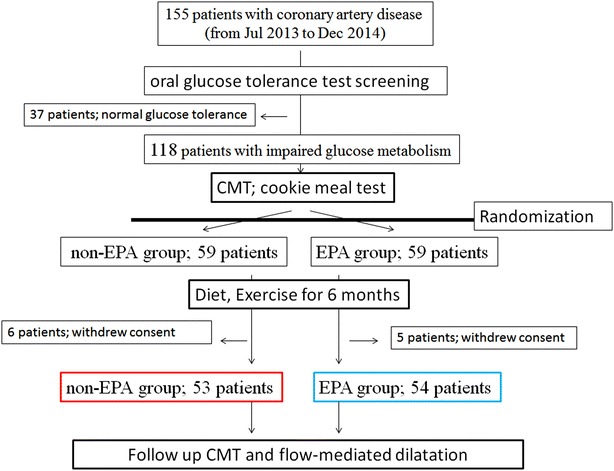
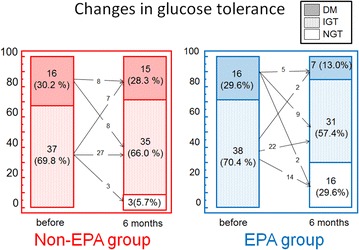
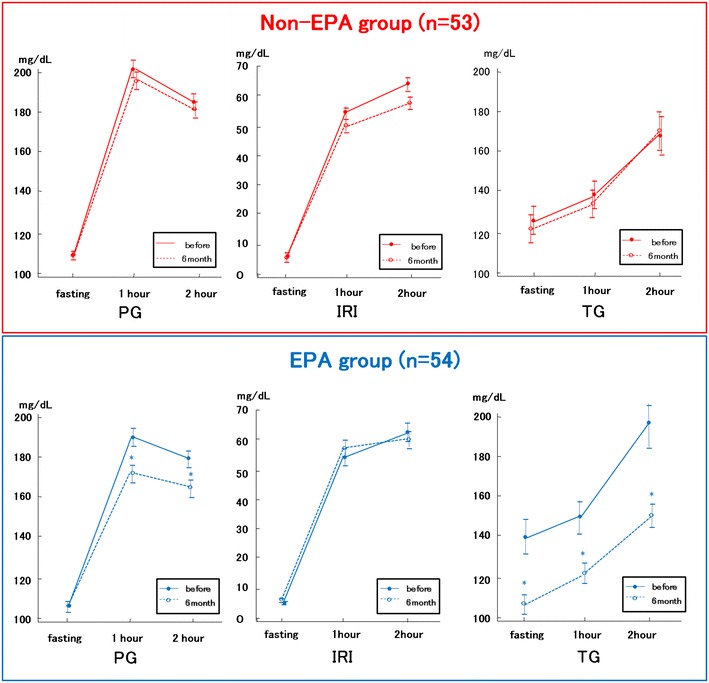
BACKGROUND: Recent experimental studies have revealed that n-3 fatty acids, such as eicosapentaenoic acid (EPA) regulate postprandial insulin secretion, and correct postprandial glucose and lipid abnormalities. However, the effects of 6-month EPA treatment on postprandial hyperglycemia and hyperlipidemia, insulin secretion, and concomitant endothelial dysfunction remain unknown in patients with impaired glucose metabolism (IGM) and coronary artery disease (CAD). METHODS AND RESULTS: We randomized 107 newly diagnosed IGM patients with CAD to receive either 1800 mg/day of EPA (EPA group, n = 53) or no EPA (n = 54). Cookie meal testing (carbohydrates: 75 g, fat: 28.5 g) and endothelial function testing using fasting-state flow-mediated dilatation (FMD) were performed before and after 6 months of treatment. The primary outcome of this study was changes in postprandial glycemic and triglyceridemic control and secondary outcomes were improvement of insulin secretion and endothelial dysfunction. After 6 months, the EPA group exhibited significant improvements in EPA/arachidonic acid, fasting triglyceride (TG), and high-density lipoprotein cholesterol (HDL-C). The EPA group also exhibited significant decreases in the incremental TG peak, area under the curve (AUC) for postprandial TG, incremental glucose peak, AUC for postprandial glucose, and improvements in glycometabolism categorization. No significant changes were observed for hemoglobin A1c and fasting plasma glucose levels. The EPA group exhibited a significant increase in AUC-immune reactive insulin/AUC-plasma glucose ratio (which indicates postprandial insulin secretory ability) and significant improvements in FMD. Multiple regression analysis revealed that decreases in the TG/HDL-C ratio and incremental TG peak were independent predictors of FMD improvement in the EPA group. CONCLUSIONS: EPA corrected postprandial hypertriglyceridemia, hyperglycemia and insulin secretion ability. This amelioration of several metabolic abnormalities was accompanied by recovery of concomitant endothelial dysfunction in newly diagnosed IGM patients with CAD. Clinical Trial Registration UMIN Registry number: UMIN000011265 ( https://www.upload.umin.ac.jp/cgi-open-bin/ctr/ctr.cgi?function=brows&action=brows&type=summary&recptno=R000013200&language=E ).
Overview
The claims and statistics of this paper haven’t been checked yet.
Free: it reads the open-access text and checks the first 5 claims that cite a source we can check. Create a free account to check every claim.
Integrity signals
Registry
Cites
Statistics
Figures
Verification
Claims the paper makes
The claims and statistics of this paper haven’t been checked yet.
Free: it reads the open-access text and checks the first 5 claims that cite a source we can check. Create a free account to check every claim.
Claims other papers make about this one
Each is checked against this paper’s own text: does it say what the citing paper says it does?
The source backs part of the claim, not all of it — or backs it for a different population, condition or comparison.
In the citing paper
“In a single-blinded RCT design in Asia, 107 subjects with newly diagnosed impaired glucose metabolism and coronary heart disease (CHD) supplemented with 1,800 mg/day of eicosapentaenoic acid (EPA) experienced improved postprandial triglycerides, glycemia, insulin secretion ability, and endothelial function over a 6-month period (68).”
From Nutrition Therapy for Adults With Diabetes or Prediabetes: A Consensus Report (2019) · cites this paper as [68]
Experimental — accuracy not yet measured
Self-check
Percentages, sums and reported differences re-computed from the paper’s own numbers.
The self-check needs the paper’s full text.
Citations
Cites
Yokoyama, M., Origasa, H., Matsuzaki, M., Matsuzawa, Y., Saito, Y., Ishikawa, Y., Oikawa, S., Sasaki, J., Hishida, H., Itakura, H., et al. (2007) · The Lancet · doi:10.1016/s0140-6736(07)60527-3 · Cited by 2,516
Self-citationOh, D. Y., Talukdar, S., Bae, E. J., Imamura, T., Morinaga, H., Fan, W., Li, P., Lu, W. J., Watkins, S. M., & Olefsky, J. M. (2010) · Cell · doi:10.1016/j.cell.2010.07.041 · Cited by 2,428 · cited 1×
“The recent experiments have revealed that n-3 PUFA act as ligands of several G-protein- coupled receptors (GPCRs) including GPCR 40 on pancreatic β cells and GPCR 120 on enteroendocrine cells of gastrointestinal tract [24, 25].”
Heitzer, T., Schlinzig, T., Krohn, K., Meinertz, T., & Münzel, T. (2001) · Circulation · doi:10.1161/hc4601.099485 · Cited by 1,961 · cited 1×
“Effects of EPA on FMD Endothelial dysfunction contributes to the onset and progression of atherosclerosis [39].”
BackgroundMeta-analysis: glycosylated hemoglobin and cardiovascular disease in diabetes mellitus
Selvin, E., Marinopoulos, S., Berkenblit, G., Rami, T., Brancati, F. L., Powe, N. R., & Golden, S. H. (2004) · Annals of Internal Medicine · doi:10.7326/0003-4819-141-6-200409210-00007 · Cited by 1,657 · cited 1×
“Effects on EPA on fasting glucose control Most observational studies have reported an association between glucose control and cardiovascular disease [46].”
BackgroundChiasson, J.-L., Josse, R. G., Gomis, R., Hanefeld, M., Karasik, A., Laakso, M., & for The STOP-NIDDM Trial Research Group (2003) · JAMA · doi:10.1001/jama.290.4.486 · Cited by 1,624
Free fatty acids regulate insulin secretion from pancreatic β cells through GPR40
Itoh, Y., Kawamata, Y., Harada, M., Kobayashi, M., Fujii, R., Fukusumi, S., Ogi, K., Hosoya, M., Tanaka, Y., Uejima, H., et al. (2003) · Nature · doi:10.1038/nature01478 · Cited by 1,538 · cited 2×
“The recent experiments have revealed that n-3 PUFA act as ligands of several G-protein- coupled receptors (GPCRs) including GPCR 40 on pancreatic β cells and GPCR 120 on enteroendocrine cells of gastrointestinal tract [24, 25].”
BackgroundSarwar, N., Danesh, J., Eiriksdottir, G., Sigurdsson, G., Wareham, N., Bingham, S., Boekholdt, S. M., Khaw, K.-T., & Gudnason, V. (2007) · Circulation · doi:10.1161/circulationaha.106.637793 · Cited by 1,408
Chapman, M. J., Ginsberg, H. N., Amarenco, P., Andreotti, F., Borén, J., Catapano, A. L., Descamps, O. S., Fisher, E., Kovanen, P. T., Kuivenhoven, J. A., et al. (2011) · European Heart Journal · doi:10.1093/eurheartj/ehr112 · Cited by 1,227
Yeboah, J., Folsom, A. R., Burke, G. L., Johnson, C., Polak, J. F., Post, W., Lima, J. A., Crouse, J. R., & Herrington, D. M. (2009) · Circulation · doi:10.1161/circulationaha.109.864801 · Cited by 888 · cited 1×
“The pathophysiology of FMD, based on reactive hyperemia, has extensively been studied and a previous large-scale population-based study demonstrated that brachial FMD predicted the incidence of cardiovascular events among adults [20].”
Gardner, C. D. (1996) · JAMA: The Journal of the American Medical Association · doi:10.1001/jama.1996.03540110029028 · Cited by 843
Malmberg, K., Yusuf, S., Gerstein, H. C., Brown, J., Zhao, F., Hunt, D., Piegas, L., Calvin, J., Keltai, M., Budaj, A., et al. (2000) · Circulation · doi:10.1161/01.cir.102.9.1014 · Cited by 750 · cited 2×
“Thereby, patients with DM are thought to belong to the highest cardiovascular disease risk category despite being treated by statin [1, 2, 29].”
BackgroundFollow-up of glycemic control and cardiovascular outcomes in type 2 diabetes
Hayward, R. A., Reaven, P. D., Wiitala, W. L., Bahn, G. D., Reda, D. J., Ge, L., McCarren, M., Duckworth, W. C., & Emanuele, N. V. (2015) · New England Journal of Medicine · doi:10.1056/nejmoa1414266 · Cited by 668 · cited 1×
“Furthermore, several randomized controlled studies of patients with type 2 DM have demonstrated that intensive glucose control was associated with a significant reduction in the rate of major cardiovascular events [47].”
Backgroundn–3 Fatty Acids in Cardiovascular Disease
De Caterina, R. (2011) · New England Journal of Medicine · doi:10.1056/nejmra1008153 · Cited by 568
Wu, L., & Parhofer, K. G. (2014) · Metabolism · doi:10.1016/j.metabol.2014.08.010 · Cited by 516
Cardiovascular effects of marine omega-3 fatty acids
Saravanan, P., Davidson, N. C., Schmidt, E. B., & Calder, P. C. (2010) · The Lancet · doi:10.1016/s0140-6736(10)60445-x · Cited by 511 · cited 1×
“It appears that EPA possesses a variety of biological actions including anti-inflammatory and antithrombotic effects, which may contribute to the prevention of cardiovascular events [22, 23, 44, 45].”
BackgroundMak, K.-H., Moliterno, D. J., Granger, C. B., Miller, D. P., White, H. D., Wilcox, R. G., Califf, R. M., & Topol, E. J. (1997) · Journal of the American College of Cardiology · doi:10.1016/s0735-1097(97)00118-6 · Cited by 430
Blake, G. J., Otvos, J. D., Rifai, N., & Ridker, P. M. (2002) · Circulation · doi:10.1161/01.cir.0000033222.75187.b9 · Cited by 409
Saito, Y., Yokoyama, M., Origasa, H., Matsuzaki, M., Matsuzawa, Y., Ishikawa, Y., Oikawa, S., Sasaki, J., Hishida, H., Itakura, H., et al. (2008) · Atherosclerosis · doi:10.1016/j.atherosclerosis.2008.06.003 · Cited by 316 · cited 1×
“and sub-analyses revealed that EPA treatment was especially beneficial among patients with IGM or patients with high TG and low HDL-C levels [11, 37, 38].”
BackgroundSelf-citationEl Harchaoui, K., van der Steeg, W. A., Stroes, E. S. G., Kuivenhoven, J. A., Otvos, J. D., Wareham, N. J., Hutten, B. A., Kastelein, J. J. P., Khaw, K.-T., & Boekholdt, S. M. (2007) · Journal of the American College of Cardiology · doi:10.1016/j.jacc.2006.09.043 · Cited by 239 · cited 13×
“In this study, the TG/ HDL-C ratio was used to assess the presence of small dense LDL particles [17].”
BackgroundInfluentialVega, G. L., Barlow, C. E., Grundy, S. M., Leonard, D., & DeFina, L. F. (2014) · Journal of Investigative Medicine · doi:10.2310/jim.0000000000000044 · Cited by 235 · cited 1×
“DM or metabolic syndrome [17, 32, 33] and the amelioration of this abnormality was associated with improvements in endothelial dysfunction [34].”
BackgroundFish Consumption, Dietary Long-Chain n-3 Fatty Acids, and Risk of Type 2 Diabetes
Wallin, A., Di Giuseppe, D., Orsini, N., Patel, P. S., Forouhi, N. G., & Wolk, A. (2012) · Diabetes Care · doi:10.2337/dc11-1631 · Cited by 220 · cited 2×
“Chapman MJ, Ginsberg HN, Amarenco P, Andreotti F, Boren J, Catapano AL, European Atherosclerosis Society Consensus panel, et al. Triglyceriderich lipoprotein and hig-density lipoprotein cholesterol in patients at high risk of cardiovascular disease: evidence and guidance for management.”
BackgroundRelationships between plasma fatty acid composition and coronary artery disease.
Itakura, H., Yokoyama, M., Matsuzaki, M., Saito, Y., Origasa, H., Ishikawa, Y., Oikawa, S., Sasaki, J., Hishida, H., Kita, T., et al. (2011) · Journal of Atherosclerosis and Thrombosis · doi:10.5551/jat.5876 · Cited by 218 · cited 1×
“Saitama, Japan), which was previously described [12, 13].”
Self-citationThe Effect of n-3 Fatty Acids on Glucose Homeostasis and Insulin Sensitivity
FLACHS, P., ROSSMEISL, M., & KOPECKY, J. (2014) · Physiological Research · doi:10.33549/physiolres.932715 · Cited by 183 · cited 3×
“N-3 PUFA also have a number of metabolic effects including improvement in insulin secretion, sensitivity and anti-obesity action [7, 8].”
BackgroundResultNesto, R. W. (2005) · American Journal of Cardiovascular Drugs · doi:10.2165/00129784-200505060-00005 · Cited by 174
Maruyama, C., Imamura, K., & Teramoto, T. (2003) · Journal of Atherosclerosis and Thrombosis · doi:10.5551/jat.10.186 · Cited by 173 · cited 3×
“DM or metabolic syndrome [17, 32, 33] and the amelioration of this abnormality was associated with improvements in endothelial dysfunction [34].”
BackgroundMethodResidual macrovascular risk in 2013: what have we learned?
(R3i), F. T. R. R. R. I., Fruchart, J.-C., Davignon, J., Hermans, M. P., Al-Rubeaan, K., Amarenco, P., Assmann, G., Barter, P., Betteridge, J., Bruckert, E., et al. (2014) · Cardiovascular Diabetology · doi:10.1186/1475-2840-13-26 · Cited by 172
Mechanisms of enhanced insulin secretion and sensitivity with n-3 unsaturated fatty acids
Bhaswant, M., Poudyal, H., & Brown, L. (2015) · The Journal of Nutritional Biochemistry · doi:10.1016/j.jnutbio.2015.02.001 · Cited by 147 · cited 2×
“N-3 PUFA also have a number of metabolic effects including improvement in insulin secretion, sensitivity and anti-obesity action [7, 8].”
BackgroundNinomiya, T., Nagata, M., Hata, J., Hirakawa, Y., Ozawa, M., Yoshida, D., Ohara, T., Kishimoto, H., Mukai, N., Fukuhara, M., et al. (2013) · Atherosclerosis · doi:10.1016/j.atherosclerosis.2013.09.023 · Cited by 142 · cited 1×
“There is accumulating evidence that blood EPA levels and the EPA/AA ratio predict the risk of cardiovascular events among the general population and patients with CAD [43].”
BackgroundSelf-citationWilkinson, P. M. H., Leach, C., Ah-Sing, E., Hussain, N., Miller, G. J., Millward, D. J., & Griffin, B. A. (2005) · Atherosclerosis · doi:10.1016/j.atherosclerosis.2004.12.029 · Cited by 140
Tagawa, H., Shimokawa, H., Tagawa, T., Kuroiwa-Matsumoto, M., Hirooka, Y., & Takeshita, A. (1999) · Journal of Cardiovascular Pharmacology · doi:10.1097/00005344-199904000-00017 · Cited by 137
Yokoyama, M., & Origasa, H. (2003) · American Heart Journal · doi:10.1016/s0002-8703(03)00367-3 · Cited by 127 · cited 3×
“We adopted highly purified EPA ethyl ester, which was approved by Japan’s Ministry of Health, Labour and Welfare for the treatment of peripheral artery disease and hyperlipidemia, to examine its effects on postprandial glucose and insulin metabolism [11, 12].”
MethodSelf-citationOikawa, S., Yokoyama, M., Origasa, H., Matsuzaki, M., Matsuzawa, Y., Saito, Y., Ishikawa, Y., Sasaki, J., Hishida, H., Itakura, H., et al. (2009) · Atherosclerosis · doi:10.1016/j.atherosclerosis.2009.03.029 · Cited by 125 · cited 1×
“and sub-analyses revealed that EPA treatment was especially beneficial among patients with IGM or patients with high TG and low HDL-C levels [11, 37, 38].”
BackgroundSelf-citationNanri, A., Mizoue, T., Noda, M., Takahashi, Y., Matsushita, Y., Poudel‐Tandukar, K., Kato, M., Oba, S., Inoue, M., & Tsugane, S. (2011) · American Journal of Clinical Nutrition · doi:10.3945/ajcn.111.012252 · Cited by 121
An inverse relationship between plasma n-3 fatty acids and C-reactive protein in healthy individuals
Micallef, M. A., Munro, I., & Garg, M. L. (2009) · European Journal of Clinical Nutrition · doi:10.1038/ejcn.2009.20 · Cited by 120
Li, Q., Zhang, Q., Wang, M., Zhao, S., Ma, J., Luo, N., Li, N., Li, Y., Xu, G., & Li, J. (2006) · Biochimie · doi:10.1016/j.biochi.2006.10.009 · Cited by 119 · cited 1×
“nitric oxide synthase and augments nitric oxide production through the activation and translocation of endothelial nitric oxide synthase in endothelial cells [42].”
BackgroundKato, T., Shimano, H., Yamamoto, T., Ishikawa, M., Kumadaki, S., Matsuzaka, T., Nakagawa, Y., Yahagi, N., Nakakuki, M., Hasty, A. H., et al. (2008) · Diabetes · doi:10.2337/db06-1806 · Cited by 102 · cited 1×
“Epidemiological studies and metaanalyses indicate that dietary modifications that increase the relative abundance of dietary n-3 polyunsaturated fatty acids (PUFA), such as eicosapentaenoic acid (EPA) and docosahexaenoic acid, can reduce the risks of DM as well as CAD [3–5] Most animal experiments also document benefi…”
BackgroundTinker, L. F., Parks, E. J., Behr, S. R., Schneeman, B. O., & Davis, P. A. (1999) · Journal of Nutrition · doi:10.1093/jn/129.6.1126 · Cited by 91 · cited 1×
“Long-term ingestion of fish oils (which include n-3 PUFA) by normal volunteers and patients with hypertriglyceridemia dramatically reduced fasting TG levels and postprandial hyperlipidemia that were produced by fat loading [35, 36].”
BackgroundCardiovascular disease and long-chain omega-3 fatty acids
Harris, W. S., Park, Y., & Isley, W. L. (2003) · Current Opinion in Lipidology · doi:10.1097/00041433-200302000-00003 · Cited by 84
Lalia, A. Z., Johnson, M. L., Jensen, M. D., Hames, K. C., Port, J. D., & Lanza, I. R. (2015) · Diabetes Care · doi:10.2337/dc14-3101 · Cited by 73 · cited 2×
“reported that dietary EPA and docosahexaenoic acid did not alter peripheral insulin sensitivity, postprandial glucose disposal, or insulin secretion in insulin-resistant, non-diabetic overweight individual [9].”
BackgroundMiyoshi, T., Noda, Y., Ohno, Y., Sugiyama, H., Oe, H., Nakamura, K., Kohno, K., & Ito, H. (2014) · Biomedicine & Pharmacotherapy · doi:10.1016/j.biopha.2014.10.008 · Cited by 69 · cited 3×
“Moreover, postprandial hyperglycemia and hypertriglyceridemia cause temporal and persistent endothelial dysfunction, and are thought to be associated with increased risk of CAD, especially among pre-diabetic and diabetic patients [18, 35].”
BackgroundSarbolouki, S., Javanbakht, M., Derakhshanian, H., Hosseinzadeh, P., Zareei, M., Hashemi, S., Dorosty, A., Eshraghian, M., & Djalali, M. (2013) · Singapore Medical Journal · doi:10.11622/smedj.2013139 · Cited by 67 · cited 2×
“Although a few previous studies have reported that n-3 PUFA improved insulin resistance [10], we did not observe any significant improvement in HOMA-R for the EPA group.”
BackgroundResultComparability of methods for LDL subfraction determination: A systematic review
Chung, M., Lichtenstein, A. H., Ip, S., Lau, J., & Balk, E. M. (2008) · Atherosclerosis · doi:10.1016/j.atherosclerosis.2008.12.011 · Cited by 65 · cited 1×
“Several methods have been developed for the measurement of atherogenic small dense LDL levels, including ultracentrifugation, gradient gel electrophoresis, nuclear magnetic resonance spectroscopy and heparin magnesium precipitation methods [30, 31].”
MethodHARANO, Y., MIYAWAKI, T., NABIKI, J., SHIBACHI, M., ADACHI, T., IKEDA, M., UEDA, F., & NAKANO, T. (2006) · Endocrine Journal · doi:10.1507/endocrj.53.173 · Cited by 58 · cited 2×
“The same values of cut-off point is proposed to be used at 2h PG for the evaluation of DM and IGT as WHO criteria for OGTT with the exception of exocrine pancreatic dysfunction [14].”
MethodDoi, M., Nosaka, K., Miyoshi, T., Iwamoto, M., Kajiya, M., Okawa, K., Nakayama, R., Takagi, W., Takeda, K., Hirohata, S., et al. (2014) · International Journal of Cardiology · doi:10.1016/j.ijcard.2014.08.055 · Cited by 53 · cited 1×
“It appears that EPA possesses a variety of biological actions including anti-inflammatory and antithrombotic effects, which may contribute to the prevention of cardiovascular events [22, 23, 44, 45].”
BackgroundPoudel-Tandukar, K., Nanri, A., Iwasaki, M., Mizoue, T., Matsushita, Y., Takahashi, Y., Noda, M., Inoue, M., & Tsugane, S. (2011) · Journal of Affective Disorders · doi:10.1016/j.jad.2010.07.014 · Cited by 50
Emoto, T., Sawada, T., Hashimoto, M., Kageyama, H., Terashita, D., Mizoguchi, T., Mizuguchi, T., Motodi, Y., Iwasaki, M., Taira, K., et al. (2011) · The American Journal of Cardiology · doi:10.1016/j.amjcard.2011.08.005 · Cited by 33 · cited 3×
“All participants rested for at least 15 min in a seated position in a quiet dark air-conditioned room (22–25 °C) before the FMD measurements, which was previously described [18, 19].”
BackgroundMethodSelf-citationSawada, T., Emoto, T., Motoji, Y., Hashimoto, M., Kageyama, H., Terashita, D., Mizoguchi, T., Mizuguchi, T., Iwasaki, M., Taira, K., et al. (2011) · International Journal of Cardiology · doi:10.1016/j.ijcard.2011.11.101 · Cited by 25 · cited 2×
“All participants rested for at least 15 min in a seated position in a quiet dark air-conditioned room (22–25 °C) before the FMD measurements, which was previously described [18, 19].”
BackgroundMethodSelf-citationSawada, T., Shiotani, H., Terashita, D., Nagasawa, Y., Kim, S.-K., Koide, M., & Yokoyama, M. (2013) · Circulation Journal · doi:10.1253/circj.cj-13-0918 · Cited by 24
Self-citationYamakawa, K., Shimabukuro, M., Higa, N., Asahi, T., Ohba, K., Arasaki, O., Higa, M., Oshiro, Y., Yoshida, H., Higa, T., et al. (2012) · Cardiology Research and Practice · doi:10.1155/2012/754181 · Cited by 23 · cited 1×
“EPA or re-composition of plasma membrane fatty acids following EPA administration (high EPA/AA ratio) directly improves endothelial dysfunction and provides a vasodilatory effect among patients with CAD and hyperlipidemia [40, 41].”
Background
Cited by
Nutrition Therapy for Adults With Diabetes or Prediabetes: A Consensus Report
Evert, A. B., Dennison, M., Gardner, C. D., Garvey, W. T., Lau, K. H. K., MacLeod, J., Mitri, J., Pereira, R. F., Rawlings, K., Robinson, S., et al. (2019) · Diabetes Care · doi:10.2337/dci19-0014 · Cited by 1,496
Role of free fatty acids in endothelial dysfunction
Ghosh, A., Gao, L., Thakur, A., Siu, P. M., & Lai, C. W. K. (2017) · Journal of Biomedical Science · doi:10.1186/s12929-017-0357-5 · Cited by 414
Zhang, M., Wang, B., Liu, Y., Sun, X., Luo, X., Wang, C., Li, L., Zhang, L., Ren, Y., Zhao, Y., et al. (2017) · Cardiovascular Diabetology · doi:10.1186/s12933-017-0514-x · Cited by 305
“After appropriate treatment of high TG and high FPG level by n-3 fatty acids in patients with impaired glucose metabolism, the ability of insulin secretion was improved [45].”
BackgroundOkamura, T., Tsukamoto, K., Arai, H., Fujioka, Y., Ishigaki, Y., Koba, S., Ohmura, H., Shoji, T., Yokote, K., Yoshida, H., et al. (2024) · Journal of Atherosclerosis and Thrombosis · doi:10.5551/jat.gl2022 · Cited by 302
Fatty Acids Consumption: The Role Metabolic Aspects Involved in Obesity and Its Associated Disorders
Silva Figueiredo, P., Carla Inada, A., Marcelino, G., Maiara Lopes Cardozo, C., De Cássia Freitas, K., De Cássia Avellaneda Guimarães, R., Pereira de Castro, A., Aragão do Nascimento, V., & Aiko Hiane, P. (2017) · Nutrients · doi:10.3390/nu9101158 · Cited by 239
Metadata
- Authors
- Sawada, T., Tsubata, H., Hashimoto, N., Takabe, M., Miyata, T., Aoki, K., Yamashita, S., Oishi, S., Osue, T., Yokoi, K., Tsukishiro, Y., Onishi, T., Shimane, A., Taniguchi, Y., Yasaka, Y., Ohara, T., Kawai, H., & Yokoyama, M.
- Affiliations
- Hyogo Brain and Heart Center (JP)
- Corresponding author
- Sawada, Takahiro
- ORCID
- Venue
- Cardiovascular Diabetology
- Published
- 2016-08-26
- Volume
- 15
- Issue
- 1
- Pages
- 121-121
- ISSN
- 1475-2840 (ISSN-L)
- PMC
- PMC5002116
- OpenAlex
- W2508920417
- Cited by
- 97
- References
- 49
- Citations by year
- 2026: 3 · 2025: 5 · 2024: 6 · 2023: 14 · 2022: 6 · 2021: 20 · 2020: 11 · 2019: 7 · 2018: 14 · 2017: 11
- FWCI
- 11.14
- Type
- journal article
- Language
- en
- Open access
- gold
- doi.org
- Licence
- cc-by
- Locations
- Cardiovascular Diabetology (publishedVersion, cc-by)
- PubMed Central (publishedVersion, cc-by)
- PubMed (publishedVersion)
- Topics
- Health Sciences › Nursing › Nutrition and Dietetics › Fatty Acid Research and Health
- Health Sciences › Medicine › Endocrinology, Diabetes and Metabolism › Diabetes, Cardiovascular Risks, and Lipoproteins
- Health Sciences › Medicine › Endocrinology, Diabetes and Metabolism › Diabetes Treatment and Management
- Keywords
- eicosapentaenoic acid, omega-3 fatty acids, impaired glucose metabolism, coronary artery disease, postprandial hyperglycemia, hypertriglyceridemia, insulin secretion, endothelial dysfunction, flow-mediated dilation, triglyceride to HDL cholesterol ratio, omega-3 supplementation, newly diagnosed diabetes, dyslipidemia, glycometabolism
- MeSH terms
- Insulin Secretion, Aged, Hypolipidemic Agents, Blood Glucose, Coronary Artery Disease, Drug Administration Schedule, Endothelium, Vascular, Female, Humans, Hyperglycemia, Hypoglycemic Agents, Insulin, Japan, Male, Middle Aged, Prospective Studies, Time Factors, Triglycerides, Vasodilation, Eicosapentaenoic Acid, Hypertriglyceridemia, Biomarkers, Single-Blind Method, Treatment Outcome, Inflammation Mediators, Postprandial Period, Recovery of Function
About these checks
Registry, retraction, Cites and statistics results are computed, not judged, with one exception: a printed reference that no index lists is read once by a model before it counts as a citation error. Claims are extracted by a model and kept only when their quote appears verbatim in the text; each cited source is then checked, with a model’s help, for whether it says what the claim relies on. Those verdicts can be wrong — read the claim’s quote and the cited source before relying on one.
Statistics and arithmetic are recomputed, not judged.
Confidence bands are shown only for fields calibrated on our annotated test set. None is calibrated yet, so no band is shown.
What counts as a claim ›How we measure confidence ›How we check this ›
Are you an author, or do you see a problem with this page? Request a review
Data sources
Bibliographic data: Semantic Scholar, OpenAlex, Crossref.
Contains information from the Semantic Scholar Academic Graph Datasets, made available under the ODC Attribution License (ODC-BY 1.0).
Semantic Scholar’s data is described in: Kinney, R., et al. (2023). The Semantic Scholar Open Data Platform. arXiv:2301.10140.
