

Combination of exercise and GLP-1 receptor agonist treatment reduces severity of metabolic syndrome, abdominal obesity, and inflammation: a randomized controlled trial
Open accessThe DOI matches its Crossref record; 34 of the 34 references it cites were found in a registry or an index.
Abstract
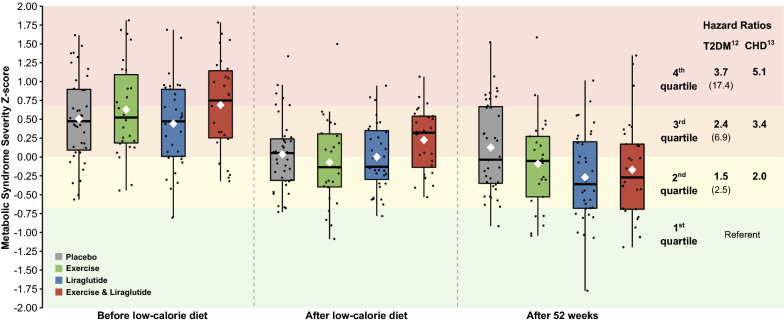
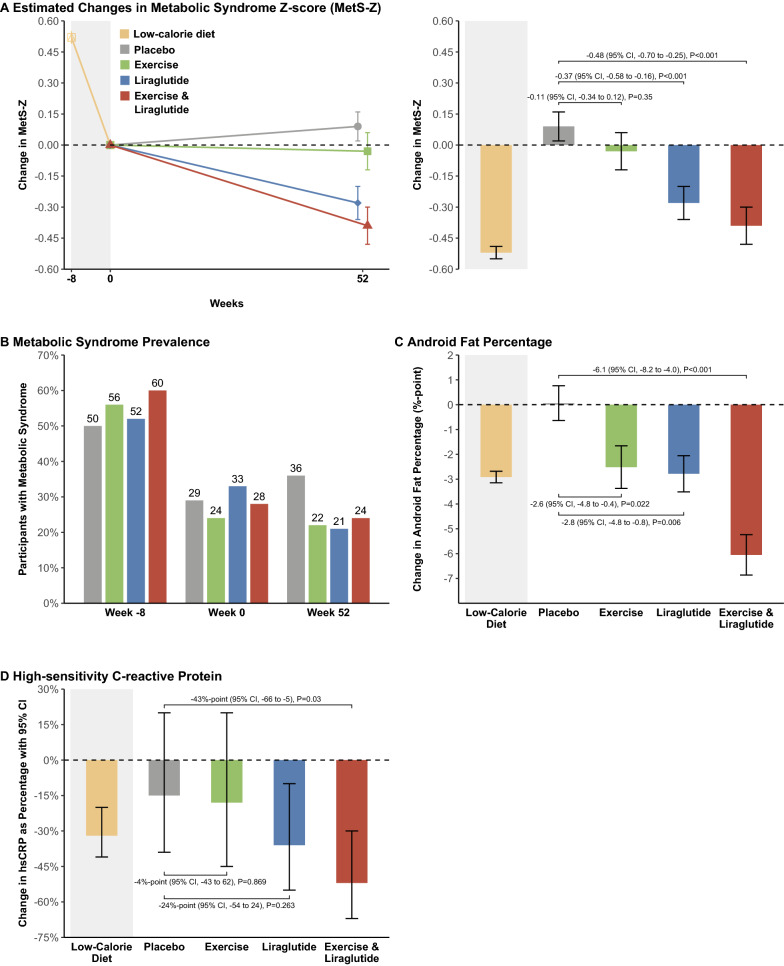
Background: Identifying and reducing cardiometabolic risks driven by obesity remains a healthcare challenge. The metabolic syndrome is associated with abdominal obesity and inflammation and is predictive of long-term risk of developing type 2 diabetes and cardiovascular disease in otherwise healthy individuals living with obesity. Therefore, we investigated the effects of adherent exercise, a glucagon-like peptide 1 receptor agonist (GLP-1 RA), or the combination on severity of metabolic syndrome, abdominal obesity, and inflammation following weight loss. Methods: This was a randomized, double-blinded, placebo-controlled trial. During an 8-week low-calorie diet (800 kcal/day), 195 adults with obesity and without diabetes lost 12% in body weight. Participants were then evenly randomized to four arms of one-year treatment with: placebo , moderate-to-vigorous exercise (minimum of 150 min/week of moderate-intensity or 75 min/week of vigorous-intensity aerobic physical activity or an equivalent combination of both), the GLP-1 RA liraglutide 3.0 mg/day, or a combination (exercise + liraglutide). A total of 166 participants completed the trial. We assessed the prespecified secondary outcome metabolic syndrome severity z-score (MetS-Z), abdominal obesity (estimated as android fat via dual-energy X-ray absorptiometry), and inflammation marker high-sensitivity C-reactive protein (hsCRP). Statistical analysis was performed on 130 participants adherent to the study interventions (per-protocol population) using a mixed linear model. Results: The diet-induced weight loss decreased the severity of MetS-Z from 0.57 to 0.06, which was maintained in the placebo and exercise groups after one year. MetS-Z was further decreased by liraglutide (− 0.37, 95% CI − 0.58 to − 0.16, P < 0.001) and the combination treatment (− 0.48, 95% CI − 0.70 to − 0.25, P < 0.001) compared to placebo. Abdominal fat percentage decreased by 2.6, 2.8, and 6.1 percentage points in the exercise, liraglutide, and combination groups compared to placebo, respectively, and hsCRP decreased only in the combination group compared with placebo (by 43%, P = 0.03). Conclusion: The combination of adherent exercise and liraglutide treatment reduced metabolic syndrome severity, abdominal obesity, and inflammation and may therefore reduce cardiometabolic risk more than the individual treatments. Trial registration EudraCT number: 2015-005585-32, ClinicalTrials.gov: NCT04122716
Overview
The claims and statistics of this paper haven’t been checked yet.
Free: it reads the open-access text and checks the first 5 claims that cite a source we can check. Create a free account to check every claim.
Integrity signals
Registry
Cites
Statistics
Figures
Verification
Claims the paper makes
The claims and statistics of this paper haven’t been checked yet.
Free: it reads the open-access text and checks the first 5 claims that cite a source we can check. Create a free account to check every claim.
Claims other papers make about this one
Each is checked against this paper’s own text: does it say what the citing paper says it does?
The source backs part of the claim, not all of it — or backs it for a different population, condition or comparison.
In the citing paper
“In that trial, GLP‐1 therapy plus exercise also produced larger reductions in abdominal fat and systematic inflammation than GLP‐1 therapy alone [171].”
From Nutritional priorities to support GLP ‐1 therapy for obesity: A joint Advisory from the American College of Lifestyle Medicine, the American Society for Nutrition, the Obesity Medicine Association, and The Obesity Society (2025) · cites this paper as [171]
Experimental — accuracy not yet measuredThe source backs part of the claim, not all of it — or backs it for a different population, condition or comparison.
In the citing paper
“Sandsdal et al. 90 revealed that structured exercise coupled with liraglutide treatment – which consists of consuming only 800 kcal/day over 8 weeks – effectively diminished metabolic syndrome severity, abdominal obesity prevalence, and inflammation levels one had priorly experienced.”
From Anti-inflammatory role of glucagon-like peptide 1 receptor agonists and its clinical implications (2024) · cites this paper as [90]
Experimental — accuracy not yet measuredThe source backs part of the claim, not all of it — or backs it for a different population, condition or comparison.
In the citing paper
“In that trial, GLP-1 therapy plus exercise also produced larger reductions in abdominal fat and systematic inflammation than GLP-1 therapy alone [171].”
From Nutritional priorities to support GLP-1 therapy for obesity: a joint Advisory from the American College of Lifestyle Medicine, the American Society for Nutrition, the Obesity Medicine Association, and The Obesity Society (2025) · cites this paper as [171]
Experimental — accuracy not yet measuredThe source backs part of the claim, not all of it — or backs it for a different population, condition or comparison.
In the citing paper
“Recent randomized controlled trials and meta-analyses suggest that combining GLP-1RAs with exercise may yield additive or synergistic effects on weight loss and metabolic syndrome severity as well as on oxidative stress and inflammation.”
From GLP-1 agonists and exercise: the future of lifestyle prioritization (2025) · cites this paper as [16]
Experimental — accuracy not yet measuredThe source backs part of the claim, not all of it — or backs it for a different population, condition or comparison.
In the citing paper
“Moreover, exercise may help maintain weight loss after cessation of pharmacotherapy (16, 17, 19, 21).”
From GLP-1 agonists and exercise: the future of lifestyle prioritization (2025) · cites this paper as [16]
Experimental — accuracy not yet measured
10 more claims about this paper
Create a free account to see every claim other papers make about this one.
Self-check
Percentages, sums and reported differences re-computed from the paper’s own numbers.
The self-check needs the paper’s full text.
Citations
Cites
Alberti, K. G. M. M., Eckel, R. H., Grundy, S. M., Zimmet, P. Z., Cleeman, J. I., Donato, K. A., Fruchart, J.-C., James, W. P. T., Loria, C. M., & Smith, S. C. (2009) · Circulation · doi:10.1161/circulationaha.109.192644 · Cited by 14,860
World Health Organization 2020 guidelines on physical activity and sedentary behaviour
Bull, F. C., Al-Ansari, S. S., Biddle, S., Borodulin, K., Buman, M. P., Cardon, G., Carty, C., Chaput, J.-P., Chastin, S., Chou, R., et al. (2020) · British Journal of Sports Medicine · doi:10.1136/bjsports-2020-102955 · Cited by 11,657 · cited 1×
“0 mg/day of liraglutide/placebo for at least 75% of the intervention period [25, 26].”
Background2013 AHA/ACC/TOS Guideline for the Management of Overweight and Obesity in Adults
Jensen, M. D., Ryan, D. H., Apovian, C. M., Ard, J. D., Comuzzie, A. G., Donato, K. A., Hu, F. B., Hubbard, V. S., Jakicic, J. M., Kushner, R. F., et al. (2014) · Journal of the American College of Cardiology · doi:10.1016/j.jacc.2013.11.004 · Cited by 4,058 · cited 1×
“Identifying and reducing cardiometabolic risks driven by obesity remains a major healthcare challenge [1].”
BackgroundThe Metabolic Syndrome and Cardiovascular Risk
Mottillo, S., Filion, K. B., Genest, J., Joseph, L., Pilote, L., Poirier, P., Rinfret, S., Schiffrin, E. L., & Eisenberg, M. J. (2010) · Journal of the American College of Cardiology · doi:10.1016/j.jacc.2010.05.034 · Cited by 3,009 · cited 1×
“Metabolic syndrome (MetS) is associated with an increased risk of cardiovascular disease, type 2 diabetes, and all-cause mortality [2, 3].”
BackgroundA Randomized, Controlled Trial of 3.0 mg of Liraglutide in Weight Management
Pi-Sunyer, X., Astrup, A., Fujioka, K., Greenway, F., Halpern, A., Krempf, M., Lau, D. C. W., le Roux, C. W., Violante Ortiz, R., Jensen, C. B., et al. (2015) · New England Journal of Medicine · doi:10.1056/nejmoa1411892 · Cited by 2,724
Mechanisms of Action and Therapeutic Application of Glucagon-like Peptide-1
Drucker, D. J. (2018) · Cell Metabolism · doi:10.1016/j.cmet.2018.03.001 · Cited by 2,170 · cited 1×
“GLP-1 RAs are also suggested to lower inflammation due to direct anti-inflammatory effects on various tissues and immune cells and partly because of the weight loss seen with GLP-1 RA treatment [22, 23].”
BackgroundMetabolic Syndrome as a Precursor of Cardiovascular Disease and Type 2 Diabetes Mellitus
Wilson, P. W. F., D’Agostino, R. B., Parise, H., Sullivan, L., & Meigs, J. B. (2005) · Circulation · doi:10.1161/circulationaha.105.539528 · Cited by 2,064 · cited 1×
“Metabolic syndrome (MetS) is associated with an increased risk of cardiovascular disease, type 2 diabetes, and all-cause mortality [2, 3].”
BackgroundVisceral and ectopic fat, atherosclerosis, and cardiometabolic disease: a position statement
Neeland, I. J., Ross, R., Després, J.-P., Matsuzawa, Y., Yamashita, S., Shai, I., Seidell, J., Magni, P., Santos, R. D., Arsenault, B., et al. (2019) · The Lancet Diabetes & Endocrinology · doi:10.1016/s2213-8587(19)30084-1 · Cited by 1,603 · cited 2×
“Abdominal obesity is associated with low-grade inflammation and has been proposed as a driver for metabolic syndrome [4].”
BackgroundMetabolic syndrome: definitions and controversies
Kassi, E., Pervanidou, P., Kaltsas, G., & Chrousos, G. (2011) · BMC Medicine · doi:10.1186/1741-7015-9-48 · Cited by 1,565
National health and nutrition examination survey: plan and operations, 1999-2010.
Zipf, G., Chiappa, M. M., Porter, K. S., Ostchega, Y., Lewis, B. G., & Dostal, J. (2013) · PubMed · Cited by 1,182
Cited by
Items 101–200 of 245
Preventive Strategies to Reduce Sarcopenia Risk During GLP-1-Based Anti-Obesity Therapy
Belančić, A., Skroče, K., Gkrinia, E. M. M., Glavić, M. M., & Kwok, M. K. (2026) · Journal of Clinical Medicine · doi:10.3390/jcm15155870 · Cited by 3
“Direct comparisons reveal that GLP-1 RAs generally produce greater short-term weight loss than exercise alone, but exercise may be more effective for preserving FFM and cardiorespiratory fitness [62–64].”
MacDonald, C., Bennekou, M., Nielsen, S. M., Junker, A. E., Biering‐Sørensen, T., Langberg, H., Christensen, R., Lieberman, D. E., Zachariae, C. O. C., & Pallisgaard, J. L. (2024) · Scandinavian Journal of Medicine and Science in Sports · doi:10.1111/sms.14770 · Cited by 4
Benefits of Supplementing a GLP-1 Type Medication With Physical Activity
Ablah, E. A., Imboden, M. T., Zendell, A. L., Hosking, M., Anderson, R. E., VanHoose, K., Peterson, N. E., Wojcik, J. R., Pronk, N. P., Harber, M., et al. (2025) · American Journal of Health Promotion · doi:10.1177/08901171251357130 · Cited by 3
“49 Reduces metabolic syndrome severity, abdominal obesity, and in fl ammation more than either alone.”
InfluentialAbild, C. B., Klein, A.-L. K., Klindt, T., Bruun, J. M., & Jakobsen, D. D. (2025) · International Journal of Obesity · doi:10.1038/s41366-025-01780-y · Cited by 3
“Bariatric surgery and pharmacotherapy are currently the most effective treatments for obesity [2 – 4], but low-energy diets (LED) and very-low-energy diets (VLED) contribute to signi fi cant initial weight loss, potentially enhancing motivation and facilitating engagement in physical activities…”
Jo, D., Ahn, S. Y., Choi, S. Y., Choi, Y., Lee, D. H., & Song, J. (2024) · Clinical Nutrition Research · doi:10.7762/cnr.2024.13.2.121 · Cited by 2
Du, M., Yue, J., Qi, Y., He, S., Lu, X., Yang, M., Wang, L., Lü, Q., & Ma, J. (2024) · Diabetology & Metabolic Syndrome · doi:10.1186/s13098-024-01540-4 · Cited by 2
Filha, A. M. S. G., Leite, J. M., Lagares, L. S., de Jesus, D. S., Bomfim, E. S., de Almeida, L. A. B., Pinto, L. L. T., de Souza, L. A. J., & dos Santos, C. P. C. (2025) · Brazilian Journal of Kinanthropometry and Human Performance · doi:10.1590/1980-0037.2025v27e103939 · Cited by 5
Role of physical activity in GLP-1 receptor agonist therapy for obesity treatment
Zdziebkowski, Ł., Wilska, H., Szatkowska, D., Ziętara, D., Kmieć, K. K., Topolska, A., Komorowski, M., Janiszewski, M., Surosz, N., Grochowalski, M., et al. (2025) · Quality in Sport · doi:10.12775/qs.2025.43.62342 · Cited by 2
“Interventions consisted of GLP-1 RA and physical exercises therapy resulted in greater body composition benefits, glycemic improvements, and inflammatory reductions than either intervention alone [26].”
InfluentialEfficacy and Safety of Tirzepatide and Semaglutide for Obesity Management: A Real-World Comparison
Shil, K. K., Hira, A. D., Bakchi, S., Paul, S., Hossain, M., & Ghosh, D. K. (2025) · Cureus · doi:10.7759/cureus.98858 · Cited by 6
“This aligns with prior studies showing that GLP-1 receptor agonists paired with lifestyle modification more effectively improve weight and metabolic outcomes than either approach alone [22].”
Glucagon-Like Peptide-1 Receptor Agonists: Their Potential Role in Prediabetes
Panou, T., Gouveri, E., Popovic, D. S., Papazoglou, D., & Παπάνας, Ν. (2026) · Diabetes Therapy · doi:10.1007/s13300-026-01865-5 · Cited by 2
“An 8-week combined dietary (low calo-rie diet) and exercise (either 150 min/week of moderate-intensity or 75 min/week of intense aerobic exercise) intervention along with GLP-1RAs treatment has been shown to potentiate the beneficial effects of GLP-1RAs [58].”
GLP-1 receptor agonists for weight loss, benefits and risks: A systematic review of the literature
de Moraes, D. S. P., & Estrín, M. A. (2024) · Salud Ciencia y Tecnología - Serie de Conferencias · doi:10.56294/sctconf2024.719 · Cited by 2
Exploring the therapeutic potential of glucagon-like peptide 1 agonists in metabolic disorders
Cortés‐Martín, A., & Plaza‐Díaz, J. (2025) · World Journal of Gastroenterology · doi:10.3748/wjg.v31.i4.101436 · Cited by 2
The assessment of exhaled nitric oxide in patients with obesity and asthma before and after exercise
Parlak, B., Tamay, Z., & Güler, N. (2025) · Journal of Asthma · doi:10.1080/02770903.2025.2453507 · Cited by 2
“It is known that obesity creates inflammation and that this inflammation improves with exercise (3).”
Integrative Therapies in Metabolic Syndrome
Lucius, K. (2024) · Integrative and Complementary Therapies · doi:10.1089/ict.2024.88345.kl · Cited by 1
de Carvalho, G. F., de Sousa, G. M. B., Moraes, G., Dorneles, H. B. F., Ferreira, L. C. L., Cury, G. A. A., Carvalho, M. D. O. P., & Lima, M. C. T. L. (2025) · Contribuciones a las Ciencias Sociales · doi:10.55905/revconv.18n.1-235 · Cited by 1
In vivo medical imaging for assessing geroprotective interventions in humans
Svensson, J. E., Schain, M., & Plavén‐Sigray, P. (2025) · GeroScience · doi:10.1007/s11357-025-01514-y · Cited by 3
Dosing Exercise to Regulate Cardiometabolic Risk Among People Requiring Cardiac Rehabilitation
Gordon, B. A., Parr, E. B., & Schultz, M. G. (2025) · Exercise and Sport Sciences Reviews · doi:10.1249/jes.0000000000000361 · Cited by 1
Дунаєва, І. (2025) · Inter Collegas · doi:10.35339/ic.2025.12.2.dun · Cited by 1
Videira‐Silva, A., de Freitas, F., Sardinha, L. B., & Fonseca, H. (2025) · Obesity Pillars · doi:10.1016/j.obpill.2025.100190 · Cited by 1
“…the combination of the two therapeutics (i.e., GLP-1 receptor agonists and high-intensity exercise) may further enhance obesity-related outcomes [31], with exercise playing a key role in maintaining weight loss after the discontinuation of pharmacological treatment [32], as it has been…”
Bawazeer, N., Ganzal, S. B., Al-Hasinah, H. F., & AlRuthia, Y. S. (2025) · Healthcare · doi:10.3390/healthcare13141755 · Cited by 1
“It is important to note that combining physical exercise with GLP-1 receptor agonists (GLP-1RAs) has been shown to yield greater weight reduction and improved glycemic control [28].”
Lewandrowski, K.-U., Bowirrat, A., Pinhasov, A., Sharafshah, A., Gold, M. S., Fuehrlein, B., Elman, I., Dennen, C. A., Thanos, P. K., Hanna, C., et al. (2025) · PubMed · Cited by 1
Choo, Y. N., Narayanan, R., & Subramaniyan, V. (2025) · Vascular Pharmacology · doi:10.1016/j.vph.2025.107553 · Cited by 2
Larsen, S. C., Heitmann, B., Wane, S., Wielsøe, S., Lindschou, J., Jakobsen, J., Engstrøm, J., Specht, I., Christiansen, A.-K. L., Jensen, A., et al. (2025) · BMJ Open · doi:10.1136/bmjopen-2025-107155 · Cited by 1
“…to detect differences (significance level 0.05) between intervention groups in the MetS-Z score of 0.3 points with a power of 74% (SD 1.0 points) 37–39 ; in the SF-36 mental component score of 4 points with a power of 82% (SD 12 points) 18 40 and in 4-m gait speed test of 0.2 m/s with a power of…”
InfluentialSelf-citationGlucagon-like Peptide-1 Agonists and Exercise for Weight Reduction: A Review of Current Evidence
Owaidat, J. F., Zuaiter, S., Daseh, A. I., Nemrawi, F. A. A., Abu‐Jeyyab, M., & Al-Jafari, M. (2025) · JAP Academy Journal · doi:10.4103/japaj.japaj_5_24 · Cited by 1
Li, L., Ma, Y. F., He, X., Cao, M., Zheng, E., & Leng, J. (2025) · BMC Geriatrics · doi:10.1186/s12877-025-06826-4 · Cited by 1
“Abdominal obesity is widely recognized to be linked to metabolic syndrome [9, 10], as well as a variety of chronic metabolic diseases [11–13].”
Sanchis‐Gomar, F., Neeland, I. J., Ruiz‐Lozano, P., Alnahar, O., & Rodríguez, F. (2025) · Current Cardiology Reports · doi:10.1007/s11886-025-02334-4 · Cited by 1
“In another study, combining liraglutide with exercise resulted in a greater reduction in metabolic syndrome severity, abdominal fat percentage, and inflammation (measured by lower high-sensitivity C-reactive protein levels) compared to either intervention alone [49].”
Adam, M., Fréget, L., Bärnighausen, T., Rodríguez, F., Amsalem, D., & Linos, E. (2026) · JAMA Network Open · doi:10.1001/jamanetworkopen.2026.0577 · Cited by 2
Extending Healthspan via GLP-1 Receptor Agonist: Insights and Perspectives
Chakrabarti, S. K., & Chattopadhyay, D. (2026) · Exploratory Research and Hypothesis in Medicine · doi:10.14218/erhm.2025.00036 · Cited by 1
Glucagon-like peptide-1 receptor agonists across anti-inflammation
Chen, D. (2026) · Molecular Aspects of Medicine · doi:10.1016/j.mam.2026.101474 · Cited by 1
24-h movement behaviors and the association of chronic pain with venous thromboembolism risk
Huang, X. B., Gao, D., Ji, M., Zhang, Y., Dai, Y., Pan, Y., Liu, Y., Wu, A., Zheng, F., & Xie, W. (2026) · Journal of Clinical Anesthesia · doi:10.1016/j.jclinane.2026.112227 · Cited by 1
Kociuba, J., Kruczek, Z., Kudła, M., Krawczyk, A., Pawełczak, N., Kołkowicz, D., Czechowicz, P., Czechowicz, J., Antkiewicz, M., Arczyńska-Antkiewicz, A., et al. (2026) · Quality in Sport · doi:10.12775/qs.2026.55.71209 · Cited by 1
Wang, H., Jin, Z., Di, S., & Alizadeh, H. (2026) · Medicinal Research Reviews · doi:10.1002/med.70063 · Cited by 2
Retzinger, A. C. (2026) · Frontiers in Microbiology · doi:10.3389/fmicb.2026.1714798 · Cited by 1
“Because pharmacologic GLP-1 receptor agonism confers substantial benefit in metabolic syndrome, obesity, and type 2 diabetes (Astrup et al., 2012; Sandsdal et al., 2023), insufficient colonization by GLP-1–stimulatory commensals such as S. epidermidis , or overrepresentation of GLP-1–degrading…”
Olumuyide, E. O., Ariel, K., & Aneni, E. (2026) · International Journal of Obesity · doi:10.1038/s41366-026-02143-x · Cited by 1
Hundal, J., Linz, M. O., Anikreddy, S., Sengupta, S., Zhou, K., & Maiti, B. (2026) · JCO Oncology Practice · doi:10.1200/op-26-00061 · Cited by 1
Baek, J., Ioannidou, A., Borg, M. L., Robert‐Nicoud, G., Pietiläinen, K. H., Rössner, S., Johnston, E. V., & Bengtsson, T. (2026) · EClinicalMedicine · doi:10.1016/j.eclinm.2026.104042 · Cited by 1
“30 Such integrative analyses provide a more clinically relevant assessment of long-term metabolic health, reinforcing the potential of SiPore21 as a comprehensive, non-pharmacological intervention.”
Li, Y. C., Xu, X., Tuersun, A., Fan, X., Qin, M., Zhao, X., Abuduaini, S., Xing, H., & Chen, H. (2026) · Pharmacological Research · doi:10.1016/j.phrs.2026.108333 · Cited by 1
Gizdović, I., Šošić‐Jurjević, B., Vlahović, D., Ristić, N., Lavrnja, I. C., Filipović, B. R., Marina, L., & Trifunović, S. L. (2026) · Cells · doi:10.3390/cells15141258 · Cited by 1
“…from a single randomized controlled trial indicates that combining structured physical exercise with liraglutide reduces metabolic syndrome severity, abdominal obesity, and systemic inflammation, while improving physical performance and cardiorespiratory fitness beyond pharmacotherapy alone [18].”
AMPK/USP10 loop activation of ACE2: implications for pulmonary hypertension
Chen, Z., Ge, D., Li, X., Wei, T. W., He, F., Chao, J., 熊正琴, Yin, Q., Chen, Y., Wang, J., et al. (2026) · European Heart Journal · doi:10.1093/eurheartj/ehag568 · Cited by 1
Zeigler, Z., Havenar, J. M., Smith, E., Tang, L., Marthaler, C., & Gardner, K. (2026) · Healthcare · doi:10.3390/healthcare14152345 · Cited by 1
“…Exercise was also the only intervention that maintained the large reductions in insulin resistance induced by the low-calorie diet at one year [31], a finding that is particularly significant given that insulin resistance is a possible mediator of cardiometabolic risk during weight regain…”
InfluentialEffects of obesity on brain health and cognition
McEntee, C. M., Savelieff, M. G., Noureldein, M. H., Eid, S., Grisold, W., Hassenstab, J. J., & Feldman, E. L. (2026) · Nature Reviews Neurology · doi:10.1038/s41582-026-01251-6 · Cited by 2
“For example, healthy dietary strategies and exercise are commonly recommended alongside GLP-1RA treatment 215 .”
Acierno, C., Cavallo, M., D’Ardes, D., Boccatonda, A., Nilo, D., & Caturano, A. (2026) · International Journal of Molecular Sciences · doi:10.3390/ijms27188063 · Cited by 1
“…and AMPK signalling: combining exercise with GLP-1 receptor agonist treatment produces a greater reduction in metabolic syndrome severity than either intervention alone, consistent with two independent anti-inflammatory mechanisms converging on the same underlying immunometabolic network [160].”
Davies, M. J., Aroda, V. R., Bajaj, M. S., ElSayed, N. A., Giorgino, F., Green, J., Kalyani, R. R., Maruthur, N. M., Mathieu, C., Rosas, S. E., et al. (2026) · Diabetologia · doi:10.1007/s00125-026-06855-7 · Cited by 1
Wisdom, E. M., Goldlist, K., Lieber, S. B., Marwell, J. G., Neukam, S., Johnston, E. A., Batsis, J. A., Eckstrom, E., & Wagle, K. C. (2026) · Journal of the American Geriatrics Society · doi:10.1111/jgs.70769 · Cited by 1
Influência do manejo terapêutico da síndrome metabólica nos parâmetros da apneia obstrutiva do sono
Camacho, S. D., Albuquerque, A. L. C., Peternelli, M. D. O., Veras, A. C. O., Bastos, L. F., Silva, L. M., Ribeiro, L. N., Pereira, J. M., Melo, I. D. F., & Macedo, M. E. G. (2023) · Brazilian Journal of Health Review · doi:10.34119/bjhrv6n5-122 · Cited by 1
Tratamento da obesidade com análogos de GLP-1: uma revisão de literatura
Ardais, G. D., de Lima, N. F., & Batista, S. L. (2023) · Revista Interdisciplinar de Saúde e Educação · doi:10.56344/2675-4827.v4n3a2023.30 · Cited by 1
Wang, Z., Lavikainen, P., Wikström, K., & Laatikainen, T. K. (2025) · Diabetes Therapy · doi:10.1007/s13300-025-01763-2 · Cited by 3
“The effect of antidiabetic medications may only be inadequate if the patient does not simultaneously receive appropriate support for dietary and other lifestyle changes [42].”
Integrative Health: Combining Exercise, Lifestyle Changes, and Gut Microbiome for Metabolic Syndrome
Srivastava, R., & Singh, G. (2025) · Springer eBooks · doi:10.1007/978-981-96-6246-3_6 · Cited by 1
22 還元進行過程の調査 : 小型高炉による製銑過程に関する基礎研究 I(製銑, 日本鉄鋼協会第 70 回(秋季)講演大会講演論文集 (I))
大蔵, 明., カルデロン, F. P., & 松下, 幸. (1965) · 鐵と鋼 : 日本鐡鋼協會々誌
DIAGNÓSTICO DA SÍNDROME METABÓLICA EM ADULTOS
Agulhan, I. D. A., Figueiredo, S. A., Grangeiro, H. C. G., Yamada, L. S., & ELEUTÉRIO-SILVA, M. A. (2023) · Anais do III Congresso Brasileiro de Saúde On-line · doi:10.51161/conbrasau2023/22715
Metabolic syndrome: A Review Involving the Hedgehog Pathway, PGC-1α , and GLP Roles
Salah, B., Abdelsalam, H. M., Khamis, T., Diab, A. A., & El-Dawy, K. (2023) · Biochemistry Letters · doi:10.21608/blj.2023.314429
In vivo medical imaging for assessing geroprotective interventions in humansPreprint
Svensson, J. E., Schain, M., & Plavén‐Sigray, P. (2024) · Research Square · doi:10.21203/rs.3.rs-4095045/v1
The Role of GLP 1 Receptor Agonists in Treating Heart Failure: Useful or Not?
Lungeanu, L., Nica, A., Rusu, E., & Radulian, G. (2024) · Internal Medicine · doi:10.2478/inmed-2024-0276
Cissus sicyoides phytotherapy as complementary to the treatment of type II diabetes mellitus
Kielb, D. S., da Cruz, A. D., Farias, F. T. P., Gaio, T. C., & Schueda, M. A. (2024) · International Seven Journal of Health Research · doi:10.56238/isevmjv3n2-026
Herbal medicine Cissus sicyoides as a complement to the treatment of type II Diabetes Mellitus
Kielb, D. S., da Cruz, A. D., Farias, F. T. P., Gaio, T. C., & Schueda, M. A. (2024) · Seven Editora eBooks · doi:10.56238/sevened2024.006-009 · Cited by 1
Kuśmierski, J., & Kuśmierska, M. (2024) · Health Problems of Civilization · doi:10.5114/hpc.2024.139680
Non-drug treatment of type II diabetes literature review
Rocha, I. G. B., Schueda, M. A., Neppel, A., Kielb, D. S., & Pereira, M. C. F. (2023) · International Seven Journal of Health Research · doi:10.56238/isevjhv2n6-011
DIAGNÓSTICO E TRATAMENTO DA SÍNDROME METABÓLICA: ESTRATÉGIAS E AVANÇOS RECENTES
Barros, A. B. C., Filho, A. C. B. V., Silva, A. K. S., Parente, L. E. G., Ferreira, W. A., Grisani, A., Simões, M. A. C., Silvério, T. M., de Souza, I. A. M., Nascimento, G. A. C., et al. (2024) · Revista Interdisciplinar de Ciências da Saúde. · doi:10.70209/rics.v1i2.28
Jabłonowska-Babij, P., Jędrzejuk, D., Majcherek, M., Szeremet, A., Karasek, M., Kuszczak, B., Kujawa, K., Sitkiewicz, M., Landwójtowicz, M., Wróbel, T., et al. (2024) · Journal of Clinical Medicine · doi:10.3390/jcm13195987 · Cited by 1
“This result aligns with current knowledge, which indicates that fat accumulation in the abdominal region, known as android fat, is strongly associated with chronic inflammation in the body and an increased risk of conditions such as diabetes and cardiovascular diseases [58,59].”
ResultAnálogos de GLP-1 e seus efeitos no emagrecimento a longo prazo: uma revisão de literatura
Alves, B. O., Santos, H. R. P., Acácio, A. F. R., Duarte, T. S., & Ribeiro, T. O. (2024) · Cuadernos de Educación y Desarrollo · doi:10.55905/cuadv16n12-068
Lim, W. (2024) · Asia-pacific Journal of Convergent Research Interchange · doi:10.47116/apjcri.2024.12.43
Impact of GLP-1 Receptor Agonists on Body Weight and Cardiovascular Outcomes: A Systematic Review
Mutairi, A. A. (2025) · Bangladesh Journal of Medical Science · doi:10.3329/bjms.v24i10.79201
Pedicino, D., & Liuzzo, G. (2025) · European Heart Journal · doi:10.1093/eurheartj/ehaf236
THE ROLE OF PHYSICAL EXERCISE IN REDUCING INFLAMMATION IN PATIENTS WITH SYSTEMIC SCLEROSIS
Gradek, A., Sawczuk, M., Nowak, D., Zarzycki, A., Tarnowska, J. A., Szydzik, F., Żegleń, B., Kozon, K., Grudzień, M., & Leśniewska, A. (2025) · International Journal of Innovative Technologies in Social Science · doi:10.31435/ijitss.3(47).2025.3488
“[15] In their study, Tadayon et al. examined the effect of physical exercise on inflammatory marker levels in female patients with multiple sclerosis.”
Guan, X., Hu, Y., Lu, M., Zhang, Z., Sun, R., Hao, J., Cui, X., Zhang, C., & Li, C. (2025) · SSRN Electronic Journal · doi:10.2139/ssrn.5356485
Sinha, A., Myers, E. R., & Visco, A. G. (2025) · Cureus · doi:10.7759/cureus.90764
Fennel, Z. J., Kurian, A., Bourrant, P., Skiles, C. M., Castro, R. J., Yee, E. M., Greilach, S. A., Keirstead, H. S., Nistor, G., Berchtold, N. C., et al. (2025) · Obesity · doi:10.1002/oby.70068 · Cited by 1
ABORDAGEM E MANEJO CLÍNICO DO PACIENTE IDOSO COM EAP NA EMERGÊNCIA
́Anna, C. O. M. D. S., & Perez, M. C. A. (2025) · Jornada Científica do Internato Médico · doi:10.29327/1718890.46-24
TRANSTORNO DO ESPECTRO AUTISTA: O DIAGNÓSTICO TARDIO E O SUBDIAGNÓSTICO
Bernardino, L. F. M., & Desiderati, M. (2025) · Jornada Científica do Internato Médico · doi:10.29327/1718890.46-20
QUEIMADURA: MANEJO NA EMERGÊNCIA
Gaspar, L. M. A., & Rodriguez, L. M. (2025) · Jornada Científica do Internato Médico · doi:10.29327/1718890.46-12
MENINGITE ASSÉPTICA INDUZIDA POR AMOXICILINA
Ribeiro, A. R., Dóczy, A. D. P., & Campos, A. R. R. (2025) · Jornada Científica do Internato Médico · doi:10.29327/1718890.46-9
ESTUDO DAS DIFERENTES TECNICAS CIRÚRGICAS NA REVASCULARIZACAO DO MIOCÁRDIO
de Moraes, B. L. L., & Nunes, C. P. (2025) · Jornada Científica do Internato Médico · doi:10.29327/1718890.46-11
EFEITOS DA SUPLEMENTAÇÃO DE VITAMINA D NA PREVENÇÃO DE DOENÇAS OCULARES
Domingos, E. D., & de Melo, L. R. B. (2025) · Jornada Científica do Internato Médico · doi:10.29327/1718890.46-16
TRATAMENTOS PARA A PERSISTÊNCIA DO CANAL ARTERIAL EM PREMATUROS
Sohn, E. R. T., & Correa, C. (2025) · Jornada Científica do Internato Médico · doi:10.29327/1718890.46-17
AVALIAÇÃO DAS DIFERENTES ETIOLOGIAS DE HIPERBILIRRUBINEMIA NEONATAL
Itajahy, M. C. C. M., Rodrigues, S., & Vasconcellos, M. (2025) · Jornada Científica do Internato Médico · doi:10.29327/1718890.46-7
A IMPORTÂNCIA DA GOLDEN HOUR PARA O FORTALECIMENTO DO VÍNCULO MAMÃE E BEBÊ
Viana, V. D. S., & Gama, C. E. D. S. (2025) · Jornada Científica do Internato Médico · doi:10.29327/1718890.46-4
SINTOMAS INESPECÍFICOS NO CÂNCER PEDIÁTRICO: O PAPEL DO DIAGNÓSTICO PRECOCE
de Pinho, L. L., & Vasconcellos, M. (2025) · Jornada Científica do Internato Médico · doi:10.29327/1718890.46-3
DERMATOLOGIA E SAÚDE MENTAL: O VÍNCULO ENTRE ACNE E DEPRESSÃO EM INDIVÍDUOS JOVENS
Motta, L. D. L., & Granja, P. D. D. (2025) · Jornada Científica do Internato Médico · doi:10.29327/1718890.46-63
INOVAÇÕES E DESAFIOS NO TRATAMENTO DA TETRALOGIA DE FALLOT
Silveira, I. M. S., & Escrivães, A. C. N. D. C. (2025) · Jornada Científica do Internato Médico · doi:10.29327/1718890.46-60
Chiconelli, H. M. A., & Desiderati, M. (2025) · Jornada Científica do Internato Médico · doi:10.29327/1718890.46-56
NEUROPROTEÇÃO COM SULFATO DE MANGÉSIO: APLICAÇÃO NA OBSTETRÍCIA
Gouvêa, E. H., & B.Gama, C. R. (2025) · Jornada Científica do Internato Médico · doi:10.29327/1718890.46-53
ATUALIZAÇÕES NOS CRITÉRIOS DIAGNÓSTICOS E TRATAMENTO DA SEPSE.
Cavalcanti, R. D. G., & Perez, M. C. A. (2025) · Jornada Científica do Internato Médico · doi:10.29327/1718890.46-50
HEMORRAGIA DIGESTIVA ALTA POR VARIZES GASTROESOFÁGICAS EM PACIENTES CIRRÓTICOS
Neves, G. V., & Figueiredo, L. F. (2025) · Jornada Científica do Internato Médico · doi:10.29327/1718890.46-54
ANÁLISE DA IMUNIZAÇÃO INFANTIL DE 0 A 5 ANOS EM UM AMBULATÓRIO DE ENSINO
Erthal, S. S., & Rodrigues, S. (2025) · Jornada Científica do Internato Médico · doi:10.29327/1718890.46-32
USO DO OMALIZUMABE PARA O TRATAMENTO DA ASMA ALÉRGICA GRAVE
Fernandes, G. N., & Nunes, C. P. (2025) · Jornada Científica do Internato Médico · doi:10.29327/1718890.46-34
TRANSTORNOS DA PERSONALIDADE DO GRUPO B NA ATENÇÃO PRIMÁRIA
Peclat, B. E., & Dóczy, A. D. P. (2025) · Jornada Científica do Internato Médico · doi:10.29327/1718890.46-35
Gil‐Redondo, R., Conde, R., Bruzzone, C., Seco, M. L., Bizkarguenaga, M., González‐Valle, B., de Diego, Á., Laín, A., Habisch, H., Haudum, C. W., et al. (2024) · Figshare · doi:10.6084/m9.figshare.26753476
Modulação da Inflamação e Mobilização de Leucócitos no Paciente com Diabetes: Uma Revisão Narrativa
Mafra, G. D. (2024) · DSpace (Federal University of Santa Catarina)
Razmi, S., Moshtaghie, A. A., Seyedabadi, M., Nayeri, H., & Akbarzadeh, S. (2026) · 3 Biotech · doi:10.1007/s13205-025-04692-w
“…control, weight regulation, and metabolic flexibility, align - ing closely with our computational and experimental find - ings showing enhanced ligand–receptor interactions, insulin sensitization, irisin induction, and mitochondrial gene activation in exercised diabetic mice (Sandsdal et al. 2023).”
Sedhunivas, R., Talawar, M. P., & Thomas, A. (2026) · Journal of Society of Indian Physiotherapists · doi:10.4103/jsip.jsip_145_24
Wiedermann, C. J., Rina, P., Kindl, U., & Prainsack, D. H. V. S. (2026) · International Journal of Environmental Research and Public Health · doi:10.3390/ijerph23020248
The Metabolic Profile of Psoriatic DiseasePreprint
Athanassiou, L., Athanassiou, P., Kaiafa, G., Savopoulos, C. G., Shoenfeld, Y., & Kostoglou‐Athanassiou, I. (2026) · Preprints.org · doi:10.20944/preprints202602.1225.v1
Raiol, R. M. (2026) · Periódicos Brasil Pesquisa Científica · doi:10.36557/2674-9432.2026v5n1p2201-2205
Maldonado, D. L. G. (2026) · Universidad Politécnica Salesiana Repositorio Digital (Universidad Politécnica Salesiana)
Wilkinson, T. J., Biddle, G. J. H., & James, E. (2026) · The Nephron journals/Nephron journals · doi:10.1159/000551510
Ibrahim, Z., & Mohammed, M. T. (2026) · Obesity Medicine · doi:10.1016/j.obmed.2026.100693
Raveendra, K., Joseph, T., Kang, J., Hurdus, B., Cutting, U., Haris, M., Younsi, T., Aslam, A., Petrie, M. C., Metra, M., et al. (2026) · ESC Heart Failure · doi:10.1093/eschf/xvag091
“33,34 Furthermore, GLP-1 receptor agonists reduce ischaemic events, which can lead to deterioration in left ventricular systolic function.”
Zhou, C., Wang, Z., Jiang, Y., Han, D., Guo, Y., & Ren, M. (2026) · Medicine · doi:10.1097/md.0000000000048188
“[38,39] Thus, CMI’s composite nature allows it to serve as a surrogate for these complex interactions, offering a practical alternative to direct VAT measurements like computed tomography or magnetic resonance imaging, which are costly and impractical for routine use.”
Beyond Weight Loss: Metabolic and Immunologic Power of GLP-1 Agonists in Plastic Surgery
Patel, N. K., Henriksson, T., Sidhu, A., Carruthers, K. H., & Woodberry, K. M. (2026) · Aesthetic Surgery Journal · doi:10.1093/asj/sjag064
Metadata
- Authors
- Sandsdal, R. M., Juhl, C. R., Jensen, S. B. K., Lundgren, J. R., Janus, C., Blond, M. B., Rosenkilde, M., Bogh, A. F., Gliemann, L., Jensen, J.-E. B., Antoniades, C., Stallknecht, B. M., Holst, J. J., Madsbad, S., & Torekov, S. S.
- Affiliations
- University of Copenhagen (DK)
- Steno Diabetes Center Copenhagen (DK)
- University of Oxford (GB)
- Hvidovre Hospital (DK)
- Corresponding author
- Torekov, Signe S.
- ORCID
- Venue
- Cardiovascular Diabetology
- Published
- 2023-02-25
- Volume
- 22
- Issue
- 1
- Pages
- 41-41
- ISSN
- 1475-2840 (ISSN-L)
- PMC
- PMC9960425
- OpenAlex
- W4321850189
- Semantic Scholar
- bd9a7e28a09adc4efa5540627cb3f10dea088317
- Cited by
- 195
- References
- 34
- Citations by year
- 2026: 67 · 2025: 66 · 2024: 48 · 2023: 13
- FWCI
- 39.80
- Type
- journal article
- Language
- en
- Open access
- gold
- doi.org
- Licence
- cc-by
- creativecommons.org/licenses/by/4.0 (tdm)
- creativecommons.org/licenses/by/4.0 (vor)
- Locations
- Cardiovascular Diabetology (publishedVersion, cc-by)
- PubMed Central (publishedVersion, cc-by)
- PubMed (publishedVersion)
- Research at the University of Copenhagen (University of Copenhagen) (publishedVersion, cc-by)
- DOAJ (DOAJ: Directory of Open Access Journals) (submittedVersion, cc-by-sa)
- Funders
- Novo Nordisk Fonden (NNF15SA0018346)
- Helsefonden
- Novo Nordisk
- Topics
- Health Sciences › Medicine › Endocrinology, Diabetes and Metabolism › Diabetes Treatment and Management
- Health Sciences › Medicine › Endocrinology, Diabetes and Metabolism › Diabetes, Cardiovascular Risks, and Lipoproteins
- Health Sciences › Medicine › Endocrinology, Diabetes and Metabolism › Adipokines, Inflammation, and Metabolic Diseases
- Keywords
- metabolic syndrome, abdominal obesity, inflammation, liraglutide, GLP-1 receptor agonists, physical activity, weight loss, obesity, hypocaloric diet, C-reactive protein, type 2 diabetes prevention, cardiovascular risk, combination therapy, android fat, aerobic physical activity, weight regain after weight loss, insulin resistance, adipokines
- MeSH terms
- Glucagon-Like Peptide-1 Receptor, Liraglutide, Glucagon-Like Peptide-1 Receptor Agonists, Adult, C-Reactive Protein, Diabetes Mellitus, Type 2, Double-Blind Method, Humans, Inflammation, Obesity, Weight Loss, Exercise, Metabolic Syndrome, Obesity, Abdominal
About these checks
Registry, retraction, Cites and statistics results are computed, not judged, with one exception: a printed reference that no index lists is read once by a model before it counts as a citation error. Claims are extracted by a model and kept only when their quote appears verbatim in the text; each cited source is then checked, with a model’s help, for whether it says what the claim relies on. Those verdicts can be wrong — read the claim’s quote and the cited source before relying on one.
Statistics and arithmetic are recomputed, not judged.
Confidence bands are shown only for fields calibrated on our annotated test set. None is calibrated yet, so no band is shown.
What counts as a claim ›How we measure confidence ›How we check this ›
Are you an author, or do you see a problem with this page? Request a review
Data sources
Bibliographic data: Semantic Scholar, OpenAlex, Crossref.
Contains information from the Semantic Scholar Academic Graph Datasets, made available under the ODC Attribution License (ODC-BY 1.0).
Semantic Scholar’s data is described in: Kinney, R., et al. (2023). The Semantic Scholar Open Data Platform. arXiv:2301.10140.
