

Combination of exercise and GLP-1 receptor agonist treatment reduces severity of metabolic syndrome, abdominal obesity, and inflammation: a randomized controlled trial
Open accessThe DOI matches its Crossref record; 34 of the 34 references it cites were found in a registry or an index.
Abstract
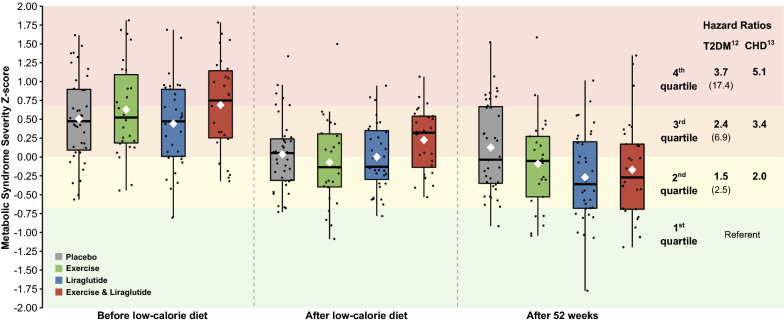
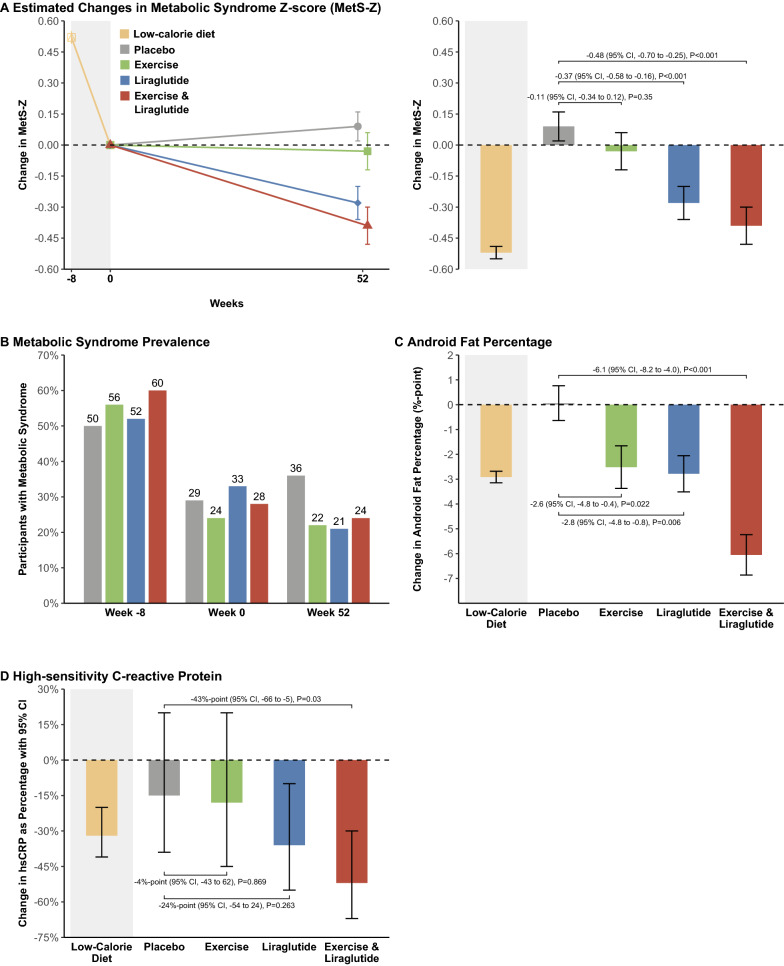
Background: Identifying and reducing cardiometabolic risks driven by obesity remains a healthcare challenge. The metabolic syndrome is associated with abdominal obesity and inflammation and is predictive of long-term risk of developing type 2 diabetes and cardiovascular disease in otherwise healthy individuals living with obesity. Therefore, we investigated the effects of adherent exercise, a glucagon-like peptide 1 receptor agonist (GLP-1 RA), or the combination on severity of metabolic syndrome, abdominal obesity, and inflammation following weight loss. Methods: This was a randomized, double-blinded, placebo-controlled trial. During an 8-week low-calorie diet (800 kcal/day), 195 adults with obesity and without diabetes lost 12% in body weight. Participants were then evenly randomized to four arms of one-year treatment with: placebo , moderate-to-vigorous exercise (minimum of 150 min/week of moderate-intensity or 75 min/week of vigorous-intensity aerobic physical activity or an equivalent combination of both), the GLP-1 RA liraglutide 3.0 mg/day, or a combination (exercise + liraglutide). A total of 166 participants completed the trial. We assessed the prespecified secondary outcome metabolic syndrome severity z-score (MetS-Z), abdominal obesity (estimated as android fat via dual-energy X-ray absorptiometry), and inflammation marker high-sensitivity C-reactive protein (hsCRP). Statistical analysis was performed on 130 participants adherent to the study interventions (per-protocol population) using a mixed linear model. Results: The diet-induced weight loss decreased the severity of MetS-Z from 0.57 to 0.06, which was maintained in the placebo and exercise groups after one year. MetS-Z was further decreased by liraglutide (− 0.37, 95% CI − 0.58 to − 0.16, P < 0.001) and the combination treatment (− 0.48, 95% CI − 0.70 to − 0.25, P < 0.001) compared to placebo. Abdominal fat percentage decreased by 2.6, 2.8, and 6.1 percentage points in the exercise, liraglutide, and combination groups compared to placebo, respectively, and hsCRP decreased only in the combination group compared with placebo (by 43%, P = 0.03). Conclusion: The combination of adherent exercise and liraglutide treatment reduced metabolic syndrome severity, abdominal obesity, and inflammation and may therefore reduce cardiometabolic risk more than the individual treatments. Trial registration EudraCT number: 2015-005585-32, ClinicalTrials.gov: NCT04122716
Overview
The claims and statistics of this paper haven’t been checked yet.
Free: it reads the open-access text and checks the first 5 claims that cite a source we can check. Create a free account to check every claim.
Integrity signals
Registry
Cites
Statistics
Figures
Verification
Claims the paper makes
The claims and statistics of this paper haven’t been checked yet.
Free: it reads the open-access text and checks the first 5 claims that cite a source we can check. Create a free account to check every claim.
Claims other papers make about this one
Each is checked against this paper’s own text: does it say what the citing paper says it does?
The source backs part of the claim, not all of it — or backs it for a different population, condition or comparison.
In the citing paper
“In that trial, GLP‐1 therapy plus exercise also produced larger reductions in abdominal fat and systematic inflammation than GLP‐1 therapy alone [171].”
From Nutritional priorities to support GLP ‐1 therapy for obesity: A joint Advisory from the American College of Lifestyle Medicine, the American Society for Nutrition, the Obesity Medicine Association, and The Obesity Society (2025) · cites this paper as [171]
Experimental — accuracy not yet measuredThe source backs part of the claim, not all of it — or backs it for a different population, condition or comparison.
In the citing paper
“Sandsdal et al. 90 revealed that structured exercise coupled with liraglutide treatment – which consists of consuming only 800 kcal/day over 8 weeks – effectively diminished metabolic syndrome severity, abdominal obesity prevalence, and inflammation levels one had priorly experienced.”
From Anti-inflammatory role of glucagon-like peptide 1 receptor agonists and its clinical implications (2024) · cites this paper as [90]
Experimental — accuracy not yet measuredThe source backs part of the claim, not all of it — or backs it for a different population, condition or comparison.
In the citing paper
“In that trial, GLP-1 therapy plus exercise also produced larger reductions in abdominal fat and systematic inflammation than GLP-1 therapy alone [171].”
From Nutritional priorities to support GLP-1 therapy for obesity: a joint Advisory from the American College of Lifestyle Medicine, the American Society for Nutrition, the Obesity Medicine Association, and The Obesity Society (2025) · cites this paper as [171]
Experimental — accuracy not yet measuredThe source backs part of the claim, not all of it — or backs it for a different population, condition or comparison.
In the citing paper
“Recent randomized controlled trials and meta-analyses suggest that combining GLP-1RAs with exercise may yield additive or synergistic effects on weight loss and metabolic syndrome severity as well as on oxidative stress and inflammation.”
From GLP-1 agonists and exercise: the future of lifestyle prioritization (2025) · cites this paper as [16]
Experimental — accuracy not yet measuredThe source backs part of the claim, not all of it — or backs it for a different population, condition or comparison.
In the citing paper
“Moreover, exercise may help maintain weight loss after cessation of pharmacotherapy (16, 17, 19, 21).”
From GLP-1 agonists and exercise: the future of lifestyle prioritization (2025) · cites this paper as [16]
Experimental — accuracy not yet measured
10 more claims about this paper
Create a free account to see every claim other papers make about this one.
Self-check
Percentages, sums and reported differences re-computed from the paper’s own numbers.
The self-check needs the paper’s full text.
Citations
Cites
Alberti, K. G. M. M., Eckel, R. H., Grundy, S. M., Zimmet, P. Z., Cleeman, J. I., Donato, K. A., Fruchart, J.-C., James, W. P. T., Loria, C. M., & Smith, S. C. (2009) · Circulation · doi:10.1161/circulationaha.109.192644 · Cited by 14,860
World Health Organization 2020 guidelines on physical activity and sedentary behaviour
Bull, F. C., Al-Ansari, S. S., Biddle, S., Borodulin, K., Buman, M. P., Cardon, G., Carty, C., Chaput, J.-P., Chastin, S., Chou, R., et al. (2020) · British Journal of Sports Medicine · doi:10.1136/bjsports-2020-102955 · Cited by 11,657 · cited 1×
“0 mg/day of liraglutide/placebo for at least 75% of the intervention period [25, 26].”
Background2013 AHA/ACC/TOS Guideline for the Management of Overweight and Obesity in Adults
Jensen, M. D., Ryan, D. H., Apovian, C. M., Ard, J. D., Comuzzie, A. G., Donato, K. A., Hu, F. B., Hubbard, V. S., Jakicic, J. M., Kushner, R. F., et al. (2014) · Journal of the American College of Cardiology · doi:10.1016/j.jacc.2013.11.004 · Cited by 4,058 · cited 1×
“Identifying and reducing cardiometabolic risks driven by obesity remains a major healthcare challenge [1].”
BackgroundThe Metabolic Syndrome and Cardiovascular Risk
Mottillo, S., Filion, K. B., Genest, J., Joseph, L., Pilote, L., Poirier, P., Rinfret, S., Schiffrin, E. L., & Eisenberg, M. J. (2010) · Journal of the American College of Cardiology · doi:10.1016/j.jacc.2010.05.034 · Cited by 3,009 · cited 1×
“Metabolic syndrome (MetS) is associated with an increased risk of cardiovascular disease, type 2 diabetes, and all-cause mortality [2, 3].”
BackgroundA Randomized, Controlled Trial of 3.0 mg of Liraglutide in Weight Management
Pi-Sunyer, X., Astrup, A., Fujioka, K., Greenway, F., Halpern, A., Krempf, M., Lau, D. C. W., le Roux, C. W., Violante Ortiz, R., Jensen, C. B., et al. (2015) · New England Journal of Medicine · doi:10.1056/nejmoa1411892 · Cited by 2,724
Mechanisms of Action and Therapeutic Application of Glucagon-like Peptide-1
Drucker, D. J. (2018) · Cell Metabolism · doi:10.1016/j.cmet.2018.03.001 · Cited by 2,170 · cited 1×
“GLP-1 RAs are also suggested to lower inflammation due to direct anti-inflammatory effects on various tissues and immune cells and partly because of the weight loss seen with GLP-1 RA treatment [22, 23].”
BackgroundMetabolic Syndrome as a Precursor of Cardiovascular Disease and Type 2 Diabetes Mellitus
Wilson, P. W. F., D’Agostino, R. B., Parise, H., Sullivan, L., & Meigs, J. B. (2005) · Circulation · doi:10.1161/circulationaha.105.539528 · Cited by 2,064 · cited 1×
“Metabolic syndrome (MetS) is associated with an increased risk of cardiovascular disease, type 2 diabetes, and all-cause mortality [2, 3].”
BackgroundVisceral and ectopic fat, atherosclerosis, and cardiometabolic disease: a position statement
Neeland, I. J., Ross, R., Després, J.-P., Matsuzawa, Y., Yamashita, S., Shai, I., Seidell, J., Magni, P., Santos, R. D., Arsenault, B., et al. (2019) · The Lancet Diabetes & Endocrinology · doi:10.1016/s2213-8587(19)30084-1 · Cited by 1,603 · cited 2×
“Abdominal obesity is associated with low-grade inflammation and has been proposed as a driver for metabolic syndrome [4].”
BackgroundMetabolic syndrome: definitions and controversies
Kassi, E., Pervanidou, P., Kaltsas, G., & Chrousos, G. (2011) · BMC Medicine · doi:10.1186/1741-7015-9-48 · Cited by 1,565
National health and nutrition examination survey: plan and operations, 1999-2010.
Zipf, G., Chiappa, M. M., Porter, K. S., Ostchega, Y., Lewis, B. G., & Dostal, J. (2013) · PubMed · Cited by 1,182
Cited by
Anti-inflammatory role of glucagon-like peptide 1 receptor agonists and its clinical implications
Alharbi, S. H. (2024) · Therapeutic Advances in Endocrinology and Metabolism · doi:10.1177/20420188231222367 · Cited by 358
“Sandsdal et al. 90 revealed that structured exercise coupled with liraglutide treatment – which consists of consuming only 800 kcal/day over 8 weeks – effectively diminished metabolic syndrome severity, abdominal obesity prevalence, and inflammation levels one had priorly experienced.”
BackgroundObesity and cardiovascular disease: An ESC clinical consensus statement
Koskinas, K. C., Van Craenenbroeck, E. M., Antoniades, C., Blüher, M., Gorter, T. M., Hanssen, H., Marx, N., McDonagh, T. A., Mingrone, G., Rosengren, A., et al. (2024) · European Heart Journal · doi:10.1093/eurheartj/ehae508 · Cited by 313
Self-citationInflammation and resolution in obesity
Soták, M., Clark, M., Suur, B. E., & Börgeson, E. (2025) · Nature Reviews Endocrinology · doi:10.1038/s41574-024-01047-y · Cited by 198
Karakasis, P., Patoulias, D., Fragakis, N., & Mantzoros, C. S. (2025) · Metabolism · doi:10.1016/j.metabol.2024.156113 · Cited by 242
Bajaj, M. S., McCoy, R. G., Balapattabi, K., Bannuru, R. R., Bellini, N. J., Bennett, A. K., Beverly, E. A., Early, K. B., ChallaSivaKanaka, S., Echouffo-Tcheugui, J. B., et al. (2025) · Diabetes Care · doi:10.2337/dc26-s005 · Cited by 282
Jensen, S. B. K., Blond, M. B., Sandsdal, R. M., Olsen, L. M., Juhl, C. R., Lundgren, J. R., Janus, C., Stallknecht, B. M., Holst, J. J., Madsbad, S., et al. (2024) · eClinicalMedicine · doi:10.1016/j.eclinm.2024.102475 · Cited by 207
Self-citationNew insights into the treatment of obesity
Blüher, M., Aras, M., Aronne, L. J., Batterham, R. L., Giorgino, F., Ji, L., Pietiläinen, K. H., Schnell, O., Tonchevska, E., & Wilding, J. P. H. (2023) · Diabetes, Obesity and Metabolism · doi:10.1111/dom.15077 · Cited by 158
Mozaffarian, D., Agarwal, M., Aggarwal, M., Alexander, L., Apovian, C. M., Bindlish, S., Bonnet, J., Butsch, W. S., Christensen, S., Gianos, E., et al. (2025) · The American Journal of Clinical Nutrition · doi:10.1016/j.ajcnut.2025.04.023 · Cited by 154
“In these situations, it is beneficial to discuss with individuals whether this is related to disordered thoughts about “ food as love, ” affective changes induced by the medication, or a loss of interest in a food-related hobby such as cooking [148].”
Strategies for minimizing muscle loss during use of incretin‐mimetic drugs for treatment of obesity
Mechanick, J. I., Butsch, W. S., Christensen, S. M., Hamdy, O., Li, Z., Prado, C. M., & Heymsfield, S. B. (2025) · Obesity Reviews · doi:10.1111/obr.13841 · Cited by 149
Mozaffarian, D., Agarwal, M., Aggarwal, M., Alexander, L., Apovian, C. M., Bindlish, S., Bonnet, J., Butsch, W. S., Christensen, S., Gianos, E., et al. (2025) · Obesity · doi:10.1002/oby.24336 · Cited by 143
“In that trial, GLP-1 therapy plus exercise also produced larger reductions in abdominal fat and systematic inflammation than GLP-1 therapy alone [171].”
Obesity and cardiovascular disease: an ESC clinical consensus statement
Koskinas, K. C., Craenenbroeck, E. M. V., Antoniades, C. A., Blüher, M., Gorter, T. M., Hanssen, H., Marx, N., McDonagh, T. A., Mingrone, G., Rosengren, A., et al. (2024) · European Journal of Preventive Cardiology · doi:10.1093/eurjpc/zwae279 · Cited by 149
Self-citationGlucagon-Like Peptide-1: New Regulator in Lipid Metabolism
Bu, T., Sun, Z., Pan, Y., Deng, X., & Yuan, G. (2024) · Diabetes & Metabolism Journal · doi:10.4093/dmj.2023.0277 · Cited by 131
“The combination of adherent exercise and Lira treatment reduced abdominal obesity and may therefore reduce obesity risk more than the individual treatments [101].”
BackgroundLuna-Marco, C., Iannantuoni, F., Hermo-Argibay, A., Devos, D., Salazar, J. D., Víctor, V. M., & Rovira-Llopis, S. (2024) · Free Radical Biology and Medicine · doi:10.1016/j.freeradbiomed.2024.01.015 · Cited by 114
Metabolic Syndrome: An Updated Review on Diagnosis and Treatment for Primary Care Clinicians
Peterseim, C., Jabbour, K., & Mulki, A. K. (2024) · Journal of Primary Care & Community Health · doi:10.1177/21501319241309168 · Cited by 95
“15,19,21,47 Taking liraglutide for 13 months also has been shown to be associated with lower risk of incident diabetes.”
Body Fat Distribution, Diabetes Mellitus, and Cardiovascular Disease: an Update
Kang, P., & Neeland, I. J. (2023) · Current Cardiology Reports · doi:10.1007/s11886-023-01969-5 · Cited by 70
Domingo, E., Marqués, P., Francisco, V., Piqueras, L., & Sanz, M. (2024) · Pharmacological Research · doi:10.1016/j.phrs.2024.107058 · Cited by 74
Rivera, F. B., Lumbang, G. N. O., Gaid, D. R. M., Cruz, L. L. A., Magalong, J. V., Bantayan, N. R. B., Lara‐Breitinger, K. M., Gulati, M., & Bakris, G. (2024) · Diabetes, Obesity and Metabolism · doi:10.1111/dom.15529 · Cited by 57
“…– 59,62,63,67,69 – 71,75,78 were done exclusively among patients with DM. 23, 25 – 36 ,38, 40 – 22 RCTs 15 – 20,23,25 – 28,34,37,41,45,48,51,54,55,64,66,73 used seated BP, Gullaksen et al. 71 used supine BP, Wadden et al. 65 used standing BP, Dushay et al. 72 did not mention the posture of the…”
Müllertz, A. L. O., Sandsdal, R. M., Jensen, S. B. K., & Torekov, S. S. (2024) · Obesity Reviews · doi:10.1111/obr.13717 · Cited by 46
Self-citationCooper, D. M., Rothstein, M. A., Amin, A., Hirsch, J. D., & Cooper, E. (2023) · Journal of Clinical and Translational Science · doi:10.1017/cts.2023.612 · Cited by 50
“We must also consider that pediatric dosage forms may be more expensive than adult formulations [23], there is a potential for lifelong reliance on these medications if started in childhood, and GLP-1RA may require lifestyle interventions [24] to optimize safety, efficacy, and value during growth and development.”
The Role of Inflammatory Mediators in the Pathogenesis of Obesity
Bakinowska, E., Krompiewski, M., Boboryko, D., Kiełbowski, K., & Pawlik, A. (2024) · Nutrients · doi:10.3390/nu16172822 · Cited by 51
“Despite their effect on weight loss, these agents have also demonstrated anti-inflammatory capabilities [166–168].”
BackgroundImpact of Visceral and Hepatic Fat on Cardiometabolic Health
Khawaja, T., Nied, M., Wilgor, A., & Neeland, I. J. (2024) · Current Cardiology Reports · doi:10.1007/s11886-024-02127-1 · Cited by 49
“Furthermore, the combination of liraglutide and adherent exercise has been shown to reduce metabolic syndrome severity, abdominal obesity, and the proinflammatory state associated with metabolic syndrome in this population [70–72].”
BackgroundSievenpiper, J. L., Ard, J. D., Blüher, M., Chen, W., Dixon, J. B., Fitch, A., Gigliotti, L., Khunti, K., Lecube, A., Lean, M., et al. (2025) · Obesity Pillars · doi:10.1016/j.obpill.2025.100228 · Cited by 58
“RCTs such as SURMOUNT-3 have demonstrated beneficial synergistic anti-inflammatory, cardioprotective and weight loss effects of combining GBT therapy with physical activity [85 – 87].”
Glucagon-Like Peptide-1 Receptor Agonists for Chronic Weight Management
Wojtara, M., Mazumder, A., Syeda, Y., & Mozgała, N. (2023) · Advances in Medicine · doi:10.1155/2023/9946924 · Cited by 36
Targeting the Gut Microbiota for Prevention and Management of Type 2 Diabetes
Zeppa, S. D., Gervasi, M., Bartolacci, A., Ferrini, F., Patti, A., Sestili, P., Stocchi, V., & Agostini, D. (2024) · Nutrients · doi:10.3390/nu16223951 · Cited by 35
“These exercises collectively contribute to better glycemic control, weight management, and overall metabolic health in individuals with T2D [182].”
Desjardins, E. M., Wu, J., Lavoie, D. C. T., Ahmadi, E., Townsend, L. K., Morrow, M. R., Wang, D., Tsakiridis, E. E., Batchuluun, B., Fayyazi, R., et al. (2023) · Cell Reports Medicine · doi:10.1016/j.xcrm.2023.101193 · Cited by 33
“This is supported by clinical studies illustrating that exercise and Lira lead to greater weight loss, visceral adiposity, and inflammation compared with either therapy alone.(13,14) There are several other rationales for the use of combination therapies to treat NASH, as combining two or more drugs could increase res…”
Mozaffarian, D., Agarwal, M., Aggarwal, M., Alexander, L., Apovian, C. M., Bindlish, S., Bonnet, J. P., Butsch, W. S., Christensen, S. M., Gianos, E., et al. (2025) · Obesity Pillars · doi:10.1016/j.obpill.2026.100269 · Cited by 41
Chen, H., Liu, S., Gao, S. H., Shi, H., Yan, Y., Xu, Y., Fang, J., Wang, W., Chen, H., & Liu, Z. (2025) · Scientific Reports · doi:10.1038/s41598-025-01206-9 · Cited by 39
“The global diabetes epidemic, affecting approximately 828 million adults in 2022 32 , has driven widespread adoption of GLP-1 RAs due to their dual glycemic and weight management benefits 33–35 .”
Mozaffarian, D., Agarwal, M., Aggarwal, M., Alexander, L., Apovian, C. M., Bindlish, S., Bonnet, J., Butsch, W. S., Christensen, S., Gianos, E., et al. (2025) · Obesity Pillars · doi:10.1016/j.obpill.2025.100181 · Cited by 28
Sun, Y., Lin, X., Zou, Z., Zhou, Y., Liu, A., Li, X., Du, Y., Ji, X., Li, Z., Wu, X.-L., et al. (2025) · Lipids in Health and Disease · doi:10.1186/s12944-025-02482-0 · Cited by 27
Lu, J., Zou, S., Liu, X., Wong, T. Y. P., Zhang, X., Xu, K., Zhao, Y., Hong, Y., Cen, A., & Wang, Y. (2025) · European Journal of Pharmacology · doi:10.1016/j.ejphar.2025.177885 · Cited by 28
Gong, H., Duan, S., & Huang, S. (2025) · Frontiers in Nutrition · doi:10.3389/fnut.2024.1508062 · Cited by 27
Quagliariello, V., Canale, M. L., Bisceglia, I., Iovine, M., Giordano, V., Giacobbe, I., Scherillo, M., Gabrielli, D., Maurea, C., Barbato, M., et al. (2024) · International Journal of Molecular Sciences · doi:10.3390/ijms252011299 · Cited by 23
“Moreover, this trial suggested that liraglutide could be useful in patients with heart failure and HFpEF [72–75].”
Choudhury, A., Boxtel, M. V., & Hanley, J. (2024) · Seminars in Arthroplasty JSES · doi:10.1053/j.sart.2024.10.001 · Cited by 21
Lifestyle Intervention for Sustained Remission of Metabolic Syndrome: A Randomized Clinical Trial
Powell, L. H., Berkley‐Patton, J., Drees, B. M., Karavolos, K., Lohse, B., Masters, K. S., Nicklas, J. M., Rothschild, S. K., Yeh, C., Zimmermann, L. J., et al. (2025) · JAMA Internal Medicine · doi:10.1001/jamainternmed.2025.5900 · Cited by 26
Obesity and Exercise: New Insights and Perspectives
James, N. M., & Stanford, K. I. (2025) · Endocrine Reviews · doi:10.1210/endrev/bnaf017 · Cited by 20
Gil‐Redondo, R., Conde, R., Bruzzone, C., Seco, M. L., Bizkarguenaga, M., González‐Valle, B., de Diego, Á., Laín, A., Habisch, H., Haudum, C. W., et al. (2024) · Cardiovascular Diabetology · doi:10.1186/s12933-024-02363-3 · Cited by 21
“…proposed here in the MetSCORE adds granularity to MetS progression and it may be helpful for managing MetS, which usually involves improving diet [33], increasing physical activity [34, 35], or taking medications to control specific risk factors like blood pressure or blood sugar or lipid levels.”
BackgroundOptimizing GLP-1 therapies for obesity and diabetes management
Noronha, J. C., Gaal, L. F. V., Neeland, I. J., Fitch, A., Pfeiffer, A. F. H., Chiavaroli, L., Kendall, C. W. C., & Sievenpiper, J. L. (2025) · Obesity Pillars · doi:10.1016/j.obpill.2025.100222 · Cited by 21
“Beyond weight loss, the S-LiTE trial also evaluated body fat distribution and inflammatory markers [14].”
The combined impact of BMI and ABSI on all-cause mortality among American adults with diabetes
Wei, S., Jiang, W., Zheng, H., Zhang, J., Yang, J., Wang, Y., Liu, Y., Sun, L., Li, X., Wei, J., et al. (2025) · Diabetology & Metabolic Syndrome · doi:10.1186/s13098-025-01614-x · Cited by 20
“Visceral fat, a metabolically active tissue, secretes pro-inflammatory cytokines such as interleukin-6 and tumor necrosis factor-alpha, driving systemic inflammation [34].”
Sawicka‐Gutaj, N., Gruszczyński, D., Nijakowski, K., Derwich-Rudowicz, A., Krenz, M., Kumar, A. A., Lu, P.-Y., & Ruchała, M. (2026) · International Journal of Obesity · doi:10.1038/s41366-026-02088-1 · Cited by 24
Rivera, F. B., Chin, M. N. C., Pine, P. L. S., Ruyeras, M. M. J., Galang, D. J. C., Gandionco, K. M., Morales, B. L. F. D., Climaco, Z. M. V., Bantayan, N. R. B., Magalong, J. V., et al. (2024) · Current Medical Research and Opinion · doi:10.1080/03007995.2024.2442027 · Cited by 20
Zheng, W., Qi, Q., Li, J., He, C., & Fan, H. (2025) · Diabetology & Metabolic Syndrome · doi:10.1186/s13098-025-01917-z · Cited by 19
GLP-1 agonists and exercise: the future of lifestyle prioritization
Codella, R., Senesi, P., & Luzi, L. (2025) · Frontiers in Clinical Diabetes and Healthcare · doi:10.3389/fcdhc.2025.1720794 · Cited by 16
Beyond Weight Loss: Optimizing GLP-1 Receptor Agonist Use in Children
Zaitoon, H., Wauters, A. D., Rodríguez, L. M., & Lynch, J. L. (2025) · Children · doi:10.3390/children12111427 · Cited by 17
“Effective use is likely to require concurrent lifestyle modification [83], yet most current interventions fail to measure diet and activity rigorously or move beyond the flawed reliance on BMI as a marker of adiposity [84].”
Omega-3 supplementation: Impact on low chronic inflammation associated with obesity
López-Millán, E., Gutierrez-Uribe, J. A., & Antunes‐Ricardo, M. (2024) · Trends in Food Science & Technology · doi:10.1016/j.tifs.2024.104799 · Cited by 14
Swift, D. L., Ross, L. M., Laddu, D. R., Conroy, M. B., German, C. A., Evangelista, L. S., Marvel, F. A., Jerome, G. J., on behalf the American Heart Association Council on Lifestyle and Cardiometabolic Health, Council on Cardiovascular and Stroke Nursing, et al. (2026) · Circulation · doi:10.1161/cir.0000000000001441 · Cited by 13
Agrò, E. F., Rosato, E., Wagg, A., Sinha, S., Spicchiale, C. F., Serati, M., Mancini, V., de Rijk, M. M., Tarcan, T., Wein, A. J., et al. (2024) · Neurourology and Urodynamics · doi:10.1002/nau.25377 · Cited by 13
“46 – 49 Treatment for OAB in individuals with MetS has been assessed; in women with MetS compared to those without, the efficacy of treatment of OAB with mirabegron 50 mg was compared before and 12 weeks after starting treatment.”
MethodWang, T., Yang, Q., Cheng, X.-Y., Ding, J.-C., & Hu, P.-F. (2024) · Heart Failure Reviews · doi:10.1007/s10741-024-10438-2 · Cited by 14
Holt, R., Holt, J., Jorsal, M. J., Sandsdal, R. M., Jensen, S. B. K., Byberg, S., Juhl, C. R., Lundgren, J. R., Janus, C., Stallknecht, B. M., et al. (2024) · The Journal of Clinical Endocrinology & Metabolism · doi:10.1210/clinem/dgae775 · Cited by 13
Self-citationInbaraj, G., Bajaj, S., Misra, P., Kandimalla, N., Thapa, A., Ghosal, A., Sharma, U., charles, P., Pobbati, H., Hashmi, I., et al. (2025) · Current Problems in Cardiology · doi:10.1016/j.cpcardiol.2025.103036 · Cited by 13
Zhang, Z., Li, C., Xiao, Y., Liu, C., Luo, X.-Q., Wang, C., Dai, Y., Lin, Q., Zhang, Z., Zheng, C., et al. (2025) · Annals of Medicine · doi:10.1080/07853890.2025.2536204 · Cited by 17
“Similarly, SGLT2is and GLP-1R agonists show anti-inflammatory effects by improving metabolic control and reducing pro-inflammatory cytokines, thus lowering the risk of cardiovascular events in diabetic patients [52–54].”
GLP ‐1 receptor agonists and cardiovascular events in metabolically healthy or unhealthy obesity
Bucci, T., Alam, U., Fauchier, G., Lochon, L., Bisson, A., Ducluzeau, P., Lip, G. Y. H., & Fauchier, L. (2025) · Diabetes Obesity and Metabolism · doi:10.1111/dom.16238 · Cited by 11
“3 A previous randomized trial of exercise and GLP-1RA demonstrated improved metabolic syndrome severity, abdominal obesity and inflammation, 18 which are the key risk factors for adverse cardiovascular and mortality outcomes.”
Minnetti, M., Barazzoni, R., Batsis, J. A., Busetto, L., Yumuk, V., Poggiogalle, E., Weijs, P. J. M., & Donini, L. M. (2025) · Obesity Facts · doi:10.1159/000548370 · Cited by 15
“Since IMs, like other obesity treatments, do not normalize body mass index in all patients, the combination with individualized D-PE-I may represent an effective strategy to synergistically improve the final results [72, 73].”
InfluentialPolymeri, A., Feres, M., Giannobile, W. V., & Loos, B. G. (2026) · Journal of Periodontology · doi:10.1002/jper.70092 · Cited by 15
de Paulo, R. S., Bonifácio, D. B., de Carvalho, M. H. L., & Bressan, J. (2026) · Diabetes Obesity and Metabolism · doi:10.1111/dom.70779 · Cited by 13
(2026) · doi:10.1007/s13668-026-00777-x · Cited by 10
“The protective effect of combining GLP-1 RA therapy with exercise has been previously reported, with Sandsdal et al. (2023) revealing reductions in abdominal obesity and inflammation, although muscle mass was not assessed [ 112].”
Body mass index is a barrier to obesity treatment
Chin, G. C., Potter, A. W., & Friedl, K. E. (2024) · Frontiers in Endocrinology · doi:10.3389/fendo.2024.1444568 · Cited by 13
Mateos, I. C., Morales, C., & Aguilera, B. G. (2025) · Journal of Clinical Medicine · doi:10.3390/jcm14155434 · Cited by 13
“Additionally, no information regarding lifestyle interventions was systematically recorded, despite the synergistic effect of dietary changes, increased physical activity, and other lifestyle modifications with GLP-1 RA on body composition, which is well established [54].”
Jamal, N. H., Hollabaugh, W. L., Scott, L., & Takkouche, S. K. (2024) · Clinical Obesity · doi:10.1111/cob.12700 · Cited by 11
The Significant Role of Physical Activity and Exercise in Health and Metabolic Diseases
Dimitriadis, G., Chryssanthopοulos, C., Philippou, Α., & Koutsilieris, M. (2025) · Physiologia · doi:10.3390/physiologia5040057 · Cited by 12
“In a randomized controlled trial, Sandsdal et al. [175] examined the effects of exercise (at least 150 min per week of moderate-intensity or 75 min per week of vigorous-intensity aerobic exercise), liraglutide (3 mg/day), and their combination in obese individuals (BMI 32–43 kg/m 2 ) over one year…”
Efficacy of liraglutide in pediatric obesity: A review of clinical trial data
Agosta, M., Sofia, M., Pezzino, S., D’Amato, S., Litrico, G., Mazzone, C., Greca, G. L., & Latteri, S. (2024) · Obesity Medicine · doi:10.1016/j.obmed.2024.100545 · Cited by 11
Mulcahy, J., DeLaRosby, A., & Norwood, T. (2025) · Physical Therapy · doi:10.1093/ptj/pzaf061 · Cited by 8
“47 Education about the importance of adopting a sustainable, enjoy-able, long term exercise routine for health maintenance is an integral component of a comprehensive physical therapy plan.”
Metabolic syndrome–associated kidney disease in young adolescents and children
Raina, R., Hu, J., Chan, E. Y.-H., Hinton, J., & Mitsnefes, M. M. (2025) · Kidney International · doi:10.1016/j.kint.2025.04.036 · Cited by 9
Zhang, F., Zhao, J., Zhang, Y., Tian, Z., Li, J., Lü, Q., Wang, W., Hong, T., Shan, Z., Yan, L., et al. (2026) · Journal of sport and health science/Journal of Sport and Health Science · doi:10.1016/j.jshs.2026.101124 · Cited by 10
“An RCT by Sandsdal et al. 205 (A) revealed that weight loss achieved through dietary adjustments (approximately 12% reduction from baseline) significantly improved the severity of metabolic syndrome, although this effect was difficult to maintain.”
Jobanputra, R., Sargeant, J. A., Plekhanova, T., James, E., Almaqhawi, A., Webb, D. R., Davies, M. J., & Yates, T. E. (2026) · Diabetes/Metabolism Research and Reviews · doi:10.1002/dmrr.70194 · Cited by 11
Wang, Y., Chen, X., Zhang, C., & Gao, S. (2025) · Advanced Exercise and Health Science · doi:10.1016/j.aehs.2025.02.002 · Cited by 8
Donate, F. I., Sánchez-Oliver, A. J., Benito, P. J., Elvar, J. R. H., Carmona, W. S., & Butragueño, J. (2023) · Retos · doi:10.47197/retos.v50.99282 · Cited by 11
Wen, J., How-Volkman, C., Truong, A., Nadora, D., Bernstein, E. M., Akhtar, M., Puglisi, J. L., & Frezza, E. E. (2024) · Cureus · doi:10.7759/cureus.75304 · Cited by 12
“More recently, it was found that combined liraglutide and exercise also reduced inflammation, cardiometabolic risk, and metabolic syndrome [32,33].”
The relationship between excess sodium intake and metabolic syndrome: Worth consideration?
Afşar, B., Afşar, R. E., Said, M., Maddukuri, G. S., & Lentine, K. L. (2025) · European Journal of Clinical Investigation · doi:10.1111/eci.70036 · Cited by 8
“111 Indeed, GLP-1RAs have favourable actions on all components of MetS including glucose, BP, body weight, TG and HDL-C.”
Zakaria, H., Jabri, H., Alshehhi, S., Caccelli, M., Debs, J., Said, Y., Kattan, J., Almarzooqi, N., HASHEMI, A., & Almarzooqi, I. (2025) · Interactive Journal of Medical Research · doi:10.2196/63079 · Cited by 7
“GLP-1 and GIP agonist use has been shown to reduce MetS severity, abdominal obesity, and inflammation [20].”
Obesity and Schizophrenia: Results of a Feasibility Study with Semaglutide to Assist Weight Loss
Heald, A. H., Reynolds, G. P., Nash, I., Boyle, O., Daly, C., Longson, D., O'Shea, D. B., Ingram, J., Holt, R. I. G., Firth, J., et al. (2025) · Advances in Therapy · doi:10.1007/s12325-025-03261-0 · Cited by 9
“Glucagon-like peptide-1 (GLP-1) receptor agonists and other incretin-based therapies or intensive weight reduction programmes have been shown to lower body weight, improve cardiovascular outcomes and lower blood glucose levels [11].”
Werndle, V. V., Stefanovic, J., & Reljic, D. (2026) · Nutrients · doi:10.3390/nu18030473 · Cited by 10
Li, Y., Ma, X., Jia, J., & Cao, L.-Y. (2025) · Clinics and Research in Hepatology and Gastroenterology · doi:10.1016/j.clinre.2025.102573 · Cited by 7
Liraglutide for adults living with obesity
Meza, N., Bracchiglione, J., Liquitay, C. M. E., Madrid, E., Varela, L. B., Guo, Y., Urrútia, G., er, S. F. S., Tiller, S., Shokraee, K., et al. (2025) · Cochrane Database of Systematic Reviews · doi:10.1002/14651858.cd016017 · Cited by 16
Bang, H. S. (2023) · Journal of Clinical Medicine · doi:10.3390/jcm12093135 · Cited by 6
“GLP-1 is a hormone secreted by the intestine in response to food intake and plays a crucial role in regulating blood glucose metabolism [32,33].”
BackgroundMotivational Interviewing for the Prevention and Treatment of Pediatric Obesity
Woolford, S. J., Villegas, J., & Resnicow, K. (2024) · Pediatric Clinics of North America · doi:10.1016/j.pcl.2024.06.006 · Cited by 6
Neto, W. D. P. P., de Lucena, T. M. C., da Paixão, G. A., Shinohara, N. K. S., Pinheiro, A. C., Vicente, A. A., de Souza, R. B., & de Morais, M. A. (2025) · International Journal of Gastronomy and Food Science · doi:10.1016/j.ijgfs.2025.101183 · Cited by 8
Dong, L., Wen, F., Qin, L.-M., Zhi, X.-Y., Li, R., Liang, Y., Song, W., Xia, Q., Wu, J., Qiu, L., et al. (2025) · Journal of Clinical Anesthesia · doi:10.1016/j.jclinane.2025.112099 · Cited by 6
Liu, B., Zhang, M., Gao, L., & Yang, H. (2026) · Frontiers in Medicine · doi:10.3389/fmed.2025.1754693 · Cited by 6
Mohseni, Y., Vazirnia, A., Minokadeh, A., AMRON, D. M., & Coleman, W. P. (2026) · Dermatologic Surgery · doi:10.1097/dss.0000000000005172 · Cited by 7
Efectos cardiometabólicos de la pérdida de peso
Genua, I., Sardà, H., & Pérez, A. (2024) · Atención Primaria · doi:10.1016/j.aprim.2024.102953 · Cited by 6
Wang, J.-K., Zhang, D., Wang, J.-F., Lu, W., Wang, J., Liang, S.-F., Liu, R., Jiang, J., Li, H., & Yang, X. (2025) · World Journal of Diabetes · doi:10.4239/wjd.v16.i1.99526 · Cited by 6
López-González, Á., Rifá, E. M.-A., Oliveira, H. P., Sánchez, C. M., López, P. T., & Ramírez-Manent, J. I. (2025) · Semergen · doi:10.1016/j.semerg.2025.102455 · Cited by 3
Time-restricted eating and its metabolic benefits in obesity and insulin resistance
Sarayreh, N. A., Al-Domi, H. A., & Jawamis, A. (2025) · Clinical Nutrition ESPEN · doi:10.1016/j.clnesp.2025.08.033 · Cited by 5
Jodoin, Z. N., Young, W. H., Sheikh, D., Peña, B., Moore, C. C., & Buttacavoli, F. A. (2025) · Arthroplasty Today · doi:10.1016/j.artd.2025.101865 · Cited by 5
“Many studies, including randomized clinical control trials, have shown both larger and more sustained weight loss with the use of GLP-1 inhibitors [7-9].”
Pardali, E. C., Gkouskou, K. K., Cholevas, C., Poulimeneas, D., Tsiroukidou, K., Goulis, D. G., & Grammatikopoulou, M. G. (2026) · Nutrients · doi:10.3390/nu18060962 · Cited by 6
“To reduce the risk of osteoporosis, Calcium and vitamin D supplementation, along with weight-bearing exercise, is recommended [145,157,158].”
NLRP3 inflammasome as a central target for the pleiotropic effects of GLP-1 receptor agonists
Mahmoudi, A. A., Saeedi‐Boroujeni, A., Vadizadeh, A., Kesharwani, P., & Sahebkar, A. (2026) · International Immunopharmacology · doi:10.1016/j.intimp.2026.117063 · Cited by 4
Wang, X., Yang, R., Li, J., Liang, Y., Jin, C., Xu, Y., Wu, X., & Zou, M. (2025) · Acta Diabetologica · doi:10.1007/s00592-025-02596-y · Cited by 4
Braddock, A. S., Bosworth, K. T., Ghosh, P., Proffitt, R. M., Flowers, L., Montgomery, E., Wilson, G., Tosh, A. K., & Koopman, R. J. (2024) · Applied Clinical Informatics · doi:10.1055/a-2283-9036 · Cited by 4
“11,12 Health data either logged by patients in mHealth apps or tracked through wearable smart devices, such as Smart Watches, can be aggregated and integrated into the EHR.”
BackgroundUnderstanding the Benefit of Combining GLP-1 Agonists With Exercise: Time Will Tell
Malin, S. K. (2023) · The Journal of Clinical Endocrinology & Metabolism · doi:10.1210/clinem/dgad426 · Cited by 5
Heald, A. H., Stedman, M., Warner-Levy, J. J., Whyte, M., Rutter, M. K., & Gibson, M. (2024) · Cardiovascular Endocrinology & Metabolism · doi:10.1097/xce.0000000000000310 · Cited by 3
“Glucagon-like peptide-1 (GLP-1) receptor agonists and associated incretin therapies have been shown to lower body weight, improve cardiovascular outcomes, and lower blood glucose levels [5].”
BackgroundMoseley, G. A., Collins, K. A., Kraus, W. E., & Ross, L. M. (2025) · Sports Medicine and Health Science · doi:10.1016/j.smhs.2025.03.006 · Cited by 3
Péč, M. J., Jurica, J., Péčová, M., Nagy, N., Focko, B., Miertová, Z., Ferencová, N., Ságová, I., Tonhajzerová, I., Bolek, T., et al. (2025) · Pharmaceuticals · doi:10.3390/ph18091364 · Cited by 4
“These data are in contrast with previous studies, which showed the anti-inflammatory effect of GLP-1 RA [36].”
Yu, W., Liu, Y., Le, S., Xiao, Y., Chen, X., Wang, J., & Gao, F. (2025) · Journal of Diabetes Investigation · doi:10.1111/jdi.70174 · Cited by 4
“…that the concurrent application of GLP-1RA and exercise can synergistically enhance b -cell secretion function, markedly diminish the severity of metabolic syndrome, reduce abdominal fat percentage and in fl ammatory markers, and more effectively regulate blood glucose and body weight 9 – 11 .”
DeBoer, M. D., Gurka, M. J., Jones, M., & Smolkin, M. E. (2025) · Metabolism Open · doi:10.1016/j.metop.2025.100415 · Cited by 3
“…components [4,5], 2) increasing scores over time were associated with heightened risk [4,5], 3) treatment with GLP-1 agonists reduced MetS-severity [6] and 4) the scores meaningfully tracked CVD and T2D risk-reduction during treatment of prediabetes [7] — suggesting potential to follow levels…”
Lin, Y., Wen, D., Sun, Q.-Y., Lv, S.-Z., Ji-Ying, W. A. N. G., & Ma, X. (2026) · Life Sciences · doi:10.1016/j.lfs.2026.124237 · Cited by 3
Domagała, S., Wiater, Z. E., Włodarczyk, A., Brankowska, K., Jakubowska, M., Olejnik, M., Tymińska, P., Górka, P. A., Frączek, J., & Kądziołka, W. J. (2026) · Quality in Sport · doi:10.12775/qs.2026.53.69771 · Cited by 3
Pharmacologic Treatment of Obesity in the Context of Type 2 Diabetes
Conte, C., & Amaro, A. (2026) · Current Diabetes Reports · doi:10.1007/s11892-026-01626-5 · Cited by 3
Liu, L., Fan, H., Ren, Z. P., Luo, R., Ma, H., Ren, H., & Li, X. (2026) · Journal of the American Heart Association · doi:10.1161/jaha.125.044744 · Cited by 3
Teng, Y., Bian, W., Li, Q., Eyk, J. E. V., Yan, X., & Zhang, S. Y. (2026) · Journal of Translational Internal Medicine · doi:10.1515/jtim-2026-0043 · Cited by 4
Sandsdal, R. M., Holt, J., Alkhefagie, H. G. A., Jørgensen, J. R., Juhl, C. R., Olsen, L. M., Byberg, S., Thirumathyam, R., Gliemann, L., Stallknecht, B. M., et al. (2026) · Nature Metabolism · doi:10.1038/s42255-026-01554-4 · Cited by 3
“Both exercise and glucagon-like peptide-1 receptor agonists (GLP-1 RAs) individually seem to promote cardiovascular health 7–10 .”
Self-citation
Metadata
- Authors
- Sandsdal, R. M., Juhl, C. R., Jensen, S. B. K., Lundgren, J. R., Janus, C., Blond, M. B., Rosenkilde, M., Bogh, A. F., Gliemann, L., Jensen, J.-E. B., Antoniades, C., Stallknecht, B. M., Holst, J. J., Madsbad, S., & Torekov, S. S.
- Affiliations
- University of Copenhagen (DK)
- Steno Diabetes Center Copenhagen (DK)
- University of Oxford (GB)
- Hvidovre Hospital (DK)
- Corresponding author
- Torekov, Signe S.
- ORCID
- Venue
- Cardiovascular Diabetology
- Published
- 2023-02-25
- Volume
- 22
- Issue
- 1
- Pages
- 41-41
- ISSN
- 1475-2840 (ISSN-L)
- PMC
- PMC9960425
- OpenAlex
- W4321850189
- Semantic Scholar
- bd9a7e28a09adc4efa5540627cb3f10dea088317
- Cited by
- 195
- References
- 34
- Citations by year
- 2026: 67 · 2025: 66 · 2024: 48 · 2023: 13
- FWCI
- 39.80
- Type
- journal article
- Language
- en
- Open access
- gold
- doi.org
- Licence
- cc-by
- creativecommons.org/licenses/by/4.0 (tdm)
- creativecommons.org/licenses/by/4.0 (vor)
- Locations
- Cardiovascular Diabetology (publishedVersion, cc-by)
- PubMed Central (publishedVersion, cc-by)
- PubMed (publishedVersion)
- Research at the University of Copenhagen (University of Copenhagen) (publishedVersion, cc-by)
- DOAJ (DOAJ: Directory of Open Access Journals) (submittedVersion, cc-by-sa)
- Funders
- Novo Nordisk Fonden (NNF15SA0018346)
- Helsefonden
- Novo Nordisk
- Topics
- Health Sciences › Medicine › Endocrinology, Diabetes and Metabolism › Diabetes Treatment and Management
- Health Sciences › Medicine › Endocrinology, Diabetes and Metabolism › Diabetes, Cardiovascular Risks, and Lipoproteins
- Health Sciences › Medicine › Endocrinology, Diabetes and Metabolism › Adipokines, Inflammation, and Metabolic Diseases
- Keywords
- metabolic syndrome, abdominal obesity, inflammation, liraglutide, GLP-1 receptor agonists, physical activity, weight loss, obesity, hypocaloric diet, C-reactive protein, type 2 diabetes prevention, cardiovascular risk, combination therapy, android fat, aerobic physical activity, weight regain after weight loss, insulin resistance, adipokines
- MeSH terms
- Glucagon-Like Peptide-1 Receptor, Liraglutide, Glucagon-Like Peptide-1 Receptor Agonists, Adult, C-Reactive Protein, Diabetes Mellitus, Type 2, Double-Blind Method, Humans, Inflammation, Obesity, Weight Loss, Exercise, Metabolic Syndrome, Obesity, Abdominal
About these checks
Registry, retraction, Cites and statistics results are computed, not judged, with one exception: a printed reference that no index lists is read once by a model before it counts as a citation error. Claims are extracted by a model and kept only when their quote appears verbatim in the text; each cited source is then checked, with a model’s help, for whether it says what the claim relies on. Those verdicts can be wrong — read the claim’s quote and the cited source before relying on one.
Statistics and arithmetic are recomputed, not judged.
Confidence bands are shown only for fields calibrated on our annotated test set. None is calibrated yet, so no band is shown.
What counts as a claim ›How we measure confidence ›How we check this ›
Are you an author, or do you see a problem with this page? Request a review
Data sources
Bibliographic data: Semantic Scholar, OpenAlex, Crossref.
Contains information from the Semantic Scholar Academic Graph Datasets, made available under the ODC Attribution License (ODC-BY 1.0).
Semantic Scholar’s data is described in: Kinney, R., et al. (2023). The Semantic Scholar Open Data Platform. arXiv:2301.10140.
