

Combination of exercise and GLP-1 receptor agonist treatment reduces severity of metabolic syndrome, abdominal obesity, and inflammation: a randomized controlled trial
Open accessThe DOI matches its Crossref record; 34 of the 34 references it cites were found in a registry or an index.
Abstract
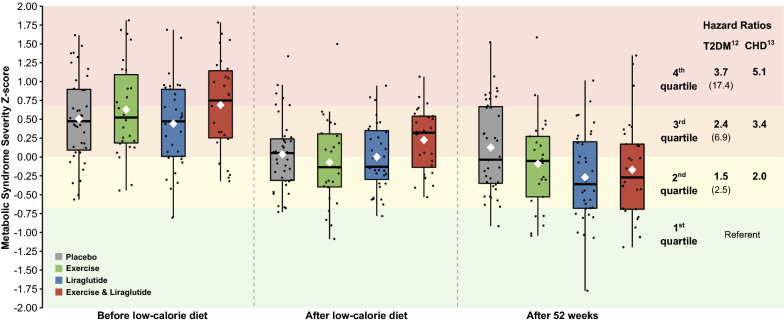
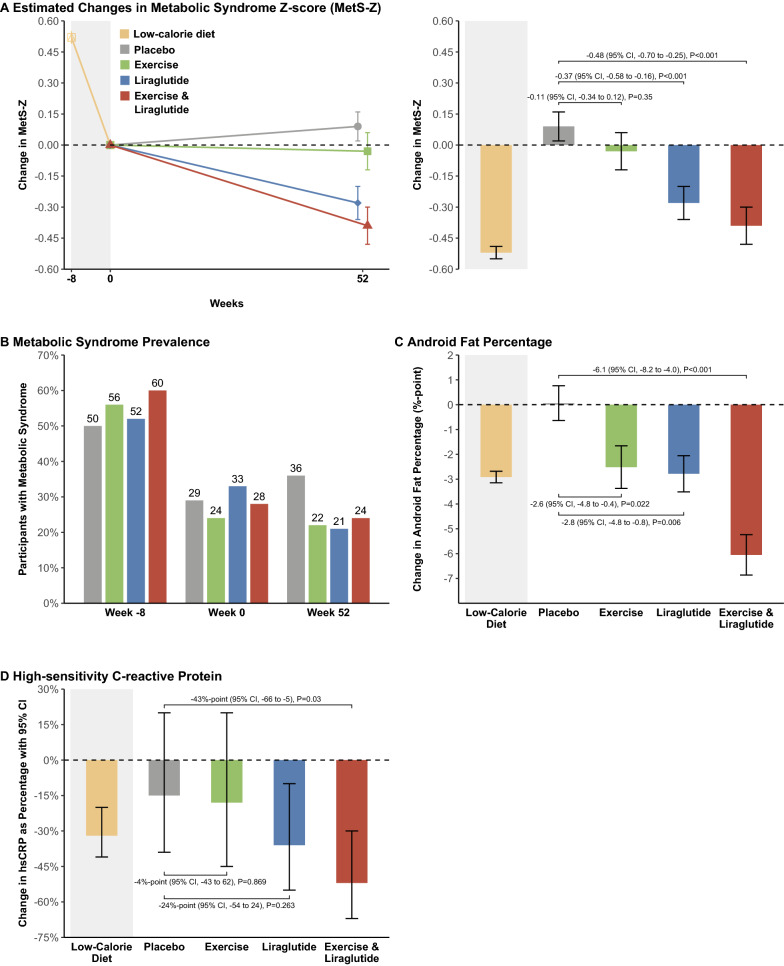
Background: Identifying and reducing cardiometabolic risks driven by obesity remains a healthcare challenge. The metabolic syndrome is associated with abdominal obesity and inflammation and is predictive of long-term risk of developing type 2 diabetes and cardiovascular disease in otherwise healthy individuals living with obesity. Therefore, we investigated the effects of adherent exercise, a glucagon-like peptide 1 receptor agonist (GLP-1 RA), or the combination on severity of metabolic syndrome, abdominal obesity, and inflammation following weight loss. Methods: This was a randomized, double-blinded, placebo-controlled trial. During an 8-week low-calorie diet (800 kcal/day), 195 adults with obesity and without diabetes lost 12% in body weight. Participants were then evenly randomized to four arms of one-year treatment with: placebo , moderate-to-vigorous exercise (minimum of 150 min/week of moderate-intensity or 75 min/week of vigorous-intensity aerobic physical activity or an equivalent combination of both), the GLP-1 RA liraglutide 3.0 mg/day, or a combination (exercise + liraglutide). A total of 166 participants completed the trial. We assessed the prespecified secondary outcome metabolic syndrome severity z-score (MetS-Z), abdominal obesity (estimated as android fat via dual-energy X-ray absorptiometry), and inflammation marker high-sensitivity C-reactive protein (hsCRP). Statistical analysis was performed on 130 participants adherent to the study interventions (per-protocol population) using a mixed linear model. Results: The diet-induced weight loss decreased the severity of MetS-Z from 0.57 to 0.06, which was maintained in the placebo and exercise groups after one year. MetS-Z was further decreased by liraglutide (− 0.37, 95% CI − 0.58 to − 0.16, P < 0.001) and the combination treatment (− 0.48, 95% CI − 0.70 to − 0.25, P < 0.001) compared to placebo. Abdominal fat percentage decreased by 2.6, 2.8, and 6.1 percentage points in the exercise, liraglutide, and combination groups compared to placebo, respectively, and hsCRP decreased only in the combination group compared with placebo (by 43%, P = 0.03). Conclusion: The combination of adherent exercise and liraglutide treatment reduced metabolic syndrome severity, abdominal obesity, and inflammation and may therefore reduce cardiometabolic risk more than the individual treatments. Trial registration EudraCT number: 2015-005585-32, ClinicalTrials.gov: NCT04122716
Overview
The claims and statistics of this paper haven’t been checked yet.
Free: it reads the open-access text and checks the first 5 claims that cite a source we can check. Create a free account to check every claim.
Integrity signals
Registry
Cites
Statistics
Figures
Verification
Claims the paper makes
The claims and statistics of this paper haven’t been checked yet.
Free: it reads the open-access text and checks the first 5 claims that cite a source we can check. Create a free account to check every claim.
Claims other papers make about this one
Each is checked against this paper’s own text: does it say what the citing paper says it does?
The source backs part of the claim, not all of it — or backs it for a different population, condition or comparison.
In the citing paper
“In that trial, GLP‐1 therapy plus exercise also produced larger reductions in abdominal fat and systematic inflammation than GLP‐1 therapy alone [171].”
From Nutritional priorities to support GLP ‐1 therapy for obesity: A joint Advisory from the American College of Lifestyle Medicine, the American Society for Nutrition, the Obesity Medicine Association, and The Obesity Society (2025) · cites this paper as [171]
Experimental — accuracy not yet measuredThe source backs part of the claim, not all of it — or backs it for a different population, condition or comparison.
In the citing paper
“Sandsdal et al. 90 revealed that structured exercise coupled with liraglutide treatment – which consists of consuming only 800 kcal/day over 8 weeks – effectively diminished metabolic syndrome severity, abdominal obesity prevalence, and inflammation levels one had priorly experienced.”
From Anti-inflammatory role of glucagon-like peptide 1 receptor agonists and its clinical implications (2024) · cites this paper as [90]
Experimental — accuracy not yet measuredThe source backs part of the claim, not all of it — or backs it for a different population, condition or comparison.
In the citing paper
“In that trial, GLP-1 therapy plus exercise also produced larger reductions in abdominal fat and systematic inflammation than GLP-1 therapy alone [171].”
From Nutritional priorities to support GLP-1 therapy for obesity: a joint Advisory from the American College of Lifestyle Medicine, the American Society for Nutrition, the Obesity Medicine Association, and The Obesity Society (2025) · cites this paper as [171]
Experimental — accuracy not yet measuredThe source backs part of the claim, not all of it — or backs it for a different population, condition or comparison.
In the citing paper
“Recent randomized controlled trials and meta-analyses suggest that combining GLP-1RAs with exercise may yield additive or synergistic effects on weight loss and metabolic syndrome severity as well as on oxidative stress and inflammation.”
From GLP-1 agonists and exercise: the future of lifestyle prioritization (2025) · cites this paper as [16]
Experimental — accuracy not yet measuredThe source backs part of the claim, not all of it — or backs it for a different population, condition or comparison.
In the citing paper
“Moreover, exercise may help maintain weight loss after cessation of pharmacotherapy (16, 17, 19, 21).”
From GLP-1 agonists and exercise: the future of lifestyle prioritization (2025) · cites this paper as [16]
Experimental — accuracy not yet measured
10 more claims about this paper
Create a free account to see every claim other papers make about this one.
Self-check
Percentages, sums and reported differences re-computed from the paper’s own numbers.
The self-check needs the paper’s full text.
Citations
Cites
Alberti, K. G. M. M., Eckel, R. H., Grundy, S. M., Zimmet, P. Z., Cleeman, J. I., Donato, K. A., Fruchart, J.-C., James, W. P. T., Loria, C. M., & Smith, S. C. (2009) · Circulation · doi:10.1161/circulationaha.109.192644 · Cited by 14,860
World Health Organization 2020 guidelines on physical activity and sedentary behaviour
Bull, F. C., Al-Ansari, S. S., Biddle, S., Borodulin, K., Buman, M. P., Cardon, G., Carty, C., Chaput, J.-P., Chastin, S., Chou, R., et al. (2020) · British Journal of Sports Medicine · doi:10.1136/bjsports-2020-102955 · Cited by 11,657 · cited 1×
“0 mg/day of liraglutide/placebo for at least 75% of the intervention period [25, 26].”
Background2013 AHA/ACC/TOS Guideline for the Management of Overweight and Obesity in Adults
Jensen, M. D., Ryan, D. H., Apovian, C. M., Ard, J. D., Comuzzie, A. G., Donato, K. A., Hu, F. B., Hubbard, V. S., Jakicic, J. M., Kushner, R. F., et al. (2014) · Journal of the American College of Cardiology · doi:10.1016/j.jacc.2013.11.004 · Cited by 4,058 · cited 1×
“Identifying and reducing cardiometabolic risks driven by obesity remains a major healthcare challenge [1].”
BackgroundThe Metabolic Syndrome and Cardiovascular Risk
Mottillo, S., Filion, K. B., Genest, J., Joseph, L., Pilote, L., Poirier, P., Rinfret, S., Schiffrin, E. L., & Eisenberg, M. J. (2010) · Journal of the American College of Cardiology · doi:10.1016/j.jacc.2010.05.034 · Cited by 3,009 · cited 1×
“Metabolic syndrome (MetS) is associated with an increased risk of cardiovascular disease, type 2 diabetes, and all-cause mortality [2, 3].”
BackgroundA Randomized, Controlled Trial of 3.0 mg of Liraglutide in Weight Management
Pi-Sunyer, X., Astrup, A., Fujioka, K., Greenway, F., Halpern, A., Krempf, M., Lau, D. C. W., le Roux, C. W., Violante Ortiz, R., Jensen, C. B., et al. (2015) · New England Journal of Medicine · doi:10.1056/nejmoa1411892 · Cited by 2,724
Mechanisms of Action and Therapeutic Application of Glucagon-like Peptide-1
Drucker, D. J. (2018) · Cell Metabolism · doi:10.1016/j.cmet.2018.03.001 · Cited by 2,170 · cited 1×
“GLP-1 RAs are also suggested to lower inflammation due to direct anti-inflammatory effects on various tissues and immune cells and partly because of the weight loss seen with GLP-1 RA treatment [22, 23].”
BackgroundMetabolic Syndrome as a Precursor of Cardiovascular Disease and Type 2 Diabetes Mellitus
Wilson, P. W. F., D’Agostino, R. B., Parise, H., Sullivan, L., & Meigs, J. B. (2005) · Circulation · doi:10.1161/circulationaha.105.539528 · Cited by 2,064 · cited 1×
“Metabolic syndrome (MetS) is associated with an increased risk of cardiovascular disease, type 2 diabetes, and all-cause mortality [2, 3].”
BackgroundVisceral and ectopic fat, atherosclerosis, and cardiometabolic disease: a position statement
Neeland, I. J., Ross, R., Després, J.-P., Matsuzawa, Y., Yamashita, S., Shai, I., Seidell, J., Magni, P., Santos, R. D., Arsenault, B., et al. (2019) · The Lancet Diabetes & Endocrinology · doi:10.1016/s2213-8587(19)30084-1 · Cited by 1,603 · cited 2×
“Abdominal obesity is associated with low-grade inflammation and has been proposed as a driver for metabolic syndrome [4].”
BackgroundMetabolic syndrome: definitions and controversies
Kassi, E., Pervanidou, P., Kaltsas, G., & Chrousos, G. (2011) · BMC Medicine · doi:10.1186/1741-7015-9-48 · Cited by 1,565
National health and nutrition examination survey: plan and operations, 1999-2010.
Zipf, G., Chiappa, M. M., Porter, K. S., Ostchega, Y., Lewis, B. G., & Dostal, J. (2013) · PubMed · Cited by 1,182
Cited by
Items 201–245 of 245
A comprehensive review of GLP-1 and aerobic training in cardiovascular disease management
Kordi, N., Kheirandish, R., Akraminia, P., Jung, F., & Karami, S. (2025) · Clinical Hemorheology and Microcirculation · doi:10.1177/13860291251414840
“71 Moreover, studies combining exercise with GLP-1R agonist administration (e.g., liraglutide) have demonstrated additive effects on reducing in fl am-mation in cardiovascular disease models 77 and improving cardiac function in heart failure patients.”
Intelligence-driven Mechanomedicine for Weight Rebound in Obesity
Zhu, S., Cheng, B., Gao, B., & Xu, F. (2026) · Current Obesity Reports · doi:10.1007/s13679-026-00714-7
Xiong, P., Hu, M., Liao, X., Zhang, B., & Mo, F. (2026) · Diabetology & Metabolic Syndrome · doi:10.1186/s13098-026-02162-8
“These beneficial effects are mediated through mechanisms such as augmenting insulin receptor affinity in adipose tissue and skeletal muscle, curbing inflammatory cell infiltration into adipose tissue, and bolstering cardiopulmonary fitness [6, 7].”
Peng, T., Liang, W., Wei, J., Ding, N., Tang, X., & Zhang, Z. (2026) · Diabetes Metabolic Syndrome and Obesity · doi:10.2147/dmso.s590529
Hu, M., Jiang, C.-J., & Yi, C. (2026) · Experimental and Therapeutic Medicine · doi:10.3892/etm.2026.13178
“…GLP‑1RAs confer therapeutic benefits in various T2D‑ or obesity‑related condi‑ tions, including polycystic ovary syndrome (80), metabolic syndrome (81), non‑alcoholic fatty liver disease (82) and obesity‑ or diabetes‑associated malignancies, such as gall‑ bladder, ovarian and esophageal cancers…”
Fąfara, M., Jeczkało, M., Kosiorowska, M., Kowalczyk, A., Lasoń, J., Makulska, M., Płachta, W., Sęk, W., Sieradzka, A., & Wegenko, C. M. (2026) · International Journal of Innovative Technologies in Social Science · doi:10.31435/ijitss.2(50).2026.5796
Zhou, Y., Cheng, Q., Yan, Z.-X., Lü, C., & Hua, B. (2026) · Journal of Functional Morphology and Kinesiology · doi:10.3390/jfmk11020226
“The dual nature of exercise effects, both circadian-dependent and circadian-independent, has important implications for individuals with disrupted rhythms, such as shift workers, older adults, and patients with metabolic syndrome [28,29].”
Tirzepatida e Semaglutida no tratamento da obesidade: eficácia, segurança e impactos metabólicos
Assis, J. N., de Oliveira, M. E. S., Antonio, T. B. R., & Furtado, R. K. (2026) · Revista JRG de Estudos Acadêmicos · doi:10.55892/jrg.v9i20.3469
GLP-1 therapies for obesity: mechanisms, outcomes, and regulatory challenges
Emos, D. D. O., González, J. D. J. M., Diani, L. M., Pinhel, M. A. D. S., Watanabe, L. M., Leca, A. V., Brandao, C. F. C., Nonino, C. B., & Noronha, N. Y. (2026) · Academia Drug Development and Pharmacotherapy · doi:10.20935/acaddrug8360
Nath, N. D., Thomas, A., & Yoshioka, J. (2026) · Journal of Cardiovascular Pharmacology · doi:10.1097/fjc.0000000000001834
Insight Into the Biological Link Between Novel Adiposity Indices and Incident Heart Failure
Yang, Y., Li, J., Xiao, X., Ning, Y., Ou, Z., Guo, S., He, X., Liu, C., Dong, B., & Xue, R. (2026) · Comprehensive physiology · doi:10.1002/cph4.70206
Abdelrahman, S. T., Karam, R. A., Ezzat, N. A., Ezzat, T. A., Hafez, N. R., Mohamed, Younes, A. E., Al-Sawat, A., Alzahrani, K. M., Almalki, O. M., et al. (2026) · Journal of Pioneering Medical Science · doi:10.47310/jpms2026150613
Associations Between Metabolic Syndrome Severity and Future Coronary Heart Disease
DeBoer, M. D., Gurka, M. J., & Jones, M. K. (2026) · JACC Advances · doi:10.1016/j.jacadv.2026.102977
Kotanidou, S., Dampali, R., Devaja, O., Montalto, S. A., Godfrey, M., Papadopoulos, A., Daniilidis, A., Nikolettos, N., & Nikolettos, K. (2026) · Reproductive Medicine · doi:10.3390/reprodmed7030034
Underlying mechanisms of exercise protection against diabetes mellitus: a narrative review
Wang, S., Lü, F., Liu, Y., Xu, R., Zhang, G., Miao, Y., Lu, S., Liu, Z., Huang, W. Q., Meng, J., et al. (2026) · Frontiers in Endocrinology · doi:10.3389/fendo.2026.1854074
“…or an equivalent combination of both) and liraglutide resulted in a greater reduction in the severity of metabolic syndrome, abdominal adiposity, and systemic in fl ammation compared to either intervention alone, suggesting a potentially superior effect on cardiometabolic risk mitigation (30).”
Sodré, A. F. P., Rodrigues, L. G., Sloan, K. P., Sloan, L. A., Tanaka, M., Curi, R., Takeda, L. N., Goulart, R. D. Á., de Souza, A. L. D. M., Detregiachi, C. R. P., et al. (2026) · International Journal of Molecular Sciences · doi:10.3390/ijms27156554
“Collectively, these findings suggest that dietary fiber, SCFA-producing bacteria, and GLP-1-mediated signaling form a microbiota–metabolic axis that may attenuate insulin resistance, adiposity, and cardiovascular risk in MetS [75,228–230].”
Gracioto, P. G. A., de Oliveira, J. C. M., & Oliveira, C. R. (2026) · Research Society and Development · doi:10.33448/rsd-v15i7.51444
Żuk, P., Pogorzelska, P., Saleh, M., KULIK, K., & Tomczyszyn, J. (2026) · Quality in Sport · doi:10.12775/qs.2026.66.74239
Tai, L.-H., Tsai, P., Wang, Y.-H., Yeh, C., & Chen, Y.-C. (2026) · BMC Infectious Diseases · doi:10.1186/s12879-026-14234-1
Ming, Q., & Li, Z. (2026) · Frontiers in Nutrition · doi:10.3389/fnut.2026.1914155
“These favorable cardiorenal findings do not justify permissive dehydration; low intake, vomiting, diarrhea, diuretic therapy, CKD, or symptomatic hypotension should trigger review of fluid intake, blood pressure, renal function, and congestion (145).”
Kim, B.-Y. (2026) · Healthcare · doi:10.3390/healthcare14162570
“…with GLP-1 receptor agonist therapy improves the maintenance of weight loss and better preserves lean body mass than pharmacotherapy alone [42], and that such combined approaches produce greater reductions in metabolic-syndrome severity and abdominal obesity than either strategy in isolation [43].”
Incretins beyond weight and hyperglycemia management: a consensus statement by AASD
Shaltout, I., Hegazy, M., Meligi, A. A. H. E., Abdelghaffar, S., Wifi, M.-N. A., Saleh, A. A., Hammad, H., Abouzeid, A. A. E. K., Fahmy, E. M., Maghraby, G. G., et al. (2026) · The Egyptian Journal of Internal Medicine · doi:10.1186/s43162-026-00689-w
Loblundo, C., Gao, S. Y., Nguyen, S. A., & Abdelwahab, M. (2026) · Otolaryngology · doi:10.1002/ohn.70407
Exercise and physical activity interventions in type 2 diabetes mellitus
Su, W., Li, X., Gou, H., Yuan, L., Lin, L., Lin, X., Wang, X., Xiong, Y., & Luan, Y. (2026) · Frontiers in Endocrinology · doi:10.3389/fendo.2026.1887543
“Clinical evidence suggests that structured exercise and GLP-1RAs have complementary effects on body composition and cardiometabolic risk markers, including greater reductions in body-fat percentage, abdominal adiposity, and hsCRP than either approach alone (104 – 106).”
Jin, C. A., Many, G. M., Spurrier, C. S. R., Borsellino, P., Wheeler, M. T., Adkins, J., Snyder, M. P., Newgard, C. B., Radom‐Aizik, S., Cooper, D. M., et al. (2026) · Physiological Genomics · doi:10.1152/physiolgenomics.00171.2026
Damasio, N. M. A., Freccia, G. W., Fortes, M. D. S. R., Gomes, M. G. Z., & de Lira, C. A. B. (2026) · Obesity Medicine · doi:10.1016/j.obmed.2026.100743
Green, C. (2026) · ScholarWorks (Walden University)
Strugała, N., Kostrzewski, M., Noworolska, M., Wojtaszkiewicz, D., Skrzeczyna, J., Sapała, E., Bednarska, K., Zurek, J., Wiśniewska, M., Bulenda, M., et al. (2026) · International Journal of Innovative Technologies in Social Science · doi:10.31435/ijitss.3(51).2026.6003
Metabolic effects of a GLP-1 analog combined with aerobic training in ovariectomized rats
Selau, B., Bastos, L. M., Normann, R. S., Cubas, G. K., Herrmann, R. D. O. C. D. C., de Barros, L. D. A. D. O., de Amaral, M., Trapp, M., Kucharski, L. C., Vogt, É. L., et al. (2026) · Molecular and Cellular Endocrinology · doi:10.1016/j.mce.2026.112917
Li, M. (2026) · Frontiers in Cardiovascular Medicine · doi:10.3389/fcvm.2026.1926629
“A randomised study found that combining exercise with GLP-1RA therapy improved abdominal adiposity and inflammatory measures more than either intervention alone (50).”
Kamia, L. Y. T., Lewis, L., Nobles, Z., & Koh, G. Y. (2026) · Nutrients · doi:10.3390/nu18193258
“From a translational perspective, the ability of dietary prebiotics to enhance endogenous GLP-1 secretion is highly relevant given the current clinical prominence of pharmacological GLP-1 receptor agonists for obesity and type 2 diabetes management [16,62,65].”
López, J. M. (2025) · Rovira & Virgili repository
AGONISTAS INCRETÍNICOS E EXERCÍCIO FÍSICO NA PRESERVAÇÃO DA MASSA MUSCULAR
de Freitas, P. H. S. (2026) · Editora Pasteur eBooks · doi:10.59290/8619300026
Wang, H., Kaili, W. A. N. G., 石进财, & Zhu, J. P. (2026) · bioRxiv (Cold Spring Harbor Laboratory) · doi:10.64898/2026.10.05.756920
Alhamad, Z. M., AlShalhoub, N., Al-mana, A., Almutairi, F. E., & Alshalhoub, H. M. (2026) · Cureus · doi:10.7759/cureus.117738
Ricardo, Y. R. (2026) · Hacia la Promoción de la Salud · doi:10.17151/hpsal.2026.31.3.5
Diabetes Technology and Physical Activity in the Youth
Tauschmann, M., Sanfilippo, S., & Dovč, K. (2026) · Endocrinology and Metabolism Clinics of North America · doi:10.1016/j.ecl.2026.08.017
Edible fungus polysaccharides and metabolism: A review
Li, H., He, J., Liu, C., Xiaolong, L., & Liu, T. (2026) · International Journal of Biological Macromolecules · doi:10.1016/j.ijbiomac.2026.154842
Chen, S. S.-Y., Lin, T. T.-A., Chiang, Y.-L., Chen, C.-Y., Chen, H.-Y., Hung, Y., & Chang, R. (2026) · The American Journal of Medicine · doi:10.1016/j.amjmed.2026.09.033
Li, Y., Zhang, T., & Chen, L. (2026) · Frontiers in Public Health · doi:10.3389/fpubh.2026.1854278
The cardiovascular risk of metabolically healthy obesity: an inflammatory perspective
Lozano-Núñez, J., Lakshmi, A., Benny, B. A., Sharma, P., Jayakumar, A., & Swathi, N. L. (2026) · Journal of Basic and Clinical Physiology and Pharmacology · doi:10.1515/jbcpp-2026-0266
Impactos da liraglutida na resistência insulínica em pacientes com obesidade sem diabetes mellitus
de Magalhães, M. J. D. S., Quaresma, A. A. C., & Cardoso, S. B. D. F. (2026) · Bionorte · doi:10.47822/bn.v15i1.1274
Safargar, M., Ahmadi, N., Prabahar, K., Zandi, R., & Varkaneh, H. K. (2026) · Bone · doi:10.1016/j.bone.2026.118160
Nutraceuticals and Metabolic Health: Can Supplements Prevent Metabolic Syndrome? A Narrative Review
Krentz, A. J., Kozhevnikov, O., McCallum, J. E., Drummond‐Clarke, L., Fant, M., Ong, J. H., Harris, S., & Walker, S. (2026) · Nutrients · doi:10.3390/nu18213672
Jacuńska, J., Chmielewska, M., Wojno, A., Lenkiewicz, P., Noszczak, Ł., & Popowczak, M. (2026) · Applied Sciences · doi:10.3390/app162110949
Metadata
- Authors
- Sandsdal, R. M., Juhl, C. R., Jensen, S. B. K., Lundgren, J. R., Janus, C., Blond, M. B., Rosenkilde, M., Bogh, A. F., Gliemann, L., Jensen, J.-E. B., Antoniades, C., Stallknecht, B. M., Holst, J. J., Madsbad, S., & Torekov, S. S.
- Affiliations
- University of Copenhagen (DK)
- Steno Diabetes Center Copenhagen (DK)
- University of Oxford (GB)
- Hvidovre Hospital (DK)
- Corresponding author
- Torekov, Signe S.
- ORCID
- Venue
- Cardiovascular Diabetology
- Published
- 2023-02-25
- Volume
- 22
- Issue
- 1
- Pages
- 41-41
- ISSN
- 1475-2840 (ISSN-L)
- PMC
- PMC9960425
- OpenAlex
- W4321850189
- Semantic Scholar
- bd9a7e28a09adc4efa5540627cb3f10dea088317
- Cited by
- 195
- References
- 34
- Citations by year
- 2026: 67 · 2025: 66 · 2024: 48 · 2023: 13
- FWCI
- 39.80
- Type
- journal article
- Language
- en
- Open access
- gold
- doi.org
- Licence
- cc-by
- creativecommons.org/licenses/by/4.0 (tdm)
- creativecommons.org/licenses/by/4.0 (vor)
- Locations
- Cardiovascular Diabetology (publishedVersion, cc-by)
- PubMed Central (publishedVersion, cc-by)
- PubMed (publishedVersion)
- Research at the University of Copenhagen (University of Copenhagen) (publishedVersion, cc-by)
- DOAJ (DOAJ: Directory of Open Access Journals) (submittedVersion, cc-by-sa)
- Funders
- Novo Nordisk Fonden (NNF15SA0018346)
- Helsefonden
- Novo Nordisk
- Topics
- Health Sciences › Medicine › Endocrinology, Diabetes and Metabolism › Diabetes Treatment and Management
- Health Sciences › Medicine › Endocrinology, Diabetes and Metabolism › Diabetes, Cardiovascular Risks, and Lipoproteins
- Health Sciences › Medicine › Endocrinology, Diabetes and Metabolism › Adipokines, Inflammation, and Metabolic Diseases
- Keywords
- metabolic syndrome, abdominal obesity, inflammation, liraglutide, GLP-1 receptor agonists, physical activity, weight loss, obesity, hypocaloric diet, C-reactive protein, type 2 diabetes prevention, cardiovascular risk, combination therapy, android fat, aerobic physical activity, weight regain after weight loss, insulin resistance, adipokines
- MeSH terms
- Glucagon-Like Peptide-1 Receptor, Liraglutide, Glucagon-Like Peptide-1 Receptor Agonists, Adult, C-Reactive Protein, Diabetes Mellitus, Type 2, Double-Blind Method, Humans, Inflammation, Obesity, Weight Loss, Exercise, Metabolic Syndrome, Obesity, Abdominal
About these checks
Registry, retraction, Cites and statistics results are computed, not judged, with one exception: a printed reference that no index lists is read once by a model before it counts as a citation error. Claims are extracted by a model and kept only when their quote appears verbatim in the text; each cited source is then checked, with a model’s help, for whether it says what the claim relies on. Those verdicts can be wrong — read the claim’s quote and the cited source before relying on one.
Statistics and arithmetic are recomputed, not judged.
Confidence bands are shown only for fields calibrated on our annotated test set. None is calibrated yet, so no band is shown.
What counts as a claim ›How we measure confidence ›How we check this ›
Are you an author, or do you see a problem with this page? Request a review
Data sources
Bibliographic data: Semantic Scholar, OpenAlex, Crossref.
Contains information from the Semantic Scholar Academic Graph Datasets, made available under the ODC Attribution License (ODC-BY 1.0).
Semantic Scholar’s data is described in: Kinney, R., et al. (2023). The Semantic Scholar Open Data Platform. arXiv:2301.10140.
