

The DOI matches its Crossref record; 35 of the 36 references it cites were found in a registry or an index.
The evidence for improving housing to reduce malaria: a systematic review and meta-analysis
Open accessAbstract
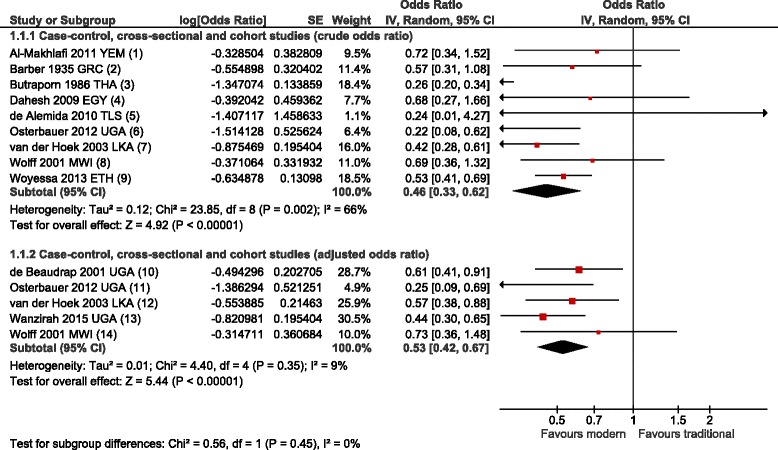
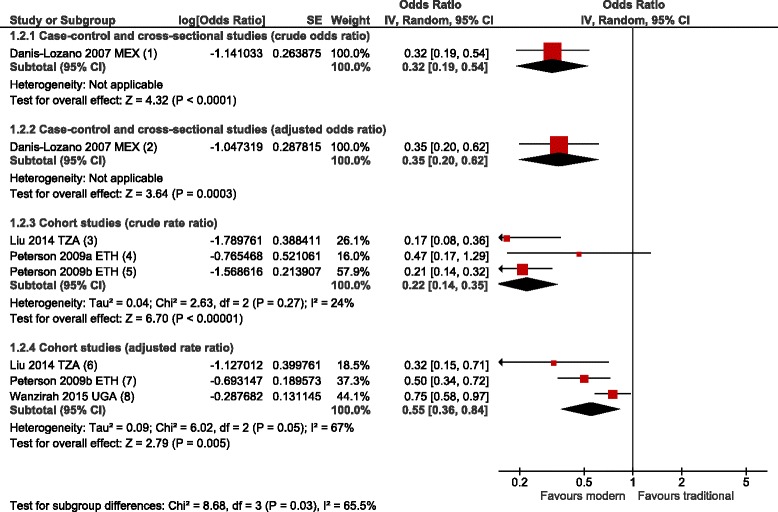
BACKGROUND: The global malaria burden has fallen since 2000, sometimes before large-scale vector control programmes were initiated. While long-lasting insecticide-treated nets and indoor residual spraying are highly effective interventions, this study tests the hypothesis that improved housing can reduce malaria by decreasing house entry by malaria mosquitoes. METHODS: A systematic review and meta-analysis was conducted to assess whether modern housing is associated with a lower risk of malaria than traditional housing, across all age groups and malaria-endemic settings. Six electronic databases were searched to identify intervention and observational studies published from 1 January, 1900 to 13 December, 2013, measuring the association between house design and malaria. The primary outcome measures were parasite prevalence and incidence of clinical malaria. Crude and adjusted effects were combined in fixed- and random-effects meta-analyses, with sub-group analyses for: overall house type (traditional versus modern housing); screening; main wall, roof and floor materials; eave type; ceilings and elevation. RESULTS: Of 15,526 studies screened, 90 were included in a qualitative synthesis and 53 reported epidemiological outcomes, included in a meta-analysis. Of these, 39 (74%) showed trends towards a lower risk of epidemiological outcomes associated with improved house features. Of studies assessing the relationship between modern housing and malaria infection (n=11) and clinical malaria (n=5), all were observational, with very low to low quality evidence. Residents of modern houses had 47% lower odds of malaria infection compared to traditional houses (adjusted odds ratio (OR) 0°53, 95% confidence intervals (CI) 0°42-0°67, p< 0°001, five studies) and a 45-65% lower odds of clinical malaria (case-control studies: adjusted OR 0°35, 95 % CI 0°20-0°62, p<0°001, one study; cohort studies: adjusted rate ratio 0°55, 95% CI 0°36-0°84, p=0°005, three studies). Evidence of a high risk of bias was found within studies. CONCLUSIONS: Despite low quality evidence, the direction and consistency of effects indicate that housing is an important risk factor for malaria. Future research should evaluate the protective effect of specific house features and incremental housing improvements associated with socio-economic development.
Overview
The claims and statistics of this paper haven’t been checked yet.
Run the check — free, no account needed. It reads the open-access text and checks the sources it cites.
Integrity signals
Registry
Cites
Statistics
Figures
Verification
Claims the paper makes
The claims and statistics of this paper haven’t been checked yet.
Run the check — free, no account needed. It reads the open-access text and checks the sources it cites.
Claims other papers make about this one
Each is checked against this paper’s own text: does it say what the citing paper says it does?
The source backs part of the claim, not all of it — or backs it for a different population, condition or comparison.
In the citing paper
“in many contemporary houses (e.g., houses comprising brick walls and metal roofs), the eaves are often closed [6].”
From Semi-field evaluation of the cumulative effects of a "Lethal House Lure" on malaria mosquito mortality (2019) · cites this paper as [6]
Experimental — accuracy not yet measuredThe cited source says what the claim attributes to it.
In the citing paper
“This sort of house improvement has been proposed as an important route to reducing disease burden [6–8].”
From Semi-field evaluation of the cumulative effects of a "Lethal House Lure" on malaria mosquito mortality (2019) · cites this paper as [6]
In the citing paper
“and that closed eaves, together with modern housing elements, such as metal roofs, window screening, and improved doors, are associated with reduced malaria burdens.10, 11, 12, 13”
From Impact and cost-effectiveness of a lethal house lure against malaria transmission in central Côte d'Ivoire: a two-arm, cluster-randomised controlled trial (2021) · cites this paper as [10]
Self-check
Percentages, sums and reported differences re-computed from the paper’s own numbers.
The self-check needs the paper’s full text.
Citations
Cites
Preferred Reporting Items for Systematic Reviews and Meta-Analyses: the PRISMA statement
Moher, D., Liberati, A., Tetzlaff, J., Altman, D. G., & for the PRISMA Group (2009) · BMJ · doi:10.1136/bmj.b2535 · Cited by 83,823
Preferred Reporting Items for Systematic Reviews and Meta-Analyses: The PRISMA Statement
Moher, D., Liberati, A., Tetzlaff, J., Altman, D. G., & The PRISMA Group (2009) · PLoS Medicine · doi:10.1371/journal.pmed.1000097 · Cited by 64,042
Preferred reporting items for systematic reviews and meta-analyses: the PRISMA Statement.
(2009) · PubMed Central · Cited by 44,859
Dermyshi, E., Wang, Y., Yan, C., Hong, W., Qiu, G., Gong, X., & Zhang, T. (2017) · Neonatology · doi:10.1159/000454668 · Cited by 24,586
Meta-analysis of Observational Studies in Epidemiology<SUBTITLE>A Proposal for Reporting</SUBTITLE>
Stroup, D. F. (2000) · JAMA · doi:10.1001/jama.283.15.2008 · Cited by 20,623
Preferred Reporting Items for Systematic Reviews and Meta-Analyses: The PRISMA Statement
Moher, D., Liberati, A., Tetzlaff, J., & Altman, D. G. (2009) · Journal of Clinical Epidemiology · doi:10.1016/j.jclinepi.2009.06.005 · Cited by 19,575
Wang, G., Ma, R., Qiao, G., Wada, K., Aizawa, Y., & Satoh, T. (2015) · Integrative Medicine International · doi:10.1159/000368408 · Cited by 18,762
(2014) · Medical Entomology and Zoology · Cited by 17,633
Grading quality of evidence and strength of recommendations
(2004) · BMJ · doi:10.1136/bmj.328.7454.1490 · Cited by 8,477
Weltgesundheitsorganisation (2005) · Cited by 3,799
Research works printed but not linked: 6
- Anderson L, Simpson D, Stephens M. Durable housing improvements to fight malaria transmission: Can we learn new strategies from past experience? Atlanta: Habitat for Humanity International Global Programs Department; 2014.
- UN-Habitat: State of African Cities 2010. Governance, inequalities and urban land markets. Nairobi: UN Habitat; 2010.
- RBM/UNDP. Multisectoral action framework for malaria. Geneva: Roll Back Malaria/United Nations Development Programme; 2013.
- Ippolito M, Tusting LS, Gosling R, Dorsey G, Lindsay SW. Malaria and housing: a systematic review and meta-analysis. PROSPERO, 2014: CRD42014009048.
- Cochrane Collaboration. Suggested risk of bias criteria for EPOC reviews. Oxford: Cochrane Collaboration; 2013.
- ICF International. The DHS progam STATcompiler. Calverton: ICF International; 2015.
Cited by
Sorted by citations
Items 101–200 of 360
McCann, R. S., Messina, J. P., MacFarlane, D. W., Bayoh, M. N., Gimnig, J. E., Giorgi, E., & Walker, E. D. (2017) · Malaria Journal · doi:10.1186/s12936-017-1938-1 · Cited by 31
Malaria outbreak investigation in a rural area south of Zimbabwe: a case–control study
Mundagowa, P. T., & Chimberengwa, P. T. (2020) · Malaria Journal · doi:10.1186/s12936-020-03270-0 · Cited by 30
Factors influencing the re-emergence of plague in Madagascar
Alderson, J., Quastel, M. N., Wilson, E., & Bellamy, D. G. (2020) · Emerging Topics in Life Sciences · doi:10.1042/etls20200334 · Cited by 33
Wubishet, M. K., Berhe, G., Adissu, A., & Tafa, M. S. (2021) · Malaria Journal · doi:10.1186/s12936-021-03833-9 · Cited by 30
Schoelitsz, B., Meerburg, B. G., & Takken, W. (2018) · Entomologia Experimentalis et Applicata · doi:10.1111/eea.12739 · Cited by 32
Nguela, R. L., Bigoga, J. D., Tedjou, A. N., Tallah, E., Line, D., Njeambosay, B., Tchouine, F., Kazi, R., Williams, P., Mbacham, W. F., et al. (2020) · Malaria Journal · doi:10.1186/s12936-020-03232-6 · Cited by 31
Mosha, J. F., Lukole, E., Charlwood, J. D., Wright, A., Rowland, M., Bullock, O., Manjurano, A. M., Kisinza, W. N., Mosha, F. W., Kleinschmidt, I., et al. (2020) · Malaria Journal · doi:10.1186/s12936-020-03369-4 · Cited by 29
Self-citationYared, S., Gebresilassie, A., Aklilu, E., Abdulahi, E., Kirstein, O. D., González‐Olvera, G., Che‐Mendoza, A., Bibiano-Marín, W., Waymire, E., Lines, J., et al. (2023) · The Lancet Planetary Health · doi:10.1016/s2542-5196(23)00250-4 · Cited by 26
Dlamini, N., Hsiang, M. S., Ntshalintshali, N., Pindolia, D. K., Allen, R. L., Nhlabathi, N., Novotny, J. M., Dufour, M. K., Midekisa, A. A., Gosling, R. D., et al. (2017) · Open Forum Infectious Diseases · doi:10.1093/ofid/ofx071 · Cited by 27
Self-citationThe impact of industrial activities on vector-borne disease transmission
Jones, R. T., Tusting, L. S., Smith, H. M. P., Segbaya, S., MacDonald, M. B., Bangs, M. J., & Logan, J. G. (2018) · Acta Tropica · doi:10.1016/j.actatropica.2018.08.033 · Cited by 29
Self-citationOdufuwa, O. G., Ross, A. J., Mlacha, Y. P., Juma, O., Mmbaga, S., Msellemu, D. F., & Moore, S. (2020) · Malaria Journal · doi:10.1186/s12936-020-03303-8 · Cited by 30
Global warming and mosquito-borne diseases in Africa: a narrative review
Khezzani, B., Baymakova, M. P., Khechekhouche, A., & Tsachev, I. (2023) · Pan African Medical Journal · doi:10.11604/pamj.2023.44.70.37318 · Cited by 31
Molecular quantification of Plasmodium parasite density from the blood retained in used RDTs
Robinson, A., Busula, A. O., Muwanguzi, J. K., Powers, S. J., Masiga, D. K., Bousema, T., Takken, W., de Boer, J. G., Logan, J. G., Beshir, K. B., et al. (2019) · Scientific Reports · doi:10.1038/s41598-019-41438-0 · Cited by 27
Gul, D., Rodríguez-Rodríguez, D., Nate, E., Auwan, A., Salib, M., Lorry, L., Keven, J. B., Katusele, M., Rosado, J., Hofmann, N., et al. (2021) · Scientific Reports · doi:10.1038/s41598-021-95959-8 · Cited by 29
One Health, many approaches: integrated vector management strategies support One Health goals
Tiffin, H. S., Gordon, J. R., & Poh, K. C. (2025) · Frontiers in Insect Science · doi:10.3389/finsc.2025.1549348 · Cited by 27
Narrative Review on Health-EDRM Primary Prevention Measures for Vector-Borne Diseases
Chan, E. Y. Y., Sham, T. S. T., Shahzada, T. S., Dubois, C., Huang, Z., Liu, S., Hung, K. K. C., Tse, S. L. A., Kwok, K. O., Chung, P.-H., et al. (2020) · International Journal of Environmental Research and Public Health · doi:10.3390/ijerph17165981 · Cited by 26
House modifications for preventing malaria
Furnival-Adams, J., Olanga, E. A., Napier, M., & Garner, P. (2020) · Cochrane Database of Systematic Reviews · doi:10.1002/14651858.cd013398.pub2 · Cited by 26
García, G. A., Janko, M., Hergott, D., Donfack, O. T., Smith, J. M., Eyono, J. N. M., DeBoer, K. R., Avue, R. M. N., Phiri, W. P., Aldrich, E. M., et al. (2023) · Malaria Journal · doi:10.1186/s12936-023-04504-7 · Cited by 26
Self-citationEave tubes for malaria control in Africa: a modelling assessment of potential impact on transmission
Waite, J. L., Lynch, P. A., & Thomas, M. B. (2016) · Malaria Journal · doi:10.1186/s12936-016-1505-1 · Cited by 25
Knoblauch, A. M., Divall, M. J., Owuor, M., Archer, C., Nduna, K., Ng’uni, H., Musunka, G., Pascall, A., Utzinger, J., & Winkler, M. S. (2017) · International Journal of Environmental Research and Public Health · doi:10.3390/ijerph14030315 · Cited by 25
Phiri, M. D., McCann, R. S., Kabaghe, A. N., van den Berg, H., Malenga, T., Gowelo, S., Tizifa, T. A., Takken, W., van Vugt, M., Phiri, K. S., et al. (2021) · Malaria Journal · doi:10.1186/s12936-021-03800-4 · Cited by 26
Screening eaves of houses reduces indoor mosquito density in rural, western Kenya
Abong’o, B., Gimnig, J. E., Omoke, D., Ochomo, E., & Walker, E. D. (2022) · Malaria Journal · doi:10.1186/s12936-022-04397-y · Cited by 24
Tizifa, T. A., Gowelo, S., Kabaghe, A. N., McCann, R. S., Malenga, T., Nkhata, R. M., Kadama, A., Chapeta, Y., Takken, W., Phiri, K. S., et al. (2022) · PLOS Global Public Health · doi:10.1371/journal.pgph.0000627 · Cited by 24
Atusingwize, E., Deane, K. D., & Musoke, D. (2025) · Malaria Journal · doi:10.1186/s12936-025-05407-5 · Cited by 23
Canavati, S. E., Kelly, G. C., Quintero, C. E., Vo, T. H., Tran, L. K., Ohrt, C., Ngo, T. D., Tran, D. T., & Martin, N. J. (2019) · Malaria Journal · doi:10.1186/s12936-019-3068-4 · Cited by 22
Malaria resurgence after significant reduction by mass drug administration on Ngodhe Island, Kenya
Kagaya, W., Gitaka, J., Chan, C. W., Kongere, J., Idris, Z. M., Deng, C., & Kaneko, A. (2019) · Scientific Reports · doi:10.1038/s41598-019-55437-8 · Cited by 23
Measuring ventilation in different typologies of rural Gambian houses: a pilot experimental study
Knudsen, J., Pinder, M., Jatta, E., Jawara, M., Yousuf, M. A., Søndergaard, A. T., & Lindsay, S. W. (2020) · Malaria Journal · doi:10.1186/s12936-020-03327-0 · Cited by 22
Self-citationHousing Risk Factors of Four Tropical Neglected Diseases: A Brief Review of the Recent Literature
Chastonay, A. H. M., & Chastonay, O. J. (2022) · Tropical Medicine and Infectious Disease · doi:10.3390/tropicalmed7070143 · Cited by 22
Vector control for malaria elimination in Botswana: progress, gaps and opportunities
Kgoroebutswe, T. K., Makate, N., Fillinger, U., Mpho, M., Segoea, G., Sangoro, O. P., Mutero, C. M., Chanda, E., Ntebela, D., Mogopa, M., et al. (2020) · Malaria Journal · doi:10.1186/s12936-020-03375-6 · Cited by 24
Leandro-Reguillo, P., Thomson-Luque, R., Monteiro, W. M., & Lacerda, M. (2015) · Malaria Journal · doi:10.1186/s12936-015-0806-0 · Cited by 22
Hast, M. A., Stevenson, J. C., Muleba, M., Chaponda, M., Kabuya, J.-B. B., Mulenga, M., Shields, T., Moss, W. J., Norris, D. E., & _, _. (2020) · American Journal of Tropical Medicine and Hygiene · doi:10.4269/ajtmh.20-0537 · Cited by 22
Looking beyond land-use and land-cover change: Zoonoses emerge in the agricultural matrix
Perfecto, I., Chaves, L. F., Fitch, G. M., Hajian‐Forooshani, Z., Iuliano, B. G., Li, K., Medina, N., Morris, J. R., Jiménez, B. O., Rivera‐Salinas, I. S., et al. (2023) · One Earth · doi:10.1016/j.oneear.2023.08.010 · Cited by 26
von Seidlein, L., Wood, H. S., Brittain, O. S., Tusting, L. S., Bednarz, A., Mshamu, S., Kahabuka, C., Deen, J. L., Bell, D., Lindsay, S. W., et al. (2019) · PLoS Medicine · doi:10.1371/journal.pmed.1002909 · Cited by 21
Self-citationRouamba, T., Samadoulougou, S., Tinto, H., Alegana, V., & Kirakoya-Samadoulougou, F. (2020) · Scientific Reports · doi:10.1038/s41598-020-58899-3 · Cited by 23
Chanda, E., Ameneshewa, B., Mihreteab, S., Berhane, A., Zehaie, A., Ghebrat, Y., & Usman, A. (2015) · Malaria Journal · doi:10.1186/s12936-015-1022-7 · Cited by 21
Spitzen, J., Koelewijn, T., Mukabana, W. R., & Takken, W. (2017) · Acta Tropica · doi:10.1016/j.actatropica.2017.05.008 · Cited by 21
Manrique-Saide, P. C., Herrera‐Bojórquez, J., Villegas‐Chim, J., Puerta-Guardo, H. N., Ayora‐Talavera, G., Parra‐Cardeña, M., Medina‐Barreiro, A., Ramírez‐Medina, M., Chi‐Ku, A., Trujillo‐Peña, E., et al. (2021) · Tropical Medicine & International Health · doi:10.1111/tmi.13680 · Cited by 19
Inthavong, N., Nonaka, D., Kounnavong, S., Iwagami, M., Phommala, S., Kobayashi, J., Hongvanthong, B., Pongvongsa, T., Brey, P. T., & Kano, S. (2017) · Tropical Medicine and Health · doi:10.1186/s41182-017-0077-2 · Cited by 19
Mmbando, A. S., Ngonzi, A. J., Mshamu, S., Bradley, J., Bøjstrup, T. C., Ngowo, H. S., Knudsen, J., von Seidlein, L., Okumu, F. O., & Lindsay, S. W. (2025) · The Lancet Planetary Health · doi:10.1016/s2542-5196(25)00046-4 · Cited by 18
Self-citationSoma, D. D., Zogo, B., Taconet, P., Somé, A. F., Coulibaly, S., Baba‐Moussa, L., Ouédraogo, G. A., Koffi, A. A., Pennetier, C., Dabiré, R. K., et al. (2021) · BMC Public Health · doi:10.1186/s12889-021-10304-y · Cited by 17
Nankabirwa, J. I., Gonahasa, S., Katureebe, A., Mutungi, P., Nassali, M., Kamya, M. R., & Westercamp, N. (2024) · Malaria Journal · doi:10.1186/s12936-024-05051-5 · Cited by 18
Rehman, A. M., Maiteki‐Sebuguzi, C., Gonahasa, S., Okiring, J., Kigozi, S. P., Chandler, C., DRAKELEY, C. J., Dorsey, G., Kamya, M. R., & Staedke, S. G. (2019) · Malaria Journal · doi:10.1186/s12936-019-2954-0 · Cited by 18
Self-citationYaro, J. B., Ouédraogo, A., Diarra, A., Sombié, S., Ouedraogo, Z. A., Nébié, I., DRAKELEY, C. J., Sirima, S. B., Tiono, A. B., Lindsay, S. W., et al. (2021) · Malaria Journal · doi:10.1186/s12936-021-03896-8 · Cited by 22
Self-citationCarrasco-Tenezaca, M., Jawara, M., Abdi, M. Y., Bradley, J., Brittain, O. S., Ceesay, S., D’Alessandro, U., Jeffries, D. J., Pinder, M., Wood, H. S., et al. (2021) · Journal of The Royal Society Interface · doi:10.1098/rsif.2021.0256 · Cited by 20
Self-citationHousing interventions for preventing malaria
Furnival-Adams, J., Olanga, E. A., Napier, M., & Garner, P. (2019) · Cochrane Database of Systematic Reviews · doi:10.1002/14651858.cd013398 · Cited by 18
Risk factors of malaria transmission in mining workers in Muara Enim, South Sumatra, Indonesia
Hasyim, H., Dewi, W. C., Lestari, R. A. F., Flora, R., Novrikasari, N., Liberty, I. A., Marini, H., Elagali, A. E. M., Herlinda, S., & Maharani, F. E. (2023) · Scientific Reports · doi:10.1038/s41598-023-40418-9 · Cited by 22
Mwakalinga, V. M., Sartorius, B. K. D., Mlacha, Y. P., Msellemu, D. F., Limwagu, A. J., Mageni, Z. D., Paliga, J. M., Govella, N. J., Coetzee, M., Killeen, G. F., et al. (2016) · Malaria Journal · doi:10.1186/s12936-016-1186-9 · Cited by 17
Housing quality improvement is associated with malaria transmission reduction in Costa Rica
Chaves, L. F., Rojas, M. R., Jiménez, S. D., Prado, M., & Rodríguez, R. M. (2020) · Socio-Economic Planning Sciences · doi:10.1016/j.seps.2020.100951 · Cited by 17
Yaro, J. B., Ouédraogo, A., Ouedraogo, Z. A., Diarra, A., Lankouande, M., Agboraw, E., Worrall, E., Toé, K. H., Sanou, A., Guelbeogo, W. M., et al. (2020) · Malaria Journal · doi:10.1186/s12936-020-03443-x · Cited by 17
Self-citationMsoffe, R. V., Hewitt, M., Masalu, J. P., Finda, M., Kavishe, D. R., Okumu, F. O., Mpolya, E. A., Kaindoa, E. W., & Killeen, G. F. (2022) · Malaria Journal · doi:10.1186/s12936-022-04333-0 · Cited by 16
Chisanga, B., Bulte, E., Kassie, M. B., Mutero, C. M., Saili, K., Masaninga, F., & Sangoro, O. P. (2023) · Social Science & Medicine · doi:10.1016/j.socscimed.2023.115778 · Cited by 15
Long-lasting household damage from Cyclone Idai increases malaria risk in rural western Mozambique
Searle, K. M., Earland, D. E., Bibe, A. F., Novela, A., Muhiro, V., & Ferrao, J. L. (2023) · Scientific Reports · doi:10.1038/s41598-023-49200-3 · Cited by 15
Daran, B., & Levasseur, P. (2021) · World Development Perspectives · doi:10.1016/j.wdp.2021.100388 · Cited by 15
SUTCLIFFE, J. F., & Yin, S. (2021) · Malaria Journal · doi:10.1186/s12936-021-03957-y · Cited by 15
Malaria in Refugee Children Resettled to a Holoendemic Area of Sub-Saharan Africa
Hauser, M., Kabuya, J.-B. B., Mantus, M., Kamavu, L. K., Lupiya, J. S., Matende, W. M., Fritschi, N., Shields, T., Curriero, F. C., Kvit, A., et al. (2022) · Clinical Infectious Diseases · doi:10.1093/cid/ciac417 · Cited by 14
Self-citationGallalee, S., Zarlinda, I., Silaen, M. G., Cotter, C., Cueto, C., Elyazar, I., Jacobson, J. O., Gosling, R. D., Hsiang, M. S., Bennett, A. F., et al. (2024) · Malaria Journal · doi:10.1186/s12936-024-04856-8 · Cited by 14
Self-citationSikalima, J., Schue, J. L., Hill, S. E., Mulenga, M., Handema, R., Daka, V., Chileshe, J., Kasongo, W., Chaponda, M., Kabuya, J.-B. B., et al. (2021) · American Journal of Tropical Medicine and Hygiene · doi:10.4269/ajtmh.20-1378 · Cited by 14
Self-citationOpiyo, M., Sherrard-Smith, E., Malheia, A., Nhacolo, A., Sacoor, C. N., Nhacolo, A., Máquina, M., Jamu, L., Cuamba, N., Bassat, Q., et al. (2022) · PLOS Global Public Health · doi:10.1371/journal.pgph.0000227 · Cited by 14
The role of human and mosquito behaviour in the efficacy of a house-based intervention
Barreaux, A. M. G., Oumbouke, W. A., Brou, N., Tia, I. Z., Alou, L. P. A., Doudou, D. T., Koffi, A. A., N’Guessan, R., Sternberg, E. D., & Thomas, M. B. (2020) · Philosophical Transactions of the Royal Society B Biological Sciences · doi:10.1098/rstb.2019.0815 · Cited by 15
Kayendeke, M., Nabirye, C., Nayiga, S., Westercamp, N., Gonahasa, S., Katureebe, A., Kamya, M. R., Staedke, S. G., & Hutchinson, E. (2023) · Malaria Journal · doi:10.1186/s12936-023-04669-1 · Cited by 13
Environmental modifiers of RTS,S/AS01 malaria vaccine efficacy in Lilongwe, Malawi
Bell, G. J., Loop, M. S., Mvalo, T., Juliano, J. J., Mofolo, I. A., Kamthunzi, P., Tegha, G., Lievens, M., Bailey, J. A., Emch, M., et al. (2020) · BMC Public Health · doi:10.1186/s12889-020-09039-z · Cited by 13
Flies, E. J., Williams, C. R., Weinstein, P., & Anderson, S. (2016) · Epidemiology and Infection · doi:10.1017/s0950268816001357 · Cited by 13
Florey, L., & Taylor, C. A. (2016) · Cited by 13
Barreaux, A. M. G., Oumbouke, W. A., Tia, I. Z., Brou, N., Koffi, A. A., N’guessan, R., & Thomas, M. B. (2019) · Malaria Journal · doi:10.1186/s12936-019-2936-2 · Cited by 10
Colston, J. M., Fang, B., Nong, M. K., Chernyavskiy, P., Annapareddy, N., Lakshmi, V., & Kosek, M. N. (2024) · PLOS Global Public Health · doi:10.1371/journal.pgph.0003338 · Cited by 12
Zegeye, A. F., Mekonen, E. G., Gebrehana, D. A., Tekeba, B., & Tamir, T. T. (2025) · BMC Infectious Diseases · doi:10.1186/s12879-025-11037-8 · Cited by 12
Weber, A.-C., Bogler, L., Vollmer, S., Simen-Kapeu, A., Ekpini, R. E., & Zagre, N. M. (2021) · Journal of Global Health · doi:10.7189/jogh.11.13009 · Cited by 12
Poda, S. B., Soma, D. D., Hien, A. S., Namountougou, M., Gnankiné, O., Diabaté, A., Fournet, F., Baldet, T., Mas‐Coma, S., Mosqueira, B., et al. (2018) · Malaria Journal · doi:10.1186/s12936-018-2273-x · Cited by 12
Poinsignon, A., Fournet, F., Ngowo, H. S., Barreira, V. F. M., Pinto, J., Bartumeus, F., Kaindoa, E. W., & Corbel, V. (2025) · Parasites & Vectors · doi:10.1186/s13071-025-06838-4 · Cited by 11
Anaele, B. I., Varshney, K., Ugwu, F. S. O., & Frasso, R. (2021) · Malaria Journal · doi:10.1186/s12936-021-03920-x · Cited by 11
Reifications in Disease Ecology 1: Demystifying Land Use Change in Pathogen Emergence
Chaves, L. F., Runk, J. V., Bergmann, L. R., & Gottdenker, N. L. (2022) · Capitalism Nature Socialism · doi:10.1080/10455752.2022.2144397 · Cited by 12
Naserrudin, N. A., Lin, P. Y. P., Monroe, A. C., Baumann, S. E., Adhikari, B., Miller, A. C., Sato, S., Fornace, K., Culleton, R. L., Cheah, P. Y., et al. (2023) · Malaria Journal · doi:10.1186/s12936-023-04750-9 · Cited by 11
Siegert, K., van Loon, W., Gai, P. P., Rohmann, J. L., Piccininni, M., Näher, A., Boloor, A., Shenoy, D., Mahabala, C., Kulkarni, S. S., et al. (2021) · International Journal of Environmental Research and Public Health · doi:10.3390/ijerph182211853 · Cited by 11
Pooda, S. H., Hien, D. F. D. S., Pagabeleguem, S., Heinrich, A. P., Porciani, A., Sagna, A. B., Zéla, L., Percoma, L., Léfèvre, T., Dabiré, R. K., et al. (2024) · PLoS ONE · doi:10.1371/journal.pone.0308293 · Cited by 9
Woolley, K. E., Bartington, S., Pope, F. D., Greenfield, S., Tusting, L. S., Price, M. J., & Thomas, G. N. (2022) · Malaria Journal · doi:10.1186/s12936-022-04152-3 · Cited by 10
Self-citationNarrative Review of the Control and Prevention of Knowlesi Malaria
Mohammad, A. H., Naserrudin, N. A., Rahim, S. S. S. A., Jelip, J., Atil, A., Sazali, M. F., Muyou, A. J., Kunasagran, P. D., Kamarudin, N. A., Azhar, Z. I., et al. (2022) · Tropical Medicine and Infectious Disease · doi:10.3390/tropicalmed7080178 · Cited by 10
Sakeni, M., Khorram, A., Majdzadeh, R., & Raiesi, A. (2015) · International Journal of Infection · doi:10.17795/iji-31548 · Cited by 10
Shenton, F. C., Addissie, A., Alabaster, G., Baziwe, D., Carrasco-Tenezaca, M., Chinula, D., Jatta, E., Jawara, M., Jones, R. G., Knudsen, J., et al. (2019) · Cities & Health · doi:10.1080/23748834.2019.1684771 · Cited by 10
Self-citationBarrow, A., Kinteh, B., Badjie, M., Kongira, A., Adebayo, A. M., Kuye, R. A., & Sanyang, E. (2025) · Journal of Tropical Medicine · doi:10.1155/jotm/6340482 · Cited by 9
Rahman, M. S., & Shiddik, M. A. B. (2025) · Scientific Reports · doi:10.1038/s41598-025-12872-0 · Cited by 11
Sangoro, O. P., Fillinger, U., Saili, K., Nkya, T. E., Marubu, R. M., Masaninga, F., Trigo, S. C., Tarumbwa, C., Hamainza, B., Candrinho, B. N., et al. (2021) · Trials · doi:10.1186/s13063-021-05768-7 · Cited by 9
Nawa, M., Mupeyo-Mudala, C., Banda-Tembo, S., & Adetokunboh, O. (2024) · Malaria Journal · doi:10.1186/s12936-024-05059-x · Cited by 11
Malaria at Forest Areas in South Kalimantan, Indonesia: Risk Factors and Strategies for Elimination
Istiana, I., Hadi, U., Dachlan, Y. P., & Arwati, H. (2021) · Open Access Macedonian Journal of Medical Sciences · doi:10.3889/oamjms.2021.7012 · Cited by 11
House screening for malaria control: views and experiences of participants in the RooPfs trial
Jones, C. O. H., Matta, A. C. Z., Pinder, M., D’Alessandro, U., Knudsen, J., & Lindsay, S. W. (2022) · Malaria Journal · doi:10.1186/s12936-022-04321-4 · Cited by 11
Self-citationEchodu, D. C., Yeka, A., Eganyu, T., Odude, W., Bukenya, F., Amoah, B., Wanzira, H., Colborn, K. L., Elliott, R. C., Powell, S. E., et al. (2023) · BMC Infectious Diseases · doi:10.1186/s12879-023-07991-w · Cited by 9
Alemu, A., Lemma, B., Bekele, T., Geshere, G., Simma, E. A., Deressa, C. T., & Ketema, T. (2024) · Malaria Journal · doi:10.1186/s12936-024-05228-y · Cited by 8
Safeguarding malaria control gains in Africa through ‘species sanitation’ and structural resilience
Okumu, F. O., Odero, J. O., Charlwood, J. D., Knols, B. G., & Monroe, A. C. (2025) · Trends in Parasitology · doi:10.1016/j.pt.2025.07.004 · Cited by 9
Musoke, D., Namata, C., Ndejjo, R., Ssempebwa, J. C., & Musoke, M. B. (2021) · Pilot and Feasibility Studies · doi:10.1186/s40814-021-00894-0 · Cited by 8
Gonahasa, S., Nassali, M., Maiteki‐Sebuguzi, C., Namuganga, J. F., Opigo, J., Nabende, I., Okiring, J., Epstein, A., Snyman, K., Nankabirwa, J. I., et al. (2024) · Malaria Journal · doi:10.1186/s12936-024-05012-y · Cited by 8
Self-citation3D mosquito screens to create window double screen traps for mosquito control
Khattab, A., Jylhä, K., Hakala, T., Aalto, M., Malima, R., Kisinza, W. N., Honkala, M., Nousiainen, P., & Meri, S. (2017) · Parasites & Vectors · doi:10.1186/s13071-017-2322-2 · Cited by 8
Musoke, D., Karani, G., Morris, K., Ndejjo, R., Atusingwize, E., Guwatudde, D., & Musoke, M. B. (2018) · African Health Sciences · doi:10.4314/ahs.v18i4.35 · Cited by 8
Gyaase, S., Asante, K. P., Adeniji, E., Boahen, O., Cairns, M. E., & Owusu‐Agyei, S. (2021) · BMC Public Health · doi:10.1186/s12889-021-10294-x · Cited by 10
Minakawa, N., Kawada, H., Kongere, J., Sonye, G. O., Lutiali, P. A., Awuor, B., Isozumi, R., & Futami, K. (2022) · Parasitology · doi:10.1017/s0031182022000415 · Cited by 8
Mponzi, W. P., Msaky, D., Binyaruka, P., & Kaindoa, E. W. (2023) · PLOS Global Public Health · doi:10.1371/journal.pgph.0002395 · Cited by 10
Factors associated with contracting border malaria: A systematic and meta-analysis
Fambirai, T., Chimbari, M. J., & Mindu, T. (2025) · PLoS ONE · doi:10.1371/journal.pone.0310063 · Cited by 7
Farnham, A., Winkler, M. S., Zabré, H. R., Divall, M. J., Fink, G., & Knoblauch, A. M. (2021) · The Extractive Industries and Society · doi:10.1016/j.exis.2021.101016 · Cited by 7
Semakula, H. M., Liang, S., Mukwaya, P. I., Mugagga, F., Nseka, D., Wasswa, H., Mwendwa, P., Kayima, P., Achuu, S. P., & Nakato, J. (2023) · Malaria Journal · doi:10.1186/s12936-023-04735-8 · Cited by 7
Obonyo, E., Pareek, S., & Woldu, D. O. (2018) · Buildings · doi:10.3390/buildings9010002 · Cited by 8
Asale, A., Kassie, M. B., Abro, Z., Enchalew, B., Belay, A. K., Sangoro, O. P., Tchouassi, D. P., & Mutero, C. M. (2022) · BMC Public Health · doi:10.1186/s12889-022-12919-1 · Cited by 11
Household structure is independently associated with malaria risk in rural Sussundenga, Mozambique
Searle, K. M., Earland, D. E., Bibe, A. F., Muhiro, V., Novela, A., & Ferrao, J. L. (2023) · Frontiers in Epidemiology · doi:10.3389/fepid.2023.1137040 · Cited by 6
Metadata
- Authors
- Tusting, L. S., Ippolito, M. M., Willey, B. A., Kleinschmidt, I., Dorsey, G., Gosling, R. D., & Lindsay, S. W.
- Affiliations
- London School of Hygiene & Tropical Medicine (GB)
- Johns Hopkins University (US)
- University of California, San Francisco (US)
- Durham University (GB)
- Corresponding author
- Tusting, Lucy S
- ORCID
- Venue
- Malaria Journal
- Published
- 2015-06-09
- Volume
- 14
- Issue
- 1
- Pages
- 209-209
- ISSN
- 1475-2875 (ISSN-L)
- PMC
- PMC4460721
- OpenAlex
- W1542774706
- Cited by
- 355
- References
- 36
- Citations by year
- 2026: 12 · 2025: 36 · 2024: 31 · 2023: 38 · 2022: 35 · 2021: 60 · 2020: 39 · 2019: 21 · 2018: 25 · 2017: 26 · 2016: 24 · 2015: 8
- FWCI
- 4.01
- Type
- journal article
- Language
- en
- Open access
- gold
- doi.org
- Locations
- Malaria Journal (publishedVersion, cc-by)
- PubMed Central (publishedVersion, cc-by)
- PubMed (publishedVersion)
- Durham Research Online (Durham University) (acceptedVersion, other-oa)
- LSHTM Research Online (London School of Hygiene and Tropical Medicine) (acceptedVersion)
- Durham Research Online (Durham University) (submittedVersion, cc-by)
- Funders
- U.S. Department of Homeland Security
- Bill and Melinda Gates Foundation (OPP1053338)
- Novartis Foundation for Sustainable Development
- Novartis Foundation
- Leverhulme Trust
- Department for International Development
- National Institutes of Health
- Science and Technology Directorate
- Medical Research Council (MR/K012126/1)
- National Institute of Allergy and Infectious Diseases (U19AI089674)
- Fogarty International Center
- Topics
- Health Sciences › Medicine › Public Health, Environmental and Occupational Health › Malaria Research and Control
- Health Sciences › Medicine › Public Health, Environmental and Occupational Health › Mosquito-borne diseases and control
- Social Sciences › Urban Studies › Urban and Rural Development Challenges
- Keywords
- malaria, housing design, modern housing, traditional dwellings, house screening, malaria risk factors, parasite prevalence, clinical malaria incidence, eaves, socio-economic development
- MeSH terms
- Housing, Humans, Malaria, Mosquito Control, Incidence, Prevalence
About these checks
Registry, retraction, Cites and statistics results are computed, not judged, with one exception: a printed reference that no index lists is read once by a model before it counts as a citation error. Claims are extracted by a model and kept only when their quote appears verbatim in the text; each cited source is then checked, with a model’s help, for whether it says what the claim relies on. Those verdicts can be wrong — read the claim’s quote and the cited source before relying on one.
Statistics and arithmetic are recomputed, not judged.
Confidence bands are shown only for fields calibrated on our annotated test set. None is calibrated yet, so no band is shown.
What counts as a claim ›How we measure confidence ›How we check this ›
Are you an author, or do you see a problem with this page? Request a review
