

The DOI matches its Crossref record; 35 of the 36 references it cites were found in a registry or an index.
The evidence for improving housing to reduce malaria: a systematic review and meta-analysis
Open accessAbstract
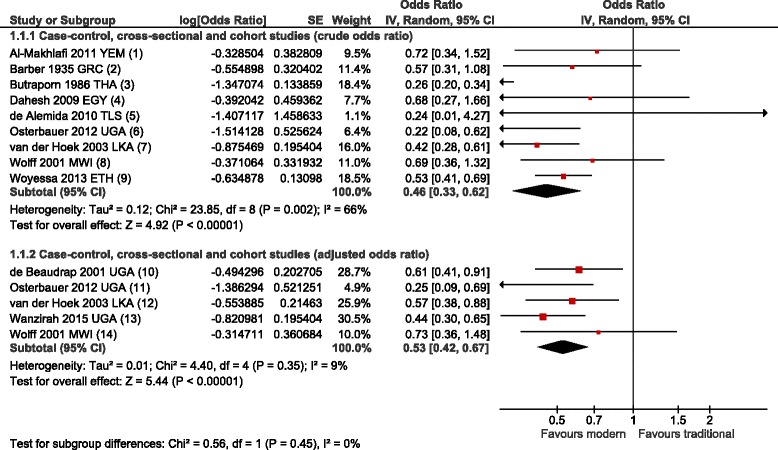
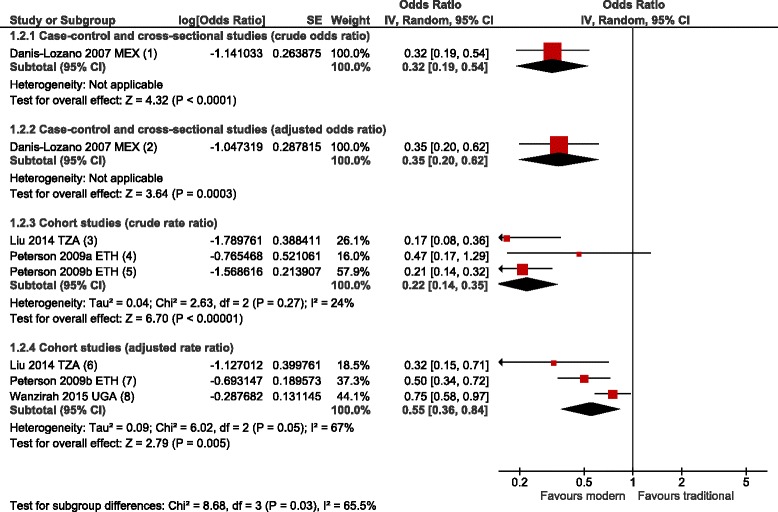
BACKGROUND: The global malaria burden has fallen since 2000, sometimes before large-scale vector control programmes were initiated. While long-lasting insecticide-treated nets and indoor residual spraying are highly effective interventions, this study tests the hypothesis that improved housing can reduce malaria by decreasing house entry by malaria mosquitoes. METHODS: A systematic review and meta-analysis was conducted to assess whether modern housing is associated with a lower risk of malaria than traditional housing, across all age groups and malaria-endemic settings. Six electronic databases were searched to identify intervention and observational studies published from 1 January, 1900 to 13 December, 2013, measuring the association between house design and malaria. The primary outcome measures were parasite prevalence and incidence of clinical malaria. Crude and adjusted effects were combined in fixed- and random-effects meta-analyses, with sub-group analyses for: overall house type (traditional versus modern housing); screening; main wall, roof and floor materials; eave type; ceilings and elevation. RESULTS: Of 15,526 studies screened, 90 were included in a qualitative synthesis and 53 reported epidemiological outcomes, included in a meta-analysis. Of these, 39 (74%) showed trends towards a lower risk of epidemiological outcomes associated with improved house features. Of studies assessing the relationship between modern housing and malaria infection (n=11) and clinical malaria (n=5), all were observational, with very low to low quality evidence. Residents of modern houses had 47% lower odds of malaria infection compared to traditional houses (adjusted odds ratio (OR) 0°53, 95% confidence intervals (CI) 0°42-0°67, p< 0°001, five studies) and a 45-65% lower odds of clinical malaria (case-control studies: adjusted OR 0°35, 95 % CI 0°20-0°62, p<0°001, one study; cohort studies: adjusted rate ratio 0°55, 95% CI 0°36-0°84, p=0°005, three studies). Evidence of a high risk of bias was found within studies. CONCLUSIONS: Despite low quality evidence, the direction and consistency of effects indicate that housing is an important risk factor for malaria. Future research should evaluate the protective effect of specific house features and incremental housing improvements associated with socio-economic development.
Overview
The claims and statistics of this paper haven’t been checked yet.
Run the check — free, no account needed. It reads the open-access text and checks the sources it cites.
Integrity signals
Registry
Cites
Statistics
Figures
Verification
Claims the paper makes
The claims and statistics of this paper haven’t been checked yet.
Run the check — free, no account needed. It reads the open-access text and checks the sources it cites.
Claims other papers make about this one
Each is checked against this paper’s own text: does it say what the citing paper says it does?
The source backs part of the claim, not all of it — or backs it for a different population, condition or comparison.
In the citing paper
“in many contemporary houses (e.g., houses comprising brick walls and metal roofs), the eaves are often closed [6].”
From Semi-field evaluation of the cumulative effects of a "Lethal House Lure" on malaria mosquito mortality (2019) · cites this paper as [6]
Experimental — accuracy not yet measuredThe cited source says what the claim attributes to it.
In the citing paper
“This sort of house improvement has been proposed as an important route to reducing disease burden [6–8].”
From Semi-field evaluation of the cumulative effects of a "Lethal House Lure" on malaria mosquito mortality (2019) · cites this paper as [6]
In the citing paper
“and that closed eaves, together with modern housing elements, such as metal roofs, window screening, and improved doors, are associated with reduced malaria burdens.10, 11, 12, 13”
From Impact and cost-effectiveness of a lethal house lure against malaria transmission in central Côte d'Ivoire: a two-arm, cluster-randomised controlled trial (2021) · cites this paper as [10]
Self-check
Percentages, sums and reported differences re-computed from the paper’s own numbers.
The self-check needs the paper’s full text.
Citations
Cites
Preferred Reporting Items for Systematic Reviews and Meta-Analyses: the PRISMA statement
Moher, D., Liberati, A., Tetzlaff, J., Altman, D. G., & for the PRISMA Group (2009) · BMJ · doi:10.1136/bmj.b2535 · Cited by 83,823
Preferred Reporting Items for Systematic Reviews and Meta-Analyses: The PRISMA Statement
Moher, D., Liberati, A., Tetzlaff, J., Altman, D. G., & The PRISMA Group (2009) · PLoS Medicine · doi:10.1371/journal.pmed.1000097 · Cited by 64,042
Preferred reporting items for systematic reviews and meta-analyses: the PRISMA Statement.
(2009) · PubMed Central · Cited by 44,859
Dermyshi, E., Wang, Y., Yan, C., Hong, W., Qiu, G., Gong, X., & Zhang, T. (2017) · Neonatology · doi:10.1159/000454668 · Cited by 24,586
Meta-analysis of Observational Studies in Epidemiology<SUBTITLE>A Proposal for Reporting</SUBTITLE>
Stroup, D. F. (2000) · JAMA · doi:10.1001/jama.283.15.2008 · Cited by 20,623
Preferred Reporting Items for Systematic Reviews and Meta-Analyses: The PRISMA Statement
Moher, D., Liberati, A., Tetzlaff, J., & Altman, D. G. (2009) · Journal of Clinical Epidemiology · doi:10.1016/j.jclinepi.2009.06.005 · Cited by 19,575
Wang, G., Ma, R., Qiao, G., Wada, K., Aizawa, Y., & Satoh, T. (2015) · Integrative Medicine International · doi:10.1159/000368408 · Cited by 18,762
(2014) · Medical Entomology and Zoology · Cited by 17,633
Grading quality of evidence and strength of recommendations
(2004) · BMJ · doi:10.1136/bmj.328.7454.1490 · Cited by 8,477
Weltgesundheitsorganisation (2005) · Cited by 3,799
Research works printed but not linked: 6
- Anderson L, Simpson D, Stephens M. Durable housing improvements to fight malaria transmission: Can we learn new strategies from past experience? Atlanta: Habitat for Humanity International Global Programs Department; 2014.
- UN-Habitat: State of African Cities 2010. Governance, inequalities and urban land markets. Nairobi: UN Habitat; 2010.
- RBM/UNDP. Multisectoral action framework for malaria. Geneva: Roll Back Malaria/United Nations Development Programme; 2013.
- Ippolito M, Tusting LS, Gosling R, Dorsey G, Lindsay SW. Malaria and housing: a systematic review and meta-analysis. PROSPERO, 2014: CRD42014009048.
- Cochrane Collaboration. Suggested risk of bias criteria for EPOC reviews. Oxford: Cochrane Collaboration; 2013.
- ICF International. The DHS progam STATcompiler. Calverton: ICF International; 2015.
Cited by
Sorted by citations
Items 301–360 of 360
Ozodiegwu, I. D., Legris, G., Chiziba, C., & Mhlanga, L. (2025) · medRxiv · doi:10.1101/2025.07.21.25331926
Regulations for integrating mosquito control measures in building-byelaws: a techno-legal commentary
Singh, R., Chauhan, A., Jadhav, A., & Frank, A. L. (2025) · Cities & Health · doi:10.1080/23748834.2025.2550873
Freedom and mosquito control: when opting out constitutes a veto of public health interventions
Crutchfield, P., & Chmura, C. (2025) · Journal of Medical Ethics · doi:10.1136/jme-2024-110523
Hydropower development and malaria transmission: A geospatial econometric study
Thomas, C. J. (2025) · Journal of Public Health in Africa · doi:10.4102/jphia.v16i1.1397
Malaria in their words: thematic analysis of online narratives from Sub-Saharan Africa
Zhang, S. H., Nwankwoala, O., Jakazi, C. S., D’Amiano, A. J., Kabuya, J.-B. B., Kapungu, K., Laker, M., & Ippolito, M. M. (2025) · International Journal for Equity in Health · doi:10.1186/s12939-025-02570-8
Self-citationQuispe, A. M., Álvarez-Antonio, C., Rodríguez, F. G., Carey, C., Rodríguez, H., Inti, C., & Kim, E. S. (2025) · PLoS ONE · doi:10.1371/journal.pone.0325089
Remiji, M. J., Mwingira, F., Kiwelu, G., Laizer, T., Govella, N. J., Kiware, S. S., & Chacky, F. (2025) · Research Square · doi:10.21203/rs.3.rs-7744849/v1
Maina, J. J., Ibrahim, M. A., Balogun, E. O., Salihu, M. M., Abdullahi, A. D., Fodeke, H., Usman, H. S., Aliyu, M., & Musa, M. S. (2025) · Research Square · doi:10.21203/rs.3.rs-8172710/v1
Knudsen, J., Pinder, M., Jatta, E., Jawara, M., Yousuf, M. A., Søndergaard, A. T., & Lindsay, S. W. (2020) · Figshare · doi:10.6084/m9.figshare.12750485
Self-citationWafula, S. T., Habermann, T., Franke, M. A., May, J., Puradiredja, D. I., Lorenz, E., & Brinkel, J. (2023) · Figshare · doi:10.6084/m9.figshare.23435122
Mundagowa, P. T., & Chimberengwa, P. T. (2020) · Figshare · doi:10.6084/m9.figshare.12414146
Gallalee, S., Zarlinda, I., Silaen, M. G., Cotter, C., Cueto, C., Elyazar, I. R. F., Jacobson, J. O., Gosling, R., Hsiang, M. S., Bennett, A., et al. (2024) · Figshare · doi:10.6084/m9.figshare.26674724
Self-citationTizifa, T. A., Kabaghe, A. N., McCann, R. S., Gowelo, S., Malenga, T., Nkhata, R. M., Chapeta, Y., Nkhono, W., Kadama, A., Takken, W., et al. (2024) · Figshare · doi:10.6084/m9.figshare.26701414
N’Guessan, R., Assi, S.-B., KOFFI, A. A., Ahoua Alou, P. L., Mian, A., Achee, N. L., Fustec, B., Grieco, J. P., Liu, F., Kumar, S., et al. (2023) · Figshare · doi:10.6084/m9.figshare.24494124
Naserrudin, N. A., Lin, P. Y. P., Monroe, A. C., Baumann, S. E., Adhikari, B., Miller, A. C., Sato, S., Fornace, K. M., Culleton, R. L., Cheah, P. Y., et al. (2024) · Figshare · doi:10.6084/m9.figshare.26637915
Phiri, M. D., McCann, R. S., Kabaghe, A. N., van den Berg, H., Malenga, T., Gowelo, S., Tizifa, T. A., Takken, W., van Vugt, M., Phiri, K. S., et al. (2021) · Figshare · doi:10.6084/m9.figshare.14776603
NG'ANG'A, P. N., Okoyo, C. O., Mbogo, C., & Mutero, C. M. (2020) · Figshare · doi:10.6084/m9.figshare.12980265
McCann, R. S., Kabaghe, A. N., Moraga, P., Gowelo, S., Mburu, M. M., Tizifa, T. A., Chipeta, M. G., Nkhono, W., Pasquale, A. D., Maire, N., et al. (2021) · Figshare · doi:10.6084/m9.figshare.14650839
Mengesha, E., Dessalegne, M., & Tola, H. H. (2022) · Figshare · doi:10.6084/m9.figshare.20962507
Naserrudin, N. A., Lin, P. Y. P., Monroe, A. C., Baumann, S. E., Adhikari, B., Miller, A. C., Sato, S., Fornace, K. M., Culleton, R. L., Cheah, P. Y., et al. (2024) · Figshare · doi:10.6084/m9.figshare.26637909
Mundagowa, P. T., & Chimberengwa, P. T. (2020) · Figshare · doi:10.6084/m9.figshare.12414149
Echodu, D. C., Yeka, A., Eganyu, T., Odude, W., Bukenya, F., Amoah, B., Wanzira, H., Colborn, K. L., Elliott, R. C., Powell, S. E., et al. (2024) · Figshare · doi:10.6084/m9.figshare.26566787
Tamari, N., Minakawa, N., Sonye, G. O., Awuor, B., Kongere, J., Hashimoto, M., Kataoka, M., & Munga, S. (2020) · Figshare · doi:10.6084/m9.figshare.13115325
Tizifa, T. A., Kabaghe, A. N., McCann, R. S., Gowelo, S., Malenga, T., Nkhata, R. M., Chapeta, Y., Nkhono, W., Kadama, A., Takken, W., et al. (2024) · Figshare · doi:10.6084/m9.figshare.26701426
Phiri, M. D., McCann, R. S., Kabaghe, A. N., van den Berg, H., Malenga, T., Gowelo, S., Tizifa, T. A., Takken, W., van Vugt, M., Phiri, K. S., et al. (2021) · Figshare · doi:10.6084/m9.figshare.14776597
Tizifa, T. A., Kabaghe, A. N., McCann, R. S., Gowelo, S., Malenga, T., Nkhata, R. M., Chapeta, Y., Nkhono, W., Kadama, A., Takken, W., et al. (2024) · Figshare · doi:10.6084/m9.figshare.26701417
Phiri, M. D., McCann, R. S., Kabaghe, A. N., van den Berg, H., Malenga, T., Gowelo, S., Tizifa, T. A., Takken, W., van Vugt, M., Phiri, K. S., et al. (2021) · Figshare · doi:10.6084/m9.figshare.14776591
Tizifa, T. A., Kabaghe, A. N., McCann, R. S., Gowelo, S., Malenga, T., Nkhata, R. M., Chapeta, Y., Nkhono, W., Kadama, A., Takken, W., et al. (2024) · Figshare · doi:10.6084/m9.figshare.25530450
Gari, T., Solomon, T., & Lindtjørn, B. (2021) · Figshare · doi:10.6084/m9.figshare.14741245
Naserrudin, N. A., Lin, P. Y. P., Monroe, A. C., Baumann, S. E., Adhikari, B., Miller, A. C., Sato, S., Fornace, K. M., Culleton, R. L., Cheah, P. Y., et al. (2024) · Figshare · doi:10.6084/m9.figshare.26637912
Tizifa, T. A., Kabaghe, A. N., McCann, R. S., Gowelo, S., Malenga, T., Nkhata, R. M., Chapeta, Y., Nkhono, W., Kadama, A., Takken, W., et al. (2024) · Figshare · doi:10.6084/m9.figshare.26701432
Asale, A., Kassie, M. B., Abro, Z., Enchalew, B., Belay, A. K., Sangoro, P. O., Tchouassi, D. P., & Mutero, C. M. (2022) · Figshare · doi:10.6084/m9.figshare.19745080
Phiri, M. D., McCann, R. S., Kabaghe, A. N., van den Berg, H., Malenga, T., Gowelo, S., Tizifa, T. A., Takken, W., van Vugt, M., Phiri, K. S., et al. (2021) · Figshare · doi:10.6084/m9.figshare.14776594
Tamari, N., Minakawa, N., Sonye, G. O., Awuor, B., Kongere, J., Hashimoto, M., Kataoka, M., & Munga, S. (2020) · Figshare · doi:10.6084/m9.figshare.13115322
Tizifa, T. A., Kabaghe, A. N., McCann, R. S., Gowelo, S., Malenga, T., Nkhata, R. M., Chapeta, Y., Nkhono, W., Kadama, A., Takken, W., et al. (2024) · Figshare · doi:10.6084/m9.figshare.26701411
Woolley, K. E., Bartington, S., Pope, F. D., Greenfield, S. M., Tusting, L. S., Price, M. J., & Thomas, G. N. (2022) · Figshare · doi:10.6084/m9.figshare.19670102
Self-citationYaro, J. B., Tiono, A. B., Sanou, A., Toé, K. H., Bradley, J., Ouédraogo, A., Ouedraogo, Z. A., Guelbeogo, M. W., Agboraw, E., Worrall, E., et al. (2021) · Figshare · doi:10.6084/m9.figshare.16780908
Self-citationTizifa, T. A., Kabaghe, A. N., McCann, R. S., Gowelo, S., Malenga, T., Nkhata, R. M., Chapeta, Y., Nkhono, W., Kadama, A., Takken, W., et al. (2024) · Figshare · doi:10.6084/m9.figshare.26701420
Woolley, K. E., Bartington, S., Pope, F. D., Greenfield, S. M., Tusting, L. S., Price, M. J., & Thomas, G. N. (2022) · Figshare · doi:10.6084/m9.figshare.19670099
Self-citationEchodu, D. C., Yeka, A., Eganyu, T., Odude, W., Bukenya, F., Amoah, B., Wanzira, H., Colborn, K. L., Elliott, R. C., Powell, S. E., et al. (2024) · Figshare · doi:10.6084/m9.figshare.26566784
Sanou, R., Maïga, H., Bilgo, E. M., Sawadogo, S. P., Sow, B. B. D., Ouema, A., Bayili, K., Belem, A. M. G., Toe, L. P., Dabiré, R. K., et al. (2021) · Figshare · doi:10.6084/m9.figshare.13514063
Tizifa, T. A., Kabaghe, A. N., McCann, R. S., Gowelo, S., Malenga, T., Nkhata, R. M., Chapeta, Y., Nkhono, W., Kadama, A., Takken, W., et al. (2024) · Figshare · doi:10.6084/m9.figshare.26701423
Gallalee, S., Zarlinda, I., Silaen, M. G., Cotter, C., Cueto, C., Elyazar, I. R. F., Jacobson, J. O., Gosling, R., Hsiang, M. S., Bennett, A. F., et al. (2024) · Figshare · doi:10.6084/m9.figshare.26674721
Self-citationKnudsen, J., Pinder, M., Jatta, E., Jawara, M., Yousuf, M. A., Søndergaard, A. T., & Lindsay, S. W. (2020) · Figshare · doi:10.6084/m9.figshare.12750482
Self-citationSemakula, H. M., Liang, S., Mukwaya, P. I., Mugagga, F., Nseka, D., Wasswa, H., Mwendwa, P., Kayima, P., Achuu, S. P., & Nakato, J. (2023) · Figshare · doi:10.6084/m9.figshare.24247989
Woolley, K. E., Bartington, S., Pope, F. D., Greenfield, S. M., Tusting, L. S., Price, M. J., & Thomas, G. N. (2022) · Figshare · doi:10.6084/m9.figshare.19670105
Self-citationAsale, A., Kassie, M. B., Abro, Z., Enchalew, B., Belay, A. K., Sangoro, P. O., Tchouassi, D. P., & Mutero, C. M. (2022) · Figshare · doi:10.6084/m9.figshare.19745083
Gallalee, S., Zarlinda, I., Silaen, M. G., Cotter, C., Cueto, C., Elyazar, I. R. F., Jacobson, J. O., Gosling, R., Hsiang, M. S., Bennett, A., et al. (2024) · Figshare · doi:10.6084/m9.figshare.26674727
Self-citationYaro, J. B., Ouédraogo, A., Diarra, A., Sombié, S., Ouedraogo, Z. A., Nébié, I., Drakeley, C., Sirima, S. B., Tiono, A. B., Lindsay, S. W., et al. (2021) · Figshare · doi:10.6084/m9.figshare.16575854
Self-citationPhiri, M. D., McCann, R. S., Kabaghe, A. N., van den Berg, H., Malenga, T., Gowelo, S., Tizifa, T. A., Takken, W., van Vugt, M., Phiri, K. S., et al. (2021) · Figshare · doi:10.6084/m9.figshare.14776600
Tizifa, T. A., Kabaghe, A. N., McCann, R. S., Gowelo, S., Malenga, T., Nkhata, R. M., Chapeta, Y., Nkhono, W., Kadama, A., Takken, W., et al. (2024) · Figshare · doi:10.6084/m9.figshare.25530214
Gao, C., Huang, S., Yin, H., Lu, S., Liu, L., Mlacha, Y. P., Chaki, P., Zhou, X.-N., Xiao, N., Richardson, S., et al. (2026) · BMJ Global Health · doi:10.1136/bmjgh-2025-021154
Control of Mosquito-Based, Vector-Borne Infections in the Built Environment
Singh, R., Madaan, N., & Dewan, A. (2026) · Springer eBooks · doi:10.1007/978-981-95-8624-0_7
Troia, A., Rosso, A., Cioni, G., Calò, G. L., Manzoli, L., & Flacco, M. E. (2026) · Journal of Tropical Medicine · doi:10.1155/jotm/6299085
Shirima, G. S., Mirau, S., Mwalimu, C. D., Gitanya, M. P., Chitnis, N., Kiware, S. S., & Masserey, T. (2026) · Current Research in Parasitology and Vector-Borne Diseases · doi:10.1016/j.crpvbd.2026.100429
Perdana, A. A., Kiptiyah, N. M., & Wahyono, T. Y. M. (2026) · Research Square · doi:10.21203/rs.3.rs-10996348/v1
Godspower, J. (2026) · Research Square · doi:10.21203/rs.3.rs-10932563/v1
MITSHENDI, G. K. (2026) · REVUE DES SCIENCES DE LA SANTE · doi:10.71004/rss.026.v5.i2.149
Mziray, N., Mandai, S. S., Petro, D. A., Francis, F., Seth, M. D., Madebe, R. A., Kisambale, A. J., Pereus, D., Nsanzabana, C., Semboja, H. J., et al. (2026) · doi:10.12688/verixiv.3787.1
Metadata
- Authors
- Tusting, L. S., Ippolito, M. M., Willey, B. A., Kleinschmidt, I., Dorsey, G., Gosling, R. D., & Lindsay, S. W.
- Affiliations
- London School of Hygiene & Tropical Medicine (GB)
- Johns Hopkins University (US)
- University of California, San Francisco (US)
- Durham University (GB)
- Corresponding author
- Tusting, Lucy S
- ORCID
- Venue
- Malaria Journal
- Published
- 2015-06-09
- Volume
- 14
- Issue
- 1
- Pages
- 209-209
- ISSN
- 1475-2875 (ISSN-L)
- PMC
- PMC4460721
- OpenAlex
- W1542774706
- Cited by
- 355
- References
- 36
- Citations by year
- 2026: 12 · 2025: 36 · 2024: 31 · 2023: 38 · 2022: 35 · 2021: 60 · 2020: 39 · 2019: 21 · 2018: 25 · 2017: 26 · 2016: 24 · 2015: 8
- FWCI
- 4.01
- Type
- journal article
- Language
- en
- Open access
- gold
- doi.org
- Locations
- Malaria Journal (publishedVersion, cc-by)
- PubMed Central (publishedVersion, cc-by)
- PubMed (publishedVersion)
- Durham Research Online (Durham University) (acceptedVersion, other-oa)
- LSHTM Research Online (London School of Hygiene and Tropical Medicine) (acceptedVersion)
- Durham Research Online (Durham University) (submittedVersion, cc-by)
- Funders
- U.S. Department of Homeland Security
- Bill and Melinda Gates Foundation (OPP1053338)
- Novartis Foundation for Sustainable Development
- Novartis Foundation
- Leverhulme Trust
- Department for International Development
- National Institutes of Health
- Science and Technology Directorate
- Medical Research Council (MR/K012126/1)
- National Institute of Allergy and Infectious Diseases (U19AI089674)
- Fogarty International Center
- Topics
- Health Sciences › Medicine › Public Health, Environmental and Occupational Health › Malaria Research and Control
- Health Sciences › Medicine › Public Health, Environmental and Occupational Health › Mosquito-borne diseases and control
- Social Sciences › Urban Studies › Urban and Rural Development Challenges
- Keywords
- malaria, housing design, modern housing, traditional dwellings, house screening, malaria risk factors, parasite prevalence, clinical malaria incidence, eaves, socio-economic development
- MeSH terms
- Housing, Humans, Malaria, Mosquito Control, Incidence, Prevalence
About these checks
Registry, retraction, Cites and statistics results are computed, not judged, with one exception: a printed reference that no index lists is read once by a model before it counts as a citation error. Claims are extracted by a model and kept only when their quote appears verbatim in the text; each cited source is then checked, with a model’s help, for whether it says what the claim relies on. Those verdicts can be wrong — read the claim’s quote and the cited source before relying on one.
Statistics and arithmetic are recomputed, not judged.
Confidence bands are shown only for fields calibrated on our annotated test set. None is calibrated yet, so no band is shown.
What counts as a claim ›How we measure confidence ›How we check this ›
Are you an author, or do you see a problem with this page? Request a review
