

Spatial and temporal variation of malaria entomological parameters at the onset of a hydro-agricultural development in central Côte d’Ivoire
Open accessThe DOI matches its Crossref record; 47 of the 47 references it cites were found in a registry or an index.
Abstract
BACKGROUND: A deeper understanding of the ecology and small-scale heterogeneity of malaria transmission is essential for the design of effective prevention, control and elimination interventions. The spatial and temporal distribution of malaria vectors was investigated in five villages in close proximity to a hydro-agricultural system in Côte d'Ivoire over the course of construction and the early phase of irrigated rice farming. METHODS: The study was carried out in five villages (Raffierkro, N'Douakro, Ahougui, Kpokahankro, Koffikro) near Bouaké, central Côte d'Ivoire, between early 2007 and late 2009. In each village, mosquitoes were collected by human landing catches and identified morphologically at genus and species level, and entomological parameters were determined. Plasmodium infection was assessed by dissection and an enzyme-linked immunosorbent assay. RESULTS: A total of 19,404 mosquitoes belonging to the genus Anopheles were sampled during 328 human-night catches. Before the construction of the hydro-agricultural system, comparable densities of Anopheles gambiae were observed in all villages. In subsequent years, densities in Raffierkro and Ahougui were significantly higher than the other villages [Kruskal-Wallis (KW) test = 31.13, p < 0.001]. The density of Anopheles funestus in the five villages was comparable in the early stage of the project, while a high density was reported in Koffikro at the end (KW test = 11.91, p = 0.018). Transmission of Plasmodium falciparum is perennial in the study area. Over the course of the study, high entomological inoculation rates (EIRs) were found: 219-328 infectious bites per person per year with An. gambiae. For An. funestus considerably lower EIRs were observed (5.7-39.4). Changing patterns of An. gambiae were not correlated with malaria transmission. CONCLUSION: In this study setting, located in the bioclimatic transition zone of Côte d'Ivoire, rice cultivation was not observed to increase malaria transmission. The entomological parameters recorded until the onset of rice-growing activities in a hydro-agricultural system presented considerable heterogeneity both in space and time; a strong increase of Anopheles mosquitoes was observed in two of the five villages located in close proximity to the dam and irrigated rice fields. Malaria still is a main public health problem in all villages that require adequate control measures.
Overview
The claims and statistics of this paper haven’t been checked yet.
Free: it reads the open-access text and checks the first 5 claims that cite a source we can check. Create a free account to check every claim.
Integrity signals
Registry
Cites
Statistics
Figures
Verification
Claims the paper makes
The claims and statistics of this paper haven’t been checked yet.
Free: it reads the open-access text and checks the first 5 claims that cite a source we can check. Create a free account to check every claim.
Claims other papers make about this one
Each is checked against this paper’s own text: does it say what the citing paper says it does?
The cited source doesn’t support the claim as written.
In the citing paper
“Several studies have shown that four vector species, An. gambiae s.s, An. coluzzii, An. funestus and An. nili, are responsible for malaria transmission (Diakité et al. 2015; Zogo et al. 2019).”
From Resting and feeding behaviour of malaria vectors, in two areas of high long-lasting insecticidal nets coverage in Côte d'Ivoire (2024) · cites this paper as Diakité et al. 2015
Checked by a reasoning model — may be wrong.
Experimental — accuracy not yet measuredThe source backs part of the claim, not all of it — or backs it for a different population, condition or comparison.
In the citing paper
“Moreover, EIR in the study area was equally high indoors and outdoors and varied across health districts in both vector species, possibly linked to the high vector abundance in the area [14].”
From Entomological indicators of malaria transmission prior to a cluster-randomized controlled trial of a 'lethal house lure' intervention in central Côte d'Ivoire (2022) · cites this paper as [14]
Experimental — accuracy not yet measuredThe source backs part of the claim, not all of it — or backs it for a different population, condition or comparison.
In the citing paper
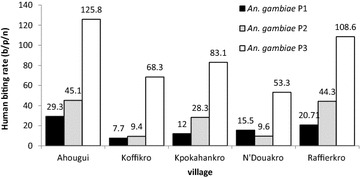
“The main malaria vector, Anopheles gambiae sensu lato (s.l.) was highly resistant to almost all public health classes of insecticides [13], with 125.8 bites per human per night and entomological inoculation rates (EIR), reaching 459.9 infected bites per human per night in some rural places of the districts [14].”
From Entomological indicators of malaria transmission prior to a cluster-randomized controlled trial of a 'lethal house lure' intervention in central Côte d'Ivoire (2022) · cites this paper as [14]
Experimental — accuracy not yet measured
Self-check
Percentages, sums and reported differences re-computed from the paper’s own numbers.
The self-check needs the paper’s full text.
Citations
Cites
Murray, C. J. L., Vos, T., Lozano, R., Naghavi, M., Flaxman, A. D., Michaud, C., Ezzati, M., Shibuya, K., Salomon, J. A., Abdalla, S., et al. (2012) · The Lancet · doi:10.1016/s0140-6736(12)61689-4 · Cited by 8,888
Steinmann, P., Keiser, J., Bos, R., Tanner, M., & Utzinger, J. (2006) · The Lancet Infectious Diseases · doi:10.1016/s1473-3099(06)70521-7 · Cited by 2,156 · cited 1×
“On the one hand, this commitment lead to an improvement of agricultural production and inland fish cultivation, but on the other hand, these water resources development and management projects altered the risk of water-based and vector-borne diseases, such as schistosomiasis and malaria [3, 4].”
BackgroundSelf-citationDetinova, T. S. (1962) · The Journal of Parasitology · doi:10.2307/3275215 · Cited by 804 · cited 1×
“nili females were dissected to determine the degree of ovarian tracheoles coiling [23].”
BackgroundThe Anophelinae of Africa south of the Sahara (Ethiopian Zoogeographical Region).
Gillies, M. T., & Meillon, B. D. (1968) · Cited by 776
Aregawi, M. W., Cibulskis, R. E., Otten, M. W., Williams, R. O., & Dye, C. (2008) · Cited by 595
Ghebreyesus, T. A., Haile, M., Witten, K. H., Getachew, A., Yohannes, A. M., Yohannes, M., Teklehaimanot, H. D., Lindsay, S. W., & Byass, P. (1999) · BMJ · doi:10.1136/bmj.319.7211.663 · Cited by 247 · cited 6×
“The Anophelinae of Africa south of the Sahara (Ethiopian Region).”
ResultInfluentialHamers, J. P. H., & JONGE, J. D. (1997) · PubMed · Cited by 237
Fillinger, U., Sonye, G., Killeen, G. F., Knols, B. G. J., & Becker, N. (2004) · Tropical Medicine & International Health · doi:10.1111/j.1365-3156.2004.01335.x · Cited by 218 · cited 1×
“areas [32].”
Resistance of Anopheles gambiae s.s. to pyrethroids in Côte d'Ivoire.
Élissa, N., Mouchet, J., Rivière, F., Meunier, J., & Yao, K. (1993) · PubMed · Cited by 204
Antonio-nkondjio, C., Kerah, C. H., Simard, F., Awono-ambene, P., Chouaibou, M., Tchuinkam, T., & Fontenille, D. (2006) · Journal of Medical Entomology · doi:10.1093/jmedent/43.6.1215 · Cited by 196
COHUET, A., SIMARD, F., TOTO, J.-C., KENGNE, P., COETZEE, M., & FONTENILLE, D. (2003) · The American Journal of Tropical Medicine and Hygiene · doi:10.4269/ajtmh.2003.69.200 · Cited by 194 · cited 7×
“The Anophelinae of Africa south of the Sahara (Ethiopian Region).”
ResultInfluentialInternational Commission on Large Dams
LEA, F. M. (1936) · Nature · doi:10.1038/138768a0 · Cited by 173
A transdisciplinary perspective on the links between malaria and agroecosystems in Kenya
Mutero, C. M., Kabutha, C., Kimani, V. N., Kabuage, L. W., Gitau, G. K., Ssennyonga, J. W., Githure, J. I., Muthami, L., Kaida, A., Musyoka, L. W., et al. (2003) · Acta Tropica · doi:10.1016/j.actatropica.2003.07.003 · Cited by 147
Lindsay, S. W., Wilkins, H. A., Zieler, H., DALY, R. J., Petrarca, V., & Byass, P. (1991) · PubMed · Cited by 115
Malaria transmission in relation to rice cultivation in the irrigated Sahel of Mali
Dolo, G., Briët, O. J. T., Dao, A., Traoré, S. F., Bouaré, M., Sogoba, N., Niaré, O., Bagayogo, M., Sangaré, D., Teuscher, T., et al. (2004) · Acta Tropica · doi:10.1016/j.actatropica.2003.10.014 · Cited by 112
Kibret, S., Wilson, G. G., Tekie, H., & Petros, B. (2014) · Malaria Journal · doi:10.1186/1475-2875-13-360 · Cited by 111 · cited 1×
“However, contrasting findings were made in central Ethiopia and in the forest area of western Côte d’Ivoire, where irrigation canals, non-functional canal pools and extensive cultivation of rice resulted in favourable conditions to vector breeding sites, thus facilitating high malaria transmission [41–44].”
ResultIdentification of Malaria-Infected Mosquitoes by a Two-Site Enzyme-Linked Immunosorbent Assay
Burkot, T. R., Zavala, F., Gwadz, R. W., Collins, F. H., Nussenzweig, R. S., & Roberts, D. R. (1984) · The American Journal of Tropical Medicine and Hygiene · doi:10.4269/ajtmh.1984.33.227 · Cited by 94 · cited 1×
“falciparum circumsporozoite protein [25].”
Githeko, A. K., Service, M. W., Mbogo, C. M., Atieli, F. K., & Juma, F. O. (1993) · Annals of Tropical Medicine & Parasitology · doi:10.1080/00034983.1993.11812782 · Cited by 92 · cited 1×
“funestus [45, 46].”
Entomological indices of malaria transmission in Chikhwawa district, Southern Malawi
Mzilahowa, T., Hastings, I. M., Molyneux, M. E., & McCall, P. J. (2012) · Malaria Journal · doi:10.1186/1475-2875-11-380 · Cited by 90
La transmission du paludisme dans la zone de Niakhar, Sénégal
Robert, V., Dieng, H., Lochouarn, L., Traoré, S. F., Trape, J. ‐., Simondon, F., & Fontenille, D. (1998) · Tropical Medicine & International Health · doi:10.1046/j.1365-3156.1998.00288.x · Cited by 86 · cited 1×
“in rice-cultivating areas [33–35].”
Parasitic diseases in water resources development: The need for intersectoral negotiation
..., J. M. H. (1993) · Cited by 83
Malaria incidence in relation to rice cultivation in the irrigated Sahel of Mali
Sissoko, M. S., Dicko, A., Briët, O., Sissoko, M., Sagara, I., Dembele, H. K., Sogoba, M., Rogier, C., Touré, Y. T., & Doumbo, O. K. (2003) · Acta Tropica · doi:10.1016/j.actatropica.2003.10.015 · Cited by 83 · cited 1×
“These results are similar to those observed in the savannah [39, 40].”
ResultJaleta, K. T., Hill, S. R., Seyoum, E., Balkew, M., Gebre-Michael, T., Ignell, R., & Tekie, H. (2013) · Malaria Journal · doi:10.1186/1475-2875-12-350 · Cited by 76
Adja, A. M., N’goran, E. K., Koudou, B. G., Dia, I., Kengne, P., Fontenille, D., & Chandre, F. (2011) · Annals of Tropical Medicine & Parasitology · doi:10.1179/136485910x12851868780388 · Cited by 69
Self-citationThe phenology of malaria mosquitoes in irrigated rice fields in Mali
Klinkenberg, E., Takken, W., Huibers, F. P., & Touré, Y. T. (2002) · Acta Tropica · doi:10.1016/s0001-706x(02)00254-1 · Cited by 67 · cited 1×
“However, contrasting findings were made in central Ethiopia and in the forest area of western Côte d’Ivoire, where irrigation canals, non-functional canal pools and extensive cultivation of rice resulted in favourable conditions to vector breeding sites, thus facilitating high malaria transmission [41–44].”
ResultHenry, M. ‐., Rogier, C., Nzeyimana, I., Assi, S. B., Dossou‐Yovo, J., Audibert, M., Mathonnat, J., Keundjian, A., Akodo, E., Teuscher, T., et al. (2003) · Tropical Medicine & International Health · doi:10.1046/j.1365-3156.2003.01053.x · Cited by 66
Briët, O. J. T., Dossou‐Yovo, J., Akodo, E., Van De Giesen, N., & Teuscher, T. M. (2003) · Tropical Medicine & International Health · doi:10.1046/j.1365-3156.2003.01054.x · Cited by 62
Khaemba, B. M., Mutani, A., & Bett, M. K. (1994) · PubMed · Cited by 59
Tia, E., Akogbeto, M. C., Koffi, A. A., Toure, M., Adja, A. M., Moussa, K., Yao, T., Carnevale, P., & Chandre, E. (2006) · PubMed · Cited by 54
Self-citationDia, I., Konaté, L., Samb, B., Sarr, J.-B., Diop, A., Rogerie, F., Faye, M., Riveau, G. J., Remoué, F., Diallo, M., et al. (2008) · Acta Tropica · doi:10.1016/j.actatropica.2007.10.010 · Cited by 54
Parasitic diseases in water resources development. The need for intersectoral negotiation
Luke, R. A. (1994) · International Journal for Parasitology · doi:10.1016/0020-7519(94)90098-1 · Cited by 53
Effect of Rice Cultivation on Malaria Transmission in Central Kenya
Muturi, E. J., Muriu, S., Shililu, J., Mwangangi, J., Jacob, B. G., Mbogo, C., Githure, J., & Novak, R. J. (2008) · The American Journal of Tropical Medicine and Hygiene · doi:10.4269/ajtmh.2008.78.270 · Cited by 47 · cited 1×
“in rice-cultivating areas [33–35].”
Marrama, L., Jambou, R., Rakotoarivony, I., Tsi, J. M. L. P., Duchemin, J., Laventure, S., Mouchet, J., & Roux, J. (2003) · Acta Tropica · doi:10.1016/j.actatropica.2003.09.014 · Cited by 44 · cited 3×
“Marrama L, Rajaonarivelo E, Laventure S, Rabarison P. Anopheles funestus and rice culture on the Plateau of Madagascar.”
ResultAfrane, Y. A., Lawson, B. W., Brenya, R., Kruppa, T., & Yan, G. (2012) · Parasites & Vectors · doi:10.1186/1756-3305-5-233 · Cited by 39
Vector Incrimination and Entomological Inoculation Rates
Beier, J. C. (2003) · Humana Press eBooks · doi:10.1385/1-59259-271-6:01 · Cited by 39
[Anopheles funestus and rice agriculture in the Madagascar highlands].
Marrama, L., Rajaonarivelo, E., Laventure, S., & Rabarison, P. (1995) · PubMed · Cited by 37
[The epidemiology of malaria in the southwestern forests of the Ivory Coast (Tai region)].
Nzeyimana, I., Henry, M.-C., Dossou-yovo, J., Doannio, J. M. C., Diawara, L., & Carnevale, P. (2002) · PubMed · Cited by 35
Dadzie, S. K., Brenyah, R., & Appawu, M. A. (2013) · Journal of Vector Ecology · doi:10.1111/j.1948-7134.2013.12015.x · Cited by 29 · cited 7×
“The Anophelinae of Africa south of the Sahara (Ethiopian Region).”
ResultInfluentialDoannio, J. M. C., Dossou-yovo, J., Diarrassouba, S., Rakotondraibe, M. E., Chauvancy, G., Chandre, F., Rivière, F., & Carnevale, P. (2002) · PubMed · Cited by 25
[Vectorial transmission of malaria in shrubby Savannah area at Ganse, Ivory Coast].
Am, A., Ke, N., Kengne, P., Koudou, G. B., Touré, M., Aa, K., Tia, E., Fontenille, D., & Chandre, F. (2006) · PubMed · Cited by 23
Betsi, A. N., Tchicaya, E. S., & Koudou, B. G. (2012) · Bulletin de la Société de pathologie exotique · doi:10.1007/s13149-012-0219-z · Cited by 19
[Anopheles funestus and rice agriculture in the Madagascar highlands].
Marrama, L., Rajaonarivelo, E., Laventure, S., et al. (1996) · PubMed · Cited by 16
Diakité, N. R., Adja, A. M., von Stamm, T., Utzinger, J., & N’Goran, E. K. (2010) · Bulletin de la Société de pathologie exotique · doi:10.1007/s13149-009-0029-4 · Cited by 15
Self-citationBétsi, N. A., Koua, H. K., & Foua-Bi, K. (2003) · Cahiers Agricultures · Cited by 9
A convenient technique for the dissection of mosquito salivary glands
Strome, C. P. A., DeSantis, P. L., Leef, J. L., & Beaudoin, R. L. (1980) · Methods in Cell Science · doi:10.1007/bf01665897 · Cited by 6
Koudou, B. G., Ouattara, F., Edi, A. V. C., Nsanzabana, C., Tia, E., Tchicaya, E. S. F., Tanner, M., Bonfoh, B., Dagnogo, M., & Utzinger, J. (2010) · PubMed · Cited by 4
Self-citationKoudou, B. G., Ouattara, F., Edi, A. V. C., Nsanzabana, C., Tia, E., Tchicaya, E. S. F., Tanner, M., Bonfoh, B., Dagnogo, M., & Utzinger, J. (2010) · Médecine Tropicale · Cited by 3
Self-citation
Research works printed but not linked: 6
- Adja MA N’Goran KE Kengne P Koudou GB Touré M Koffi AA Transmission vectorielle du paludisme en savane arborée à Gansé Côte d’Ivoire Med Trop 2006 66 445 455 17201288
- Tia E, Akogbeto M, koffi A, Touré M, Adja MA, Moussa K, et al. Situation de la résistance d’Anopheles gambiae s.s (Diptera:Culicidae) aus pyréthrinoides at au DDT dans Cinq écosystèmes agricoles de Côte d’Ivoire. Bull soc Pathol Exot. 2006;99:278–82. 17111979
- Doannio JMC Dossou-Yovo J Diarrassouba S Rakotondraibé ME Chauvancy G Chandre F La dynamique de la transmission du paludisme à Kafiné, un village rizicole en zone de savane humide de Côte d’Ivoire Bull Soc Pathol Exot 2002 95 11 16 12012955
- Dolo G Briet OJ Dao A Traore SF Bouare M Sogoba N Malaria transmission in relation to rice cultivation in the irrigated Sahel of Mali Acta Trop 2004 89 147 159 10.1016/j.actatropica.2003.10.014 14732237 · DOI · Paper page
- Nzeyimana I Henry MC Dossou-Yovo J Doannio JMC Diawara L Carnevale P Épidémiologie du paludisme dans le Sud-Ouest forestier de la Côte-d’Ivoire (Région de Taï) Bull Soc Pathol Exot 2002 95 89 94 12145967
- Marrama L Rajaonarivelo E Laventure S Rabarison P Anopheles funestus and rice culture on the Plateau of Madagascar Cahi Etu Recher Franc Sante 1995 5 415 419 8784552
Cited by
Chan, K., Tusting, L. S., Bottomley, C., Saito, K., Djouaka, R., & Lines, J. (2021) · The Lancet Planetary Health · doi:10.1016/s2542-5196(21)00349-1 · Cited by 103
Rice volatiles lure gravid malaria mosquitoes, Anopheles arabiensis
Wondwosen, B., Birgersson, G., Seyoum, E., Tekie, H., Torto, B., Fillinger, U., Hill, S. R., & Ignell, R. (2016) · Scientific Reports · doi:10.1038/srep37930 · Cited by 87
Kahamba, N. F., Finda, M. F., Ngowo, H. S., Msugupakulya, B. J., Baldini, F., Koekemoer, L. L., Ferguson, H. M., & Okumu, F. O. (2022) · Malaria Journal · doi:10.1186/s12936-022-04198-3 · Cited by 67
“In west African countries such as Ghana [37], Côte d’Ivoire [38], and Benin [39], An.”
BackgroundOumbouke, W. A., Pignatelli, P., Barreaux, A. M. G., Tia, I. Z., Koffi, A. A., Ahoua Alou, L. P., Sternberg, E. D., Thomas, M. B., Weetman, D., & N’Guessan, R. (2020) · Scientific Reports · doi:10.1038/s41598-020-71933-8 · Cited by 49
Diakité, N. R., Winkler, M. S., Coulibaly, J. T., Guindo‐Coulibaly, N., Utzinger, J., & N'Goran, E. K. (2017) · Infectious Diseases of Poverty · doi:10.1186/s40249-017-0305-3 · Cited by 49
“Ahougui, Koffikro, Kpokahankro, N’Douakro and Raffierkro) [18] and two villages without activities in proximity to the small dam (i.”
BackgroundSelf-citation
Metadata
- Authors
- Diakité, N. R., Guindo-Coulibaly, N., Adja, A. M., Ouattara, M., Coulibaly, J. T., Utzinger, J., & N’Goran, E. K.
- Affiliations
- Université Félix Houphouët-Boigny (CI)
- Swiss Tropical and Public Health Institute (CH)
- Corresponding author
- Diakité, Nana R.
- Venue
- Malaria Journal
- Published
- 2015-09-05
- Volume
- 14
- Issue
- 1
- Pages
- 340-340
- ISSN
- 1475-2875 (ISSN-L)
- PMC
- PMC4560863
- OpenAlex
- W2167199369
- Cited by
- 26
- References
- 47
- Citations by year
- 2024: 5 · 2023: 2 · 2022: 8 · 2021: 4 · 2020: 3 · 2019: 1 · 2018: 1 · 2017: 1 · 2016: 1
- FWCI
- 1.07
- Type
- journal article
- Language
- en
- Open access
- gold
- doi.org
- Licence
- cc-by
- Locations
- Malaria Journal (publishedVersion, cc-by)
- Europe PMC (PubMed Central) (publishedVersion, cc-by)
- PubMed Central (publishedVersion, cc-by)
- PubMed (publishedVersion)
- edoc (University of Basel) (acceptedVersion)
- Funders
- FAIRMED (Raffierkro SE 32515)
- Topics
- Health Sciences › Medicine › Public Health, Environmental and Occupational Health › Malaria Research and Control
- Health Sciences › Medicine › Public Health, Environmental and Occupational Health › Mosquito-borne diseases and control
- Health Sciences › Medicine › Infectious Diseases › Parasitic Diseases Research and Treatment
- Keywords
- malaria vectors, Anopheles gambiae, Anopheles funestus, entomological inoculation rate, malaria transmission, irrigated rice farming, hydro-agricultural development, spatiotemporal heterogeneity, Plasmodium falciparum, Bouaké, Côte d'Ivoire, malaria control planning, human landing catches
- MeSH terms
- Agriculture, Animals, Anopheles, Cross-Sectional Studies, Humans, Insect Bites and Stings, Insect Vectors, Cote d'Ivoire, Malaria, Spatio-Temporal Analysis
About these checks
Registry, retraction, Cites and statistics results are computed, not judged, with one exception: a printed reference that no index lists is read once by a model before it counts as a citation error. Claims are extracted by a model and kept only when their quote appears verbatim in the text; each cited source is then checked, with a model’s help, for whether it says what the claim relies on. Those verdicts can be wrong — read the claim’s quote and the cited source before relying on one.
Statistics and arithmetic are recomputed, not judged.
Confidence bands are shown only for fields calibrated on our annotated test set. None is calibrated yet, so no band is shown.
What counts as a claim ›How we measure confidence ›How we check this ›
Are you an author, or do you see a problem with this page? Request a review
Data sources
Bibliographic data: Semantic Scholar, OpenAlex, Crossref.
Contains information from the Semantic Scholar Academic Graph Datasets, made available under the ODC Attribution License (ODC-BY 1.0).
Semantic Scholar’s data is described in: Kinney, R., et al. (2023). The Semantic Scholar Open Data Platform. arXiv:2301.10140.
