

Gender differences in perceived food healthiness and food avoidance in a Swedish population-based survey: a cross sectional study
Open accessThe DOI matches its Crossref record; 15 of the 15 references it cites were found in a registry or an index.
Abstract
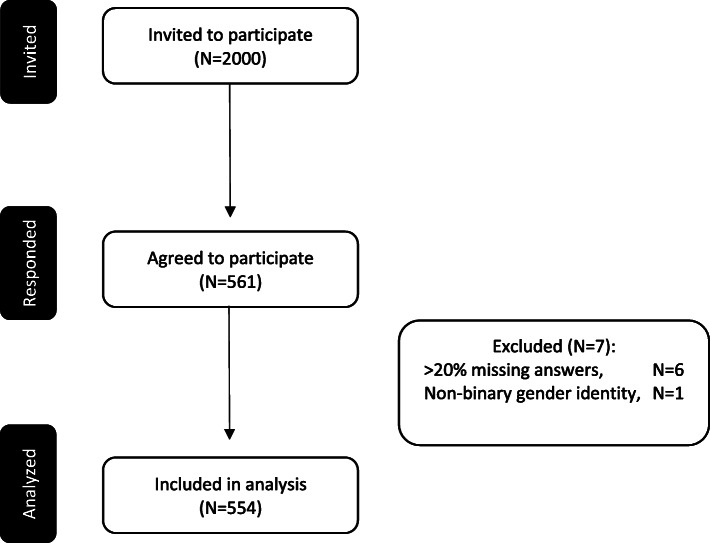
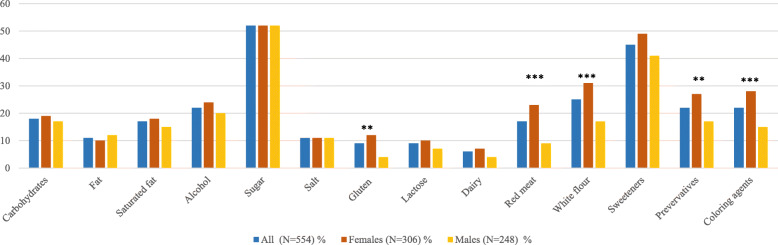
BACKGROUND: The aim of this work was to study potential gender differences in perceived food healthiness and food avoidance in a population-representative sample of the Swedish adult population. METHODS: A questionnaire regarding diet and health was posted to 2000 randomly selected residents in Sweden, aged 20-65 years. Questions were posed regarding which foods or food components the participants avoided due to perceived unhealthiness and how healthy they believed the food items to be. The pre-specified food components included sugar, carbohydrate, gluten, lactose, dairy, fat, saturated fat, red meat, white flour, salt, alcohol and food additives (specifically glutamate, sweetening, preservative and coloring agents). Chi square tests were used to study differences in perceived food healthiness and food avoidance depending on gender. RESULTS: Around 50% reported avoidance of sugar (51.6%) and sweeting agents (45.2%), whereas fewer reported avoidance of saturated fat (16.8%) and salt (10.6%). Women were more likely than men to avoid gluten (AOR [95% CI] 2.84 [1.33-6.05]), red meat (3.29 [1.86-5.80]), white flour (2.64 [1.65-4.21]), preservatives (1.7 [1.07-2.70]) and coloring agents (2.10 [1.29-3.41]) due to perceived unhealthiness. Gender differences were also apparent in perceived healthiness of sugar, gluten, dairy, red meat, white flour, alcohol and food additives, where women tended to be more negative than men in their attitudes. Women more often said to read new findings in media about diet (16% vs 9%, p = 0.029) and prioritize a healthy lifestyle (35% vs 25%, p = 0.015). More than a third of both women and men reported worrying over the healthiness of their diet, and a higher proportion of women than men (18% vs 11%, p = 0.015) agreed with the statement that they were often anxious over having an unhealthy diet. CONCLUSIONS: Women in this population-based study of residents in Sweden were more likely than men to avoid eating gluten, red meat, white flour and food additives due to perceived unhealthiness, and reported more diet and health related anxiety. Future research to identify effective ways of promoting healthy eating for both women and men, while minimizing diet-health related anxiety, is highly warranted.
Overview
The claims and statistics of this paper haven’t been checked yet.
Free: it reads the open-access text and checks the first 5 claims that cite a source we can check. Create a free account to check every claim.
Integrity signals
Registry
Cites
Statistics
Figures
Verification
Claims the paper makes
The claims and statistics of this paper haven’t been checked yet.
Free: it reads the open-access text and checks the first 5 claims that cite a source we can check. Create a free account to check every claim.
Claims other papers make about this one
Each is checked against this paper’s own text: does it say what the citing paper says it does?
The cited source says what the claim attributes to it.
In the citing paper
“For example, women are more health-conscious and risk-averse than men [62,63,64] and thus may not be in favour of upcycled foods [22,25,59] as they probably perceive these foods as unhealthy options.”
From Challenges for Upcycled Foods: Definition, Inclusion in the Food Waste Management Hierarchy and Public Acceptability (2021) · cites this paper as [64]
Self-check
Percentages, sums and reported differences re-computed from the paper’s own numbers.
The self-check needs the paper’s full text.
Citations
Cites
Afshin, A., Sur, P. J., Fay, K. A., Cornaby, L., Ferrara, G., Salama, J. S., Mullany, E. C., Abate, K. H., Abbafati, C., Abebe, Z., et al. (2019) · The Lancet · doi:10.1016/s0140-6736(19)30041-8 · Cited by 5,811
Gender differences in food choice: The contribution of health beliefs and dieting
Wardle, J., Haase, A. M., Steptoe, A., Nillapun, M., Jonwutiwes, K., & Bellisie, F. (2004) · Annals of Behavioral Medicine · doi:10.1207/s15324796abm2702_5 · Cited by 1,358
Gender differences in health information behaviour: a Finnish population-based survey
Ek, S. (2015) · Health Promotion International · doi:10.1093/heapro/dat063 · Cited by 559
Nordic Nutrition Recommendations 2012 : Integrating nutrition and physical activity
Nordic Council of Ministers (2014) · Nordic Council of Ministers eBooks · doi:10.26530/oapen_483279 · Cited by 482
Gender Differences in Opinions and Practices with Regard to a "Healthy Diet">
FAGERLI, R. A., & WANDEL, M. (1999) · Appetite · doi:10.1006/appe.1998.0188 · Cited by 315
Eating Sweet Snacks: Gender Differences in Attitudes and Behaviour
Grogan, S., BELL, R., & Conner, M. T. (1997) · Appetite · doi:10.1006/appe.1996.0067 · Cited by 135
Drake, I., Gullberg, B., Sonestedt, E., Wallström, P., Persson, M., Hlebowicz, J., Nilsson, J., Hedblad, B., & Wirfält, E. (2013) · Public Health Nutrition · doi:10.1017/s1368980012002789 · Cited by 126
Sundberg, L., Agahi, N., Fritzell, J., & Fors, S. (2018) · International Journal of Public Health · doi:10.1007/s00038-018-1097-3 · Cited by 109
Ambwani, S., Shippe, M., Gao, Z., & Austin, S. B. (2019) · Journal of Eating Disorders · doi:10.1186/s40337-019-0246-2 · Cited by 62
Leikas, S., Lindeman, M., Roininen, K., & Lähteenmäki, L. (2006) · Appetite · doi:10.1016/j.appet.2006.09.009 · Cited by 58
Research works printed but not linked: 1
- Amcoff E, Edberg A, Enghardt Barbieri H, Lindroos A, Nälsén C, Pearson M, et al. Riksmaten – vuxna 2010–11. Livsmedels- och näringsintag bland vuxna i Sverige. National Food Agency. 2010–11. National Food Agency, Uppsala, Sweden. ISBN 978 9177142164.
Cited by
Moshtaghian, H., Bolton, K., & Rousta, K. (2021) · Foods · doi:10.3390/foods10112874 · Cited by 150
The credibility of dietary advice formulated by ChatGPT: Robo-diets for people with food allergies
Niszczota, P., & Rybicka, I. (2023) · Nutrition · doi:10.1016/j.nut.2023.112076 · Cited by 138
Lombardo, M., Feraco, A., Armani, A., Camajani, E., Gorini, S., Strollo, R., Padua, E., Caprio, M., & Bellia, A. (2024) · Frontiers in Nutrition · doi:10.3389/fnut.2024.1414217 · Cited by 105
Sex differences in frailty among older adults
Zeidan, R. S., McElroy, T., Rathor, L., Martenson, M. S., Lin, Y., & Mankowski, R. T. (2023) · Experimental Gerontology · doi:10.1016/j.exger.2023.112333 · Cited by 86
“Additionally, women are less likely to eat processed foods like bleached flour and food additives (B ¨ arebring et al., 2020).”
BackgroundZhao, B.-Y., Huang, L., Xiao, C., Chen, T., Li, S., Wang, X.-J., Huang, S.-X., Hu, R., & Li, H. (2024) · BMC Public Health · doi:10.1186/s12889-024-18324-0 · Cited by 107
“Women place a greater importance on healthy lifestyles than men d o[73], females are more likely to seek health-related information online owing to the role they play in their familie s[72, 74, 75], and women search for health information not only for themselves but also for their children or…”
Background
Metadata
- Authors
- Bärebring, L., Palmqvist, M., Winkvist, A., & Augustin, H.
- Affiliations
- University of Gothenburg (SE)
- Corresponding author
- Bärebring, Linnea
- Venue
- Nutrition Journal
- Published
- 2020-12
- Volume
- 19
- Issue
- 1
- Pages
- 140-140
- ISSN
- 1475-2891 (ISSN-L)
- PMC
- PMC7772926
- OpenAlex
- W3115697607
- Cited by
- 167
- References
- 15
- Citations by year
- 2026: 25 · 2025: 39 · 2024: 37 · 2023: 34 · 2022: 24 · 2021: 8
- FWCI
- 12.37
- Type
- journal article
- Language
- en
- Open access
- gold
- doi.org
- Licence
- cc-by
- creativecommons.org/licenses/by/4.0/ (tdm)
- creativecommons.org/licenses/by/4.0/ (vor, 28 d)
- Locations
- Nutrition Journal (publishedVersion, cc-by)
- PubMed Central (publishedVersion, cc-by)
- PubMed (publishedVersion)
- DOAJ (DOAJ: Directory of Open Access Journals) (submittedVersion, cc-by-sa)
- Topics
- Health Sciences › Medicine › Public Health, Environmental and Occupational Health › Consumer Attitudes and Food Labeling
- Health Sciences › Nursing › Nutrition and Dietetics › Nutrition, Health and Food Behavior
- Health Sciences › Medicine › Public Health, Environmental and Occupational Health › Nutritional Studies and Diet
- Keywords
- gender differences, food avoidance, gluten avoidance, food additives, preservatives, sweeteners, salt avoidance, women's diet, Swedish adults, population survey
- MeSH terms
- Adult, Cross-Sectional Studies, Diet, Female, Food, Humans, Male, Sex Factors, Sweden
About these checks
Registry, retraction, Cites and statistics results are computed, not judged, with one exception: a printed reference that no index lists is read once by a model before it counts as a citation error. Claims are extracted by a model and kept only when their quote appears verbatim in the text; each cited source is then checked, with a model’s help, for whether it says what the claim relies on. Those verdicts can be wrong — read the claim’s quote and the cited source before relying on one.
Statistics and arithmetic are recomputed, not judged.
Confidence bands are shown only for fields calibrated on our annotated test set. None is calibrated yet, so no band is shown.
What counts as a claim ›How we measure confidence ›How we check this ›
Are you an author, or do you see a problem with this page? Request a review
How to cite
Cite CoChat for the checks on this page, and the paper for its own findings.
- This page
- CoChat. (2026). Citation check: Gender differences in perceived food healthiness and food avoidance in a Swedish population-based survey: a cross sectional study. https://app.cochat.ai/papers/10.1186/s12937-020-00659-0
- The paper
- Bärebring, L., Palmqvist, M., Winkvist, A., & Augustin, H. (2020). Gender differences in perceived food healthiness and food avoidance in a Swedish population-based survey: a cross sectional study. Nutrition Journal. https://doi.org/10.1186/s12937-020-00659-0
Data sources
Bibliographic data: Semantic Scholar, OpenAlex, Crossref.
Contains information from the Semantic Scholar Academic Graph Datasets, made available under the ODC Attribution License (ODC-BY 1.0).
Semantic Scholar’s data is described in: Kinney, R., et al. (2023). The Semantic Scholar Open Data Platform. arXiv:2301.10140.
