

Towards health equity: a framework for the application of proportionate universalism
Open accessThe DOI matches its Crossref record; 51 of the 53 references it cites were found in a registry or an index.
Abstract
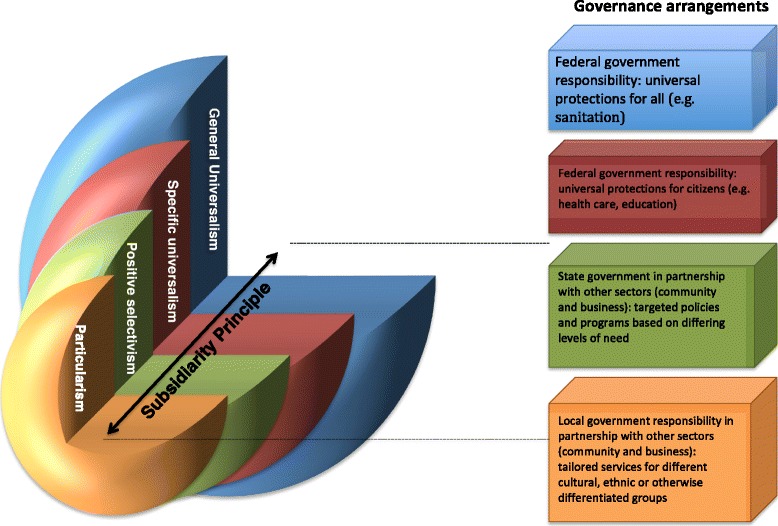
INTRODUCTION: The finding that there is a social gradient in health has prompted considerable interest in public health circles. Recent influential works describing health inequities and their causes do not always argue cogently for a policy framework that would drive the most appropriate solutions differentially across the social gradient This paper aims to develop a practice heuristic for proportionate universalism. METHODS: Through a review the proposed heuristic integrates evidence from welfare state and policy research, the literature on universal and targeted policy frameworks, and a multi-level governance approach that adopts the principle of subsidiarity. RESULTS: The proposed heuristic provides a more-grained analysis of different policy approaches, integral for operationalizing the concept of proportionate universalism. CONCLUSION: The proposed framework would allow governments at all levels, social policy developers and bureaucrats, public health professionals and activists to consider the appropriateness of distinctive policy objectives across distinctive population needs within universal welfare state principles.
Overview
The claims and statistics of this paper haven’t been checked yet.
Free: it reads the open-access text and checks the first 5 claims that cite a source we can check. Create a free account to check every claim.
Integrity signals
Registry
Cites
Statistics
Figures
Verification
Claims the paper makes
The claims and statistics of this paper haven’t been checked yet.
Free: it reads the open-access text and checks the first 5 claims that cite a source we can check. Create a free account to check every claim.
Claims other papers make about this one
Each is checked against this paper’s own text: does it say what the citing paper says it does?
The source backs part of the claim, not all of it — or backs it for a different population, condition or comparison.
In the citing paper
“In our review, most of interventions were either home visiting and then by nature PU because they are almost individual care, either a sum of actions targeting the most deprived (45,61).”
From Theoretical and practical challenges of proportionate universalism: a review (2020) · cites this paper as [45]
Experimental — accuracy not yet measuredThe cited source says what the claim attributes to it.
In the citing paper
“It appears that the precise and practical definition of the principle is not consensual and may lead to different interpretations (45).”
From Theoretical and practical challenges of proportionate universalism: a review (2020) · cites this paper as [45]
Self-check
Percentages, sums and reported differences re-computed from the paper’s own numbers.
The self-check needs the paper’s full text.
Citations
Cites
Hamilton, H., & Marshall, T. H. (1951) · The British Journal of Sociology · doi:10.2307/587460 · Cited by 4,094
Tudor Hart, J. (1971) · The Lancet · doi:10.1016/s0140-6736(71)92410-x · Cited by 3,253
The Concepts and Principles of Equity and Health
Whitehead, M. (1992) · International Journal of Health Services · doi:10.2190/986l-lhq6-2vte-yrrn · Cited by 2,284 · cited 1×
“grammes and workplace smoking bans increase health inequity [32, 33, 34].”
BackgroundThe Three Worlds of Welfare Capitalism.
O'Connell, P. J., & Esping-Anderson, G. (1991) · Social Forces · doi:10.2307/2580262 · Cited by 2,148
Marmot, M. G., Allen, J., Goldblatt, P., Boyce, T., McNeish, D., Grady, M., & Geddes, I. (2010) · Europe PMC (PubMed Central) · Cited by 1,404
What types of interventions generate inequalities? Evidence from systematic reviews
Lorenc, T., Petticrew, M., Welch, V., & Tugwell, P. (2013) · Journal of Epidemiology and Community Health · doi:10.1136/jech-2012-201257 · Cited by 927
Marshall, T. H. (1987) · Citizenship and Social Class · doi:10.2307/j.ctt18mvns1.5 · Cited by 836
Classifying Welfare States: a Two-dimension Approach
BONOLI, G. (1997) · Journal of Social Policy · doi:10.1017/s0047279497005059 · Cited by 697 · cited 1×
“erate social policies either universally available to all, or focused on categorical entitlements [8].”
BackgroundHill, M. R. H., & Hupe, P. L. (2002) · Andalas University Repository (Andalas University) · Cited by 646
Watts, H. W., Jencks, C., & Peterson, P. E. (1992) · Industrial and Labor Relations Review · doi:10.2307/2524605 · Cited by 598
Research works printed but not linked: 7
- 11. Wilensky H. The Welfare State and Equality. Berkeley: University of California Press; 1975.
- 16. Williams JF. Somewhere over the rainbow: universality and diversity in social policy. In: Manning N, Page R, editors. Social Policy Review. Canterbury: Social Policy Association; 1992. p. 200-19.
- 22. Carey G, Crammond B. Online Firest. A glossary of policy frameworks: the many forms of "universalism" and policy "targeting." Journal of Epidemiology and Community Health. 2014. doi:10.1136/jech-2014-204311. · DOI · Paper page
- 26. Department of Social Services. Consumer directed care (CDC) in home care packages. 2015. Australian Government.
- 34. Whitehead M, Dahlgren G. Concepts and Principles for Tackling Social Inequities in Health: Levelling Up Part 1. Copenhagen: WHO Regional Office for Europe, Copenhagen; 2006.
- 41. House of Commons. The Localism Act 2011. London: House of Commons; 2011.
- 47. Carcillo S, Grubb D. From inactivity to work (OECD social, employment and migration working papers No. 36). 2006.
Cited by
Items 201–300 of 328
Banham, D., Roder, D. M., Stone, E. C. A., Quayle, S., Rushton, S. A., & O'Brien, T. A. (2024) · Discover Social Science and Health · doi:10.1007/s44155-024-00095-z · Cited by 2
Neighbourhood Social Sustainability, Urban Renewal, and Health Inequalities: A Viewpoint
Macassa, G. (2022) · International Journal of Urban Planning and Smart Cities · doi:10.4018/ijupsc.301552 · Cited by 4
Hjern, A., Arat, A., & Klöfvermark, J. (2017) · Cited by 8
Public needs for information disclosure on healthcare performance
Sasaki, N., Groenewoud, S., Kunisawa, S., Westert, G. P., & Imanaka, Y. (2019) · Medicine · doi:10.1097/md.0000000000017690 · Cited by 2
“This implication would be in line with the framework of “proportionate universalism” towards health equity to effectively benefit multiple layers of people when implementing policies and projects.([36,37]) We may recognize that the same “goal of providing appropriate supports for different social groups would be best…”
BackgroundResultTaylor, C. L., Christensen, D., Venn, A., Preen, D. B., Stafford, J., Hansen, E., Jose, K., & Zubrick, S. R. (2022) · International Journal for Population Data Science · doi:10.23889/ijpds.v6i3.1681 · Cited by 6
“These frameworks recognise that tackling the social determinants of health and education inequalities is beyond the remit of any one sector and requires a coordinated, cross-sectoral approach to service provision [5, 15, 16].”
BackgroundA Framework for Healthy Urbanism
Pineo, H. (2022) · Planning, Environment, Cities · doi:10.1007/978-981-16-9647-3_3 · Cited by 2
The equity implications of an expanded health and wellbeing role for housing associations
Hjelmskog, A., & Deas, I. (2023) · Public Health in Practice · doi:10.1016/j.puhip.2023.100355 · Cited by 2
“The social housing sector lacks the capacity to provide universal (or at least proportionately universal) interventions, instead relying on piecemeal or inconsistent efforts that previous research demonstrates can accentuate inequality [43 – 45].”
Rigby, M. (2021) · Child Care Health and Development · doi:10.1111/cch.12907 · Cited by 2
Mackenbach, J. P. (2019) · Oxford University Press eBooks · doi:10.1093/oso/9780198831419.003.0006 · Cited by 2
Boskovic, A., Burgoine, T., & Hoenink, J. C. (2025) · medRxiv · doi:10.1101/2025.03.07.25323573 · Cited by 2
Davies, N., Murray, R. L., Morling, J. R., Bains, M., Jones, M., & Langley, T. E. (2025) · medRxiv · doi:10.1101/2025.06.13.25328563 · Cited by 2
“[34] We assumed a 50% increase in the effect of SFG in the central and UK government scenarios in the two lowest IMD quintiles and a 50% decrease in effect of SFG in the two highest quintiles.”
Mackenbach, J. P. (2019) · Oxford University Press eBooks · doi:10.1093/oso/9780198831419.003.0003 · Cited by 1
Reeder, A. L. (2023) · Journal of Correctional Health Care · doi:10.1089/jchc.22.03.0022 · Cited by 2
“…CARE universalism, also called targeting within universalism (Skocpol, 1991), selectivism (Kuivalainen & Niemela¨, 2010), and proportionate universalism (Carey et al. , 2015), is concerned with problem identification and finding socially inclusive solutions to social problems (powell et al. , 2019).”
Pianarosa, E., O’Neill, M., Kornas, K., Diemert, L. M., Tait, C. A., & Rosella, L. C. (2023) · Preventive Medicine · doi:10.1016/j.ypmed.2023.107673 · Cited by 2
Emerson, E., & Llewellyn, G. M. (2023) · Child Psychiatry & Human Development · doi:10.1007/s10578-023-01608-8 · Cited by 5
“[37].”
Fenech, B., & Riedel, N. (2024) · Springer-AAS acoustics series. · doi:10.1007/978-981-97-6121-0_8 · Cited by 1
Auguste, B. L., Wong, B. M., & Tad‐y, D. (2025) · Medical Clinics of North America · doi:10.1016/j.mcna.2025.03.004 · Cited by 1
Die Rolle des ÖGD in der kommunalen Sozialpolitik
Starke, D., Trützschler, J., & Arnold, L. (2025) · Springer eBooks · doi:10.1007/978-3-658-38616-0_51-2 · Cited by 1
Campbell, M., Dawkins, B., Fergie, G., Jung, A.-S., Lewis, R., McDaid, L. M., Olsen, J. R., Pollack, R., Rigby, B. P., Robinson, M., et al. (2025) · Journal of Epidemiology & Community Health · doi:10.1136/jech-2025-224952 · Cited by 4
“51 However, the process for considering and operationalising proportionate universalism remains underdeveloped.”
Macgregor, C., Seenan, C., Shanmugam, S., & Blane, D. (2026) · British Journal of Pain · doi:10.1177/20494637251413581 · Cited by 2
“52 Examples from some FOI responses were given as deliberate location of services and outreach hubs in areas of socioeconomic deprivation.”
Smith, J., Dwyer, P. S. R., O’Connor, E. E., Gurba, A. N., Aulich, A., Constantine, C., Fidock, E., Gore, K., Green, C. C., Harrington, L. T., et al. (2026) · Autism in Adulthood · doi:10.1177/25739581251371874 · Cited by 1
Davies, N., Murray, R., Morling, J. R., Bains, M., Jones, M., & Langley, T. E. (2026) · Tobacco Control · doi:10.1136/tc-2025-059669 · Cited by 1
“34 We assumed a 50% increase in the effect of SFG in the central and UK government scenarios in the two lowest IMD quintiles and a 50% decrease in effect of SFG in the two highest quintiles.”
Groombridge, D., Lane, C., Daniel, J., Robertson, K., Harwood, S., Stephenson, M., Wolfenden, L., & Sutherland, R. (2026) · Health Promotion Journal of Australia · doi:10.1002/hpja.70201 · Cited by 1
Conversion cascades for sensory and oral capability in primary care and community settings
Huang, X., Chia, A. C. K., Low, L. L., & Straus, S. E. (2026) · The Lancet Healthy Longevity · doi:10.1016/j.lanhl.2026.100864 · Cited by 1
Abubakar, E., MacRae, C., Zheng, C., Rowley-Abel, L., Guthrie, B., Dibben, C. J. L., Pearce, J., & Marshall, A. D. (2026) · BMJ Public Health · doi:10.1136/bmjph-2025-002878 · Cited by 1
“Collectively, these innovations establish this study as one of the most comprehensive population-level analyses of MM to date, providing new empirical evidence and methodological guidance for future health-inequality research.”
Social and structural inequalities should be central to schizophrenia management
Das‐Munshi, J., Grant‐Rowles, J., Stansfield, J., & Kirkbride, J. B. (2026) · BMJ · doi:10.1136/bmj-2026-100670 · Cited by 1
“2 For a group with health outcomes on par with some of the mostsociallyexcludedinsociety, 18 a“proportionateuniversalism” approach, 30 which scales access to preventive services according to need, is vital.”
Global Health Disparities in High-Resource Settings
Subrahmanian, K., & Swamy, P. (2018) · SpringerBriefs in public health · doi:10.1007/978-3-319-75136-8_3 · Cited by 1
Patterns of health inequalities explained
Mackenbach, J. P. (2019) · Oxford University Press eBooks · doi:10.1093/oso/9780198831419.003.0004 · Cited by 1
Ghanem, M., Drachmann, D., Münter, L., Faber, N. H. R., Eliasen, B., Fullilove, R. E., & Sørensen, K. (2022) · Elsevier eBooks · doi:10.1016/b978-0-12-821318-6.00004-9 · Cited by 6
Unmet healthcare need and the significance of charity hospitals in Aotearoa New Zealand
Bagshaw, S., Bagshaw, P., & Barnett, P. (2022) · New Zealand Medical Journal · doi:10.26635/6965.e1560 · Cited by 1
Holmes, L., Enguancho, E. M., Hinson, R., Williams, J., Nelson, C. D., Whaley, K. J., DABNEY, K. W., Williams, J., & Dias, E. (2022) · International Journal of Human Rights in Healthcare · doi:10.1108/ijhrh-03-2022-0017 · Cited by 1
McAndie, E., Murray, C., Wilson, P., & Thompson, L. C. (2022) · PLoS ONE · doi:10.1371/journal.pone.0279559 · Cited by 1
“Despite a prior focus on targeting those deemed most ‘at risk’, it has been argued that effective research and health care provision must be universally developed and delivered with all in mind [20].”
BackgroundAre modifiable risk factors for dementia really modifiable?
Ma’u, E., Cullum, S. J., Röhr, S., & Brayne, C. (2025) · Current Opinion in Psychiatry · doi:10.1097/yco.0000000000001018 · Cited by 3
Santos, F., Malcolm, D., Pullen, E., Marcén, C., Fernandes, P. T., & Beggan, A. (2025) · Critical Public Health · doi:10.1080/09581596.2025.2524011 · Cited by 1
“Neoliberal and capitalistic health-PA purports to target individuals considered as part of marginalized groups using the principle of proportionate universalism (Carey et al., 2015).”
Platforms to reach children in early childhood
Black, M. M., Gove, A. K., & King, K. M. (2017) · Europe PMC (PubMed Central) · doi:10.1596/978-1-4648-0423-6/pt4.ch19 · Cited by 1
Ost, K., Duquesne, L., Duguay, C., Traverson, L., Mathevet, I., Ridde, V., & Zinszer, K. (2021) · medRxiv · doi:10.1101/2021.02.22.21252205 · Cited by 1
Holman, D., Salway, S., Bell, A., Beach, B., Adebajo, A., Ali, N., & Butt, J. (2020) · Research Square · doi:10.21203/rs.3.rs-132861/v1 · Cited by 2
Leta, K., Verloigne, M., Bradt, L., Sabbe, S., Demeester, B., Lauwerier, E., & Willems, S. J. T. (2025) · Scandinavian Journal of Public Health · doi:10.1177/14034948251352643 · Cited by 2
De beleidscontext van onrechtvaardige vermijdbare gezondheidsverschillen
de Leeuw, E. (2018) · TSG - Tijdschrift voor gezondheidswetenschappen · doi:10.1007/s12508-018-0104-7
Dealing with oral health inequalities in Flanders, Belgium
Lambert, M. (2018) · Ghent University Academic Bibliography (Ghent University)
Social Determinants of Health and Diabetes Outcomes
Hashimoto, H. (2019) · Springer eBooks · doi:10.1007/978-3-030-11815-0_5 · Cited by 1
Mackenbach, J. P. (2019) · Oxford University Press eBooks · doi:10.1093/oso/9780198831419.003.0005
Blair, M. E., & Alexander, D. (2019) · Emerald Group Publishing Limited eBooks · doi:10.1108/978-1-78973-351-820191002 · Cited by 1
Morele dilemma’s rond gelijke kansen op gezondheid
Haverkamp, B., & Verweij, M. F. (2022) · TSG - Tijdschrift voor gezondheidswetenschappen · doi:10.1007/s12508-022-00370-x
“Dat brengt een risico van betutteling en stigmatisering met zich mee [21].”
BackgroundUniversal and Targeted Policy for Health Equity in the Neoliberal Era
Fisher, M., Harris, P. J., Freeman, T., George, E., & Baum, F. E. (2023) · International Journal of Health Policy and Management · doi:10.34172/ijhpm.2023.7998
Social Determinants of Health and Diabetes Outcomes
Hashimoto, H. (2023) · Springer eBooks · doi:10.1007/978-3-031-25519-9_5
Bahmanteymouri, E., & Mohammadzadeh, M. (2023) · International Planning Studies · doi:10.1080/13563475.2023.2250563
Fox, N. (2023) · Cambridge Prisms Coastal Futures · doi:10.1017/cft.2023.24.pr6
Fox, N., Tilt, J. H., Ruggiero, P., et al. (2023) · Cambridge Prisms Coastal Futures · doi:10.1017/cft.2023.24.pr11
Fox, N., Tilt, J. H., Ruggiero, P., et al. (2023) · Cambridge Prisms Coastal Futures · doi:10.1017/cft.2023.24.pr3
Fox, N., Tilt, J. H., Ruggiero, P., et al. (2023) · Cambridge Prisms Coastal Futures · doi:10.1017/cft.2023.24.pr9
Fox, N., Tilt, J. H., Ruggiero, P., et al. (2023) · Cambridge Prisms Coastal Futures · doi:10.1017/cft.2023.24.pr5
Fox, N. (2023) · Cambridge Prisms Coastal Futures · doi:10.1017/cft.2023.24.pr13
Fox, N., Tilt, J. H., Ruggiero, P., et al. (2023) · Cambridge Prisms Coastal Futures · doi:10.1017/cft.2023.24.pr2
Fox, N. (2023) · Cambridge Prisms Coastal Futures · doi:10.1017/cft.2023.24.pr1
Fox, N., Tilt, J. H., Ruggiero, P., et al. (2023) · Cambridge Prisms Coastal Futures · doi:10.1017/cft.2023.24.pr15
Fox, N., Tilt, J. H., Ruggiero, P., et al. (2023) · Cambridge Prisms Coastal Futures · doi:10.1017/cft.2023.24.pr12
Fox, N., Tilt, J. H., Ruggiero, P., et al. (2023) · Cambridge Prisms Coastal Futures · doi:10.1017/cft.2023.24.pr7
Fox, N., Tilt, J. H., Ruggiero, P., et al. (2023) · Cambridge Prisms Coastal Futures · doi:10.1017/cft.2023.24.pr14
Fox, N. (2023) · Cambridge Prisms Coastal Futures · doi:10.1017/cft.2023.24.pr10
Fox, N., Tilt, J. H., Ruggiero, P., et al. (2023) · Cambridge Prisms Coastal Futures · doi:10.1017/cft.2023.24.pr4
Fox, N., Tilt, J. H., Ruggiero, P., et al. (2023) · Cambridge Prisms Coastal Futures · doi:10.1017/cft.2023.24.pr8
Flatt, A., Vivancos, R., French, N., Quinn, S., Ashton, M., Decraene, V., Hungerford, D., & Taylor-Robinson, D. C. (2024) · medRxiv · doi:10.1101/2024.02.03.24301936
“The broad principle of health equity action requires action on the upstream social drivers of ill health and inequalities[50].”
BackgroundGreen, H. (2024) · Elsevier eBooks · doi:10.1016/b978-0-323-99967-0.00222-2
Mackenbach, J. P. (2019) · Oxford University Press eBooks · doi:10.1093/oso/9780198831419.002.0003
Mackenbach, J. P. (2019) · Oxford University Press eBooks · doi:10.1093/oso/9780198831419.005.0001
Mackenbach, J. P. (2019) · Oxford University Press eBooks · doi:10.1093/oso/9780198831419.002.0005
Mackenbach, J. P. (2019) · Oxford University Press eBooks · doi:10.1093/oso/9780198831419.002.0001
Mackenbach, J. P. (2019) · Oxford University Press eBooks · doi:10.1093/oso/9780198831419.002.0008
Ajrouche, S., Louis, L., Esvan, M., Chapron, A., Garlantézec, R., & Allory, E. (2024) · BMC Endocrine Disorders · doi:10.1186/s12902-024-01601-9 · Cited by 4
Fordítás: Színterek, célcsoportok és idő
Vitrai, J. (2024) · Multidiszciplináris Egészség és Jóllét · doi:10.58701/mej.15864
Foster, H. M. E., Mair, F. S., & O’Donnell, C. A. (2024) · Health Expectations · doi:10.1111/hex.70069 · Cited by 3
“Although population ‐ level interventions can have disproportionate benefit among more deprived populations [13, 14], interventions proportionate to need at individual or community levels are rare [15 – 17].”
BackgroundQuach, J., Siew, M. L., Sinclair, C., Snow, P. C., Eadie, P. A., Poed, S., Shingles, B., Gold, L. H., Orsini, F., Connell, J., et al. (2024) · BMJ Paediatrics Open · doi:10.1136/bmjpo-2023-002466 · Cited by 1
Die Rolle des ÖGD in der kommunalen Sozialpolitik
Starke, D., Trützschler, J., & Arnold, L. (2024) · Springer eBooks · doi:10.1007/978-3-658-38616-0_51-1
Counil, É., Ismail, W., Roblin, A., Luce, D., & Paris, C. (2024) · American Journal of Epidemiology · doi:10.1093/aje/kwae464
Banham, D., Roder, D. M., Nguyen, A. M., Stone, E. C. A., Rushton, S. A., & O'Brien, T. A. (2025) · Cancers · doi:10.3390/cancers17111791
“The results of this study may help guide preventive efforts toward previously under-recognized groups of people with the potential to benefit from health-related information and proportionately greater attention to their health, social, and economic needs [41,42].”
Jones, A., Lee, J., Schumacher, C., Sultan, H., Mayhew, A., Watt, J. A., McArthur, C., Tannahill-Wade, M., Holyoke, P., Bronskill, S. E., et al. (2025) · BMC Health Services Research · doi:10.1186/s12913-025-12975-4
“Universality is cornerstone of Canadian, and many other, healthcare systems, yet given the constrained resources available for home care, distribution of services irrespective of economic means to pay for private care may fail to meaningfully improve health equity [32, 33].”
Nygren, U. S., Eriksson, L., Sandberg, H., Tindberg, Y., & Nordgren, L. (2025) · BMC Family Practice · doi:10.1186/s12875-025-02981-0 · Cited by 1
“However, there are challenges regarding how to apply CHS proportionally, as well as how to identify the prerequisites and needs [2, 4].”
Cheng, Y., Lim, C. C. W., Carrillo-Larco, R. M., & Xu, X. (2025) · American Journal of Public Health · doi:10.2105/ajph.2025.308237 · Cited by 1
How can funding for nature-based programmes impact health inequalities? A realist protocol
Forbes, H., Wheeler, B. W., Reeves, J. P., & Lovell, R. (2025) · Systematic Reviews · doi:10.1186/s13643-025-02938-5 · Cited by 3
Addressing socioeconomic inequalities in perinatal outcomes in the UK: a critical discussion
Elumogo, D. C., & Rayment‐Jones, H. (2025) · Midwifery · doi:10.1016/j.midw.2025.104649
Wills, J., Oha, J. T., Bridge, G., Callaghan, P., Flood, C., Jenkins, C. L., Reavey, P., & Sykes, S. (2025) · European Journal of Public Health · doi:10.1093/eurpub/ckaf200
“Moreover, PHM’s segmentation and targeting must be balanced with proportionate universalism [21], ensuring universal offers (e.g. community hubs) are adapted in intensity and form for different subgroups.”
Early Childhood Intervention and Inclusion in the Swedish Welfare System
Björck‐Åkesson, E., Åström, F., & Öhman, C. (2025) · Infants & Young Children · doi:10.1097/iyc.0000000000000318
Kim, J., Kim, M., & Lee, W. (2025) · Prevention Science · doi:10.1007/s11121-025-01858-z
“…this principle by identifying populations that require intensified or tailored responses, and by offering a benchmark to calibrate the relative balance between reducing disparities in mediator levels and mitigating disparities in mediator effects (Carey & Crammond, 2017; Carey et al., 2015).”
Additional file 1 of Inequities and inequalities in outdoor walking groups: a scoping review
Rigby, B. P., Dodd-Reynolds, C. J., & Oliver, E. J. (2020) · Figshare · doi:10.6084/m9.figshare.11984799
Barboza, M., Marttila, A., Burström, B., & Kulane, A. (2022) · Figshare · doi:10.6084/m9.figshare.19955719
Barboza, M., Marttila, A., Burström, B., & Kulane, A. (2022) · Figshare · doi:10.6084/m9.figshare.19955710
Holman, D., Salway, S., Bell, A., Beach, B., Adebajo, A., Ali, N., & Butt, J. (2021) · Figshare · doi:10.6084/m9.figshare.14850688
Additional file 3 of Inequities and inequalities in outdoor walking groups: a scoping review
Rigby, B. P., Dodd-Reynolds, C. J., & Oliver, E. J. (2020) · Figshare · doi:10.6084/m9.figshare.11984808
Additional file 2 of Inequities and inequalities in outdoor walking groups: a scoping review
Rigby, B. P., Dodd-Reynolds, C. J., & Oliver, E. J. (2020) · Figshare · doi:10.6084/m9.figshare.11984802
Hermans, L., Braekman, E., Drieskens, S., & Demarest, S. (2022) · Figshare · doi:10.6084/m9.figshare.20056200
Barboza, M., Marttila, A., Burström, B., & Kulane, A. (2022) · Figshare · doi:10.6084/m9.figshare.19955713
Holman, D., Salway, S., Bell, A., Beach, B., Adebajo, A., Ali, N., & Butt, J. (2021) · Figshare · doi:10.6084/m9.figshare.14850685
Additional file 4 of Inequities and inequalities in outdoor walking groups: a scoping review
Rigby, B. P., Dodd-Reynolds, C. J., & Oliver, E. J. (2020) · Figshare · doi:10.6084/m9.figshare.11984814
Holman, D., Salway, S., Bell, A., Beach, B., Adebajo, A., Ali, N., & Butt, J. (2021) · Figshare · doi:10.6084/m9.figshare.14850691
Barboza, M., Marttila, A., Burström, B., & Kulane, A. (2022) · Figshare · doi:10.6084/m9.figshare.19955716
Durand, M.-A., Lamouroux, A., Redmond, N. M., Rotily, M., Bourmaud, A., Schott, A., Aubin-Auger, I., Frachon, A., Exbrayat, C., Balamou, C., et al. (2021) · Figshare · doi:10.6084/m9.figshare.16632975
Ajrouche, S., Louis, L., Esvan, M., Chapron, A., Garlantézec, R., & Allory, E. (2024) · Figshare · doi:10.6084/m9.figshare.25865079
Valaitis, R. K., Wong, S. T., MacDonald, M., Martin-Misener, R., O’Mara, L., Meagher-Stewart, D. M., Isaacs, S., Murray, N., Baumann, A., Burge, F., et al. (2020) · Figshare · doi:10.6084/m9.figshare.12144345
Barboza, M., Marttila, A., Burström, B., & Kulane, A. (2022) · Figshare · doi:10.6084/m9.figshare.19955707
Metadata
- Authors
- Carey, G., Crammond, B., & De Leeuw, E.
- Affiliations
- Australian National University (AU)
- Monash University (AU)
- Corresponding author
- Carey, Gemma
- ORCID
- Carey, Gemma
- Venue
- International Journal for Equity in Health
- Published
- 2015-09-15
- Volume
- 14
- Issue
- 1
- Pages
- 81-81
- ISSN
- 1475-9276 (ISSN-L)
- PMC
- PMC4570091
- OpenAlex
- W2157527617
- Cited by
- 328
- References
- 53
- Citations by year
- 2026: 32 · 2025: 38 · 2024: 27 · 2023: 50 · 2022: 38 · 2021: 37 · 2020: 40 · 2019: 33 · 2018: 14 · 2017: 12 · 2016: 7
- FWCI
- 2.00
- Type
- journal article
- Language
- en
- Open access
- gold
- doi.org
- Licence
- cc-by
- Locations
- International Journal for Equity in Health (publishedVersion, cc-by)
- Europe PMC (PubMed Central) (publishedVersion, cc-by)
- PubMed Central (publishedVersion, cc-by)
- PubMed (publishedVersion)
- UNSWorks (UNSW Sydney) (submittedVersion, cc-by-nc-nd)
- Minerva Access (University of Melbourne) (submittedVersion, cc-by)
- ANU Open Research (Australian National University) (submittedVersion, cc-by)
- UNSWorks (UNSW Sydney) (submittedVersion, cc-by)
- Topics
- Health Sciences › Medicine › Public Health, Environmental and Occupational Health › Public Health Policies and Education
- Social Sciences › Health › Public Health and Social Inequalities
- Social Sciences › Health › Health disparities and outcomes
- Keywords
- proportionate universalism, health equity, social gradient in health, health disparities, universal welfare state, targeted policy, multi-level governance, subsidiarity, policy framework, social policy
- MeSH terms
- Health Equity, Health Policy, Social Welfare, Healthcare Disparities
About these checks
Registry, retraction, Cites and statistics results are computed, not judged, with one exception: a printed reference that no index lists is read once by a model before it counts as a citation error. Claims are extracted by a model and kept only when their quote appears verbatim in the text; each cited source is then checked, with a model’s help, for whether it says what the claim relies on. Those verdicts can be wrong — read the claim’s quote and the cited source before relying on one.
Statistics and arithmetic are recomputed, not judged.
Confidence bands are shown only for fields calibrated on our annotated test set. None is calibrated yet, so no band is shown.
What counts as a claim ›How we measure confidence ›How we check this ›
Are you an author, or do you see a problem with this page? Request a review
Data sources
Bibliographic data: Semantic Scholar, OpenAlex, Crossref.
Contains information from the Semantic Scholar Academic Graph Datasets, made available under the ODC Attribution License (ODC-BY 1.0).
Semantic Scholar’s data is described in: Kinney, R., et al. (2023). The Semantic Scholar Open Data Platform. arXiv:2301.10140.
