

Towards health equity: a framework for the application of proportionate universalism
Open accessThe DOI matches its Crossref record; 51 of the 53 references it cites were found in a registry or an index.
Abstract
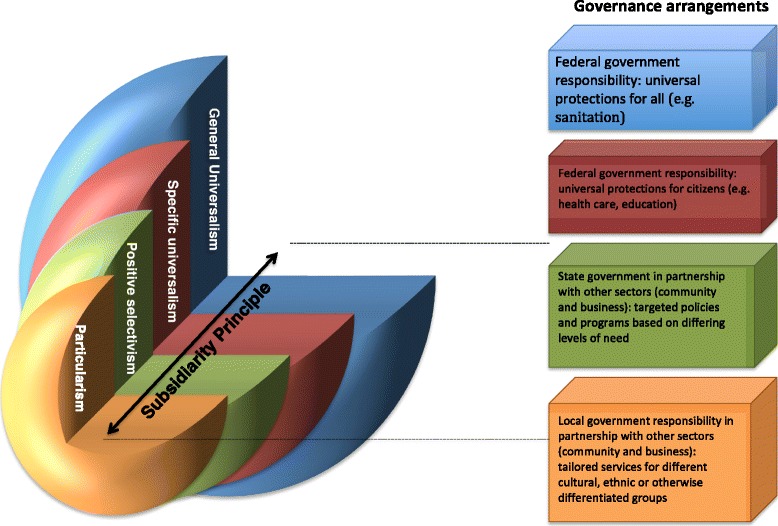
INTRODUCTION: The finding that there is a social gradient in health has prompted considerable interest in public health circles. Recent influential works describing health inequities and their causes do not always argue cogently for a policy framework that would drive the most appropriate solutions differentially across the social gradient This paper aims to develop a practice heuristic for proportionate universalism. METHODS: Through a review the proposed heuristic integrates evidence from welfare state and policy research, the literature on universal and targeted policy frameworks, and a multi-level governance approach that adopts the principle of subsidiarity. RESULTS: The proposed heuristic provides a more-grained analysis of different policy approaches, integral for operationalizing the concept of proportionate universalism. CONCLUSION: The proposed framework would allow governments at all levels, social policy developers and bureaucrats, public health professionals and activists to consider the appropriateness of distinctive policy objectives across distinctive population needs within universal welfare state principles.
Overview
The claims and statistics of this paper haven’t been checked yet.
Free: it reads the open-access text and checks the first 5 claims that cite a source we can check. Create a free account to check every claim.
Integrity signals
Registry
Cites
Statistics
Figures
Verification
Claims the paper makes
The claims and statistics of this paper haven’t been checked yet.
Free: it reads the open-access text and checks the first 5 claims that cite a source we can check. Create a free account to check every claim.
Claims other papers make about this one
Each is checked against this paper’s own text: does it say what the citing paper says it does?
The source backs part of the claim, not all of it — or backs it for a different population, condition or comparison.
In the citing paper
“In our review, most of interventions were either home visiting and then by nature PU because they are almost individual care, either a sum of actions targeting the most deprived (45,61).”
From Theoretical and practical challenges of proportionate universalism: a review (2020) · cites this paper as [45]
Experimental — accuracy not yet measuredThe cited source says what the claim attributes to it.
In the citing paper
“It appears that the precise and practical definition of the principle is not consensual and may lead to different interpretations (45).”
From Theoretical and practical challenges of proportionate universalism: a review (2020) · cites this paper as [45]
Self-check
Percentages, sums and reported differences re-computed from the paper’s own numbers.
The self-check needs the paper’s full text.
Citations
Cites
Hamilton, H., & Marshall, T. H. (1951) · The British Journal of Sociology · doi:10.2307/587460 · Cited by 4,094
Tudor Hart, J. (1971) · The Lancet · doi:10.1016/s0140-6736(71)92410-x · Cited by 3,253
The Concepts and Principles of Equity and Health
Whitehead, M. (1992) · International Journal of Health Services · doi:10.2190/986l-lhq6-2vte-yrrn · Cited by 2,284 · cited 1×
“grammes and workplace smoking bans increase health inequity [32, 33, 34].”
BackgroundThe Three Worlds of Welfare Capitalism.
O'Connell, P. J., & Esping-Anderson, G. (1991) · Social Forces · doi:10.2307/2580262 · Cited by 2,148
Marmot, M. G., Allen, J., Goldblatt, P., Boyce, T., McNeish, D., Grady, M., & Geddes, I. (2010) · Europe PMC (PubMed Central) · Cited by 1,404
What types of interventions generate inequalities? Evidence from systematic reviews
Lorenc, T., Petticrew, M., Welch, V., & Tugwell, P. (2013) · Journal of Epidemiology and Community Health · doi:10.1136/jech-2012-201257 · Cited by 927
Marshall, T. H. (1987) · Citizenship and Social Class · doi:10.2307/j.ctt18mvns1.5 · Cited by 836
Classifying Welfare States: a Two-dimension Approach
BONOLI, G. (1997) · Journal of Social Policy · doi:10.1017/s0047279497005059 · Cited by 697 · cited 1×
“erate social policies either universally available to all, or focused on categorical entitlements [8].”
BackgroundHill, M. R. H., & Hupe, P. L. (2002) · Andalas University Repository (Andalas University) · Cited by 646
Watts, H. W., Jencks, C., & Peterson, P. E. (1992) · Industrial and Labor Relations Review · doi:10.2307/2524605 · Cited by 598
Research works printed but not linked: 7
- 11. Wilensky H. The Welfare State and Equality. Berkeley: University of California Press; 1975.
- 16. Williams JF. Somewhere over the rainbow: universality and diversity in social policy. In: Manning N, Page R, editors. Social Policy Review. Canterbury: Social Policy Association; 1992. p. 200-19.
- 22. Carey G, Crammond B. Online Firest. A glossary of policy frameworks: the many forms of "universalism" and policy "targeting." Journal of Epidemiology and Community Health. 2014. doi:10.1136/jech-2014-204311. · DOI · Paper page
- 26. Department of Social Services. Consumer directed care (CDC) in home care packages. 2015. Australian Government.
- 34. Whitehead M, Dahlgren G. Concepts and Principles for Tackling Social Inequities in Health: Levelling Up Part 1. Copenhagen: WHO Regional Office for Europe, Copenhagen; 2006.
- 41. House of Commons. The Localism Act 2011. London: House of Commons; 2011.
- 47. Carcillo S, Grubb D. From inactivity to work (OECD social, employment and migration working papers No. 36). 2006.
Cited by
Items 301–328 of 328
Valaitis, R. K., Wong, S. T., MacDonald, M., Martin-Misener, R., O’Mara, L., Meagher-Stewart, D. M., Isaacs, S., Murray, N., Baumann, A., Burge, F., et al. (2020) · Figshare · doi:10.6084/m9.figshare.12144351
Valaitis, R. K., Wong, S. T., MacDonald, M., Martin-Misener, R., O’Mara, L., Meagher-Stewart, D. M., Isaacs, S., Murray, N., Baumann, A., Burge, F., et al. (2020) · Figshare · doi:10.6084/m9.figshare.12144336
Erdős, M., Vassányi, I., Nemes, A., & Kósa, I. (2026) · International Journal of Health Geographics · doi:10.1186/s12942-025-00444-4
“In general, the principle of ‘expanding health care service availability proportionally to demand’ has a firm theoretical background [33] and proven good practices for implementation in other countries [34, 35].”
Advancing equity and value in United States healthcare: an umbrella review
Naghibi, D., Bloschichak, A. M., Qin, Q., & Fiscella, K. A. (2026) · International Journal for Equity in Health · doi:10.1186/s12939-026-02784-4
“This approach, called proportionate universalism, aims to balance the ethical considerations of targeting with the political considerations of universalism [75, 76].”
Universal targeting in local public health: a comparative study of Polish cities
Gędek, W. (2026) · Journal of Public Policy · doi:10.1017/s0143814x26101007
Legrand, K. (2017) · theses.fr (ABES) · doi:10.70675/30a6ea3cz5b1bz48e4zbff4zb2c7dbf591b4
“complexe PRALIMAP-INÉS était un projet de recherche interventionnelle qui propose des interventions basées su le p i ipe de l’u i e salis e p opo tio (Carey et al., 2015; Marmot, 2010).”
BackgroundOuazzani, H. E. (2021) · theses.fr (ABES) · doi:10.70675/c6b9c8bdzfb57z462az9990zd44b451c63c4 · Cited by 1
Francis-Oliviero, F. (2022) · theses.fr (ABES) · doi:10.70675/157b53f7zd548z4f02zab61zc00eb00ad402 · Cited by 1
Développement et validation d’un outil de dépistage de la vulnérabilité sociale en pédiatrie
Laporte, R. (2023) · theses.fr (ABES) · doi:10.70675/dacc96b2z3cbez4ba6zbdefz5d44ed780f35
Boulton, A. J., Lang, N., Miller, J., Whitley, G. A., Zorab, O., de Paeztron, A., Leech, C., Gill, P. S., Perkins, G. D., Brown, T. P., et al. (2026) · Resuscitation · doi:10.1016/j.resuscitation.2026.111093 · Cited by 1
“32 33–35 Notably, Central Birmingham had high clustering and was unique in having a land-based NHS-delivered PHCC asset, which may serve as a model for improving access in other areas.”
Interventions for health equity with a One Health focus: a review of reviews
Delisle, H. F., Ingabire, A., Søvold, L. E., & Vissandjée, B. (2026) · Frontiers in Public Health · doi:10.3389/fpubh.2026.1736987 · Cited by 1
Mindful Equity in Canadian public health policy: Moving beyond afterthoughts
Shah, C. P. (2026) · Canadian Journal of Public Health · doi:10.17269/s41997-026-01194-x
Chen, Z., Hu, Y., He, H., Ou, Q., Liu, Y., Xu, T., Tu, J., Lu, Z., Wang, Z., Xu, D., et al. (2026) · International Journal for Equity in Health · doi:10.1186/s12939-026-02880-5 · Cited by 1
“These findings support proportionate universalism [43].”
Kim, Y., & Park, S. Y. (2026) · Healthcare · doi:10.3390/healthcare14131897
“This pattern can be interpreted in light of the weathering hypothesis, which proposes that prolonged exposure to socioeconomic adversity may lead to cumulative physiological strain over time [31].”
Azizatunnisa’, L., Kuper, H., Probandari, A., & Banks, L. M. (2026) · medRxiv · doi:10.64898/2026.06.29.26356885
Knesebeck, O. V. D., Lüdecke, D., & Vonneilich, N. (2026) · BMC Public Health · doi:10.1186/s12889-026-28473-z
Henking, C., & Reeves, A. (2026) · European Journal of Public Health · doi:10.1093/eurpub/ckag146
“Universal mental health prevention should set mid-life as a priority for all—given the observed decline in this age period—but with particular emphasis on those experiencing financial hardship in childhood or adulthood [17, 18].”
Gemmell-Sinnott, L., & Makowharemahihi, C. (2026) · Australian and New Zealand Journal of Public Health · doi:10.1016/j.anzjph.2026.100583
Beyond the dental clinic: ending the global stagnation in pediatric caries with program science
Kumar, S., Verma, S., Khanna, R., Khanna, V., Hardeep, M., Singh, R. D., & Kumar, S. (2026) · Frontiers in Public Health · doi:10.3389/fpubh.2026.1897048
“The intervention strategies are designed and developed based on the epidemiological data collected in Phase 1, guided by the principle of Proportionate Universalism (18).”
InfluentialLee, Y., & Shin, H. (2026) · Nutrients · doi:10.3390/nu18172848
“The continued use of voluntary and educational approaches also illustrates the diversity of policy instruments used in Korea [39,40].”
Manneville, F., Perrin, M., Balde, A., Coly, A., Ricci, L., & Omorou, A. Y. (2026) · Santé Publique · doi:10.3917/spub.hs1.2026.0043
Decision tree for improving the impact of equity-focused public health service delivery and research
Lane, C., Groombridge, D., Byaruhanga, J., McFadyen, T., & Wolfenden, L. (2026) · Frontiers in Health Services · doi:10.3389/frhs.2026.1948535
John, J. R., Kohlhoff, J. R., Lambiase, S., Nicholls, S., Díez, M. A., Doyle, K., Barr, K. R., Boydell, K., Brennan, C., Carson, T., et al. (2026) · BMJ Open · doi:10.1136/bmjopen-2026-122902
Scala, A., Cristillo, S., Loperto, I., Gubitosi, M., Ortolani, R., & Improta, G. (2026) · Frontiers in Public Health · doi:10.3389/fpubh.2026.1959445
Intersectional Trajectories in Physical and Mental Health: A UK Longitudinal Study (2009-2024)Preprint
Holman, D., Bell, A., Bennett, M., Constante, H. M., Green, M. A., & Piekut, A. (2026) · medRxiv · doi:10.64898/2026.10.14.26365511
Advancing Digital Health Equity: Strategies to Bridge the Divide
Bloom, S. (2026) · Oxford University Press eBooks · doi:10.1093/9780197779033.003.0010
Tremblay, C., & Schuld, K. (2026) · Santé mentale au Québec · doi:10.7202/1129198ar
Metadata
- Authors
- Carey, G., Crammond, B., & De Leeuw, E.
- Affiliations
- Australian National University (AU)
- Monash University (AU)
- Corresponding author
- Carey, Gemma
- ORCID
- Carey, Gemma
- Venue
- International Journal for Equity in Health
- Published
- 2015-09-15
- Volume
- 14
- Issue
- 1
- Pages
- 81-81
- ISSN
- 1475-9276 (ISSN-L)
- PMC
- PMC4570091
- OpenAlex
- W2157527617
- Cited by
- 328
- References
- 53
- Citations by year
- 2026: 32 · 2025: 38 · 2024: 27 · 2023: 50 · 2022: 38 · 2021: 37 · 2020: 40 · 2019: 33 · 2018: 14 · 2017: 12 · 2016: 7
- FWCI
- 2.00
- Type
- journal article
- Language
- en
- Open access
- gold
- doi.org
- Licence
- cc-by
- Locations
- International Journal for Equity in Health (publishedVersion, cc-by)
- Europe PMC (PubMed Central) (publishedVersion, cc-by)
- PubMed Central (publishedVersion, cc-by)
- PubMed (publishedVersion)
- UNSWorks (UNSW Sydney) (submittedVersion, cc-by-nc-nd)
- Minerva Access (University of Melbourne) (submittedVersion, cc-by)
- ANU Open Research (Australian National University) (submittedVersion, cc-by)
- UNSWorks (UNSW Sydney) (submittedVersion, cc-by)
- Topics
- Health Sciences › Medicine › Public Health, Environmental and Occupational Health › Public Health Policies and Education
- Social Sciences › Health › Public Health and Social Inequalities
- Social Sciences › Health › Health disparities and outcomes
- Keywords
- proportionate universalism, health equity, social gradient in health, health disparities, universal welfare state, targeted policy, multi-level governance, subsidiarity, policy framework, social policy
- MeSH terms
- Health Equity, Health Policy, Social Welfare, Healthcare Disparities
About these checks
Registry, retraction, Cites and statistics results are computed, not judged, with one exception: a printed reference that no index lists is read once by a model before it counts as a citation error. Claims are extracted by a model and kept only when their quote appears verbatim in the text; each cited source is then checked, with a model’s help, for whether it says what the claim relies on. Those verdicts can be wrong — read the claim’s quote and the cited source before relying on one.
Statistics and arithmetic are recomputed, not judged.
Confidence bands are shown only for fields calibrated on our annotated test set. None is calibrated yet, so no band is shown.
What counts as a claim ›How we measure confidence ›How we check this ›
Are you an author, or do you see a problem with this page? Request a review
Data sources
Bibliographic data: Semantic Scholar, OpenAlex, Crossref.
Contains information from the Semantic Scholar Academic Graph Datasets, made available under the ODC Attribution License (ODC-BY 1.0).
Semantic Scholar’s data is described in: Kinney, R., et al. (2023). The Semantic Scholar Open Data Platform. arXiv:2301.10140.
