

Changes in catastrophic health expenditure in post-conflict Sierra Leone: an Oaxaca-blinder decomposition analysis
Open accessThe DOI matches its Crossref record; 44 of the 45 references it cites were found in a registry or an index.
Abstract
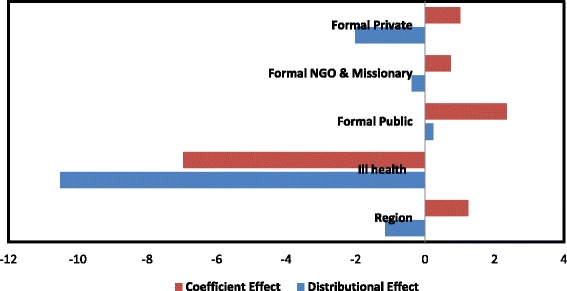
BACKGROUND: At the end of the eleven-year conflict in Sierra Leone, a wide range of policies were implemented to address both demand- and supply-side constraints within the healthcare system, which had collapsed during the conflict. This study examines the extent to which households' exposure to financial risks associated with seeking healthcare evolved in post-conflict Sierra Leone. METHOD: This study uses the 2003 and 2011 cross-sections of the Sierra Leone Integrated Household Survey to examine changes in catastrophic health expenditure between 2003 and 2011. An Oaxaca-Blinder decomposition approach is used to quantify the extent to which changes in catastrophic health expenditure are attributable to changes in the distribution of determinants (distributional effect) and to changes in the impact of these determinants on the probability of incurring catastrophic health expenditure (coefficient effect). RESULTS: The incidence of catastrophic health expenditure decreased significantly by 18% from approximately 50% in 2003 t0 32% in 2011. The decomposition analysis shows that this decrease represents net effects attributable to the distributional and coefficient effects of three determinants of catastrophic health expenditure - ill-health, the region in which households reside and the type of health facility used. A decrease in the incidence of ill-health and changes in the regional location of households contributed to a decrease in catastrophic health expenditure. The distributional effect of health facility types observed as an increase in the use of public health facilities, and a decrease in the use of services in facilities owned by non-governmental organizations (NGOs) also contributed to a decrease in the incidence of catastrophic health expenditure. However, the coefficient effect of public health facilities and NGO-owned facilities suggests that substantial exposure to financial risk remained for households utilizing both types of health facilities in 2011. CONCLUSION: The findings support the need to continue expanding current demand-side policies in Sierra Leone to reduce the financial risk of exposure to ill health.
Overview
The claims and statistics of this paper haven’t been checked yet.
Free: it reads the open-access text and checks the first 5 claims that cite a source we can check. Create a free account to check every claim.
Integrity signals
Registry
Cites
Statistics
Figures
Verification
Claims the paper makes
The claims and statistics of this paper haven’t been checked yet.
Free: it reads the open-access text and checks the first 5 claims that cite a source we can check. Create a free account to check every claim.
Self-check
Percentages, sums and reported differences re-computed from the paper’s own numbers.
The self-check needs the paper’s full text.
Citations
Cites
Male-female wage differentials in urban labor markets
Oaxaca, R. (1973) · International Economic Review · doi:10.2307/2525981 · Cited by 8,463
Wage discrimination: Reduced form and structural estimates
Blinder, A. S. (1973) · The Journal of Human Resources · doi:10.2307/144855 · Cited by 6,922
Household catastrophic health expenditure: a multicountry analysis
Xu, K., Evans, D. B., Kawabata, K., Zeramdini, R., Klavus, J., & Murray, C. J. (2003) · The Lancet · doi:10.1016/s0140-6736(03)13861-5 · Cited by 2,309
The Blinder–Oaxaca Decomposition for Linear Regression Models
Jann, B. (2008) · The Stata Journal: Promoting communications on statistics and Stata · doi:10.1177/1536867x0800800401 · Cited by 1,860
Catastrophe and impoverishment in paying for health care: with applications to Vietnam 1993–1998
Wagstaff, A., & Doorslaer, E. V. (2003) · Health Economics · doi:10.1002/hec.776 · Cited by 1,222
Decomposition Methods in Economics
Fortin, N., Lemieux, T., & Firpo, S. (2011) · Handbook of Labor Economics · doi:10.1016/s0169-7218(11)00407-2 · Cited by 1,029
Insuring Consumption Against Illness
Gertler, P., & Gruber, J. (2002) · American Economic Review · doi:10.1257/000282802760015603 · Cited by 835 · cited 1×
“Given the economic consequences of health shocks [7, 8], possibly worsened by delaying or not seeking healthcare, the measure of catastrophic health expenditure described in this study only partly captures the true extent of financial risks facing households.”
BackgroundMcIntyre, D., Thiede, M., Dahlgren, G., & Whitehead, M. (2006) · Social Science & Medicine · doi:10.1016/j.socscimed.2005.07.001 · Cited by 805 · cited 1×
“This effect may partly be explained by health financing reforms including the reintroduction of the cost recovery scheme and user fees in public health facilities in 2006 which would have resulted in higher out-of-pocket health expenditure for those utilizing these services in 2011 [2, 30, 31].”
BackgroundDecomposition Methods in Economics
Fortin, N., Lemieux, T., & Firpo, S. (2010) · National Bureau of Economic Research · doi:10.3386/w16045 · Cited by 736
RUSSELL, S. (2004) · The American Journal of Tropical Medicine and Hygiene · doi:10.4269/ajtmh.2004.71.147 · Cited by 650 · cited 1×
“depletion of savings and assets or through the accumulation of debt [6].”
BackgroundA Dirty War in West Africa: The RUF and the Destruction of Sierra Leone
Gberie, L. (2005) · Indiana University Press eBooks · doi:10.2979/4355.0 · Cited by 498
Can insurance increase financial risk?
Wagstaff, A., & Lindelow, M. (2008) · Journal of Health Economics · doi:10.1016/j.jhealeco.2008.02.002 · Cited by 447
Methods of household consumption measurement through surveys: Experimental results from Tanzania
Beegle, K., De Weerdt, J., Friedman, J., & Gibson, J. (2012) · Journal of Development Economics · doi:10.1016/j.jdeveco.2011.11.001 · Cited by 419
Li, Y., Wu, Q., Xu, L., Legge, D., Hao, Y., Gao, L., Ning, N., & Wan, G. (2012) · Bulletin of the World Health Organization · doi:10.2471/blt.12.102178 · Cited by 418 · cited 1×
“Depending on the design features (for example, levels of co-payments, types of benefit package and payment-provider mechanisms), enrolment into health insurance schemes has been shown to either increase protection against catastrophic health expenditure [9, 14, 15], to have a limited effect or to increase the risk of…”
BackgroundA Dirty War in West Africa: The RUF and the Destruction of Sierra Leone
Gberie, L. (2005) · Virtual Defense Library (Ministerio de Defensa) · Cited by 350
The economic consequences of health shocks: Evidence from Vietnam
Wagstaff, A. (2007) · Journal of Health Economics · doi:10.1016/j.jhealeco.2006.07.001 · Cited by 332 · cited 1×
“Given the economic consequences of health shocks [7, 8], possibly worsened by delaying or not seeking healthcare, the measure of catastrophic health expenditure described in this study only partly captures the true extent of financial risks facing households.”
BackgroundDecomposing Differences between Groups: A Cautionary Note on Measuring Discrimination
JONES, F. L., & KELLEY, J. (1984) · Sociological Methods & Research · doi:10.1177/0049124184012003004 · Cited by 276
Health Financing Revisited: A Practitioner's Guide
Gottret, P., & Schieber, G. (2006) · World Bank Publications · doi:10.1596/978-0-8213-6585-4 · Cited by 267 · cited 1×
“Background Direct payment made by patients at the point of care (out-of-pocket payment) is the major source of financing health care in low income countries [1].”
BackgroundJames, C. D., Hanson, K., McPake, B., Balabanova, D., Gwatkin, D., Hopwood, I., Kirunga, C., Knippenberg, R., Meessen, B., Morris, S. S., et al. (2006) · Applied Health Economics and Health Policy · doi:10.2165/00148365-200605030-00001 · Cited by 260
Self-citationConflict and Emerging Infectious Diseases
Gayer, M., Legros, D., Formenty, P., & Connolly, M. A. (2007) · Emerging Infectious Diseases · doi:10.3201/eid1311.061093 · Cited by 251
Van Minh, H., Kim Phuong, N. T., Saksena, P., James, C. D., & Xu, K. (2013) · Social Science & Medicine · doi:10.1016/j.socscimed.2012.11.028 · Cited by 242
Social risk management options for medical care in Indonesia
Pradhan, M., & Prescott, N. (2002) · Health Economics · doi:10.1002/hec.689 · Cited by 197 · cited 1×
“Following previous studies, for examples [3, 5], catastrophic health expenditure is defined as health expenditure exceeding 10% of household total expenditure.”
MethodGalárraga, O., Sosa-Rubí, S. G., Salinas-Rodríguez, A., & Sesma-Vázquez, S. (2010) · The European Journal of Health Economics · doi:10.1007/s10198-009-0180-3 · Cited by 195 · cited 1×
“Depending on the design features (for example, levels of co-payments, types of benefit package and payment-provider mechanisms), enrolment into health insurance schemes has been shown to either increase protection against catastrophic health expenditure [9, 14, 15], to have a limited effect or to increase the risk of…”
BackgroundWang, Z., Li, X., & Chen, M. (2015) · International Journal for Equity in Health · doi:10.1186/s12939-015-0134-6 · Cited by 184
Catastrophic health expenditure and its determinants in Kenya slum communities
Buigut, S., Ettarh, R., & Amendah, D. D. (2015) · International Journal for Equity in Health · doi:10.1186/s12939-015-0168-9 · Cited by 174
The impact of recall periods on reported morbidity and health seeking behavior
Das, J., Hammer, J. S., & Sánchez-Páramo, C. (2011) · Journal of Development Economics · doi:10.1016/j.jdeveco.2011.07.001 · Cited by 152
Li, Y., Wu, Q., Liu, C., Kang, Z., Xie, X., Yin, H., Jiao, M., Liu, G., Hao, Y., & Ning, N. (2014) · PLoS ONE · doi:10.1371/journal.pone.0093253 · Cited by 148
Why the poor pay more: household curative expenditures in rural Sierra Leone
Fabricant, S. J., Kamara, C., & MILLS, A. J. (1999) · The International Journal of Health Planning and Management · doi:10.1002/(sici)1099-1751(199907/09)14:3<179::aid-hpm548>3.0.co;2-n · Cited by 124 · cited 3×
“privately owned facilities, charging patients a fee-forservice at the point of care [30, 46].”
BackgroundExplaining the incidence of catastrophic expenditures on health care: Comparative evidence from Asia
O’Donnell, O., van Doorslaer, E. K. A., Rannan-Eliya, R. P., Lanka, S. S., Garg, C. C., Hanvoravongchai, P., Huq, M. N., Karan, A., & Leung, G. M. (2005) · Cited by 109
The free health care initiative: how has it affected health workers in Sierra Leone?
Witter, S., Wurie, H., & Bertone, M. P. (2016) · Health Policy and Planning · doi:10.1093/heapol/czv006 · Cited by 80
Bertone, M. P., Samai, M., Edem-Hotah, J., & Witter, S. (2014) · Conflict and Health · doi:10.1186/1752-1505-8-11 · Cited by 79 · cited 1×
“In the aftermath of the conflict, NGOs and private actors played an important role in the provision of healthcare [45], filling the gap left by the destruction of public health infrastructure during the conflict.”
BackgroundSelf-citationThe impact of the introduction of user fees at a district hospital in Cambodia
Jacobs, B. (2004) · Health Policy and Planning · doi:10.1093/heapol/czh036 · Cited by 76
A Simple Solution to the Identification Problem in Detailed Wage DecompositionsPreprint
Yun, M. (2003) · SSRN Electronic Journal · doi:10.2139/ssrn.435000 · Cited by 65
Why Quality Matters: Rebuilding Trustworthy Local Government in Post-Conflict Sierra Leone
Sacks, A., & Larizza, M. (2012) · World Bank, Washington, DC eBooks · doi:10.1596/1813-9450-6021 · Cited by 64
Impact of health financing policies in Cambodia: A 20 year experience
Ensor, T., Chhim, C., Kimsun, T., McPake, B., & Edoka, I. (2017) · Social Science & Medicine · doi:10.1016/j.socscimed.2017.01.034 · Cited by 64 · cited 1×
“These demand-side mechanisms including health insurance schemes and partial or full health care fee waivers (voucher schemes and health equity funds) have been shown to reduce out-of-pocket payments amongst the most vulnerable populations in other settings [56].”
BackgroundSelf-citationPonsar, F., Tayler-Smith, K., Philips, M., Gerard, S., Van Herp, M., Reid, T., & Zachariah, R. (2011) · International Health · doi:10.1016/j.inhe.2011.01.002 · Cited by 63
Shi, W., Chongsuvivatwong, V., Geater, A. F., Zhang, J., Zhang, H., & Brombal, D. (2011) · Health Research Policy and Systems · doi:10.1186/1478-4505-9-16 · Cited by 46
Sierra Leone's free health-care initiative: work in progress
Maxmen, A. (2013) · The Lancet · doi:10.1016/s0140-6736(13)60074-4 · Cited by 41
Decentralization, Democracy and Development
Zhou, Y. (2009) · World Bank country study · doi:10.1596/978-0-8213-7999-8 · Cited by 40 · cited 1×
“In order to increase responsiveness to local needs in pre-conflict marginalized areas, a Local Government Act was passed in 2004 to decentralize some central government functions (including healthcare provision) to local councils [25, 26].”
BackgroundEdoka, I., Ensor, T., McPake, B., Amara, R., Tseng, F., & Edem-Hotah, J. (2016) · Health Economics Review · doi:10.1186/s13561-016-0096-4 · Cited by 30 · cited 1×
“example through the FHCI and the proposed national health insurance scheme, the FHCI has been shown to provide partial financial protection for vulnerable populations due to implementation challenges [50].”
MethodSelf-citationShi, W., Chongsuvivatwong, V., Geater, A. F., Zhang, H., Zhang, J., Brombal, D., Santonastaso, M., & Cortassa, G. M. (2011) · Health Research Policy and Systems · doi:10.1186/1478-4505-9-21 · Cited by 29
Amuasi, J., Diap, G., Nguah, S. B., Karikari, P., Boakye, I., Jambai, A., Lahai, W. K., Louie, K. S., & Kiechel, J. (2012) · PLoS ONE · doi:10.1371/journal.pone.0047733 · Cited by 12 · cited 1×
“privately owned facilities, charging patients a fee-forservice at the point of care [30, 46].”
BackgroundFree health care in Sierra Leone: a mite too optimistic?
Obermann, K. (2011) · The Lancet · doi:10.1016/s0140-6736(11)61209-9 · Cited by 8
Pushak, N., & Foster, V. (2011) · World Bank, Washington, DC eBooks · doi:10.1596/27260 · Cited by 5
Research works printed but not linked: 5
- Smillie I, Minear L. The Charity of Nations: Humanitarianism in a Calculating World. 2004. Bloomfield: Kumarian Press.
- Jann B The blinder–Oaxaca decomposition for linear regression models Stata J 2008 8 4 453 479 · DOI · Paper page
- Dowd C Raleigh C Mapping conflict across Liberia and Sierra Leone Accord 2012 2 23 13 18
- Pushak N, Foster V. Sierra Leone’s Infrastructure: A Continental Perspective. 2011. World Bank. · DOI
- Witter, S., H. Wurie, and M.P. Bertone, The free health care initiative: how has it affected health workers in Sierra Leone? Health Policy Plan, 2015. 0(0): p. 1–9. PMC4724164 25797469
Cited by
Rahman, T., Gasbarro, D., & Alam, K. (2022) · Health Research Policy and Systems · doi:10.1186/s12961-022-00886-3 · Cited by 184
Catastrophic health expenditure in sub-Saharan Africa: systematic review and meta-analysis
Eze, P., Osaheni Lawani, L., Justina Agu, U., & Acharya, Y. (2022) · Bulletin of the World Health Organization · doi:10.2471/blt.21.287673 · Cited by 133
Health financing in fragile and conflict-affected settings: What do we know, seven years on?
Bertone, M. P., Jowett, M. R., Dale, E. M., & Witter, S. (2019) · Social Science & Medicine · doi:10.1016/j.socscimed.2019.04.019 · Cited by 96
Factors associated with catastrophic health expenditure in sub-Saharan Africa: A systematic review
Eze, P., Lawani, L. O., Agu, U. J., Amara, L. U., Okorie, C. A., & Acharya, Y. (2022) · PLOS ONE · doi:10.1371/journal.pone.0276266 · Cited by 60
“CHE incidence was significantly associated with advanced age [17, 21, 26, 28, 39, 41, 43, 45, 50, 52, 56, 62, 63, 65, 68, 73, 75, 78, 83, 91–93, 98, 103], chronic illness [21, 25, 26, 28, 34, 39, 45, 56, 62, 67, 68, 74–76, 83, 92, 93, 95, 99], and hospitalization [17, 25, 27, 41, 52, 58, 62, 68, 83, 94, 103, 104]; but…”
BackgroundInfluentialImprovement of the reduction in catastrophic health expenditure in China’s public health insurance
Wu, D., Fang, Y., & Nie, W. (2018) · PLoS ONE · doi:10.1371/journal.pone.0194915 · Cited by 24
Metadata
- Authors
- Edoka, I., McPake, B., Ensor, T., Amara, R., & Edem-Hotah, J.
- Affiliations
- University of the Witwatersrand (ZA)
- The University of Melbourne (AU)
- University of Leeds (GB)
- University of Sierra Leone (SL)
- Corresponding author
- Edoka, Ijeoma
- Venue
- International Journal for Equity in Health
- Published
- 2017-09-04
- Volume
- 16
- Issue
- 1
- Pages
- 166-166
- ISSN
- 1475-9276 (ISSN-L)
- PMC
- PMC5583765
- OpenAlex
- W2752690999
- Cited by
- 33
- References
- 45
- Citations by year
- 2026: 2 · 2025: 3 · 2024: 6 · 2023: 4 · 2022: 6 · 2021: 4 · 2020: 3 · 2019: 4 · 2018: 1
- FWCI
- 3.17
- Type
- journal article
- Language
- en
- Open access
- gold
- doi.org
- Licence
- cc-by
- Locations
- International Journal for Equity in Health (publishedVersion, cc-by)
- PubMed Central (publishedVersion, cc-by)
- PubMed (publishedVersion)
- White Rose Research Online (University of Leeds, The University of Sheffield, University of York) (acceptedVersion)
- Queen Margaret University Publications Repository (Queen Margaret University) (acceptedVersion)
- DOAJ (DOAJ: Directory of Open Access Journals) (submittedVersion, cc-by-sa)
- Queen Margaret University Publications Repository (Queen Margaret University) (submittedVersion, cc-by)
- Minerva Access (University of Melbourne) (submittedVersion, cc-by)
- Funders
- Department for International Development
- Topics
- Health Sciences › Medicine › Public Health, Environmental and Occupational Health › Healthcare Systems and Reforms
- Social Sciences › Economics, Econometrics and Finance › Economics and Econometrics › Economic and Financial Impacts of Cancer
- Social Sciences › Economics, Econometrics and Finance › Economics and Econometrics › Global Health Care Issues
- Keywords
- catastrophic health expenditure, post-conflict Sierra Leone, health facility type, public health facilities, health problems, regional disparities, health system collapse
- MeSH terms
- Catastrophic Illness, Cross-Sectional Studies, Health Expenditures, Family Characteristics, Health Policy, Humans, Risk, Sierra Leone, Warfare
About these checks
Registry, retraction, Cites and statistics results are computed, not judged, with one exception: a printed reference that no index lists is read once by a model before it counts as a citation error. Claims are extracted by a model and kept only when their quote appears verbatim in the text; each cited source is then checked, with a model’s help, for whether it says what the claim relies on. Those verdicts can be wrong — read the claim’s quote and the cited source before relying on one.
Statistics and arithmetic are recomputed, not judged.
Confidence bands are shown only for fields calibrated on our annotated test set. None is calibrated yet, so no band is shown.
What counts as a claim ›How we measure confidence ›How we check this ›
Are you an author, or do you see a problem with this page? Request a review
Data sources
Bibliographic data: Semantic Scholar, OpenAlex, Crossref.
Contains information from the Semantic Scholar Academic Graph Datasets, made available under the ODC Attribution License (ODC-BY 1.0).
Semantic Scholar’s data is described in: Kinney, R., et al. (2023). The Semantic Scholar Open Data Platform. arXiv:2301.10140.
