

The DOI matches its Crossref record; 106 of the 106 references it cites were found in a registry or an index.
Reactive oxygen species: a volatile driver of field cancerization and metastasis
Open accessAbstract
Field cancerization and metastasis are the leading causes for cancer recurrence and mortality in cancer patients. The formation of primary, secondary tumors or metastasis is greatly influenced by multifaceted tumor-stroma interactions, in which stromal components of the tumor microenvironment (TME) can affect the behavior of the cancer cells. Many studies have identified cytokines and growth factors as cell signaling molecules that aid cell to cell communication. However, the functional contribution of reactive oxygen species (ROS), a family of volatile chemicals, as communication molecules are less understood. Cancer cells and various tumor-associated stromal cells produce and secrete a copious amount of ROS into the TME. Intracellular ROS modulate cell signaling cascades that aid in the acquisition of several hallmarks of cancers. Extracellular ROS help to propagate, amplify, and effectively create a mutagenic and oncogenic field which facilitate the formation of multifoci tumors and act as a springboard for metastatic tumor cells. In this review, we summarize our current knowledge of ROS as atypical paracrine signaling molecules for field cancerization and metastasis. Field cancerization and metastasis are often discussed separately; we offer a model that placed these events with ROS as the focal instigating agent in a broader "seed-soil" hypothesis.
Overview
The claims and statistics of this paper haven’t been checked yet.
Run the check — free, no account needed. It reads the open-access text and checks the sources it cites.
Integrity signals
Registry
Cites
Statistics
Figures
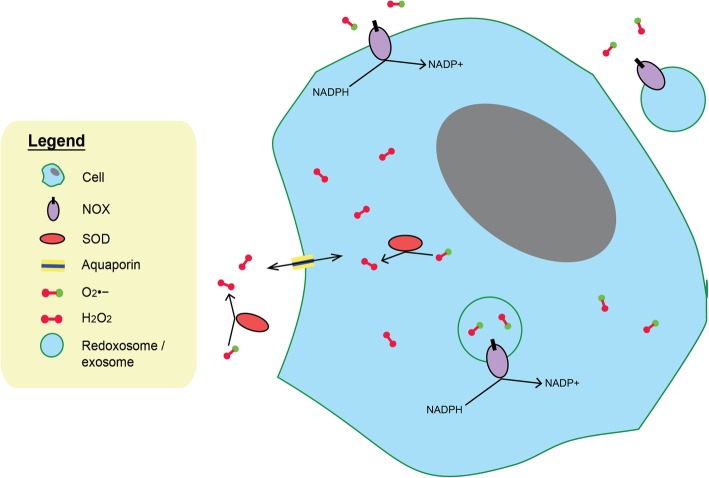
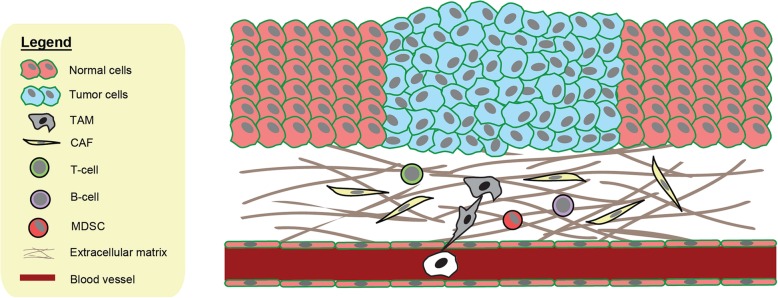
Verification
Claims the paper makes
The claims and statistics of this paper haven’t been checked yet.
Run the check — free, no account needed. It reads the open-access text and checks the sources it cites.
Claims other papers make about this one
Each is checked against this paper’s own text: does it say what the citing paper says it does?
In the citing paper
“Oxidative stress is strongly associated with the expression of various inflammatory transcription factors, such as nuclear factor-kB (NF- kB) that modulates proteolytic pathways and promotes inflammation (29–31).”
From Diabetes and Sarcopenic Obesity: Pathogenesis, Diagnosis, and Treatments (2020) · cites this paper as [31]
In the citing paper
“Cancer is a class of diseases resulted from external factors such as environment, diet and radiation as well as internal factors including obesity and diabetes (31, 116, 117).”
From Diabetes and Sarcopenic Obesity: Pathogenesis, Diagnosis, and Treatments (2020) · cites this paper as [31]
Self-check
Percentages, sums and reported differences re-computed from the paper’s own numbers.
The self-check needs the paper’s full text.
Citations
Cites
Bray, F., Ferlay, J., Soerjomataram, I., Siegel, R. L., Torre, L. A., & Jemal, A. (2018) · CA: A Cancer Journal for Clinicians · doi:10.3322/caac.21492 · Cited by 84,109
The basics of epithelial-mesenchymal transition
Kalluri, R., & Weinberg, R. A. (2009) · Journal of Clinical Investigation · doi:10.1172/jci39104 · Cited by 10,196
NF-κB signaling in inflammation
Liu, T., Zhang, L., Joo, D., & Sun, S.-C. (2017) · Signal Transduction and Targeted Therapy · doi:10.1038/sigtrans.2017.23 · Cited by 8,791
How mitochondria produce reactive oxygen species
Murphy, M. P. (2009) · Biochemical Journal · doi:10.1042/bj20081386 · Cited by 8,207
Molecular mechanisms of epithelial–mesenchymal transition
Lamouille, S., Xu, J., & Derynck, R. (2014) · Nature Reviews Molecular Cell Biology · doi:10.1038/nrm3758 · Cited by 8,091
The NOX Family of ROS-Generating NADPH Oxidases: Physiology and Pathophysiology
Bedard, K., & Krause, K.-H. (2007) · Physiological Reviews · doi:10.1152/physrev.00044.2005 · Cited by 6,989
Myeloid-derived-suppressor cells as regulators of the immune system
Gabrilovich, D. I., & Nagaraj, S. (2009) · Nature Reviews Immunology · doi:10.1038/nri2506 · Cited by 6,753
The biology and function of fibroblasts in cancer
Kalluri, R. (2016) · Nature Reviews Cancer · doi:10.1038/nrc.2016.73 · Cited by 4,366
Microenvironmental regulation of metastasis
Joyce, J. A., & Pollard, J. W. (2009) · Nature Reviews Cancer · doi:10.1038/nrc2618 · Cited by 3,684
Slaughter, D. P., Southwick, H. W., & Smejkal, W. (1953) · Cancer · doi:10.1002/1097-0142(195309)6:5 · Cited by 3,558
Cited by
Sorted by citations
Role of Reactive Oxygen Species in Cancer Progression: Molecular Mechanisms and Recent Advancements
Aggarwal, V., Tuli, H. S., Varol, A., Thakral, F., Yerer, M. B., Sak, K., Varol, M., Jain, A., Khan, M. A., & Sethi, G. (2019) · Biomolecules · doi:10.3390/biom9110735 · Cited by 1,260
Altered metabolism in cancer: insights into energy pathways and therapeutic targets
Tufail, M., Jiang, C.-H., & Li, N. (2024) · Molecular Cancer · doi:10.1186/s12943-024-02119-3 · Cited by 534
From pre-diabetes to diabetes: diagnosis, treatments and translational research
Khan, R., Chua, Z., Tan, J., Yang, Y., Liao, Z., & Zhao, Y. (2019) · Medicina · doi:10.3390/medicina55090546 · Cited by 484
Self-citationChemotherapy: a double-edged sword in cancer treatment
Behranvand, N., Nasri, F., Emameh, R. Z., Khani, P., Hosseini, A., Garssen, J., & Falak, R. (2021) · Cancer Immunology Immunotherapy · doi:10.1007/s00262-021-03013-3 · Cited by 454
The interplay of ROS and the PI3K/Akt pathway in autophagy regulation
Kma, L., & Baruah, T. J. (2021) · Biotechnology and Applied Biochemistry · doi:10.1002/bab.2104 · Cited by 408
Metadata
- Authors
- Liao, Z., Chua, D., & Tan, N. S.
- Affiliations
- Nanyang Technological University (SG)
- Corresponding author
- Tan, Nguan Soon
- Venue
- Molecular Cancer
- Published
- 2019-03-30
- Volume
- 18
- Issue
- 1
- Pages
- 65-65
- ISSN
- 1476-4598 (ISSN-L)
- PMC
- PMC6441160
- OpenAlex
- W2943576188
- Cited by
- 284
- References
- 106
- Citations by year
- 2026: 18 · 2025: 34 · 2024: 38 · 2023: 42 · 2022: 60 · 2021: 51 · 2020: 32 · 2019: 8
- FWCI
- 3.33
- Type
- journal article
- Language
- en
- Open access
- gold
- doi.org
- Licence
- Locations
- Molecular Cancer (publishedVersion, cc-by)
- PubMed Central (publishedVersion, cc-by)
- PubMed (publishedVersion)
- DOAJ (DOAJ: Directory of Open Access Journals) (submittedVersion, cc-by-sa)
- DR-NTU (Nanyang Technological University) (submittedVersion, cc-by)
- Funders
- Ministry of Education, Singapore (2014-T2-1-012, 2017-T1-002-103)
- Topics
- Life Sciences › Biochemistry, Genetics and Molecular Biology › Molecular Biology › Redox biology and oxidative stress
- Life Sciences › Biochemistry, Genetics and Molecular Biology › Molecular Biology › Cancer and biochemical research
- Health Sciences › Medicine › Oncology › Cancer Cells and Metastasis
- Keywords
- reactive oxygen species, field cancerization, metastasis, tumor microenvironment, tumor-stroma interactions, paracrine signaling, multifocal tumors, cancer hallmarks, cytokines and growth factors
- MeSH terms
- Animals, Cell Communication, Humans, Neoplasm Metastasis, Neoplasms, Signal Transduction, Reactive Oxygen Species, Oxidative Stress
About these checks
Registry, retraction, Cites and statistics results are computed, not judged, with one exception: a printed reference that no index lists is read once by a model before it counts as a citation error. Claims are extracted by a model and kept only when their quote appears verbatim in the text; each cited source is then checked, with a model’s help, for whether it says what the claim relies on. Those verdicts can be wrong — read the claim’s quote and the cited source before relying on one.
Statistics and arithmetic are recomputed, not judged.
Confidence bands are shown only for fields calibrated on our annotated test set. None is calibrated yet, so no band is shown.
What counts as a claim ›How we measure confidence ›How we check this ›
Are you an author, or do you see a problem with this page? Request a review
